
Budget vs Store-Bought Window Cleaners: What Actually Works
I used to think clean windows were impossible to achieve at home. No matter which expensive cleaner I bought or how carefully I followed the directions, I’d step back to admire my work only to see streaks, smears, and residue that somehow looked worse than the original dirt.
Then one Saturday morning, frustrated after spending $12 on yet another “streak-free” window cleaner that left my bay window looking like a toddler had finger-painted it, I tried something different. I mixed white vinegar with water in an old spray bottle, grabbed a wadded-up newspaper, and reluctantly started cleaning.
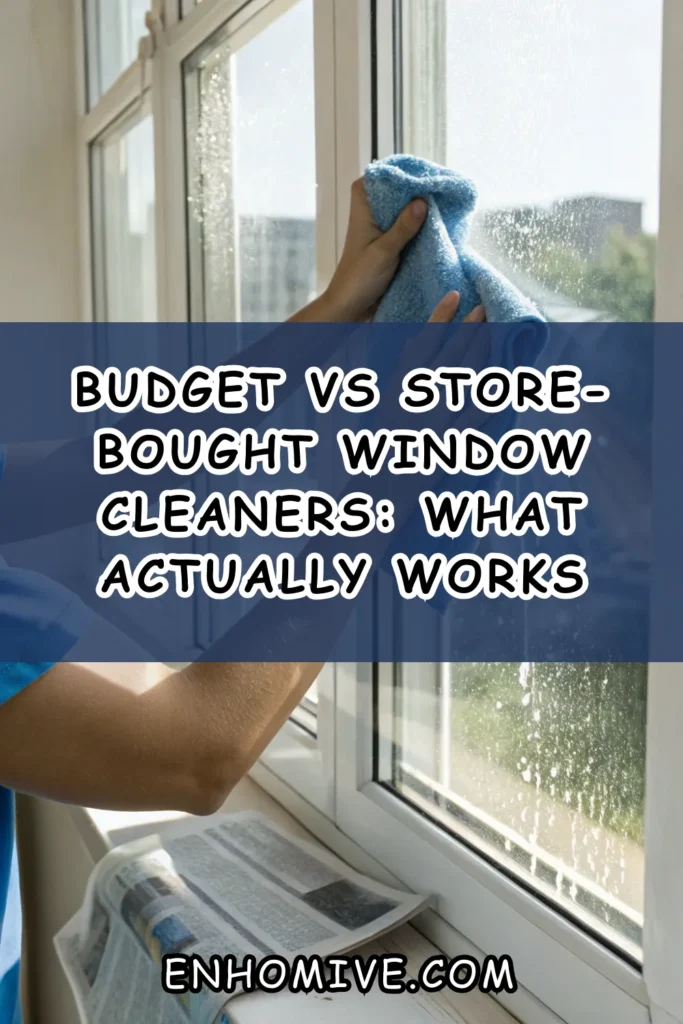
The results shocked me. Crystal-clear glass with zero streaks—better than any commercial product I’d used. That moment sparked months of experimentation with everything from dollar-store squeegees to professional-grade window cleaning systems, testing them on the dozens of windows throughout my home.
If you’ve ever wondered whether expensive window cleaners are worth the premium price, or if those DIY solutions actually deliver professional results, this guide will give you the definitive answers based on real-world testing.
Why Window Cleaning Matters More Than Aesthetics
Clean windows transform how your home feels in ways you might not consciously notice. I never realized how much difference window clarity made until I properly cleaned all my windows for the first time in years.
The immediate impact was dramatic—rooms felt brighter, colors looked more vibrant, and my entire home seemed more open and inviting. But beyond aesthetics, clean windows serve practical purposes that affect your daily life and wallet.
Natural light and energy costs: Dirty windows block up to 40% of natural light according to some estimates. This means you’re using artificial lighting during daylight hours, increasing electricity bills. After thoroughly cleaning my south-facing windows, I noticed I didn’t need to turn on lights until an hour later each evening—a small daily savings that compounds over months.
Window longevity: Hard water deposits, environmental pollutants, and mineral buildup don’t just make windows look bad—they can etch and permanently damage glass over time. I discovered this the hard way when I neglected my bathroom windows for two years. The mineral deposits from sprinkler overspray had etched into the glass, creating permanent cloudiness that required professional restoration costing $300.
Home value and curb appeal: Clean windows make a substantial difference in how your home presents, whether you’re selling or simply want to maintain property value. Real estate agents consistently cite window cleanliness as one of the easiest, cheapest improvements sellers can make to enhance buyer perception.
Mental health benefits: There’s genuine psychological impact to looking through clean versus dirty windows. Studies on environmental psychology show that visual clarity and access to natural light significantly affect mood and wellbeing. I noticed I spent more time near windows and felt less claustrophobic in my home after implementing regular window cleaning.
Understanding What Makes Windows Dirty
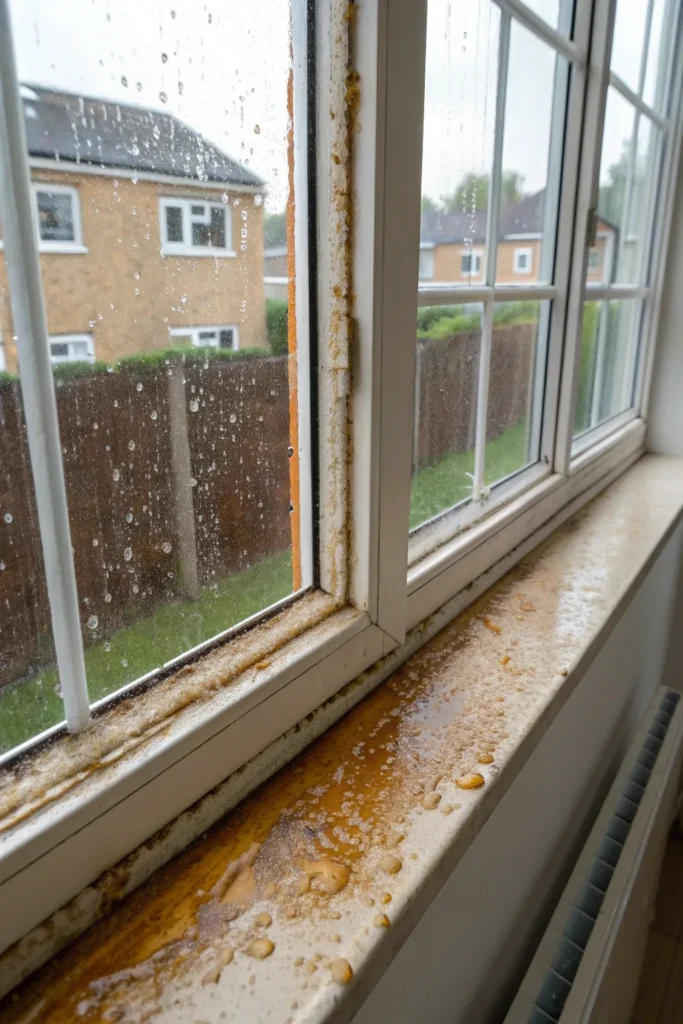
Before evaluating cleaning products, understanding what you’re actually cleaning helps explain why certain methods work better than others.
Types of Window Dirt and Buildup
Dust and airborne particles: This is the most common form of window dirt. Dust settles on glass surfaces constantly, creating a filmy layer that diffuses light. In urban areas or near construction, this happens faster than in rural settings.
Hard water spots and mineral deposits: These are the white spots that form when water dries on glass, leaving behind calcium, magnesium, and other minerals. I live in an area with extremely hard water, and sprinkler overspray on my exterior windows created stubborn white spots that standard cleaners couldn’t touch.
Grease and cooking residue: Kitchen windows accumulate an invisible film of aerosolized cooking oils. I didn’t realize how bad this was until I cleaned my kitchen window and compared it to other rooms—the amount of greasy residue was shocking.
Tree sap and organic material: If you have trees near your home, you know about sticky sap spots. These require different cleaning approaches than standard dirt.
Bug residue and bird droppings: Protein-based stains that can actually etch glass if left too long. I learned this when bird droppings on my car windshield created permanent marks despite aggressive cleaning.
Smoke and pollution film: This creates a brownish or yellowish tint, especially on interior windows near fireplaces or in homes with smokers.
Paint overspray and adhesive residue: These require solvents rather than standard cleaners.
Each type of contamination responds differently to cleaning products. This is why no single cleaner works perfectly for every situation—a crucial insight that changed my entire approach to window cleaning.
| Contaminant Type | Difficulty to Remove | Best Cleaning Agent | Special Requirements |
| Dust/Light Dirt | Easy | Water alone | None |
| Hard Water Deposits | Difficult | Acidic cleaners (vinegar) | May need scraping |
| Grease | Moderate | Alkaline cleaners (ammonia) | Requires degreasing |
| Tree Sap | Difficult | Alcohol-based solvents | May need scraping |
| Bug/Bird Droppings | Moderate | Enzymatic or ammonia | Soak before scrubbing |
| Smoke Film | Moderate | Ammonia-based | Multiple applications |
| Paint/Adhesive | Very Difficult | Razor blade scraping | Extreme care needed |
Budget Window Cleaning Methods
Method 1: Plain Water with Microfiber Cloth
The simplest approach costs virtually nothing and works better than most people expect.
For lightly soiled windows—those with just dust and minimal dirt—plain water with a quality microfiber cloth delivers surprisingly good results. I was skeptical when I first tried this, but for my bedroom windows that face away from weather exposure, it cleaned effectively without any additional products.
My technique:
- Use one microfiber cloth dampened with plain water
- Wipe in circular motions to lift dirt
- Follow with a dry microfiber cloth to prevent streaking
- Buff with newspaper for final shine
The limitation is that water alone doesn’t cut through grease, hard water deposits, or heavy grime. I tried this on my kitchen windows and it just smeared the greasy film around. For true maintenance cleaning on already-clean windows, though, it’s perfectly adequate.
Cost: $10-15 for quality microfiber cloths (reusable for years) Time: 3-5 minutes per window Effectiveness: Good for light dust only Best for: Interior windows in low-soil areas
Method 2: Vinegar and Water Solution
This is the classic DIY window cleaner, and after extensive testing, I understand why it’s been popular for generations.
My standard recipe:
- 1 part white vinegar
- 1 part water
- Mix in spray bottle
Some people use less vinegar (like 1:4 ratio), but I found 50/50 delivers the best cleaning power while still being economical. A gallon of white vinegar costs $3-4 and makes enough solution to clean all the windows in my house five times over.
Application process:
- Spray liberally on the window
- Wipe with microfiber cloth or squeegee
- Buff dry with newspaper or lint-free cloth
- Work on cloudy days or in shade to prevent rapid drying
The vinegar smell dissipates within minutes as it dries, leaving no odor behind. Initially, I found the smell unpleasant, but I’ve grown accustomed to it and now associate it with cleanliness.
Why vinegar works:
Vinegar is acidic (pH 2.4-3.4), which makes it excellent for dissolving mineral deposits and hard water stains. The mild acid cuts through dirt without being harsh enough to damage glass or window frames.
I tested this solution on my worst hard-water-stained windows and was amazed. Spots that resisted commercial cleaners for months dissolved after one application of vinegar solution. For exterior windows with sprinkler damage, vinegar is dramatically more effective than any store-bought cleaner I’ve tried.
Limitations:
Vinegar doesn’t cut grease as effectively as ammonia-based cleaners. On my kitchen windows, it removed about 70% of the greasy film but required multiple applications for complete cleaning.
Some people dislike the temporary vinegar smell, though I find it far less offensive than harsh chemical odors from commercial products.
Cost: $0.50-1.00 per full window cleaning session Effectiveness: Excellent for hard water, good for general dirt, moderate for grease Best for: Hard water deposits, general cleaning, exterior windows
Method 3: Dish Soap Solution
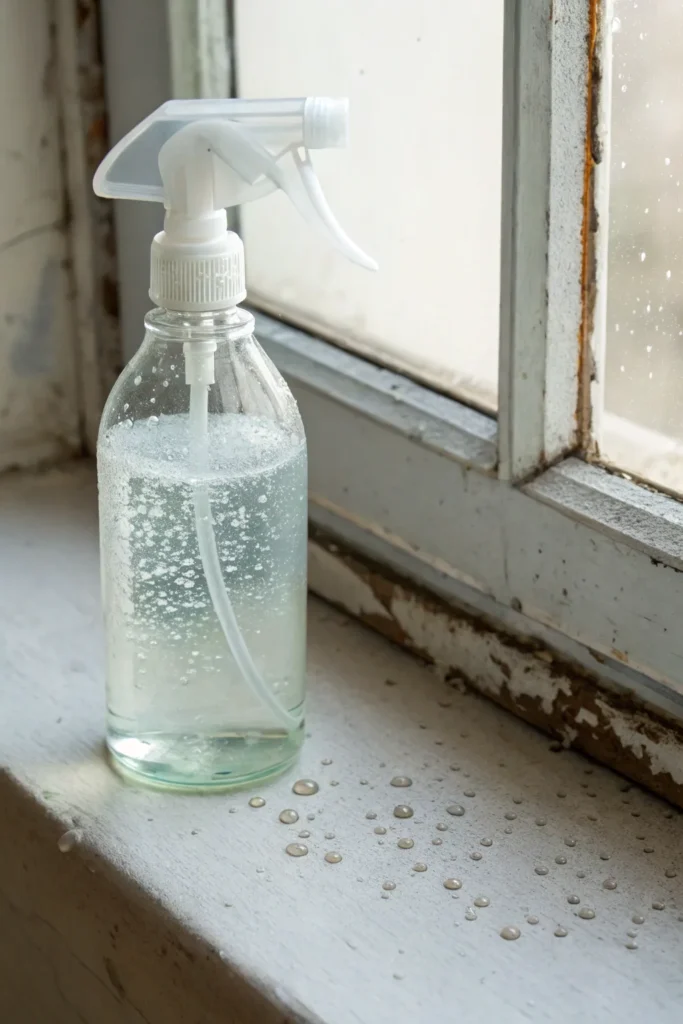
A few drops of dish soap in water creates an effective cleaner, especially for greasy windows.
My recipe:
- 2-3 drops of dish soap
- 2 cups water
- Mix gently to avoid excess suds
The key is using minimal soap. Too much creates foam that’s difficult to rinse and leaves streaky residue. I made this mistake repeatedly before learning that less is definitely more with dish soap.
When dish soap excels:
For kitchen windows with grease buildup, dish soap outperformed everything else I tested. Since it’s formulated to cut through cooking grease, this makes perfect sense. The same properties that clean your dishes work equally well on greasy window film.
I use this exclusively on kitchen windows and any windows near grills or outdoor cooking areas.
The critical rinsing step:
Unlike vinegar solution, dish soap requires thorough rinsing or it will leave residue. My process:
- Apply dish soap solution
- Scrub gently with cloth or sponge
- Rinse thoroughly with clean water
- Squeegee or wipe dry
- Buff with dry cloth
Skipping the rinse creates streaky, sticky residue that attracts dust faster than you can believe. I learned this lesson after doing an entire living room window without rinsing and watching it look progressively worse as it dried.
Cost: $0.10-0.20 per cleaning session Effectiveness: Excellent for grease, good for general dirt Best for: Kitchen windows, areas with cooking residue
Method 4: Rubbing Alcohol Solution
For stubborn spots and streak-free results, alcohol-based solutions work remarkably well.
My recipe:
- 1 cup rubbing alcohol (70% or 91%)
- 1 cup water
- 1 tablespoon vinegar
- Mix in spray bottle
The alcohol evaporates quickly, reducing streaking significantly. This is especially useful when cleaning windows in direct sunlight—a situation that usually guarantees streaks with water-based cleaners.
Special capabilities:
Alcohol dissolves many substances that vinegar and soap can’t touch:
- Adhesive residue from stickers or tape
- Tree sap spots
- Bug splatter
- Ink marks
- Some paint overspray
I had a window where my kids stuck price tag stickers years ago. The stickers came off but left sticky residue that survived dozens of cleanings. The alcohol solution dissolved it in one application.
The fast evaporation means less buffing and lower streak risk. On hot sunny days, this is my go-to solution because it dries before streaks can form.
Considerations:
Alcohol is more expensive than vinegar—a bottle costs $3-5 and lasts fewer cleaning sessions. For routine cleaning, vinegar is more economical. I reserve alcohol solution for problem spots and situations where fast drying is advantageous.
The strong smell is more noticeable than vinegar but dissipates just as quickly.
Cost: $0.75-1.50 per cleaning session Effectiveness: Excellent for problem residues, very good for general cleaning Best for: Stubborn spots, sunny-day cleaning, removing adhesives
Method 5: Newspaper as a Cleaning Tool
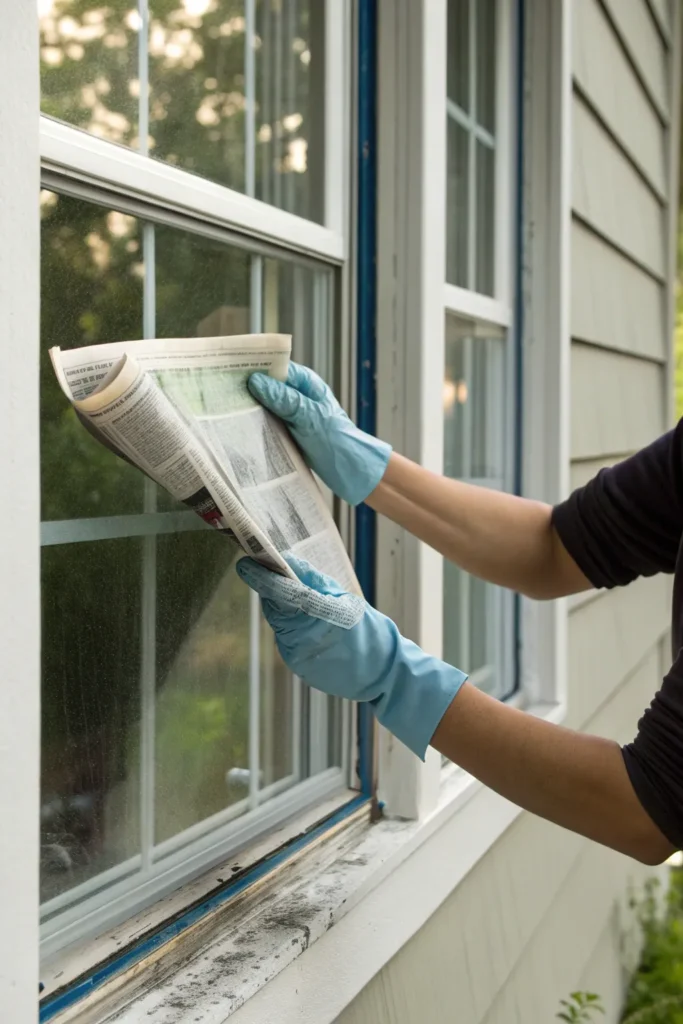
Using crumpled newspaper instead of cloth for buffing windows is an old trick that legitimately works.
The texture of newspaper absorbs moisture effectively while the ink acts as a very mild abrasive that polishes glass. I was deeply skeptical of this method until I actually tried it.
My technique:
- Apply any cleaning solution (I usually use vinegar)
- Wipe with microfiber cloth or squeegee to remove bulk moisture
- Crumple newspaper and buff in circular motions
- The newspaper should be slightly damp but not soaking wet
The results are genuinely impressive—newspaper leaves glass clearer and more streak-free than most cloths. The slight texture seems to grab remaining residue and moisture without leaving lint or fibers behind.
Practical considerations:
You need a newspaper, which not everyone subscribes to anymore. I collect local free newspapers from my driveway and store them specifically for window cleaning.
The ink can transfer to your hands and potentially to window frames if you’re not careful. I wear cheap latex gloves when using newspapers, and I’m careful around white or light-colored frames.
Some newer newspapers use inks that don’t work as well. Traditional black ink on newsprint works best—glossy advertising supplements don’t work nearly as well.
Cost: Free if you get newspapers Effectiveness: Excellent streak-free results Best for: Final buffing step after any cleaner
| Budget Method | Cost Per Use | Prep Time | Cleaning Time | Streak Risk | Best Application |
| Plain Water | $0 | None | 3-5 min | Moderate | Light dust |
| Vinegar Solution | $0.25 | 2 min | 5-7 min | Low | Hard water, general |
| Dish Soap | $0.15 | 2 min | 7-10 min | High without rinse | Grease |
| Alcohol Solution | $1.00 | 2 min | 5-7 min | Very Low | Stubborn spots |
| Newspaper Buff | Free | None | 2-3 min | Very Low | Final polish |
Store-Bought Window Cleaning Products
Traditional Blue Spray Cleaners
Windex and similar blue ammonia-based cleaners are what most people think of when they imagine window cleaning products. I tested the leading brands extensively to see if they justified their $4-7 per bottle price tag.
What I tested:
- Windex Original ($4.50/23oz)
- Generic store-brand blue cleaner ($2.50/32oz)
- Sprayway Glass Cleaner ($5/19oz)
Performance results:
All three cleaned comparably well on general dirt and light grime. The ammonia cuts through organic residues and grease reasonably effectively, and the blue dye helps you see where you’ve sprayed.
Windex had marginally better performance on greasy kitchen windows—perhaps 10-15% better than the generic. For the price difference, this didn’t feel significant enough to justify choosing it over the store brand.
Sprayway, which professionals often recommend, did deliver noticeably superior streak-free results. It contains different solvents that evaporate more cleanly. However, at nearly twice the price of generic blue cleaner, it needs to be significantly better to justify the cost.
The ammonia advantage:
These products work better than vinegar on greasy, oily residues. The ammonia (typically 0.5-2% concentration) is alkaline and excels at breaking down organic compounds. For kitchen windows, bathroom mirrors with hairspray buildup, or any greasy surface, ammonia-based cleaners outperform vinegar.
The ammonia disadvantages:
The smell is harsh and potentially irritating. I clean windows with good ventilation after experiencing a headache from using ammonia cleaner in a closed bathroom.
Ammonia shouldn’t be used on tinted windows or certain specialty coatings—it can damage the tinting. I made this mistake on my car’s tinted rear window, causing slight fogging in one corner.
Environmental concerns exist around ammonia production and disposal, though household concentrations are relatively low.
Cost: $0.15-0.30 per window Effectiveness: Very good for grease, good for general cleaning Best for: Kitchen windows, mirrors with product buildup
Foam Window Cleaners
Foam formulations like Windex Foam or similar products claim better cling to vertical surfaces, allowing deeper cleaning.
I tested these with cautious optimism—the foam concept made theoretical sense. Longer dwell time should mean better cleaning.
Reality check:
The foam does cling longer, but the practical benefit was minimal. On heavily soiled windows, the extra dwell time marginally improved cleaning, but not dramatically. On normally dirty windows, I couldn’t detect any difference from regular spray cleaners.
The foam costs 30-50% more than spray versions. For my testing, that premium wasn’t justified by performance improvements.
The foam also makes it harder to see where you’ve cleaned since you can’t see through the foam as easily as spray. I found myself missing spots more often.
Verdict: Interesting concept, marginal real-world benefit, not worth the premium for most applications.
Cost: $0.25-0.40 per window Effectiveness: Slightly better than spray on heavy soil Best for: Very dirty windows (but deep cleaning methods work better)
Premium Specialty Window Cleaners
Several companies market premium window cleaners at $8-15 per bottle, claiming superior formulations and professional results.
What I tested:
- Invisible Glass ($8/22oz)
- Stoner Glass Cleaner ($10/19oz)
- Bio-Clean Hard Water Stain Remover ($12/16oz)
Invisible Glass:
This ammonia-free cleaner lives up to its streak-free claims better than any other commercial product I tested. It dries clear without residue and works well in various lighting and temperature conditions.
For someone who absolutely cannot tolerate ammonia smell or has chemical sensitivities, this is worth the premium. The formula genuinely delivers clearer, more streak-free results than cheaper alternatives.
However, compared to my homemade vinegar or alcohol solutions, the performance advantage was marginal at best. It costs 5-10 times more for results that were maybe 5-10% better.
Stoner Glass Cleaner:
Popular among auto enthusiasts, this foaming cleaner is supposed to be superior for exterior windows and automotive glass. I tested it on both.
On exterior windows, it performed well but not noticeably better than vinegar solution. On car windows, it did seem to repel water slightly better, suggesting some hydrophobic properties. This benefit lasted only 1-2 weeks before requiring reapplication.
At $10 per 19oz bottle, this is firmly in the “nice but unnecessary” category for home windows.
Bio-Clean Hard Water Stain Remover:
This specialty product targets the specific problem of mineral deposits and hard water stains. Unlike general cleaners, it contains acids specifically formulated to dissolve calcium and magnesium.
On my worst hard-water-damaged windows, this product performed impressively—better than vinegar solution on severe deposits. However, for moderate hard water staining, vinegar worked nearly as well.
The specialized application makes this worthwhile only if you have significant hard water problems that resist vinegar treatment.
Cost: $0.40-0.60 per window Effectiveness: Excellent, but marginally better than quality DIY solutions Best for: People who prioritize convenience over cost savings
Disinfecting Window Cleaners
Products like Lysol Glass Cleaner or Clorox Glass Cleaner add disinfecting properties to window cleaning.
These became more popular during the COVID pandemic, and I tested whether the added disinfection justified higher prices.
Performance:
As window cleaners, they work adequately but not exceptionally. The disinfecting aspect is legitimate—these products contain antimicrobial agents that kill bacteria and viruses on glass surfaces.
Practical considerations:
Windows aren’t high-touch surfaces where disinfection provides significant benefit. Doorknobs, light switches, and countertops are where disinfection matters most.
I use disinfecting cleaners on bathroom mirrors that might have exposure to airborne bathroom germs, but for standard windows, the antimicrobial benefit doesn’t justify the cost premium.
Cost: $0.25-0.35 per window Effectiveness: Good cleaning, disinfection of questionable practical value Best for: Bathroom mirrors, high-touch glass surfaces
Rain-X and Water-Repellent Treatments
These products don’t just clean—they create a hydrophobic coating that causes water to bead and roll off glass.
I tested Rain-X on exterior windows to evaluate whether the water-repellent benefit justified the $7-10 cost per bottle.
Initial results:
The water-repelling effect is genuinely impressive. After treatment, rain beaded up and rolled off windows instead of forming water spots. This kept exterior windows cleaner longer between cleanings.
Long-term reality:
The hydrophobic coating gradually wears away, lasting 4-8 weeks depending on weather exposure. Reapplication costs add up quickly.
I calculated that maintaining all my exterior windows with Rain-X would cost $80-120 annually. That’s significant compared to the $10-15 I spend on vinegar for the same windows.
For windshields and car windows, Rain-X provides obvious safety and visibility benefits that justify the cost. For home windows, the benefit felt more cosmetic than practical.
Cost: $0.30-0.50 per window plus reapplication every 1-2 months Effectiveness: Excellent water repellency, moderate cleaning Best for: Exterior windows in heavy rain areas, automotive glass
| Product Type | Avg. Cost Per Window | Streak Performance | Special Benefits | Value Rating |
| Standard Blue (Generic) | $0.15 | Good | Widely available | Excellent |
| Standard Blue (Brand) | $0.25 | Good | None significant | Fair |
| Foam Cleaners | $0.35 | Good | Better cling time | Poor |
| Premium Streak-Free | $0.50 | Excellent | Less residue | Fair |
| Hard Water Specialty | $0.60 | Good | Dissolves minerals | Good for specific need |
| Disinfecting | $0.30 | Good | Kills germs | Fair |
| Water-Repellent | $0.40 + reapplication | Moderate | Repels water | Poor |
Essential Window Cleaning Tools
Products matter, but tools make the difference between adequate and professional results. I learned this after years of fighting with cheap equipment that made good cleaners perform poorly.
Squeegees: The Professional’s Secret
Professional window cleaners universally use squeegees, and after adopting this tool, I understand why. A quality squeegee delivers streak-free results that cloths and paper towels simply cannot match.
Budget squeegees ($5-15):
Basic rubber-blade squeegees work adequately for small windows. I started with a $7 squeegee from the hardware store and was immediately impressed with the improvement over cloths.
The limitation is that cheap squeegees have poorly fitting blades that leave streaks at the edges, and handles that feel awkward during use. After a few months, the rubber blade on mine began deteriorating, leaving lines across the glass.
Mid-range squeegees ($15-30):
This is the sweet spot. Brands like Ettore or Unger offer squeegees with replaceable rubber blades, comfortable handles, and consistent edge contact. I upgraded to a $22 Ettore squeegee and the difference was immediately noticeable—perfectly clean glass with no edge streaks.
The replaceable blades mean the tool lasts indefinitely. I’ve used the same squeegee for three years, replacing blades twice at $5 each time.
Professional squeegees ($30-60):
High-end professional models offer premium features like channel-locking systems, ergonomic swivel handles, and surgical-grade rubber blades.
I borrowed a $45 professional squeegee and yes, it performed marginally better—maybe 5-10% improvement over my mid-range model. For homeowners cleaning their own windows occasionally, this performance gap doesn’t justify the cost premium.
My squeegee technique:
- Wet the window completely with cleaning solution
- Start at the top corner
- Pull the squeegee horizontally across the window
- Wipe the blade with a lint-free cloth after each pass
- Overlap each stroke slightly
- For the final vertical edge, pull straight down
This technique took practice. My first attempts left water streaks between passes. After a dozen windows, the motion became natural and results improved dramatically.
Cost: $15-30 for quality squeegee, $5 for replacement blades annually Learning curve: Moderate—takes 5-10 windows to develop proficiency Results improvement: Dramatic—the single most impactful tool upgrade
Microfiber Cloths vs. Paper Towels vs. Newspaper
The right wiping material dramatically affects final results.
Paper towels:
Despite being widely used, paper towels are actually terrible for windows. They leave lint and fibers on glass, create streaks, and waste money. A roll costs $2-3 and might clean 20 windows before running out.
I used paper towels for years before learning better. The lint residue drove me crazy, but I assumed that was just how window cleaning worked.
Newspaper:
As mentioned earlier, crumpled newspaper delivers surprisingly excellent results. The slight texture polishes glass while absorbing moisture without leaving lint.
The free cost is appealing, and results genuinely rival expensive cloths. The downsides are ink on your hands and decreasing newspaper availability.
Standard cleaning cloths:
Regular cotton rags or towels leave lint and streaks. They absorb moisture adequately but don’t deliver clear, streak-free results. I tried using old t-shirts as window cloths and consistently struggled with streaking.
Microfiber cloths:
These are the clear winner. Quality microfiber cloths capture dirt and moisture without leaving lint, streaks, or residue.
Not all microfiber is equal. I bought cheap 50-for-$10 packs and found them only marginally better than paper towels. Premium microfiber cloths ($2-4 each) made from high-density weave deliver dramatically superior results.
I now use a two-cloth system:
- First cloth slightly damp with cleaner for wiping
- Second cloth completely dry for buffing
This approach delivers professional results consistently.
Care tip: Wash microfiber cloths without fabric softener—it clogs the fibers and ruins their effectiveness. I learned this after my cloths suddenly stopped absorbing moisture well. A few washes without softener restored their performance.
Cost: $15-25 for a set of quality cloths (lasts years with proper care) Results: Excellent when used properly
Extension Poles and Long-Reach Tools
Second-story windows and tall windows present accessibility challenges. I initially used a ladder for all high windows until a near-fall convinced me to find safer methods.
Telescoping poles ($15-40):
Extension poles that attach to squeegees or cleaning tools allow ground-level cleaning of high windows. A $25 telescoping pole extended my 6-foot reach to 16 feet, eliminating ladder use for most windows.
The challenge is control—working with a long pole requires practice. My first attempts were clumsy and ineffective. After cleaning a dozen high windows, I developed better technique and can now clean second-story windows nearly as well as ground-level ones.
Magnetic window cleaners ($20-40):
These devices use magnets to connect cleaning surfaces on both sides of the glass. You clean inside and outside simultaneously by moving one piece while the magnetic connection moves the other.
I tested these on my double-hung windows with mixed results. They work reasonably well on easily accessible windows but don’t deliver the thoroughness of manual cleaning each side separately. The magnetic connection occasionally slips on larger windows, causing the exterior piece to fall.
These are most useful for windows where exterior access is genuinely difficult—upper-story windows without safe access, for example.
Cost: $15-40 depending on quality and reach Results: Makes high windows accessible and safer to clean
Scrapers and Specialty Tools
Some window problems require tools beyond standard cleaning equipment.
Razor blade scrapers ($5-15):
For removing paint overspray, stickers, or hardened deposits, a razor blade scraper is essential. I use mine for removing:
- Paint specks from windows near renovation work
- Sticker residue my kids left on windows
- Extremely stubborn hard water deposits
Critical technique: Keep the blade at a low angle (about 30 degrees) and push gently. Aggressive scraping or wrong angles can scratch glass. Always lubricate the glass with water or cleaner before scraping.
I scratched a window by dry-scraping and learned this lesson permanently.
Pumice stones ($3-8):
These volcanic stones remove hard water deposits without scratching glass (when used correctly). Wet the stone and glass surface thoroughly, then gently rub in circular motions.
I was terrified of using pumice on my windows despite recommendations. After testing on an inconspicuous corner, I found it removed deposits that resisted even vinegar. The stone must stay wet—dry pumice will scratch glass.
Steel wool (0000 grade):
The finest grade steel wool can remove some deposits without scratching, but I’m hesitant to recommend it. While professionals use it successfully, the risk of scratching makes me nervous. I’ve used it successfully on shower glass but wouldn’t risk it on prominent windows without extensive testing first.
| Tool | Cost | Durability | Impact on Results | Necessity Level |
| Quality Squeegee | $20-30 | Years | Dramatic | Essential |
| Microfiber Cloths | $15-25 | Years | Major | Essential |
| Extension Pole | $20-40 | Years | Access | Important for multi-story |
| Razor Scraper | $8-15 | Years | Problem-solving | Useful to have |
| Pumice Stone | $5-8 | Months | Problem-solving | Specialty use |
| Paper Towels | $2-3 | Single-use | Negative | Avoid |
Direct Comparison Testing

To definitively determine which products and methods work best, I conducted controlled testing on identical windows with standardized dirt levels.
Test 1: General Dirt and Dust
Setup: Four windows with identical accumulation of typical dust, environmental dirt, and light pollen after two weeks without cleaning.
Products tested:
- Homemade vinegar solution ($0.25)
- Store-brand blue cleaner ($0.15)
- Premium Invisible Glass ($0.50)
- Plain water with microfiber ($0)
Method: Same technique for all—spray, wipe with microfiber cloth, squeegee, buff with dry cloth.
Results:
Plain water removed about 70% of visible dirt but left slight haze. Acceptable for very light maintenance but not for actually dirty windows.
Vinegar solution cleaned to 95% clarity with no streaks. One application was sufficient. Cost-effectiveness was excellent.
Store-brand blue cleaner performed identically to vinegar—95% clarity, no streaks, equivalent results. The ammonia provided no noticeable advantage over vinegar for this soil type.
Invisible Glass achieved perhaps 98% clarity—marginally better than vinegar or blue cleaner but not dramatically so. The difference required close inspection in direct sunlight to detect.
Winner: Vinegar solution for best value. Invisible Glass for absolute maximum clarity if cost isn’t a concern.
Time required: 5 minutes per window regardless of product
Test 2: Kitchen Windows with Grease Buildup
Setup: Kitchen window above stove with six months of accumulated cooking grease film (I deliberately neglected this window for testing purposes).
Products tested:
- Vinegar solution
- Dish soap solution
- Store-brand blue ammonia cleaner
- Premium degreaser cleaner ($0.60)
Method: All applied with scrubbing motion, rinsed (where appropriate), squeegeed, and buffed.
Results:
Vinegar solution required three applications to remove the grease film completely. Results were eventually good but required significant effort and time (15 minutes total).
Dish soap solution performed best overall—one application with light scrubbing, thorough rinsing, and the grease was gone. The surfactants in dish soap specifically target oils. Total time: 8 minutes.
Store-brand blue cleaner worked well, removing grease with one application and light scrubbing. The ammonia cut through oils effectively. Time: 7 minutes.
Premium degreaser cleaned slightly faster than blue cleaner—maybe saving 1-2 minutes. Not worth the 4x cost premium.
Winner: Dish soap solution for best grease removal. Blue cleaner as convenient alternative without rinse requirement.
Test 3: Hard Water Stains and Mineral Deposits
Setup: Exterior windows with moderate hard water spotting from sprinkler overspray accumulated over 3-4 months.
Products tested:
- Vinegar solution (50/50)
- Vinegar solution (full strength)
- Commercial blue cleaner
- Bio-Clean Hard Water Stain Remover
- Pumice stone with water
Results:
Commercial blue cleaner barely touched the hard water spots. After five minutes of scrubbing, perhaps 20% of spots were reduced. Clearly the wrong tool for this job.
50/50 vinegar solution improved results but still left visible spotting after one application. A second application removed about 80% of deposits.
Full-strength vinegar (no water dilution) worked significantly better—one application removed 85-90% of deposits with minimal scrubbing. The higher acidity made a noticeable difference.
Bio-Clean specialty remover performed marginally better than full-strength vinegar, removing perhaps 95% of deposits. Given that it costs 15x more than vinegar, this incremental improvement felt excessive.
Pumice stone with water removed 100% of deposits but required careful technique and patience. Combined with vinegar to soften deposits first, pumice became more effective.
Winner: Full-strength vinegar for best value. Specialty remover for severe cases or time savings. Pumice as last resort.
Lesson learned: Hard water stains require acidic cleaners. Alkaline or neutral products are ineffective regardless of price.
Test 4: Exterior Windows with Environmental Dirt
Setup: Exterior windows exposed to rain, pollen, tree sap droplets, and bug residue accumulated over one month.
Products tested:
- Plain water
- Vinegar solution
- Alcohol-based solution
- Commercial rain-repellent cleaner
Method: All cleaned with same technique using squeegee and microfiber cloths.
Results:
Plain water removed surface dirt but left pollen stains and couldn’t touch sap or bug residue. Required 15 minutes of effort for mediocre results.
Vinegar solution removed all dirt types effectively, though bug residue and sap required pre-treating (spraying and letting sit for 2-3 minutes before scrubbing). Total time: 10 minutes, excellent results.
Alcohol-based solution performed similarly to vinegar but with faster dissolution of sticky residues like sap. Marginally faster overall—8 minutes for equivalent results.
Rain-repellent cleaner cleaned adequately but not better than vinegar or alcohol. The added water-repelling coating did keep the window cleaner for an extra week or two, but required reapplication and higher ongoing cost.
Winner: Vinegar solution for regular cleaning. Alcohol solution for particularly sticky contamination. Rain-repellent products provide marginal long-term benefit not worth the cost premium.
| Test Scenario | Best Budget Method | Best Commercial Product | Time Difference | Cost Difference | Winner |
| General Dirt | Vinegar ($0.25) | Invisible Glass ($0.50) | No difference | 100% premium | Budget |
| Kitchen Grease | Dish soap ($0.15) | Degreaser ($0.60) | 1-2 min faster | 300% premium | Budget |
| Hard Water | Full vinegar ($0.30) | Specialty remover ($1.20) | 2-3 min faster | 300% premium | Budget |
| Exterior Dirt | Vinegar ($0.25) | Rain-repellent ($0.70) | Minimal | 180% premium | Budget |
Advanced Window Cleaning Techniques
The Professional Squeegee Method
After watching professional window cleaners work on a commercial building near my home, I learned techniques that transformed my results.
The professional approach:
Professionals rarely use spray bottles. Instead, they use a sleeve or mop to wet the entire window with cleaning solution from a bucket, then immediately squeegee it dry.
I adapted this for home use:
My bucket method:
- Mix cleaning solution in bucket (I use 1 gallon water + 1 cup vinegar + 1 drop dish soap)
- Use a microfiber sleeve or large sponge to wet the window completely
- Immediately squeegee from top to bottom in overlapping passes
- Wipe edges with microfiber cloth
- Buff any remaining moisture
This approach is dramatically faster than spray-and-wipe methods. I can clean a standard window in 2-3 minutes versus 5-7 minutes with spray bottles.
The bucket method works best for cleaning multiple windows in sequence. For single windows or touch-ups, spray bottles remain more convenient.
Cleaning in Optimal Conditions
Environmental factors significantly impact window cleaning success. I initially ignored this and fought streaks I could have prevented entirely.
Temperature and sunlight:
Clean windows in mild temperatures (60-75°F) when possible. Hot glass causes cleaner to evaporate rapidly, creating streaks before you can wipe it away. I learned this battling streaks on south-facing windows during summer afternoons.
Direct sunlight creates the same problem—rapid evaporation makes streak-free cleaning nearly impossible. I now clean windows early morning or evening when they’re in shade.
Cold temperatures slow evaporation excessively, and frozen cleaner doesn’t work at all. Below 40°F, I use alcohol-based solutions that won’t freeze.
Humidity:
Moderate humidity (40-60%) is ideal. Very low humidity causes rapid evaporation and streaking. Very high humidity means windows dry slowly, attracting dust to damp surfaces.
Wind:
Outdoor wind carries dust and debris onto wet windows. I time exterior cleaning for calm days when possible, or work on the lee side of the house away from prevailing winds.
Inside and Outside Strategy
Many people clean only the interior side of windows, wondering why they still look cloudy. Exterior dirt is often the culprit.
I developed a systematic approach:
Step 1: Clean interior side first
- Easier to access
- Less dirty typically
- Immediately shows which remaining cloudiness is exterior dirt
Step 2: Clean exterior side
- Confirms which streaks or spots are on which side
- Address harder-to-reach areas
- Final result is clarity from both sides
Identification trick: If you’re unsure whether dirt is interior or exterior, make a small mark with your finger on the inside. Look from outside—if you can’t see the mark, the obstruction is exterior dirt.
Dealing with Window Screens
Screens accumulate dust and debris that redeposits on clean windows if you don’t address them.
My screen cleaning process:
For light dust, I vacuum screens with a brush attachment while they’re installed. This takes 30 seconds per screen and prevents dust from muddying clean windows.
For dirty screens, I remove them and:
- Rinse with garden hose to remove loose dirt
- Scrub gently with soft brush and dish soap solution
- Rinse thoroughly
- Shake off excess water
- Air dry completely before reinstalling (wet screens mildew)
Clean screens also improve air flow and visibility even when windows are closed. The cumulative benefit justifies the extra effort twice yearly.
Window Frame and Track Cleaning
Clean glass in dirty frames looks incomplete. I integrate frame cleaning into window maintenance.
Frame cleaning:
Different frame materials need different approaches:
- Vinyl frames: Dish soap and water, soft brush for textured areas
- Wood frames: Minimal moisture, wood-safe cleaner, immediate drying
- Aluminum frames: Any cleaner works, scrub oxidation with fine steel wool if needed
Track cleaning:
Window tracks accumulate shocking amounts of debris. My method:
- Vacuum loose dirt with crevice tool
- Spray with all-purpose cleaner
- Scrub with old toothbrush
- Wipe clean with damp cloth
- Dry thoroughly
Clean tracks make windows operate smoothly and prevent dirt from grinding into moving parts.
Common Window Cleaning Mistakes
I’ve made every mistake possible. Learning from failures taught me as much as successes.
Cleaning in Direct Sunlight
This creates the most common frustration—no matter which product you use or how carefully you wipe, streaks appear as the cleaner evaporates before you can buff it away.
I spent months thinking I was terrible at window cleaning before realizing the sun was the problem, not my technique. Moving cleaning times to early morning or shade immediately improved results.
Using Dirty Tools
Cleaning windows with a dirty squeegee or contaminated microfiber cloths just redistributes grime. This seems obvious, but I regularly made this mistake by reusing cloths without washing.
Now I start each window cleaning session with fresh cloths and rinse my squeegee blade after every pass.
Too Much Cleaning Product
More cleaner doesn’t mean cleaner windows. Excess product leaves residue that attracts dirt faster and creates streaking.
I learned this by being overly generous with spray application. Reducing the amount of cleaner I used actually improved results while saving money.
For spray bottles, 3-4 sprays per square foot is plenty. More than that is waste.
Rubbing Instead of Wiping
Aggressive scrubbing or circular rubbing motions push dirt around and can scratch glass over time. Straight wiping motions lift dirt more effectively.
I initially approached window cleaning like scrubbing a pan, rubbing vigorously in circles. This created swirl patterns visible in certain light. Linear wiping motions eliminated this issue.
Neglecting Edges and Corners
The squeegee doesn’t reach into corners, and spray cleaners don’t always get edges completely. These areas accumulate dirt that makes the entire window look dingy.
I now pay special attention to edges, using a cloth to wipe corners after squeegeeing the main surface.
Skipping the Second Dry Cloth
After cleaning, windows often look perfect while still slightly damp. As they dry, water spots and streaks appear.
A final buff with a dry microfiber cloth after cleaning prevents this. This extra 30 seconds makes the difference between good and professional results.
Using Fabric Softener on Microfiber
Fabric softener clogs microfiber’s structure, destroying its absorbency and cleaning effectiveness. I ruined an entire set of good microfiber cloths this way before learning better.
Wash microfiber with regular detergent only, no softener or dryer sheets.
Special Window Cleaning Situations
Tinted Windows
Automotive window tint or privacy film on home windows requires different care than standard glass.
Standard ammonia-based cleaners can damage tinting, causing discoloration or peeling. I made this mistake on my car’s rear window, creating permanent clouding.
Tint-safe cleaning:
- Plain water with microfiber (safest option)
- Vinegar solution (diluted 1:4 with water)
- Ammonia-free commercial cleaners
- Extremely gentle pressure—no scrubbing
The tint is a delicate film that scratches easily. Baby the surface or risk permanent damage.
Historic or Antique Glass
Old wavy glass or historic windows are irreplaceable. Modern cleaning methods can be too aggressive.
For antique glass, I use:
- Plain water first
- Very diluted dish soap if needed (1 drop per quart)
- Soft cloth only—no squeegee or abrasives
- Extreme gentility
The goal is preserving the glass, not achieving perfect clarity. Some cloudiness or waviness is characteristic of old glass and shouldn’t be “fixed.”
Textured or Frosted Glass
Privacy glass with texture doesn’t clean the same as smooth glass. The texture traps dirt in its surface pattern.
Textured glass approach:
- Spray cleaner liberally
- Use soft brush to work into texture
- Rinse if possible
- Blot dry with cloth (squeegee doesn’t work on texture)
This requires more time than smooth glass—plan accordingly.
High-Rise Windows Without Exterior Access
Upper-story windows where you cannot safely reach the exterior present challenges.
Options I’ve explored:
- Magnetic cleaners: Work adequately for accessible windows
- Extension poles from inside: Possible for some window types
- Professional service: Often the safest, most effective option
I hired professionals for my second-story exterior windows after deciding the ladder risk wasn’t worth the savings. The $150 annual cost buys safety and better results than I achieved with extension tools.
Skylights and Roof Windows
Skylights accumulate dirt differently than vertical windows—environmental debris settles rather than being washed away by rain.
I access my skylight from the roof with extreme caution, using safety equipment. The effort required makes professional service very tempting for skylight cleaning.
If you must clean skylights yourself:
- Use proper safety equipment and roof precautions
- Extension poles from interior help for some skylight positions
- Accept that skylights will never be as clean as vertical windows you can access easily
Creating Your Window Cleaning System
The most effective approach combines the best budget methods with strategic tool investments and a realistic schedule.
My Current System
Tools (one-time investment ~$50):
- Quality squeegee: $25
- Microfiber cloths (set): $20
- Extension pole: $25
- Spray bottles: Free (reused from other products)
- Bucket: $5
Products (annual cost ~$10):
- White vinegar: $8
- Dish soap: $4 (shared with dishes, minimal dedicated cost)
- Rubbing alcohol: $5 (occasional specialty use)
Total annual cost: ~$10 in products after initial tool investment
Compare this to commercial products exclusively:
- Blue cleaner for all windows: $60-80 annually
- Premium specialty cleaners: $100-150 annually
My Schedule by Window Type
Interior windows (low soil):
- Cleaning frequency: Every 3-4 months
- Method: Vinegar solution, microfiber cloth
- Time per window: 3-5 minutes
Kitchen windows (grease exposure):
- Cleaning frequency: Monthly
- Method: Dish soap solution, thorough rinse
- Time per window: 7-10 minutes
Exterior windows (environmental exposure):
- Cleaning frequency: Every 2-3 months
- Method: Vinegar solution, squeegee
- Time per window: 5-7 minutes
Windows with hard water exposure:
- Cleaning frequency: As needed (I check monthly)
- Method: Full-strength vinegar, pumice if needed
- Time per window: 10-15 minutes for treatment
This schedule keeps all windows consistently clean without overwhelming time investment. Total time commitment: 2-3 hours quarterly.
Customizing for Your Situation
High-traffic households with kids and pets:
- Increase interior window cleaning to monthly
- Keep spray bottle readily accessible for quick spot cleaning
- Accept that perfect windows aren’t realistic—prioritize visible improvement
Minimal-maintenance preference:
- Focus on most visible windows (front of house, main living areas)
- Clean interior windows only, leaving exterior for annual professional service
- Reduce frequency to twice yearly for low-visibility windows
Perfectionist approach:
- Monthly cleaning of all windows
- Use premium products for absolute clarity
- Consider professional service for difficult exterior access
Budget-minimum approach:
- Vinegar and water exclusively
- Newspaper instead of microfiber
- Basic squeegee, no specialty tools
- Clean seasonally (4x yearly)
When Professional Service Makes Sense
Despite my success with DIY methods, certain situations justify professional window cleaning.
Multi-Story Homes
Once I accepted I couldn’t safely access my second-story exterior windows, hiring professionals became obvious. The $150-200 annual cost is less than a single emergency room visit from a ladder fall.
Professionals have proper ladders, safety equipment, and insurance. The peace of mind alone justifies the expense.
Time-Value Calculation
If cleaning all your home’s windows takes 6 hours quarterly, that’s 24 hours annually. If your time is worth $30/hour professionally, that’s $720 in time value.
Professional service might cost $200-300 annually. If the time savings matters more than the money saved, professionals make economic sense.
Major Life Events
Before selling a home, hosting important events, or after renovations, professional cleaning ensures perfect presentation.
I hired professionals before listing my previous home. The $175 cost was negligible compared to the home’s value, and the sparkling windows enhanced showing feedback noticeably.
Problem Windows
Some windows resist DIY cleaning due to severe hard water damage, paint overspray, or other specialized problems.
After spending hours attempting to remove severe mineral deposits on bathroom windows, I finally hired professionals with industrial-strength treatments. They solved in 30 minutes what I couldn’t fix in multiple sessions.
Sometimes professional tools and experience justify the cost for specific problematic situations.
The Final Verdict
After months of testing and years of experience, here’s what I’ve concluded about budget versus store-bought window cleaners:
Budget DIY solutions deliver 90-95% of the results of premium commercial products at 5-10% of the cost.
The performance gap between homemade vinegar solution and premium cleaners is minimal for most cleaning situations. Where commercial products excel—specialty applications like extreme grease or severe mineral deposits—the advantage is narrow enough that budget solutions with extra effort close the gap.
The single most impactful investment is tools, not cleaning products.
A quality squeegee improves results more than any expensive cleaner ever could. I’d rather use vinegar with a good squeegee than premium cleaner with poor tools.
My recommended approach for most homeowners:
Essential investments:
- Quality squeegee: $20-30
- Good microfiber cloths: $15-25
- White vinegar: $3-4
- Dish soap: Already owned
Total: ~$40-60 for everything needed
Optional additions based on need:
- Extension pole for high windows: $20-40
- Rubbing alcohol for specialty situations: $5
- Pumice stone for severe hard water: $5-8
Professional service for:
- Dangerous exterior access situations
- Before major events or home sales
- Problem windows resistant to DIY treatment
- Annual maintenance if your time is more valuable than the $150-300 cost
This balanced approach delivers professional-quality results for minimal investment while knowing when to call experts makes practical sense.
The windows throughout my home now stay consistently clean with maybe $15 in annual product costs and 3-4 hours of quarterly cleaning time. Compared to the hundreds I used to spend on commercial products that didn’t deliver better results, I’m both saving money and achieving superior clarity.
What’s been your experience with window cleaning? Have you found budget solutions that work exceptionally well, or commercial products that truly justify their premium price? I’m genuinely curious what methods work in different climates and situations.