
15 Bunk Room Ideas for Shared Kids Bedrooms
The shared children’s bedroom is one of the home’s most challenging and most rewarding design projects.
It is challenging because it must satisfy multiple occupants simultaneously — children with different ages, different personalities, different organizational styles, and often fundamentally different ideas about what their bedroom should look like — within a single room whose square footage must be divided, practically and psychologically, into territories that each child experiences as genuinely their own.
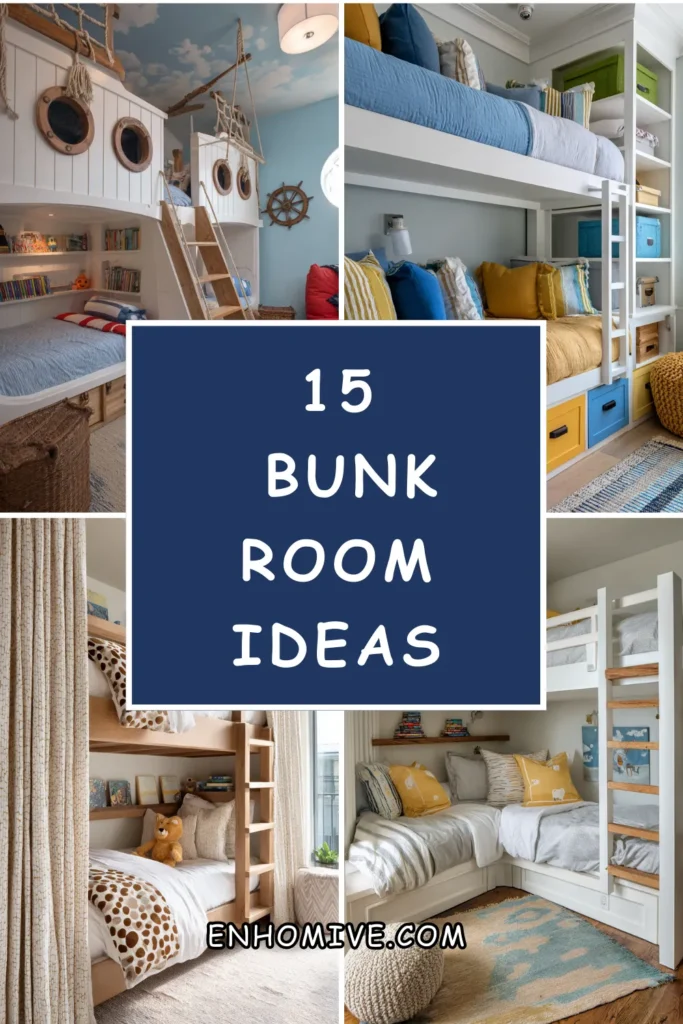
It is rewarding because the bunk room, when it is well designed, creates something that a child’s individual bedroom cannot: the specific quality of shared childhood experience — the whispered conversations after lights out, the imaginative play that unfolds between bunks, the particular friendships that form between siblings who share a sleeping space — that becomes one of the most warmly remembered aspects of childhood for the adults it eventually produces.
The bunk bed is the organizing element around which the shared children’s room is built, and its design, positioning, and configuration determine more about the room’s success than any other single decision. Here are fifteen ideas for building a bunk room that works beautifully for the children who use it and the parents who maintain it.
1. Built-In Bunk Beds with Integrated Storage
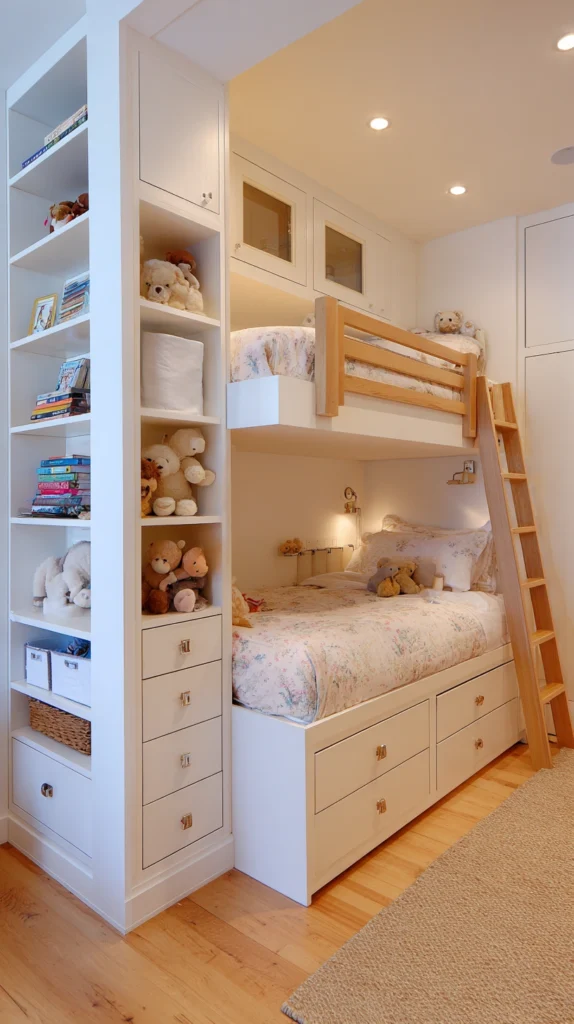
The built-in bunk bed — a bunk system constructed as part of the room’s architecture rather than as a freestanding piece of furniture placed within it — is the bunk room configuration that delivers the highest ratio of sleeping and storage capacity to floor footprint, and it is the choice that most completely transforms the shared bedroom from a room containing furniture into a room whose architecture is the furniture.
A built-in bunk system that incorporates the bed frames, the ladder or stair access, the side rails, the overhead shelving, and the under-bed storage in a single architectural composition creates a room feature of considerable presence and functionality — a sleeping alcove that gives each child their own defined territory within the shared space while maintaining the organizational coherence of a single designed element rather than two separate pieces of furniture competing for the same floor area.
The built-in format also allows the bunk system to be precisely calibrated to the room’s specific dimensions, taking advantage of alcoves, sloped ceilings, and irregular wall configurations that standard freestanding bunks cannot accommodate.
Commission a joiner or use a quality bespoke furniture service for a built-in system of sufficient quality to last through the full length of childhood.
2. L-Shaped Bunks for Corner Efficiency
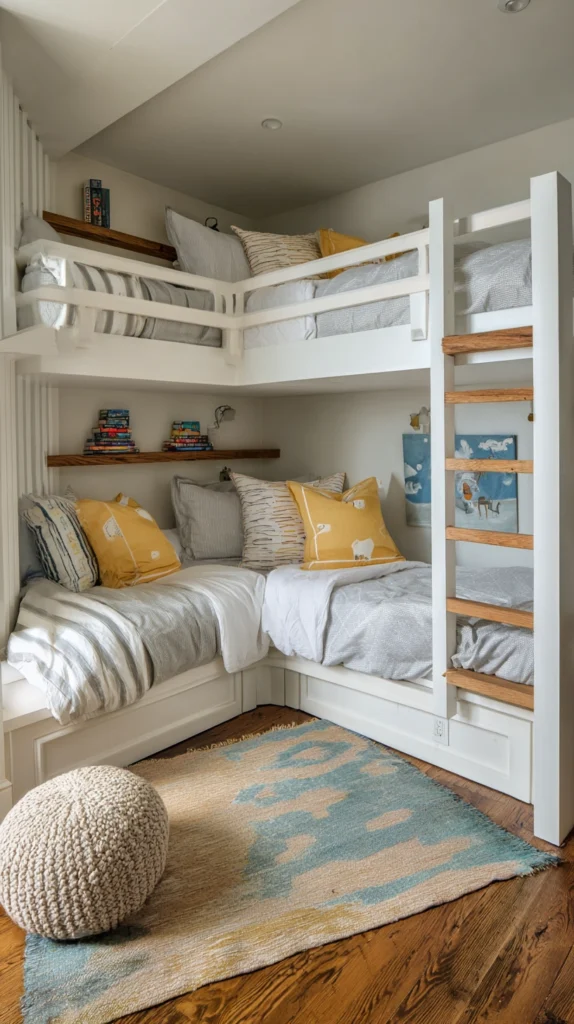
The L-shaped bunk configuration — in which one bed extends in one direction and the second bed extends perpendicularly, the two beds sharing a single corner support post — creates a bunk arrangement of considerable spatial efficiency in a room’s corner while also providing a visual distinction between the two sleeping positions that the standard vertically stacked bunk cannot offer.
The L-shaped layout means that neither child is directly above or below the other, which resolves many of the practical tensions of stacked bunk use: the upper child’s movement does not disturb the lower child as directly, the lower child has more headroom and a greater sense of enclosed personal space, and the two beds create a natural corner zone that can be furnished with a shared play and seating area beneath the elevated end of the upper bunk.
This configuration is particularly effective in square rooms where the corner position creates a bunk zone that leaves the room’s central floor area completely free for play, movement, and the additional furniture that a shared children’s room requires.
3. Bunk Beds with Individual Curtains or Privacy Screens
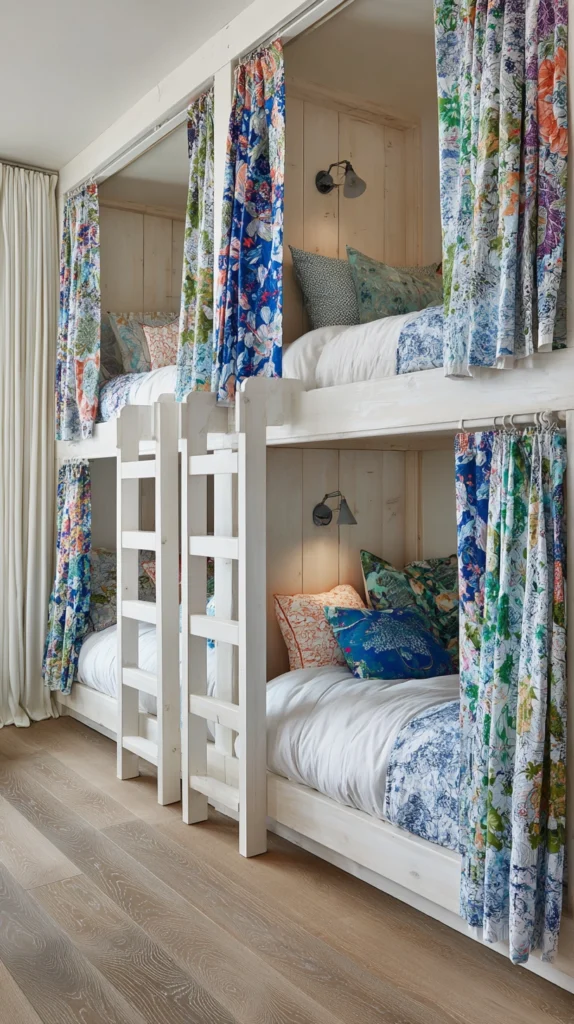
One of the most consistent complaints about bunk beds from children who share them is the absence of privacy — the feeling of sleeping in a completely open environment where the other occupant’s movements, light, and noise are fully shared regardless of the desires of either child.
Individual curtains on each bunk — fabric panels hung from a track or rod mounted at the bunk’s opening, drawnable to create a completely enclosed sleeping alcove for each child — address this complaint with simple, inexpensive, and completely reversible effectiveness.
The curtained bunk transforms each sleeping position from an open shelf into a private den — the specific quality of enclosed personal space that children find deeply compelling and that promotes the sense of individual territory within the shared room that each child needs.
Choose curtain fabrics in colors or patterns that each child has selected for their own bunk — this small act of individual choice gives the personalization of the shared room a specific, bounded expression that does not require the room’s overall design to be compromised.
4. A Triple Bunk for Three Siblings
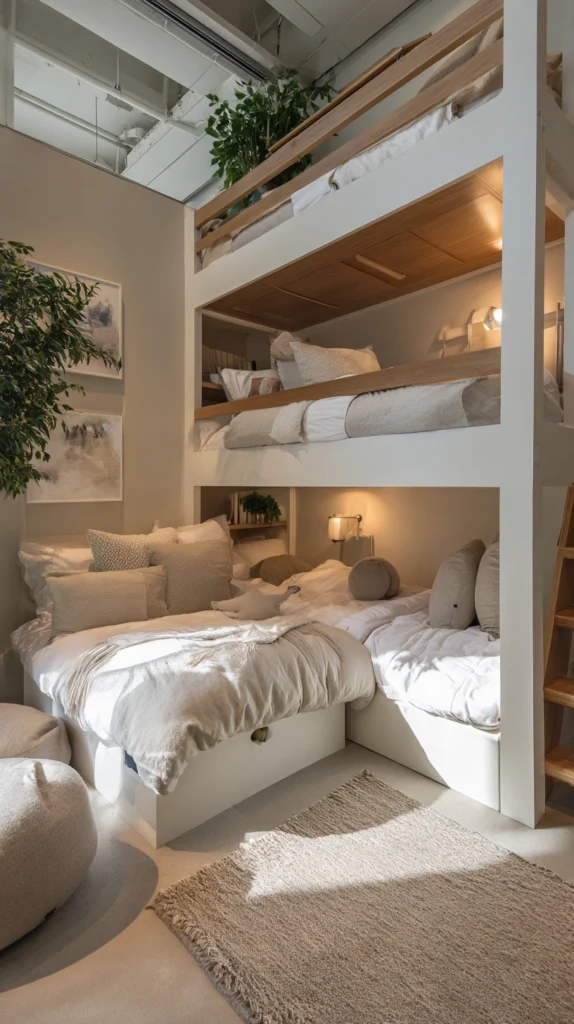
The triple bunk — a stacked sleeping system for three children, either three beds stacked vertically or two stacked with a third extending laterally in an L formation — is the solution for the shared bedroom that must accommodate three occupants without consuming the full floor area in sleeping provision.
The vertical triple bunk requires a ceiling height of at least 2.7 meters to provide adequate headroom at each sleeping level, and the access ladder must be of sufficient quality and angle to allow safe ascent and descent for children of different ages and sizes.
The lateral triple — two vertically stacked in the conventional bunk format with a third extending perpendicular at the lower level — is more spatially generous and more practically comfortable for the younger or less agile child who occupies the lower lateral position, and suits rooms of at least three meters in width on the bunk wall. Guardrails on all beds at height — not only the uppermost bunk — are a safety requirement rather than an optional addition for any multi-level sleeping configuration.
5. Bunk Beds with Dedicated Study Zones Below
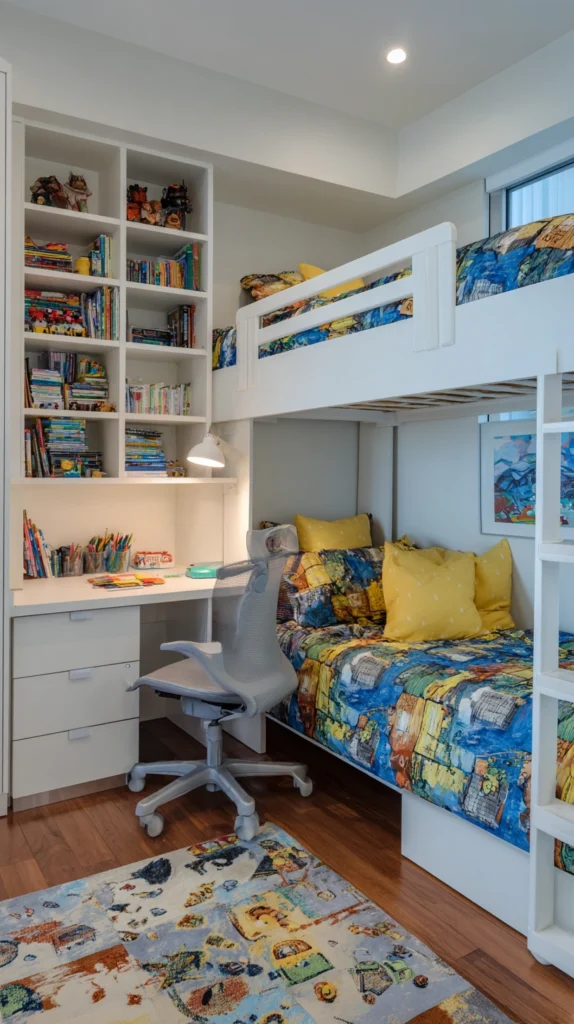
The bunk bed whose lower level is configured as a study and homework zone rather than a second sleeping position — a desk and chair beneath the elevated upper bunk, with shelving on the surrounding walls for books, stationery, and study materials — creates a childhood room that addresses the sleeping and studying needs of a growing child within a single integrated furniture system that uses the room’s height dimension efficiently.
This configuration suits a single child’s bedroom as much as a shared one, but in a shared room it creates a clear functional distinction between the sleeping zone and the studying zone that both children benefit from.
The study zone beneath the upper bunk has the specific appeal of enclosure — a workspace with a low ceiling that creates the focused, den-like quality that many children find conducive to concentration. Ensure adequate task lighting at the desk — an LED desk lamp mounted to the bunk structure above — and sufficient ventilation, as the enclosed position can feel warm in summer.
6. Color-Coded Bunk Zones for Individual Identity
In a shared children’s room where the two or more occupants have equal claim to the space, the design challenge of creating individual identity within a shared environment is one of the most important and most frequently underestimated aspects of the room’s function.
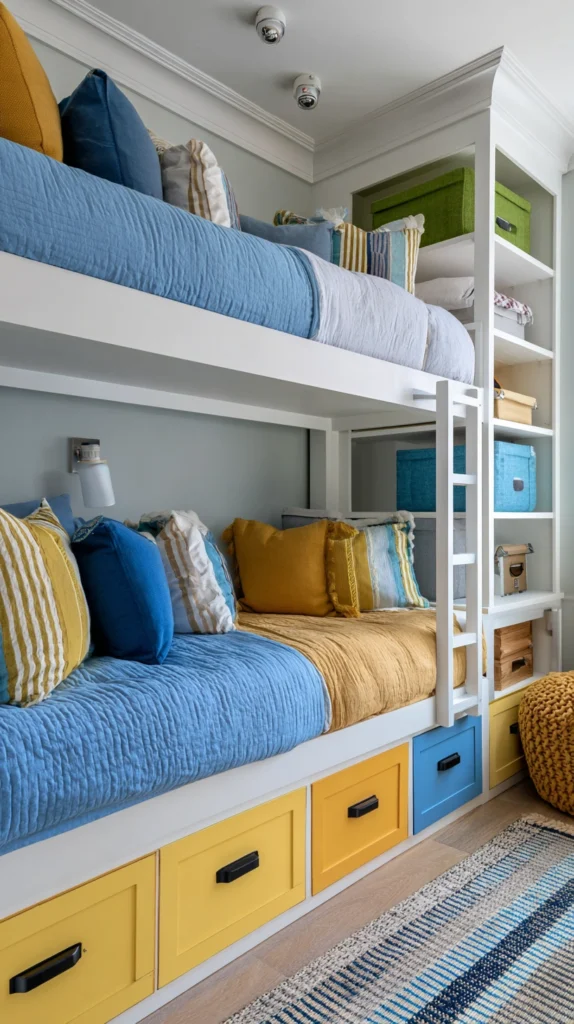
Color-coding each child’s bunk zone — a different color accent, a different bedding palette, a different arrangement of personal objects at each sleeping level — creates the visual distinction of individual territory within the shared framework of the bunk structure.
The color-coding can extend beyond the bunk itself to include the storage area associated with each child — their specific drawer bank, their shelf section, their desk or study zone — creating a complete personal zone for each occupant that is clearly distinguished from the adjacent sibling’s territory.
The two color palettes should be complementary rather than clashing — related tones within the same color family, or two colors from the same palette — so that the room maintains visual coherence even as each zone expresses individual identity.
7. A Cabin Bed Lower Bunk with Playhouse Upper
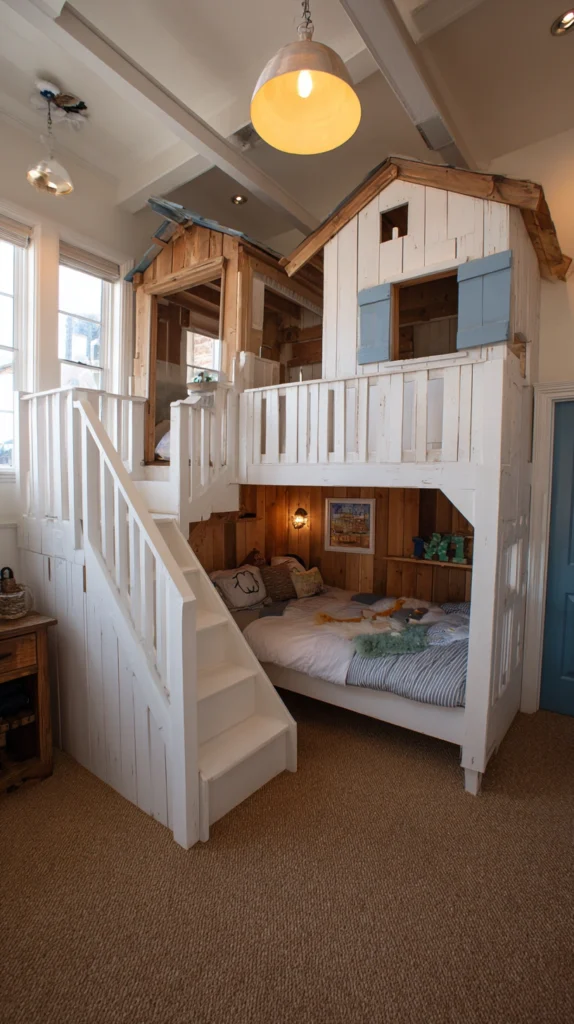
The cabin bunk — a sleeping system in which the lower bunk is enclosed on three sides to create a den or cabin-like sleeping space, with the upper bunk or storage platform providing the overhead structure — creates the most playfully architectural bunk bed available and one that children consistently describe as their favorite type of sleeping space.
The lower cabin’s enclosed walls can be fitted with a window-shaped opening, a small door, blackboard panels, or decorative elements that reinforce the playhouse reference and give the occupant of the lower bunk the specific pleasure of a room within a room.
The upper level can be configured as a second sleeping bunk, as an open play platform accessible by ladder, or as a storage loft for toys and equipment — the configuration depending on the children’s ages, the room’s ceiling height, and the relative priority of sleeping versus play space within the bunk structure’s overall function.
8. Individual Reading Lights and Shelves at Each Bunk
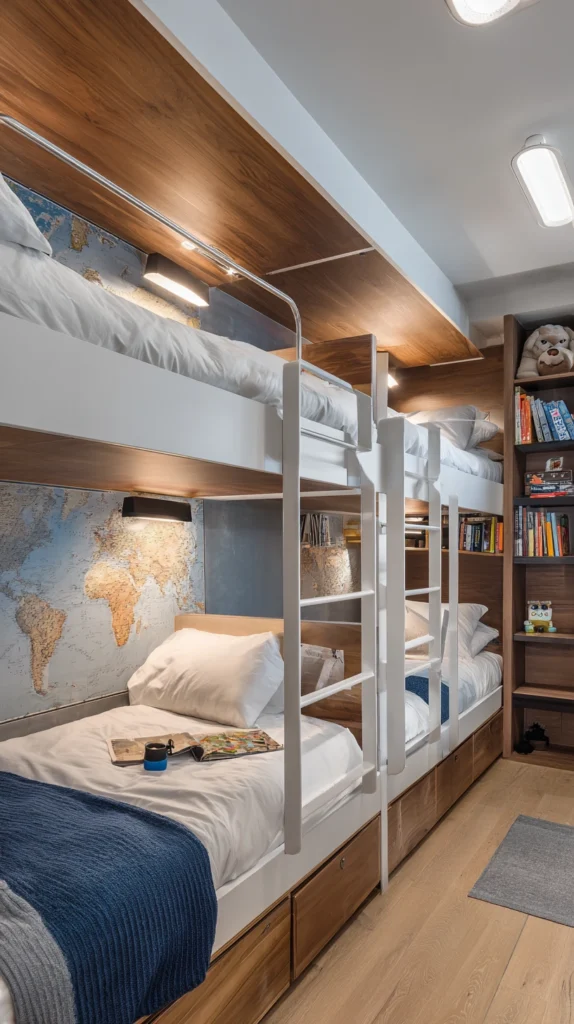
The practical infrastructure of each bunk — the small but important details that make the sleeping position genuinely comfortable and functional for a child who reads, draws, keeps a diary, or simply needs a place for a glass of water and a current book — is the element of bunk design most frequently overlooked in favor of the structural and aesthetic decisions that are more immediately visible.
A small shelf at the head of each bunk, sized for a book, a water bottle, a small toy, and a phone or device, gives each child the bedside equivalent that a standard bedroom provides in a standard bedside table.
A reading light mounted at each bunk — either a wall-mounted adjustable arm light above the head position or a clip-on LED light attached to the bunk structure — allows each child to read after lights-out without disturbing the other occupant, which is one of the most practically significant details in managing the bedtime routine of children who share a room and whose sleep schedules may differ.
9. Bunk Beds in a Sloped Ceiling Room
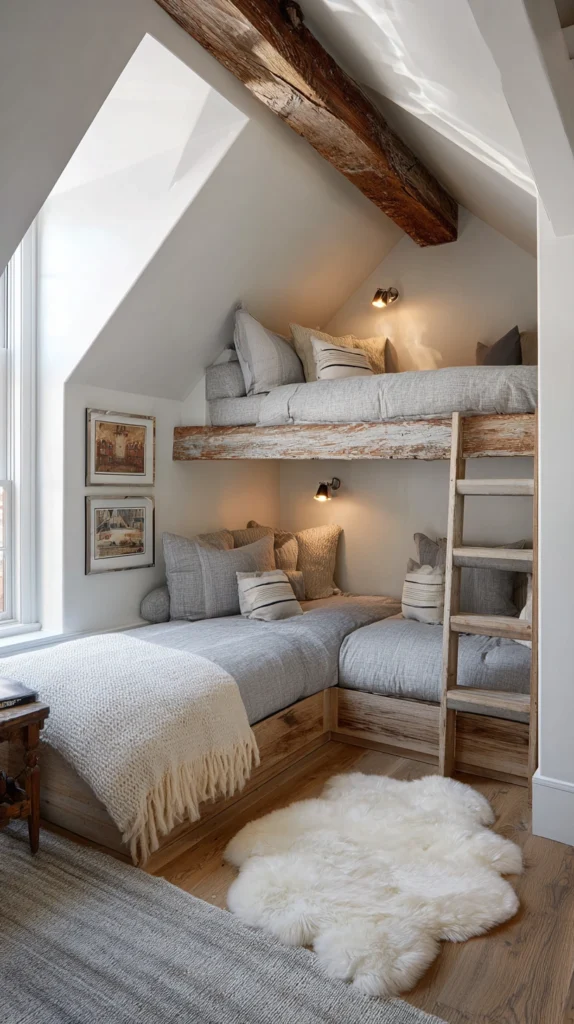
The bedroom with a sloped ceiling — the attic room, the top floor room with a pitched roof — presents a bunk installation challenge that standard vertical bunk systems cannot address, because the slope reduces the usable ceiling height progressively from one wall to the other in a way that the uniform height requirement of a standard bunk bed cannot accommodate.
A custom-built bunk system designed specifically for the sloped ceiling room turns this architectural constraint into a design feature: the lower bunk positioned at the room’s lowest point where the ceiling is most intimate, the upper bunk positioned where the ceiling is higher, and the access ladder positioned at the point of maximum clearance.
The sloped ceiling creates different qualities of enclosure at different heights within the bunk structure, and these different qualities suit different children and different uses — the cozy, low-ceilinged lower bunk for the child who loves enclosed spaces, the higher, more open upper bunk for the child who prefers greater visual freedom.
10. Gender-Neutral Design for Flexible Use Over Time
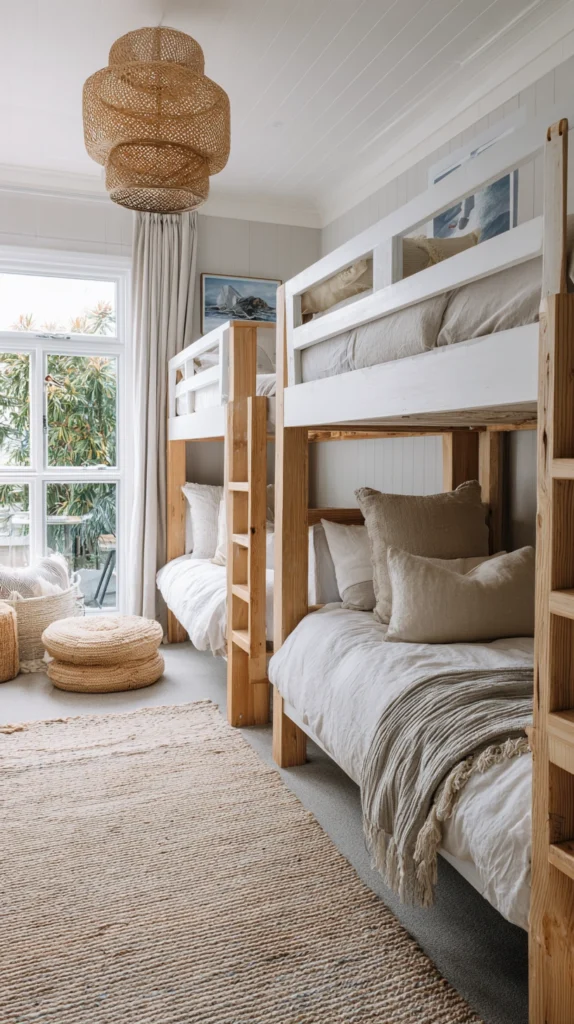
The shared children’s bedroom designed for maximum longevity — one that will serve different combinations of occupants over the years as the household’s composition changes — benefits from a gender-neutral design approach that does not commit the room’s architectural elements to a color palette or decorative theme that will either date quickly or suit only one specific combination of occupants.
A gender-neutral bunk room uses natural timber, white or off-white painted elements, and neutral-toned textiles as its architectural base, and expresses individuality through the easily changeable decorative layer — bedding, cushions, rugs, wall art, and the personal objects that each current occupant brings to their own zone.
This approach means that the room serves equally well for two boys, two girls, or a mixed combination of siblings, and that each new occupant can personalize their zone genuinely rather than inheriting a design that was specifically created for someone else.
11. A Bunk Room with Dedicated Toy and Activity Storage
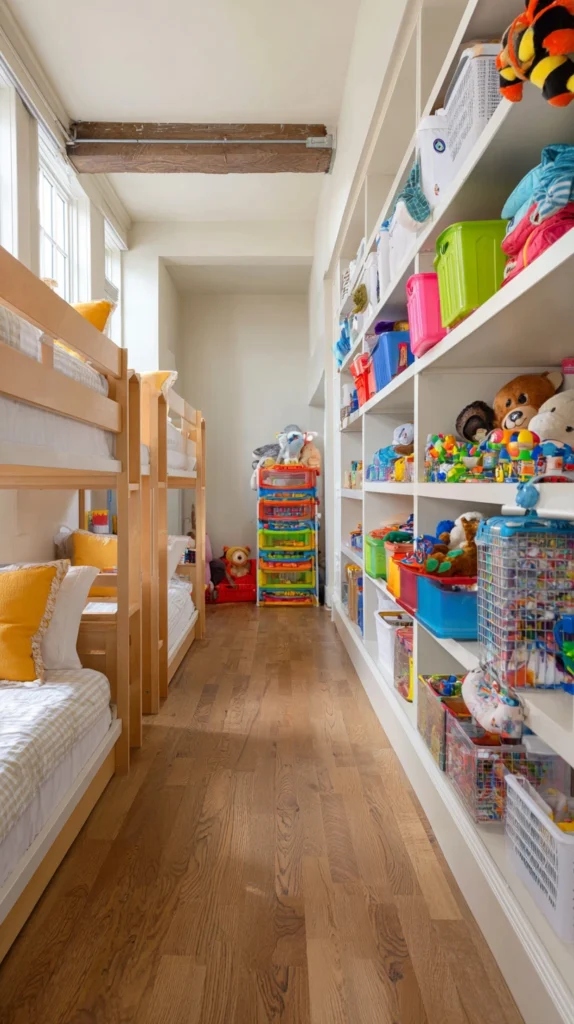
The shared children’s bedroom is not only a sleeping room — it is a playing room, a craft room, a social space, and a private retreat, and the storage provision for all the equipment these activities require must be as comprehensively addressed in the bunk room’s design as the sleeping provision.
A dedicated toy and activity storage zone — a wall of open shelving and closed cabinet combinations, sized and organized for the specific categories of the children’s current play and creative interests — keeps the floor area available for active play while maintaining the organizational clarity that makes the room usable rather than simply a storage area with bunks in it.
Label all storage clearly at a height children can read, organize by category rather than by child to encourage sharing and collaborative play, and include a clearly designated sorting and tidying system that children can operate independently — a toy room that children can tidy themselves is the goal, and the storage design determines whether that goal is achievable.
12. Themed Bunk Beds for Maximum Childhood Magic
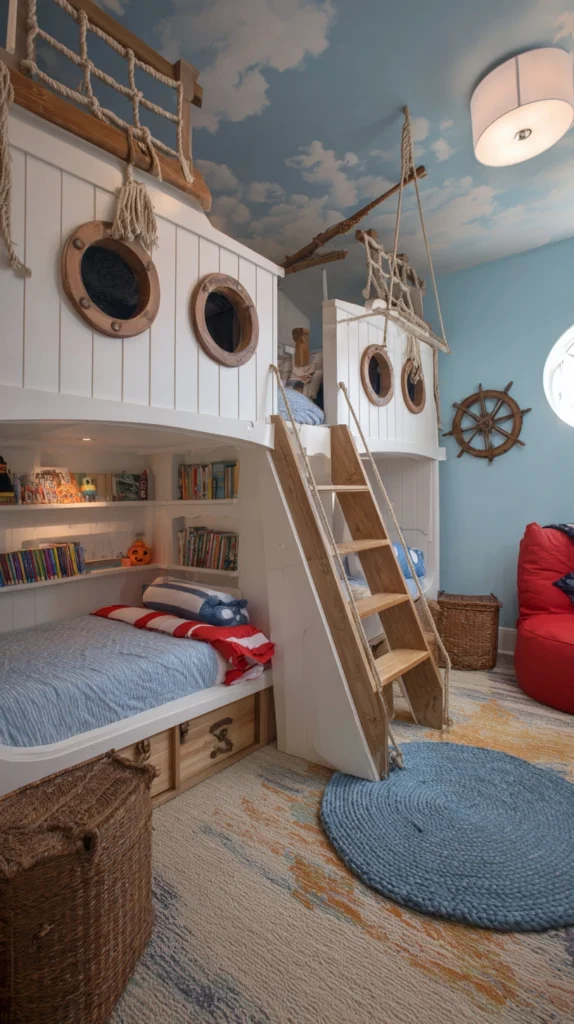
The themed bunk bed — a sleeping system built around a narrative concept that gives the bunk room its organizing imaginative idea — is the bunk design that most completely captures what children actually want from their sleeping space: a bed that is also an adventure, a room that is also a world.
A bunk designed as a ship’s cabin, with porthole windows cut into the side panels, rope ladder access, and a helm at the upper level. A bunk in the form of a treehouse, with branch-shaped structural elements, a rope bridge between levels, and a canopy of fabric leaves above the upper bunk. A castle bunk with battlemented upper walls, an arched doorway to the lower chamber, and a lookout platform at the top.
These themed designs require custom construction and a significant budget relative to standard bunk alternatives, but the childhood experience they create — the years of imaginative play organized around the room’s central narrative concept — is of a quality and memorability that no standard bunk bed can approach.
13. Folding or Murphy Bunk Beds for Daytime Transformation
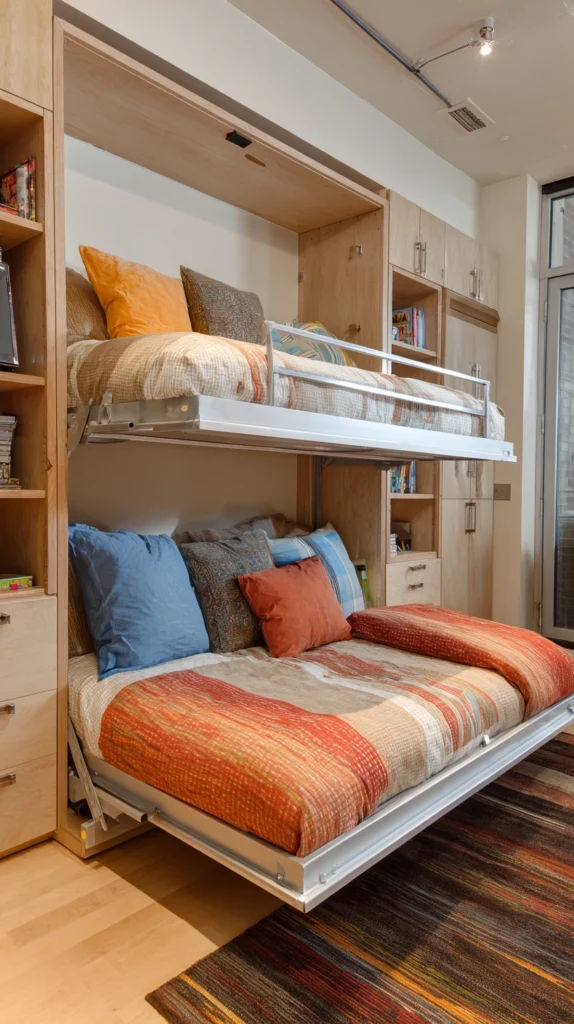
In a bedroom that must serve as a daytime playroom as well as a nighttime sleeping space — a common requirement in smaller homes where every room must serve multiple functions — a folding or Murphy bunk system that allows the beds to be stored vertically against the wall when not in use creates a daytime floor area that the permanent bunk structure cannot provide.
Murphy bunk beds — two beds that fold upward into a wall cabinet, leaving the full floor area of the room available during waking hours — are available in configurations designed specifically for children, with safety mechanisms that prevent accidental deployment and aesthetic designs that suit a child’s bedroom rather than the spare-room context in which adult Murphy beds are most commonly used.
The daytime transformation of a Murphy bunk room is not instantaneous — the beds take a minute or two to lower safely — but the spatial benefit of the full floor area during the day is significant enough in a small bedroom to justify the slightly more complex bedtime routine it requires.
14. A Bunk Room Designed to Evolve with Age
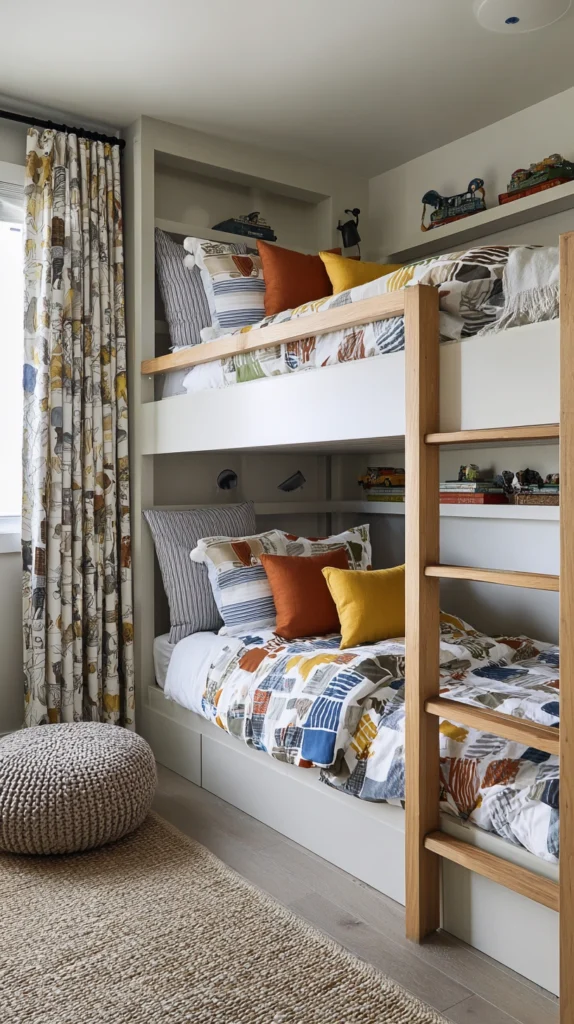
The most practically intelligent bunk room design is one that builds in the capacity to evolve as the children occupying it age — acknowledging that the room serving a five and seven-year-old pair has different requirements from the same room serving a twelve and fourteen-year-old pair, and that the design should accommodate this evolution without requiring complete replacement.
The evolving bunk room achieves this through a modular or adaptable structure that can be reconfigured as needs change: bunk beds that can be separated into two individual beds when the children reach the age where stacked sleeping feels less desirable, study zones that can be upgraded from simple shelving to proper desk configurations as homework demands increase, and storage systems with adjustable shelves and changeable organizational components that suit different categories of possessions at different life stages.
Building this adaptability into the initial design costs relatively little additional planning and investment, and it delivers its return in the extended period over which the room remains genuinely suitable for its occupants without the significant disruption of a complete room redesign.
15. Make the Bunk Room a Space Both Children Love
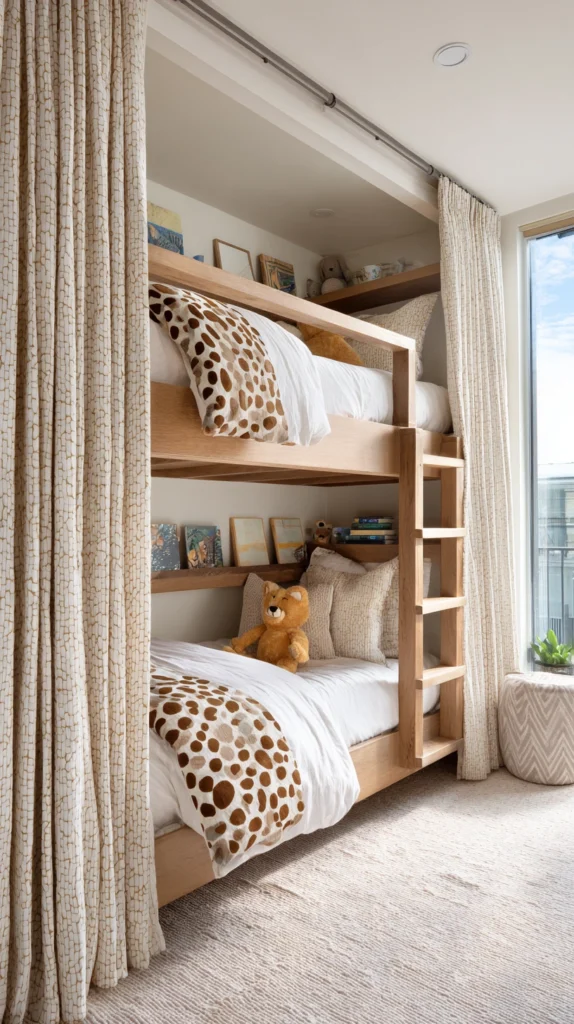
The final bunk room idea is the most important and the least frequently discussed in practical terms: the decision to involve both children genuinely in the design process, giving each occupant real input into the decisions that affect their specific zone while maintaining the overall coherence that makes the room work as a shared space.
A child who has chosen the color of their own bunk curtains, who has selected the arrangement of their personal shelf, who has been asked what they need from their storage space and has seen those needs addressed in the finished room — this child has a relationship with their bedroom that is entirely different from the child who was simply installed in a room designed entirely by adults without consultation.
The practical design decisions — the structural choices, the material specifications, the organizational systems — remain with the adults.
But the specific, bounded choices that each child can genuinely own — their color zone, their personal objects, their individual lighting preference — are the choices that make the bunk room feel like home to both of the children who share it.