
14 Carpet Runner Ideas for Stairs
Stairs are one of the most architecturally significant and most frequently neglected surfaces in a home.
They connect the floors of a house both literally and visually, they are among the first things seen by anyone who enters the front door, and they are traversed multiple times every day by everyone in the household — making them, by any measure, one of the highest-traffic, highest-visibility surfaces in the building.

And yet most stairs receive the same undifferentiated flooring treatment as every other surface in the home, or worse, they are left in whatever state the previous occupant or builder left them in without further consideration. The carpet runner changes this completely.
A well-chosen stair runner — the right pattern, the right color, the right pile height and fiber for the specific demands of stair use — transforms the staircase from a purely functional element into one of the home’s most characterful and most beautiful features, adding warmth, noise reduction, safety, and considerable visual interest to what is often the home’s most publicly visible interior space.
The options available today span a range broad enough to suit every interior style from the most rigorously contemporary to the most deeply traditional, and the practical considerations — installation, durability, maintenance — are more manageable than most people assume before they begin the process. Here are fourteen ideas for getting it right.
1. The Classic Wool Herringbone in Neutral Tones
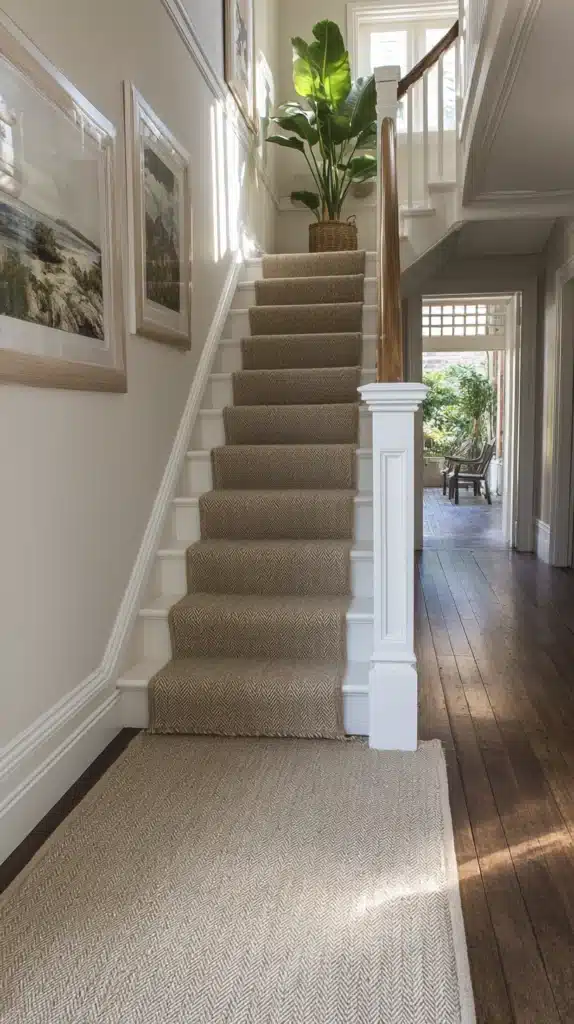
The wool herringbone runner is the carpet equivalent of a navy blazer — a choice so fundamentally right for its context that it transcends trend cycles entirely and simply becomes part of the permanent vocabulary of good interior design.
Wool is the ideal fiber for a stair runner for reasons that go beyond aesthetics: it is naturally resilient, recovering from compression underfoot more effectively than synthetic fibers; it is naturally soil-resistant, as the outer layer of the wool fiber repels liquid before it can penetrate; it is naturally flame-retardant to a degree that many synthetic fibers are not; and it wears in a way that improves rather than diminishes its character, developing the softly pressed patina of a well-used quality textile rather than the pilled, flattened degradation of cheaper alternatives.
The herringbone weave adds a texture that reads beautifully across the changing angles of a staircase, and in the neutral tones — warm oatmeal, natural undyed wool, stone gray, putty — it suits virtually every interior palette without competing with any of them.
2. A Bold Geometric Pattern for Contemporary Stairs
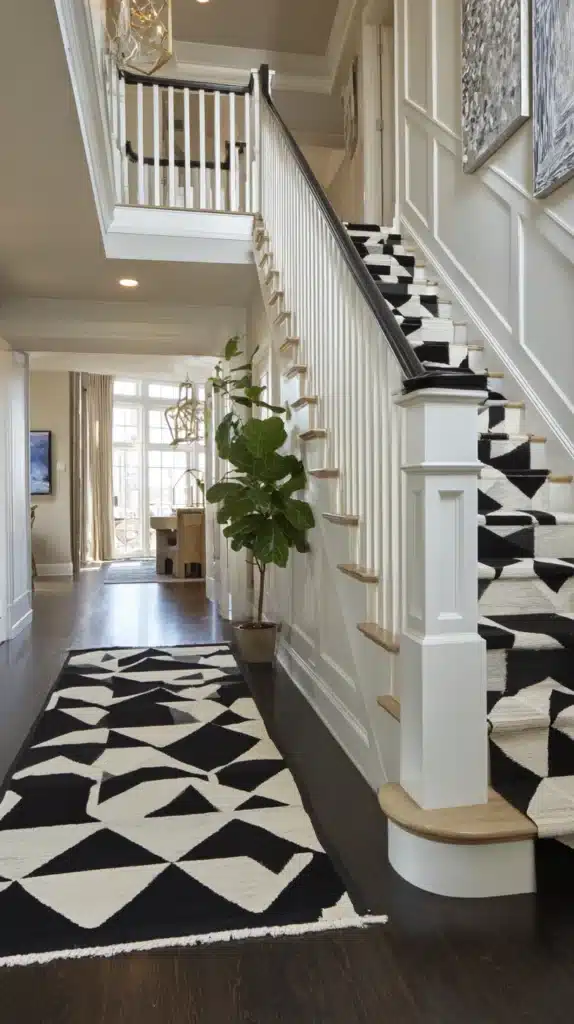
The contemporary staircase — in a new building or a renovated home with a strong design sensibility — is often best served by a runner whose pattern is bold enough to be read from a distance and geometric enough to suit the architectural language of the space. A large-scale diamond, chevron, or abstract geometric in a two or three-color scheme announces the staircase as a designed feature rather than a functional element, and the repeated geometric motif running up the stair’s vertical plane creates a visual rhythm that is deeply satisfying when seen from either above or below.
The color choices matter enormously here: high-contrast geometric patterns — black and white, navy and cream, charcoal and warm white — read with maximum graphic impact; tonal geometrics in close values of the same color family are more sophisticated and work better in spaces where the staircase is visible from multiple rooms that must all sit comfortably with the runner’s palette.
3. A Persian or Oriental Runner for Traditional Warmth
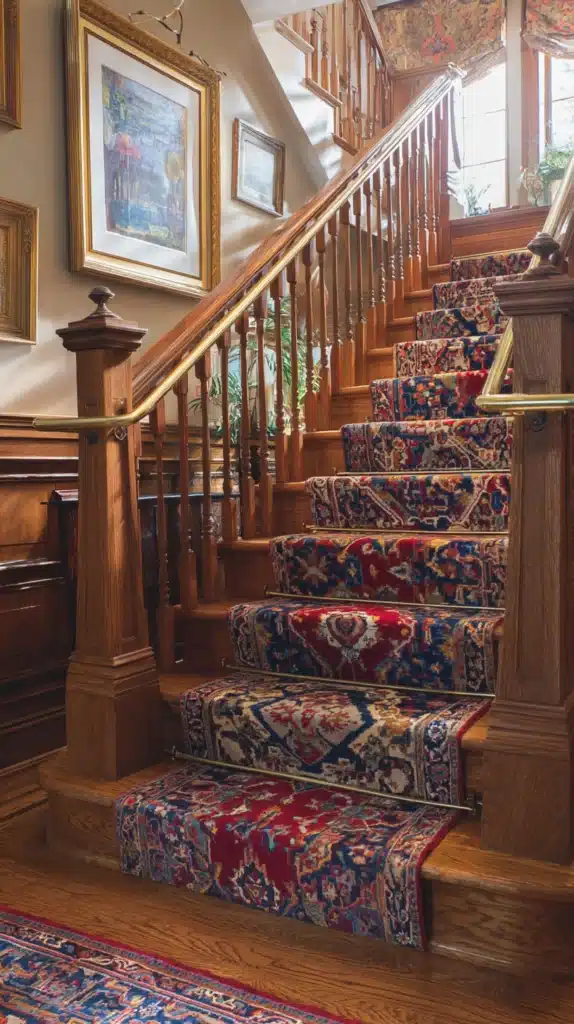
The Persian or Oriental carpet runner is perhaps the most historically resonant of all stair treatments, and in a traditional home — Georgian, Victorian, Edwardian, Federal, or any architecture with period detailing and classical proportions — it is also the most architecturally appropriate.
These runners bring an extraordinary density of pattern, color, and cultural history to the staircase, their intricate floral and geometric motifs developed over centuries of craft tradition and refined to a level of compositional sophistication that no contemporary design can quite match.
The rich reds, deep blues, warm golds, and soft greens of authentic or quality reproduction Oriental runners suit the warm tones of period timber staircases and the aged patina of Victorian brass stair rods with a naturalness that reflects genuine historical authenticity rather than mere stylistic compatibility. Choose a runner whose colors relate to at least two of the rooms visible from the staircase for maximum visual integration.
4. A Striped Runner for Graphic Energy
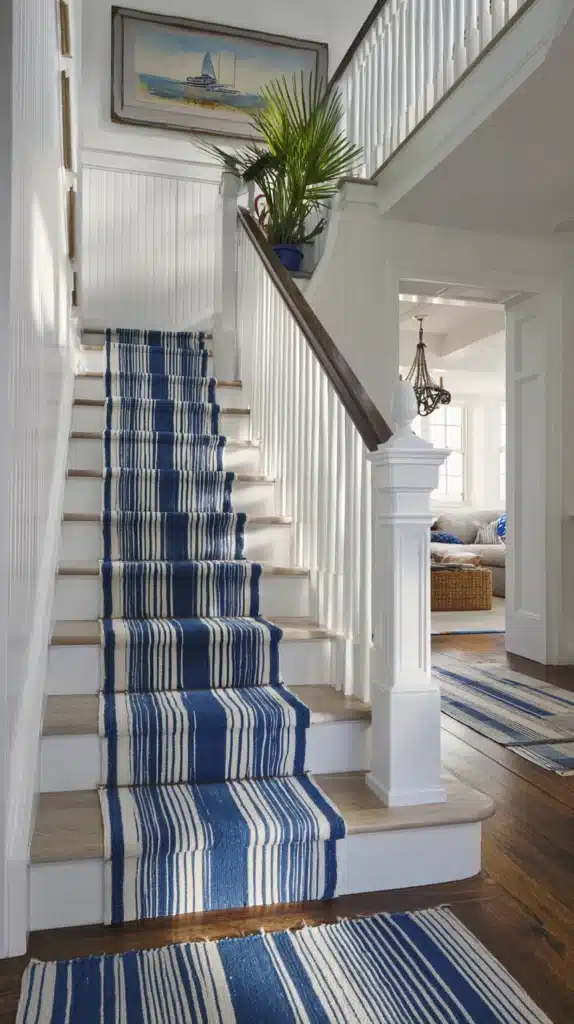
The striped stair runner is one of the most graphically energetic and visually dynamic options available, because the relationship between the stripe’s direction — which runs along the runner’s length — and the stair’s geometry — which runs perpendicular to it — creates a visual tension that gives the staircase a sense of movement and liveliness that few other patterns can match.
A wide, bold stripe in two contrasting colors — a classic French country combination of cream and ticking blue, a preppy combination of navy and white, a warm rustic pairing of terracotta and natural — creates a runner that is simultaneously simple and striking, instantly recognizable as a design choice rather than a default.
The stripe width relative to the tread depth is a critical design decision: very narrow stripes can create a dizzying effect when viewed from the bottom of a long staircase, while stripes wide enough that one or two colors span a complete tread have a more resolved, architectural quality.
5. A Jute or Sisal Runner for Natural Texture
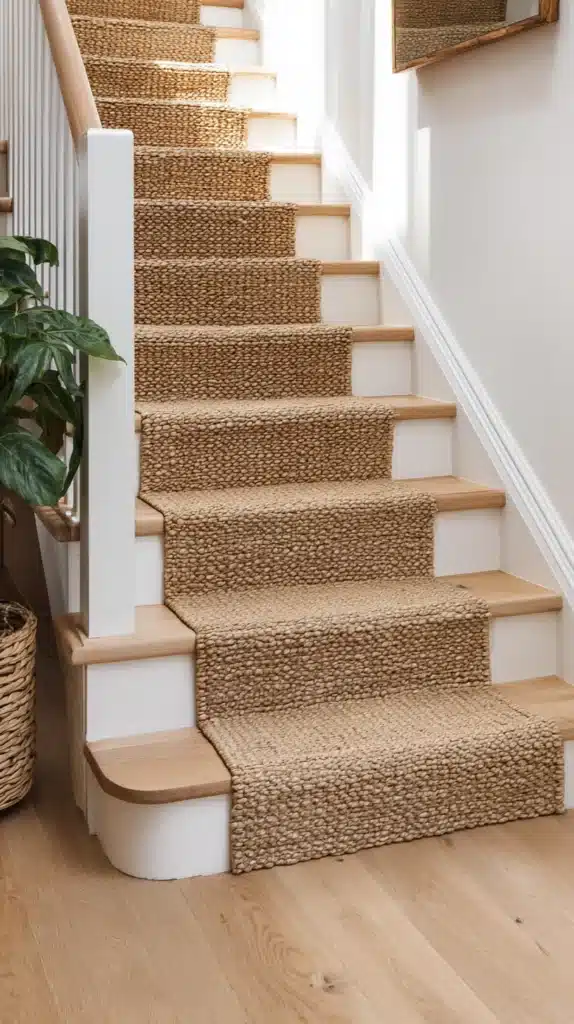
Natural fiber runners in jute, sisal, or seagrass bring a material honesty and organic warmth to a staircase that wool and synthetic alternatives can approach but not fully replicate, and their particular quality of texture — the slight roughness, the visible weave structure, the warm honey tone of undyed plant fiber — makes them one of the most universally successful choices available for staircases in homes with a natural, relaxed, or Scandinavian aesthetic. The practical consideration with natural fiber runners is that their relative roughness makes them more demanding on bare feet than softer pile alternatives, and they are less forgiving of liquid spills than treated wool, as plant fibers absorb moisture more readily.
In a household where the staircase sees heavy daily traffic from children and pets, these considerations are worth weighing carefully. In a household where aesthetics and material authenticity are the primary priorities and the traffic is more moderate, natural fiber runners are among the most beautiful stair treatments available.
6. A Patterned Runner That Echoes the Home’s Textiles
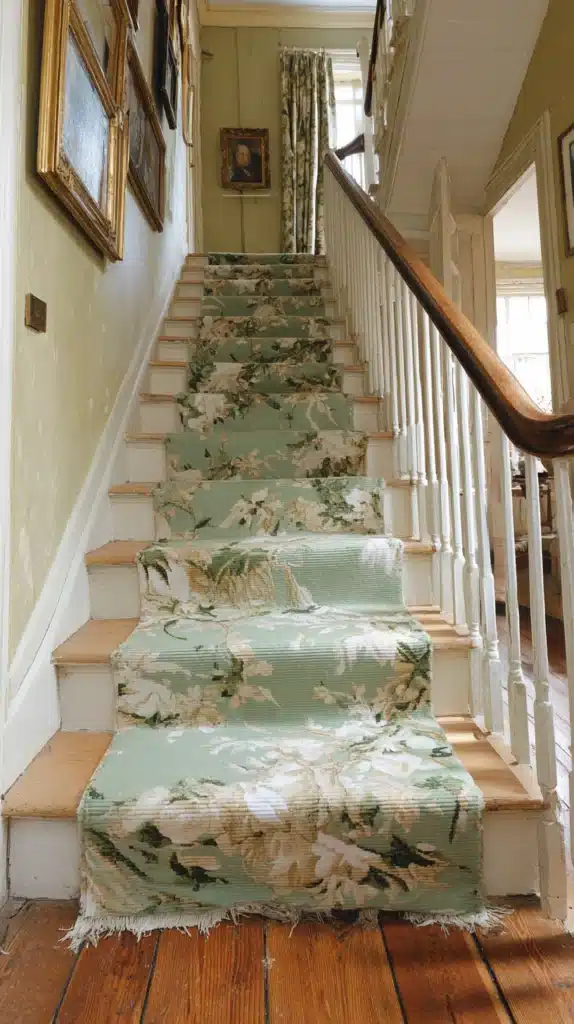
One of the most sophisticated approaches to stair runner selection is to choose a pattern that explicitly echoes or relates to the textile patterns already present in the home — the upholstery fabric on a sitting room sofa, the wallpaper in a hallway, the curtain fabric in an adjoining room — creating a visual conversation between the staircase and its surrounding interior that ties the design of the home together with a coherence that feels considered rather than merely coordinated.
This approach requires identifying the dominant pattern in the adjacent space — its scale, its color palette, its style reference — and finding a runner that shares at least two of these qualities without literally duplicating the pattern.
A floral wallpaper paired with a botanical runner in a related color palette. A geometric upholstery fabric paired with a smaller-scale geometric runner in a shared accent color. The connection should be felt rather than explained.
7. A Dark, Dramatic Runner for a Statement Staircase
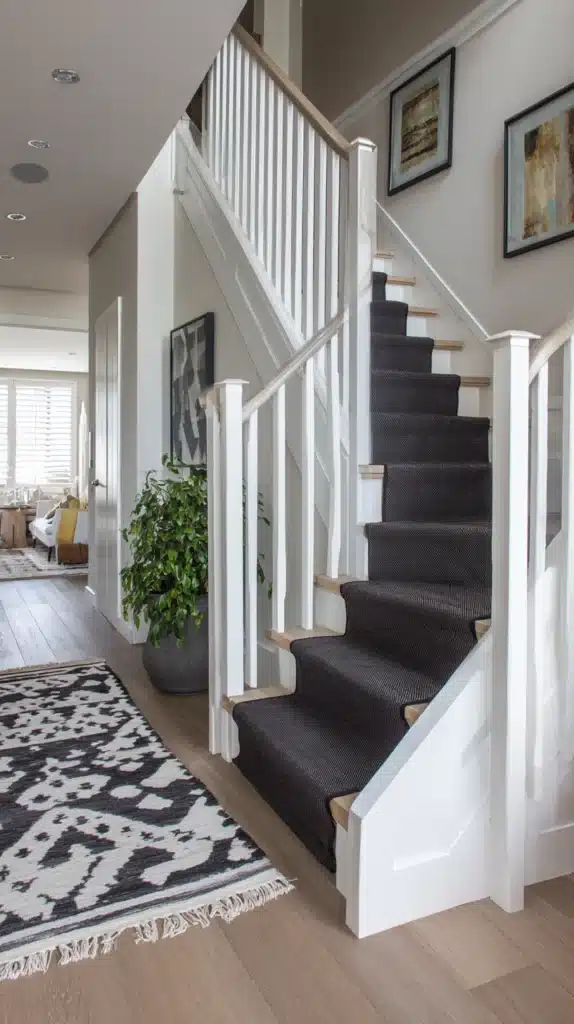
The dark stair runner — in deep charcoal, midnight navy, forest green, or even near-black — is a choice that requires confidence and produces results that consistently justify that confidence in the right interior context.
Dark runners anchor the staircase visually, giving it a gravity and intentionality that lighter options cannot achieve, and against a pale or white stair surround — painted risers, bare timber treads, white-painted balustrades — a dark runner creates a graphic contrast of maximum impact.
The practical advantage of a dark runner is that it conceals dirt and wear more effectively than pale alternatives, which is a meaningful consideration for a high-traffic surface that is difficult to remove for cleaning.
A dark runner also makes a staircase feel wider — the eye reads the runner’s width against the pale surround rather than the total stair width — and in a narrow staircase this optical effect can be genuinely useful.
8. A Vintage or Antique Runner for Collected Character
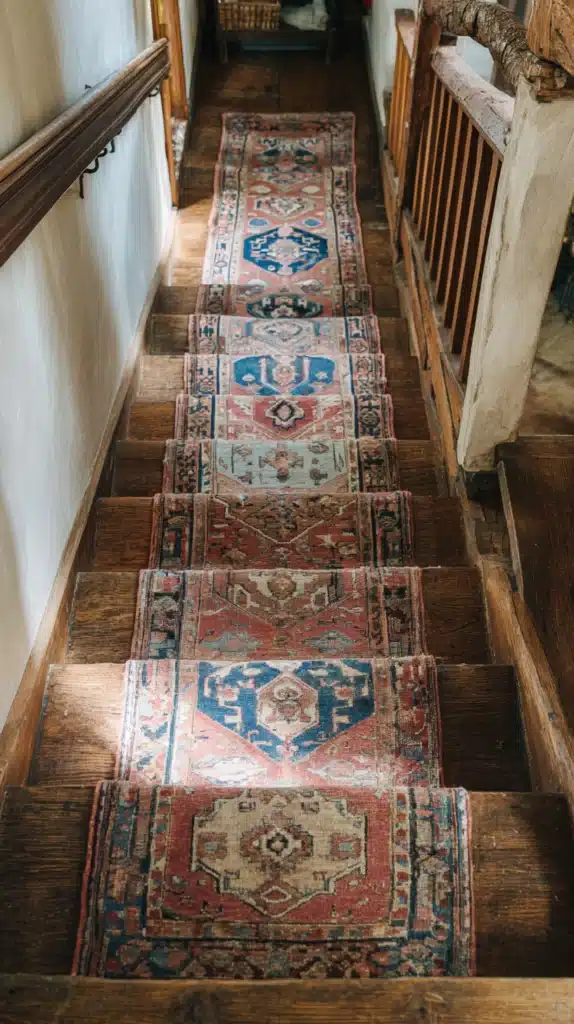
A genuine vintage or antique carpet runner — sourced from a specialist dealer, an auction house, or an estate sale — brings to a staircase a quality of character and authenticity that no new carpet, however well designed and beautifully made, can replicate.
The faded, softened tones of an aged carpet, the slight irregularities in its pile where decades of foot traffic have gently compressed particular areas, the specific combination of colors that reflect the dye technology and aesthetic sensibility of its original period of manufacture — all of these qualities contribute to a stair treatment that looks as though it belongs to the house rather than having been added to it recently.
Vintage runners require careful assessment before purchase: check the backing for integrity, examine the pile depth across the full length, and ensure that any repair or restoration needed is within your budget and capability before committing.
9. A Two-Tone Color Block Runner for Modern Edge
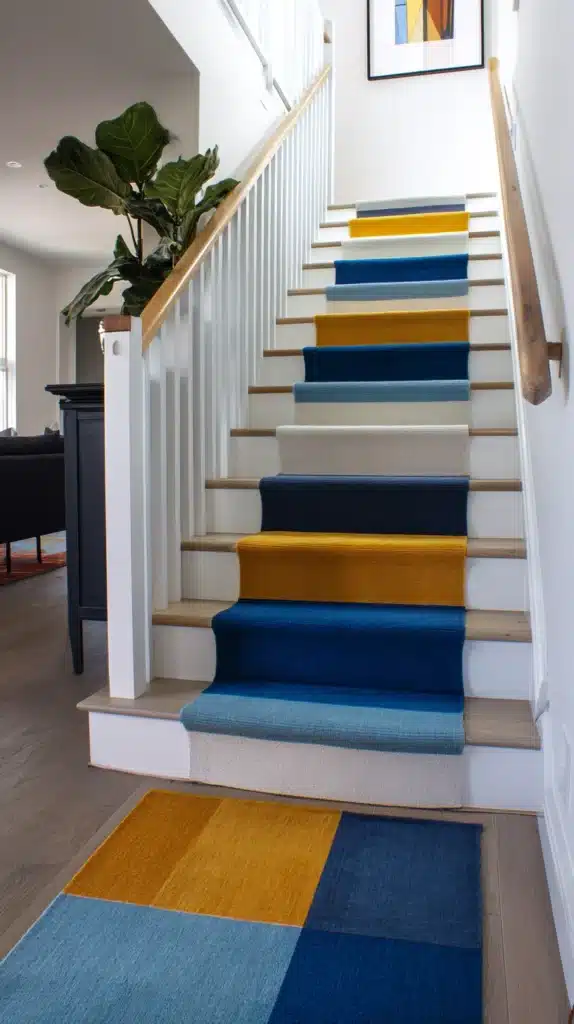
The color block runner — a carpet in two or more solid colors arranged in clearly defined bands or sections along its length — brings a contemporary graphic sensibility to the staircase that pattern-based alternatives cannot achieve.
Where a patterned runner creates visual complexity that rewards close inspection, a color block runner creates visual impact from a distance — a bold statement visible from across the room that draws the eye to the staircase with the directness of a piece of abstract art.
The color choices are everything: adjacent tones of the same color family — warm white and soft cream, sage green and eucalyptus, dusty pink and terracotta — create a sophisticated, graduated effect; contrasting colors — black and warm white, navy and mustard, forest green and natural — create maximum graphic energy. Install the runner so that the color transitions occur at consistent intervals relative to the stair structure for the most resolved result.
10. A Stair Runner with Contrasting Border
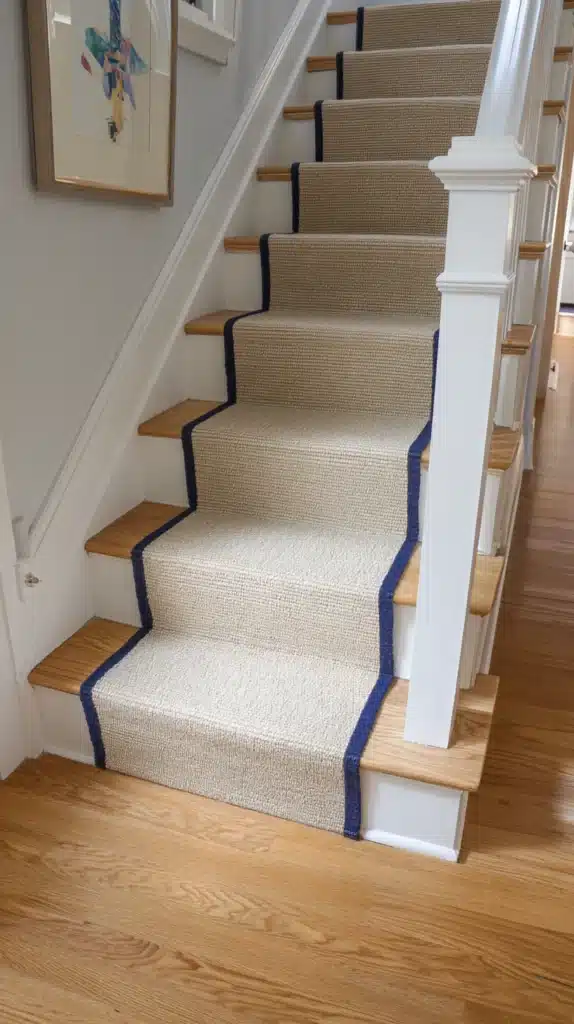
The runner with a contrasting border — a field color surrounded by a border in a different, complementary tone — is a refinement borrowed from the vocabulary of room-sized carpets and Oriental rugs and applied to the stair runner format with consistently elegant results.
The border adds a framing quality to the runner that gives it the visual completeness of a finished object rather than a cut length of carpet, and when the border color is chosen to relate to the surrounding paintwork, timber, or interior palette, it creates an integration between the runner and its architectural context that borderless alternatives cannot achieve.
A warm oatmeal runner with a deep navy border suits a coastal or traditional interior. A stone gray runner with a terracotta border suits a contemporary or Mediterranean-influenced space. A cream runner with a forest green border is among the most classically beautiful combinations available in the stair runner category.
11. A Plaid or Tartan Runner for Heritage Character
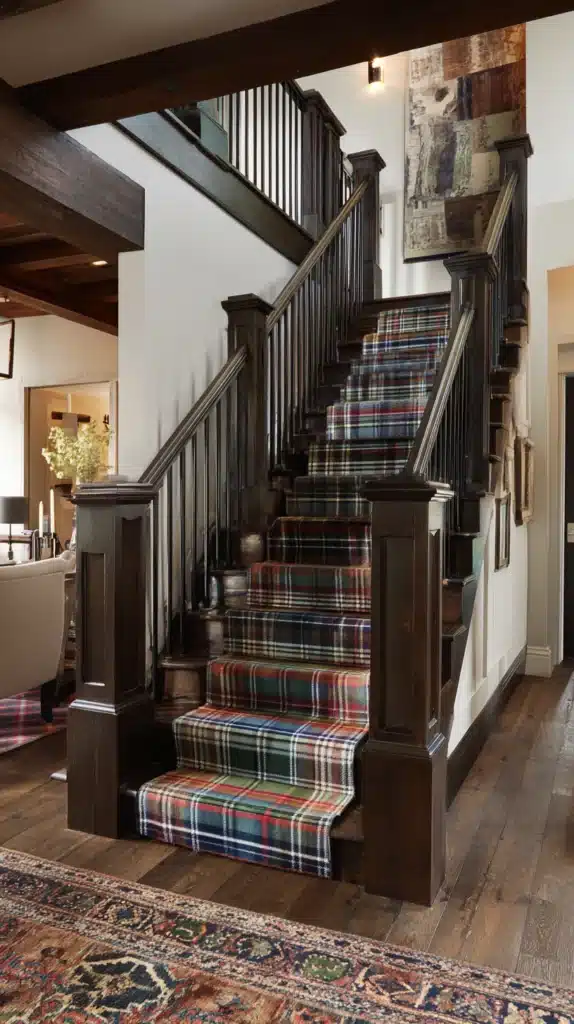
The plaid or tartan stair runner occupies a specific and underserved niche in the stair treatment market — a choice with strong heritage associations that have been made relevant to contemporary interiors by a new generation of colorways and scaled patterns that move well beyond the traditional Scottish clan associations of the format’s origins.
A large-scale plaid in warm, contemporary tones — deep teal and warm amber, forest green and rust red, charcoal and camel — suits an interior with a strong material sensibility and an appreciation for traditional craft techniques translated into modern design. The crossing lines of the plaid pattern create a complex, textural visual effect that reads differently depending on viewing distance, and its relative rarity as a stair treatment choice gives the staircase a distinctiveness that more commonly selected patterns cannot provide.
12. A Patterned Runner Installed with Visible Timber Surrounds
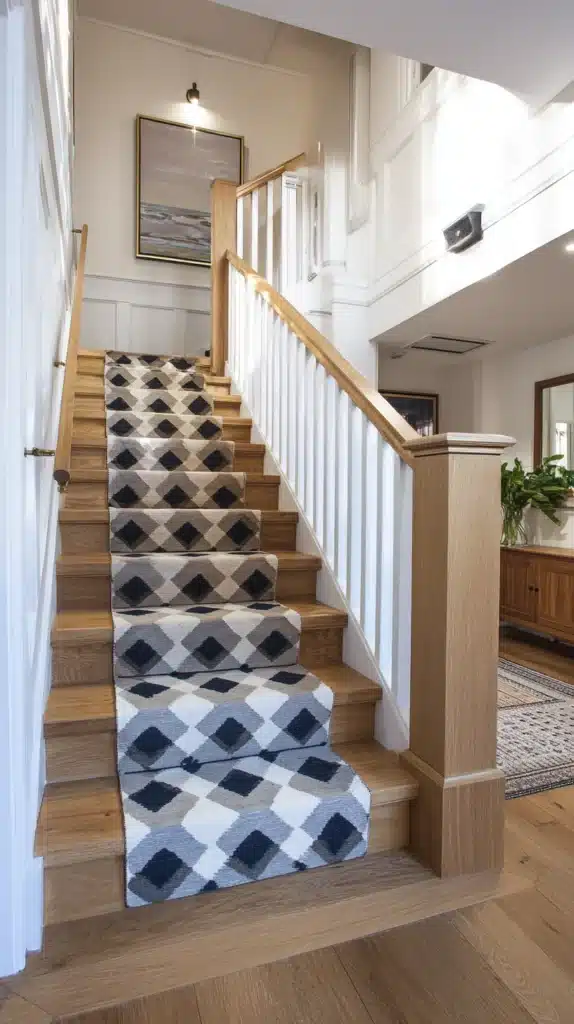
The installation approach for a stair runner is as important a design decision as the runner itself, and the choice between wall-to-wall coverage — where the runner fills the stair’s full width and no timber is visible — and centered installation with visible timber surrounds on either side changes the character of the staircase entirely.
Centered installation with timber surrounds is the more traditional and the more visually interesting approach, because it creates a layered composition — timber, runner, timber — that gives the staircase a finished, architectural quality that wall-to-wall coverage cannot.
The width of the exposed timber surround should be consistent on both sides and calibrated to the runner’s width — a narrow surround with a wide runner reads as formal and upholstered; a wider surround with a narrower runner reads as more relaxed and shows more of the timber’s quality. The timber surround should be finished — painted, stained, oiled, or simply cleaned and waxed — with the same care as any other featured timber surface in the home.
13. A Custom Printed Runner for Completely Personal Expression
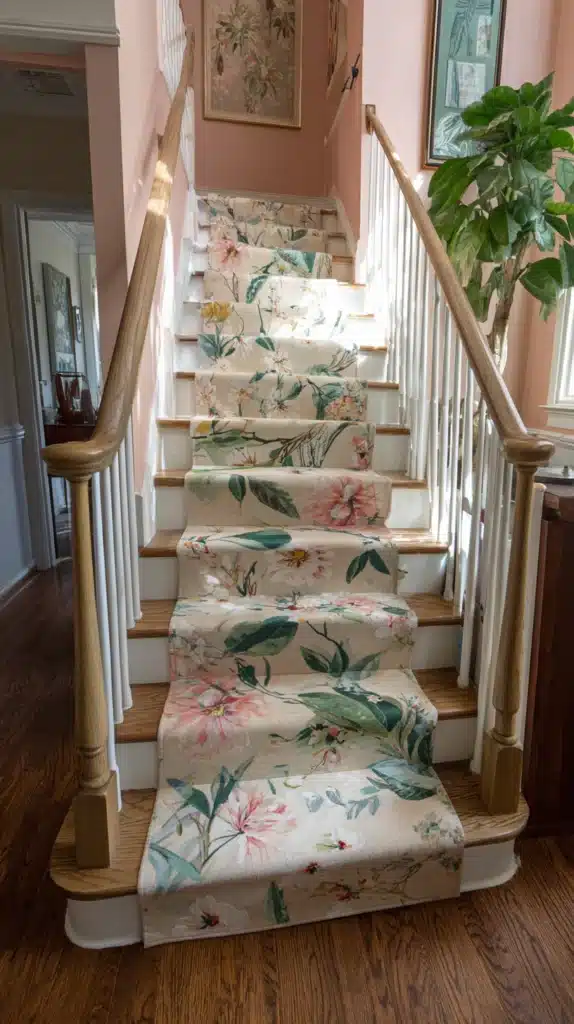
The availability of custom-printed carpet and flatweave runners — where a specific design, pattern, or image is printed onto a runner to the customer’s specification — opens up a dimension of stair runner personalization that the standard market cannot approach. A custom botanical illustration that runs the full length of the staircase. A family tartan in specific colors. An abstract design created with an artist. A geometric pattern developed specifically to complement a particular interior’s tile or wallpaper.
The technical quality of digitally printed carpet has improved to the point where the results are genuinely beautiful rather than the slightly pixelated approximations of earlier technology, and the lead times and minimum order quantities have reduced to levels that make custom printing accessible for a single domestic staircase. This is the option for the homeowner who has a genuinely specific design vision that the standard market cannot satisfy.
14. A Runner Secured with Decorative Stair Rods
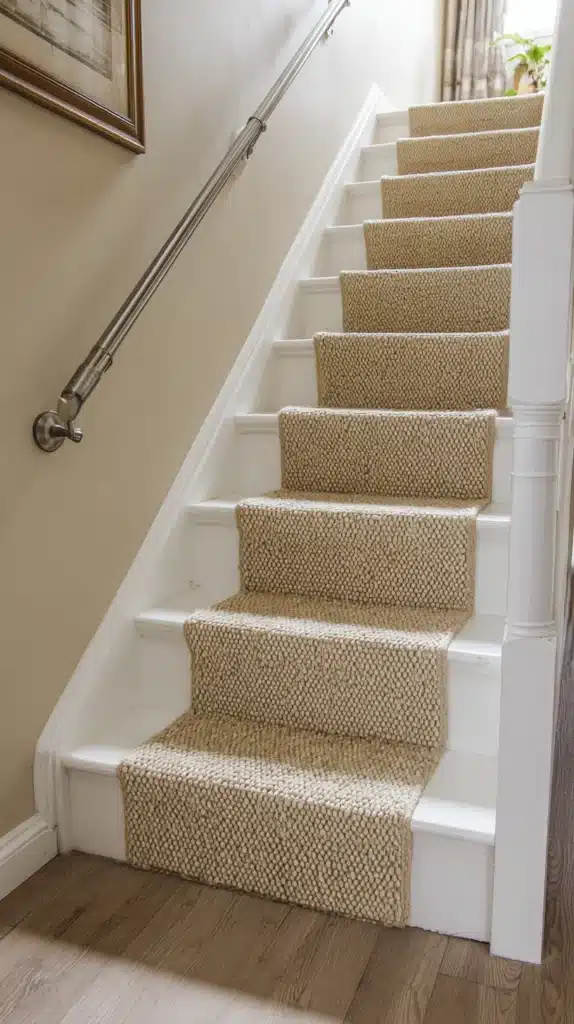
The stair rod — a thin horizontal rod spanning the width of the staircase at each tread-riser junction, securing the runner to the stair rather than relying on tacks or adhesive and adding a decorative element to the installation simultaneously — is one of those period details that has a disproportionately large impact on the overall quality and character of a stair runner installation. In polished brass, the stair rod creates a warmth and traditional elegance that suits period homes and traditional runners with complete appropriateness.
In satin nickel or chrome, it suits contemporary runners and modern interiors with a quiet refinement. In matte black, it provides a graphic, modern contrast with pale runners and suits contemporary and industrial-influenced interiors.
The rod ends — the decorative finials that cap the rod at each side of the runner — are available in a wide range of profiles from simple flat discs to ornate acorn and arrow forms, and their choice is a small but genuinely important detail that distinguishes a properly finished stair runner installation from a merely adequate one.