
15 Dark Green Kitchen Ideas for a Bold, Luxe Look
There is a color that has been quietly dominating the kitchens of design-forward homes for several years now, appearing in architects’ project portfolios, in the most respected interiors publications, and increasingly in the homes of people who have decided that the white kitchen — however clean, however practical, however thoroughly it has served the domestic interior for the past three decades — is simply not what they want to look at every morning for the next thirty years. Dark green in the kitchen is a choice that requires confidence and rewards it.
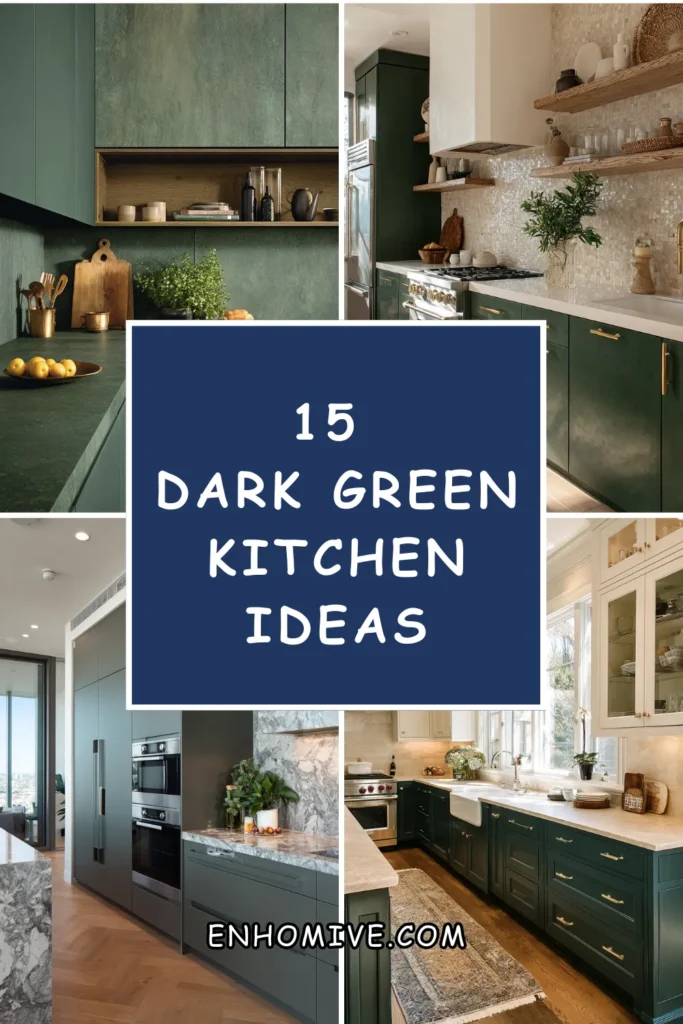
It is a color with genuine complexity — it reads differently in morning light than in evening light, differently against timber than against stone, differently with brass hardware than with matte black — and that complexity is precisely what gives a dark green kitchen its particular quality of luxurious depth. It is never flat, never stark, never the kind of color that gives you everything it has at first glance and nothing thereafter. Here are fifteen ideas for deploying it with the boldness and the intelligence it deserves.
1. Floor-to-Ceiling Dark Green Cabinetry for Maximum Impact
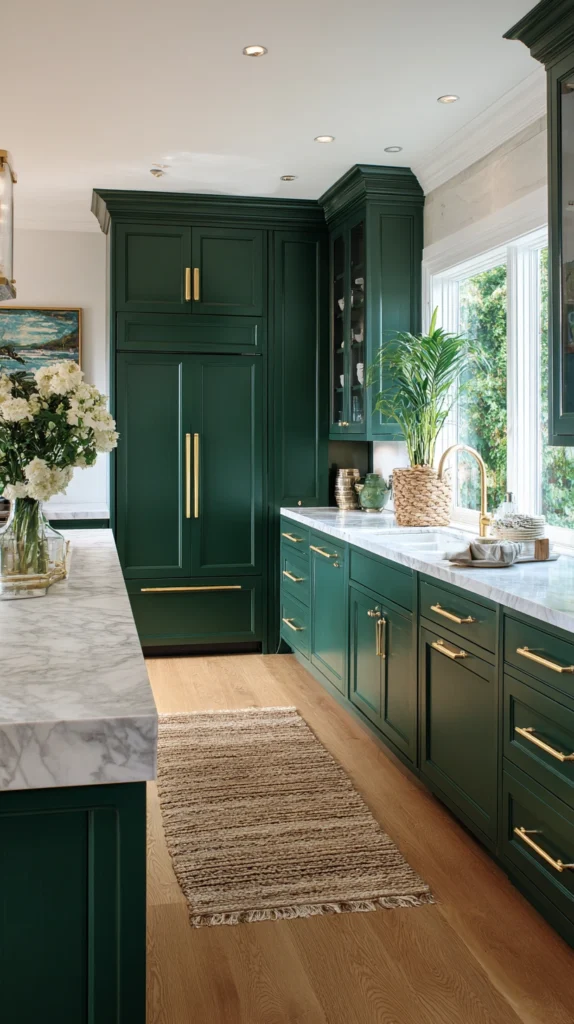
The dark green kitchen that commits fully — floor units, wall units, island, and tall larder cabinets all in the same deep green — is the dark green kitchen at its most resolved and most luxurious.
The continuity of color from floor level to ceiling height creates a kitchen with genuine enveloping quality — you are not looking at green, you are within it — and the result is a room of extraordinary atmosphere that functions as well as any conventionally colored kitchen while feeling entirely unlike any of them. The critical balance in an all-green kitchen is the countertop and hardware.
A marble or quartzite countertop in white, gray, or veined ivory against floor-to-ceiling dark green cabinetry creates one of the most classically beautiful kitchen combinations available — the contrast between the cool pale stone and the deep warm green is both dramatic and perfectly resolved.
Brass or unlacquered copper hardware completes the palette with a warmth that ties the green and the stone together through a third tone that relates to both. This is not a kitchen for the ambivalent — it demands commitment, and it delivers in proportion to the confidence with which that commitment is made.
2. Dark Green Lower Cabinets with White or Cream Uppers
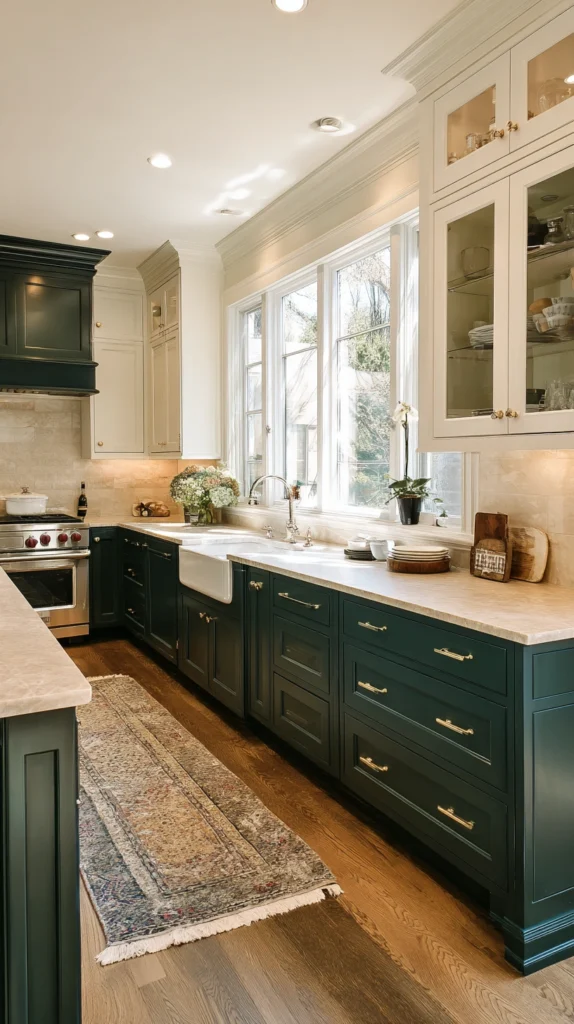
For those who want the richness and visual weight of dark green in the kitchen but prefer to maintain some visual lightness above the counter, the combination of dark green lower cabinets with white or cream upper cabinets is a reliably beautiful and practically intelligent solution. The dark green below the counter provides the visual grounding — the depth and luxe quality — while the light uppers maintain the brightness and sense of vertical space that an all-dark kitchen can sometimes compromise.
The transition between the two tones happens at the countertop, which serves as a natural horizontal divider, and the counter’s material choice becomes the compositional key that either unites or separates the two cabinet tones.
A warm stone or timber countertop bridges the transition with an organic material warmth that prevents the contrast from feeling abrupt. A white marble countertop creates a crisper, more graphic transition that suits contemporary kitchens with precise, architectural detailing.
3. Dark Green Island as a Statement Piece in a Neutral Kitchen
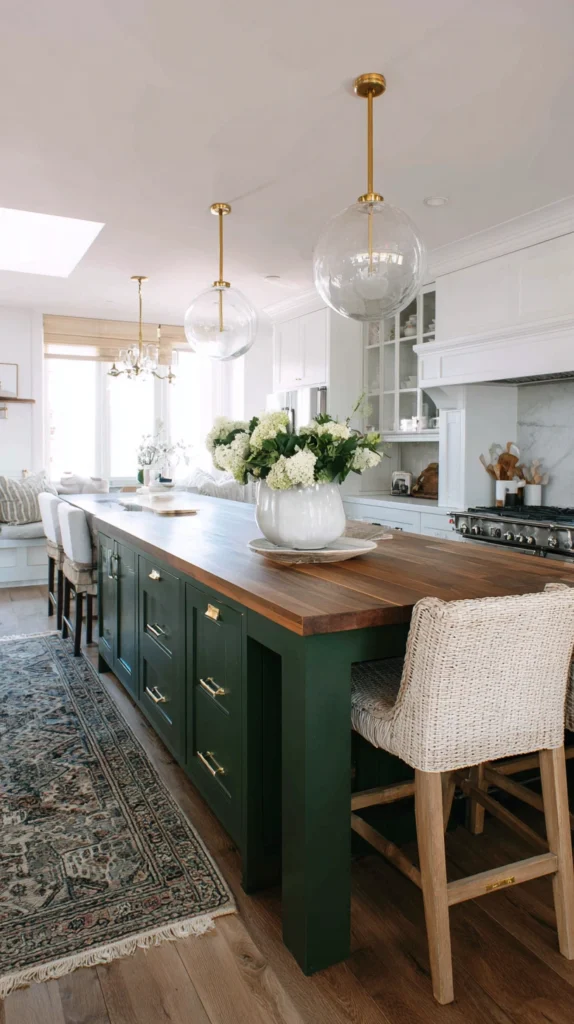
The kitchen island positioned as a standalone statement piece — dark green in a kitchen whose perimeter cabinets are painted white, off-white, or a warm neutral — creates a visual focal point of considerable drama without requiring the full commitment of an all-green kitchen.
The island’s dark green reads as a deliberate design choice, a piece of furniture-like cabinetry that was selected for its color rather than finished to match the surrounding elements, and this suggestion of independence — as though the island arrived from a different source and a different history than the fitted perimeter units — is one of the most sophisticated effects available in kitchen design.
Brass or aged bronze legs on the island, in the manner of a freestanding piece of furniture, amplify the furniture-like quality and distinguish the island further from the perimeter cabinetry. A contrasting countertop — green island with a butcher block timber top in a white marble kitchen, for example — adds a further layer of material variety that rewards detailed attention.
4. Dark Green Kitchen with Exposed Brick Backsplash
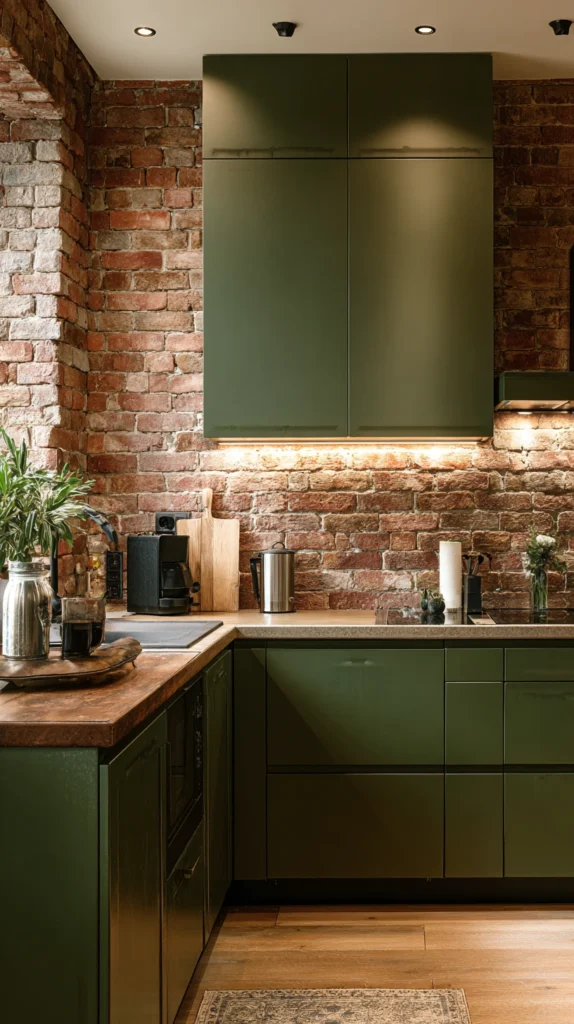
The combination of dark green cabinetry with an exposed brick backsplash — the warm, irregular surface of reclaimed or original brick providing the textural counterpoint to the smooth painted cabinet faces — is one of the most successful of all dark green kitchen material combinations, because the brick’s warm red, orange, and brown tones sit in precisely the right chromatic relationship to a dark, slightly warm-toned green.
The complementary relationship between red-orange and green is one of the most powerful in the color wheel, and in the restrained, material-honest context of a kitchen with painted cabinetry and exposed brick, this relationship produces a warmth and depth that more conventional backsplash materials cannot match.
The brick should be left unsealed where the kitchen’s humidity and grease management permits — the raw surface has a quality and texture that sealing compromises — and cleaned periodically with a dry brush rather than wet washing.
5. Forest Green Cabinets with Zellige Tile Backsplash
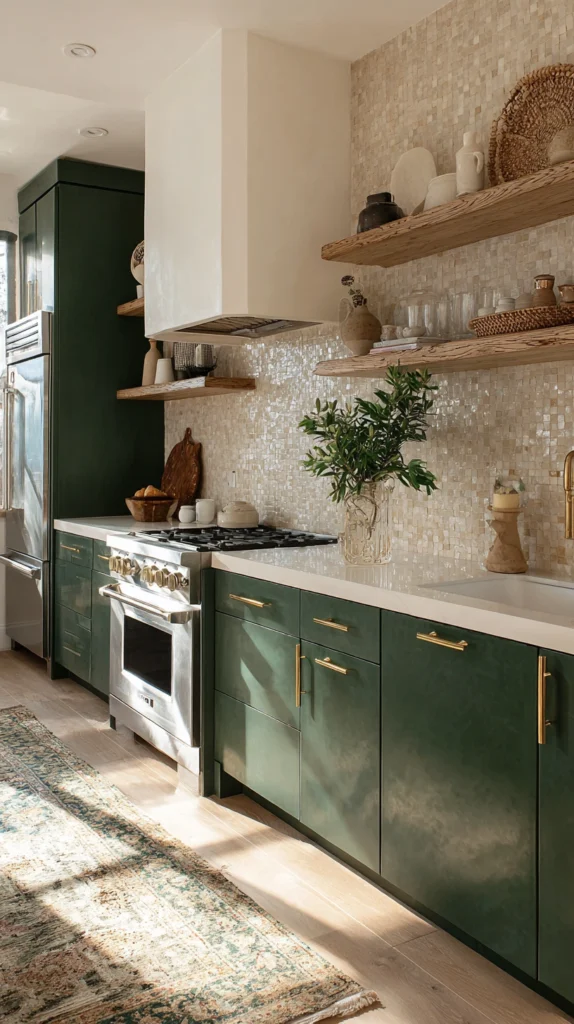
Zellige tile — the hand-cut, uneven Moroccan ceramic tile whose irregularly reflective glaze surface creates a shimmering, light-catching mosaic effect — is one of the most luxurious and most distinctive backsplash materials available, and its relationship with dark green cabinetry is one of extraordinary beauty.
The zellige’s slight surface irregularity catches light from every direction and at every angle, creating a backsplash that seems to move and shift as the kitchen’s light changes throughout the day — a quality that the smooth, reflective surfaces of conventional tiles cannot replicate.
In a warm white or cream glazing against dark green cabinets, the zellige backsplash creates a luminous surface that provides visual interest and material richness without competing with the cabinetry’s strong color. In a deeper, richer glaze — a teal, a terracotta, an aged ochre — it creates a more complex and more maximalist kitchen that rewards total commitment to the approach.
6. Dark Green with Unlacquered Brass Hardware
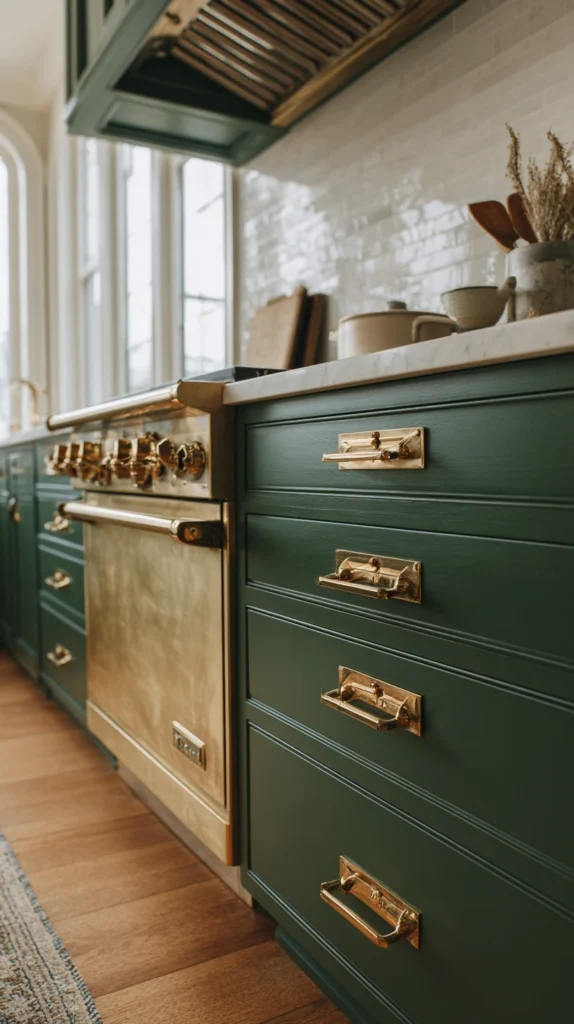
The hardware choice in a dark green kitchen is as important as any other material decision, because it is the hardware that determines the kitchen’s emotional register — whether it reads as warm and luxurious or cool and contemporary, whether it suggests tradition or modernity, whether it sits in conversation with the green or simply coexists with it. Unlacquered brass is the material that dark green cabinets were made to be paired with.
It is not the shiny, too-new quality of lacquered brass hardware that ages badly and looks dated within a few years — it is the living, warm, slightly irregular surface of unlacquered brass that develops a patina with use and handling, darkening at the points where hands have gripped it and maintaining its warm gleam in the areas that receive less contact.
Against dark green cabinets, unlacquered brass creates a combination of materials that is simultaneously timeless and deeply contemporary, formal and warm, sophisticated and entirely livable. No other hardware finish achieves the same quality of relationship with dark green.
7. Dark Green Open Shelving for Visual Breathing Room
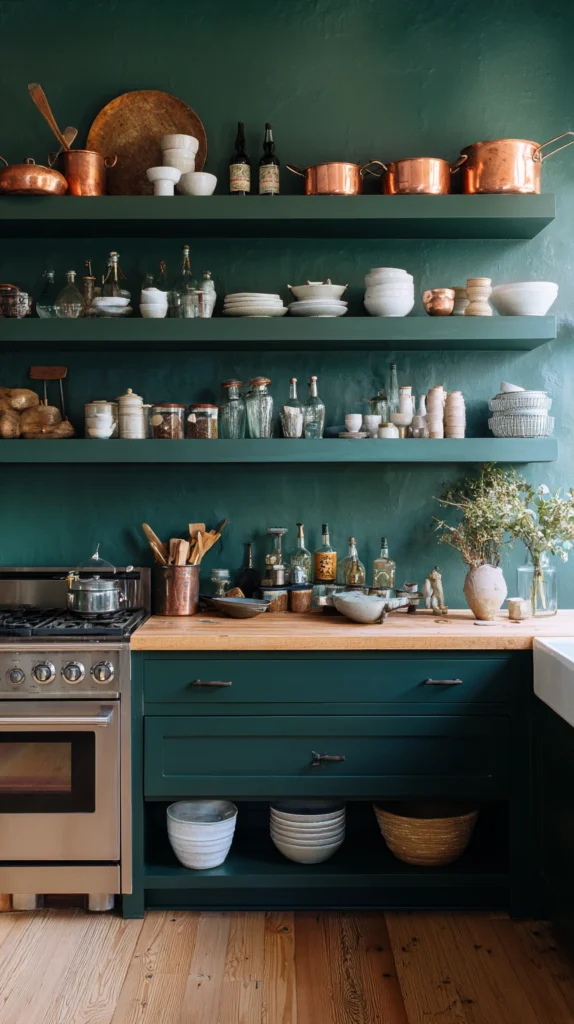
A kitchen that incorporates open shelving alongside its closed cabinetry in the same dark green finish creates a display opportunity that enclosed cabinets cannot provide while maintaining the visual continuity of the green palette throughout the space.
Open shelves in dark green — whether floating wall shelves, a section of upper cabinetry with doors removed, or a dedicated open shelving unit — display their contents against a backdrop of rich dark color that makes white ceramics, copper cookware, glass bottles, and wooden objects look more vivid and more considered than they would on a pale-painted shelf.
The contrast between the dark green shelf surface and the objects displayed on it creates a gallery-like quality — the green backdrop serves as the display environment in the way that a dark gallery wall serves as the backdrop for art — and the result is a kitchen where the everyday objects of cooking and eating are presented with a visual intentionality that makes the daily experience of the kitchen genuinely pleasurable.
8. A Dark Green Kitchen with Concrete Countertops
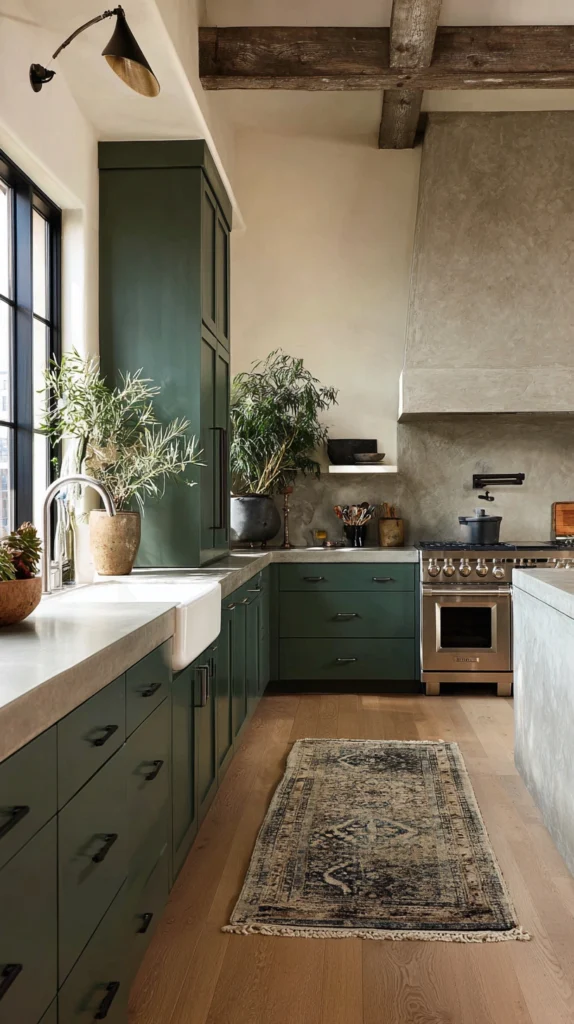
Poured concrete countertops — either cast in place or precast and installed in large slabs — have a material quality that is entirely distinct from stone, timber, or engineered alternatives, and their particular combination of industrial texture and organic warmth creates a countertop surface of genuine interest against dark green cabinetry.
The gray of concrete — which is never a flat, uniform gray but always slightly varied in tone across its surface as a result of the curing process — sits in a cool, sophisticated relationship with the warm depth of dark green that creates a kitchen palette of adult restraint and genuine sophistication.
Concrete countertops should be properly sealed and maintained to prevent staining and etching from the acidic foods and liquids that inevitably characterize kitchen use, and the sealing process requires periodic renewal, but the material’s uniqueness and beauty justify the maintenance commitment for the homeowner who values material authenticity over convenience.
9. Dark Green with White Marble Countertops and Backsplash
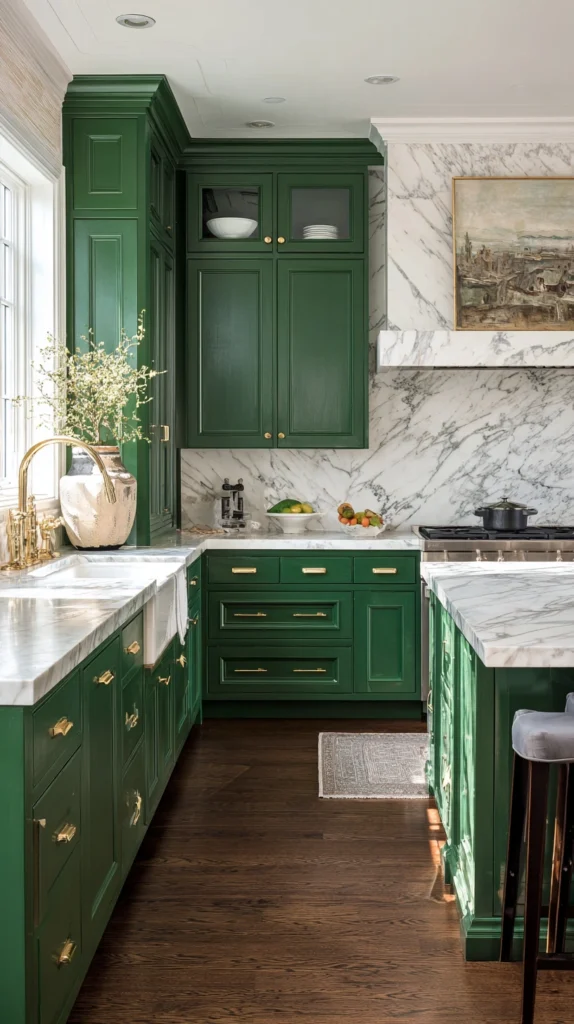
The pairing of dark green cabinetry with white marble — in the countertop, in a full-height backsplash, or in both — is the dark green kitchen combination with the longest design heritage and the most enduring visual power.
Marble’s soft white ground veined with gray, green, or gold provides a surface of such inherent beauty that it requires no decorative support from the surrounding cabinetry, and against dark green its brightness is amplified into something very close to luminosity.
The full-height marble backsplash in a dark green kitchen — the marble running from countertop to ceiling in large uninterrupted slabs whose veining creates a continuous pattern across the entire back wall — is the kitchen treatment that is currently most favored by the most respected residential designers, and its appeal lies in the way it creates a focal wall of extraordinary material quality within the darker, more enveloping environment of the green cabinetry surrounding it.
10. Matte Dark Green for a Contemporary, Non-Reflective Finish
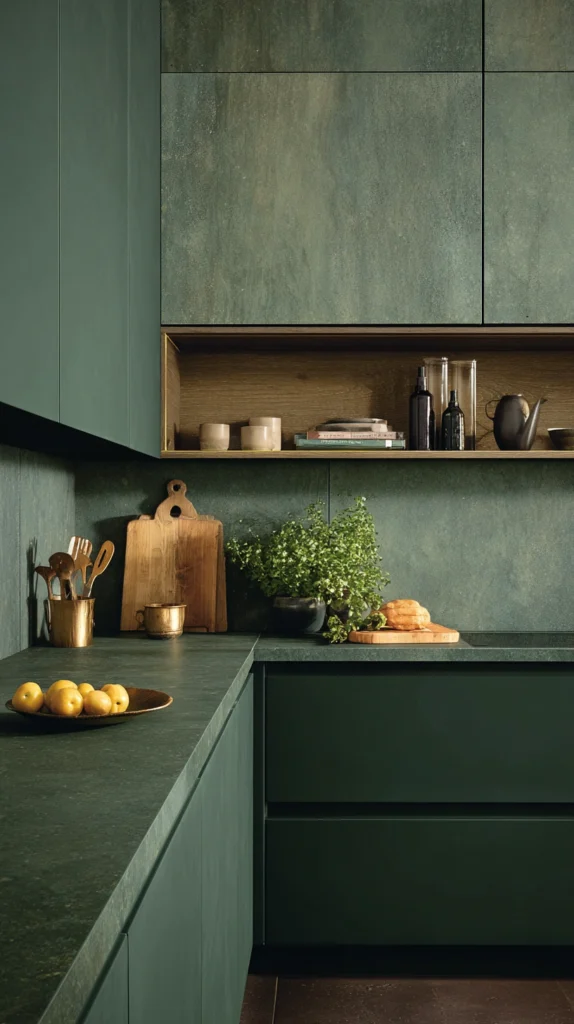
The finish of the dark green paint or lacquer is a design decision that significantly affects the character of the kitchen’s overall aesthetic, and matte or ultra-matte finishes are increasingly favored over satin and gloss by designers who want the dark green to have a depth and softness rather than the slightly hard, reflective quality that higher-sheen finishes introduce.
A matte dark green cabinet face absorbs light rather than reflecting it, which gives the color a velvet-like quality of depth that no gloss finish can replicate — the green appears richer, softer, and more complex in matte than in any higher-sheen alternative.
The practical consideration is that ultra-matte finishes are more susceptible to marking and more difficult to clean than satin or gloss surfaces, which is a meaningful factor in a kitchen environment where surfaces are exposed to cooking residue, moisture, and regular wiping. Choosing a high-quality kitchen paint or lacquer in a matte finish with adequate durability — rather than a standard interior matte paint that will not withstand kitchen conditions — is the practical requirement that allows this aesthetic choice to remain beautiful in daily use.
11. Dark Green in a Small Kitchen for Dramatic Intimacy
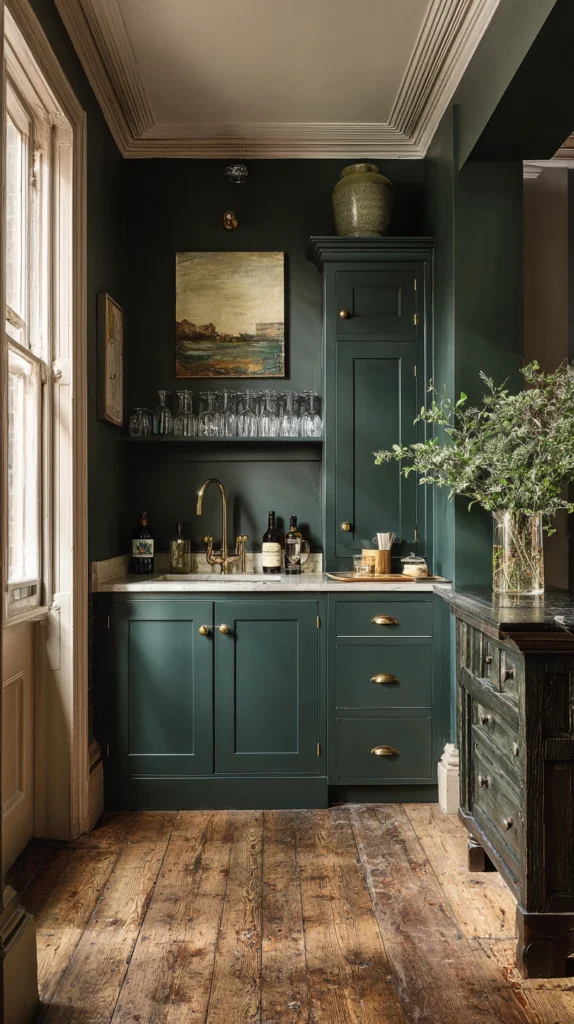
The conventional wisdom of small space design — keep it light, keep it pale, maximize the sense of space through bright colors and reflective surfaces — is worth questioning in the context of a kitchen where the room is small and the use is primarily functional.
A small kitchen painted dark green on every surface — walls, ceiling, and cabinetry in a continuous application of the same dark tone — creates a space that abandons the aspiration to appear larger than it is and embraces instead the quality of intimate drama that small dark rooms at their best can achieve.
This approach requires excellent lighting — generous task lighting under cabinets, proper ceiling illumination, and natural light from a window that is dressed lightly if at all — and the confidence to accept that the small kitchen will feel small and to make that smallness as beautiful and as atmospheric as possible rather than pretending it does not exist. The result, when executed with genuine commitment and quality materials, is a kitchen of extraordinary character.
12. Dark Green with Warm Timber Flooring
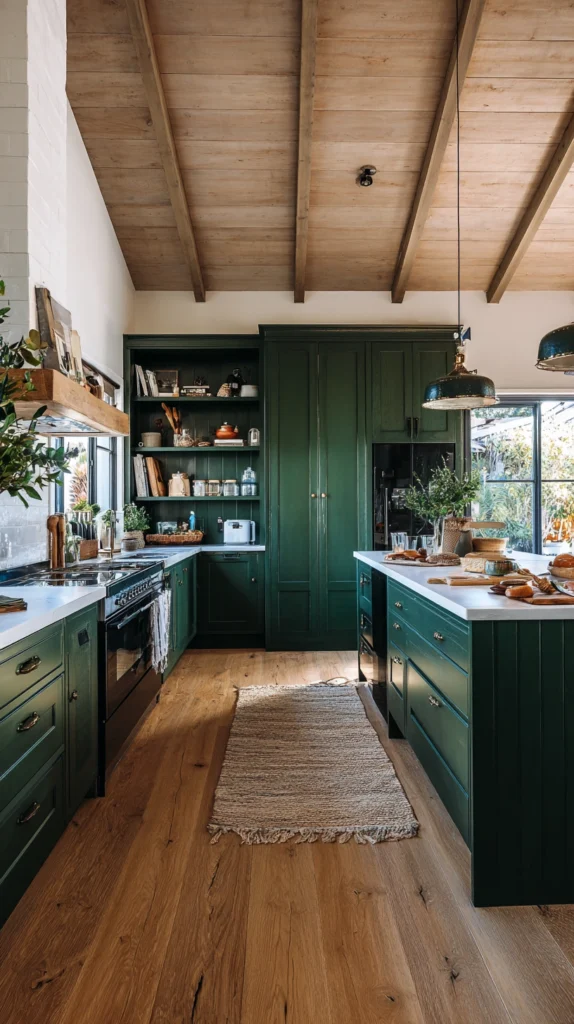
Timber flooring in a dark green kitchen creates the material grounding that the strong overhead color requires — a warm, natural surface beneath the cabinetry that prevents the kitchen from feeling too heavy or too interior-dark while maintaining the organic warmth that the green’s natural reference suggests.
Wide-plank oak in a warm, mid-tone natural finish is the most versatile and most consistently beautiful timber flooring choice in a dark green kitchen, its golden and honey tones relating warmly to the green above while providing sufficient contrast to distinguish the floor plane clearly from the cabinetry.
Oiled or wax-finished timber rather than lacquered — the maintenance requirement is higher but the material quality is incomparably superior — creates a floor surface whose warmth and grain remain visible and expressive rather than sealed beneath a plastic film.
The combination of dark green cabinetry and warm oiled timber flooring creates a kitchen with the material depth and warmth of a forest — an effect that is both entirely intentional and entirely successful.
13. A Dark Green Kitchen with Pendant Lighting in Warm Metal
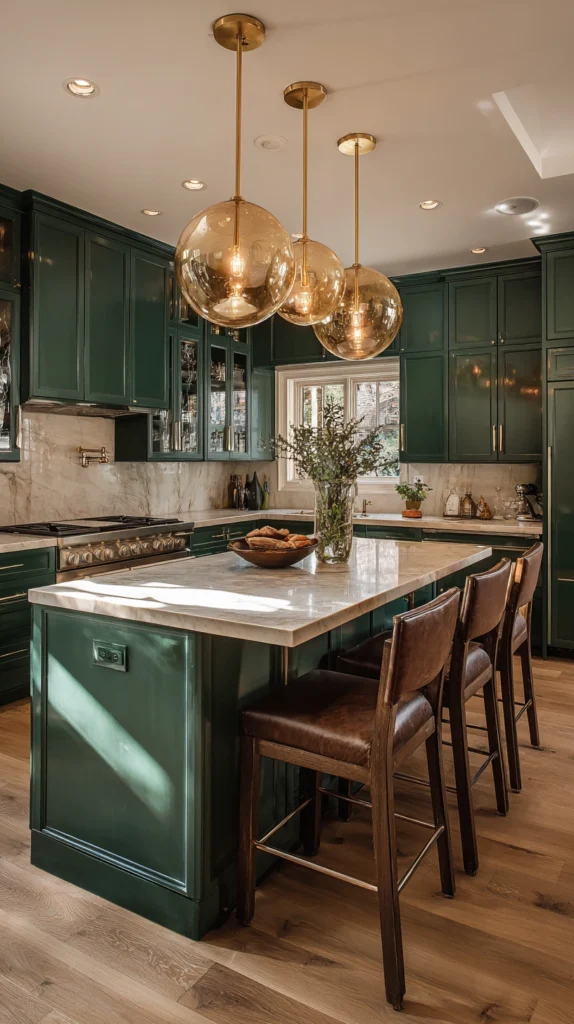
Pendant lights over a kitchen island or dining area within an open-plan kitchen are the lighting element most visible from a distance, and in a dark green kitchen they carry significant atmospheric responsibility.
The pendant style and material should relate to the kitchen’s hardware and the overall aesthetic register — in a kitchen with brass hardware and a luxurious material palette, a cluster of hand-blown glass pendants in amber or smoke, or a series of brass-bodied dome pendants, creates the right quality of warm, slightly precious light that the material richness below it requires.
The light’s color temperature matters enormously in a dark kitchen: warm white light — in the 2700K to 3000K range — maintains the kitchen’s dark, enveloping quality and allows the green to show in its warmest, richest expression; cool white or daylight-temperature light strips the warmth from dark green and replaces it with something harder and less appealing.
14. Dark Green with Integrated Appliances for a Seamless Composition
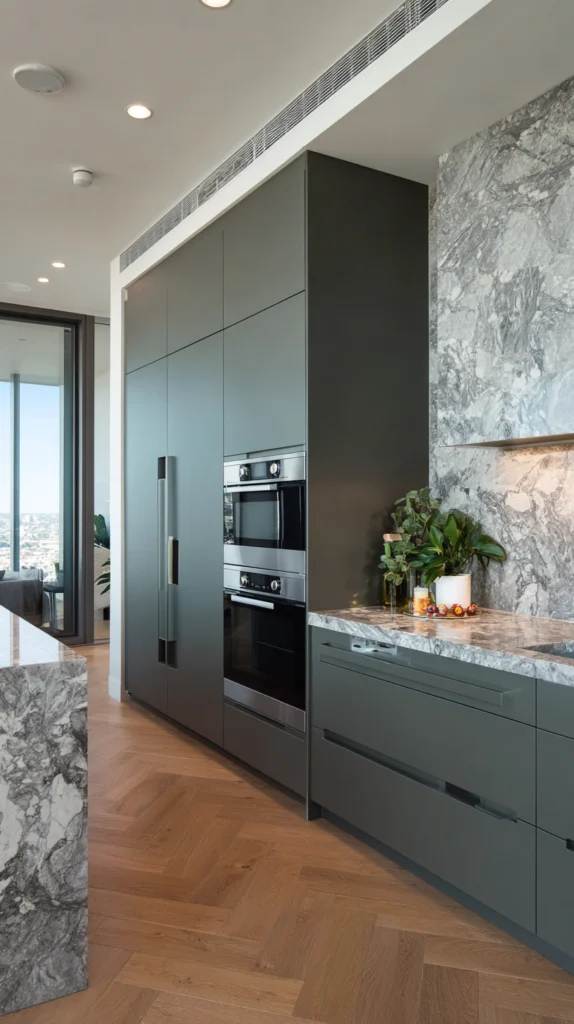
The dark green kitchen that integrates its appliances — refrigerator, dishwasher, and oven behind matching cabinet doors rather than exposed in stainless steel or appliance-finish panels — achieves a visual seamlessness that allows the green to read as a continuous architectural surface rather than a painted cabinet around exposed appliance elements.
Integrated appliances are more expensive than freestanding alternatives and more demanding in their installation, but in a dark green kitchen where the color and the composition of the cabinetry is the primary design statement, the visual interruption of stainless steel or contrasting appliance finishes compromises the coherence of that statement significantly.
The exception is the deliberate use of a statement appliance — a British Racing Green AGA, a dark green Smeg range cooker, or a bespoke range in a complementary tone — as a designed feature within the kitchen rather than a concealed appliance, which creates a focal point of considerable beauty within the green composition rather than a visual disruption to it.
15. Dark Green as a Starting Point for a Lifelong Kitchen
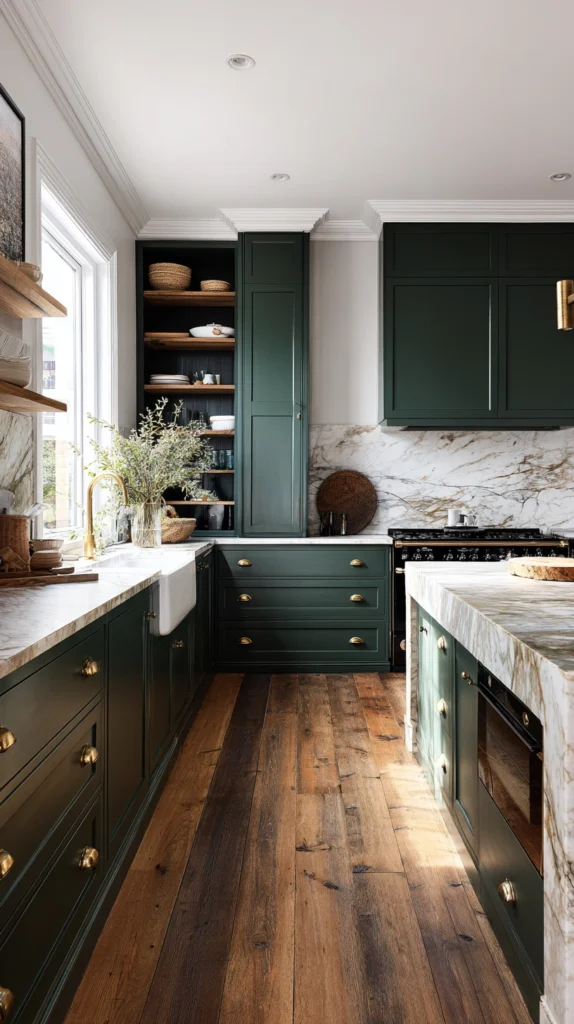
The final and most important thing to understand about the dark green kitchen is not a specific design idea but a quality of relationship between the homeowner and the space — the recognition that a kitchen decorated with genuine conviction in a color of real depth and complexity is a kitchen that grows more beautiful with time rather than less.
The dark green kitchen at five years old is better than at one — the brass hardware has developed its patina, the timber floor has deepened, the marble has acquired the slight warmth of a surface that has been used and cared for. At ten years it is still better.
The green that seemed bold at the moment of its creation has become simply the kitchen’s color — familiar, reliable, warm in the morning light and dramatic in the evening, always the same and somehow always slightly different depending on the season, the light, and the specific quality of the day outside the window. This is what timeless kitchen design looks like in practice: not a kitchen that escapes the passage of time, but one that becomes more fully itself as time passes.