
15 Fluted Wood Accent Ideas
There is a detail in contemporary interior design that has moved quietly from architectural reference to mainstream design vocabulary over the past several years, appearing in the most respected interiors studios’ project portfolios before migrating outward to the homes of anyone paying attention to where design was heading.
Fluted wood — timber whose surface is carved, routed, or manufactured with a series of parallel vertical or horizontal channels, creating a surface of regular, shadow-casting ridges — has deep roots in classical architectural decoration, where it appeared on the shafts of Greek and Roman columns as a purely aesthetic refinement of a structural element.
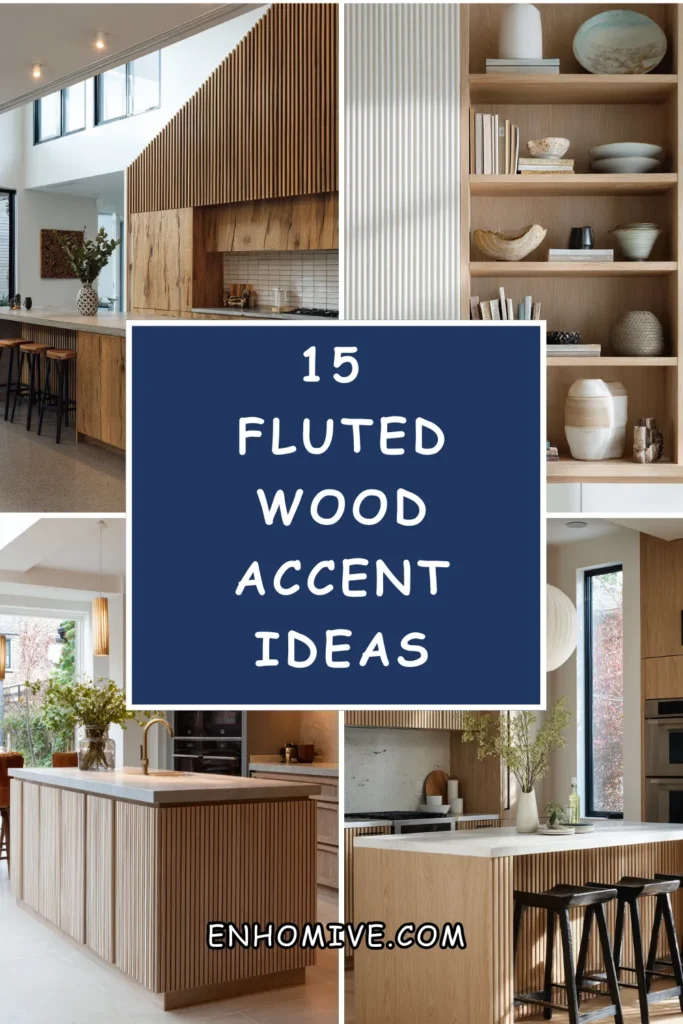
Its contemporary application strips away the classical context and retains the essential quality: a surface that is more interesting than a flat panel, that catches light differently at every angle of the day, and that introduces a tactile dimension to interior surfaces that smooth timber, paint, and laminate simply cannot provide.
Fluted wood works in virtually every interior style — from the most formally classical to the most rigorously contemporary — because it is ultimately a study in light, shadow, and surface texture rather than a period reference, and these qualities are as relevant in a modern apartment as in a Georgian townhouse. Here are fifteen ideas for using it with intelligence and style.
1. A Fluted Wood Feature Wall in the Living Room
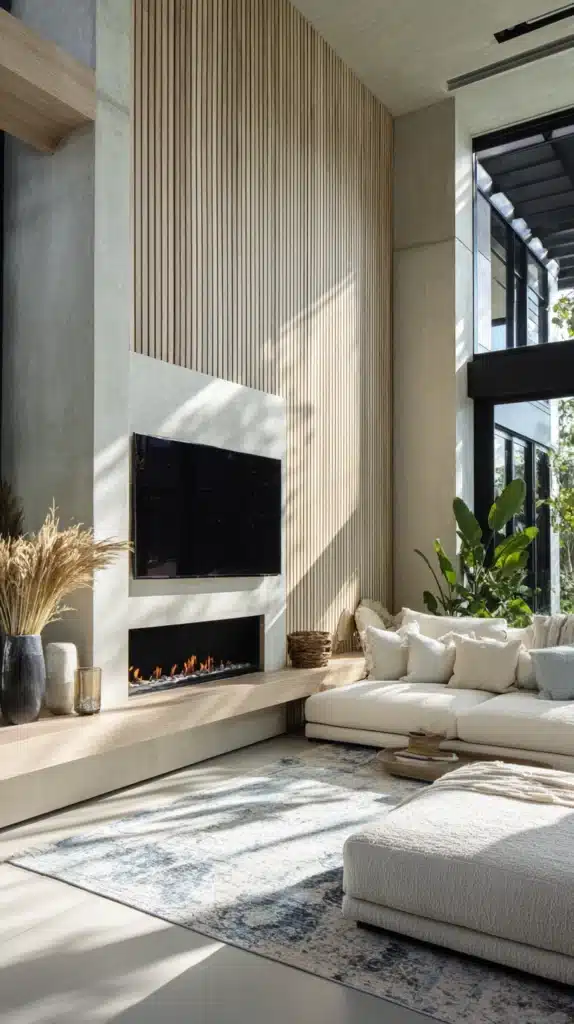
The living room feature wall is perhaps the most visible and most impactful application for fluted wood in the domestic interior, and the transformation that a full wall of vertically fluted panels achieves in a living room is one of the most significant available through a single material intervention.
A floor-to-ceiling fluted panel wall — either constructed from individual solid timber boards with routed channels, from MDF panels with a machined fluted profile, or from proprietary fluted panel systems available from quality suppliers — creates a living room focal wall of extraordinary textural depth.
The vertical channels catch the room’s light and cast fine, consistent shadows that change as the light source moves throughout the day, creating a wall that looks different at nine in the morning than it does at four in the afternoon and different again in the warm lamplight of an evening gathering.
Position the television or a fireplace against the fluted wall to give the focal element the architectural setting it deserves, and choose a timber species or painted finish that relates to the room’s overall palette — natural oak for a warm, contemporary result; painted white or off-white for a more classical, layered effect; deep painted green or blue for a dramatic, jewel-box quality.
2. Fluted Wood Kitchen Cabinet Fronts
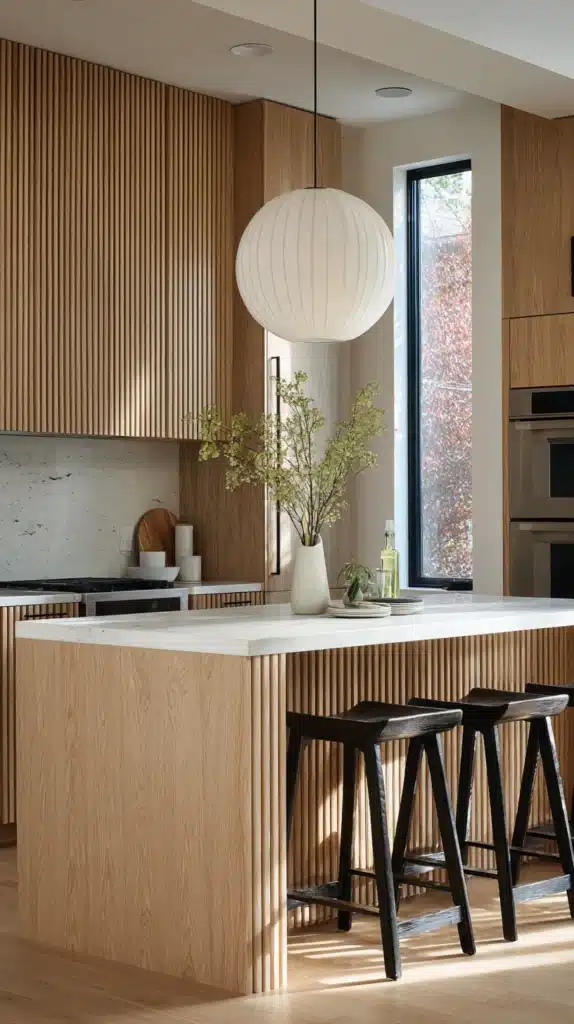
The kitchen is the interior space where material detail is most closely observed on a daily basis — its surfaces are examined at close range, touched repeatedly, and experienced in the changing light of morning, afternoon, and evening in a way that no other room in the house matches for sheer material intimacy. Fluted wood cabinet fronts — either in solid timber with routed channels or in a veneered MDF panel with a factory-machined flute profile — bring this material intimacy a quality of surface interest that flat-fronted cabinets, however beautifully proportioned or carefully painted, cannot provide.
The fluting runs vertically on cabinet doors, which aligns the rhythm of the channels with the vertical geometry of the kitchen’s overall composition and creates a visual height in the cabinets that flat doors do not possess.
The channels collect light along their ridges and shadow in their recesses, creating a surface that reads as three-dimensional and genuinely crafted — a quality that suits both the natural timber kitchen where warmth and material honesty are the design priorities and the painted kitchen where the fluting adds textural interest to a color-focused scheme.
3. A Fluted Wood Bed Headboard
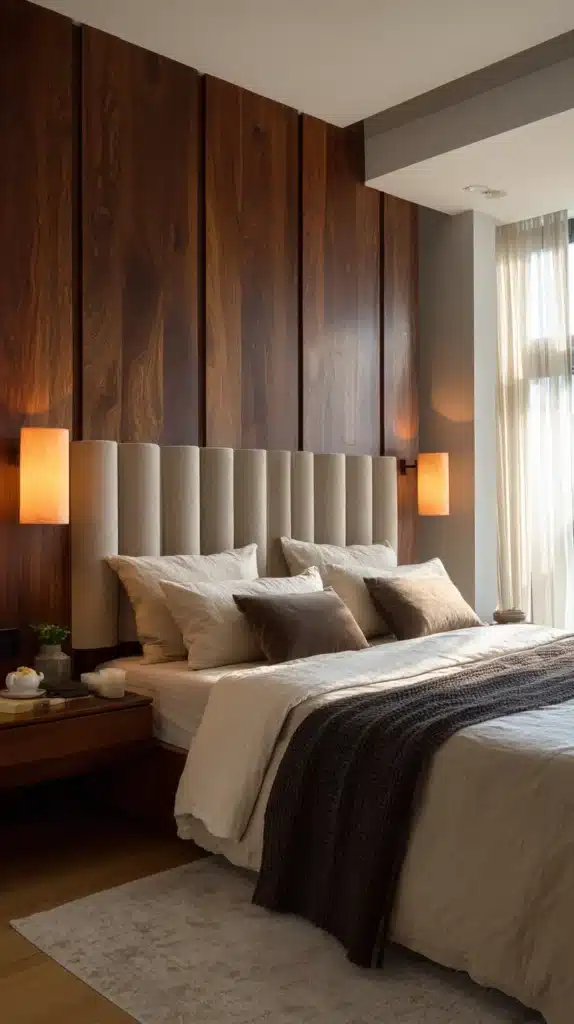
The bed headboard is the bedroom’s most visible decorative surface — positioned at the room’s focal wall, seen from the bed itself and from the doorway, framing the sleeping space with a material presence that sets the room’s aesthetic tone.
A fluted wood headboard — either upholstered in a performance fabric over a fluted timber substructure so that the fluting creates a gentle surface relief in the fabric, or constructed from natural timber with clearly expressed channels in the wood’s surface — creates a bedroom focal feature of considerable sophistication and warmth.
The timber headboard’s warmth and natural quality suits the bedroom context particularly well, because the bedroom is the room where material warmth matters most — the room that is occupied at its most intimate hours, where cold or industrial materials feel less appropriate than in the more public rooms of the home.
A natural oak or walnut fluted headboard in a warm oil finish creates a bedroom of genuine material richness, and its tactile quality — the ridges and channels perceptible to the touch as well as the eye — rewards the close proximity in which the bedroom’s occupant experiences it.
4. Fluted Wood as a Bathroom Vanity Front
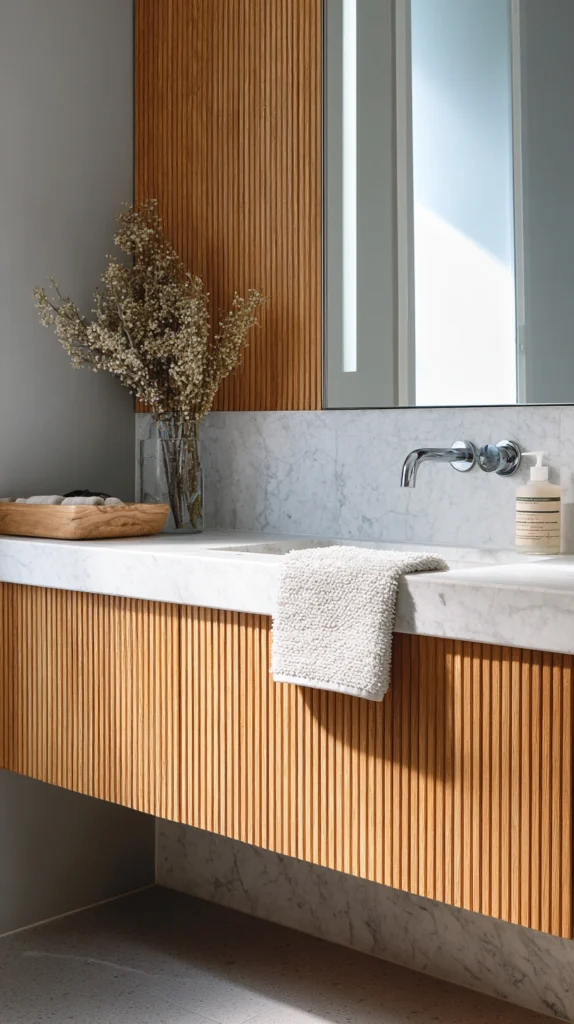
The bathroom is a space where material detail is experienced with particular intensity — the combination of water, steam, light, and the specific intimacy of personal care routines creates an environment where the quality of every surface is noticed and felt.
A fluted wood front on a bathroom vanity — the cabinet beneath the basin, finished in a timber species with adequate moisture resistance or protected with a quality exterior-grade finish — brings the same textural richness to the bathroom that it delivers in the kitchen and living room, with the additional sensory dimension of the way the fluted surface catches the specific quality of bathroom lighting.
Side-lit vanity mirrors — the correct lighting choice for makeup and grooming — create a raking light across the fluted vanity front that emphasizes every channel and ridge, creating a surface of extraordinary beauty directly below the mirror that is at its most spectacular at exactly the moments of the day when the bathroom is most attentively occupied.
5. A Fluted Wood Room Divider
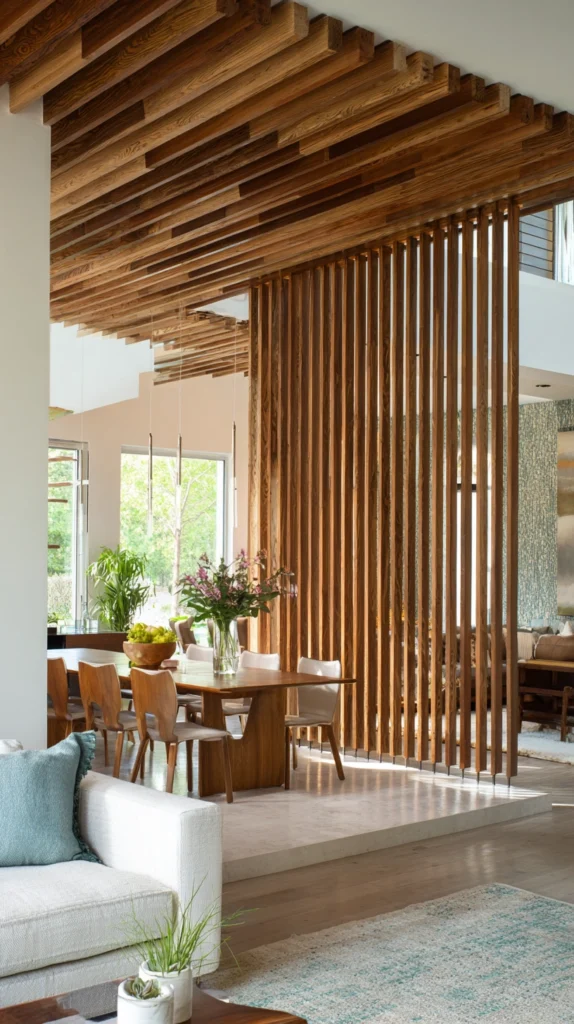
A freestanding or suspended fluted wood panel used as a room divider — separating a dining zone from a living zone in an open-plan space, dividing a bedroom from a dressing area, or creating a visual boundary between a home office and a surrounding room — combines the spatial definition function of a partition with the material beauty of fluted timber in a way that plasterboard, glass, and standard timber partitions cannot approach.
The fluted room divider is particularly effective when the panels are not solid to the floor — when they are suspended from a ceiling track with a gap beneath them, or raised on a slim base with open space above and below — because this partial enclosure creates a visual boundary without complete separation, and the light that passes through and around the fluted panels creates a play of shadow and illumination on the surrounding surfaces.
A double-sided fluted divider — its channels running vertically on both faces — creates a feature of equal beauty from both sides of the boundary it defines.
6. Fluted Wood on a Fireplace Surround
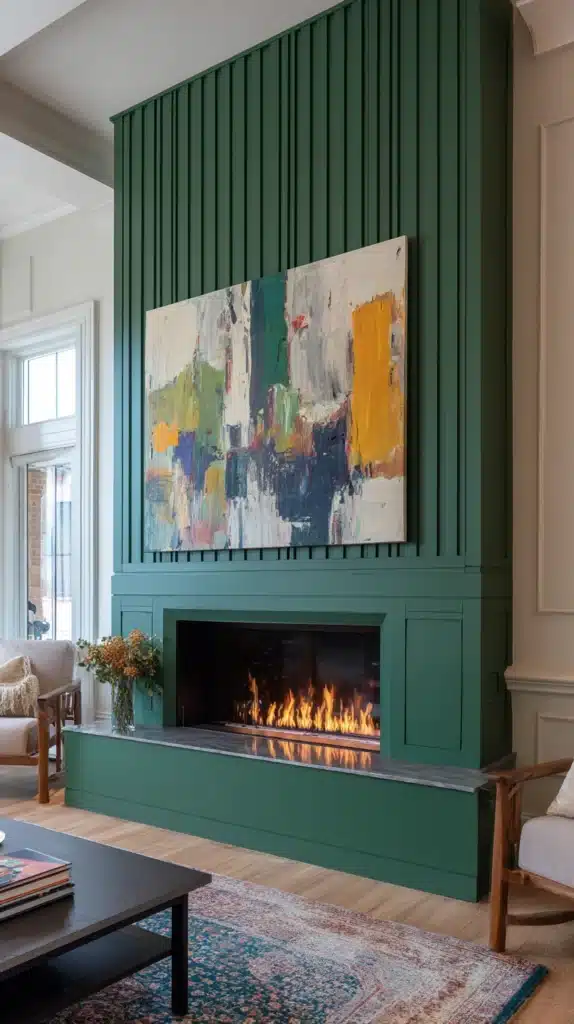
The fireplace surround is one of the classic home’s most architecturally significant surfaces, and the application of fluted wood to its flat panels — either the pilasters on either side of the opening, the flat frieze panel above the opening, or the full surround including the overmantel — brings a material richness and textural depth to the mantelpiece that painted flat surfaces cannot achieve.
The classical pedigree of fluted architectural detail makes its application to a fireplace surround historically resonant and architecturally appropriate in a way that more contemporary material applications are not, and in a room with strong period architectural character — Georgian, Victorian, or Arts and Crafts — a fluted timber surround creates a fireplace of genuine classical refinement.
In a contemporary interior, the same fluted surround stripped of classical molding detail and painted in a strong color — forest green, deep navy, or a warm charcoal — creates a fireplace feature that references the classical tradition through surface texture while being entirely contemporary in its visual language.
7. Fluted Wood Shelving for Display and Storage
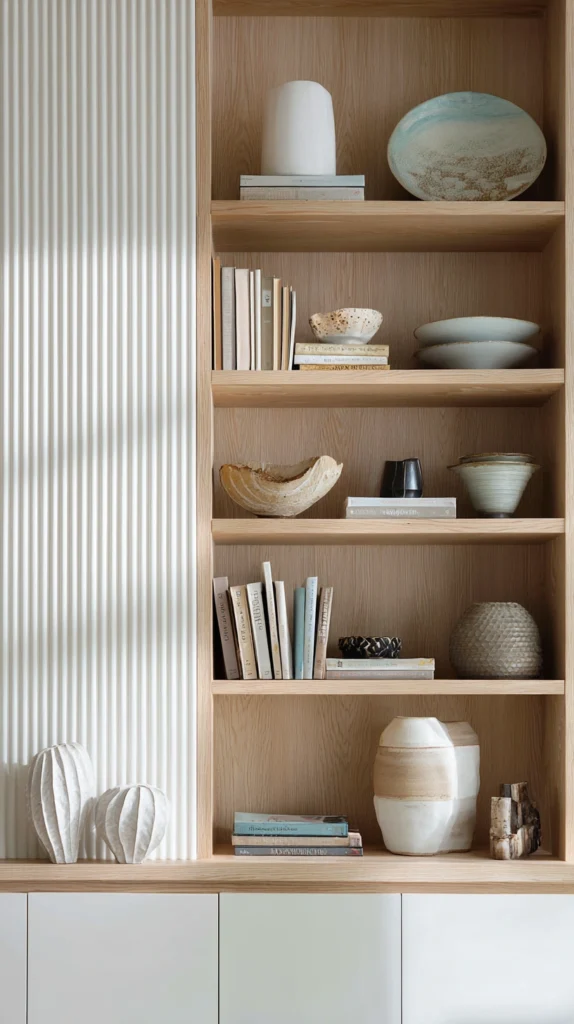
Shelving constructed with fluted panel backs or fluted panel sides — so that the surface visible when the shelving is dressed with books and objects includes the textured relief of fluted timber — creates a display and storage system of considerably more visual richness than the conventional smooth-backed shelf.
The fluted back panel of a bookcase or display shelf provides a patterned backdrop against which objects are displayed, creating an effect similar to the designer’s practice of painting the back of a bookcase in a contrasting color — the fluting adds visual interest and depth behind the objects on the shelf without requiring any color departure from the shelving’s overall finish.
A white-painted fluted back panel behind a collection of books and ceramics creates a subtle surface texture that is registered peripherally and contributes to the overall visual richness of the shelving composition without competing with the objects displayed on it.
8. Fluted Wood on a Dining Room Buffet or Sideboard
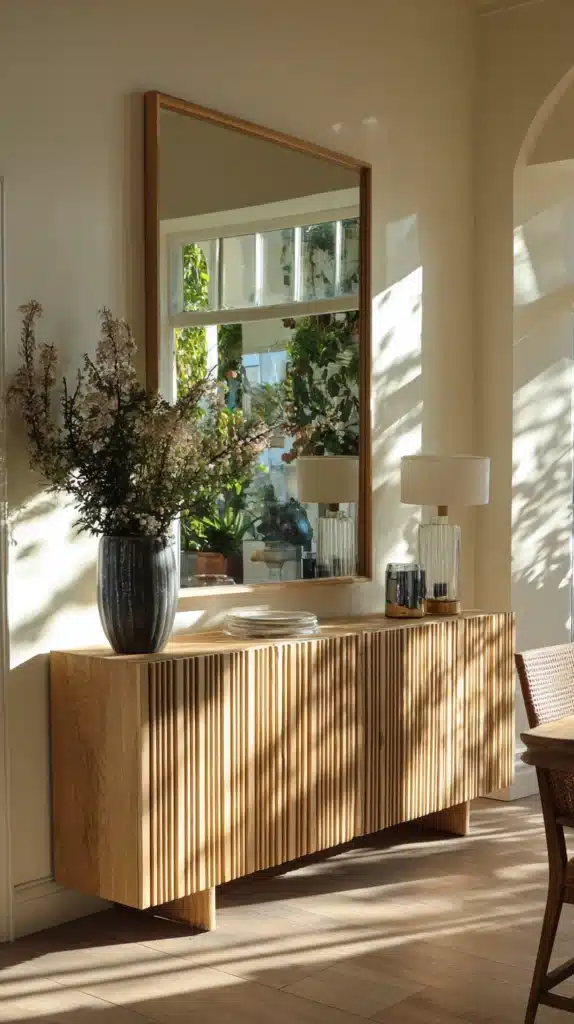
The dining room sideboard or buffet is a piece of furniture that combines considerable scale with a primary function of storage and display, and its large, flat cabinet faces represent one of the best opportunities in the home for fluted wood to make its textural contribution. A sideboard with fluted front panels — in natural timber with oiled channels that catch the light at every angle, or in a painted finish where the fluting creates shadow and relief in a single-color surface — creates a dining room piece of genuine distinction and material quality.
The sideboard’s scale means that the fluting covers a significant surface area, and this coverage creates an effect of architectural ambition that smaller fluted elements cannot achieve. Position the sideboard on the dining room’s principal wall beneath a significant piece of art or a substantial mirror, and the combination of fluted timber and reflective surface creates a dining room composition of considerable elegance.
9. A Fluted Wood Ceiling Treatment
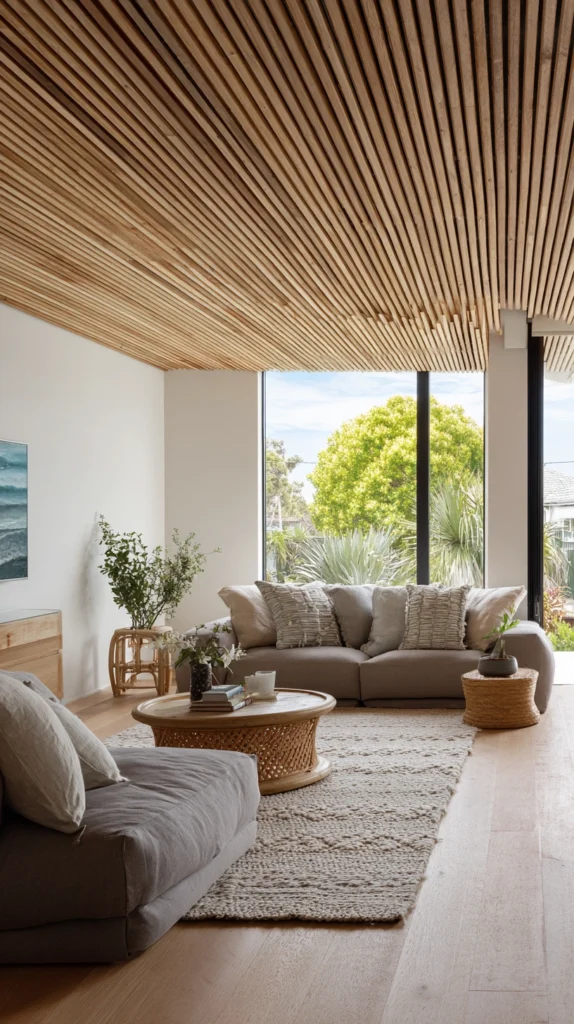
Taking fluted wood from its conventional wall and furniture applications to the ceiling — installing fluted panels horizontally across the ceiling surface, their channels running in a consistent direction that relates to the room’s geometry — creates a ceiling of extraordinary textural interest that transforms the room’s most consistently neglected surface into one of its most beautiful.
The ceiling’s fluted surface catches light differently from every position in the room, creating a dynamic overhead plane whose visual quality shifts as the light source moves and as the viewer’s position changes.
This treatment works particularly well in rooms with a single significant directional light source — a large window on one wall, a skylight, or a strong pendant fixture — because the raking quality of directional light across the fluted surface creates the maximum shadow and relief that makes the textural detail most clearly visible and most dramatically beautiful.
10. Fluted Wood in a Home Office or Library Setting
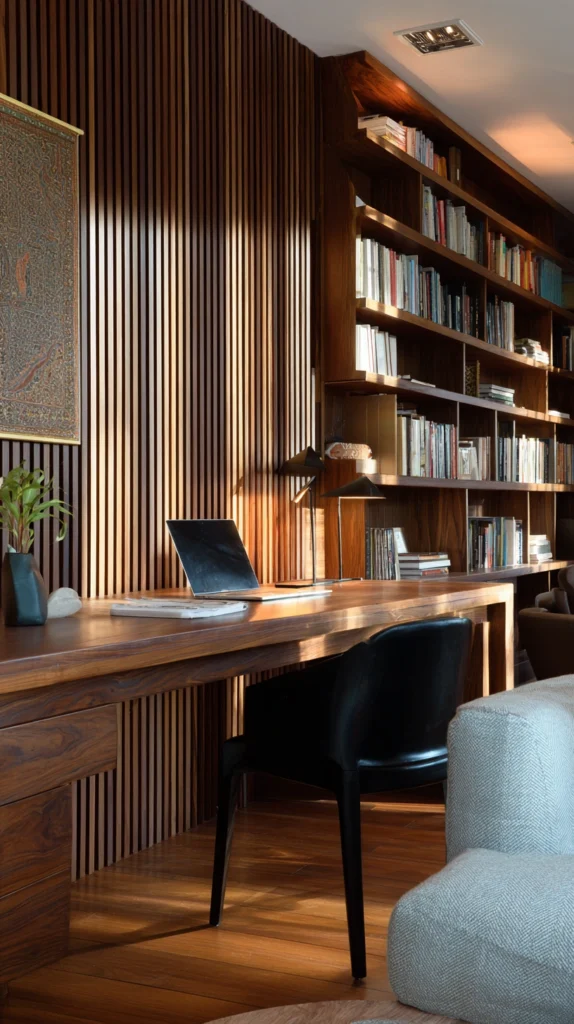
The home office or library lined with fluted wood — on the desk front, on built-in shelving surrounds, on the wall behind the primary seating position — creates a working environment of serious material quality and considerable scholarly atmosphere that smooth, painted surfaces cannot approach.
The specific quality of a library or study lined with textured timber — a quality that connects to centuries of the finest scholarly and professional interiors — is not a period reference or a nostalgic effect but a genuine response to the way that rich, warm, material surfaces create the conditions for sustained intellectual work: the reduction of acoustic brightness through surface absorption, the visual warmth that maintains energy and focus over long working periods, and the quality of gravitas and permanence that communicates to the room’s occupant that what happens here matters.
Fluted timber in a deep stain or a warm natural finish achieves this quality more completely than any other material available at comparable cost.
11. A Fluted Wood Kitchen Island
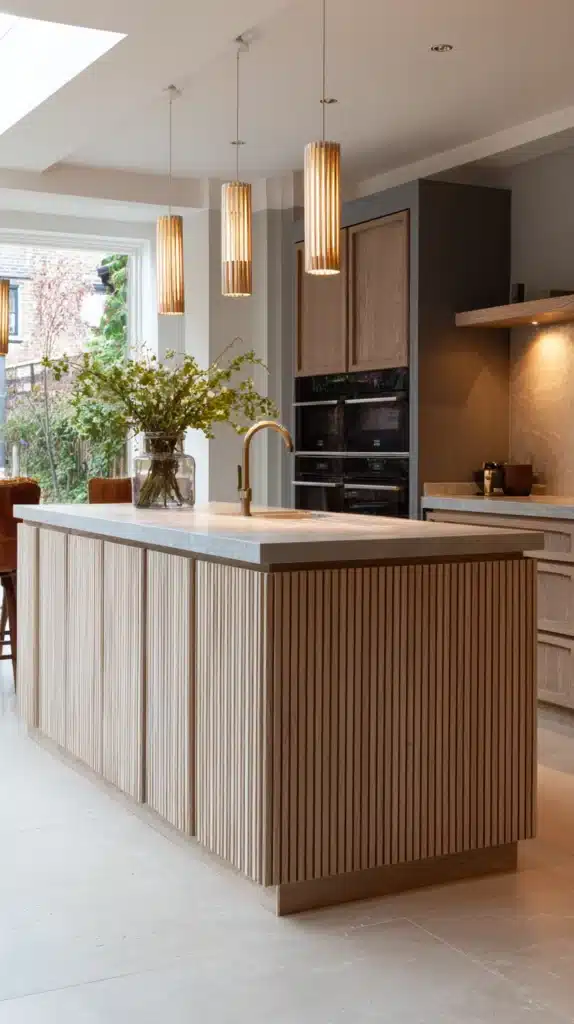
The kitchen island is the kitchen’s most prominently visible piece of furniture — visible from the adjacent living space in open-plan kitchens, approached and used many times each day, and experienced at close range from multiple angles throughout the cooking and dining routine.
A kitchen island with fluted wood panel fronts — its sides and end panels finished in vertical channels that catch the kitchen’s light and cast fine consistent shadows — creates a kitchen feature of considerable material distinction that reads as furniture rather than cabinetry, with the quality of a bespoke piece rather than a fitted unit.
The fluted island front in natural timber or painted in a contrasting tone to the surrounding cabinetry creates the two-tone island effect that contemporary kitchen designers favor as a way of distinguishing the island as a separate architectural element within the kitchen’s overall composition.
12. Fluted Wood on Stair Risers
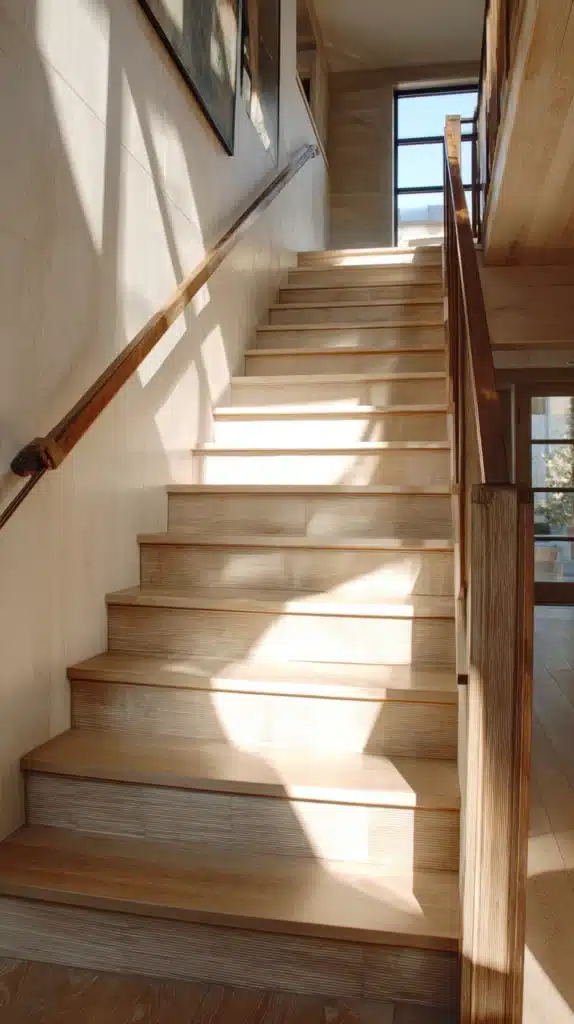
The staircase riser — the vertical face of each stair step, typically painted white or finished to match the surrounding wall — is a surface that receives far less decorating attention than the stair treads above it and the balustrade beside it, and yet it represents, multiplied across the full height of the staircase, a significant surface area that is visible from the ground floor and experienced at close range on every ascent and descent.
Fluted wood risers — individual panels of fluted timber cut to the width and height of each riser and fixed to the stair’s front face — create a staircase of extraordinary textural character that is immediately visible from the hallway below and rewards the close proximity in which it is experienced during daily use.
The fluting runs horizontally across the riser face, creating a pattern of fine horizontal lines that suits the staircase’s own horizontal geometry and creates a visual rhythm as the eye travels up the stair from bottom to top.
13. Fluted Wood as a Bedside Table or Nightstand
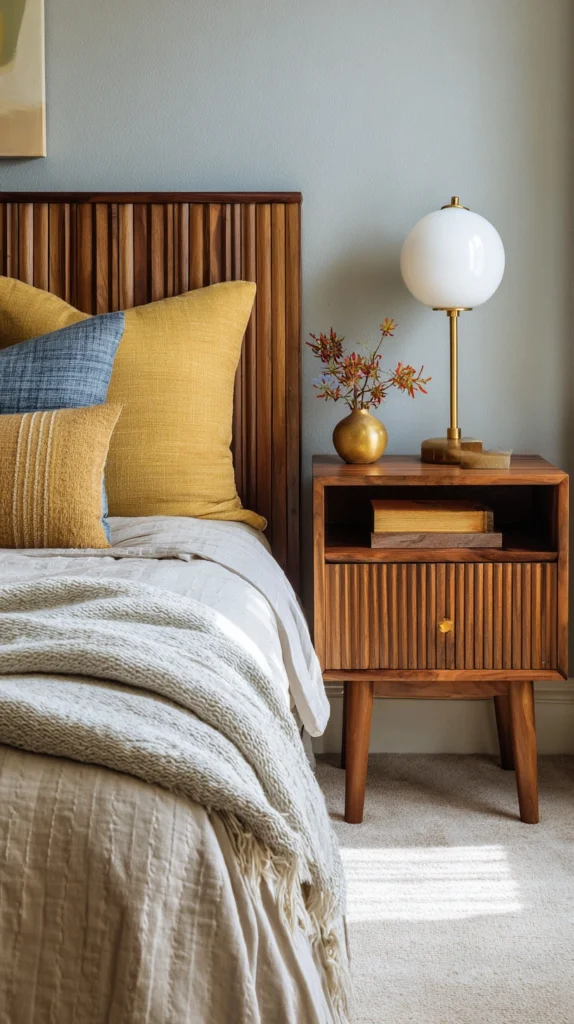
The bedside table occupies a position of intimate daily proximity — it is the surface closest to the sleeping position, touched each day at the most private moments of waking and retiring — and a fluted wood nightstand, whether a simple drum form with a routed exterior surface or a small cabinet with fluted drawer fronts, brings the tactile dimension of the fluted surface to the room’s most intimate functional object.
At the bedside scale, the fluting is experienced more through touch than vision — the slight ridge of each channel perceptible when reaching for the lamp or placing a glass of water — and this tactile quality gives the simple functional object a material depth and character that smooth alternatives lack.
A pair of matching fluted bedside tables flanking the bed creates a symmetrical composition with considerable bedroom authority, the fluting catching the bedside lamp’s light in a warm, directional way that makes the room’s most intimate surface area its most texturally interesting.
14. Fluted Wood as a Room’s Unifying Material
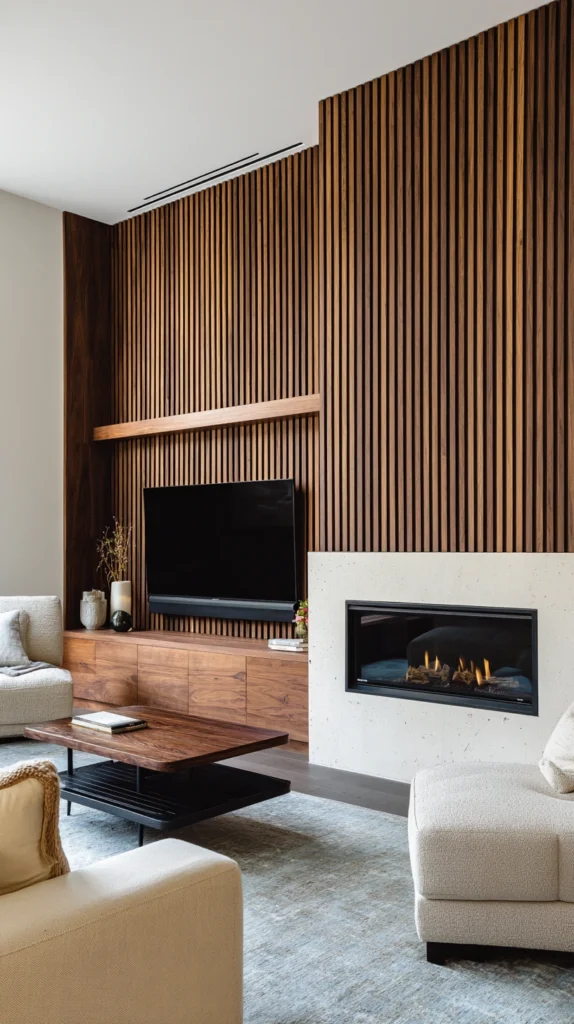
Perhaps the most sophisticated application of fluted wood in the contemporary interior is its use as a unifying material language — a surface treatment that runs consistently through a single room or through connected spaces, appearing on the wall panels, on the furniture fronts, on the shelving surrounds, and on the architectural details, creating a room with a single, coherent material voice rather than a collection of surfaces in different materials and finishes.
A living room where the feature wall, the television cabinet, the fireplace surround, and the floating shelves are all in the same fluted timber or painted fluted MDF creates a space of extraordinary material coherence and deliberate design intention — the room speaks in a single material language from floor to ceiling, and every element relates to every other element through their shared surface character.
This level of material consistency is demanding in its execution — every piece must be specified carefully to ensure the flute profile, spacing, and depth are consistent throughout — but the result is a room of genuine distinction that no eclectic collection of different materials and surfaces can approximate.
15. Fluted Wood Combined with Contrasting Materials
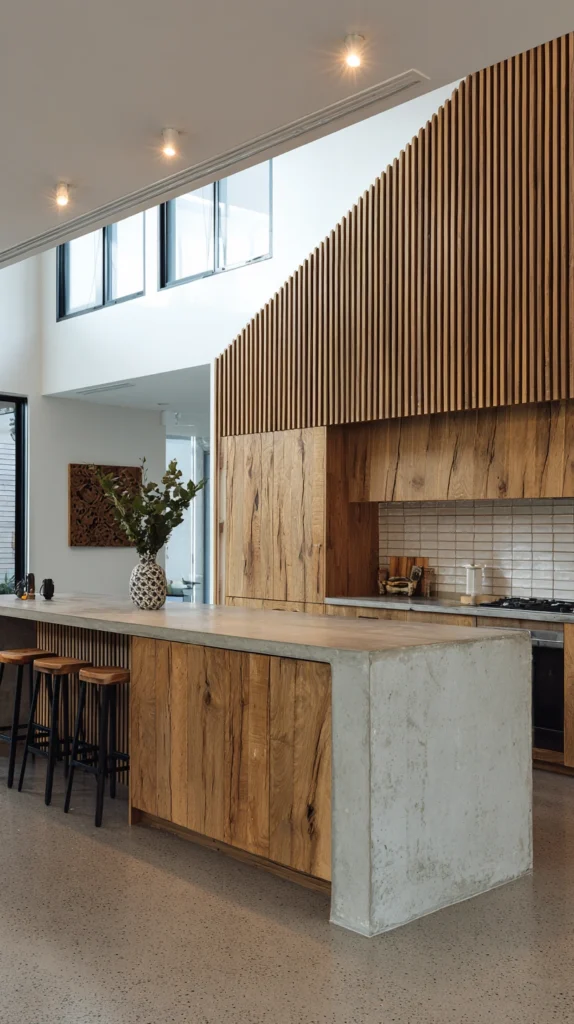
The final and perhaps most dynamically interesting application of fluted wood is its use in deliberate contrast with materials of opposite character — the smooth against the textured, the warm against the cool, the organic against the industrial. A fluted natural timber wall panel behind a polished concrete kitchen counter. Fluted oak cabinet fronts beside marble subway tile. A fluted walnut headboard against a smooth plaster wall painted in a saturated color.
A fluted timber room divider beside large-format, smooth-surfaced ceramic tile. In each of these pairings, the fluted timber’s warmth, texture, and natural quality is amplified by the contrast with its material opposite, creating a surface composition whose energy comes from the productive tension between different material languages.
The contrast should be genuine — not the timid combination of materials that are almost the same but slightly different, but the confident pairing of genuinely different materials whose dialogue creates something more interesting than either could achieve in isolation.