
15 Interior Archway Decor Ideas to Instantly Add Character
There is something about an archway that changes the experience of moving through a home. Where a rectangular doorway is efficient — a functional opening that connects one space to another with the minimum of architectural ceremony — an archway introduces something else entirely.
It slows the transition, frames the view beyond, creates a threshold that feels considered rather than simply cut. Arches have been used in domestic architecture for thousands of years across virtually every culture, and their persistent presence in the built environment is not coincidental.

The curved form resonates with the human eye and brain in ways that straight lines and right angles do not, suggesting the organic, the natural, the handmade.
In a contemporary interior, an archway is simultaneously a historical reference and a modern design statement, and the way you choose to decorate it — to acknowledge its presence, amplify its character, or use it as a framing device for the space beyond — determines whether it becomes one of the home’s great architectural assets or simply a curved opening that nobody thinks about. Here are fifteen ideas for making the most of every arch in your home.
1. Paint the Arch a Different Color from the Surrounding Wall
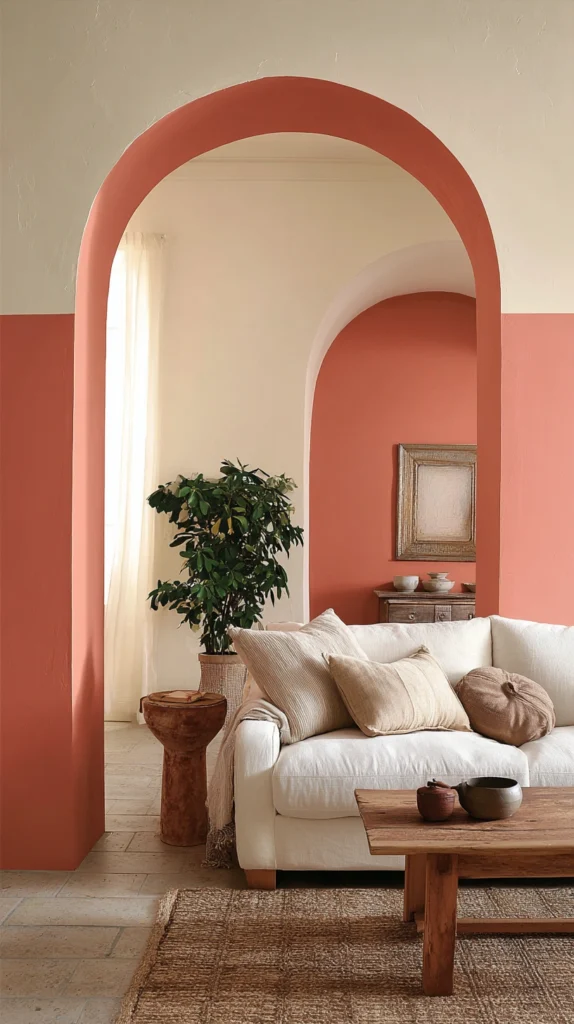
The simplest and most immediately impactful way to give an archway the decorative attention it deserves is to paint it a different color from the walls on either side of it.
This treatment does two things simultaneously: it draws the eye to the architectural feature and encourages appreciation of its form, and it creates a framing effect that makes the space visible through the arch look more intentional and composed. The color relationship between the arch and the surrounding wall is where the real design decision lies.
A deep, saturated color on the arch against a lighter surrounding wall creates drama and definition — a terracotta arch against warm white walls, a forest green arch against pale cream, a dusty navy against a soft gray.
A tonal approach — a slightly deeper or richer version of the wall color used on the arch itself — creates a more subtle effect that is sophisticated without being assertive. Either approach works; the choice depends on whether you want the arch to announce itself or simply to be noticed by those paying attention.
2. Hang a Curtain for Softness and Drama
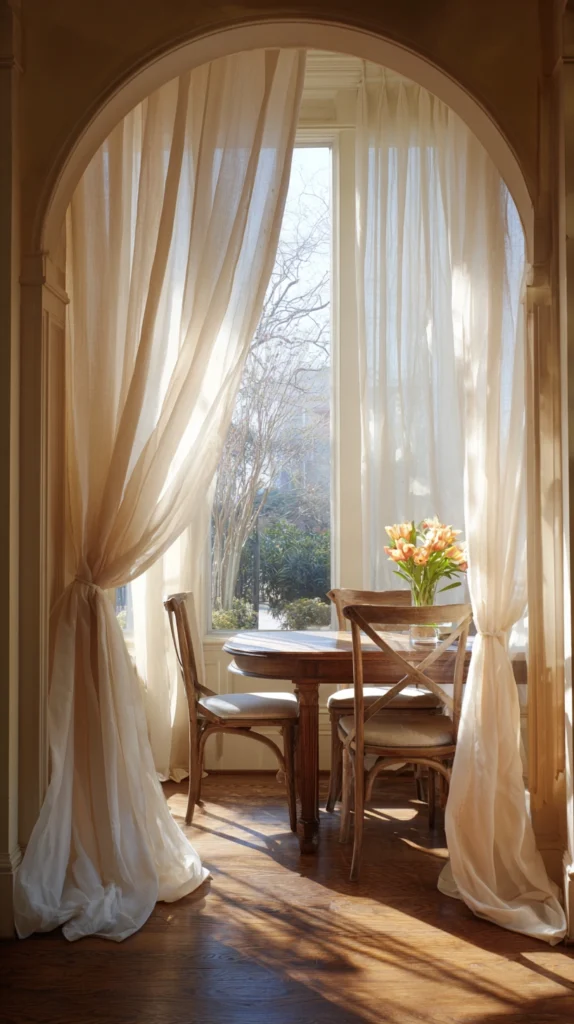
A curtain hung within or just inside an archway is a decorating move that has deep roots in traditional interiors and translates with remarkable ease into contemporary homes, because the combination of a curved architectural form and flowing fabric creates a visual contrast — structured geometry meeting organic softness — that is consistently beautiful.
Floor-length curtains in a natural fabric — linen, cotton velvet, or a heavy woven textile — hung from a tension rod or a simple curved curtain track fitted to the inside of the arch create privacy, acoustic softness, and genuine drama without permanently altering the architecture.
In spring and summer, lightweight sheer curtains allow light to filter through while maintaining the layered, considered quality of the treatment. In autumn and winter, a heavier fabric adds warmth and enclosure.
The curtain does not need to be drawn closed to do its decorative work — simply hanging it at the sides of the arch, drawn back with a simple tie or holdback, frames the space beyond and adds the softness that hard architectural surfaces always benefit from.
3. Line the Arch with Trailing Plants and Greenery
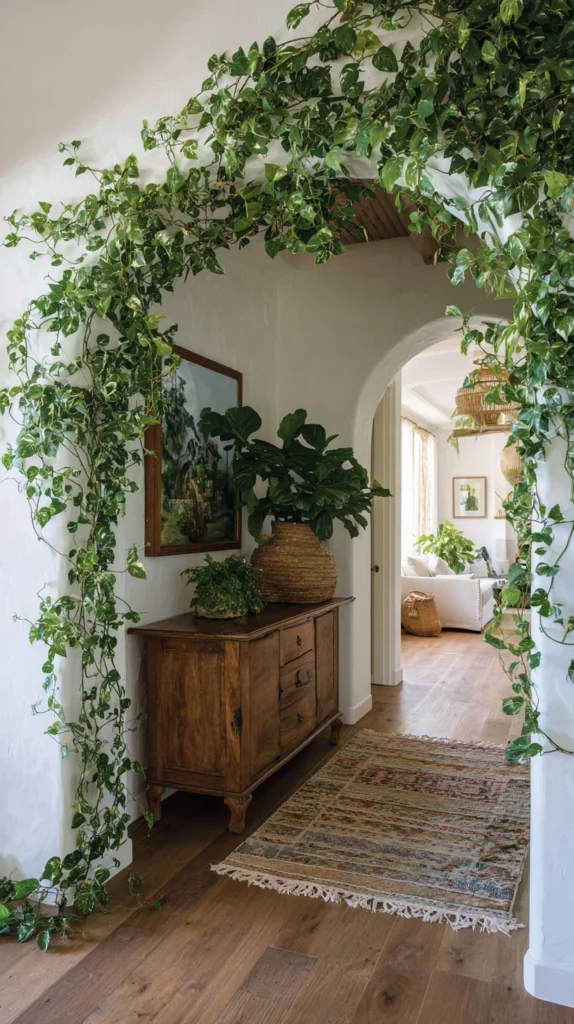
Using an archway as a support structure for trailing or climbing plants is one of the most biophilically satisfying interior design moves available, and in a home where the arch appears in a room with adequate natural light, the effect of greenery framing a curved opening is genuinely spectacular.
Pothos, heartleaf philodendron, and devil’s ivy are the most practical choices for arches that receive indirect light, their long trailing stems easily directed and secured along the arch’s curve with small adhesive hooks.
In a room with better light, a climbing plant trained up either side of the arch and allowed to meet at the apex creates a living frame that changes the character of the opening entirely.
The key is training the plants along the arch’s curve rather than allowing them to hang freely, so that the form of the arch remains visible through and beneath the foliage. Replace any failing stems quickly to maintain the lushness that makes this treatment so effective.
4. Install Shelving Within a Wide Arch Opening
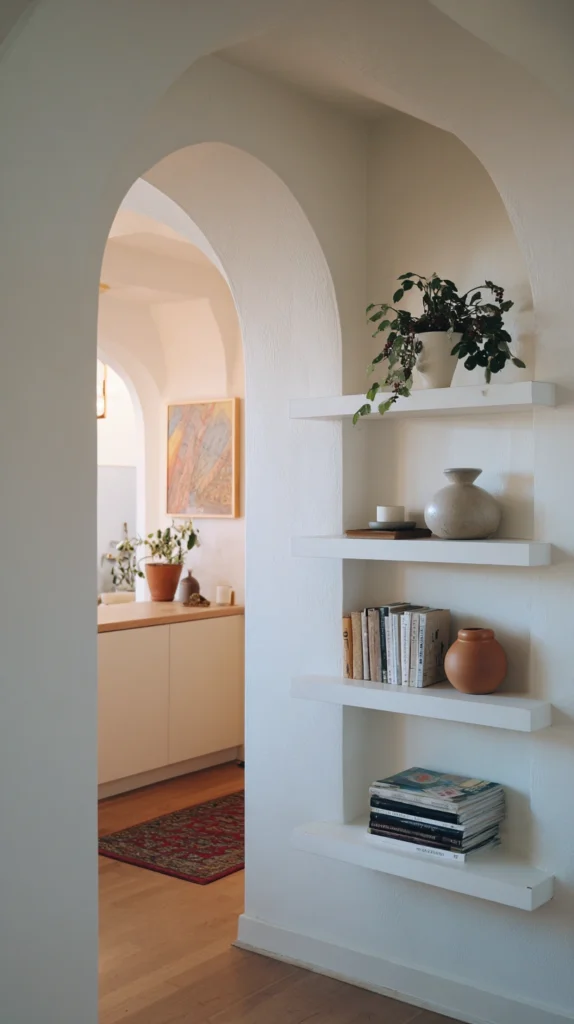
A wide archway that connects two spaces without functioning as a conventional doorway — the kind common in older homes between a sitting room and a dining room, or between a kitchen and a living area — presents the opportunity to install shelving within the opening itself, creating a display and storage element that occupies the transitional space while maintaining visual connection between the rooms on either side.
Built-in shelving fitted within the arch’s width, with shelves spanning from wall to wall at intervals determined by what they will hold, creates a room divider that is simultaneously open and functional — books, objects, plants, and ceramics visible from both sides, the arch’s curved top framing the whole arrangement like a picture frame on a particularly beautiful scale. This treatment works particularly well in homes where storage is limited and where the visual weight of a fully closed wall between rooms would feel oppressive.
5. Use the Arch as a Gallery Frame
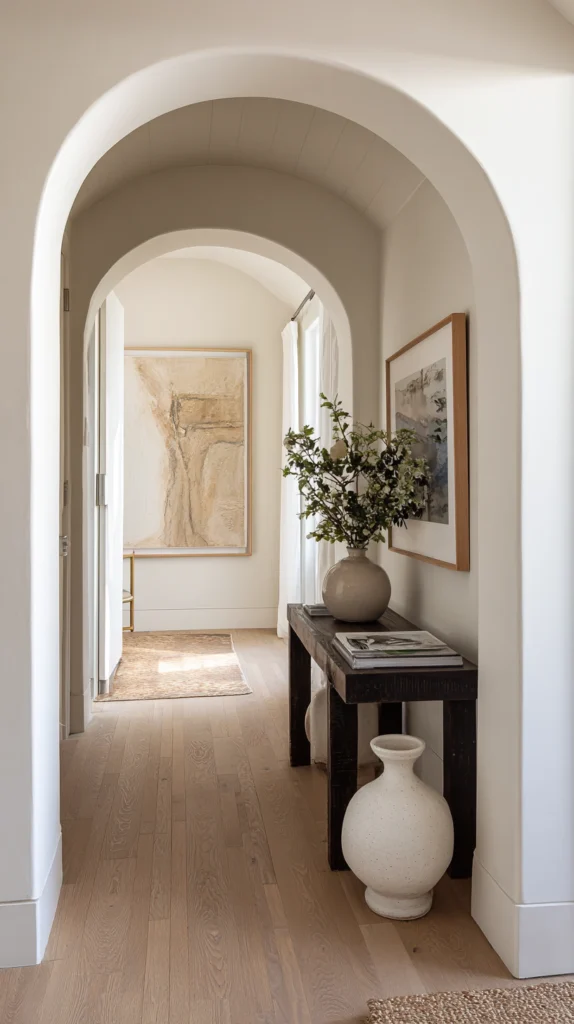
One of the most elegant ways to treat an arch that opens onto a hallway, staircase, or particularly beautiful room is to think of it as a picture frame — a curved border through which a composed view is presented — and then to dress the space beyond it as you would dress a painting: with attention to what is seen, from what angle, and in what light. Place a console table centered in the view through the arch, styled with a lamp, a mirror, and a simple seasonal arrangement.
Or hang a single significant piece of art on the wall directly opposite the arch, positioned so that it is perfectly framed by the curve when viewed from the room on the other side. This approach requires no intervention on the arch itself — the decorating happens in the framed view — but it gives the architectural feature a purpose and a visual payoff that makes passing through it a genuinely pleasurable experience.
6. Apply Decorative Molding to the Arch’s Profile
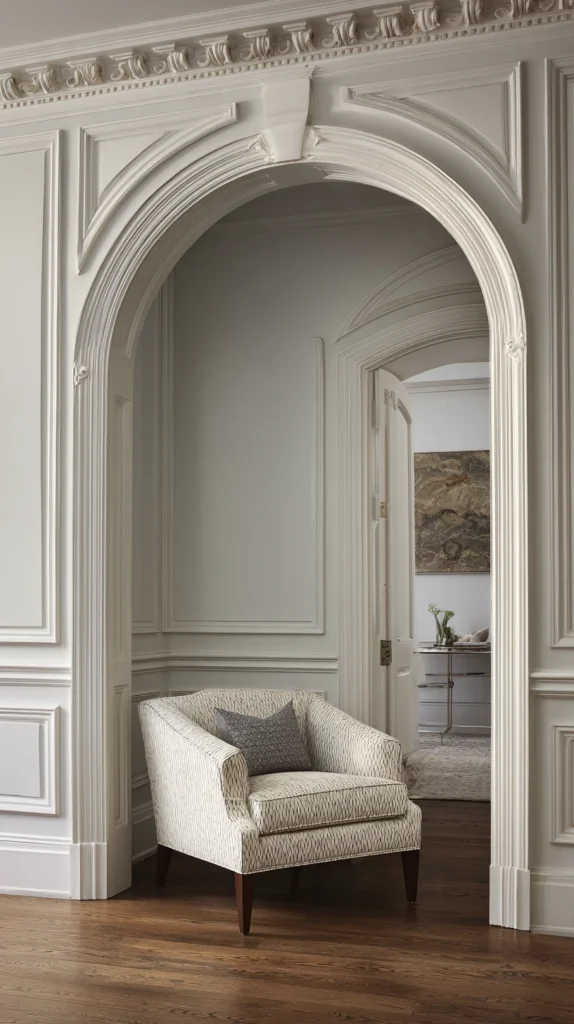
Architectural molding applied to the face of an arch — a simple but carefully chosen profile of plaster or medium-density fiberboard that follows the curve and adds visual depth to what might otherwise be a flat, featureless surface — is a classical treatment that suits both traditional and contemporary interiors depending on the molding profile chosen.
In a traditional home, an egg-and-dart or dentil molding follows historical precedent with the confidence of a proven idea. In a contemporary home, a simple flat-faced shadow gap molding — a recessed line that follows the arch’s curve and creates a subtle but defined shadow — adds architectural interest without period reference.
The molding treatment is most effective when painted in the same color as the arch itself, so that the added depth is felt as texture and shadow rather than color contrast.
7. Create a Tile Feature Within the Arch’s Reveal
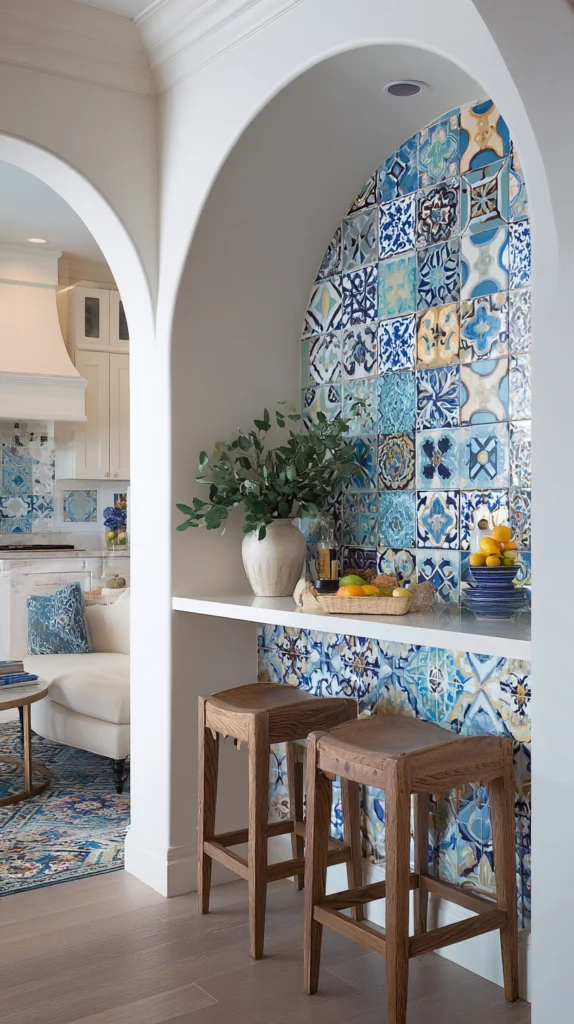
In kitchens, bathrooms, and utility spaces where tile is already present on walls or floors, extending a decorative tile treatment into the reveal — the inner surface of the arch — creates a feature of considerable beauty that uses the arch’s three-dimensional form to display the tile at an angle visible from multiple positions in the room.
A plain kitchen arch whose reveal is tiled in a decorative Moroccan zellige, a simple hand-painted tile, or a bold geometric porcelain pattern becomes a design statement that is visible from across the room and rewards close inspection.
The reveal is a small surface — typically only a few inches deep — which means that even expensive or complex tile treatments remain affordable within this limited application, and the contained scale of the feature prevents a bold tile choice from becoming overwhelming.
8. Frame the Arch with Wallpaper on One Side
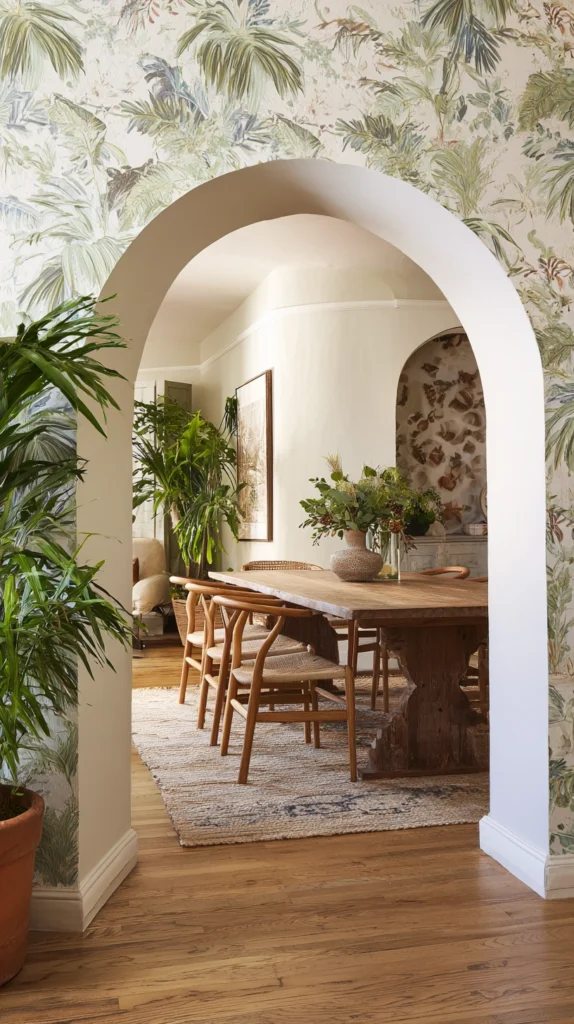
Applying wallpaper to the wall on one side of an archway — treating the arch as the boundary between a papered room and a plain one — uses the architectural feature as a natural transition point that makes the wallpaper feel considered rather than arbitrary.
This is a technique used frequently in interior design to introduce wallpaper into a space without committing to papering the entire room, and the arch provides the most architecturally satisfying possible border for the transition. The wallpaper should run up to and around the arch’s reveals if possible, so that the inside face of the arch is papered and the transition between papered and plain surfaces is complete rather than simply a line where the pattern stops. A botanical wallpaper on the dining room side of an arch between kitchen and dining room, with the kitchen remaining plain on the other side, creates a domestic landscape of genuine variety and intention.
9. Add Lighting Within or Around the Arch
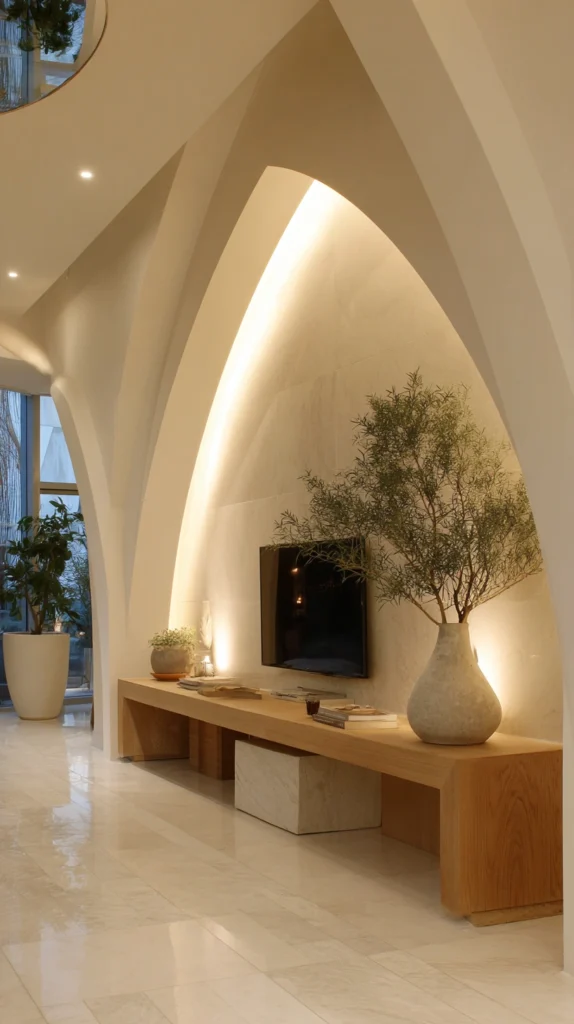
Lighting an arch — either from within, with recessed spots fitted into the arch’s soffit, or around it, with wall-mounted sconces placed on either side of the opening at the height where the curve begins — transforms the architectural feature from a passive element into an active one, present and visible at all hours rather than only when the ambient lighting of the room happens to illuminate it.
Recessed lighting within an arch’s soffit creates a subtle glow that outlines the curve from above, making the arch visible and defined even in low ambient light. Wall sconces flanking the arch at shoulder height create symmetrical pools of warm light that frame the opening formally and draw the eye from across the room.
Either approach is most effective when the arch is painted in a contrasting color, so that the light has a defined surface to illuminate and the curve is clearly articulated.
10. Style a Console Table Beneath the Arch
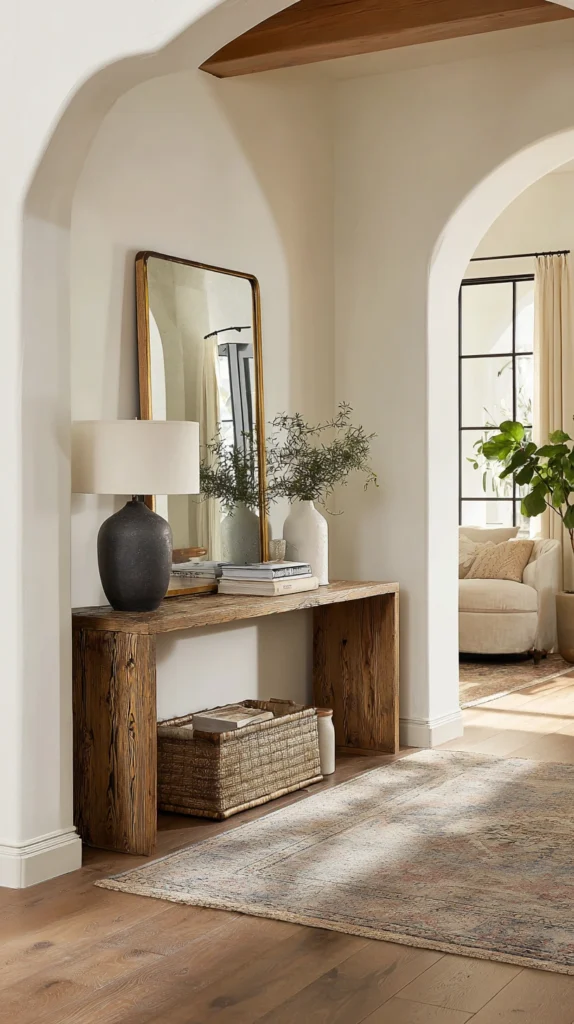
An arch that spans a hallway or connects two rooms over a console table height — lower than a full doorway, functioning more as a decorative frame than a passage — is best treated as a display opportunity rather than a transitional one.
A console table positioned directly beneath and against the arch, styled with lamps, art, plants, and objects that together create a vignette of real beauty, turns the archway into the home’s most considered display surface. The arch above the console functions as both ceiling and frame, creating an enclosed, intimate display zone within a larger room.
The height and proportions of the console should relate carefully to the height of the arch — the space between the tabletop and the arch’s apex should be neither too cramped nor too generous — and the objects on the table should be scaled to fill that vertical space with visual interest without actually touching the arch above them.
11. Mirror the Arch with a Shaped Mirror
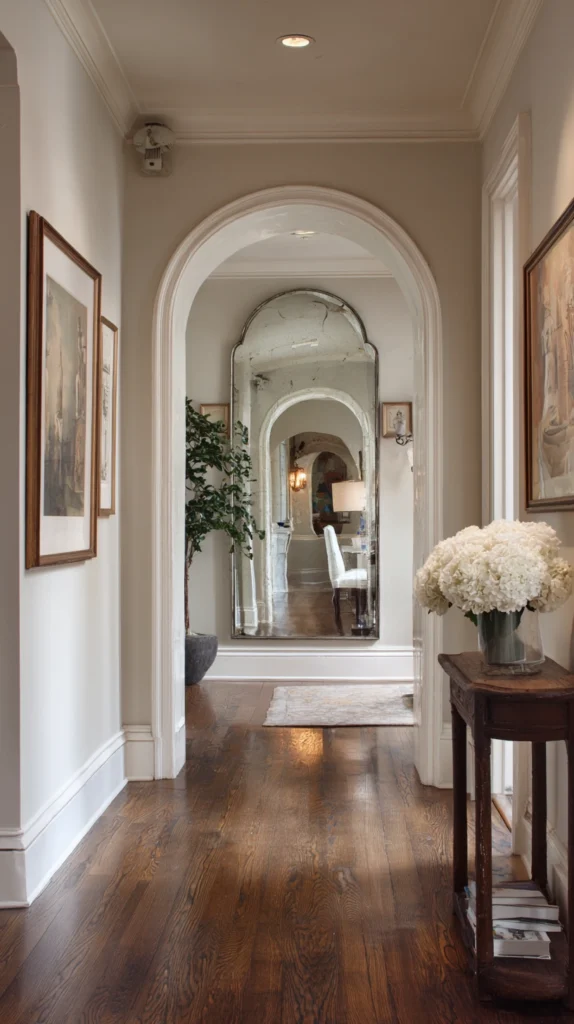
Placing a mirror whose shape echoes the arch — an arched-top mirror hung on the wall within or just beyond the archway — creates a visual dialogue between the architectural feature and the decorative object that is both clever and deeply satisfying.
The mirror reflects the arch, doubles it, and fills the space it frames with reflected light and depth in a way that makes both the room and the architectural feature feel significantly larger and more beautiful than they actually are.
An arched mirror hung in the center of the wall visible through an arch creates the illusion of a second arch beyond, opening the visual space of the home in a way that no other single decorating decision can replicate at comparable cost. Choose a mirror in a frame that complements the arch’s material context — plaster or painted wood for traditional arches, metal or frameless glass for contemporary ones.
12. Install a Window Seat in an Arched Alcove
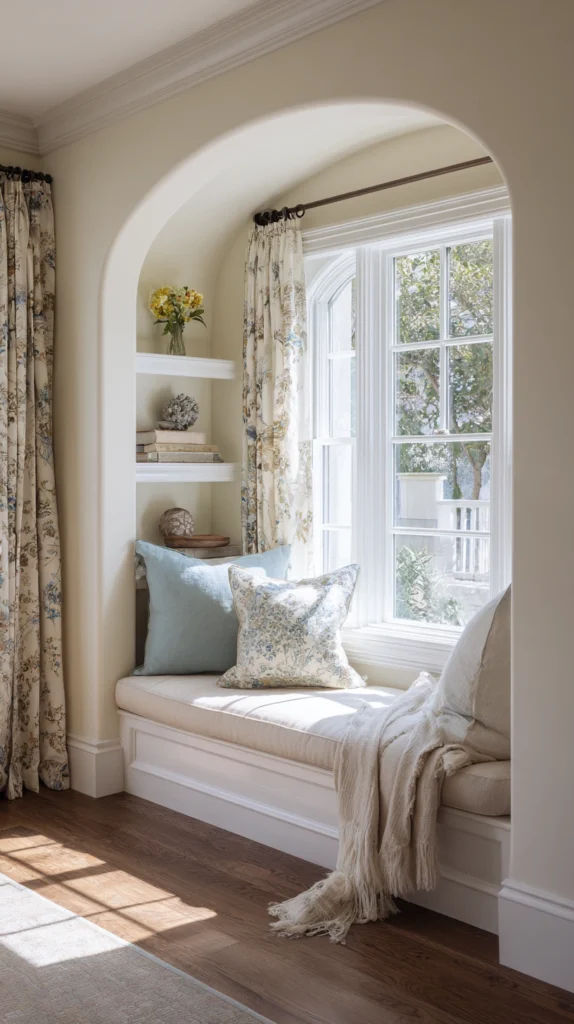
Where an arch frames an alcove rather than a through-passage — a recessed arched niche large enough to accommodate seating — the most rewarding treatment is a built-in window seat that occupies the full width of the alcove and transforms it from a decorative cavity into a genuinely functional and beloved space.
The arch above provides the sense of enclosure and intimacy that makes window seats so psychologically appealing — the feeling of being held within the architecture, sheltered within the larger room while remaining visually connected to it.
Cushion the seat in a fabric that complements the room’s palette, add pillows that reference the room’s decorative language, and fit shelving or storage into the alcove’s side walls to complete the transformation from architectural feature to functional room element. This is the kind of built-in that adds both character and genuine value to a home.
13. Use the Arch to Introduce a Contrasting Material
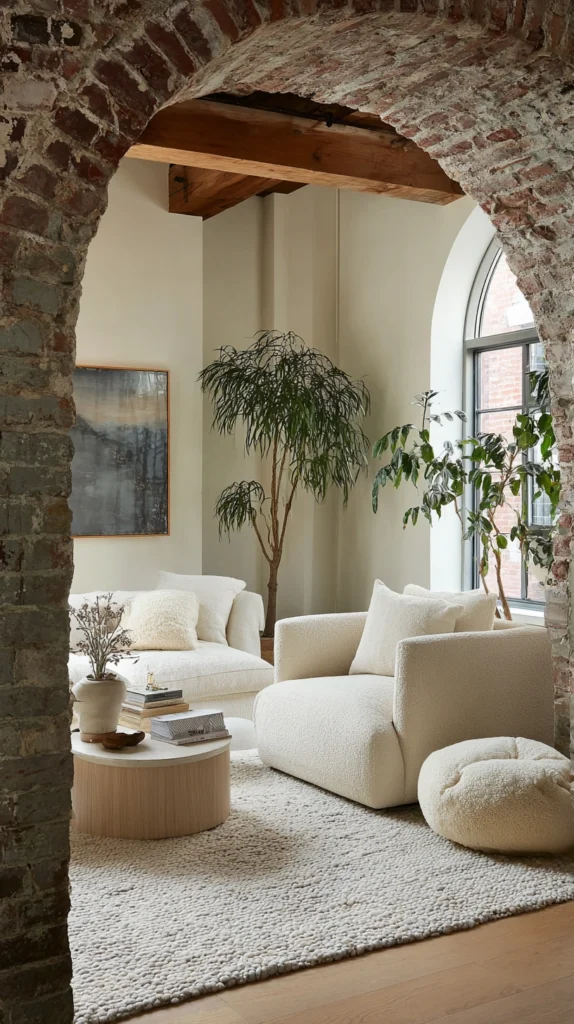
A smooth plaster arch in a room with painted walls becomes more architecturally interesting when its surface is finished in a contrasting material — exposed brick, stone cladding, limewash plaster, or a polished venetian plaster treatment — that introduces a different texture and a different material history into the room’s surface palette.
An exposed brick arch in a contemporary room creates a deliberate tension between old and new that is one of interior design’s most reliably successful strategies.
A limewashed arch in a neutral room adds the aged, layered quality that modern materials struggle to replicate. A polished plaster arch in a pared-back space introduces an almost sculptural quality that elevates the entire room’s material language. The contrast between the arch’s surface and the surrounding walls should be sufficient to read clearly from across the room without being so dramatic that it feels disconnected from the overall interior.
14. Decorate the Apex with a Hanging Pendant or Botanical
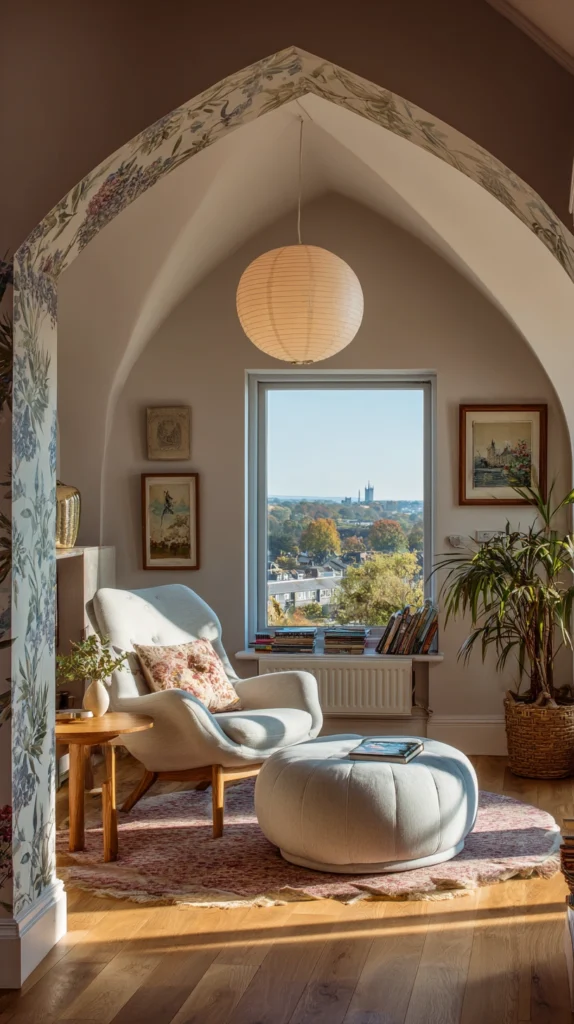
The apex of an arch — the highest point of its curve — is a natural focus point that most interior decorating ignores entirely, and yet it offers a small but real opportunity for a decorative gesture that draws the eye upward and acknowledges the arch’s form.
A small hanging pendant light suspended from the apex, its cord running up and over the arch to a power source on the wall, creates a lit focal point within the opening that is both functional and visually interesting.
A hanging botanical — a small bunch of dried flowers or herbs, a trailing plant in a small hanging vessel, a single dramatic dried seed head — creates a gentler version of the same effect without the electrical requirement. Either gesture acknowledges the apex, draws attention to the arch’s form, and gives the opening a sense of considered completion that the bare apex never quite achieves.
15. Let the View Through the Arch Be the Decoration
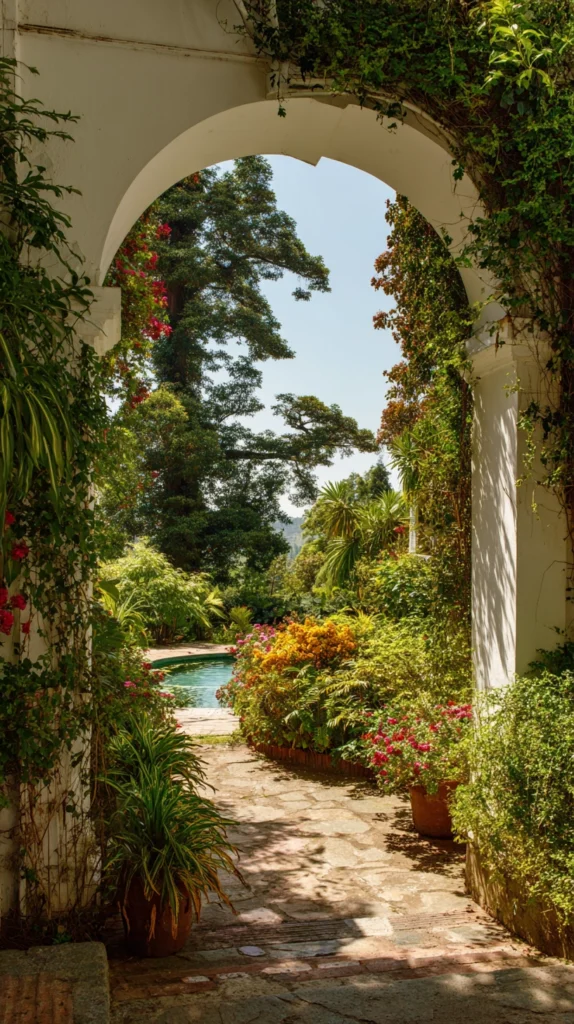
The final and perhaps most sophisticated archway decorating idea is the one that requires the least intervention on the arch itself and the most attention to what lies beyond it. An arch that frames a genuinely beautiful view — a well-styled room, a dramatic piece of art, a perfectly positioned plant, a window with a garden beyond it — needs nothing added to its own surface to perform its decorative function.
The arch is already doing everything asked of it by framing and elevating what is seen through it, and any decoration applied to the arch itself would simply compete with the view it is presenting. This approach demands that you look honestly at what your arch frames and decide whether that view is worthy of the frame.
If it is, leave the arch alone and dress the space beyond it. If it is not, that is where the decorating energy should be directed — not toward the arch, but toward making what it reveals worth seeing.