
14 Kitchen Organization Hacks That Actually Make a Difference
A disorganized kitchen is one of those slow, daily frustrations that is easy to dismiss as just the way things are. The drawer that will not close properly, the avalanche of Tupperware every time you open a cabinet, the spice jars you have to move four things to reach — none of it feels urgent enough to fix, but all of it adds up to a kitchen that is quietly exhausting to work in every single day.
The good news is that kitchen organization does not require a full renovation, an enormous budget, or a weekend’s worth of work. The right hacks — simple, clever, low-cost interventions that change how a space functions — deliver results that are immediate, lasting, and genuinely transformative. A well-organized kitchen is not just tidier. It is calmer, faster, more enjoyable to cook in, and significantly less stressful to maintain.
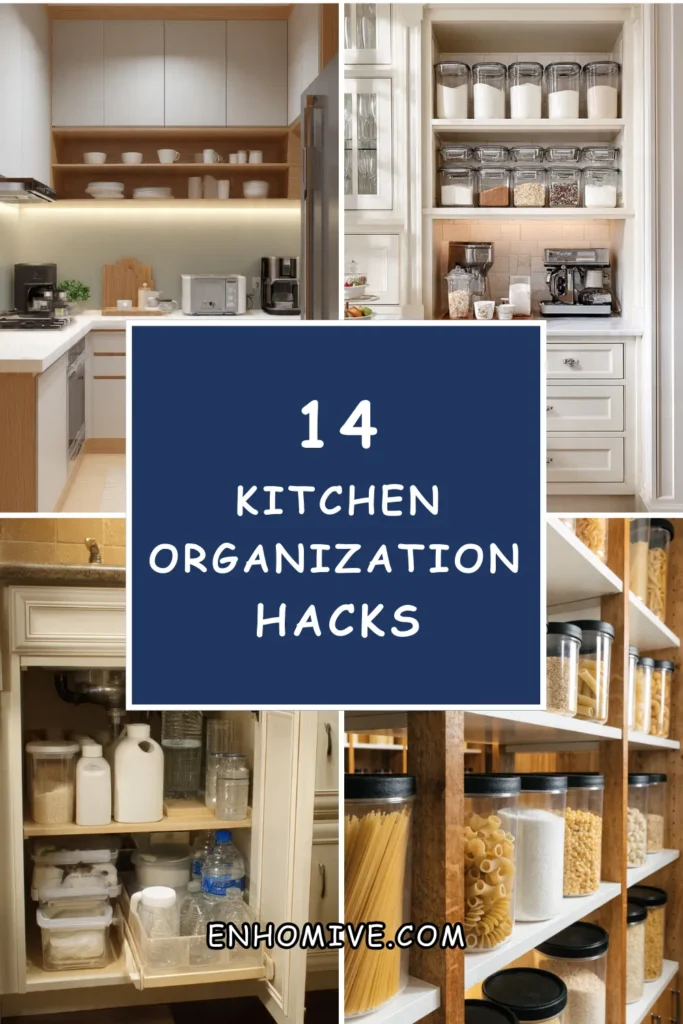
Here are 14 kitchen organization hacks that make a real, lasting difference to how your kitchen looks and works every day.
1. Decant Dry Goods Into Uniform Airtight Containers
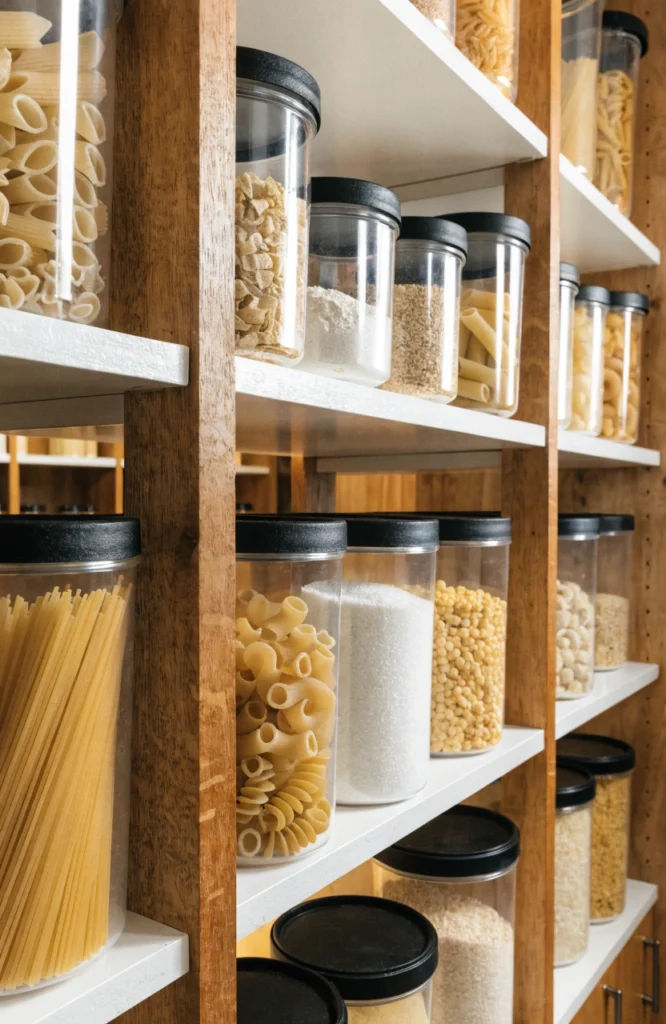
Decanting pasta, rice, flour, sugar, cereals, and other dry goods from their original packaging into uniform airtight containers is one of the single most transformative kitchen organization moves you can make. The visual chaos of differently sized packets, half-open bags, and mismatched boxes is replaced instantly with a clean, consistent, cohesive pantry that is easier to navigate and significantly more pleasurable to look at.
Uniform containers also stack efficiently, seal food properly to extend shelf life, and make it immediately obvious at a glance when supplies are running low. Label each container clearly with the contents and — for baking ingredients that look similar — the specific variety. The initial investment of time in decanting pays dividends every single day afterward.
Pro Tip: Measure the internal dimensions of your pantry shelves or cabinet before buying containers and choose a size that fits your shelf height exactly with minimal wasted space above. A container that is even a centimeter too tall to allow double-stacking wastes a significant amount of vertical storage space over the course of an entire pantry. Getting the sizing right from the start makes the whole system significantly more efficient.
2. Use Drawer Dividers for Utensils and Cutlery
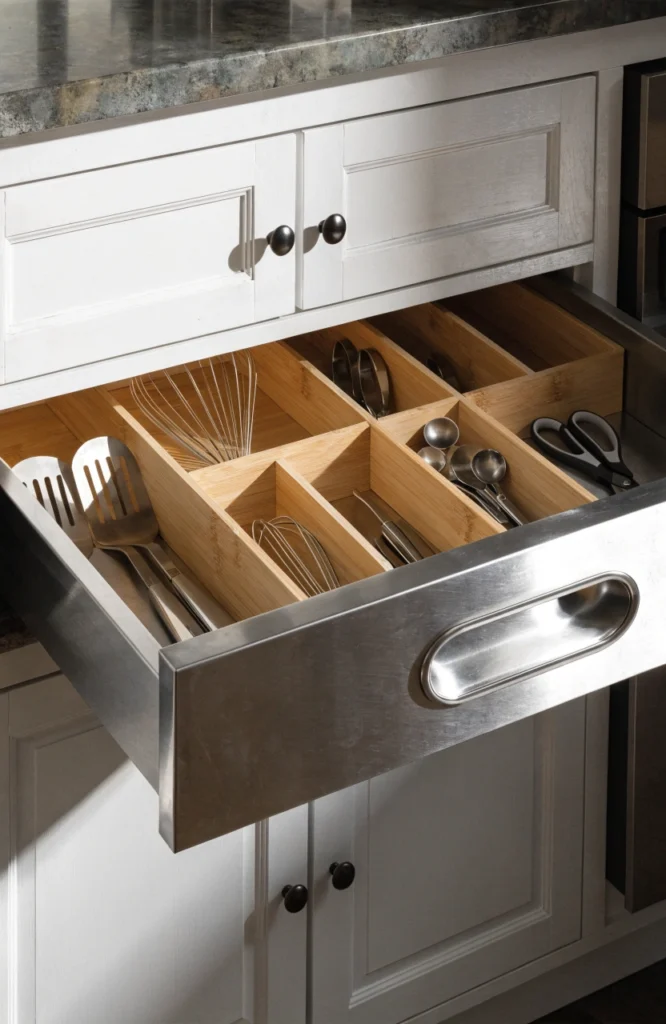
The kitchen junk drawer — that chaotic collection of spatulas, whisks, peelers, scissors, random batteries, and takeaway menus — is one of the most universal kitchen problems in existence. The solution is not a bigger drawer but a divided one. Drawer dividers — whether purpose-made inserts, bamboo dividers, or simple repurposed boxes — transform a chaotic drawer into a genuinely functional storage system.
Apply the same principle to cutlery drawers with a proper cutlery tray rather than throwing everything in loose. Group utensils by function in dedicated sections — stirring and serving tools together, prep tools together, measuring tools together — so that everything has a home and everything can be found without rummaging.
Pro Tip: When sorting a kitchen drawer with dividers, take everything out first and edit ruthlessly before putting anything back. Most kitchen drawers contain duplicates, broken items, and tools that have never been used in years. Removing everything that does not genuinely earn its place reduces the volume to be organized significantly and makes the divider system far more effective and easier to maintain long term.
3. Install a Pegboard on a Kitchen Wall
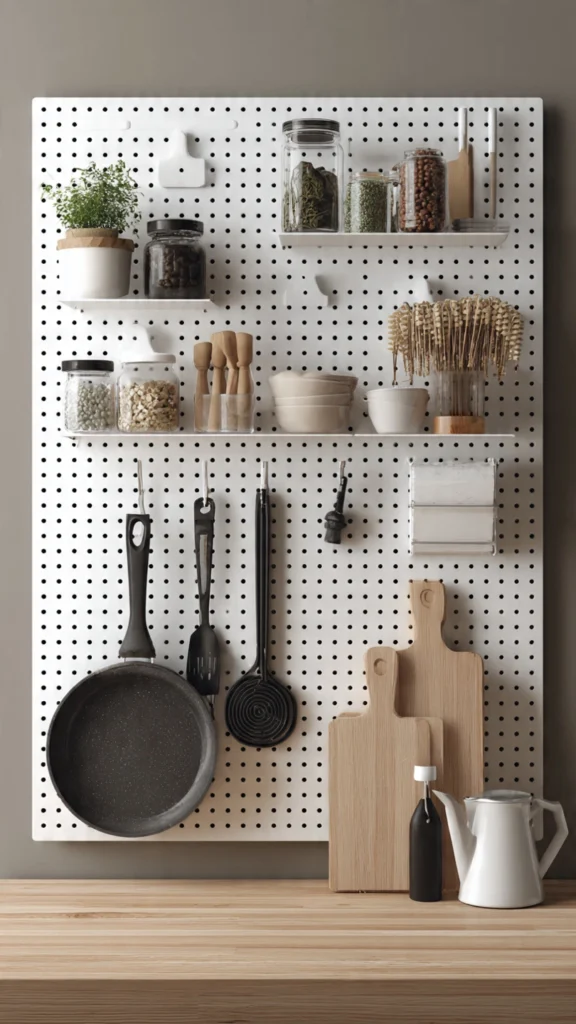
A pegboard mounted on a kitchen wall — beside the cooker, on a blank wall between cabinets, or inside a pantry door — creates an infinitely flexible storage system that keeps frequently used tools visible, accessible, and completely off the counter. Hooks, shelves, rails, and baskets can be rearranged at any time as your storage needs evolve.
Hanging pots, pans, ladles, spatulas, scissors, and even small containers of frequently used spices on a pegboard frees up enormous amounts of cabinet and drawer space for the items that genuinely need to be stored inside. It also makes cooking faster and more efficient — everything you reach for regularly is right there, at arm’s reach, without opening a single door or drawer.
Pro Tip: Mount the pegboard on standoff spacers that hold it at least 20 to 25 millimetres away from the wall. This gap behind the board is essential for inserting hooks and hanging accessories through the holes — without it the pegboard system simply does not function. Paint the wall behind the pegboard in a contrasting color before mounting it for a finished, intentional look that makes the pegboard feel like a design feature rather than an afterthought.
4. Stack Pots and Pans with Lid Organisers
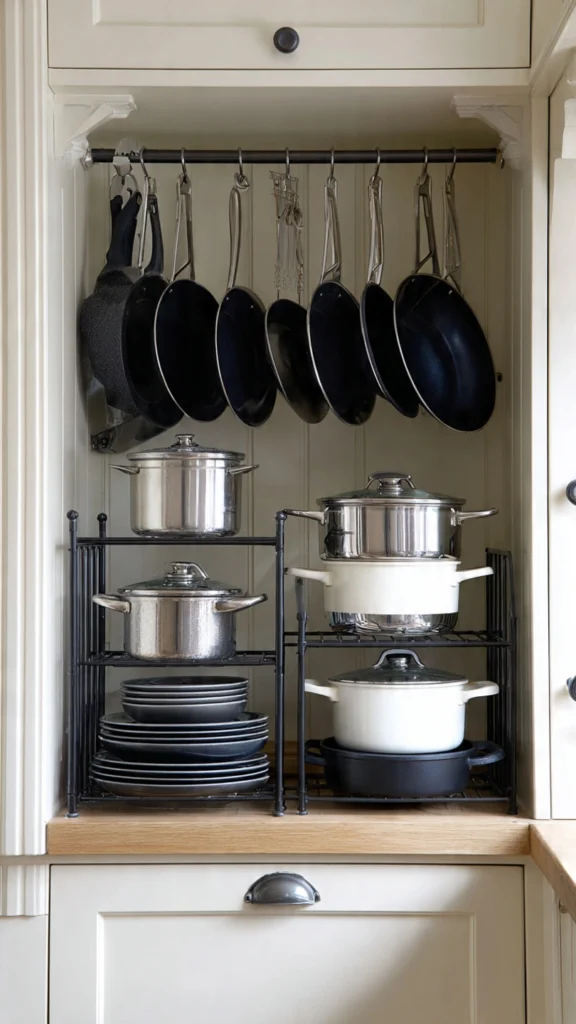
Pots and pans are among the most space-inefficient items in any kitchen because of their irregular shapes and the separate lids that accompany them. A dedicated pot and pan organiser — whether a vertical pan rack, a set of adjustable shelf dividers, or a pull-out cabinet insert — transforms a cabinet of stacked, clattering pots into a genuinely functional storage system where every piece has a designated place.
Store lids separately in a dedicated lid organiser — a simple wire rack mounted inside a cabinet door, a file organiser used on its side, or a purpose-made lid holder — rather than balancing them precariously on top of their pots. Separating lids from pans makes both significantly easier to access without disturbing everything else in the cabinet.
Pro Tip: Store pots and pans by frequency of use rather than by size. The pieces you use every day — a medium saucepan, a frying pan, a large pot — should be at the front and most accessible point of the cabinet or rack. Rarely used pieces like a large roasting tin or a preserving pan can live at the back, on a higher shelf, or even outside the main kitchen in a utility area if space is genuinely limited.
5. Use the Inside of Cabinet Doors for Storage
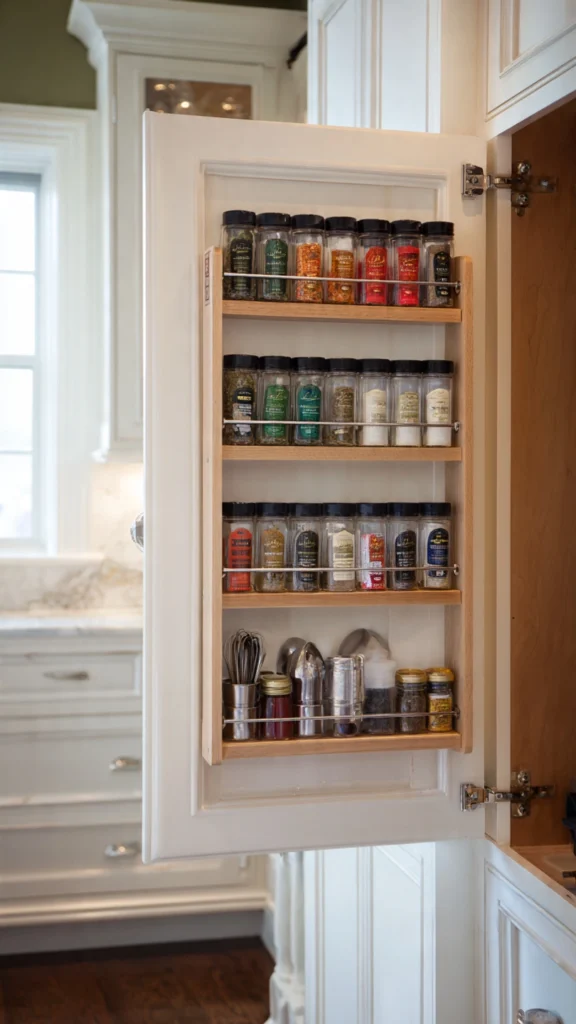
The inside surface of cabinet doors is one of the most consistently overlooked storage opportunities in any kitchen. A blank cabinet door represents usable storage space that most kitchens waste entirely. Simple additions — an adhesive hook, a small wire rack, a mounted spice rail, or an over-door organiser — transform this dead space into genuinely useful storage without taking up a single inch of shelf, counter, or drawer space.
Mount a small wire rack inside the cleaning cabinet door for storing bottles of washing up liquid, surface spray, and cloths. Add a spice rack inside a cabinet door near the cooker. Hang a small chalkboard or whiteboard inside a pantry door for shopping lists. Each intervention is small but the cumulative effect across multiple cabinet doors is a kitchen with significantly more usable storage than it appeared to have.
Pro Tip: Check the clearance between the inside of the cabinet door and the shelf behind it before mounting anything. A rack or organiser that protrudes too far from the door will prevent the door from closing properly and make the storage system unusable. Measure the available depth carefully and choose products that fit within the available clearance with at least a centimetre to spare.
6. Create a Dedicated Baking Station
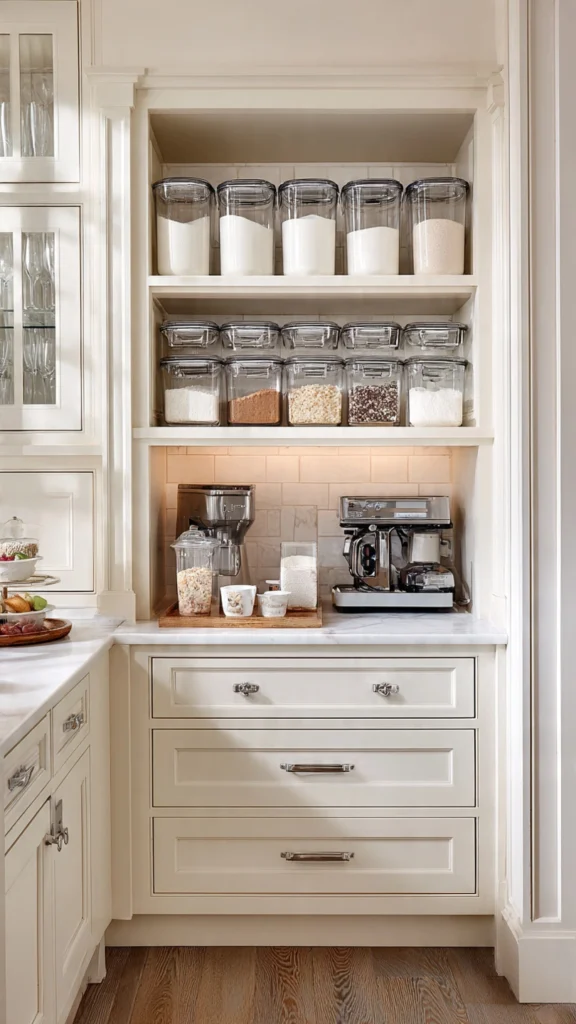
If you bake regularly, having to gather ingredients, equipment, and tools from different cabinets and drawers every time you want to make something is a genuine friction point that makes baking feel more effortful than it needs to be. A dedicated baking station — even a single shelf, drawer, or section of cabinet — that keeps all your baking essentials together in one place transforms the experience completely.
Group your baking flours, sugars, leavening agents, and extracts together in one area. Store your mixing bowls, measuring cups, scales, and hand mixer in the same zone. Keep baking trays and tins on a dedicated shelf or in a vertical rack nearby. When everything you need for baking lives in one place, the whole process becomes faster, calmer, and significantly more enjoyable.
Pro Tip: Position your baking station as close to your primary prep surface as possible — ideally directly below or beside the section of counter where you do most of your baking. The shorter the distance between your storage and your work surface, the less effort every baking session requires. Even moving a baking station one cabinet closer to where you actually work makes a surprisingly noticeable difference to the flow of the process.
7. Tension Rods to Divide Deep Drawers and Shelves
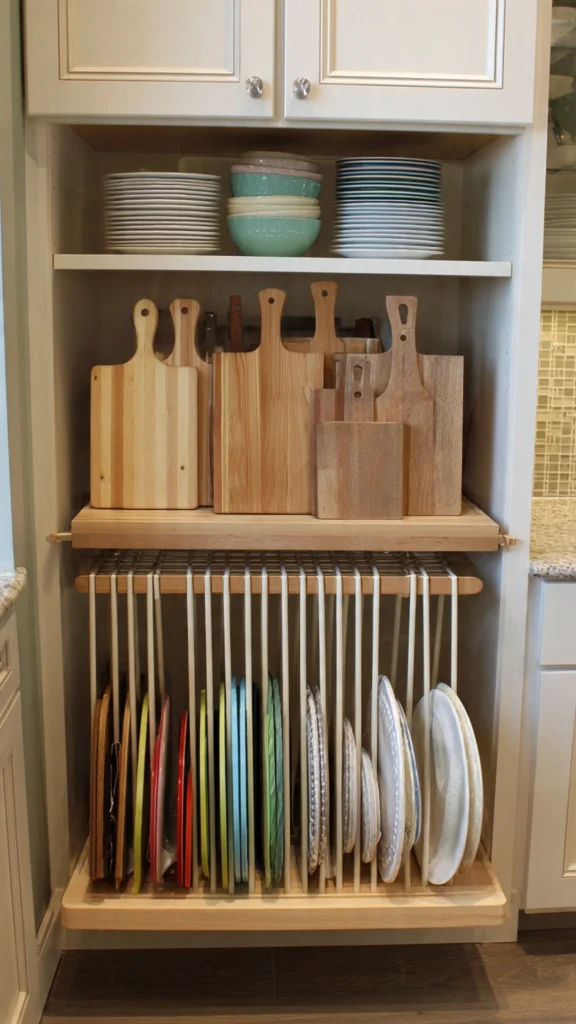
Tension rods — the same spring-loaded rods used for shower curtains and window treatments — are one of the most versatile and inexpensive kitchen organisation tools available. Placed vertically in a deep drawer or across the depth of a shelf, they create dividers that keep chopping boards, baking trays, serving platters, and pan lids stored upright and individually accessible rather than in an unstable, space-inefficient horizontal stack.
A set of tension rods placed across a deep cabinet shelf at regular intervals turns a space that previously held an avalanche of flat items into an organised vertical filing system where every item can be retrieved individually without disturbing anything else. The rods are adjustable, require no installation, and cost almost nothing.
Pro Tip: Use tension rods in multiple sizes — shorter ones for deep drawers and longer ones for cabinet shelves — and position them to create sections that match the dimensions of the items you are storing. Sections that are slightly narrower than the items they hold keep everything firmly upright without gaps that allow pieces to lean and fall over. Fine-tuning the rod positions for your specific items makes the system work significantly better.
8. Label Everything — Shelves, Containers, and Zones
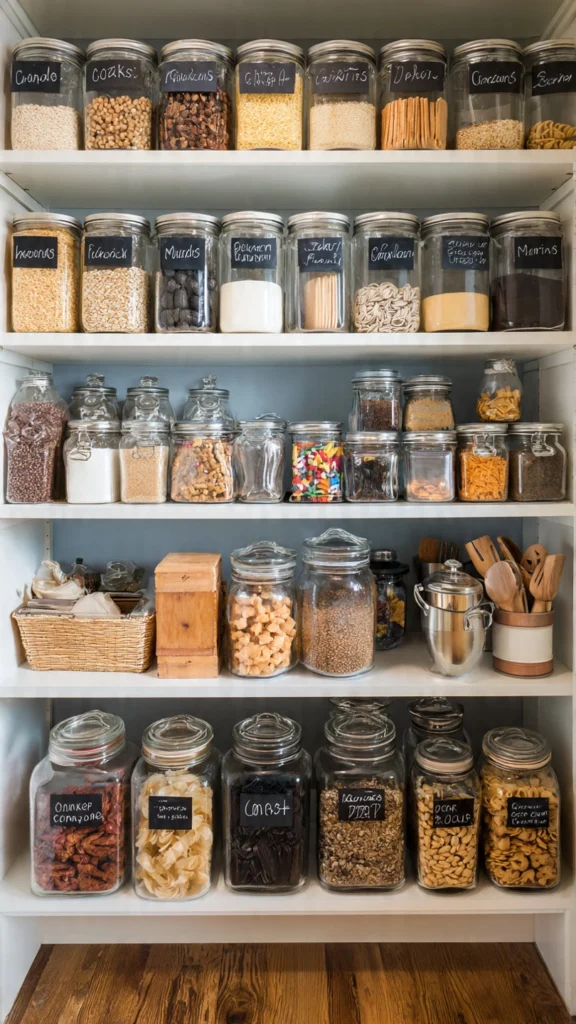
Labelling is the step that most kitchen organisation projects skip — and it is the step that determines whether a newly organised system lasts for years or reverts to chaos within a few weeks. Labels are not just for identifying contents. They are instructions that communicate to everyone in the household exactly where things belong and where they should be returned after use.
A labelled shelf, drawer, or container zone removes the ambiguity that causes things to drift back to wherever is most convenient rather than where they are supposed to live. Labels make the system self-explanatory and self-maintaining — which is the difference between a kitchen organisation project that lasts indefinitely and one that gradually unravels until the next big sort-out.
Pro Tip: Invest in a label maker rather than handwriting labels on masking tape. Printed labels look considerably more considered and finished than handwritten ones, they are easier to read at a glance, and they adhere more reliably to containers, shelves, and surfaces over time. A basic label maker is an inexpensive tool that pays for itself immediately in the quality and longevity of the organisation system it helps to maintain.
9. Use Risers and Shelf Inserts to Double Cabinet Space
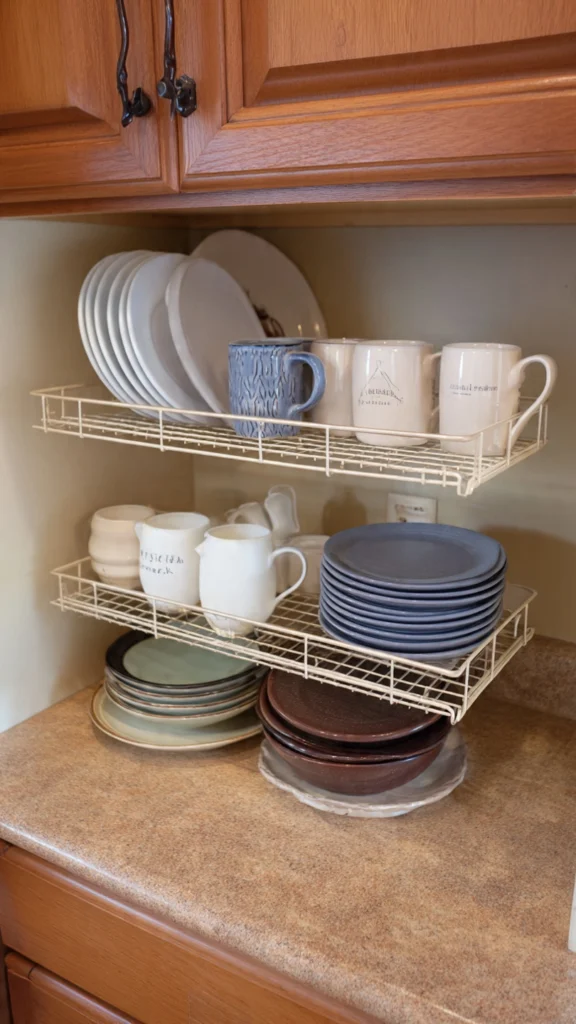
Most kitchen cabinets have shelves set at a fixed height that wastes enormous amounts of vertical space. Plates stacked 15 centimetres high leave 25 centimetres of empty air above them. Shelf risers — simple stepped platforms that sit on the existing shelf and create a second level above — turn this wasted vertical space into usable storage and effectively double the capacity of every cabinet they are used in.
Risers work particularly well in pantry cabinets for canned goods, in upper cabinets for glasses and mugs, and in any cabinet where items are stored in a single layer with significant dead air space above them. The investment is minimal and the additional storage created is immediately and permanently useful.
Pro Tip: Measure the height of the items you plan to store on each riser level before buying. A riser that creates a second level with insufficient clearance for the items above it is useless and frustrating. Calculate the height of the tallest items on the lower level, add the height of the riser platform itself, then subtract from the total shelf-to-shelf distance to establish how much clearance is available for the upper level.
10. Hang a Rail System Inside the Pantry or Larder
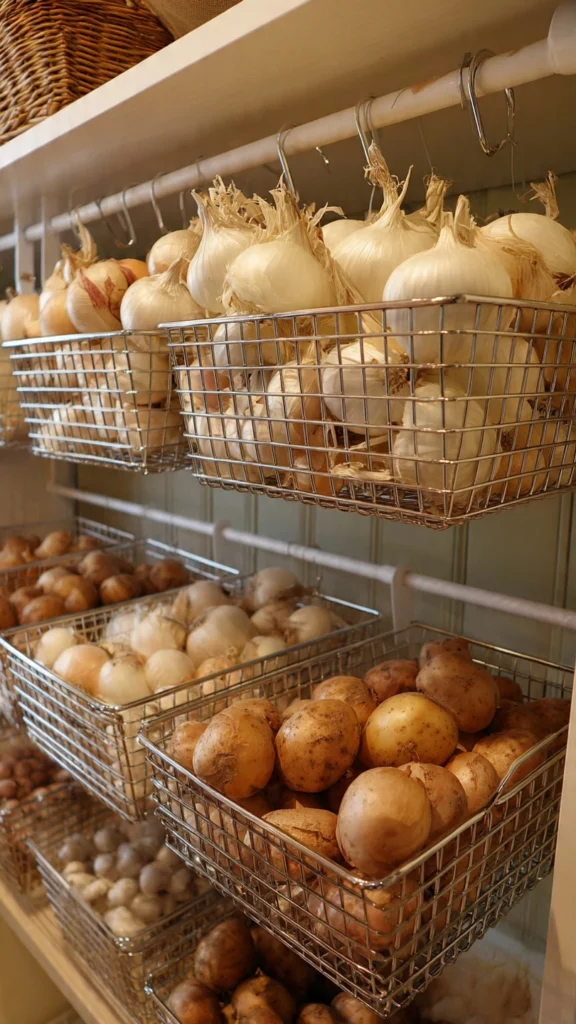
A rail system installed inside a pantry or larder cupboard — a horizontal bar or series of bars mounted on the interior walls from which baskets, hooks, and accessories can be hung — transforms a deep, dark pantry into a genuinely organised, accessible storage space where every item has a visible and reachable home.
Hanging baskets from a rail system keeps produce like onions, garlic, and potatoes off the shelf and circulating in air. Hook-mounted bins hold packets of snacks, dried goods, and frequently used ingredients. Rail-mounted spice racks keep the spice collection organised and visible on the inside of the pantry door. The system is completely modular and can be reconfigured as storage needs change.
Pro Tip: Install rail systems on the inside walls of the pantry rather than on the door alone. Door-mounted storage is limited by the weight the door hinges can support and by the clearance between the door and the shelves behind it. Wall-mounted rails can carry significantly more weight and create storage on surfaces that are typically left completely bare — which in a deep pantry represents an enormous amount of wasted space.
11. Corral Cleaning Products Under the Sink
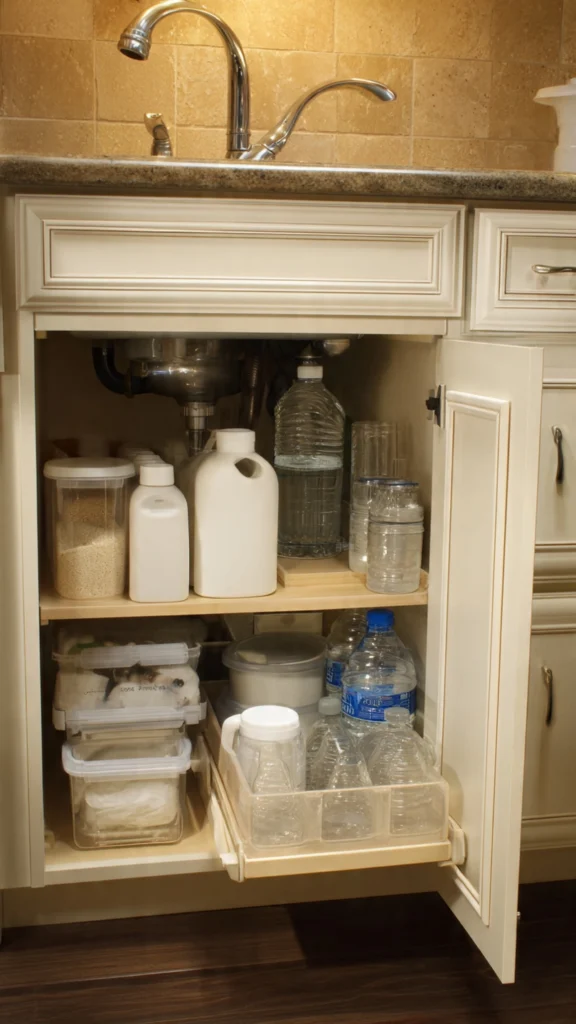
The cabinet under the kitchen sink is one of the most chaotically organised spaces in most homes — a jumble of cleaning products, spare sponges, bin bags, and miscellaneous items that have nowhere else to go. A simple combination of a turntable, a small tension rod across the cabinet width, and a tiered shelf insert transforms this cabinet from a black hole into a functional cleaning station.
Mount a tension rod across the cabinet and hang spray bottles from it by their trigger guards — this keeps them upright, accessible, and off the base of the cabinet, freeing floor space for other items. Place a turntable on the base for cleaning products so everything is accessible with a single spin rather than requiring you to remove the front row to reach the back.
Pro Tip: Line the base of the under-sink cabinet with an adhesive waterproof mat or a piece of cut-to-size shelf liner before organising it. The area under a kitchen sink is susceptible to minor leaks, condensation from pipes, and cleaning product drips — all of which damage unprotected cabinet bases over time. A waterproof liner protects the cabinet, is easy to wipe clean, and costs almost nothing.
12. Create a Command Centre for Paperwork and Admin
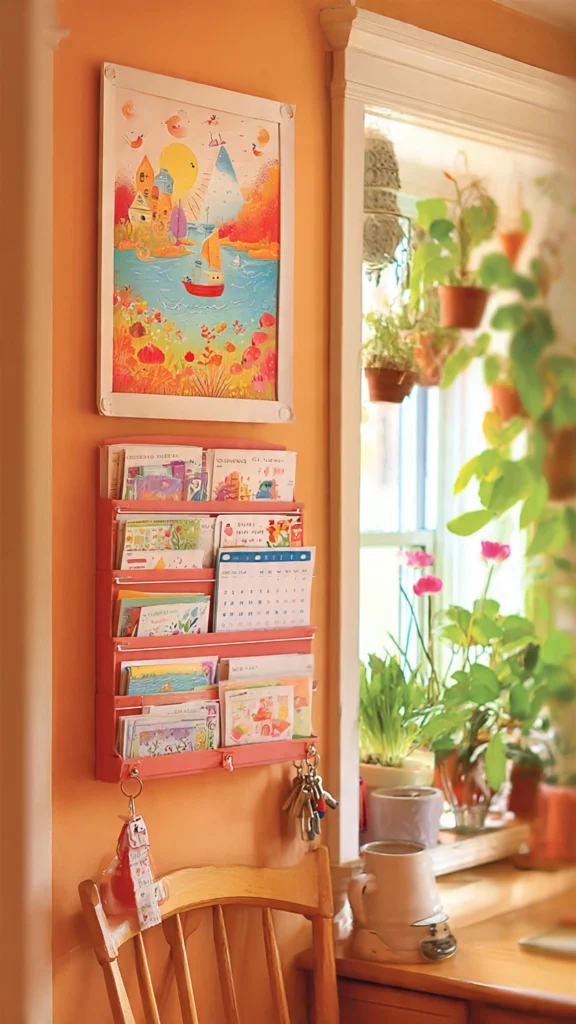
Kitchen counters and tables have a magnetic quality when it comes to paperwork — bills, school letters, takeaway menus, appointment cards, and general household admin accumulate on kitchen surfaces faster than almost anywhere else in the home. Creating a dedicated command centre — a small, defined area for household paperwork and admin — gives all of this material a home and keeps it off the surfaces where it does not belong.
A small wall-mounted organiser with sections for incoming post, outgoing items, and current paperwork, combined with a small calendar or whiteboard for scheduling and a hook for keys, creates a command centre that corrals household admin without allowing it to spread across the rest of the kitchen. Define the zone clearly, keep it small, and edit it regularly.
Pro Tip: Position the kitchen command centre near the main entry point to the kitchen — typically close to the back door or the door from the hallway — so that incoming items naturally land in the organiser rather than on the nearest available counter surface. Proximity to the point of entry is the single most important factor in how consistently a command centre gets used. A command centre positioned inconveniently across the kitchen will be ignored.
13. Organise the Fridge with Dedicated Zones and Bins
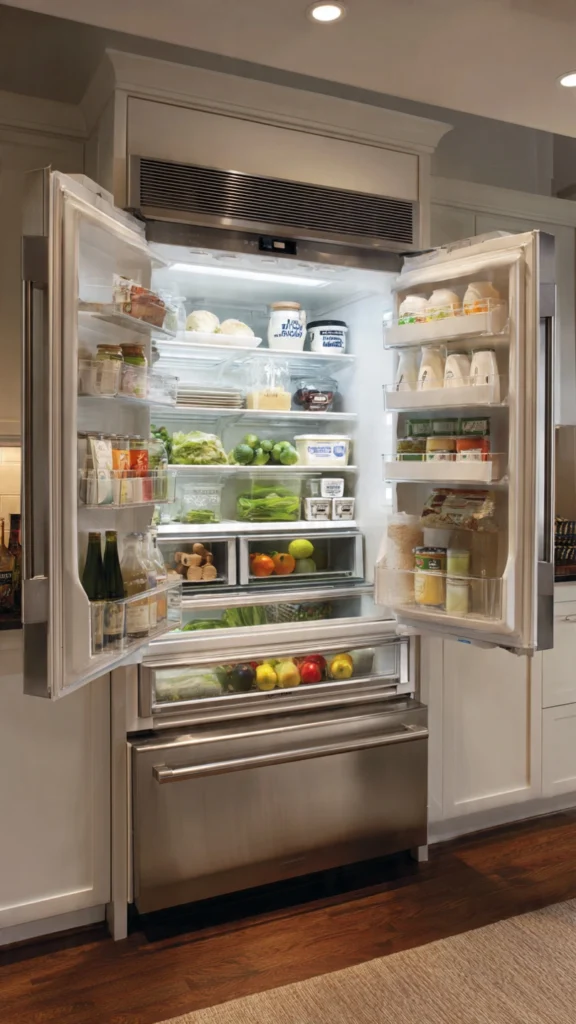
The inside of a refrigerator is as susceptible to organisational chaos as any cabinet or drawer — and the consequences of a disorganized fridge are more serious than most people realize. Items pushed to the back go unnoticed and expire. Different food types stored without separation lead to cross-contamination. And the simple inability to see what you have leads to duplicate purchases and significant food waste.
Assign a dedicated zone to each food category — dairy on one shelf, leftovers in a consistent spot, drinks in the door, produce in the drawer — and use small bins or clear containers to group related items within each zone. A dedicated leftover bin where all leftover containers are placed immediately after cooling means leftovers are never forgotten at the back of the fridge.
Pro Tip: Do a full fridge clean-out and reorganization immediately before your weekly grocery shop rather than after it. Cleaning out the fridge when it is relatively empty is significantly faster and less wasteful than doing it after new groceries have been added. It also gives you a clear picture of exactly what needs to be used up and what needs to be replenished — which makes the shopping list more accurate and reduces food waste measurably.
14. Adopt the One In One Out Rule for Kitchen Equipment
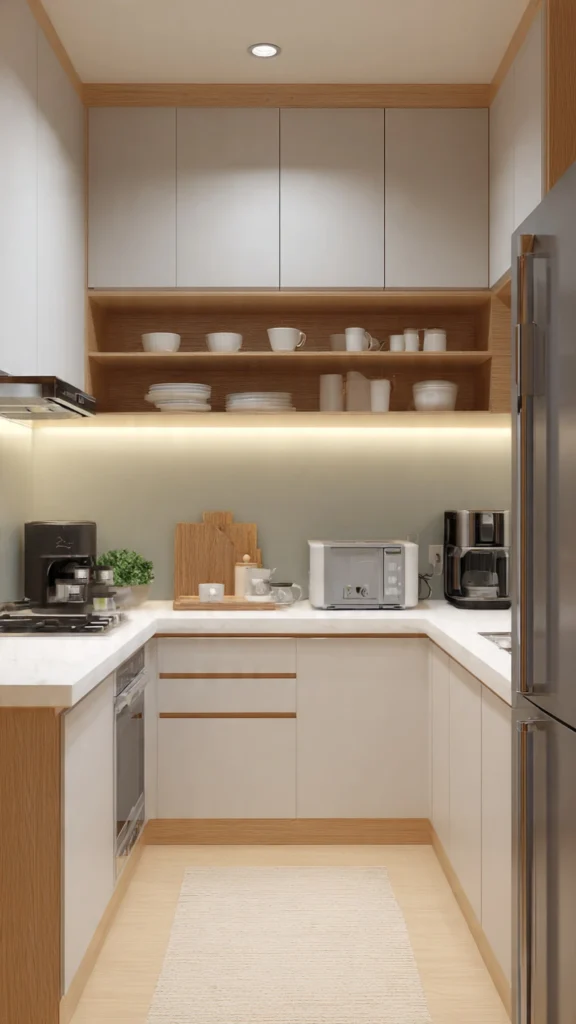
No amount of clever storage, labelling, or organizational systems will keep a kitchen genuinely organized long term if the volume of equipment, gadgets, and food items in it continues to grow unchecked. The single most effective long-term kitchen organization strategy is also the simplest — for every new item that comes into the kitchen, one existing item must leave.
The one in one rule prevents the slow accumulation of duplicates, unused gadgets, and excess equipment that gradually fills every available storage space until the kitchen reaches critical mass again. Applied consistently, it keeps the volume of kitchen possessions permanently in balance with the available storage — which means the organizational systems you put in place stay effective indefinitely.
Pro Tip: Apply the one in one out rule most strictly to kitchen gadgets and appliances — the category most prone to impulse purchasing and subsequent neglect. Before buying any new kitchen gadget, identify specifically which existing item it will replace and commit to removing that item before the new one arrives. This single moment of friction prevents a significant proportion of the unnecessary kitchen clutter that undermines even the best organizational systems over time.
A Kitchen That Works as Hard as You Do
The best organized kitchen is not the one with the most storage solutions, the most uniform containers, or the most elaborately labelled system. It is the one that has been thought through honestly — where things live where they are actually used, where the most reached-for items are the most accessible, and where the system is simple enough to maintain without effort.
Start with the area that frustrates you most. Fix that one thing properly. Then move to the next. Small, deliberate improvements made consistently will always outperform a single ambitious reorganization that is impossible to sustain. Your kitchen should work for you — and with the right organization in place, it genuinely will.