
15 Vintage Storybook Nursery Ideas
The nursery is the one room in the home where the imagination is given complete permission — the room where the adult design sensibility can set aside its commitment to restraint, its instinct toward the minimal and the sophisticated, and indulge the specific pleasure of creating a world within a room.
The vintage storybook nursery takes this permission and applies it with a particular tenderness and a particular cultural richness, drawing from the visual tradition of illustrated children’s books — the watercolor forests of Beatrix Potter, the pen-and-ink whimsy of E.H. Shepard, the botanical precision of Victorian natural history illustration, the romantic pastoral landscapes of the golden age of children’s book illustration from the late nineteenth and early twentieth centuries — to create a room that is simultaneously beautiful to the adult eye and genuinely magical to the developing imagination of the child who will grow up within it.
The vintage storybook aesthetic is not nostalgic for its own sake — it is a visual language of considerable richness and depth that happens to have been produced in an earlier era, and its application to the contemporary nursery creates a room of genuine warmth and lasting beauty rather than the trend-dependent aesthetic that will look dated before the occupant is old enough to remember it. Here are fifteen ideas for creating a vintage storybook nursery of complete magic and complete practicality.
1. Choose a Warm, Soft Color Palette Inspired by Watercolor Illustration
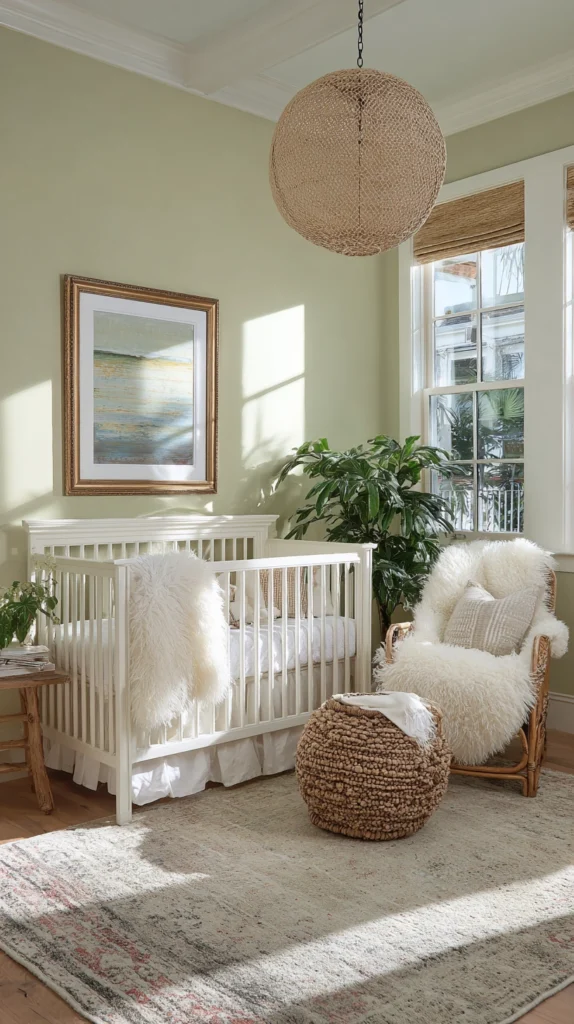
The vintage storybook nursery’s color palette is drawn from the specific quality of watercolor illustration — the soft, slightly faded tones of pigment applied in transparent washes over white paper, the colors that appear to be lit from within rather than from without, the warm palette without being saturated, and gentle without being insipid.
Warm cream as the room’s foundation — not the stark white of the contemporary nursery but the gentle, slightly yellow-tinted white of aged paper and old linen.
Soft sage green from the illustrated forest. Dusty rose from the watercolor garden. Warm terracotta from the illustrated cottage roof. Deep but faded navy from the storybook night sky. These colors should be applied with the layered, slightly worn quality of vintage illustration — no color perfectly flat, no surface without the slight tonal variation that age and the hand of the illustrator introduce.
Choose paints with a chalky, matte finish that captures the quality of the watercolor wash rather than the smooth perfection of modern emulsion, and layer them in combinations that reference the palette of a specific illustrator or a specific era of children’s book illustration that resonates most personally.
2. Wallpaper with a Vintage Botanical or Woodland Pattern
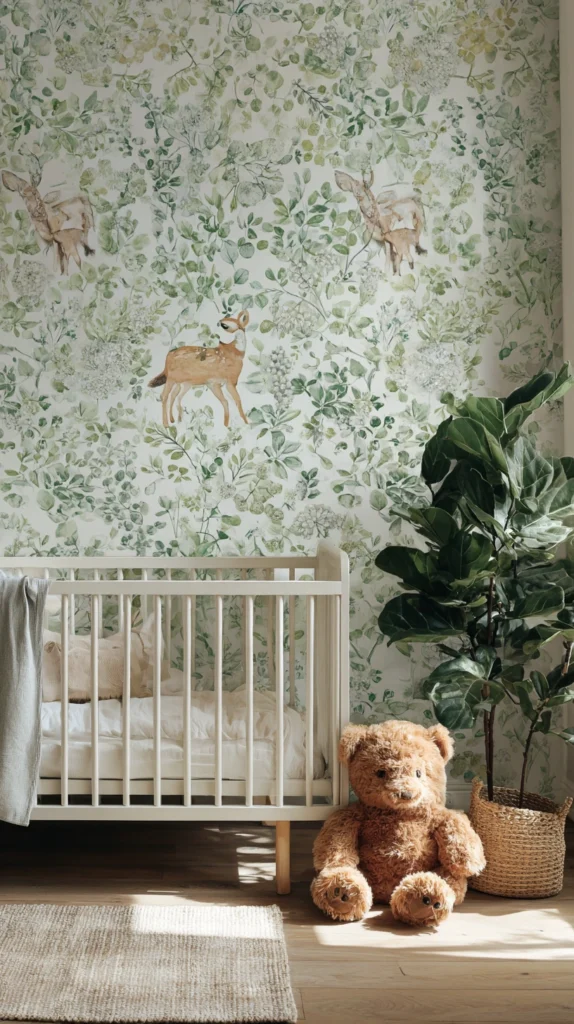
The wallpaper is the vintage storybook nursery’s most transformative single element — the surface treatment that most immediately creates the room’s narrative world and most powerfully communicates the specific visual language of the storybook illustration tradition.
A vintage botanical wallpaper — one whose pattern draws from the illustrated natural history traditions of the Victorian and Edwardian eras, with the detailed rendering of plants, flowers, and creatures that characterizes scientific illustration given the warmth and life of artistic interpretation — creates a nursery wall of extraordinary richness and visual complexity that will reward the child’s developing attention for years.
A woodland animal wallpaper in the manner of the golden age illustrators — rabbits and foxes and hedgehogs inhabiting a stylized forest of soft greens and warm ochres — creates the specific storybook world that the vintage nursery evokes most directly.
The pattern should be generous in its scale and complexity, because the nursery’s occupant will spend many hours lying, sitting, and later standing in direct proximity to the wall surface, and a pattern of sufficient complexity rewards that extended attention.
3. Install a Classic Vintage Crib or Cot
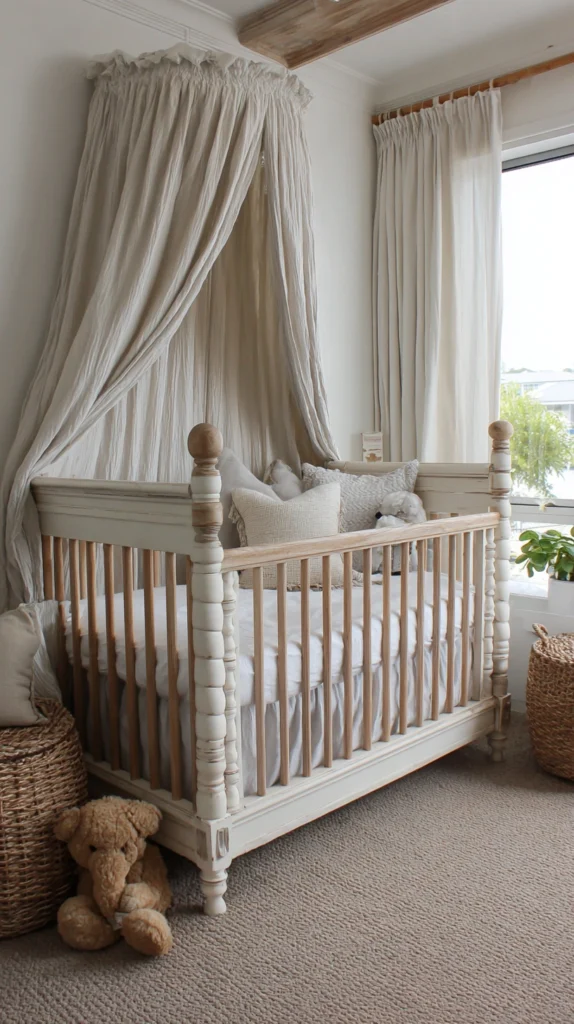
The crib is the nursery’s central piece of furniture — its most practically important element and its most visually significant — and the vintage storybook nursery’s version should be a piece of genuine character rather than the generic white MDF crib that most contemporary nursery furniture ranges offer.
A vintage-style iron crib with simple turned spindles and a gentle arching hood in a warm white or antique cream creates a sleeping vessel of considerable beauty and obvious period reference. A wooden crib with turned posts and a canopy frame — the canopy hung with sheer linen or cotton voile in a soft tone — creates a sleeping alcove of extraordinary intimacy and romance.
A genuine antique crib, if one can be found that meets current safety standards or can be adapted to meet them — with the appropriate mattress dimensions and spindle spacing — brings the authentic material quality and the genuine age that the vintage aesthetic most honestly requires.
Whatever the crib’s specific form, its finish should be in a tone drawn from the nursery’s warm palette — antique white, soft cream, or a pale sage — rather than the stark white that reads as contemporary rather than vintage.
4. Create a Reading Corner with a Vintage Armchair
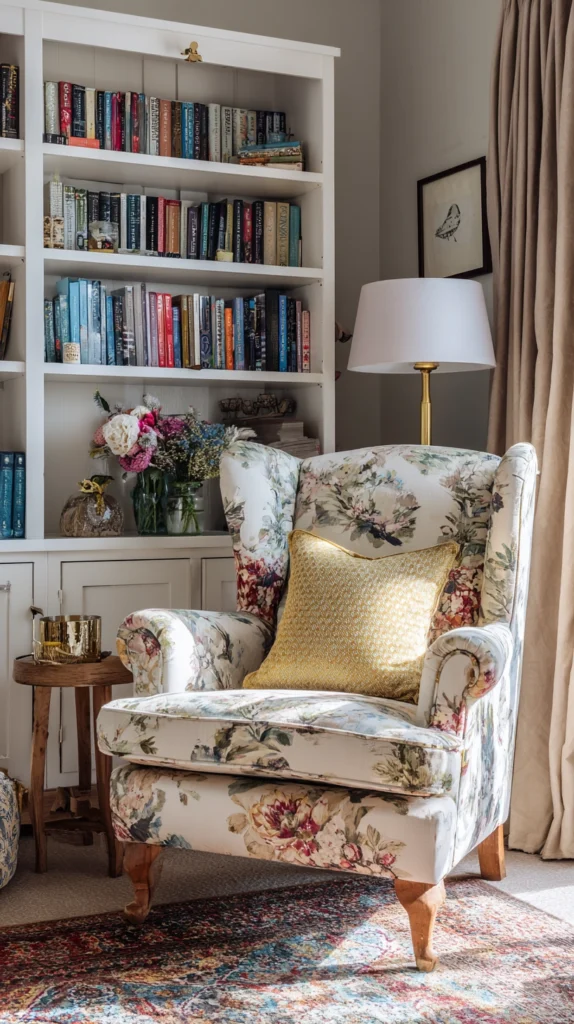
The reading corner is the vintage storybook nursery’s most important functional zone after the sleeping arrangement — the place where the child’s relationship with books and story begins, where the nightly ritual of bedtime reading creates the specific intimacy and the specific association between narrative and comfort that the storybook nursery’s entire aesthetic is designed to support.
A vintage armchair — an upholstered tub chair, a wingback in a soft floral or stripe, a nursing chair in an antique curved form — in a fabric drawn from the nursery’s palette and positioned in the room’s most comfortable corner creates the reading corner’s physical heart. A small bookcase positioned within reach of the chair, holding the child’s growing library of illustrated books with their spines facing outward.
A small side table for a lamp and a cup of something warm for the reading adult. A floor cushion or a small ottoman for the growing child to sit on independently. A lamp of warm, gentle quality that creates the specific quality of light that story and imagination require — warm, soft, focused, the light of a winter evening and a tale being told.
5. Display Vintage Children’s Book Illustrations as Wall Art
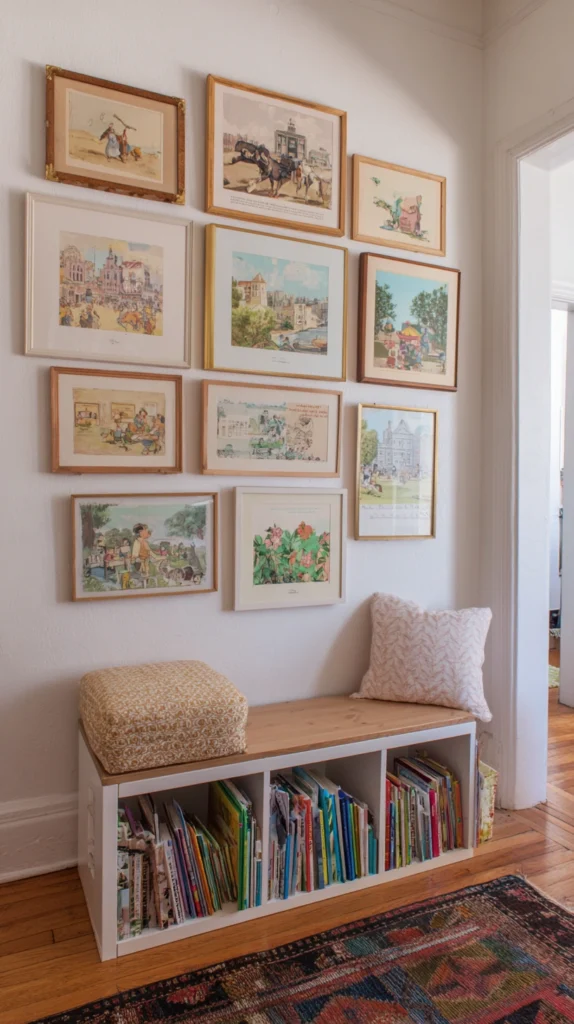
The vintage children’s book illustration — the original artwork or a quality reproduction print of the illustrations that have defined the visual language of childhood for generations — is the nursery wall’s most appropriate and most culturally resonant decorating element, and its display in simple frames creates a gallery of considerable beauty and personal meaning.
Original prints from the illustration traditions of Arthur Rackham, Beatrix Potter, Ernest Shepard, Kate Greenaway, and the many other illustrators who contributed to the golden age of children’s book illustration are available from specialist print dealers and quality reproduction sources, and their framed display creates a nursery art collection of genuine cultural depth.
The frames should be simple and warm — thin timber frames in a natural or painted wood tone, or simple white mount boards within a slightly larger frame — and the arrangement on the wall should be the loosely composed gallery that the storybook aesthetic favors over the rigidly geometric grid of contemporary gallery wall styling.
6. Use Natural Textiles Throughout
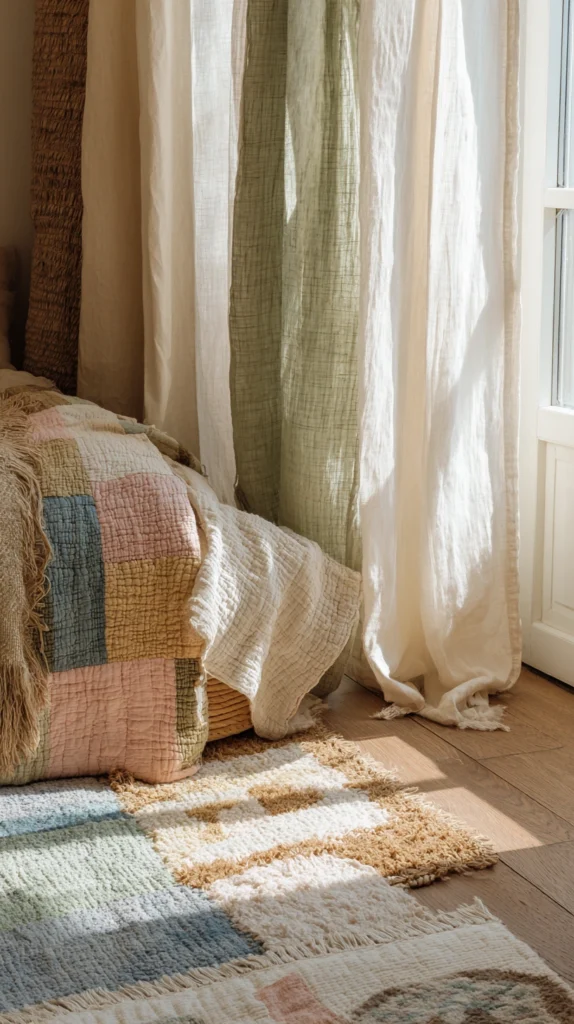
The vintage storybook nursery’s commitment to the materials of an earlier era extends to its textile choices — the natural, washable, soft materials that the pre-synthetic textile tradition produced and that the contemporary nursery’s functional requirements of easy laundering and sensory gentleness both support.
Linen curtains in a warm natural tone or a soft printed botanical pattern, their weight and drape creating the specific quality of a room dressed with care rather than efficiency.
Cotton quilts in vintage-style patchwork patterns — the hexagon and log cabin patterns of the Victorian quilting tradition — in fabrics drawn from the nursery’s color palette. Wool rugs in soft, warm tones with simple geometric or botanical borders that lie flat enough for the crawling and later playing child to move across freely.
Sheepskin throws on the reading chair. Embroidered cotton pillow covers on the cot cushion. These natural textile choices create a nursery of extraordinary sensory warmth whose materials are also, in their natural fiber composition, the most gentle against the child’s developing skin.
7. Incorporate a Vintage Toy Collection as Decoration
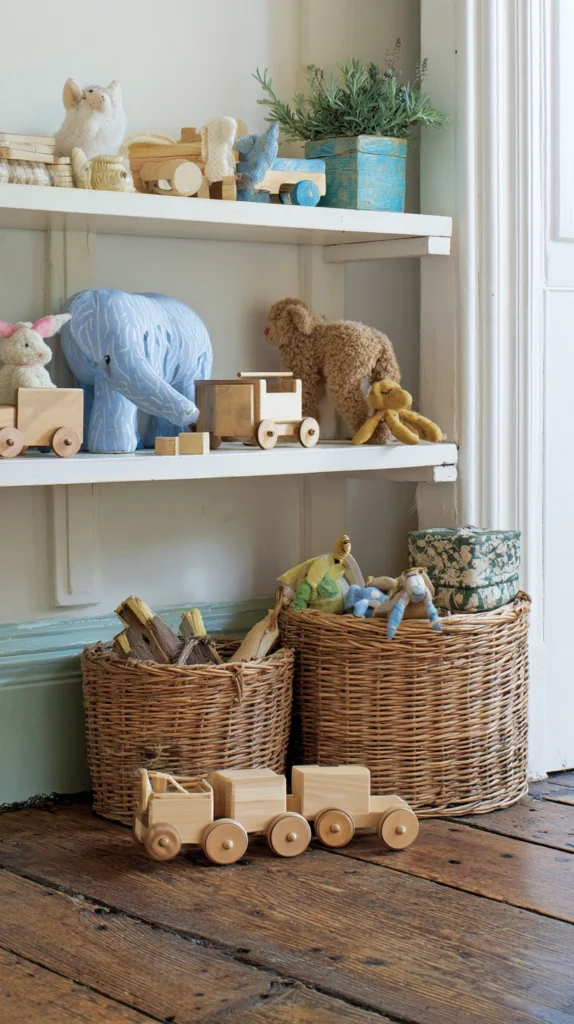
The vintage toy — the wooden pull-along, the cloth doll, the painted tin, the hand-sewn stuffed animal, the miniature wooden barnyard — is both a genuine play object and a decorating element of considerable charm in the vintage storybook nursery, and its presence on shelves, in baskets, and on ledges throughout the room creates the specific visual atmosphere of a childhood that is rich in imagination and material warmth.
A collection of vintage-style wooden toys displayed on a low shelf that the child can access independently creates both a decorating element for the early months and a play resource for the later months and years. Antique teddy bears and cloth dolls arranged on a high shelf, out of reach but visible, create the audience of soft characters that the storybook nursery’s narrative world requires.
A basket of natural wooden blocks beside the reading corner provides both a practical play resource and a warm visual element that relates to the nursery’s material palette.
The toy collection should be genuinely curated rather than randomly accumulated — chosen for the specific warmth, craft quality, and vintage character that relates to the nursery’s overall aesthetic language.
8. Add Fairy Lights and Warm Lighting for Magic
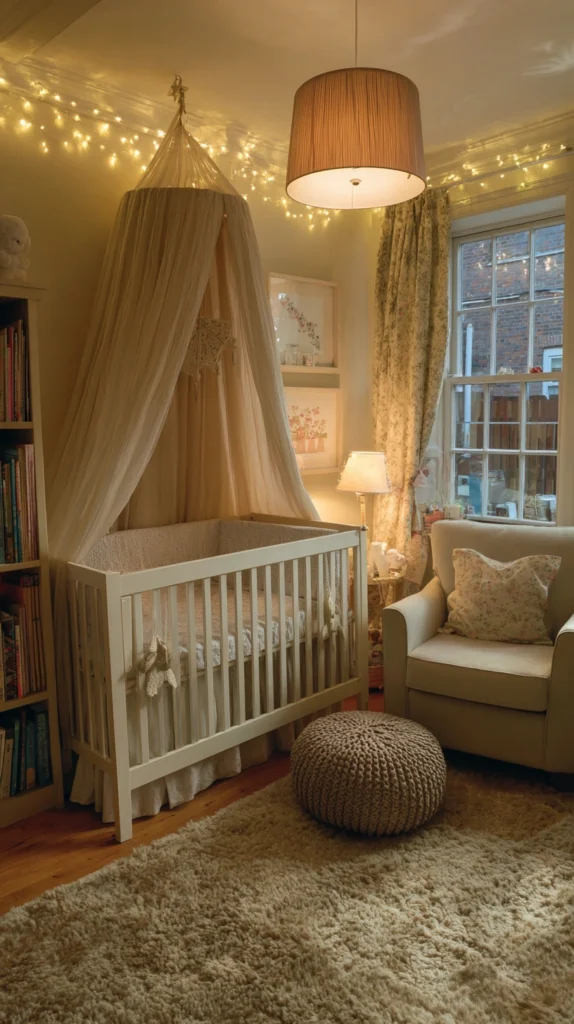
The lighting of the vintage storybook nursery should create the quality of magical illumination that the storybook itself creates — the warm, gentle light of a world that is slightly more beautiful and slightly more enchanted than the ordinary world beyond the nursery door.
A warm-toned pendant light as the room’s central fixture — an antique glass shade, a paper lantern in a warm natural tone, or a simple fabric shade in a botanical printed material — provides the ambient illumination whose quality sets the room’s atmospheric tone. A string of warm fairy lights along the crib’s canopy frame or along the window’s upper edge creates the specific magical quality of small, scattered warm light that children find consistently enchanting.
A nightlight of gentle warmth — a ceramic figure, a star projector in warm amber, or a simple lamp with a low-watt warm bulb — provides the residual illumination that children often need during the night without the disruption of the main light. All lighting in the nursery should be on dimmer switches that allow the light level to be adjusted from the full brightness of active, playful daytime to the near-darkness of settled sleep.
9. Create a Whimsical Forest Mural on One Wall
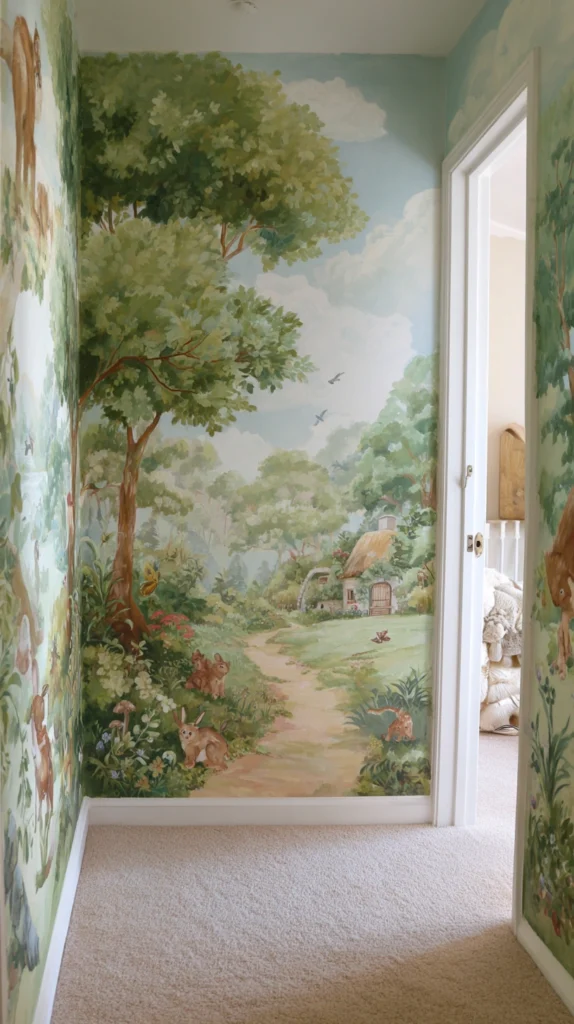
A hand-painted mural on the nursery’s primary wall — a forest scene in the manner of vintage illustration, with stylized trees in soft greens and warm ochres, woodland animals at different heights and depths within the forest composition, a path leading into the trees toward a suggested cottage or clearing, and the gentle, slightly mysterious quality of the illustrated forest at its most enchanting — creates a nursery feature of complete magic that no wallpaper, however beautiful, can replicate.
The mural’s advantage over wallpaper is its total specificity to the room — it can be scaled precisely to the wall’s dimensions, can incorporate elements of personal significance to the family, and can be painted in the exact tones of the nursery’s specific palette rather than the palette of a commercially produced product.
A local illustrator or muralist with an appropriate style can be commissioned for this project, and the investment is repaid across the full period of the child’s occupation of the room in the daily pleasure and the specific visual world that only a hand-painted mural provides.
10. Choose Furniture with Vintage Character
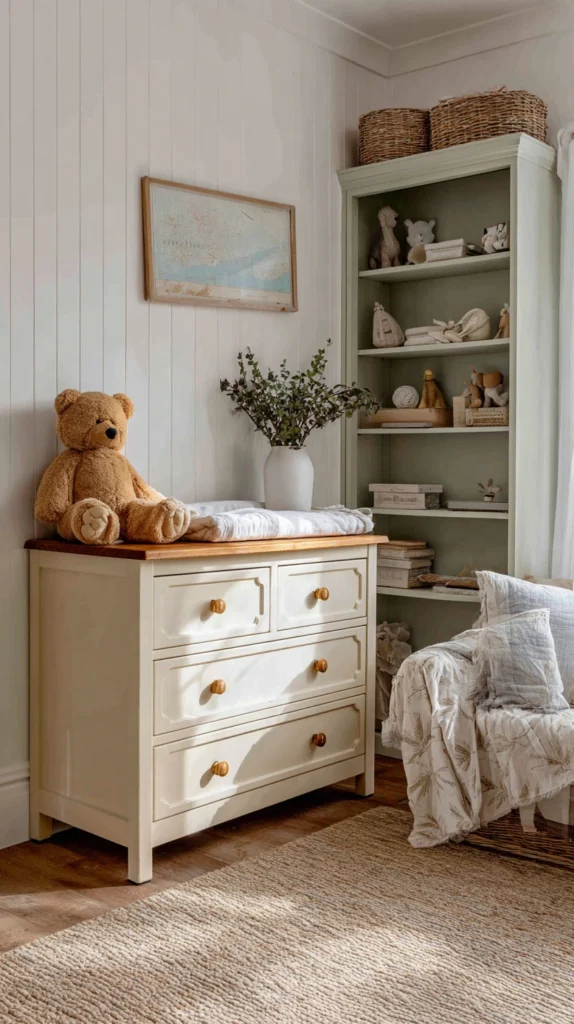
The furniture of the vintage storybook nursery beyond the crib should maintain the same period character and material warmth that the primary sleeping piece establishes — each piece in a natural timber or a painted finish that relates to the nursery’s palette, with the gentle curves and the hand-craftsmanship quality that the vintage aesthetic values over the precision of machine production.
A painted dresser in antique cream — its drawers holding the folded textiles of the early months before becoming a clothing storage piece as the child grows — with simple knob or drop handle hardware in a warm brass or ceramic. A small wardrobe in a matching painted finish with a simple interior organization of hanging rail and shelf.
A low bookcase in natural timber, its shelves at a height the child can access as soon as they are mobile. A changing table in a vintage-style painted finish, with a changing mat and a collection of organized storage baskets on its lower shelves. Each piece is chosen for its specific charm and material quality rather than the coordinated set that mass-market nursery furniture ranges offer.
11. Hang a Canopy Above the Crib for Enchantment
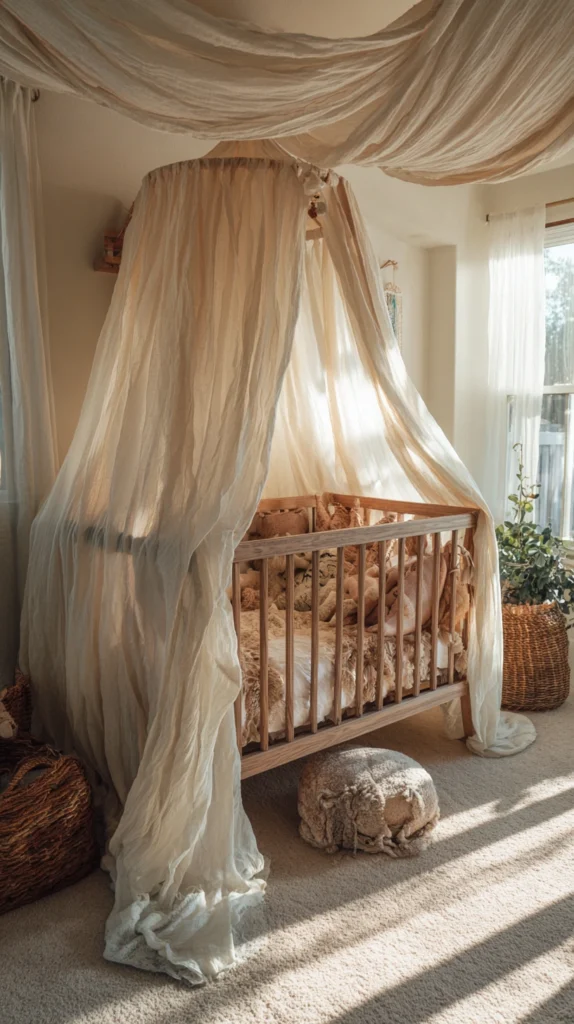
The canopy — a fabric drape suspended above the crib from a ceiling-mounted hook or a simple bent rod fixed to the wall, falling in soft folds around the sleeping space — creates the nursery’s most overtly magical element, transforming the crib from a functional sleeping vessel into the enclosed, intimate world that the storybook’s most enchanted spaces create.
The canopy fabric should be light enough to drape softly and create movement in gentle air currents — a sheer linen or a fine cotton voile in a warm cream or soft blush — and long enough to create the full enclosing quality of a dreaming space.
The canopy’s installation requires a ceiling hook of adequate strength and a fabric of sufficient length — allow at least three meters of fabric from the ceiling hook for a full, generous drape.
The effect created — the crib as a space within a space, softly enclosed in pale fabric that filters the room’s light into a gentle, diffused glow — is among the most beautiful and most consistently enchanting elements available in any nursery design.
12. Add Botanical Elements and Living Plants
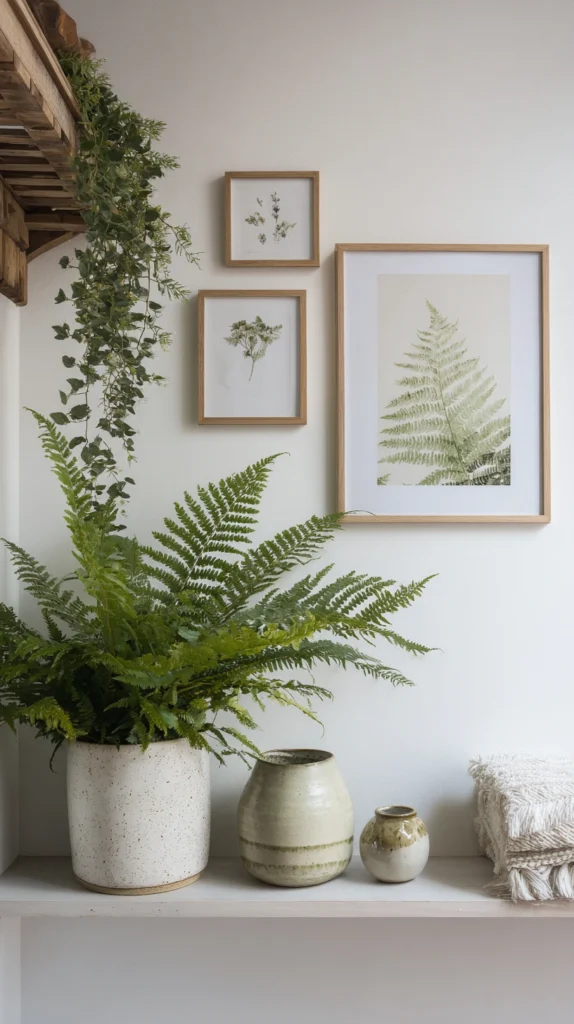
The vintage storybook nursery’s connection to the natural world — the gardens, forests, and pastoral landscapes that populate its literary and illustrative references — should extend beyond the illustrated and the printed to include genuine living plant material that brings the natural world’s specific quality of growth and organic beauty into the room.
A simple fern in a ceramic pot on a high shelf, out of reach of the developing child but visible as a living green element. Dried botanical wreaths in vintage-style frames on the wall beside the illustrated prints.
Pressed flower arrangements under glass, their botanical precision relating to the Victorian natural history illustration tradition. A small bunch of dried lavender hanging from a shelf bracket, its gentle scent creating the specific olfactory quality of the cottage garden.
These natural elements connect the nursery’s illustrated world to the actual natural world beyond its walls and create the multi-sensory richness that the vintage storybook aesthetic at its most complete achieves.
13. Create a Sky Ceiling with Stars or Clouds
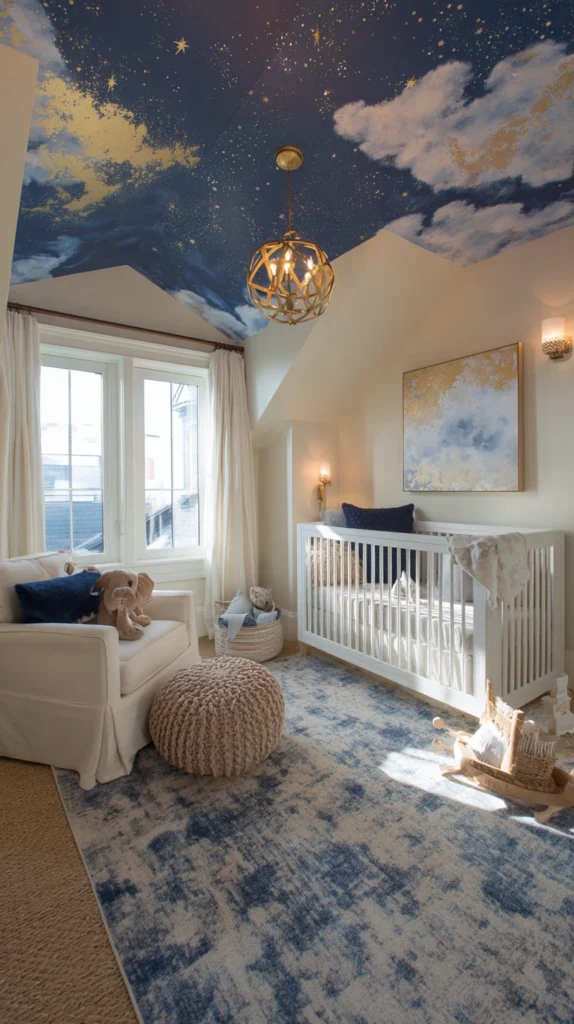
The nursery ceiling — looked up at from the crib, from the changing table, and from the floor during the extended periods of lying, playing, and simply existing that define the early months of a child’s life — is the surface that receives more sustained attention from the nursery’s occupant than any wall, and its treatment as a genuine design element rather than a simple painted surface creates a nursery of complete spatial consideration.
A painted sky ceiling — warm cream as the daytime sky, with hand-painted clouds in soft white and the occasional bird or balloon at gentle scale — creates an overhead world of organic, gentle beauty.
A night sky ceiling — deep navy with hand-painted or applied gold leaf stars in the constellation patterns that the nursery’s bedtime narrative might introduce — creates an overhead environment of extraordinary magic that the child will fall asleep watching for years. Star-shaped ceiling medallions in plaster surrounding the central light fitting create the decorative quality of the Victorian parlor ceiling applied to the nursery’s softer, more intimate context.
14. Organize Storage in Vintage-Style Baskets and Boxes
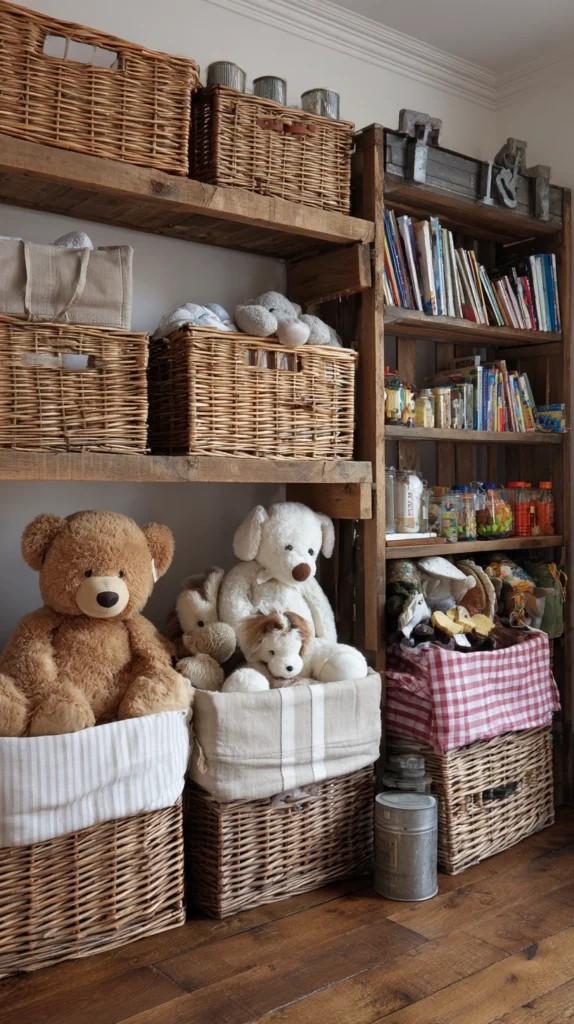
The nursery’s storage challenge — the enormous quantity of small items that the care of a young child requires, from nappies and wipes to small clothing and toy collections — is most practically and most aesthetically resolved in the vintage storybook nursery through the use of baskets, boxes, and containers of appropriate vintage character.
Wicker baskets in natural or painted tones, lined with cotton fabric in the nursery’s palette, holding folded blankets, stuffed animals, and the various soft items of the early months.
Cardboard storage boxes covered in vintage botanical or toile fabric, stacked on the dresser or shelving, holding the organized small items of the daily routine. Wooden crates in natural or painted timber, holding books, toys, and the growing collection of objects that the child’s development requires.
Ceramic pots and glass jars on the changing table surface, holding cotton wool, nappy cream, and the small items of care in an organized, beautiful arrangement. Each storage solution should be chosen for its specific vintage character and its visual contribution to the nursery’s aesthetic as well as its practical organizational function.
15. Design the Nursery to Grow with the Child
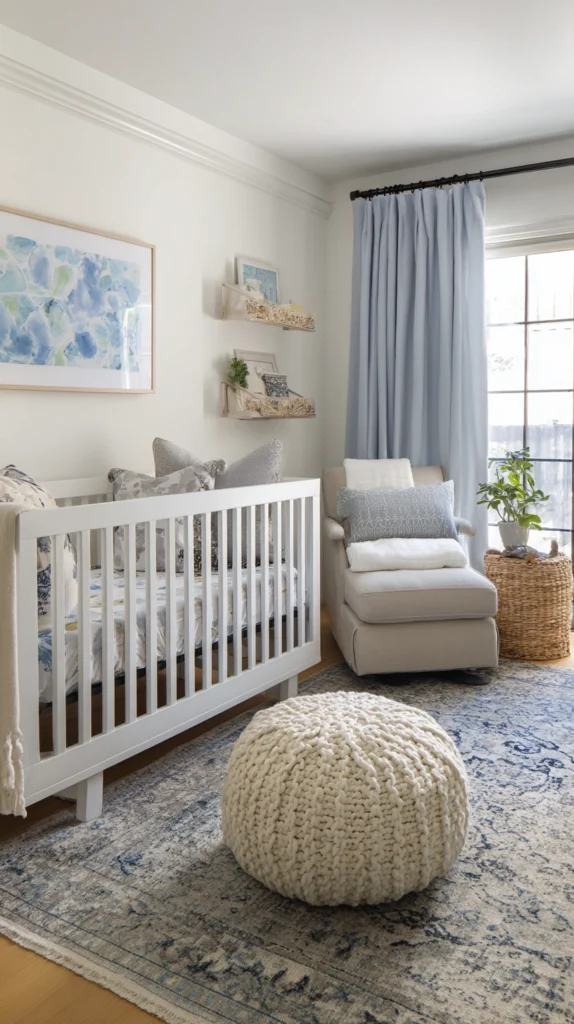
The final vintage storybook nursery idea is the most practically important and the most frequently overlooked in the enthusiasm of the initial design: the commitment to creating a room whose fundamental elements — the wall treatment, the furniture, the color palette — are sufficiently enduring in their beauty and their flexibility to grow with the child through the nursery years and beyond, rather than a room that is exquisitely appropriate for a newborn but requires complete redesign when the occupant reaches toddlerhood or early childhood.
The vintage storybook aesthetic is one of the most naturally longevous nursery design approaches available, because its references — the illustrated natural world, the warmth of natural materials, the gentle color palette — are as appropriate for a five-year-old’s imagination as for a newborn’s sensory environment.
The crib is the only element that requires mandatory replacement as the child grows — everything else can evolve through the addition of new books, new toys, new art, and the gradual accumulation of the child’s own creative work and personal objects, building a room that reflects the specific childhood being lived within it rather than the generic concept of childhood that a single, static design inevitably represents.