
Budget vs Premium Floor Cleaners: What Actually Works
I’ll never forget the moment I realized I’d been wasting money on floor cleaning products for years. Standing in the cleaning aisle, staring at a $28 bottle of premium floor cleaner next to a $3 generic version, I wondered: was I paying for results or just fancy packaging?
That question launched me into months of testing everything from dollar-store mops to high-end steam cleaners across the hardwood, tile, and laminate floors in my home. The discoveries surprised me—sometimes the expensive products delivered, but other times the budget options outperformed their premium competitors.
If you’ve ever questioned whether that expensive floor cleaning system is worth the investment, or wondered if cheap alternatives actually damage your floors over time, this guide will give you the answers I wish I’d had years ago.
The Real Cost of Floor Care
Your floors represent a massive investment in your home. Quality hardwood can cost $8-15 per square foot installed, tile ranges from $5-20 per square foot, and even laminate runs $3-8 per square foot. With the average home containing 1,500-2,000 square feet of flooring, you’re looking at a $10,000-40,000 investment.
Yet most homeowners spend more time researching a $200 vacuum than understanding how to properly maintain flooring worth tens of thousands of dollars.
I used to grab whatever floor cleaner was on sale, assuming all products were basically interchangeable. Then I noticed my hardwood developing a cloudy film that wouldn’t come off. A flooring professional informed me that the buildup was residue from my “all-purpose” cleaner—residue that was now permanently dulling my finish. Fixing it required professional refinishing at $3 per square foot.
That $800 mistake taught me that floor cleaning products aren’t all created equal, and that choosing the wrong one can cause damage far exceeding any money saved.
Understanding Your Floor Type Before Choosing Products
The biggest mistake people make is using universal cleaners on floors that need specific care. Each flooring material has unique characteristics that determine which cleaning products are safe and effective.
Hardwood Floors
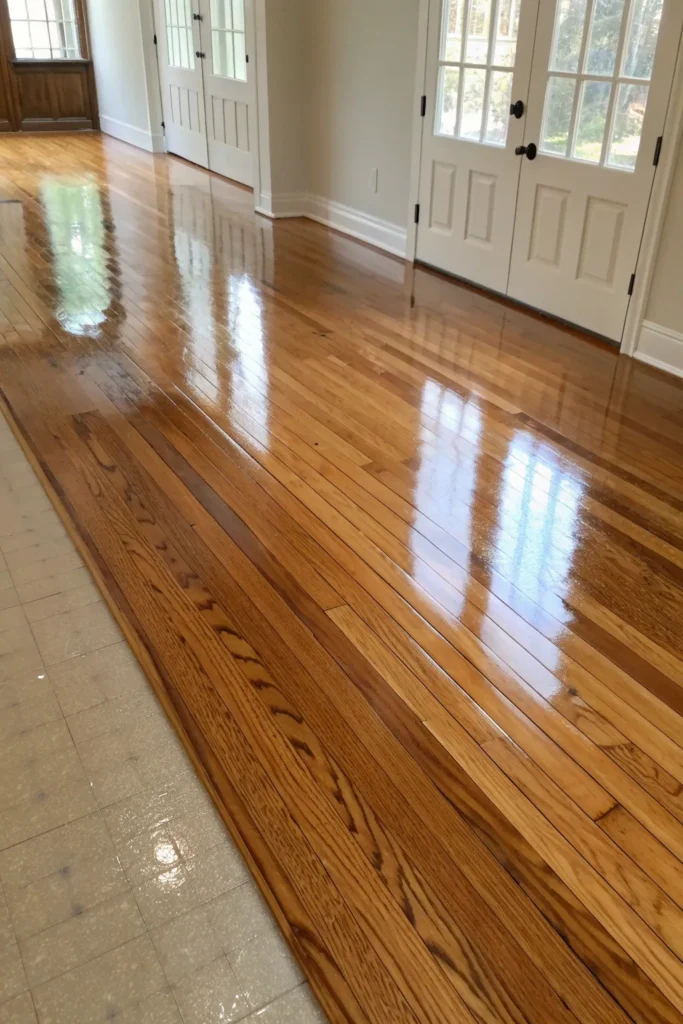
Hardwood is either sealed with polyurethane or finished with oil. The finish type completely changes which products you should use.
Polyurethane-sealed hardwood (the most common type) tolerates minimal moisture and pH-neutral cleaners. Water is actually hardwood’s enemy—excess moisture seeps between boards, causes warping, and damages the subfloor beneath. I learned this when enthusiastic mopping left standing water that seeped into seams and created cupped boards that needed replacing.
Oil-finished hardwood requires completely different care. These floors need regular oiling to maintain their finish and can’t tolerate water-based cleaners at all. Using the wrong product strips the oil finish and leaves wood unprotected.
Engineered hardwood is more water-resistant than solid hardwood but still requires pH-neutral products and minimal moisture. I treat mine similarly to solid hardwood to be safe.
Tile and Grout
Ceramic and porcelain tile are extremely durable and tolerate aggressive cleaning. The challenge isn’t the tile itself—it’s the grout lines between tiles.
Grout is porous and stains easily. Acidic cleaners can erode grout over time, while oils and waxes build up in the grout pores, attracting dirt. I initially used an oil-based cleaner on my kitchen tile that left grout lines looking progressively dirtier no matter how much I cleaned.
Natural stone tile (marble, granite, travertine) requires completely different care than ceramic. These stones are acid-sensitive—vinegar, lemon, and many commercial cleaners will etch and dull the surface permanently. My parents learned this the hard way when they used vinegar solution on their travertine, creating dull spots that required professional honing to correct.
Laminate Flooring
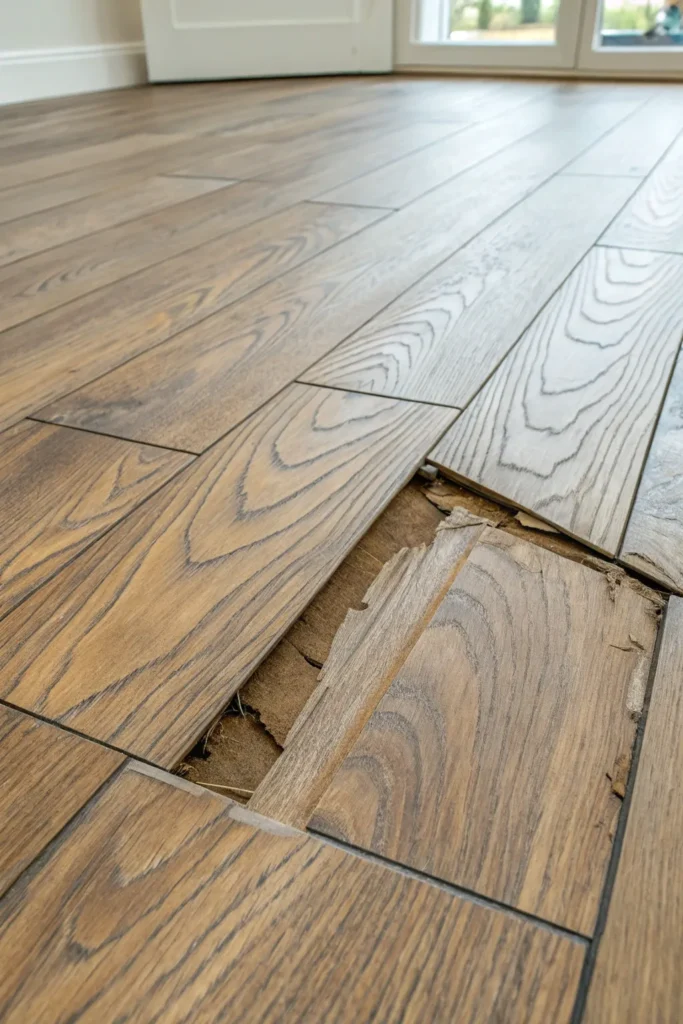
Laminate is a printed image covered with a protective layer, sitting on a compressed wood core. Despite looking like hardwood, it can’t be treated the same way.
The good news: laminate’s protective layer is durable and stain-resistant. The bad news: the wood core underneath swells and warps if moisture penetrates through seams. Using too much water on laminate is the fastest way to destroy it.
I ruined a section of laminate in my first apartment by using a traditional mop with excessive water. The boards swelled at the seams, creating permanent bumps in the floor that couldn’t be repaired.
Vinyl and Linoleum
These resilient floors are water-resistant and tolerate most cleaning products well. However, they can yellow or discolor from certain chemicals, and abrasive cleaners will eventually dull their finish.
The confusion comes because vinyl and linoleum look similar but aren’t identical. Linoleum is a natural material that needs pH-neutral cleaners, while vinyl is synthetic and more chemical-tolerant.
| Floor Type | Water Tolerance | pH Requirements | Avoid | Best Cleaning Method |
| Hardwood | Low | Neutral (7) | Excess water, acids, ammonia | Damp mop, dry immediately |
| Tile/Ceramic | High | Any | Oils on grout | Wet mop, steam |
| Natural Stone | Moderate | Neutral to Alkaline | Acids, vinegar | Damp mop, pH-neutral |
| Laminate | Very Low | Neutral | Standing water | Spray and wipe |
| Vinyl/Linoleum | High | Neutral | Abrasives | Wet mop, gentle |
Budget Floor Cleaning Methods
Method 1: The Basic Broom and Dustpan
This costs essentially nothing and forms the foundation of all floor care. Before testing various cleaning products, I established a baseline by simply sweeping my floors daily for a month.
The results were better than expected. Regular sweeping removes the abrasive dirt particles that scratch floors over time. Most visible floor damage comes from ground-in dirt acting like sandpaper under foot traffic—preventing this alone extends floor life significantly.
My sweeping technique:
- Sweep daily in high-traffic areas
- Use a soft-bristled broom on hardwood to avoid scratching
- Sweep in one direction, then cross-perpendicular to catch everything
- Empty the dustpan outside to prevent spreading dust
- Get into corners where dirt accumulates
The limitation is that sweeping only addresses surface dirt. It doesn’t clean sticky spills, remove stains, or sanitize floors. But as maintenance between deeper cleaning, it’s remarkably effective.
Cost: $10-25 for quality broom and dustpan Time: 5-10 minutes daily Effectiveness: Excellent for maintenance
Method 2: Vinegar and Water Solution
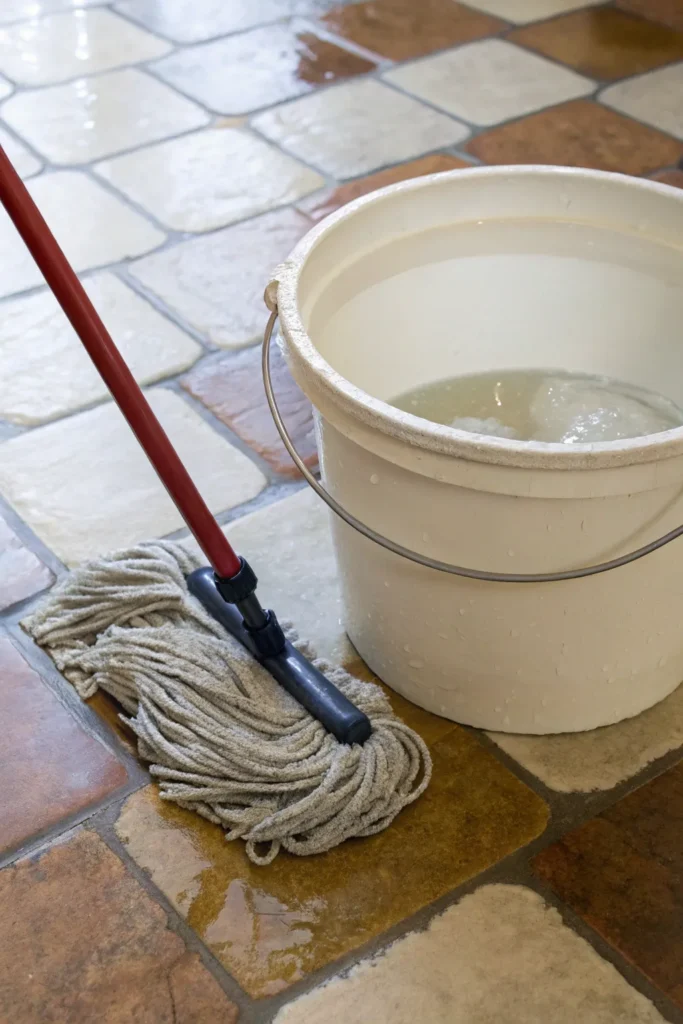
This is the most popular DIY floor cleaner, and for good reason—it’s cheap, natural, and actually works on appropriate floor types.
My recipe:
- 1/2 cup white vinegar per gallon of warm water
- Mix in a bucket
- Use with damp (not wet) mop
I tested this on my kitchen tile for three months and found it cleaned effectively without residue buildup. The floors stayed clean, dried quickly, and cost about 10 cents per cleaning.
However, vinegar has serious limitations. It’s acidic (pH around 2.5), which means it will damage hardwood finishes over time and should never touch natural stone. I made the mistake of using it on my hardwood once and noticed the finish looked slightly duller afterward.
Where vinegar works:
- Ceramic tile
- Porcelain tile
- Vinyl flooring
- Linoleum (in diluted form)
Never use vinegar on:
- Hardwood
- Natural stone (marble, granite, travertine)
- Waxed floors
Cost: $3 per gallon, lasts 20+ cleanings Pros: Natural, no residue, disinfects Cons: Limited to certain floor types, smell dissipates slowly
Method 3: Dish Soap and Water
A few drops of clear dish soap in warm water creates an effective, pH-neutral cleaner that’s safe for virtually all floor types.
My method:
- 2-3 drops of clear dish soap per gallon of warm water
- More soap isn’t better—excess creates residue
- Damp mop, then go over with clean water if needed
- Dry completely
I use this on my hardwood floors and it works beautifully. The key is using minimal soap. My first attempt used too much, and I spent an hour removing the streaky residue film.
The cleaning power is moderate—it handles everyday dirt and light stains but struggles with heavy grease or ground-in grime. For regular maintenance, though, it’s perfectly adequate.
Cost: $4 dish soap lasts 6+ months Time: 15-20 minutes for average room Best for: Hardwood, tile, laminate
Method 4: Microfiber Mop Systems
Microfiber revolutionized my floor cleaning. A basic microfiber mop ($20-40) with reusable pads cleaned better than my traditional string mop while using less water.
Microfiber’s tiny fibers trap dirt instead of pushing it around. The pads are machine-washable and last for years. I’ve used the same set of four pads for three years, rotating them through the washing machine after each use.
Why microfiber works:
- Cleans with just water on many surfaces
- Picks up rather than spreading dirt
- Uses minimal moisture (perfect for hardwood and laminate)
- No residue or streaking
- Machine-washable pads save money
I spray my floors lightly with a cleaning solution, then glide the microfiber mop over the surface. The floor dries within minutes, and the results match expensive systems.
Initial cost: $20-40 for mop and pads Ongoing cost: Virtually nothing Effectiveness: Excellent for all floor types
Method 5: Steam Mops
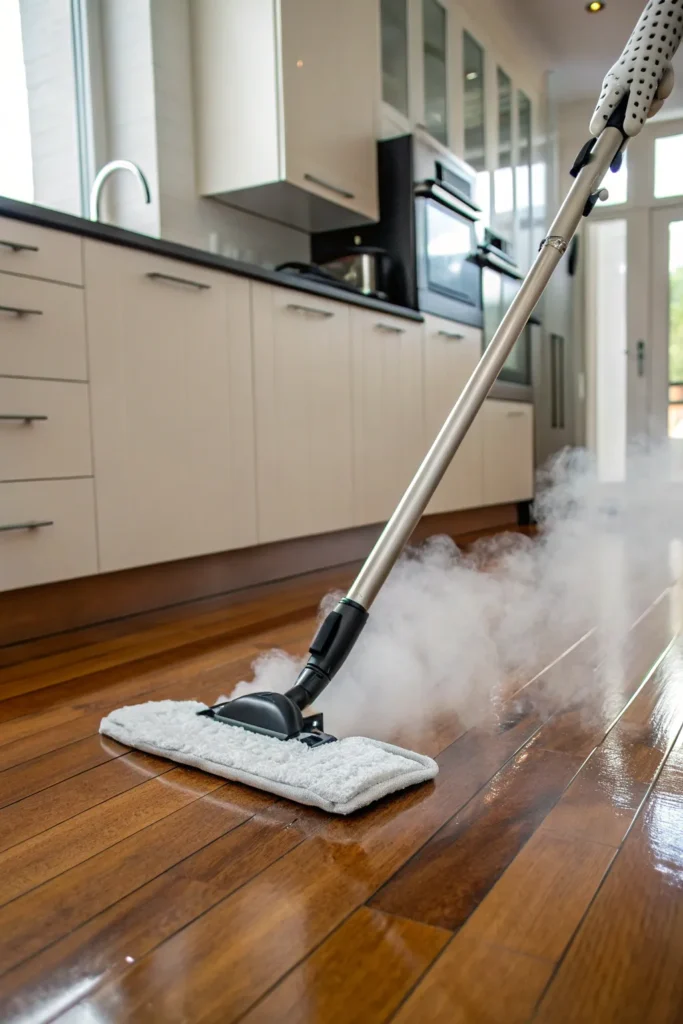
This represents the upper end of budget cleaning but bridges into premium territory at $50-120 for a basic model.
Steam mops use only water heated to 200+ degrees to sanitize and clean. No chemicals means no residue, and the high heat kills bacteria and germs that traditional mopping can’t touch.
I purchased a $70 steam mop and was initially skeptical about cleaning without chemicals. However, it exceeded expectations on my tile floors—removing stuck-on spills that required scrubbing with traditional methods.
Important limitations:
Steam mops work beautifully on tile but are controversial for hardwood. Manufacturers market them as hardwood-safe, but flooring professionals have mixed opinions. The heat and moisture can damage hardwood finishes and seep into seams over time.
I use mine exclusively on tile and vinyl, never on hardwood or laminate. When I tested it briefly on hardwood, I noticed the boards felt slightly rougher afterward—likely from the moisture raising the grain.
Best uses:
- Ceramic and porcelain tile
- Vinyl flooring
- Grout cleaning and sanitizing
Avoid on:
- Hardwood (controversial)
- Laminate (heat can damage)
- Natural stone (check manufacturer specs)
Cost: $50-120 Ongoing cost: Distilled water only Effectiveness: Excellent for tile, questionable for wood
| Budget Method | Initial Cost | Per-Use Cost | Time Required | Effectiveness | Best Floor Types |
| Sweep/Vacuum | $10-25 | $0 | 5-10 min | Maintenance | All |
| Vinegar Solution | $3 | $0.10 | 15-20 min | Good | Tile, vinyl |
| Dish Soap | $4 | $0.05 | 15-20 min | Good | All (careful amounts) |
| Microfiber Mop | $20-40 | $0 | 10-15 min | Very Good | All |
| Budget Steam Mop | $50-120 | $0.20 | 10-15 min | Excellent | Tile, vinyl only |
Premium Floor Cleaning Products and Systems
High-End Floor Cleaning Solutions
Premium floor cleaners cost $15-30 per bottle compared to $3-5 for budget options. I tested leading brands on identical floor sections to see if the price difference delivered actual performance improvements.
What I tested:
- Bona Hardwood Floor Cleaner ($20/32oz)
- Method Squirt + Mop ($8/25oz)
- Generic store brand ($3/32oz)
On hardwood, Bona performed noticeably better. It cleaned without streaking, dried faster, and left no residue even after months of use. The cheap generic cleaner left a dull film that gradually accumulated despite claims of being “residue-free.”
However, the mid-price Method cleaner performed almost as well as Bona at half the cost. This taught me that premium doesn’t always mean most expensive—sometimes mid-tier products offer the best value.
For tile cleaning:
- Black Diamond Stoneworks ($25/gallon)
- Zep Commercial Cleaner ($12/gallon)
- Homemade vinegar solution ($0.10/gallon)
On tile, the differences were minimal. All three cleaned effectively, though the premium cleaner had a more pleasant scent and perhaps slight better grout brightening. But the performance gap didn’t justify the 25x price increase over vinegar.
My conclusion: Premium cleaners make the most difference on hardwood and other finicky surfaces. On durable flooring like tile, budget options work nearly as well.
Professional-Grade Spray Mop Systems
Systems like Bona spray mops ($40-80) or Swiffer WetJet ($30) integrate the cleaning solution with the mop in a spray-and-clean design.
I tested a Bona spray mop system against my basic microfiber mop for six months. The Bona worked excellently—the spray trigger allowed precise solution application, the microfiber pad cleaned well, and the system felt premium and well-built.
However, my $25 microfiber mop with a separate $5 spray bottle delivered virtually identical results at a third of the cost. The integrated system was more convenient, but the cleaning performance was the same.
The real cost difference emerges over time. Bona’s replacement pads cost $10-15 for a two-pack, while generic microfiber pads cost $8-12 for a four-pack. The proprietary cleaning solution refills cost $8-12 per 32oz, while I can make equivalent solution for pennies.
Integrated system advantages:
- Convenience of one tool
- Consistent solution delivery
- Quality construction
- Specific formulas for your floor type
Separate components advantages:
- Lower initial cost
- Cheaper replacement parts
- Use any cleaning solution
- More flexible for different floor types
High-End Steam Cleaners
Premium steam cleaners ($150-400) like Bissell PowerFresh or Shark steam mops offer adjustable steam levels, larger water tanks, and better build quality than budget models.
I borrowed a $280 Shark steam mop from a friend to compare with my $70 budget steam mop. The Shark heated faster, held more water (meaning fewer refills), and had adjustable steam output.
The adjustable steam proved valuable—I could use low steam on delicate vinyl and high steam on grimy tile. My budget model only had one steam level, which sometimes felt too aggressive for vinyl and too weak for heavily soiled areas.
However, both cleaned tile equally well once operating. The Shark was more convenient and felt sturdier, but the cleaning results on tile were identical. Whether the convenience justifies 4x the price depends on how much floor space you clean regularly.
For households with large tile areas, the premium steam cleaner saves time and effort. For smaller spaces or occasional use, budget models work fine.
Robotic Floor Cleaners
Robot mops like iRobot Braava ($200-300) or Roborock ($300-500) automate floor cleaning entirely. I tested a Braava for three months to evaluate if automated mopping actually works.
The reality of robot mops:
They excel at maintenance cleaning—daily or every-other-day automatic mopping keeps floors consistently clean without effort. I programmed mine to run every evening after dinner, and my kitchen floor stayed noticeably cleaner than with my twice-weekly manual mopping.
However, robot mops don’t deep clean. They handle dust, light dirt, and minor spills but struggle with sticky messes or ground-in grime. When my daughter spilled syrup, the robot just spread it around. I had to manually clean the mess anyway.
Think of robot mops as automated maintenance, not complete floor cleaning solutions. They reduce how often you need to deep clean but don’t eliminate the need entirely.
Cost consideration:
At $200-500, robot mops are expensive. The value depends on your lifestyle and floor space. For busy households with large tile or vinyl floors, daily automated cleaning might justify the cost. For smaller homes or anyone who doesn’t mind mopping, the expense is harder to justify.
I ultimately returned my borrowed robot mop. While I enjoyed the automatic cleaning, I couldn’t justify spending $250 for convenience that only saved me 15 minutes twice a week.
| Premium Product | Cost | Key Advantage | Worth It? |
| Premium cleaners (hardwood) | $15-30 | No residue, better results | Yes |
| Premium cleaners (tile) | $15-30 | Marginal improvement | Probably not |
| Integrated spray mops | $40-80+ | Convenience | Depends on budget |
| Premium steam cleaners | $150-400 | Adjustable steam, capacity | If you have large tile areas |
| Robot mops | $200-500 | Automation | If you value convenience highly |
Direct Comparison Testing Results
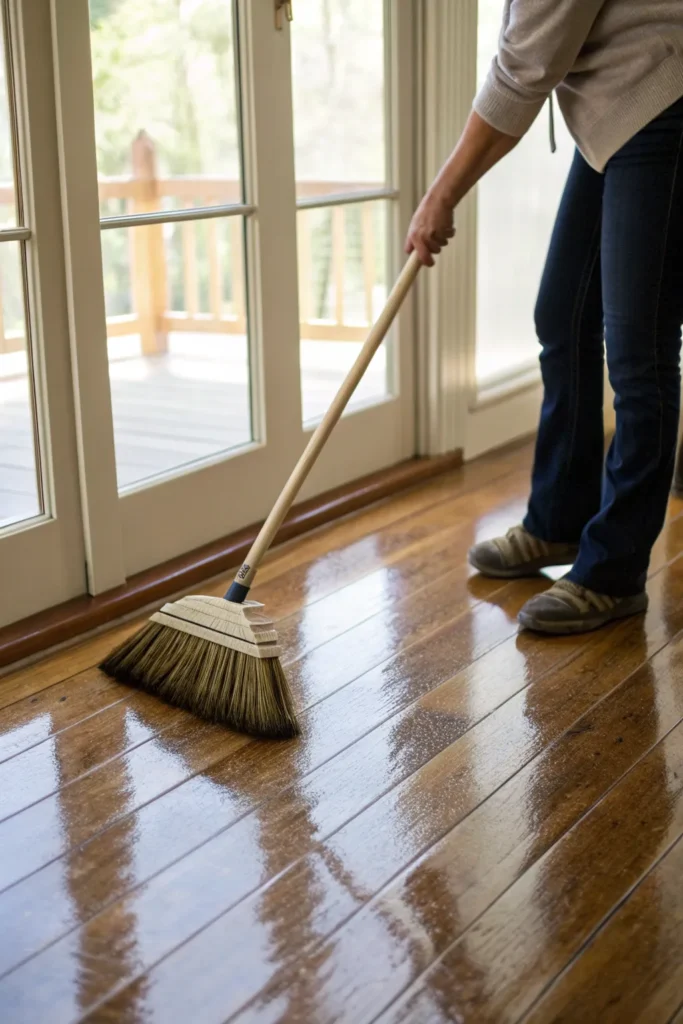
To definitively answer which products work best, I conducted side-by-side testing on identical floor sections with common messes.
Test 1: Everyday Dirt on Hardwood
Scenario: One week of normal foot traffic, including tracked-in dirt, dust, and light kitchen spills.
Products tested:
- Homemade dish soap solution
- Mid-range Method cleaner ($8)
- Premium Bona cleaner ($20)
- Plain water with microfiber mop
Results:
All products cleaned the visible dirt effectively. The differences appeared in the details:
Plain water left very slight streaking visible in direct sunlight. The floor looked clean but not quite perfect.
Dish soap solution cleaned well but required an extra pass with clean water to prevent residue buildup. Without this second pass, the floor felt slightly sticky after a few cleanings.
Method cleaner performed excellently with no residue or streaking. The floor looked and felt clean, dried quickly, and maintained its shine.
Bona cleaner delivered virtually identical results to Method, perhaps with slightly faster drying time.
Winner: Method cleaner for best value. Bona for those who don’t mind paying extra for marginal convenience improvements.
Test 2: Sticky Spills on Tile
Scenario: Dried soda spill, cooking oil splatter, and muddy footprints on kitchen tile.
Products tested:
- Vinegar and water
- Generic all-purpose cleaner
- Premium tile cleaner
- Steam mop
Results:
Vinegar solution required scrubbing but eventually removed everything. The low cost is appealing, but the extra effort was noticeable.
Generic all-purpose cleaner worked similarly to vinegar with slightly less scrubbing needed.
Premium tile cleaner cleaned with minimal scrubbing and left the floor looking slightly brighter. Whether this justifies the higher cost is debatable.
Steam mop was the clear winner. It removed sticky spills without any scrubbing, sanitized with heat, and dried almost instantly. For tile, steam cleaning outperformed all chemical cleaners regardless of price.
Winner: Steam mop for performance. Vinegar solution for budget-conscious cleaning.
Test 3: Grout Cleaning
Scenario: Kitchen grout lines with accumulated dirt and staining from two months of regular use.
Products tested:
- Baking soda paste with scrub brush
- OxiClean solution
- Professional grout cleaner ($15)
- Steam mop with grout brush attachment
Results:
Baking soda paste (mixing baking soda with water to create thick paste) cleaned grout effectively but required significant scrubbing. My arm was tired after cleaning a 4×6 foot section.
OxiClean solution lightened grout noticeably with less scrubbing. Spray it on, wait 10 minutes, then scrub and rinse. Results were impressive for a $6 product.
Professional grout cleaner worked marginally better than OxiClean with slightly less scrubbing required. Not worth triple the price in my testing.
Steam mop with grout attachment cleaned best with least effort. The concentrated steam loosened dirt that wiped away easily. Grout looked nearly new after one pass.
Winner: Steam mop for effectiveness. OxiClean for budget choice.
Test 4: Water Sensitivity on Laminate
Scenario: Testing how different cleaning methods affect laminate’s water-sensitive core.
Products tested:
- Traditional wet mop
- Spray and wipe with microfiber
- Barely damp microfiber mop
- Steam mop (against manufacturer recommendations)
Results:
Traditional wet mopping left standing water in seams for several minutes. While it dried without immediate damage, this amount of moisture makes me nervous about long-term effects.
Spray-and-wipe method (spraying floor lightly, immediately wiping with microfiber) cleaned well with minimal moisture. The floor dried within 2-3 minutes.
Barely damp microfiber (mop wrung nearly dry) gave similar results to spray-and-wipe, perhaps slightly more effort but equally safe.
Steam mop left boards feeling slightly swollen at the seams after drying. While not visible damage, I could feel a slight texture change. This confirmed my suspicion that steam and laminate don’t mix.
Winner: Spray-and-wipe or barely damp microfiber for laminate safety and effectiveness.
The Science Behind Cleaning Products
Understanding why certain products work helps you make smarter purchasing decisions instead of falling for marketing claims.
pH Levels and Floor Safety
The pH scale (0-14) measures how acidic or alkaline a solution is. pH 7 is neutral. Most floor finishes are damaged by strong acids or strong alkalines.
Floor-safe pH ranges:
- Hardwood: 6-8 (neutral)
- Tile: 5-10 (wide tolerance)
- Natural stone: 7-10 (never acidic)
- Vinyl/Linoleum: 6-8 (neutral)
Vinegar (pH 2.5) is acidic enough to slowly etch hardwood polyurethane and will permanently damage marble. Ammonia (pH 11.5) is alkaline enough to dull floor finishes over time.
Premium floor cleaners are formulated to specific pH ranges for each floor type. Budget alternatives often use pH-neutral dish soap as a base, which is why the dish soap method works across multiple floor types.
I tested pH strips on various cleaning solutions and discovered that some “all-purpose” cleaners marketed for floors had pH levels of 10-11—far too alkaline for hardwood. This explained why these products left my floors looking progressively duller.
Surfactants and Cleaning Power
Surfactants are molecules that allow water to bond with oils and dirt, making them washable. All cleaners contain surfactants—the differences are in type and concentration.
Premium cleaners often use multiple surfactant types for different soil types. Budget cleaners typically use one or two basic surfactants. For everyday cleaning, basic surfactants work fine. For heavy grease or stubborn soil, multiple surfactants may deliver noticeably better results.
Dish soap is primarily surfactant, which is why diluted dish soap cleans effectively. The premium floor cleaner advantage comes from pH optimization and added ingredients that prevent residue or enhance drying.
Residue Formation
Cleaning residue—the cloudy film that gradually dulls floors—forms when cleaners leave behind non-volatile compounds after the water evaporates.
Budget cleaners often contain fillers, fragrances, and other ingredients that don’t evaporate. With repeated use, these build up on your floor. Premium cleaners are formulated with volatile compounds that evaporate completely.
This is the main justification for premium hardwood cleaners. On tile, residue is less problematic because you can use stronger cleaners periodically to strip it away. On hardwood, residue accumulates until professional refinishing is required.
My experience confirmed this. After six months using a cheap “hardwood cleaner,” my floors developed visible haze. Switching to pH-neutral dish soap (which contains minimal additives) or premium Bona cleaner prevented further buildup.
When Budget Methods Fall Short
Budget cleaning works for regular maintenance, but certain situations require premium products or professional intervention.
Deep-Set Stains
Wine, pet urine, and other penetrating stains that have soaked into wood grain need specialized treatments. I tried every budget remedy on a pet urine stain in hardwood before finally using an enzymatic cleaner ($25) specifically formulated for wood floors. Only the specialized product removed the stain without damaging the finish.
For grout stains, peroxide-based cleaners ($10-15) worked far better than baking soda or vinegar. The whitening power of peroxide specifically targets grout discoloration.
Damaged or Worn Finishes
If your floor finish is worn through to raw wood, no cleaning product will restore it. I spent months trying different products on a high-traffic area where the polyurethane had worn away, thinking the right cleaner would fix it. Eventually, I accepted that the area needed refinishing.
Similarly, scratched or gouged floors need repair, not different cleaning products. Budget methods can’t fix physical damage.
Professional Restoration Services
When my hardwood developed extensive residue buildup from using the wrong cleaners, I hired a professional floor cleaning service ($150 for 800 square feet). They used industrial buffers with special pads and professional-grade cleaners to remove the buildup without damaging the finish.
The investment saved me from $3,000 refinishing. Sometimes professional service is the budget-smart choice because it prevents more expensive repairs.
Creating Your Optimal Floor Cleaning Strategy
The most cost-effective approach combines budget maintenance with strategic use of premium products and occasional professional service.
My Current Routine by Floor Type
Hardwood floors:
- Daily: Sweep or vacuum high-traffic areas
- Weekly: Damp mop with pH-neutral dish soap solution or mid-range Method cleaner
- Monthly: Inspect for wear or damage
- Annually: Professional deep cleaning if needed ($150-200)
This keeps my hardwood looking excellent while spending less than $50 per year on products.
Kitchen and bathroom tile:
- Daily: Sweep or vacuum
- Weekly: Clean with vinegar solution or steam mop
- Monthly: Deep clean grout with OxiClean
- Quarterly: Consider professional grout sealing if grout shows staining ($100-200)
Annual cost: $20-30 in cleaning products, plus occasional professional grout service.
Laminate flooring:
- Daily: Sweep high-traffic areas
- Twice weekly: Spray and wipe with barely damp microfiber
- Monthly: Inspect seams for any moisture damage
- Never: Use steam mops or excessive water
Annual cost: $10-15 in cleaning products.
Mixing Budget and Premium Products
My kitchen uses this hybrid approach:
Budget products I always use:
- White vinegar for tile
- Baking soda for scrubbing
- Microfiber mops and pads
- Plain dish soap for most cleaning
Premium products worth the investment:
- Bona hardwood cleaner for my living room ($20, lasts 6 months)
- OxiClean for grout ($6, lasts months)
- Quality microfiber pads ($20 for set that lasts years)
Professional services I schedule:
- Annual hardwood deep cleaning
- Grout sealing every 2-3 years
- Refinishing hardwood every 8-10 years
This strategy costs approximately $200-300 annually including professional services, compared to $600-800 using all premium products or professional cleaning exclusively, or potential thousands in floor replacement from using inappropriate budget methods.
Calculating Your Personal Cost-Benefit
To decide which products justify their premium prices, calculate your specific situation:
Time value calculation:
- If a premium product saves 30 minutes per week
- And your time is worth $25/hour
- That’s $12.50 weekly savings in time value
- Or $650 annually
If the premium product costs $100 more per year than budget alternatives, it’s financially justified by time savings alone.
Floor value calculation:
- If hardwood cost $15,000 to install
- Expected lifespan is 15 years with proper care ($1,000/year depreciation)
- But improper cleaning reduces lifespan to 10 years ($1,500/year depreciation)
- The extra $500 annual depreciation from poor cleaning far exceeds premium product costs
For expensive flooring, premium products designed for that specific floor type are usually justified investments.
Convenience factor:
- Some premium products simply make cleaning less unpleasant
- If you avoid cleaning because you dislike it, premium tools that make cleaning easier may improve consistency
- Consistent budget cleaning beats inconsistent premium cleaning every time
| Scenario | Best Approach | Estimated Annual Cost |
| Mostly tile, limited hardwood | Budget methods with occasional premium | $50-100 |
| Extensive hardwood flooring | Mid-range products, annual professional | $200-400 |
| Mixed flooring types | Hybrid approach, targeted premium | $150-300 |
| High-value flooring | Premium products throughout | $400-600 |
| Very large home | Robot maintenance + periodic deep clean | $300-500 |
Common Floor Cleaning Mistakes to Avoid
I’ve made every error possible while learning optimal floor care. These are the most costly mistakes and how to prevent them.
Using Too Much Water
This is the most common mistake across all floor types. Even water-tolerant tile suffers from excessive moisture in grout lines and subfloors.
For hardwood and laminate, it’s catastrophic. I watched a friend mop her laminate with a sopping wet mop, leaving puddles. Within weeks, boards were swelling and separating at seams. The entire floor needed replacement at $4,000.
The rule: your mop should be damp enough to clean but dry enough that it leaves no standing water. If you can see water sitting on the floor after mopping, you’re using too much.
Ignoring Manufacturer Guidelines
Every floor comes with care instructions. Following them prevents warranty-voiding damage.
I ignored warnings about acidic cleaners on my parents’ limestone floors because “vinegar is natural and cleans everything.” The etching damage required professional restoration costing $800. Reading the installation manual would have prevented this entirely.
Using Dirty Mops
Mopping with a dirty mop just spreads dirt around. I used to use the same mop pad for my entire house before washing it, essentially transferring bathroom germs to kitchen floors.
Now I use separate pads for different areas and wash microfiber pads after every use. This simple change dramatically improved cleaning effectiveness.
Overlapping Cleaning Products
Using multiple products in sequence can create chemical reactions or residue buildup. I once cleaned with a commercial floor cleaner, then followed with vinegar solution thinking it would enhance cleaning. Instead, the acid-alkaline reaction created a sticky mess requiring hours to remove.
Choose one appropriate product and use it consistently.
Neglecting Regular Maintenance
Waiting until floors look dirty before cleaning allows dirt to become ground-in and difficult to remove. Regular light cleaning prevents the need for aggressive deep cleaning that’s harder on both floors and your back.
I clean high-traffic areas twice as frequently as other areas, preventing wear patterns from becoming visible.
Specialized Situations and Solutions
Pet Owners
Pets require modified floor cleaning approaches. Urine, in particular, can permanently damage hardwood if not addressed immediately.
My pet-owner protocol:
- Keep enzymatic cleaner accessible for immediate accident cleanup ($15-20 bottle lasts months)
- Use slightly more frequent cleaning schedule
- Consider area rugs in pet zones to protect flooring
- Steam mop pet areas weekly for sanitization (tile only)
The enzymatic cleaner investment is non-negotiable. Standard cleaners don’t break down organic compounds that cause odors and stains.
Homes with Allergies or Asthma
Floor cleaning directly impacts indoor air quality. For sensitive households, certain products and methods work better.
Air quality considerations:
- Avoid fragranced products that trigger reactions
- Use HEPA vacuum before wet cleaning to prevent dust dispersion
- Steam cleaning sanitizes without chemical exposure
- Open windows during cleaning for ventilation
I switched to unscented dish soap and vinegar after my daughter’s asthma worsened. Her symptoms improved noticeably within weeks.
High-Traffic Commercial Spaces
Commercial floors endure significantly more wear. Budget methods typically can’t keep up with commercial demands.
For business settings, professional maintenance contracts ($100-300 monthly depending on space) usually provide better value than DIY approaches. The frequency and expertise required justifies the cost.
Historic or Antique Flooring
Older floors may have finishes or wood types that require specialized care. Modern products can damage historic finishes.
I have 100-year-old pine floors in one room. Standard cleaners were too harsh for the original shellac finish. A specialty cleaner recommended by a restoration expert ($35) works effectively without damage.
When dealing with valuable or historic flooring, professional guidance prevents irreversible mistakes.
The Verdict: What Actually Works
After extensive testing, here’s what I’ve concluded about budget versus premium floor cleaning products:
Budget methods work excellently when:
- Cleaning durable tile and vinyl floors
- Performing regular maintenance on any floor type
- You understand your floor type and choose appropriate pH levels
- You’re willing to invest time in proper technique
Premium products justify their cost when:
- Cleaning expensive or delicate hardwood floors
- You need specialized formulations for specific floor types
- Time savings matter more than money savings
- You’re addressing specific problems like grout staining or odor removal
The sweet spot for most homes:
- Use budget methods (dish soap, vinegar, microfiber) for maintenance
- Invest in 1-2 premium products specific to your most valuable floor type
- Schedule professional service annually or when problems arise
- Focus budget on quality tools (good microfiber mops, possibly steam cleaner) rather than expensive consumable products
The most important factor isn’t whether products are budget or premium—it’s using appropriate products correctly for your specific floor type. An inexpensive pH-neutral cleaner used properly outperforms an expensive product used incorrectly.
Final Recommendations by Budget Level
Minimal budget ($50-100 annually):
- Broom and quality microfiber mop ($30)
- Dish soap for cleaning ($5/year)
- White vinegar for tile ($5/year)
- Focus on technique and consistency
Moderate budget ($100-200 annually):
- Above essentials plus:
- Steam mop for tile areas ($70)
- Mid-range floor cleaner for hardwood ($20/year)
- Occasional professional service for problem areas
Higher budget ($200-400+ annually):
- Premium cleaners specific to each floor type
- Robot mop for maintenance
- Annual professional deep cleaning
- Preventive professional services like grout sealing
The floors in my home now look better than they have in years, and my total cleaning product expense dropped from $400 annually (when I was buying whatever seemed good) to $150 (using this strategic approach). The time I spend cleaning decreased from 2 hours weekly to about 45 minutes, and the results are noticeably better.
What’s your experience with floor cleaning products? Have you found budget alternatives that work as well as expensive products, or premium items that truly justify their price? I’m always interested in hearing what works in different homes and situations.