
15 French-Style Backyard Ideas
The French garden is not one thing. It is, depending on which tradition within French garden design you are drawing from, either the supreme expression of geometric formality — the parterre, the clipped allée, the perfectly symmetrical basin and fountain of Versailles and its descendants — or the intimate, slightly overgrown, deeply personal garden of the French farmhouse and the provincial town, where roses climb without direction, lavender softens every hard edge, and the potager provides vegetables and flowers in a productive profusion that is simultaneously practical and beautiful.
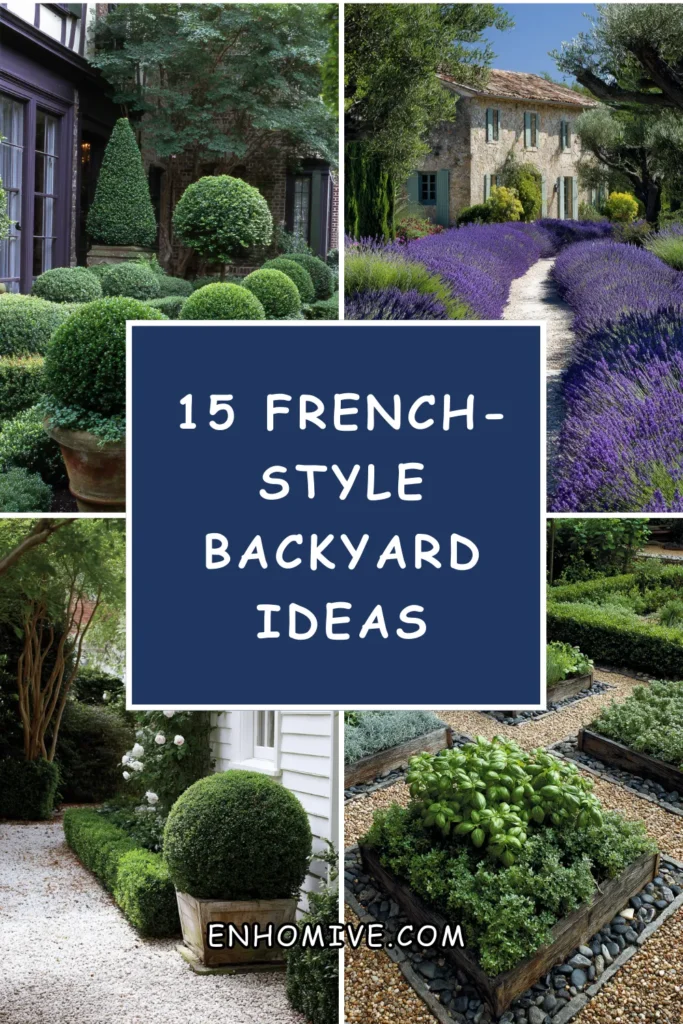
These two French garden traditions are not in opposition — they share an underlying commitment to the garden as a designed environment that reflects human intention and aesthetic sensibility rather than simply allowing nature to proceed undirected — but they produce outdoor spaces of entirely different character, scale, and practical ambition.
The backyard interpretation of the French garden draws from both traditions, adapting the formality of the great gardens to the intimate scale of the domestic outdoor space and the productive abundance of the French countryside garden to the needs of a household that wants beauty alongside function.
The result is one of the most naturally suited of all international garden styles to the domestic backyard, because the French garden tradition has always balanced art and practicality, formality and warmth, with an intelligence and a pleasure in living that produces outdoor spaces genuinely designed for human enjoyment. Here are fifteen ideas for bringing that tradition into your own backyard.
1. Create a Central Axis with Symmetrical Planting
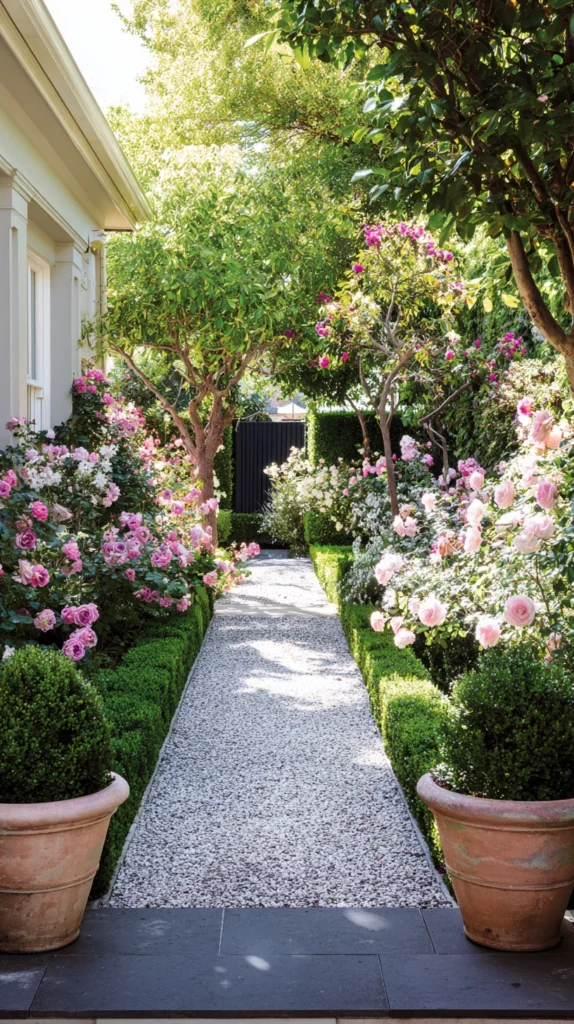
The defining organizational principle of the French formal garden is the central axis — a line of visual symmetry that runs through the garden’s length, organizing the planting, paths, and architectural elements into a composition that the eye reads as resolved and intentional from the primary viewpoint.
In a domestic backyard, the central axis does not need to be the grand allée of Versailles — it can be expressed as simply as a central path running the garden’s length, flanked by symmetrically placed planters, clipped topiary, or matching planting beds on both sides.
The axis creates the visual structure that the French garden style requires, and everything within the garden is organized in deliberate relationship to it. Symmetrical planting along the axis — matching standard roses, paired clipped box balls, identical terracotta urns at the path’s end — creates the visual rhythm that is the French formal style’s most immediately recognizable characteristic.
Even a modest suburban backyard of ten meters depth can accommodate a simplified central axis that creates the characteristic French garden sense of organized, purposeful outdoor space.
2. Plant a Classic French Potager
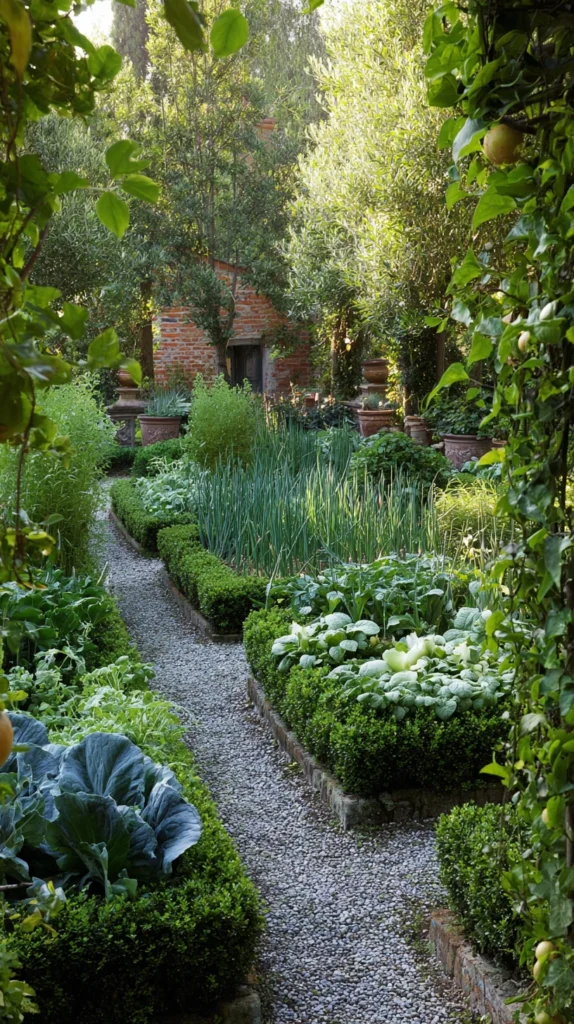
The potager — the French ornamental kitchen garden, where vegetables, herbs, and flowers are grown together in a formal geometric arrangement that is simultaneously productive and beautiful — is the French garden tradition most naturally suited to the contemporary backyard, because it provides the dual function of food production and visual beauty in a form whose geometric structure suits even small spaces.
A classic potager is divided into geometric beds — squares, rectangles, or more complex patterns separated by narrow gravel or brick paths — each planted with a mixture of edible and ornamental species that creates a colorful, productive surface that looks as beautiful from above as it does at ground level.
The French potager planting principle mixes the utilitarian with the beautiful at every scale: rows of leeks beside stands of marigolds, climbing beans on a simple timber frame beside a standard rose, a central topiary or a sundial providing the compositional focus around which the productive planting is organized.
3. Install Gravel Paths and Paving Throughout
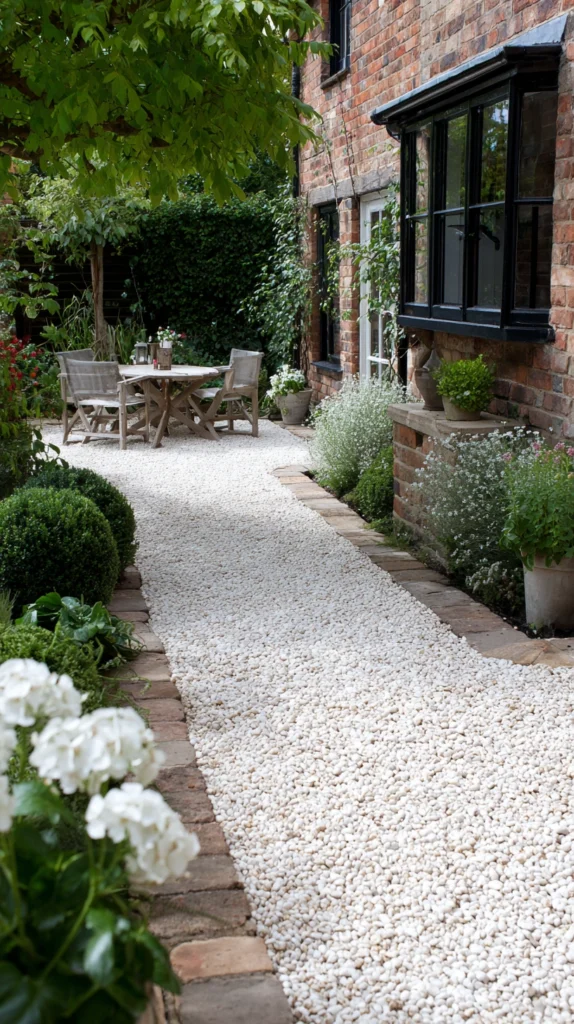
Gravel is the French garden’s ground material of choice — the material that appears in the paths, the seating areas, and the decorative parterre panels of French gardens from the grandest to the most intimate, and whose warm, crunching quality underfoot is as much a part of the French garden experience as any planting or architectural element.
Fine angular gravel in a warm pale tone — the crushed limestone or pale flint that appears in the paths of French provincial gardens and the parterre panels of formal French chateaux — creates a ground surface of considerable visual warmth that relates to the stone and render of French architecture with a naturalness that no hard-paved surface can replicate.
Gravel paths in a backyard require edging to prevent the gravel from spreading into adjacent planting beds — a steel or brick edging creates the clean definition that the French garden’s geometric path network requires — and occasional raking to maintain the level, smooth surface that French garden tradition expects.
4. Add Clipped Topiary for Formal Structure
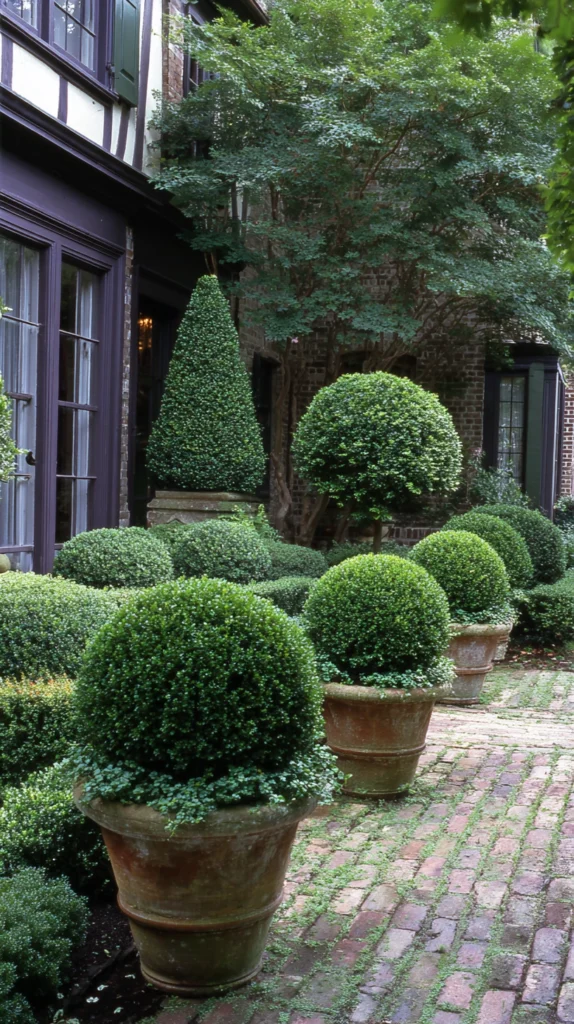
Topiary — the art of clipping woody plants into geometric or figurative forms — is one of the French garden’s most characteristic and most practically achievable design elements, providing the vertical punctuation, the geometric structure, and the evidence of human intervention and care that distinguishes the designed French garden from a naturalistic planting.
Box balls, cone-clipped yews, standard roses on clear stems, and the simple globe forms of clipped lavender are the most accessible topiary forms available to the domestic backyard gardener, and their repeated placement at key positions throughout the garden — flanking a gate, marking the corners of a planting bed, lining a path — creates the formal rhythm that the French style requires.
Box blight and box moth have made traditional box topiary increasingly challenging in many climates, and the replacement species — Ilex crenata, Lonicera nitida, and Euonymus japonicus — provide equivalent topiary performance with greater disease resistance for the contemporary French-style garden.
5. Create a Formal Seating Area with Stone or Rendered Paving
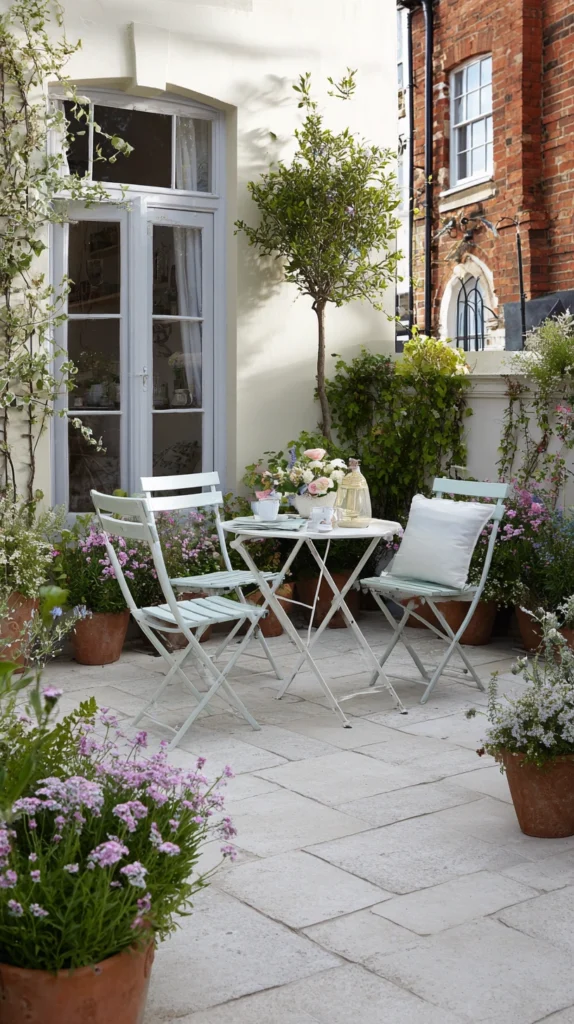
The French formal garden’s seating area — the outdoor salon where the pleasures of the designed garden are most immediately enjoyed — is typically paved in a material of architectural formality: natural stone, rendered concrete, or the pale limestone that floors the outdoor areas of the finest French country properties.
A formal seating area in the backyard created from large-format stone pavers, rendered in pale gray or cream, and furnished with simple wrought iron or painted timber furniture creates the French garden’s outdoor room with appropriate material character.
The seating area’s formal quality is maintained by the precision of the paving layout — perfectly square joints, consistent grout lines, the geometric regularity of a correctly laid stone surface — and by the restraint of the furniture and accessory selection.
French garden seating does not accumulate the casual clutter of the British garden — a table, four chairs, and a simple planter are sufficient for the French outdoor salon’s characteristic quality of elegant simplicity.
6. Introduce Espaliered Fruit Trees on Walls and Fences
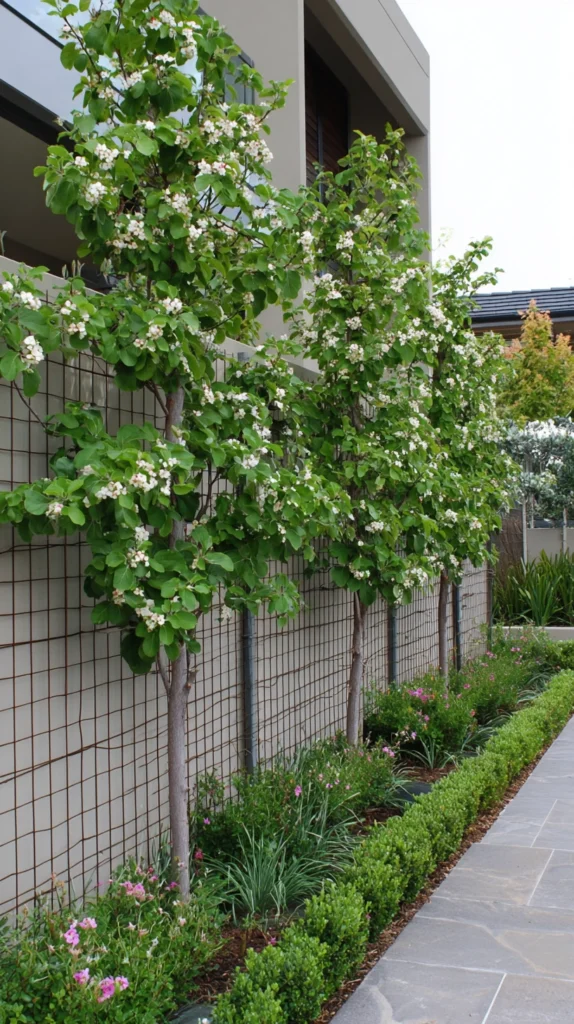
Espalier — the practice of training fruit trees against a wall or fence in a flat, structured form, with branches trained horizontally or in fan shapes to lie flat against the supporting surface — is a French productive garden technique of considerable age and considerable beauty, creating a living wall covering of architectural precision that produces fruit alongside its ornamental contribution.
Espaliered apple, pear, and quince trees on the backyard’s boundary walls create a French potager aesthetic at the garden’s perimeter, softening hard surfaces with living material while maintaining the geometric, controlled quality that distinguishes the French garden’s relationship with plant material from the romantic naturalism of the English cottage garden approach.
The espalier requires a training framework — horizontal wires or timber battens fixed to the wall — and an annual pruning regime that maintains the flat, structured form, but the skill required is straightforwardly learned and the results — a productive, beautiful wall covering that improves each year — are worth every aspect of the maintenance commitment.
7. Plant Lavender Extensively Along Paths and Borders
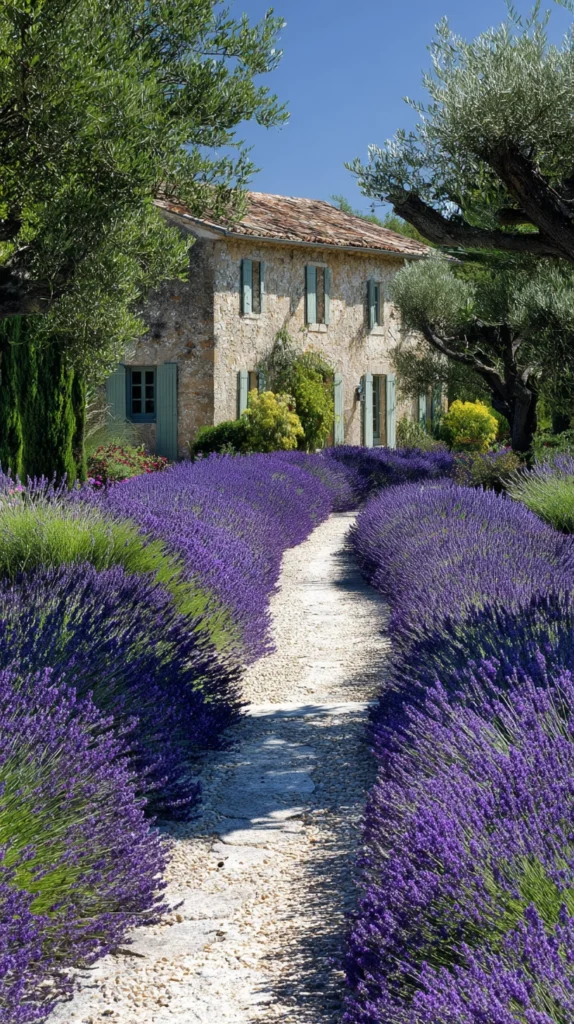
Lavender is the French garden’s most iconic planting — the plant most immediately associated with the Provençal landscape, most deeply embedded in the visual memory of anyone who has visited the lavender fields of Haute Provence or walked the garden paths of a French farmhouse — and its extensive use in a backyard garden creates the specific olfactory and visual quality of the French garden more immediately and more completely than any other single planting decision.
Mass lavender planting along path edges — a continuous edging of the same lavender variety on both sides of a central path, clipped to a consistent height and width after flowering — creates the classic French garden path treatment that is as appropriate in a small suburban backyard as in a grand country garden.
The lavender’s fragrance, released by the brushing of hands and clothing against its foliage and flowers as visitors walk the path, is as much a part of the French garden experience as its visual presence, and the combination of the two sensory qualities creates the characteristic Provençal atmosphere that lavender alone can provide.
8. Install a Simple Fountain or Water Feature
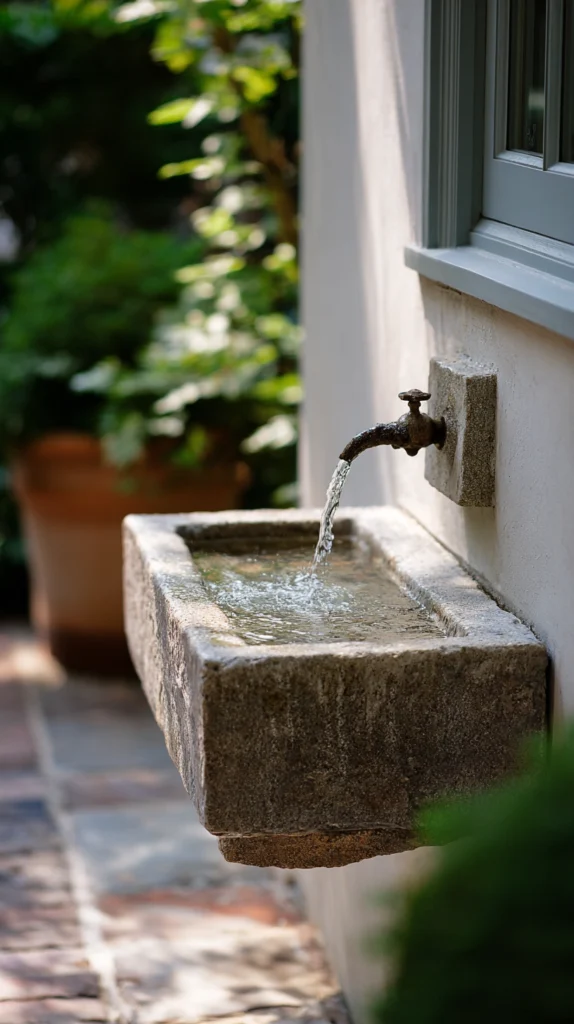
The water feature — a stone basin or rendered concrete pool with a simple jet or spout, creating the sound and movement of water in the garden — is one of the French formal garden’s defining architectural elements, and even in a modest backyard a simple wall-mounted fountain or a small recirculating basin creates the specific quality of presence that moving water brings to an outdoor space.
A simple stone or rendered concrete basin mounted on the garden’s axial wall — a lion’s head or a simple spout directing water into the basin below, the water recirculated by a concealed pump — is the most practically achievable and most typically French wall fountain available for domestic garden installation.
The sound of trickling water is as important as the visual element of the fountain — the acoustic quality of water in a garden provides a background sound that masks urban noise and creates the enclosed, contemplative atmosphere that the French garden at its best always achieves.
9. Use Timber Trellises for Climbing Roses and Clematis
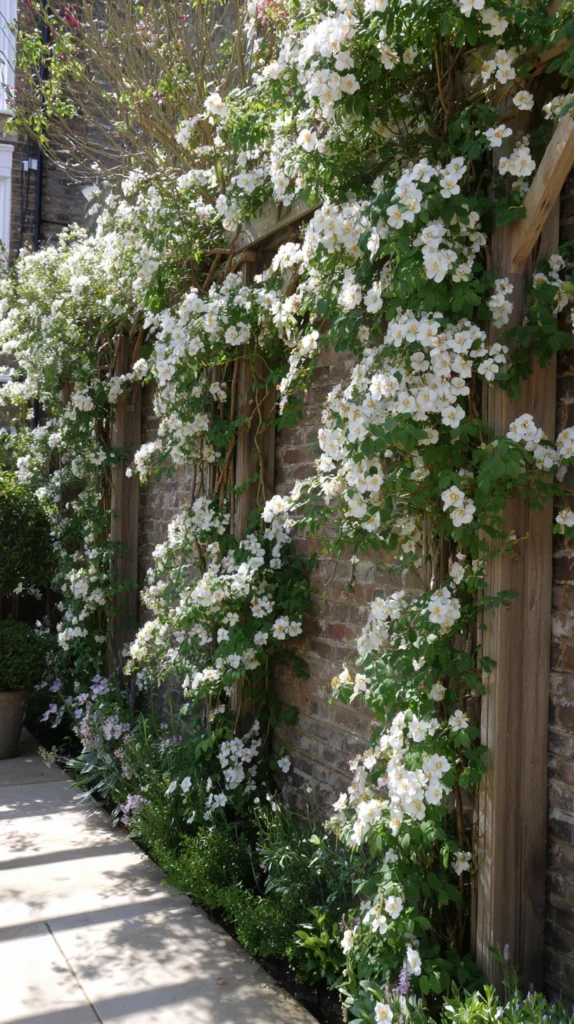
The timber trellis — a simple framework of horizontal and vertical timber members fixed to a wall or fence and used to support climbing plants — is the French garden’s most versatile structural element, providing the support for the climbing roses, clematis, and wisteria that create the romantic, vertical dimension of the French garden’s planting.
A trellis painted in a French garden color — the soft gray-green of a Provence farmhouse shutter, the pale blue of a Normandy fishing village, the deep cream of a Loire valley chateau — creates a wall surface of considerable decorative interest even before the climbing plant has established, and the combination of the painted trellis and the climbing rose or clematis growing through it is one of the most classically beautiful surface treatments available in any garden style.
The trellis should be installed with spacers that hold it off the wall surface — a gap of at least five centimeters allows air circulation behind the climbing plant, which reduces the risk of fungal disease that tight wall training promotes.
10. Create a Kitchen Herb Garden in a Formal Pattern
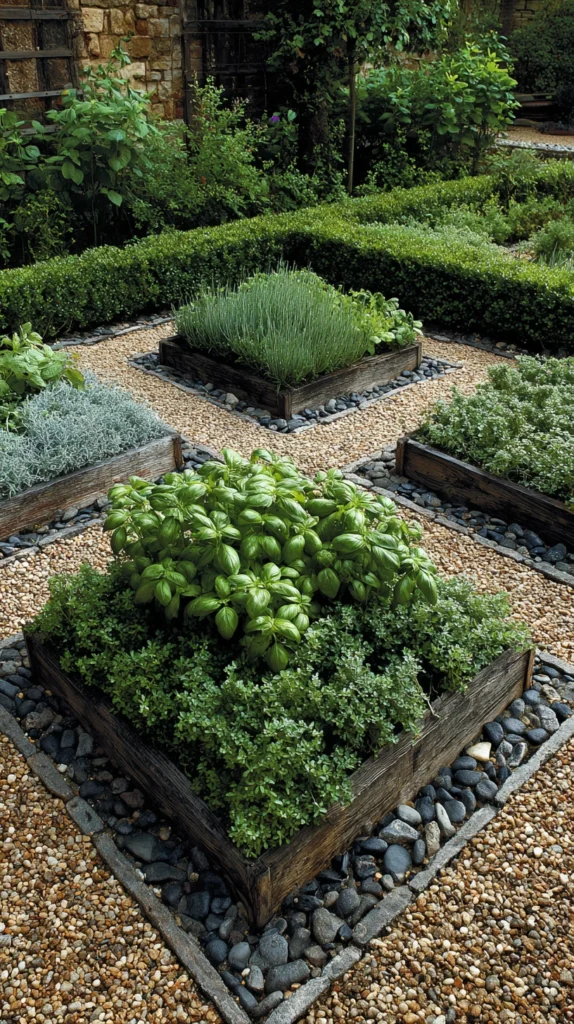
The formal herb garden — a geometric arrangement of raised or sunken beds planted with culinary and medicinal herbs, organized around a central feature and edged with low clipped hedging of box, lavender, or thyme — is a French garden tradition that connects the garden’s aesthetic aspiration to its practical purpose with characteristic French efficiency.
A simple formal herb garden in a backyard can be created within a square or rectangular footprint of three to four meters, divided into four or nine equal beds by narrow gravel paths, with each bed planted with a single or complementary group of herbs — one bed of various thymes, one of rosemary varieties, one of French tarragon and chives, one of basil and flat-leaf parsley. The geometric arrangement transforms the practical herb planting into a garden feature of visual interest, and the herbs’ varied leaf colors, textures, and flowering habits create a seasonal display of considerable beauty across the growing season.
11. Paint Garden Structures in Muted French Colors
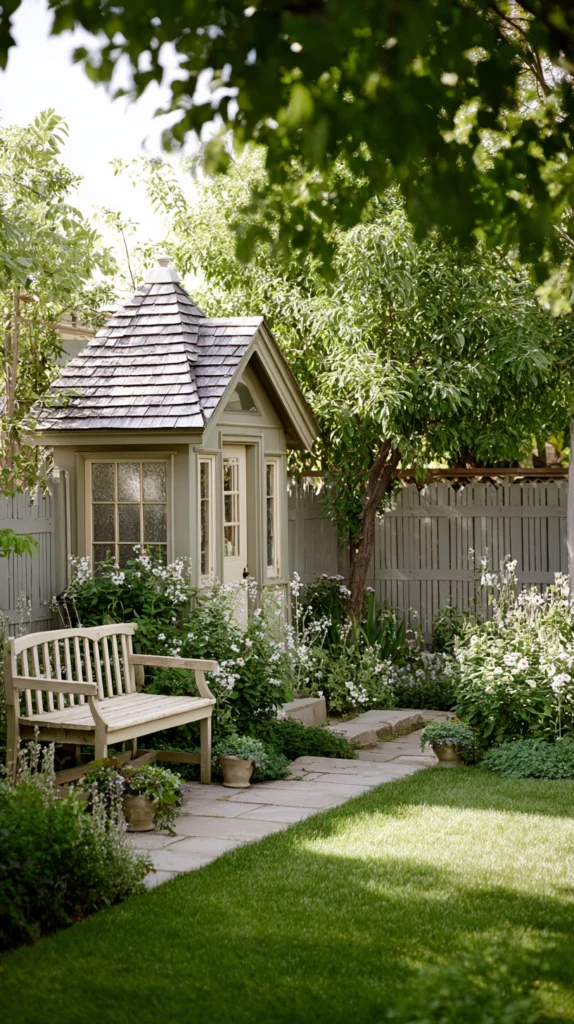
The color of the backyard’s painted structures — fences, gates, pergolas, garden furniture, sheds, and outbuildings — is one of the most powerful determinants of the garden’s overall aesthetic character, and the specific palette of muted, slightly faded tones that characterizes the finest French garden architecture creates the particular quality of the French garden more efficiently and more economically than almost any other single design decision.
French garden colors are not bright or saturated — they are the slightly desiccated, slightly chalky tones of a palette that has been exposed to the Provençal sun and the northern French rain for decades: gray-greens, soft blues, warm creams, chalky whites, and the specific terracotta of unglazed French garden ceramics.
Farrow and Ball, Little Greene, and several French paint manufacturers produce exterior paint ranges that capture these tones with considerable accuracy, and a garden fence painted in the right gray-green immediately creates a French garden context that more vivid colors entirely undermine.
12. Incorporate a Pergola Draped with Wisteria or Roses
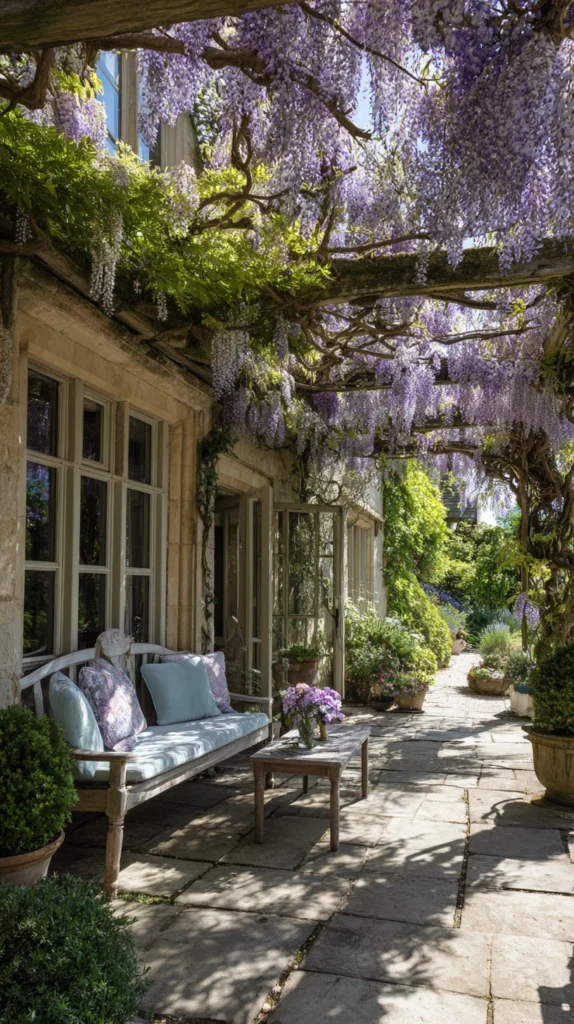
The pergola — a simple overhead structure of posts and beams through which climbing plants are trained to create a living canopy — is the French garden’s most romantic architectural element, and its association with the wisteria and climbing roses that are its natural planting partners creates one of the most universally beautiful garden experiences available anywhere in the domestic outdoor landscape.
A pergola over the backyard’s primary seating area, draped with a well-established wisteria whose spring flowering creates a cascading purple canopy of extraordinary beauty and fragrance, or with a vigorous climbing rose whose summer flowering covers the structure in color, creates a French garden destination of complete atmospheric quality.
The pergola’s timber should be painted in the muted French palette described above, and its proportions should be generous — posts of sufficient height to create comfortable headroom with the climbing plant’s growth allowance, and beams of sufficient depth to bear the weight of a mature climbing plant without flexing.
13. Add French Garden Furniture in Iron or Painted Timber
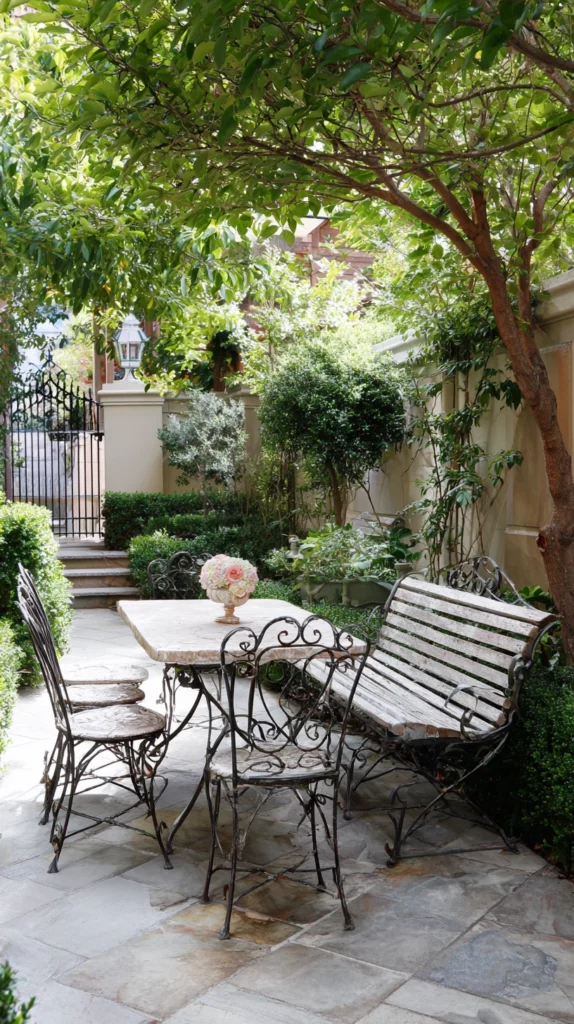
The furniture of a French garden — the chairs and tables that equip the outdoor salon for the al fresco living that the French garden tradition prizes — has its own specific aesthetic character that distinguishes it from the teak and rattan of British garden furniture, the white plastic of the minimal contemporary patio, and the stainless steel of the modernist outdoor furniture catalogue. French garden furniture is iron or painted timber: the classic bistro chair in cast iron or powder-coated steel, the simple painted timber bench in a French garden color, the stone or concrete table whose permanence reflects the garden’s long-term inhabitation.
These pieces should be selected with the same attention to proportion and quality that any furniture purchase deserves — a well-made cast iron chair that ages beautifully over decades of outdoor use is a better investment than a cheaper alternative that deteriorates within a few seasons — and they should be positioned in the garden with the deliberate attention to axial composition and spatial relationship that the French garden style consistently applies to every element within its boundaries.
14. Install Stone Urns and Ornaments as Focal Points
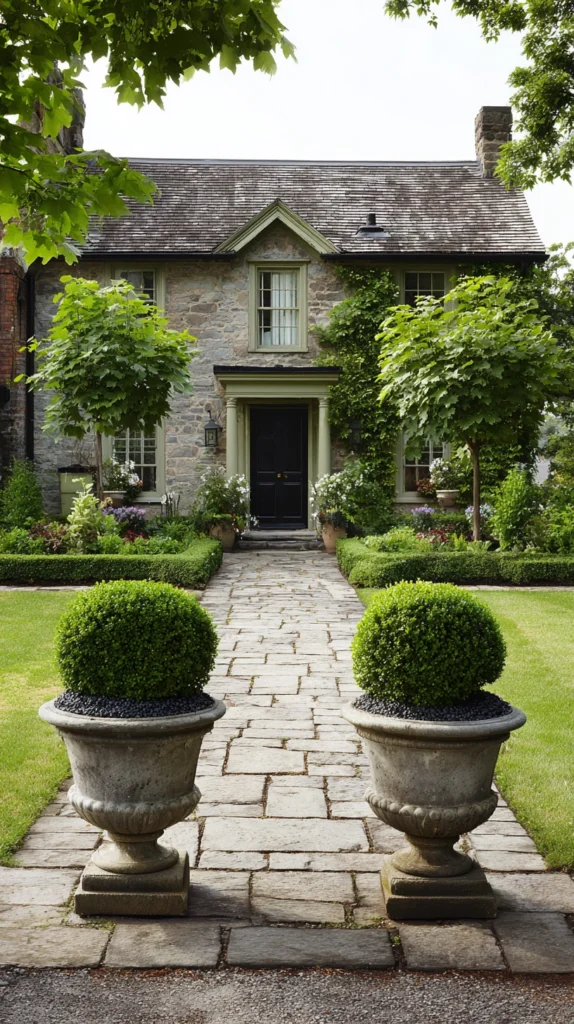
The stone urn — a classical vessel in natural stone, reconstituted stone, or cast concrete, positioned at a key point in the garden as a focal point and as a planting container — is the French formal garden’s most accessible decorative element, bringing the classical vocabulary of European garden design to the backyard in a form that is available at a wide range of budget levels and appropriate to gardens of every scale from the grandest to the most intimate.
A pair of matching stone urns flanking the garden’s central path at its midpoint creates a formal garden moment of considerable authority without any additional design intervention — the urns’ symmetrical placement organizes the path’s length into sections and creates the visual punctuation that the French garden’s axial design requires.
Plant the urns with simple, appropriate planting — a single standard bay tree in each, or a clipped box ball, or a seasonal planting of French garden flowers — rather than the complex, overplanted mixture that contemporary container planting sometimes favors.
15. Embrace the Art of Doing Less, Better
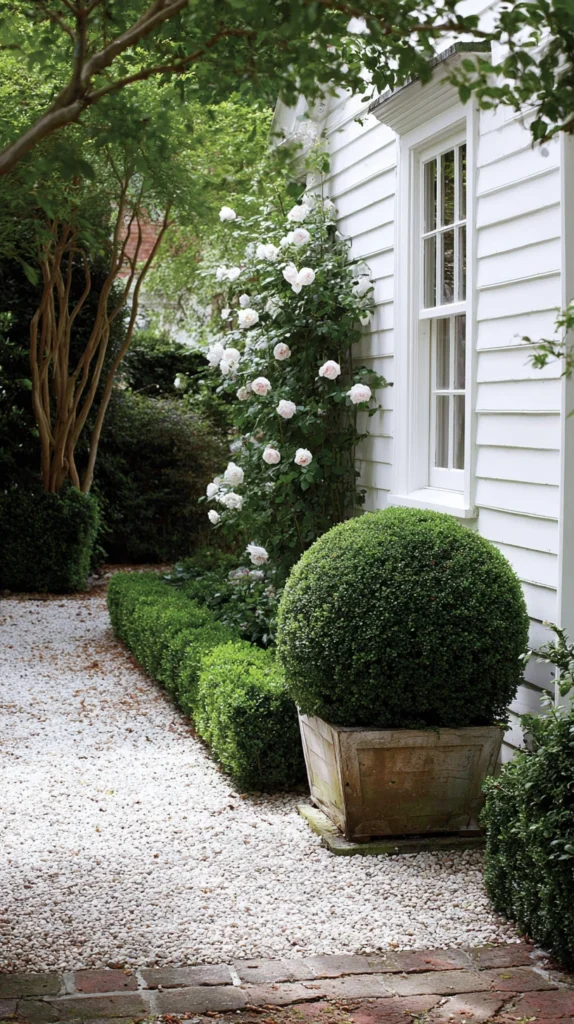
The final and most important French backyard idea is a philosophical one rather than a design prescription, and it is the principle that most clearly distinguishes the French garden sensibility from the English one and from the maximalist approach to garden design that more is always better.
The French garden tradition is founded on the conviction that a few things done with complete precision and complete care create a more beautiful and more satisfying outdoor environment than many things done with less attention and less rigor — that a single clipped box ball in a perfect sphere is more beautiful than twelve clipped box balls in approximate spheres, that a path raked to perfect smoothness is more beautiful than a path that is smooth in most places but irregular in some, that a rose trained to its trellis with complete consistency is more beautiful than the same rose allowed to grow as it wishes.
This principle of selective perfectionism — choosing what to do carefully and then doing it with complete attention — is the French garden’s most transferable and most personally demanding design lesson, and it produces backyard gardens of the specific, composed beauty that the French tradition at its best consistently achieves.