
15 Open Wardrobe Ideas for Very Small Bedrooms
The small bedroom’s relationship with clothing storage is one of the most consistently difficult organizational challenges in domestic life.
Standard wardrobes — the freestanding kind with doors that swing outward into the room, or the fitted kind that requires a contractor and a significant budget — demand floor space and wall space that small bedrooms simply do not have in the quantities required. The door clearance alone on a standard double wardrobe can render an otherwise functional bedroom layout impossible.

But the open wardrobe — a storage system without doors, without the space penalty of door swing, and without the visual opacity that closes off large sections of a small room’s wall area — offers a fundamentally different approach to clothing storage in small spaces, one that is more space-efficient, more visually accessible, more budget-friendly in most configurations, and increasingly, more aesthetically considered than the enclosed wardrobe it replaces.
The objection most commonly raised against open wardrobes — that the clothing is visible and the system therefore requires constant tidiness — is real but manageable, and for most people it resolves itself naturally within a few weeks of living with the system: the visibility that requires tidiness also makes the morning routine faster, the contents of the wardrobe clearer, and the tendency to accumulate unworn clothing considerably lower. Here are fifteen ideas for making an open wardrobe work beautifully in a very small bedroom.
1. A Simple Wall-Mounted Rail at the Correct Height
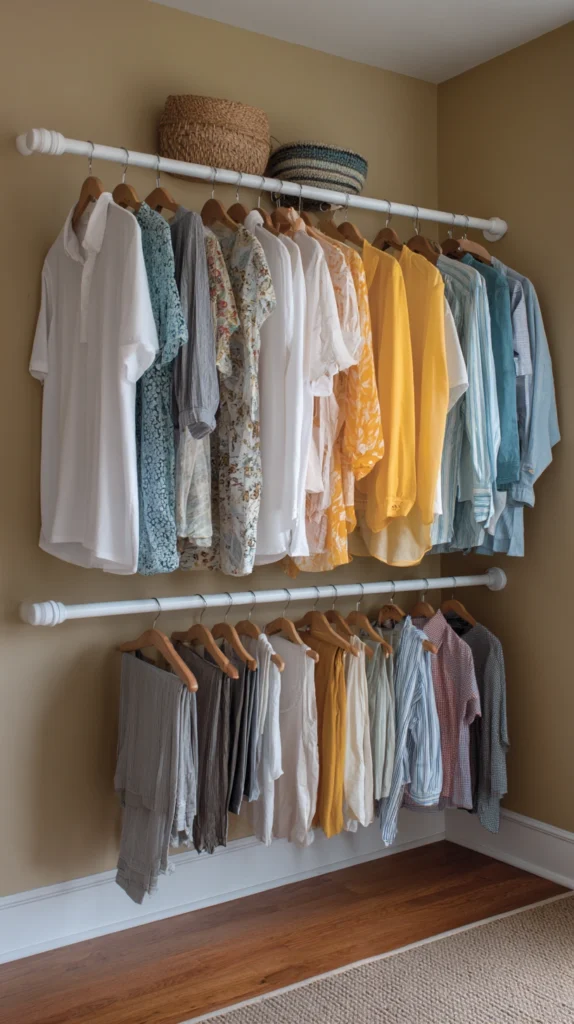
The most minimal and most space-efficient open wardrobe configuration available is a single wall-mounted clothing rail — a powder-coated steel or solid brass tube fixed to the wall at an appropriate height with sturdy bracket supports — which occupies exactly the depth of the garments hanging from it and the floor area of nothing whatsoever.
A wall-mounted rail requires no freestanding frame, no base footprint, and no overhead structure — it is simply a horizontal tube fixed to the wall from which clothing hangs, and in a very small bedroom this simplicity is not a limitation but a genuine spatial advantage.
The rail should be installed at a height that provides sufficient clearance beneath the hanging garments for the longest items in the wardrobe — dresses, long coats, formal trousers — which typically means a minimum of 170 centimeters from floor to rail for most adult wardrobes. Add a shelf above the rail for folded items, bags, and accessories, and the wall-mounted rail becomes a complete, functional open wardrobe system in the smallest possible floor footprint.
2. An Alcove Fitted with Rails and Shelving
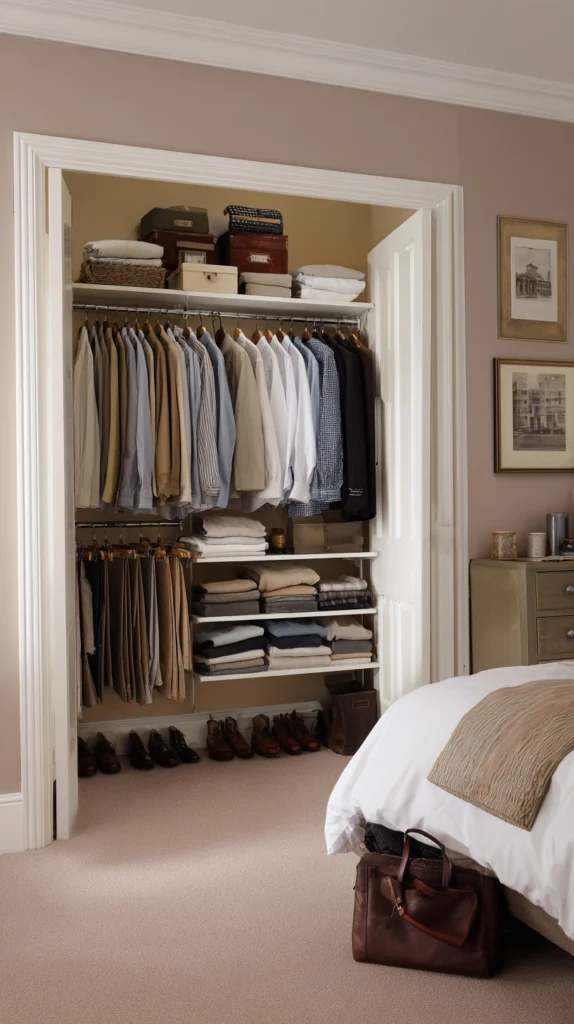
The bedroom alcove — a recessed area created by a chimney breast, a structural column, or simply an architectural irregularity in the room’s perimeter — is the open wardrobe’s most natural home in a small bedroom, because the alcove provides the three sides of enclosure that give the storage system definition and organization without requiring any constructed framework.
Fitting the alcove with a combination of rails and shelves — a hanging rail at full height on one side for long garments, a double rail system on the other side for shorter items that can be stacked in two layers, and shelving across the back or upper section for folded items, shoes, and accessories — creates a complete wardrobe system within the footprint of the alcove that takes nothing from the bedroom’s usable floor area.
The alcove wardrobe can be defined further with a painted interior in a contrasting or complementary tone to the bedroom walls, creating a visual frame for the clothing display that makes the open wardrobe look designed rather than simply undressed.
3. A Curtained Rail System for Visual Softness
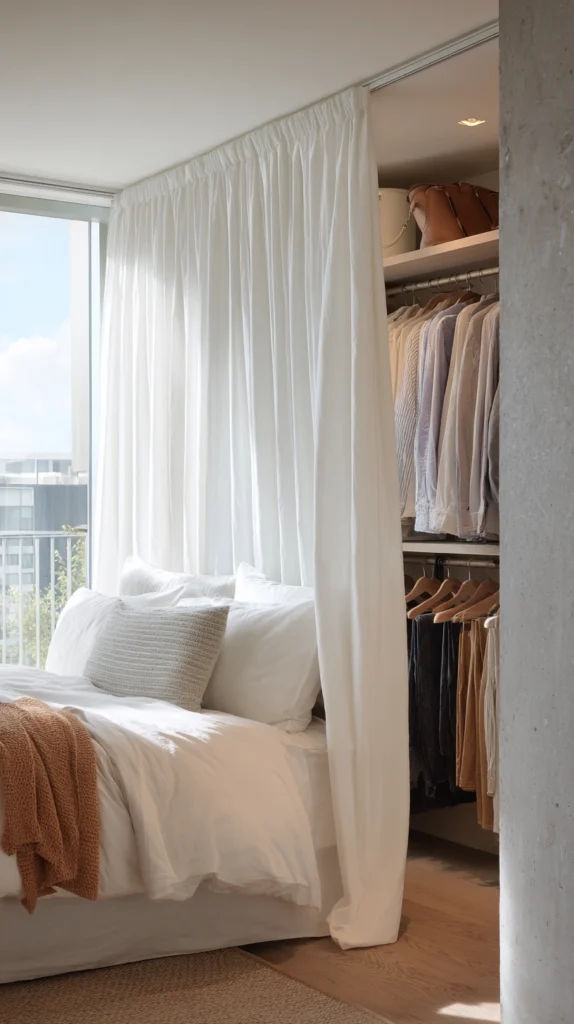
The open wardrobe with a curtain — a ceiling-mounted track or a tension wire from which a floor-length curtain panel can be drawn to conceal the clothing behind it — offers the best of both worlds: the space efficiency of an open system and the visual privacy of an enclosed one, with the flexibility to open or close the concealment as needed.
The curtain does not need to be heavy or opaque — a lightweight linen panel that filters light and softens the visual presence of the clothing behind it while maintaining the open system’s accessibility is often more appropriate in a small bedroom than a fully blackout curtain that creates a solid visual mass.
The curtain track should be mounted at ceiling height — or as close to ceiling height as the room permits — so that the curtain reads as an architectural element from floor to ceiling rather than a pragmatic panel hung at rail height. Choose a fabric that relates to the bedroom’s overall textile palette and contributes positively to the room’s aesthetic even when the curtain is fully drawn.
4. A Pipe Rail System for Industrial Warmth
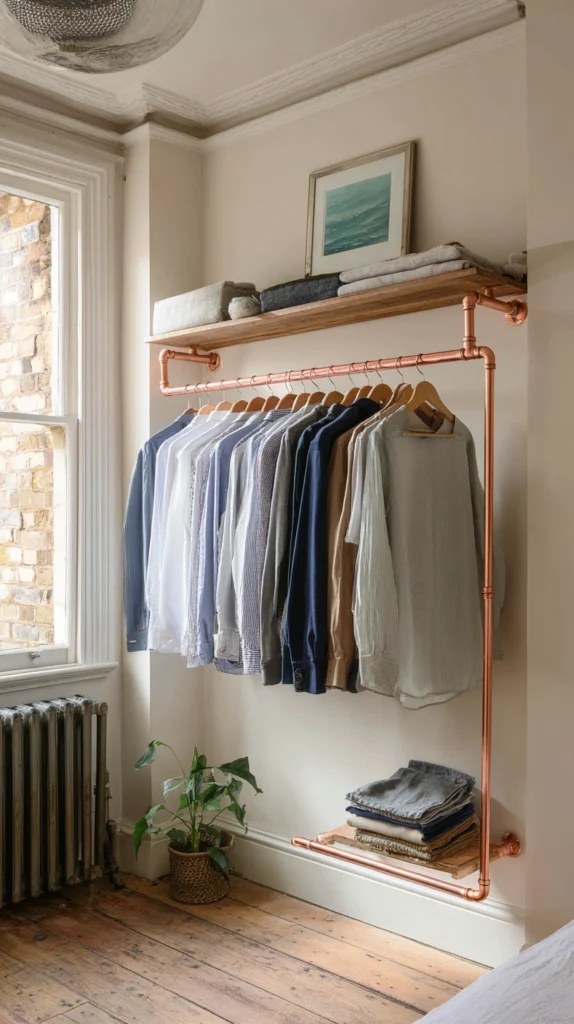
The exposed pipe rail — a system of plumbing-style pipes and fittings repurposed as a clothing storage framework, typically in copper, brass, or black-painted steel — brings an industrial warmth and artisanal character to the open wardrobe that proprietary retail systems cannot replicate.
Copper pipe rails in particular have a warm, metallic quality that photographs beautifully and suits bedrooms with a natural, slightly eclectic aesthetic — the warm amber of the copper pipe against white or plaster-toned walls creates a material contrast of considerable appeal.
The pipe system’s great advantage as an open wardrobe solution is its complete configurability: pipes can be cut to any length and connected at any angle, allowing the system to be precisely calibrated to the available wall space and the specific clothing storage requirements of its user.
A skilled DIY practitioner can install a copper pipe wardrobe system in a single day at a material cost significantly below equivalent retail systems, and the result has a bespoke quality that retail systems cannot match.
5. A Floor-to-Ceiling Shelving Tower with Integrated Rail
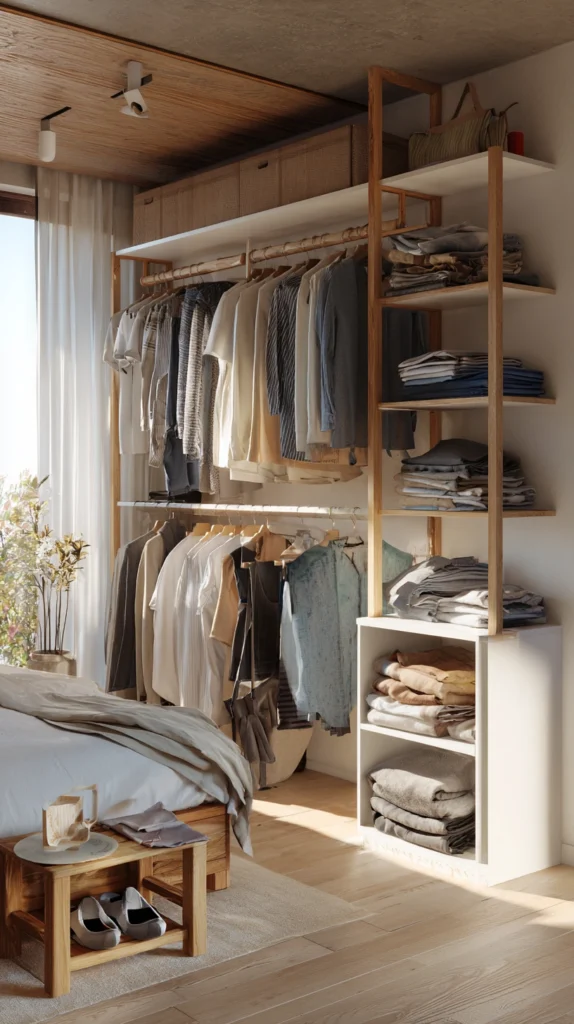
A floor-to-ceiling shelving tower positioned against one wall of the bedroom — a unit that extends from baseboard to ceiling in a single continuous composition of shelves, rails, and storage modules — creates a complete open wardrobe system that uses the wall’s full vertical dimension while occupying only the depth of a shelf.
The shelving tower provides different types of storage at different heights: folded items and shoes at the lower levels most easily accessible when standing; hanging items on rails at mid-height; less frequently needed items — seasonal storage, luggage, spare bedding — at the upper levels accessible with a small step.
The tower’s floor-to-ceiling format gives it an architectural quality that makes it read as a designed feature of the room rather than a piece of furniture placed within it, and this reading is enhanced by choosing materials and finishes that relate to the bedroom’s existing aesthetic — timber matching the floor, a painted finish matching the walls, or a contrasting tone that creates the deliberate distinction of a designed element.
6. A Corner Rail System to Exploit Dead Space
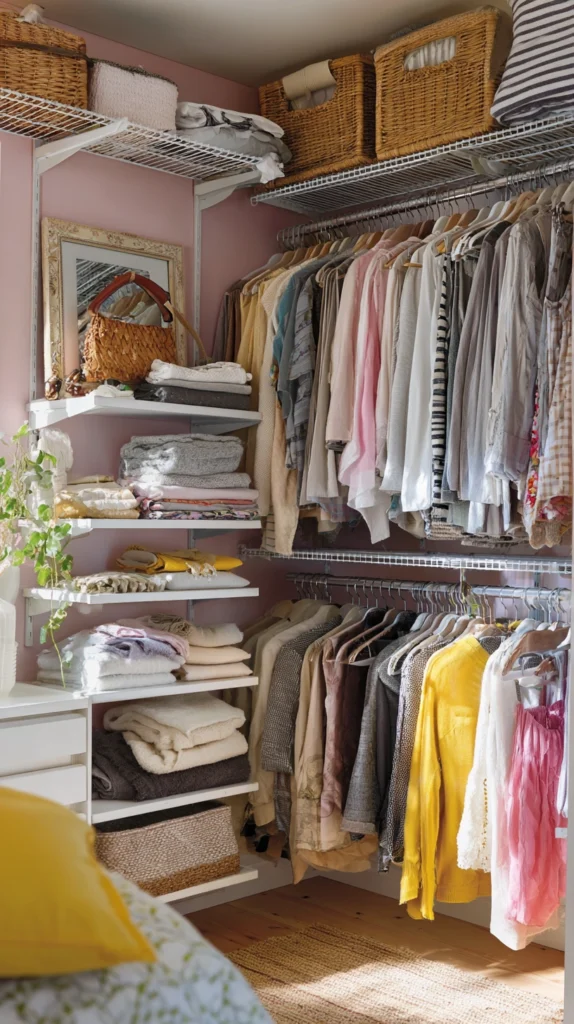
The corner of a small bedroom is typically among the least productive floor areas in the room — too awkward for standard furniture, too confined for comfortable movement, too irregular in its geometry for conventional storage.
A corner rail system — two rails meeting at the corner angle with an L-shaped shelf above them — converts this dead space into the bedroom’s most space-efficient storage zone, creating a wardrobe footprint in an area that no freestanding wardrobe could occupy and that would otherwise contribute nothing to the room’s functional value.
The corner position also provides natural enclosure on two sides, which gives the storage system the visual definition of a designed zone rather than a rail placed in the middle of a wall. A small mirror mounted at the corner’s apex — the point where the two walls meet — provides a dressing function within the wardrobe zone that makes the entire corner a complete getting-ready station.
7. A Modular Cube System for Flexible Organization
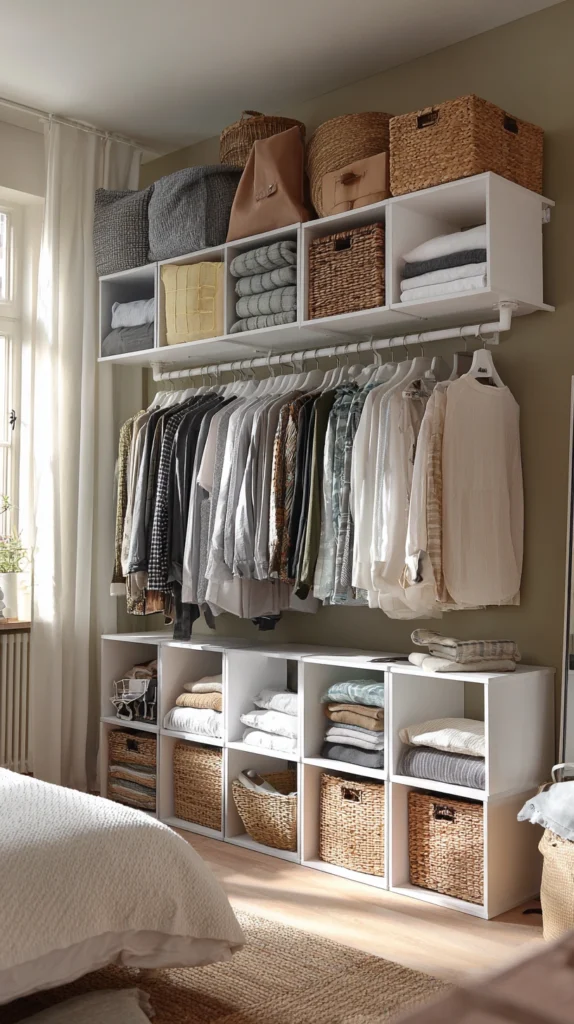
The modular cube shelving system — a grid of open cubic compartments that can be arranged in any configuration and combined with rail inserts, drawer units, and basket components — is the open wardrobe system with the greatest organizational flexibility available at any price point, because every element is interchangeable and the system’s configuration can be modified as the user’s clothing collection and storage requirements change over time.
In a very small bedroom, a modular cube system mounted to the wall — rather than standing on feet that add height and visual weight — in a configuration of four to six columns provides a complete open wardrobe with folded storage, hanging storage, and display space in a wall area of perhaps two meters width and one and a half meters height.
Choose cube inserts with hanging rails for the garment sections and lined baskets for folded items that benefit from some concealment — the combination of open display and contained storage creates a visually varied, organized surface rather than a uniform expanse of hanging clothing.
8. A Clothing Rail Behind a Room Divider
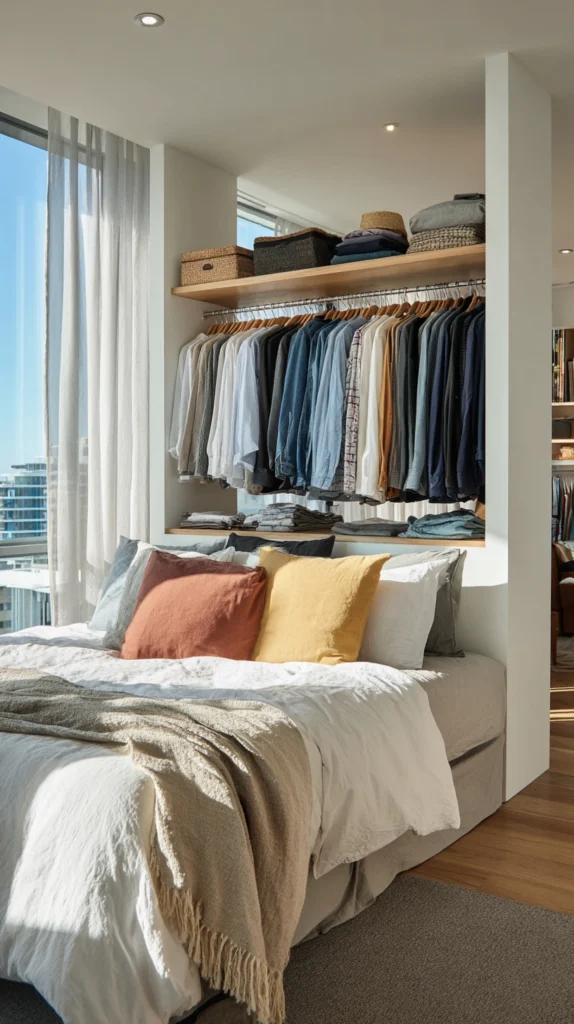
In a studio or single-room apartment where the sleeping zone and the living zone are combined, a clothing rail positioned behind a room divider — a bookcase, a curtain on a ceiling track, a decorative screen, or a partial wall — creates a dressing area that is functionally accessible but visually separated from the main living space.
The divider provides the visual privacy that a completely open rail in the center of a living space cannot, and the defined zone behind the divider gives the dressing function the spatial identity that makes it feel organized and deliberate rather than improvised.
The divider itself should be chosen for its contribution to the overall room aesthetic as well as its screening function — a bookcase that provides display and storage on both faces is the most functionally efficient choice, while a sheer curtain is the lightest and most spatially airy.
9. A Peg Rail System for Everyday Accessible Items
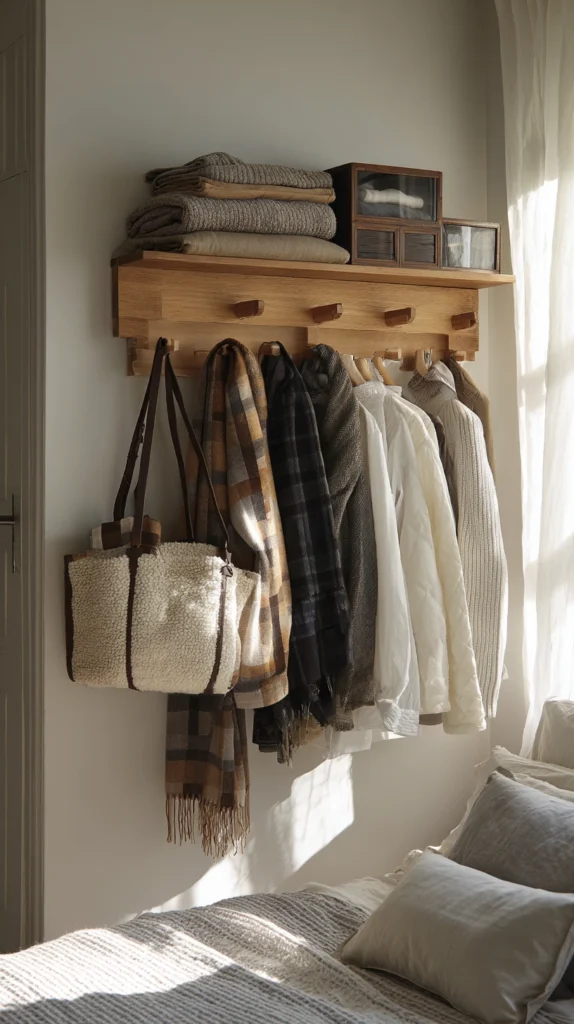
The peg rail — a simple horizontal timber board mounted at shoulder height on the bedroom wall, fitted with a series of hooks at regular intervals — is one of the most ancient and most useful clothing storage solutions available, and its application in the contemporary small bedroom as a complement to or substitute for a conventional wardrobe creates an accessible, display-like organization for the items most frequently worn and most frequently needed.
Everyday outerwear, bags, belts, scarves, and the small selection of items that are in regular rotation but not hung in a wardrobe can be organized on a peg rail in a way that is simultaneously accessible and visually intentional — the clothing displayed on a well-chosen peg rail reads as a curated arrangement rather than a random deposit of items, provided the rail is maintained with the same discipline that any open storage system requires.
Choose a peg rail in a material that relates to the bedroom’s aesthetic — a natural timber rail with brass hooks suits a warm, traditional bedroom; a painted rail with matte black hooks suits a contemporary one.
10. A Capsule Wardrobe Approach to Open Storage
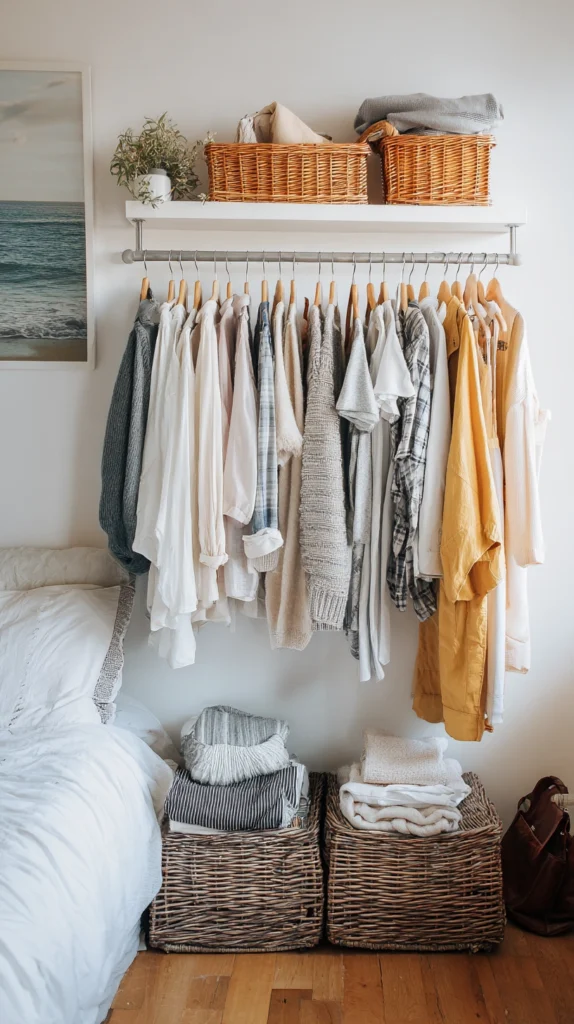
The open wardrobe in a small bedroom is, more than any enclosed system, a wardrobe that benefits from the application of the capsule wardrobe philosophy — the deliberate reduction of the clothing collection to a smaller number of genuinely useful, genuinely worn items that work together as a coherent system rather than accumulating as an uncurated collection of individual pieces.
The open wardrobe is honest about the quantity of clothing it contains in a way that an enclosed wardrobe is not — everything is visible, everything takes up the visible space it actually occupies, and the result of too many items is immediately apparent rather than hidden behind closed doors.
This honesty is the open wardrobe’s most useful organizational feature: it creates a natural incentive to keep the clothing collection at the level the storage system can accommodate and present beautifully, which is almost always a smaller and more considered collection than the enclosed wardrobe would accumulate. Use the open wardrobe as an incentive to practice the regular editing that the capsule wardrobe approach requires.
11. Use Color Coordination to Create Visual Order
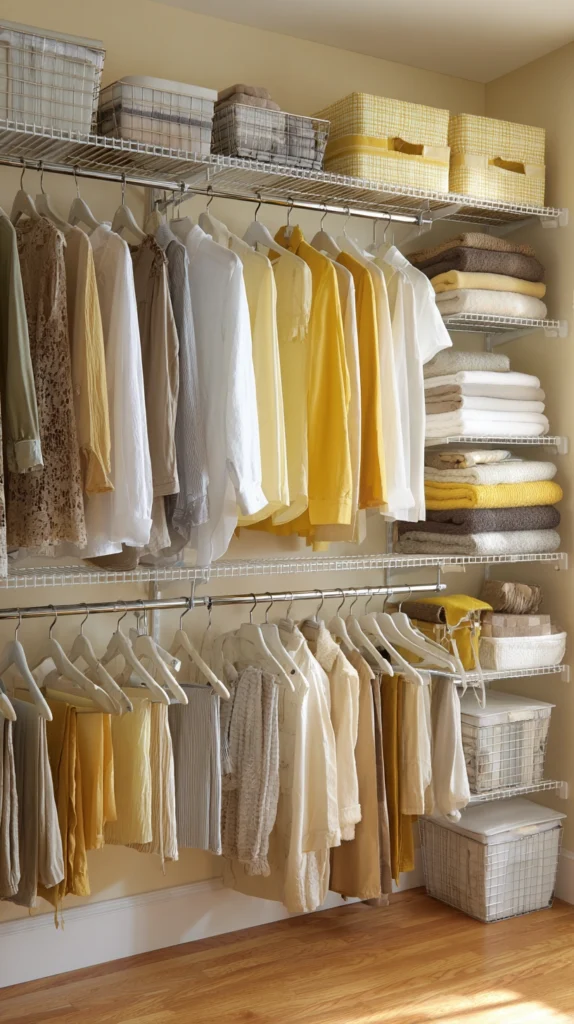
The open wardrobe’s greatest visual challenge — the variety of colors, shapes, and textures of clothing that creates visual noise when displayed without organization — is most effectively addressed through color coordination: organizing the hanging items by color family so that the wardrobe reads as a graduated palette rather than a random arrangement.
Group whites and creams together, neutrals together, earth tones together, and any brighter colors at one end of the rail where they are visible and accessible without disrupting the overall composition’s visual calm.
This color organization is not simply aesthetic — it also makes the morning selection process faster and more satisfying, because similar items are grouped in a way that makes outfit coordination intuitive. Maintaining the color organization requires the simple discipline of returning items to their correct color zone when replacing them after use, which becomes entirely automatic within a week of establishing the system.
12. A Slim Rolling Rail for Maximum Flexibility
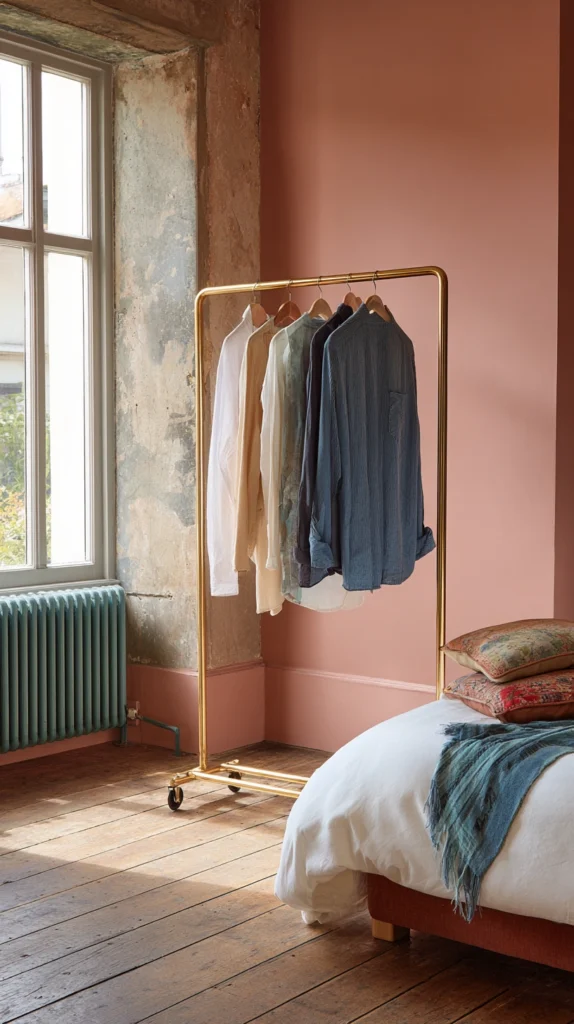
A slim rolling clothing rail — a freestanding rail on castors that can be moved to any position in the bedroom and stored in a closet, under a staircase, or in another room when not needed — is the open wardrobe solution with the maximum spatial flexibility, because it occupies floor space only when it is needed and can be removed completely when the bedroom is used for other purposes.
In a bedroom that doubles as a home office, a guest room, or a yoga space, the rolling rail’s mobility allows the clothing storage function to be present during the dressing routine and absent during other activities.
The rail should be of sufficient quality — solid steel rather than the lightweight versions that wobble and lean — and of a design that suits the bedroom’s aesthetic. A brass or copper-tone rolling rail in a bedroom with warm natural materials is a genuinely beautiful object in addition to a functional one.
13. Maximize Vertical Space with Stacked Rails
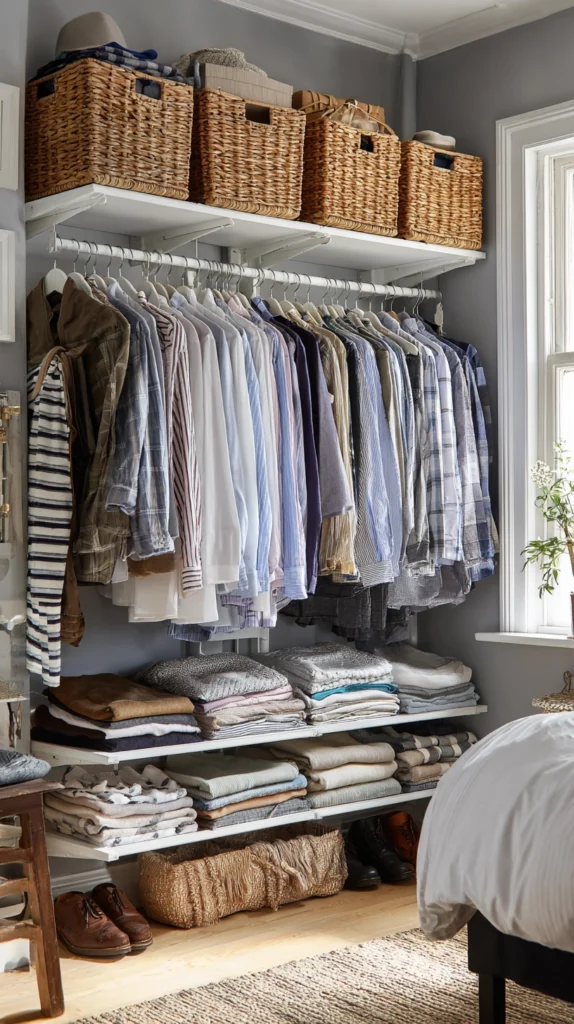
The standard open wardrobe rail system, like the standard enclosed wardrobe, typically uses only half the vertical space available to it — a single rail at full height for longer garments, with the lower half of the space wasted below shorter hanging items.
Installing stacked double rails — a full-height rail for long garments on one section, and two rails at half-height stacked above each other on the adjacent section for shorter items — doubles the hanging capacity within the same wall footprint, and in a very small bedroom this doubling can make the difference between a storage system that adequately accommodates the wardrobe and one that does not.
The lower rail of the stacked section should be at a comfortable reaching height — approximately one meter from the floor — and the upper rail should be accessible without a step for everyday items. The space below the lower rail, at approximately half a meter of clearance, accommodates a small chest of drawers, a shoe rack, or folded storage baskets that complete the lower zone of the wardrobe system.
14. Add Integrated Lighting for Practicality and Beauty
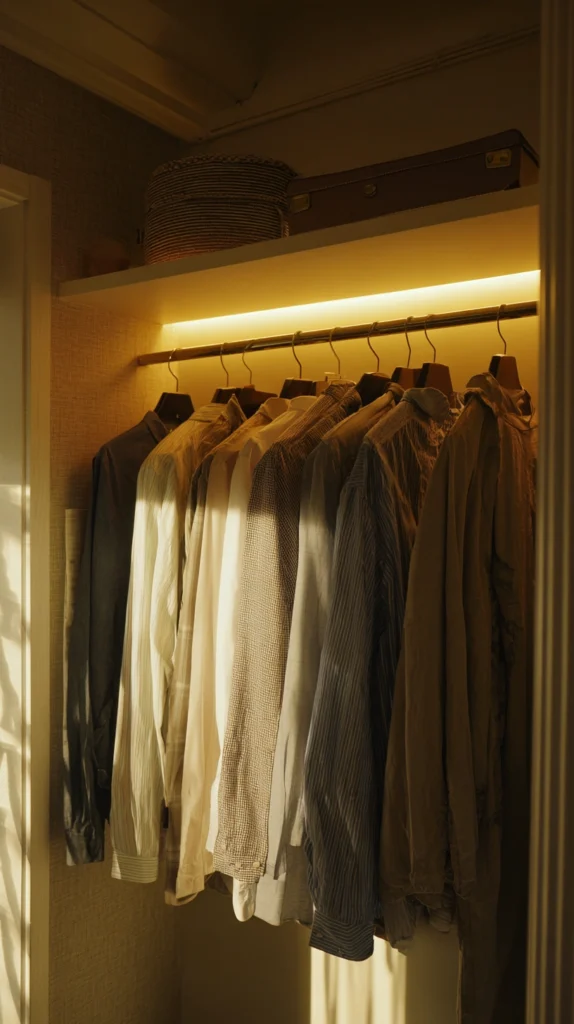
A lighting element integrated into the open wardrobe system transforms the morning routine from a search through imperfectly lit hanging clothing into a well-illuminated selection process where every item is clearly visible and accurately colored.
An LED strip light mounted along the underside of the shelf above the hanging rail, directed downward into the clothing zone, provides even, shadow-free illumination that makes every garment clearly visible regardless of the ambient lighting of the bedroom at the time of the morning routine. Warm white LED at 2700K maintains the bedroom’s restful quality while providing sufficient brightness for accurate color assessment.
The lighting also gives the open wardrobe a visual presence after dark — the illuminated clothing becomes a warm, ambient feature of the bedroom rather than a dark zone of hanging shapes — that makes the open system an aesthetic asset in the bedroom’s evening atmosphere as well as a practical one in the morning.
15. Style the Open Wardrobe as a Designed Feature
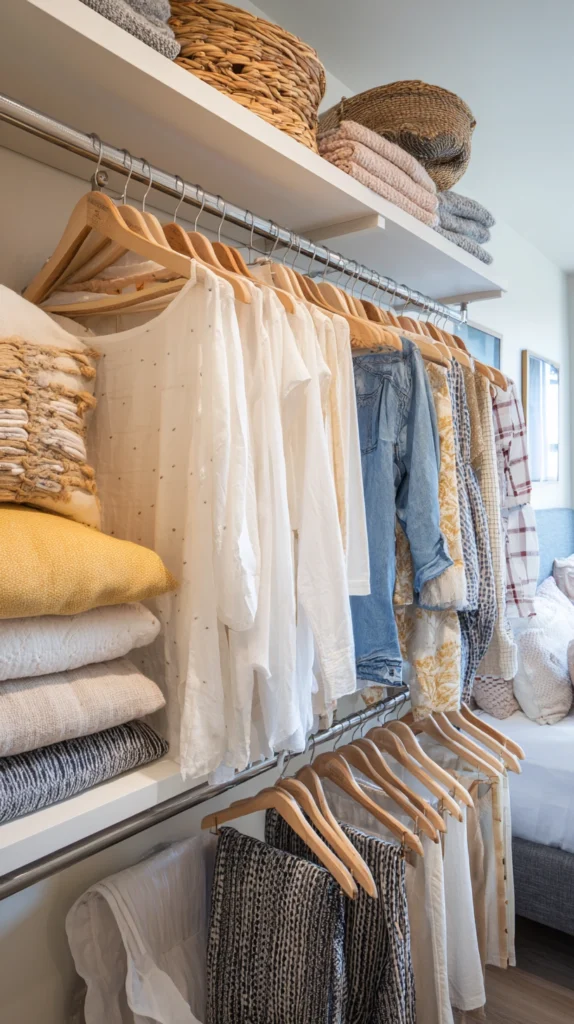
The final and most important principle for an open wardrobe in a very small bedroom is the decision to treat it as a designed feature of the room rather than a practical compromise — to give it the same aesthetic attention as any other decorative element, to style it with genuine care, and to maintain it with the discipline that makes the difference between an open wardrobe that is beautiful and organized and one that is chaotic and visually exhausting.
This means choosing matching hangers throughout — a simple investment in a consistent set of slim velvet or timber hangers that replaces the variety of wire, plastic, and mismatched hangers that most wardrobes accumulate.
It means folding and displaying visible items with the same care as a retail display rather than simply placing them on the shelf. It means keeping the rail to a maximum of two-thirds capacity so that items hang with the breathing room that allows them to be seen, accessed, and replaced without difficulty.
The open wardrobe styled as a designed feature is one of the small bedroom’s most effective and most rewarding organizational and aesthetic interventions — the decision that transforms a practical necessity into a genuine contribution to the room’s beauty.