

15 Slim Storage Ideas for Narrow Gaps
Every home has them — the narrow gaps that exist between the refrigerator and the wall, beside the washing machine, between two kitchen cabinets, alongside the bathroom vanity, in the slim corridor between a doorway and a bookcase — spaces of ten to thirty centimeters width that are too narrow for standard furniture, too significant in their combined area to simply ignore, and too consistently present in every home of every size and every layout to be dismissed as a problem specific to small houses.
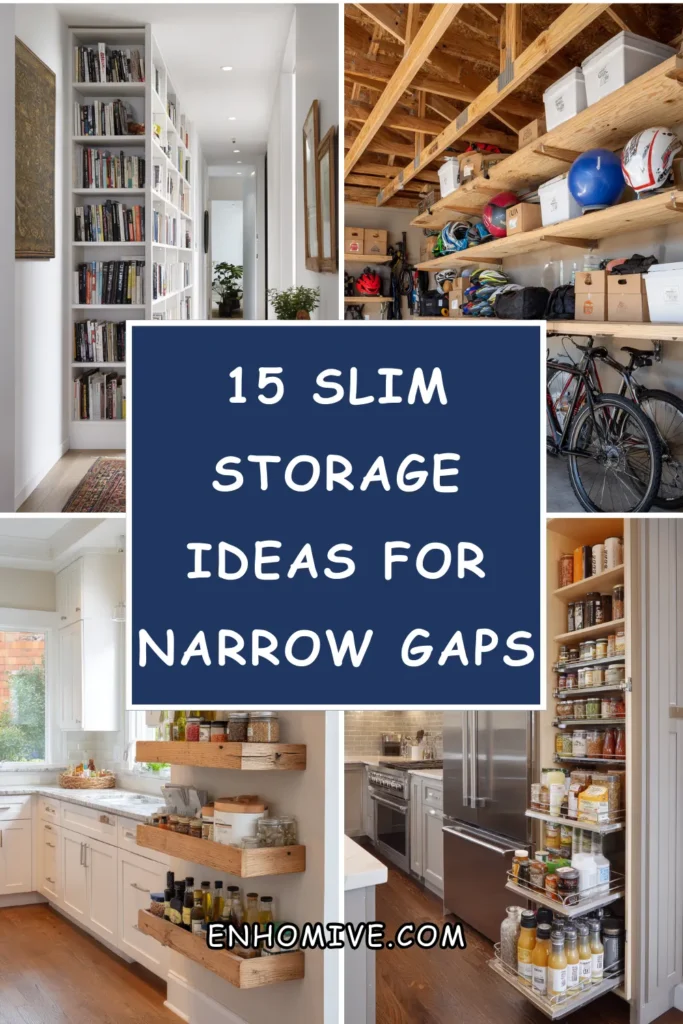
The narrow gap is the domestic interior’s most universal organizational challenge, and its consistent underutilization represents a storage opportunity of genuine significance in a home where storage is always, inevitably, in shorter supply than the accumulated possessions of a household require.
The genius of narrow gap storage is not simply that it provides additional capacity — it is that it provides additional capacity in exactly the locations where storage is most needed: beside the appliances and surfaces where specific items are used, in the rooms where clutter accumulates most persistently, and in the transitional spaces where the daily routines of the household create the deposits of objects that need somewhere to go. Here are fifteen ideas for turning every narrow gap in your home into a storage asset that earns its space completely.
1. A Pull-Out Pantry Tower Beside the Refrigerator
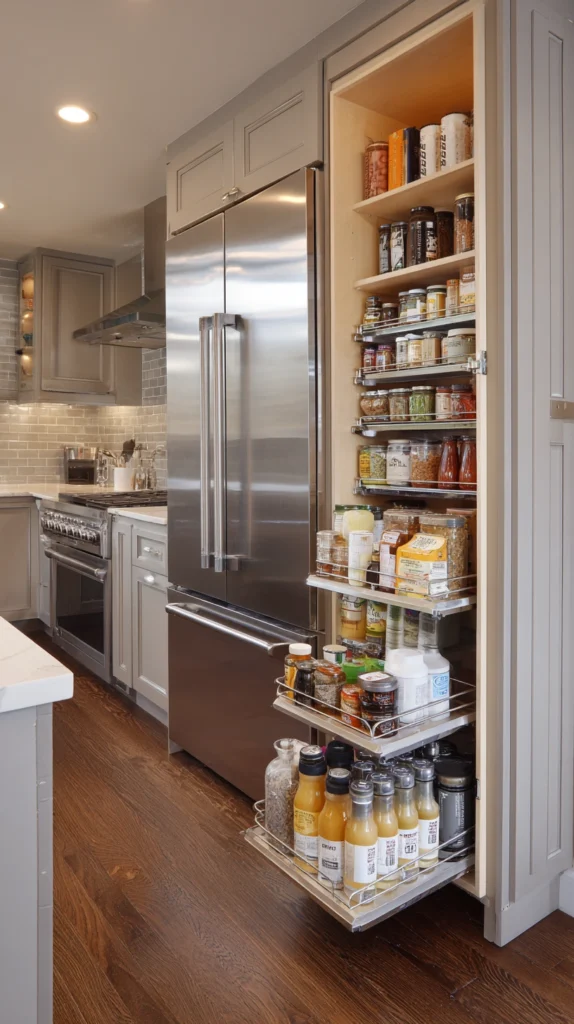
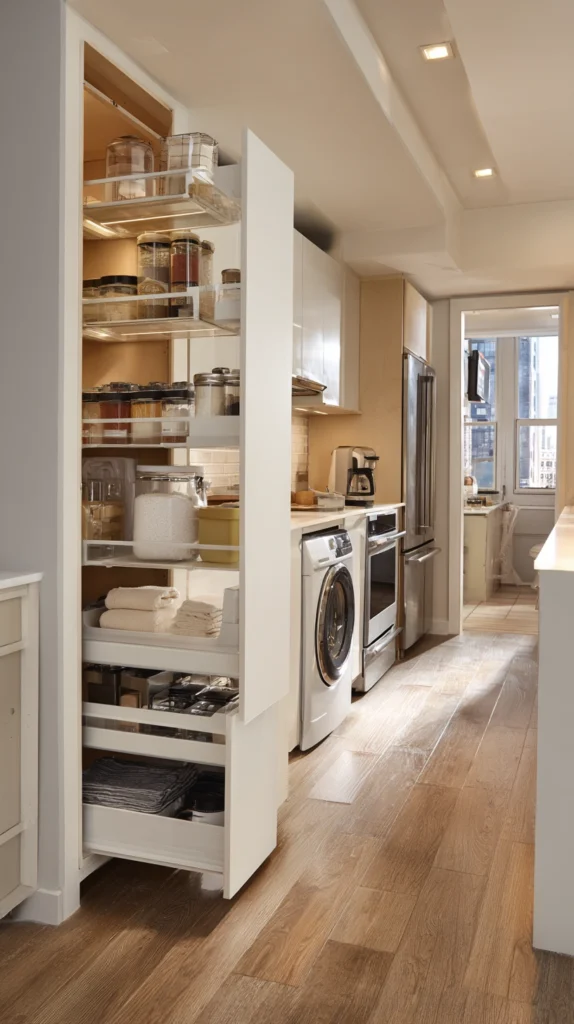
The gap between the refrigerator and the adjacent wall or cabinet — typically ten to twenty centimeters wide, the product of a refrigerator that is slightly narrower than the space allocated for it — is the kitchen’s most valuable narrow storage opportunity, and its development into a pull-out pantry tower creates a kitchen storage resource of remarkable capacity and organizational intelligence.
A pull-out tower unit — a slim, wheeled frame fitted with multiple horizontal shelves and designed to slide out from the gap on smooth-running castors — creates a storage column whose individual shelves hold the small kitchen items that have no other natural home: spice jars organized at a glance, condiment bottles accessed without rummaging, canned goods in a visible single layer, oil and vinegar bottles within immediate reach of the cooking surface.
The pull-out mechanism is the critical element — a unit that slides smoothly on quality castors requires no significant effort to operate and becomes a naturally used part of the kitchen’s daily routine, while a unit that sticks or requires effort quickly falls into disuse. Commission a bespoke unit from a kitchen joiner or source a quality proprietary pull-out pantry tower in a width precisely calibrated to the gap’s actual dimensions.
2. Slim Rolling Shelving for the Laundry Room
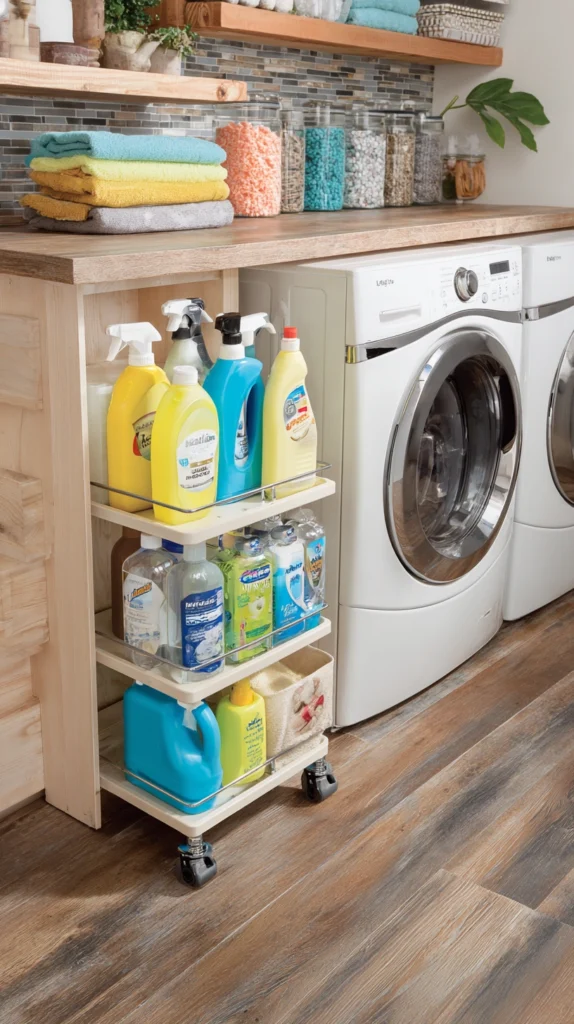
The laundry room’s narrow gaps — beside the washing machine, between the dryer and the wall, in the slim space beside the utility sink — are the locations where the laundry’s organizational infrastructure most urgently needs accommodation: the detergents, the fabric softeners, the stain treatments, the ironing accessories, and the cleaning products that the laundry function requires but that the standard laundry room’s limited cabinet provision rarely adequately stores.
A slim rolling shelving unit — a wheeled frame of three to five shelves in a width of fifteen to thirty centimeters — slides into the laundry gap and provides the organized storage for every laundry product in a single, accessible column that rolls out when needed and returns to its gap when the laundry routine is complete.
The shelving unit’s height should match the adjacent appliances for a flush, integrated appearance when stored, and its shelves should be spaced for the specific products it will hold — taller shelves for large detergent bottles, smaller shelves for narrow products and accessories.
3. A Bathroom Tower Cabinet for Slim Wall Sections
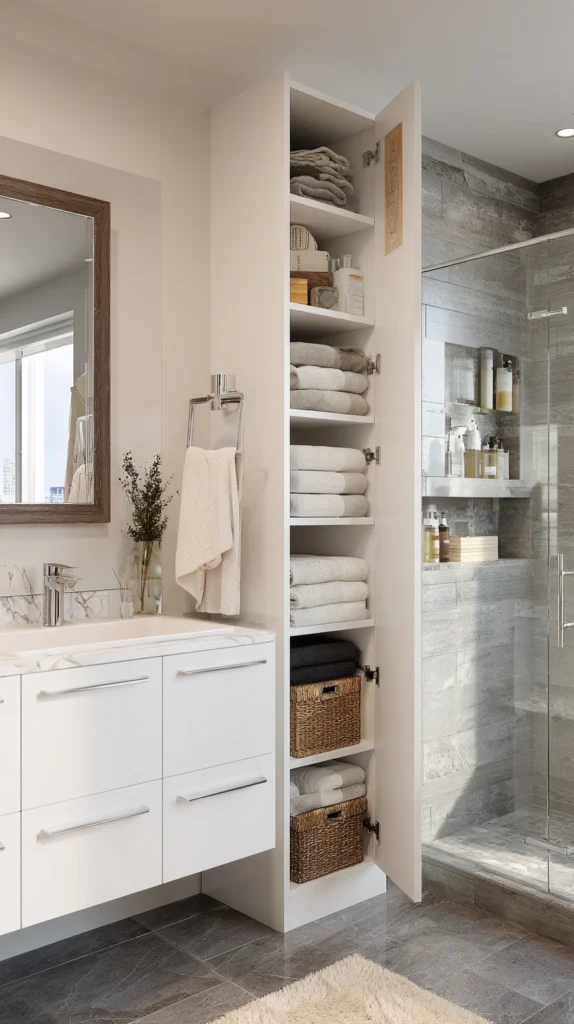
The bathroom’s slim wall sections — the ten to twenty centimeter strips of wall beside the door, between the mirror and the side wall, or alongside the toilet — provide the surface area for a wall-mounted tower cabinet of appropriate depth that creates vertical storage in a space too narrow for standard bathroom furniture.
A slim tower cabinet of ten to fifteen centimeters depth, floor-mounted or wall-mounted, provides a column of shelves behind a mirrored or paneled door that holds the bathroom’s overflow storage — spare toiletries, medicines, first aid supplies, the accumulated small items of a bathroom that exceed the vanity’s storage capacity.
The cabinet’s mirrored front, if chosen, adds the mirror function to the storage function and creates a secondary reflection surface that increases the bathroom’s light and apparent depth without requiring any additional wall space.
The tower cabinet’s slim profile allows it to occupy the narrow bathroom wall sections that no standard bathroom cabinet can fit, and its vertical height compensates for its limited width with a storage capacity that surprises every occupant who first opens its door.
4. Magnetic Knife and Tool Strips for Kitchen Gaps
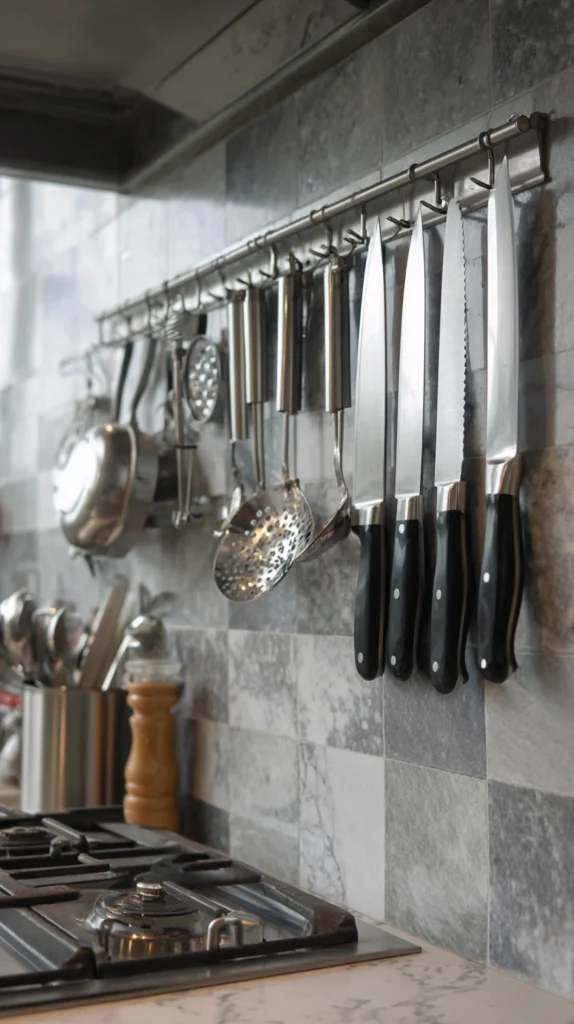
The narrow vertical surface beside the kitchen’s cooking zone — the slim wall section between the range and the adjacent cabinet, the side of the refrigerator, the narrow strip of wall beside the kitchen door.
It provides the mounting surface for a magnetic strip storage system that holds knives, cooking tools, and metal kitchen accessories within immediate reach of the cooking position without requiring any floor area, any cabinet space, or any more than the few centimeters of wall depth that a surface-mounted magnetic strip occupies.
A quality magnetic knife strip of appropriate length, mounted at a height convenient for the primary cook, holds the full knife collection in a visible, immediately accessible arrangement that the knife block on the counter cannot match for spatial efficiency.
Additional magnetic strips or magnetic tool holders beside it can accommodate metal spatulas, ladles, and the flat-edged tools that the kitchen drawer stores inefficiently and the knife strip holds perfectly. The magnetic strip system’s installation requires only two wall fixings of adequate strength for the anticipated weight load.
5. A Slim Bookcase for Hallway and Corridor Gaps
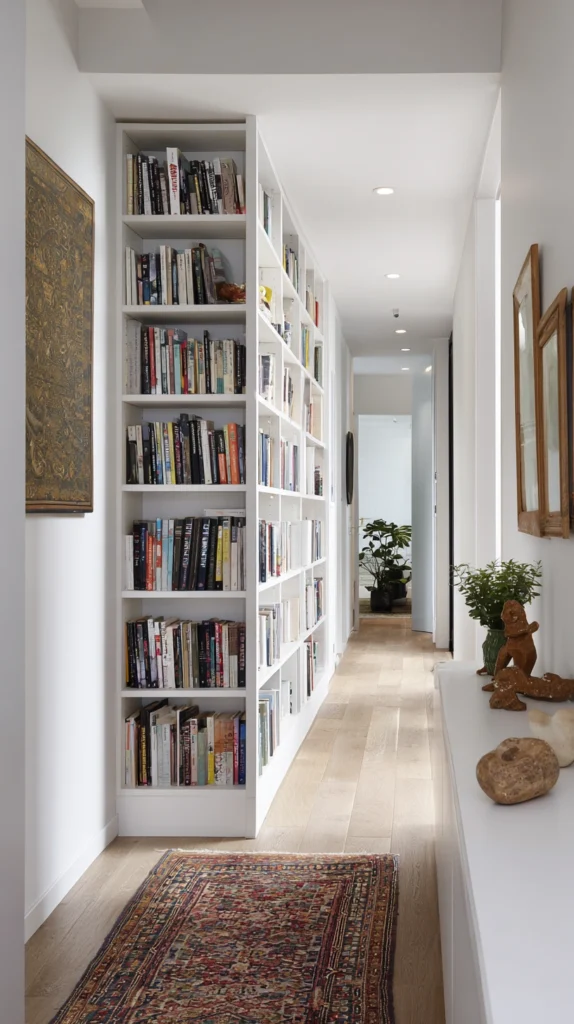
The hallway and corridor — the transitional spaces whose walls are consistently underutilized despite often providing the linear extent of wall surface that the adjacent rooms lack — typically contains the narrow gaps beside doorways, beside coat hooks, and at the end of corridors that are precisely the right width for a slim bookcase of fifteen to twenty centimeters depth.
A slim bookcase in this format — its depth precisely calibrated to the paperback book’s dimensions, its height extending to the ceiling to maximize the vertical storage capacity — creates a library resource in the transitional space that removes books from the living room, the bedroom, and the study where they accumulate beyond the storage capacity of the primary bookshelves.
The hallway bookcase provides the secondary library function that every reading household needs — the overflow storage for the books that are between the active reading pile and the long-term archive — in a space that contributes nothing else to the household’s organizational capacity. Paint it in the hallway’s wall color for an integrated, architectural appearance, or in a contrasting tone for a deliberate feature.
6. Under-Stair Narrow Gap Drawers
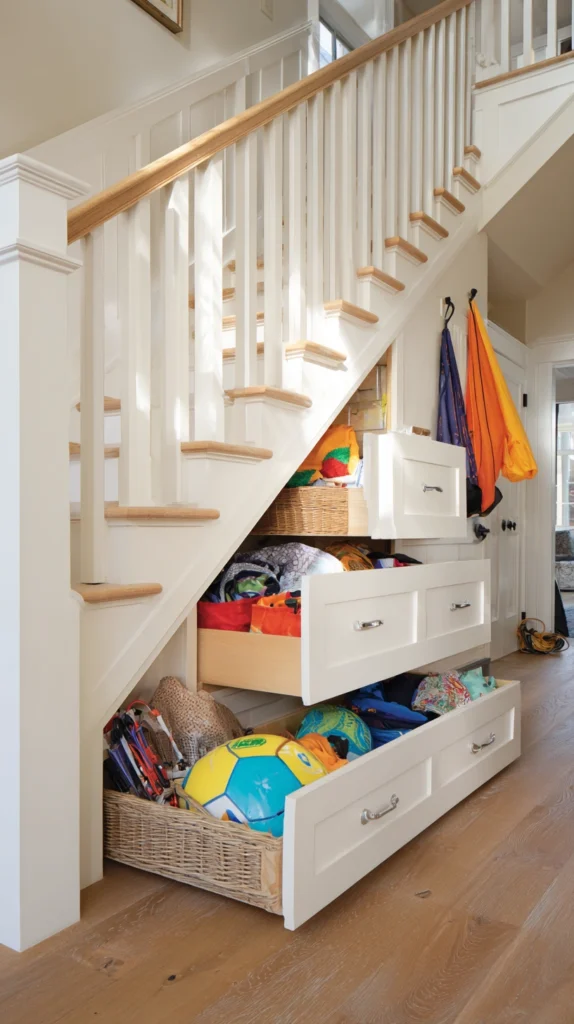
The space beneath a staircase — the triangular volume that standard under-stair storage development addresses with either open shelving or a built-in cupboard — often contains the narrow vertical sections at the stair’s sides, where the height reduces toward the end of the flight to dimensions that standard storage cannot efficiently use.
The installation of pull-out drawers in these narrow vertical sections — each drawer calibrated in height to the available dimension at its specific position along the stair’s descent, the shallowest drawers at the stair’s end and the deeper drawers at the stair’s beginning — creates a storage system that uses every centimeter of the under-stair volume with the specificity that only bespoke construction can achieve.
These narrow drawers suit the storage of flat items that most storage systems accommodate poorly: gift wrap and tubes, sports equipment and rackets, flat-pack items awaiting assembly, and the miscellaneous long, flat objects that every household accumulates without ever having an appropriate storage solution.
7. A Slim Shoe Storage Unit for the Entryway
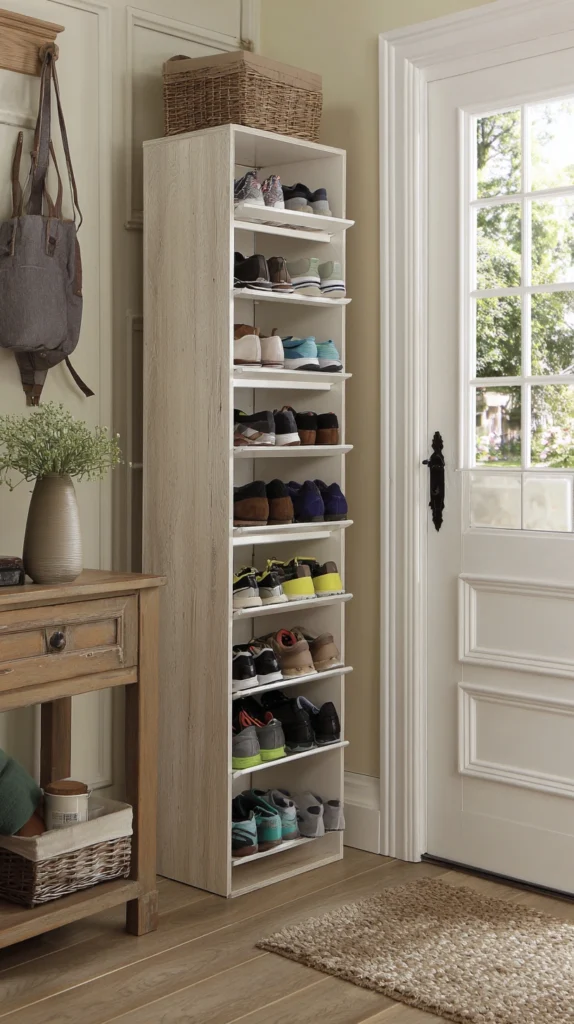
The entryway’s narrow gap — the slim section of wall beside the front door, the space between the door and the adjacent staircase, the narrow corridor between the entry and the main hallway — is the home’s most urgent shoe storage location and the one where slim storage solutions provide their most immediately felt organizational benefit.
A slim shoe cabinet of twenty to twenty-five centimeters depth in a floor-to-ceiling format stores a remarkable quantity of shoes in a very small footprint — the tilted shelf design that places shoes at an angle rather than flat uses the available depth with maximum efficiency, typically accommodating two shoes per tilted shelf in a space of twenty centimeters.
A pull-out shoe tower on castors — sliding out from the gap beside the door for access and returning flush with the adjacent surfaces when closed — provides the same shoe storage capacity with the tactile satisfaction of a well-engineered sliding mechanism. Either solution removes the shoe accumulation from the entryway floor that makes the first impression of any home its least favorable one.
8. Between-Joist Shelf Storage in the Garage
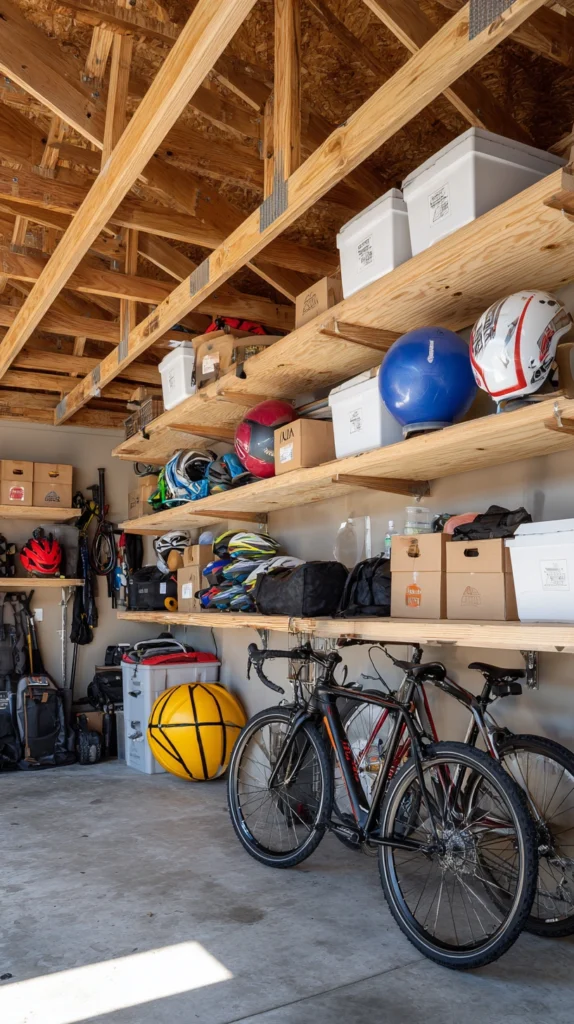
The garage’s structural ceiling joists — parallel timber members at regular spacing that create the narrow gaps between them — provide the mounting surface for between-joist storage shelves that use the garage ceiling’s depth for the storage of flat, lightweight items that the garage’s floor and wall areas are too valuable for utility use to accommodate.
A shelf fixed to the sides of adjacent joists in each bay of the joist spacing creates a storage platform of the full joist depth — typically thirty to forty centimeters — at ceiling level, accessible by stepladder for the seasonal and occasional items that the garage stores but that do not require regular access. Sports equipment, camping gear, seasonal garden tools, and the flat boxes of items stored for long periods suit the between-joist shelf with particular efficiency.
The system requires no structural modification to the ceiling — simply screwing timber shelf boards to the joist sides — and creates a storage resource in a zone that most garages leave entirely unused despite its significant cumulative area.
9. A Narrow Bathroom Shelf Above the Door
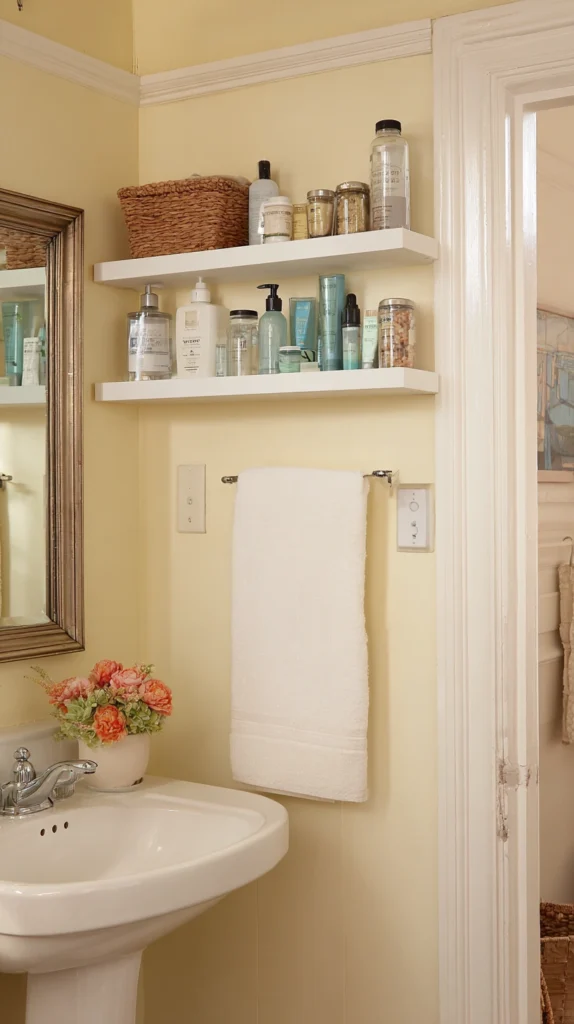
The wall space above internal doorways — the horizontal strip of wall between the door’s top edge and the ceiling — provides the mounting surface for a narrow shelf of ten to fifteen centimeters depth that creates storage in the space that most rooms never consider using.
In the bathroom, where storage is consistently insufficient relative to the quantity of items that personal care routines require, an above-door shelf holds the overflow toiletries, the spare towels, the decorative baskets of bathroom accessories, and the items of periodic use that the vanity and the cabinet cannot accommodate.
The shelf’s height above the door means it is accessed less frequently than the primary storage surfaces at eye and counter level, which suits it for items of periodic rather than daily use.
Choose the shelf material and finish to relate to the bathroom’s overall aesthetic — a timber shelf in a painted finish matching the woodwork, or a simple white painted shelf in a painted white bathroom — so that the above-door shelf reads as a designed architectural element rather than an improvised addition.
10. Slim Pull-Out Waste and Recycling in the Kitchen
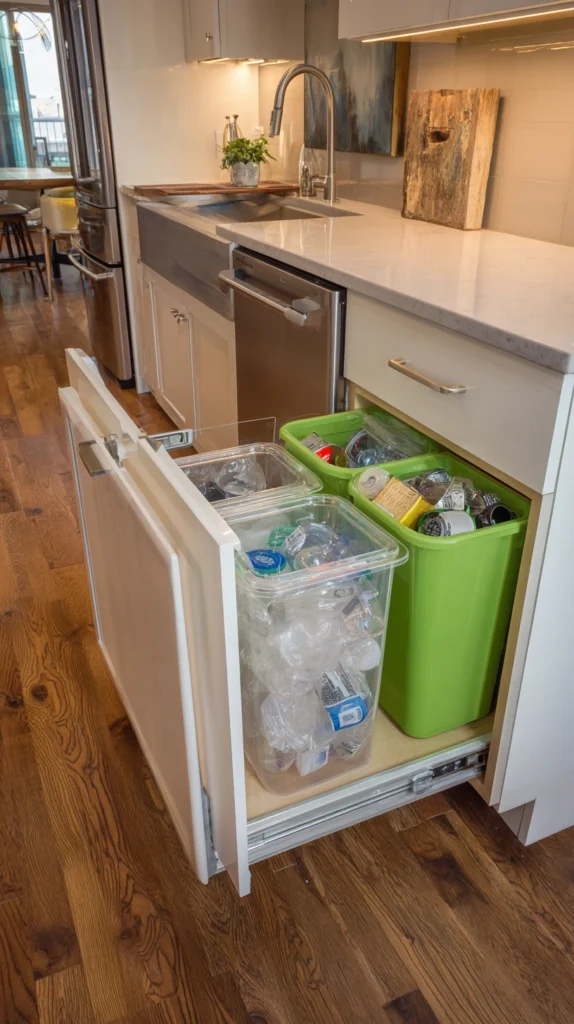
The kitchen’s waste and recycling management — the bins for general waste, recycling, compost, and the various separation categories that modern waste management requires — creates an organizational and spatial challenge in kitchens where the base cabinet provision does not include dedicated bin storage.
The narrow gap beside the kitchen’s base cabinet run — or the slim base cabinet at the kitchen’s end — provides the installation location for a pull-out bin unit of appropriate width that holds two or three segregated waste containers in a single slim pull-out frame.
A pull-out bin system of twenty to thirty centimeters width, fitted precisely into the available gap, provides the kitchen’s waste management infrastructure in a minimal floor footprint with the hygienic enclosure of a cabinet-fronted pull-out that the open bin beside the counter cannot provide.
The pull-out mechanism should be of adequate quality to operate smoothly under the daily use that the waste bin receives — more frequent than any other pull-out in the kitchen — and the bins within it should be removable for emptying without removing the entire unit from its gap.
11. A Narrow Garden Tool Store Beside the Shed
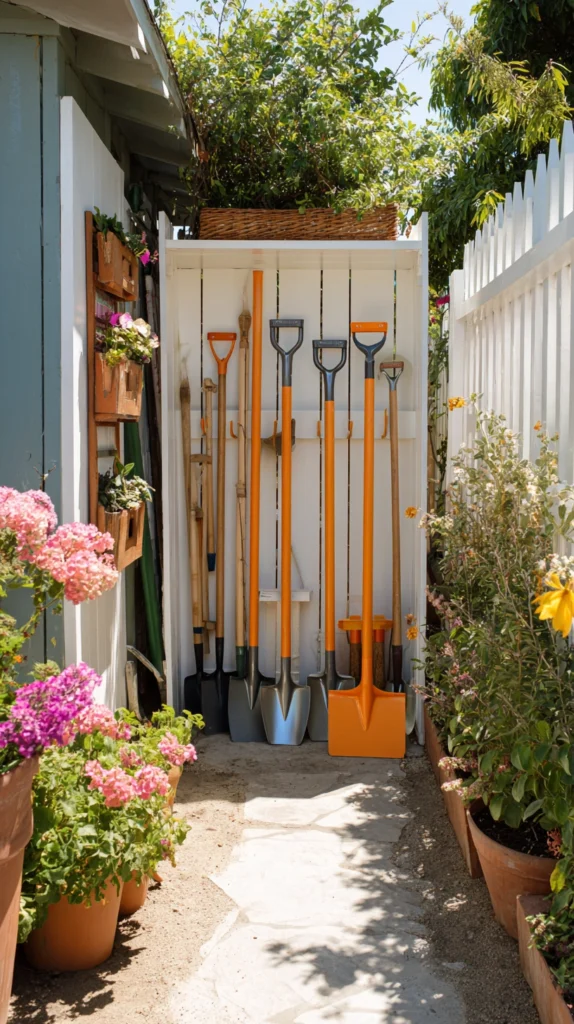
The exterior gap beside the garden shed — the narrow passage between the shed’s side wall and the boundary fence or adjacent structure — is one of the garden’s most consistently wasted spatial resources, typically used for nothing more useful than the accumulation of fallen leaves and the occasional forgotten garden tool.
A slim, weatherproof tool storage system fitted into this gap — wall-mounted hooks and rails on the shed’s exterior wall holding long-handled tools, a narrow shelf at waist height for smaller equipment, and a secure latch at the gap’s entrance to prevent unauthorized access — creates a garden tool store in space that requires no dedicated garden building and no footprint beyond the gap’s existing dimensions.
The exterior wall mounting keeps the shed’s interior clear for the larger equipment and storage that the shed’s floor area most productively serves, and the gap’s natural enclosure between the shed and the fence provides a degree of weather protection for the stored tools that a completely exposed tool store cannot offer.
12. Floating Shelves in the Kitchen’s Slim Wall Sections
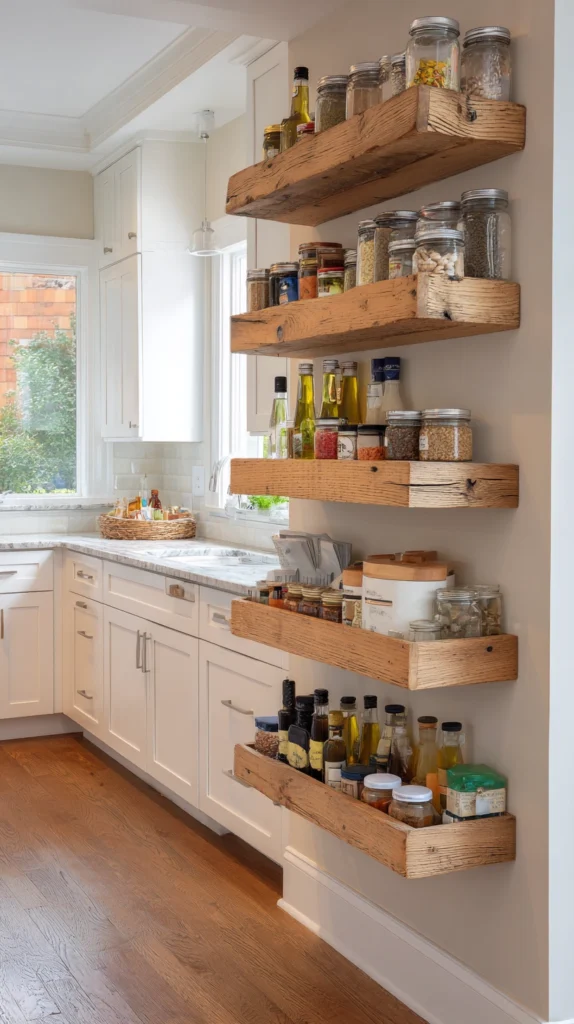
The kitchen’s slim wall sections — the narrow strips of wall between windows, beside the refrigerator alcove, above the counter run’s end — provide the mounting surface for floating shelves whose depth can be calibrated to the available projection and whose width fills the slim section with organized storage at the precise location where kitchen items are most conveniently accessed.
A floating shelf of fifteen centimeters depth and forty centimeters width in the narrow wall section beside the cooking zone holds the most frequently used spices and small condiments in a visible, immediately accessible arrangement at the cook’s eye level — a more convenient and more organizationally clear arrangement than the spice drawer or the spice rack on the counter that most kitchens default to.
The floating shelf’s invisible bracket maintains the slim wall section’s visual clarity without the visual weight of a cabinet, and its surface is the same depth as the item it holds, creating a purpose-specific storage solution rather than a general shelf that accommodates its contents with unnecessary excess space.
13. A Slim Bedside Storage Solution for Narrow Bedroom Gaps
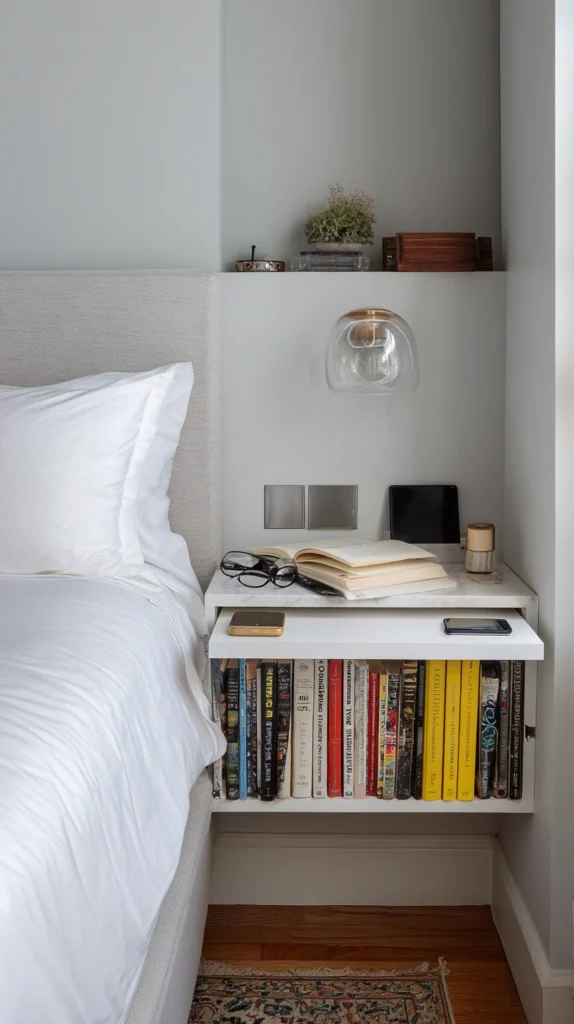
The bedroom gap beside the bed — the slim section of floor between the bed’s side and the adjacent wall, often too narrow for a standard bedside table but wide enough for a purpose-designed slim bedside storage solution — is the room’s most urgently needed storage location and one of the domestic interior’s most commonly improvised organizational challenges.
A slim pull-out bedside unit of fifteen to twenty centimeters width — its face flush with the bed frame, its shelves holding the phone, the book, the water glass, and the small items of the bedtime routine — slides out from the gap for access and returns flush when not in use.
Wall-mounted bedside solutions — a fold-down shelf, a small wall-mounted cabinet of appropriate depth — use the wall surface above the narrow floor gap without requiring any floor footprint, and provide the bedside function in the specific situation where even the slimmest floor-standing unit exceeds the available gap width.
14. A Tall Slim Cabinet for the Bathroom’s Towel Gap
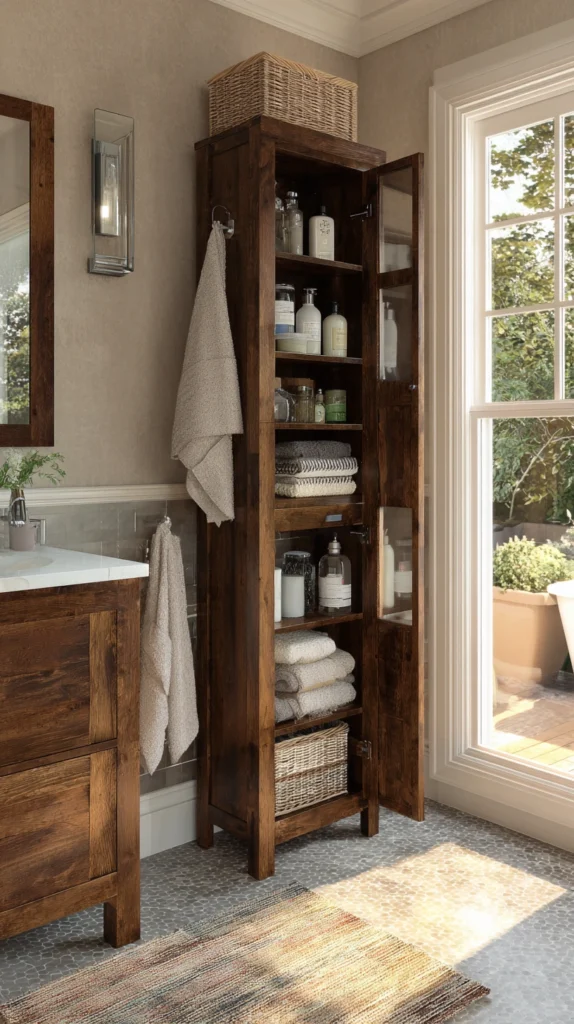
The gap beside the bathroom door — the slim wall section between the door frame and the adjacent wall or fixture — is typically the bathroom’s most accessible but least used storage location, and its development into a tall, slim cabinet of ten to fifteen centimeters depth creates the bathroom’s most convenient towel and linen storage.
A floor-to-ceiling slim cabinet in this location — its shelves spaced for folded towels on the lower levels and smaller items above — holds the full bathroom linen supply in a dedicated storage column that removes towels from the vanity counter, from hooks on the back of the door, and from the improvised storage arrangements that every bathroom develops when dedicated linen storage is absent.
The cabinet’s door — mirrored, paneled, or simply painted — closes flush with the surrounding wall surfaces and creates the visual integration of a fitted element rather than the applied quality of furniture placed in a gap.
15. Design a Whole-Home Narrow Gap Audit
The final slim storage idea is not a single product or a single location solution but a systematic approach: the whole-home narrow gap audit — a complete survey of every gap, every slim section of wall, every narrow space between appliances, beside furniture, under stairs, and above doorways that the home contains, conducted with a tape measure and a notebook and resulting in a comprehensive inventory of unused spatial resource that can be developed systematically rather than reactively.
Most homes contain far more usable narrow gap space than their occupants realize, because the gaps are individually inconspicuous — each one too small to register as a significant spatial resource — while collectively representing a storage capacity that, properly developed, can resolve the organizational challenges of a household that has run out of obvious storage options.
The gap audit converts the invisible spatial resource into a visible organizational opportunity, and the systematic development of each identified gap — with the specific, purpose-designed storage solution that its dimensions and location most naturally suggest — creates a home of organizational completeness that the addition of standard furniture can never achieve.