
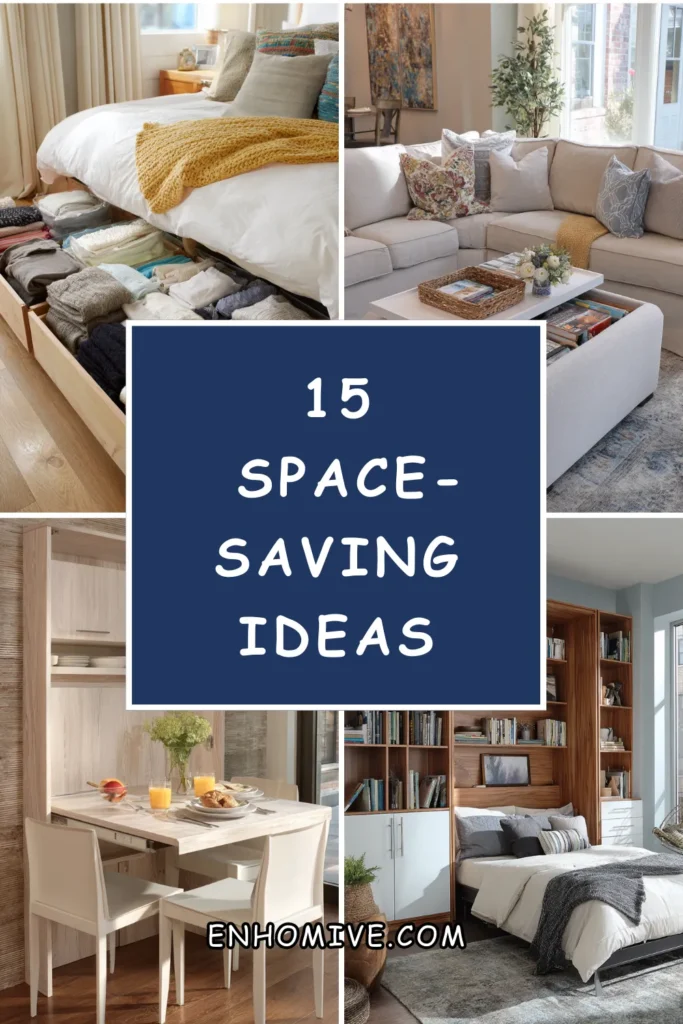
15 Space-Saving Ideas
The small home’s relationship with space is one of the most consistently misunderstood challenges in domestic design. Most people who live in small homes approach the space problem as a storage problem, believing that if they could simply find enough places to put their things, the small home’s limitations would be resolved.
The storage problem is real, but it is only one dimension of the space challenge. The deeper challenge is the organizational and design intelligence that determines how every cubic centimeter of the home’s total volume is used, not just the volumes that are obviously available for storage but the volumes that conventional furniture and conventional room organization leave entirely unused. The gap above the kitchen cabinets. The void beneath the staircase.
The depth behind the door. The wall thickness between the studs. The space beneath the bed. The volume within the ottoman. These are the small home’s hidden spatial resources, and their development through the application of specific space-saving ideas creates a home that functions with the completeness of a much larger dwelling within the actual dimensions of the compact one.
The space-saving ideas that work most powerfully are not the ideas that simply add more storage to the existing room organization.
They are the ideas that fundamentally rethink the relationship between the furniture, the architecture, and the daily routines of the household to create a home where every element serves multiple functions, every surface conceals as well as displays, and every room transitions effortlessly between its different daily uses without the cumbersome rearrangement that inadequately designed small homes require. Here are fifteen space-saving ideas that transform the small home’s relationship with its own dimensions.
1. Install a Murphy Bed with Integrated Shelving
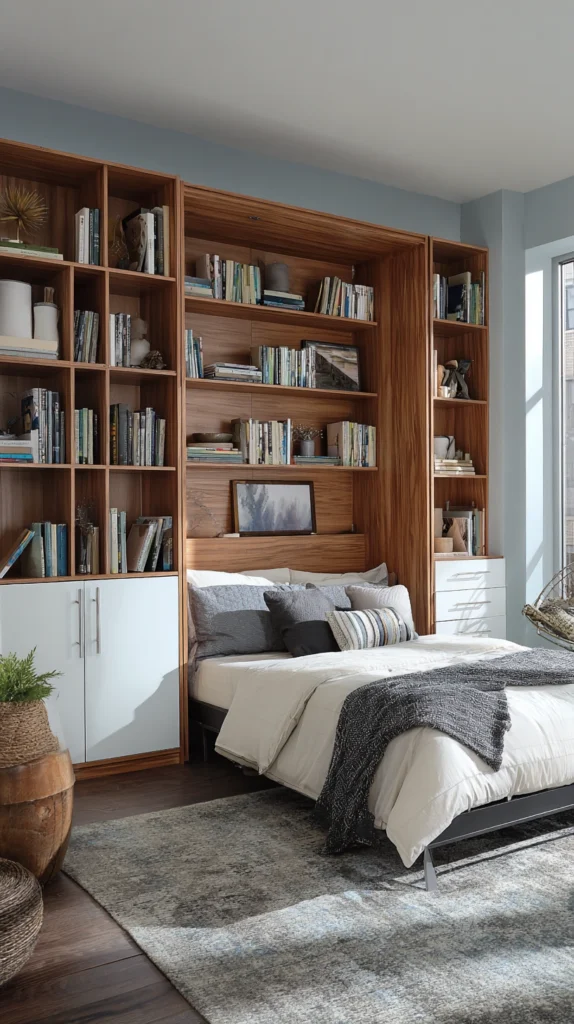
The Murphy bed is the single most transformative space-saving intervention available to the small home, and its combination with an integrated shelving system that surrounds the fold-down bed on both sides and above creates a wall unit of complete spatial intelligence whose two states, the daytime shelving wall and the nighttime bedroom, serve entirely different functions within the same wall footprint.
The shelving unit that surrounds the Murphy bed should be designed for genuine daily use rather than purely decorative display. Deep shelves that hold real books, real objects, and the real storage requirements of the room create the daytime shelving wall of authentic domestic warmth. Shallow decorative shelves that cannot hold anything of practical significance create the unconvincing backdrop that undermines the Murphy bed installation’s practical and aesthetic credibility.
The mechanism quality of the Murphy bed determines its daily usability more directly than any other single specification decision. A smooth, counterbalanced fold-down mechanism that requires minimal physical effort to operate will be used willingly every day. A stiff, heavy mechanism that requires significant effort creates the daily resistance that eventually results in the bed being left permanently in one position, defeating the installation’s entire spatial purpose.
Commission the integrated Murphy bed unit from a specialist joiner or use one of the quality proprietary systems available with comprehensive installation guidance. The investment in quality at the specification stage creates a unit of long-term reliability and daily pleasure whose spatial benefit is felt every morning when the bed folds up and the room becomes something other than a bedroom.
2. Take Every Cabinet to the Ceiling
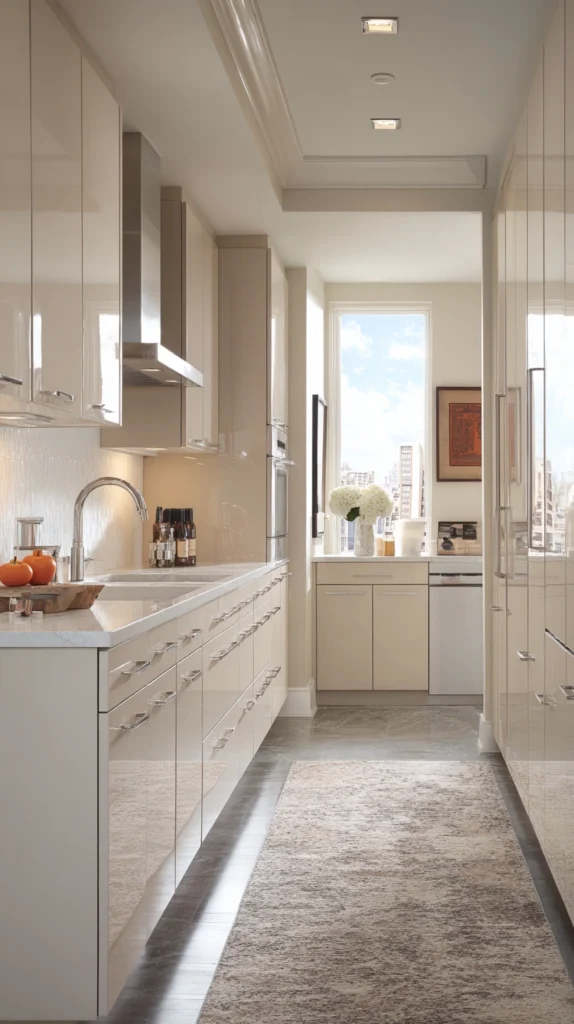
The gap between the top of the wall cabinets and the ceiling, present in almost every kitchen, bathroom, and living room where standard-height cabinetry has been installed, is the domestic interior’s most consistently wasted storage volume. Extending every cabinet in the home to the ceiling height creates a storage increase of significant practical consequence while simultaneously improving the room’s visual quality through the elimination of the horizontal line at the cabinet’s top edge.
The ceiling-height cabinet extension does not require the replacement of existing cabinetry. In most installations, additional cabinet units of the appropriate width and depth can be ordered from the same manufacturer as the existing cabinets and installed above the current top units, creating the extended run in a matching finish without the cost of a complete cabinetry replacement.
The additional units hold the less frequently accessed items of the room’s storage requirements at heights where occasional access by step stool is an acceptable operational requirement.
The visual benefit of the ceiling-height cabinetry is as significant as its practical benefit. The cabinet run that extends continuously from the floor to the ceiling creates a wall of storage whose vertical continuity makes the room feel taller and more architecturally resolved than the same cabinets stopping at the conventional intermediate height.
The elimination of the dust-collecting gap between the cabinet top and the ceiling is the additional practical benefit whose maintenance value is felt with every cleaning session.
Paint the ceiling in the same color as the cabinetry for the most complete visual integration of the extended cabinet run with the room’s architectural envelope. The continuous color from the cabinet surface to the ceiling surface above it eliminates the visual boundary between the furniture and the architecture, creating the built-in quality of a room whose storage is part of the building rather than furniture placed within it.
3. Build Storage into Every Staircase
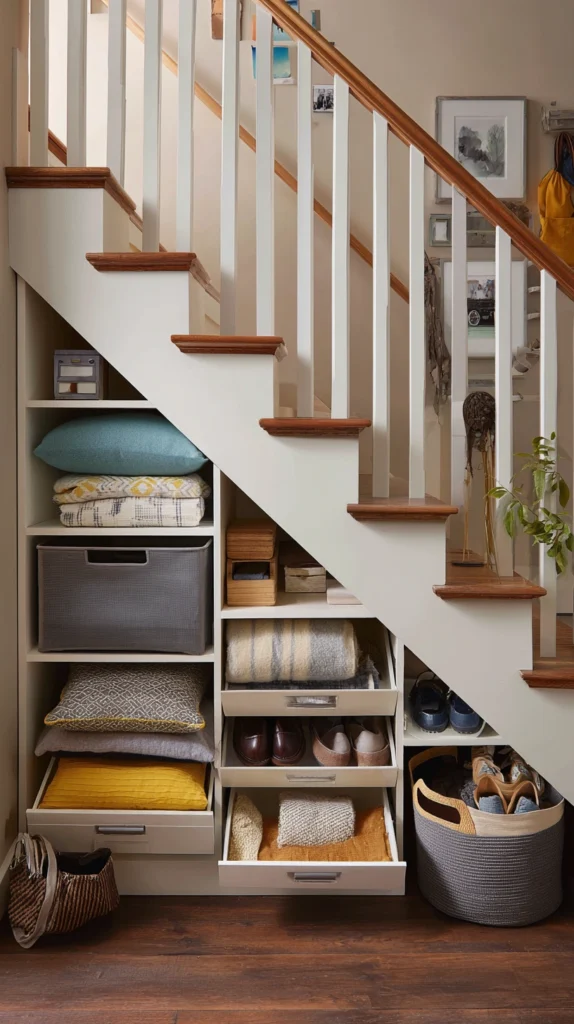
The staircase’s structural void, the triangular volume between the stair’s underside and the floor below, is one of the small home’s most significant and most consistently underused storage resources. Its development into a complete storage system, whether through the installation of pull-out drawers in the stair risers, the creation of a full cupboard beneath the stair’s run, or the installation of open shelving in the void’s accessible sections, creates a storage provision of substantial capacity in space that the un-developed staircase wastes entirely.
The pull-out drawer installation in the stair risers creates the most visually surprising and most spatially efficient use of the staircase void. Each riser, the vertical face of the stair step, becomes the front face of a pull-out drawer whose depth extends into the stair’s structural volume.
The drawer heights vary along the stair’s run, the deepest drawers at the stair’s beginning and progressively shallower drawers toward the stair’s end, creating a storage system of varied capacity calibrated to the specific items each drawer’s dimension most efficiently holds.
The under-stair cupboard is the most commonly executed staircase storage solution and the one whose execution is most frequently compromised by inadequate internal organization.
The under-stair cupboard that is simply an enclosed void without internal shelving, hanging provision, and organizational infrastructure becomes a dark, disorganized storage space whose contents become inaccessible and forgotten within months of the installation’s completion. Design the under-stair cupboard’s internal organization with the same specificity as any other storage space in the home.
4. Use the Wall Thickness for Recessed Shelving
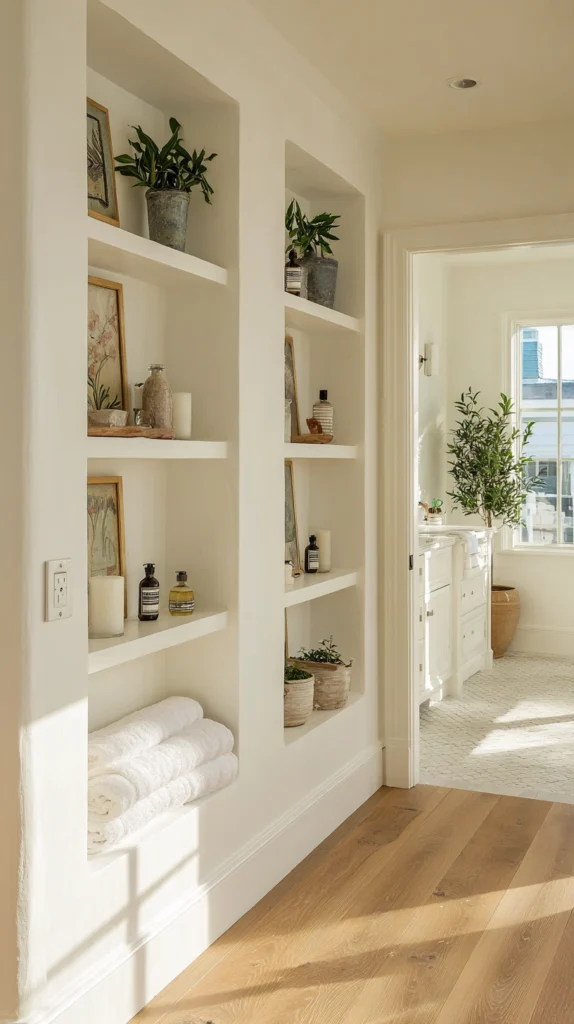
The wall cavities between timber studs in a standard timber-framed wall, typically ninety to one hundred millimeters of available depth, provide the installation space for recessed shelving that creates storage within the wall’s own thickness without projecting into the room at all.
The recessed shelf’s zero-floor-footprint quality makes it the space-saving idea of most pure spatial efficiency, creating storage capacity from the wall’s structural void rather than from the room’s usable floor area.
The installation process requires the identification of the stud positions, the verification of the absence of cables and pipes within the chosen cavity, and the careful cutting of the wall surface to expose the cavity.
A framing of the opening in simple timber creates the recessed shelf’s finished perimeter, and shelves fixed within the cavity at appropriate spacing create the storage positions. The entire installation is then painted in the wall color for the seamless visual integration that makes the recessed shelf appear as an architectural feature rather than a retrofitted addition.
The bathroom and the hallway are the rooms where the recessed shelf’s zero-footprint quality delivers the greatest spatial benefit. The bathroom where every projecting centimeter reduces the usable floor area finds in the recessed shower niche, the recessed vanity shelf, and the recessed medicine cabinet the storage solutions whose functional value is matched by their complete spatial efficiency.
The hallway where projecting furniture creates circulation obstacles finds in the recessed shelf the organizational provision of a bookcase or a display surface without any reduction of the passage’s usable width.
5. Choose Furniture That Serves Multiple Functions
The single-function piece of furniture is the small home’s most expensive spatial luxury. Every piece of furniture that occupies floor area in a small home and serves only one purpose, a chair that is only a chair, a table that is only a table, a bed that is only a bed, represents a spatial commitment of significant consequence whose cost in floor area the small home can rarely afford without sacrificing the organizational completeness the household requires.
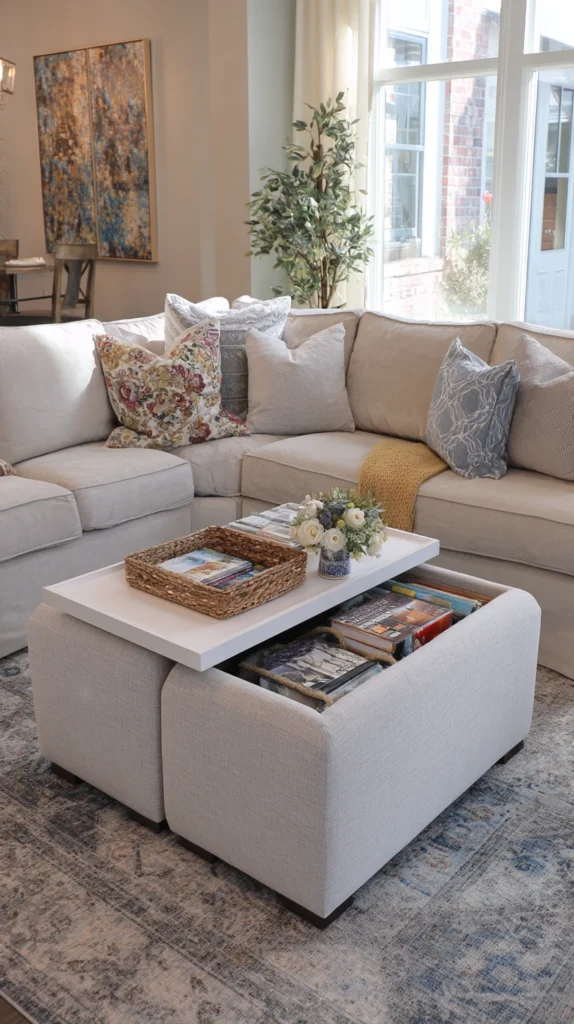
The ottoman that serves as a coffee table, additional seating, a footrest, and a storage volume for the living room’s soft goods represents the same floor area as the coffee table it replaces while serving four functions to the coffee table’s one.
The dining table with integrated drawers that hold the dining linen, the serving accessories, and the household’s document management serves the dining function while simultaneously eliminating the need for a separate storage piece that the dining room’s limited area cannot accommodate.
The selection of multi-function furniture should begin with the honest assessment of every single-function piece currently in the home and its replacement, where possible, with a piece of equivalent or superior aesthetic quality that serves the same primary function with the addition of the secondary functions that the small home’s spatial intelligence requires.
This replacement process creates the small home of complete organizational sophistication without the reduction of the home’s furnishing quality that the compromise of a poorly designed multi-function piece would create.
6. Install Sliding and Pocket Doors Throughout
The conventional hinged door requires a clearance arc of approximately one square meter of floor space on one side of its opening for the door swing that its operation demands. In a small home where one square meter of floor space is a significant proportion of the room’s total usable area, the hinged door’s clearance requirement is a spatial cost of considerable consequence.
The sliding door and the pocket door eliminate this clearance requirement entirely, returning the door swing’s former occupation of the floor area to the room’s usable space.
The pocket door, a door that slides into a cavity within the wall rather than along the wall’s surface, creates the most complete spatial recovery of the door swing area by making the door invisible when open.
The pocket door installation requires the wall cavity to be free of structural elements, electrical cables, and plumbing services, which in many existing homes requires the rerouting of services before the pocket door can be installed. In new construction or significant renovation, the pocket door should be the default door type throughout the small home rather than the exception reserved for specific locations.
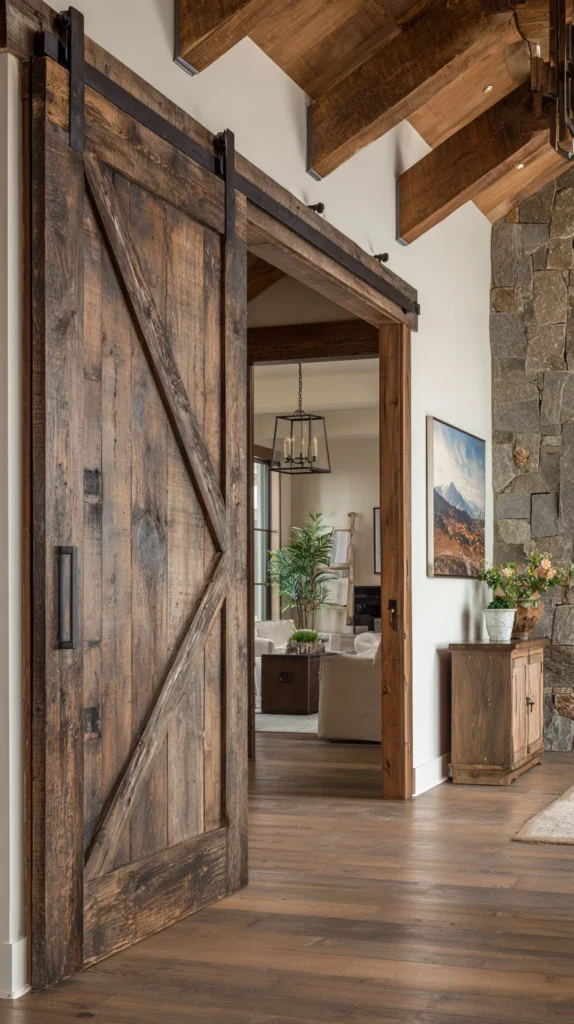
The sliding barn door on a surface-mounted track provides the same door swing area recovery as the pocket door without the structural complexity of the wall cavity installation. Its surface-mounted track and the door’s visible presence along the wall when open create a different aesthetic quality from the pocket door’s complete disappearance, but its spatial benefit of the eliminated door swing clearance is identical. The barn door’s aesthetic quality, when the door is chosen with genuine design consideration, creates a room feature of considerable character that the standard hinged door cannot approach.
7. Create a Dedicated Hideaway Home Office
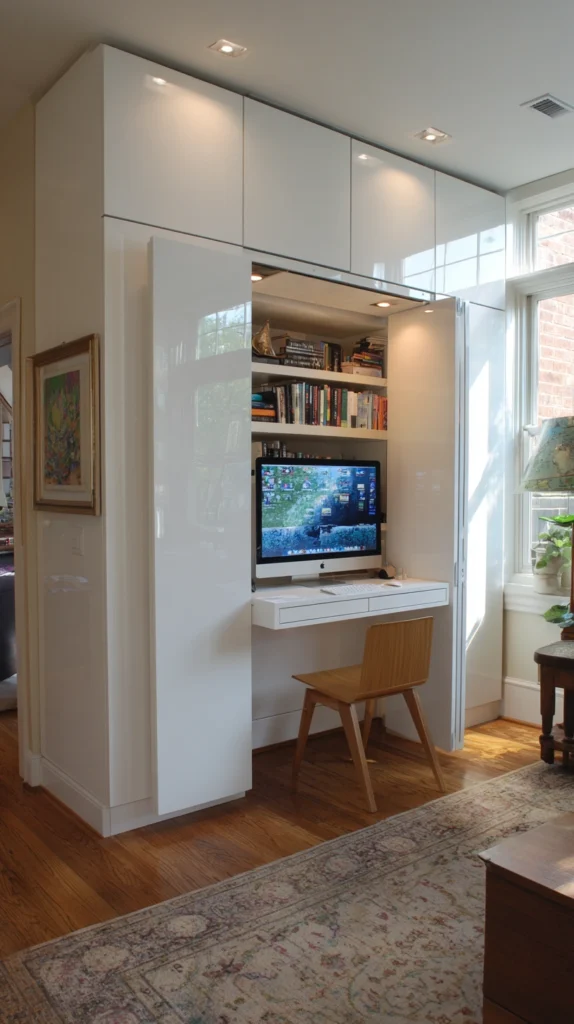
The home office that exists as a permanently set-up workspace within the main living area of a small home creates two simultaneous problems. It reduces the living area’s usable floor area for the desk and chair’s footprint, and it creates the visual intrusion of the work environment within the relaxation environment whose psychological separation the small home’s occupants need as urgently as its physical separation but cannot achieve while the desk is permanently visible in the living space.
A hideaway home office, created within a repurposed wardrobe, a built-in alcove with closing doors, or a dedicated cabinet unit with a fold-down desk surface, creates the complete home office provision within a footprint that closes entirely when the working day is complete. The closed wardrobe or cabinet door conceals every element of the work environment from the living space, creating the psychological separation of leaving the office that the permanently visible desk in the living area entirely prevents.
The hideaway office’s internal organization should be as carefully considered as a permanent office space, with adequate desk depth for the monitor and the keyboard, adequate shelving for the reference materials and the office equipment, adequate cable management for the power and the data connections, and adequate task lighting for the working hours when the natural light is insufficient.
The hideaway office that compromises on any of these functional requirements in favor of the concealment creates a workspace of daily frustration rather than the daily pleasure of a well-designed working environment.
8. Use Vertical Space on Every Wall
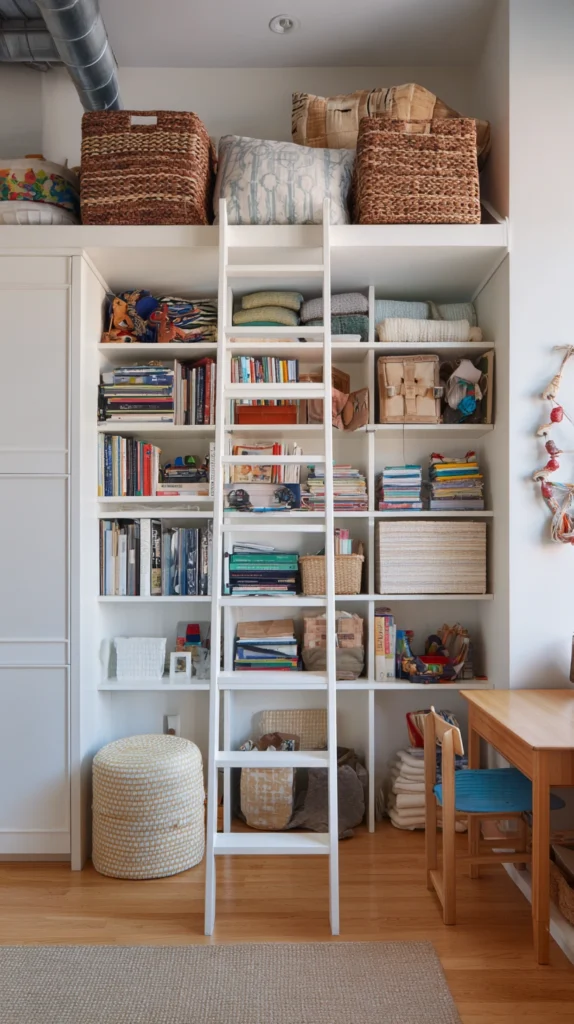
The small home typically uses the wall surface from the floor to approximately two meters height, the zone of comfortable reach and comfortable visual engagement, and leaves the wall surface above this height entirely unaddressed. The wall surface from two meters to the ceiling, available in every room of the home as a continuous horizontal band of vertical surface, represents a storage and display resource of significant cumulative area that the conventionally organized small home wastes consistently.
High-level shelving installed at two meters height and above, accessible by a simple step stool or a library ladder on a rail system, creates the additional storage volume for the household’s less frequently accessed possessions without consuming any floor area. The library ladder on a rail, allowing the high-level shelving to be accessed efficiently and elegantly, creates the small home’s most visually dramatic and most practically intelligent vertical space utilization solution.
The wall surface above the kitchen cabinets, the wall above the bedroom wardrobe, and the wall above the bathroom vanity all represent the specific examples of the vertical space resource that most small homes leave entirely unused.
Simple shelving installed at these high positions, accessible when needed and out of the daily visual field when not, creates the storage capacity that the small home’s organizational completeness requires without the floor footprint that the equivalent storage in a freestanding unit would demand.
9. Install Under-Bed Storage Systems
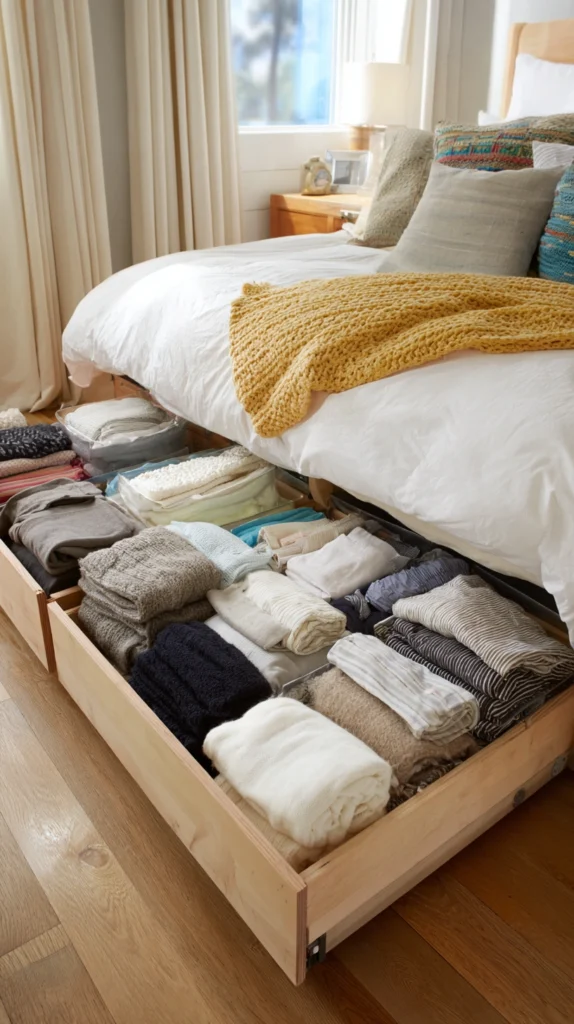
The space beneath the bed is the bedroom’s largest single storage volume and the one most consistently underused or used with the least organizational intelligence. A bed whose underbed space is occupied by accumulated boxes, random objects, and the domestic drift of items that have no other designated home is a bed whose storage resource is technically used but practically inaccessible, because the accumulated clutter beneath it resists the organized retrieval that genuine storage requires.
A bed frame with integrated pull-out drawers creates the bedroom’s most organizationally efficient underbed storage system. The drawers, fitted on full-extension runners that allow the drawer’s complete depth to be accessed from the front, hold the bedroom’s overflow storage, the additional bedlinen, the seasonal clothing, the stored items of the bedroom’s organizational requirement, in an organized, accessible system that eliminates the inaccessible random accumulation of the unorganized underbed space.
For beds without integrated drawer storage, underbed storage containers of consistent dimensions fitted with smooth-running wheel systems create the organized storage provision within the existing bed frame’s clearance.
Vacuum storage bags within these containers, compressing the bulk of seasonal textiles to a fraction of their normal volume, multiply the effective storage capacity of the underbed space beyond what the physical dimensions of the clearance volume suggest is possible.
10. Mirror Every Possible Surface
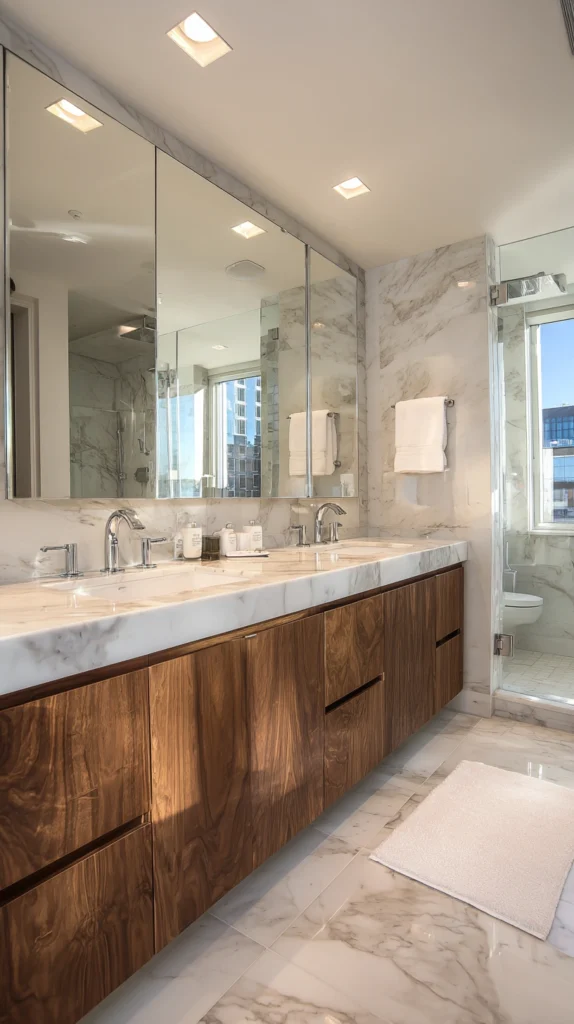
The mirror’s spatial function in the small home extends beyond the purely practical to the fundamentally spatial.
A mirror of adequate size on the right wall creates the visual impression of a room that extends beyond its actual boundaries, doubling the apparent depth of the room in the mirror’s specific reflection direction and amplifying the room’s natural light to the point where the mirrored small room has the visual quality of brightness and spatial generosity that its physical dimensions alone cannot create.
A full-height mirror on the bedroom wall opposite the window creates a bedroom whose apparent width is doubled in the mirror’s reflection and whose natural light is amplified by the window’s reflected light source that the mirror creates on the opposite wall. The effect is most dramatic in narrow rooms where the mirror’s doubling of the apparent width transforms a corridor-like bedroom into a room of perceptible spatial generosity.
Mirrored cabinet doors replace the visual weight of the solid cabinet door with the reflective transparency of the mirror surface, creating the paradox of a storage unit that makes the room appear larger rather than smaller.
The mirrored wardrobe door, the mirrored bathroom cabinet, and the mirrored sideboard front all serve their storage function while contributing the mirror’s spatial expansion effect to the room’s overall quality, creating the storage and the space simultaneously within the same surface.
11. Create Zones with Furniture Rather Than Walls
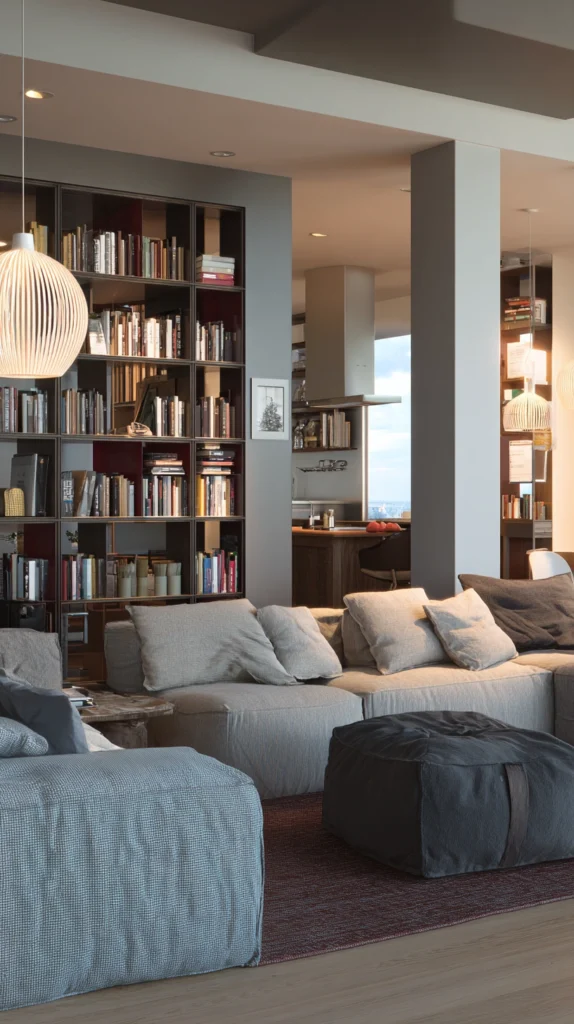
The small home that uses walls to divide its spatial program into separate rooms creates the most spatially inefficient version of the small home’s layout because the walls consume floor area, block natural light, and eliminate the spatial flexibility that the multi-functional small home most urgently requires.
The small home that uses furniture to define zones within a single open-plan volume creates the spatial efficiency of the open plan while maintaining the functional distinction of separate use areas that the household’s daily life requires.
A sofa positioned with its back to the kitchen-dining area creates the visual and social boundary between the living zone and the cooking zone without any physical wall. A bookcase placed perpendicular to the main wall creates the visual division between the home office zone and the living zone while simultaneously serving its shelving function.
A rug beneath the dining table creates the visual definition of the dining zone within the open-plan floor area without any physical boundary that restricts movement or light.
The furniture-defined zone’s critical advantage over the wall-defined room is its reversibility. The furniture arrangement can be changed as the household’s requirements change, the home office zone relocated, the dining zone expanded, the living zone reconfigured, without any structural consequence to the building.
The small home designed with furniture-defined zones is the most adaptable and the most future-proof spatial organization available within the compact dwelling’s limited square meterage.
12. Install a Fold-Down Dining Table
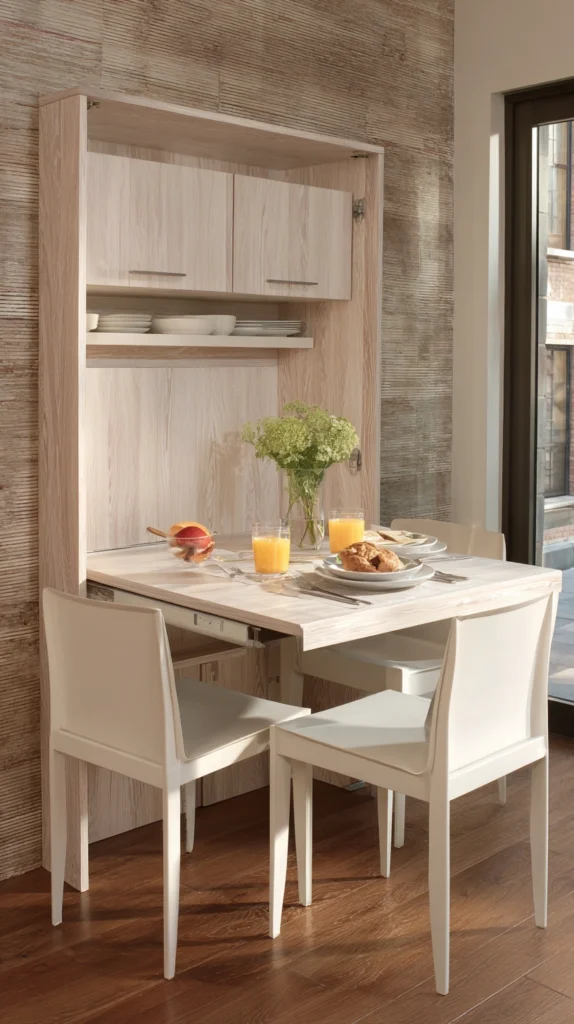
The dining table that is permanently set up in the small kitchen or the small open-plan living area consumes the floor area of the dining function throughout every hour of the day, including the many hours of each day when the dining function is not being performed.
The fold-down dining table, fixed to the wall on a hinged bracket system, occupies the floor area of the dining function only during the specific hours when the dining function is actually performed, returning the floor area to the room’s other functions for every other hour of the day.
The fold-down table’s installation specification should prioritize the structural adequacy of the wall fixing above all other considerations.
A fold-down dining table whose wall fixing is inadequate for the loads that dining creates, including the weight of the table surface, the weight of the place settings and food, and the dynamic loads of reaching, leaning, and the general physical activity of the dining event, creates a safety risk of serious consequence. Fix the bracket system into structural wall elements with appropriate fixings of the correct specification.
The fold-down table’s aesthetic integration with the room’s wall surface when in the folded-up position is the installation’s most important design quality for the small home’s daily visual character.
A fold-down table whose vertical face in the closed position is painted to match the wall, paneled to match the adjacent cabinetry, or mirrored to contribute the reflective quality of the mirror surface to the room, creates the visual seamlessness of a storage solution that disappears completely when not in use rather than announcing its presence as a piece of folded furniture on the wall.
13. Maximize the Kitchen with a Pegboard
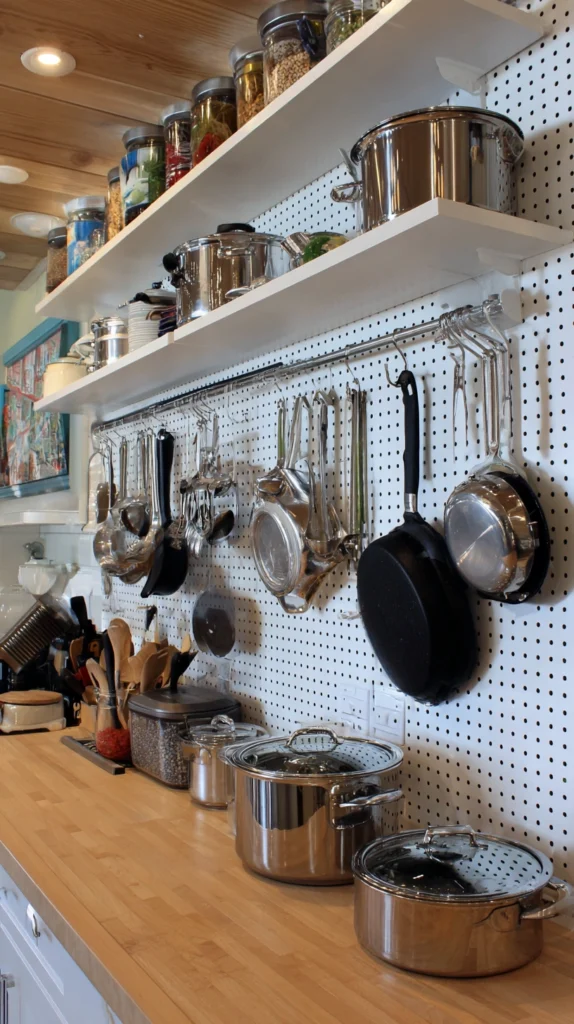
The kitchen’s wall surfaces, in particular the surfaces between the upper cabinets and the lower counter, and the wall sections beside and behind the cooking zone, represent the most practically valuable vertical storage surface in the home’s most storage-intensive room.
A pegboard system installed on these kitchen wall surfaces, with a considered organization of hooks, shelves, and holders specific to the kitchen’s equipment, creates the additional storage that removes the kitchen’s tools, small appliances, and frequently used accessories from the counter to the wall.
The counter area freed by the pegboard’s wall-mounted storage is the kitchen’s most valuable square footage, the specific surface where the food preparation activity takes place and whose availability determines the quality and the ease of the daily cooking experience.
A counter cleared of the knife block, the utensil holder, the small appliances, and the accumulated objects of a kitchen without adequate wall storage is a counter that can function as a genuine food preparation surface rather than an obstacle course navigated around the permanent presence of displaced storage items.
The pegboard’s organizational system should be planned with the kitchen’s specific workflow in mind. The items most frequently used during cooking should occupy the most accessible positions at the center of the board at the most comfortable height for the primary cook’s reach.
The items used less frequently occupy the board’s upper and lower sections where the less convenient access is appropriate to the less frequent use. The planned organization implemented consistently prevents the gradual disorder that the unplanned pegboard develops as items are replaced at random after use.
14. Use the Space Above Doorways
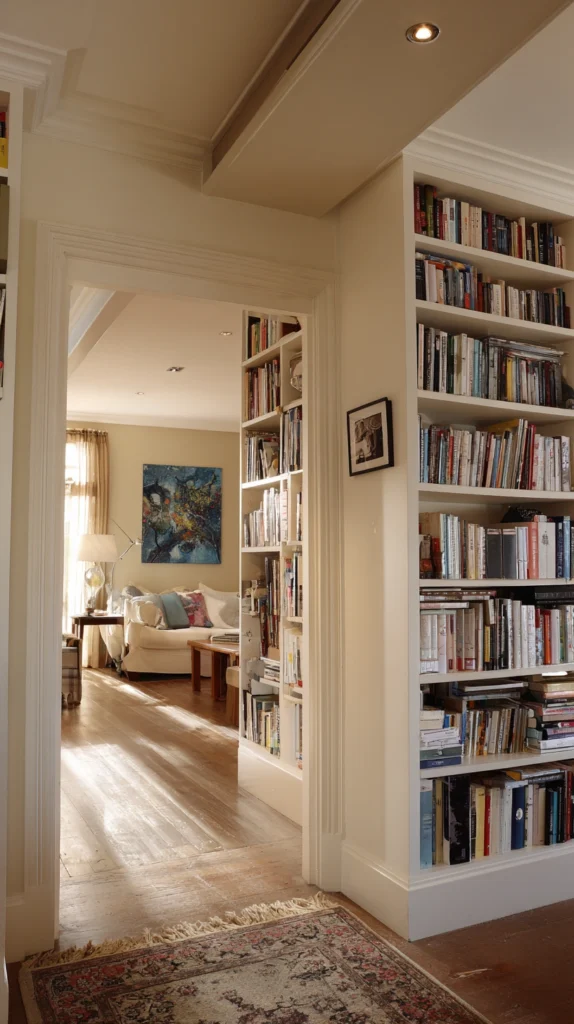
The wall surface above interior doorways, the horizontal strip of wall between the door frame’s top edge and the ceiling, is a specific spatial resource whose availability in every room of the small home creates a cumulative storage and display area of significant aggregate size that virtually no small home currently exploits with any organizational intention.
A shelf of appropriate depth installed above every interior doorway in the home creates the additional storage and display surface of approximately thirty to forty centimeters depth and the door opening’s full width at a height where the projection into the room creates no functional obstruction to movement or to light.
The above-door shelf’s specific use should be calibrated to the room’s function and the height’s accessibility implications. The above-door shelf in the kitchen holds the less frequently used serving pieces, the seasonal entertaining equipment, and the large items that the standard cabinet cannot accommodate at its interior dimensions.
The above-door shelf in the bedroom holds the display objects, the books, and the decorative items whose presence at the room’s upper register creates the inhabited quality of a room whose walls are used to their full height.
The above-door shelf’s visual integration with the room requires the shelf to be mounted flush against both the door frame and the ceiling, creating the architectural quality of a built-in element rather than the improvised quality of a shelf hung on brackets at a convenient height.
A shelf that reads as a deliberate architectural addition to the room’s design creates a different and more satisfying spatial quality than the same shelf mounted as an afterthought whose relationship to the surrounding architectural elements communicates the ad hoc intention of its installation.
15. Design the Small Home as a Complete Space-Saving System
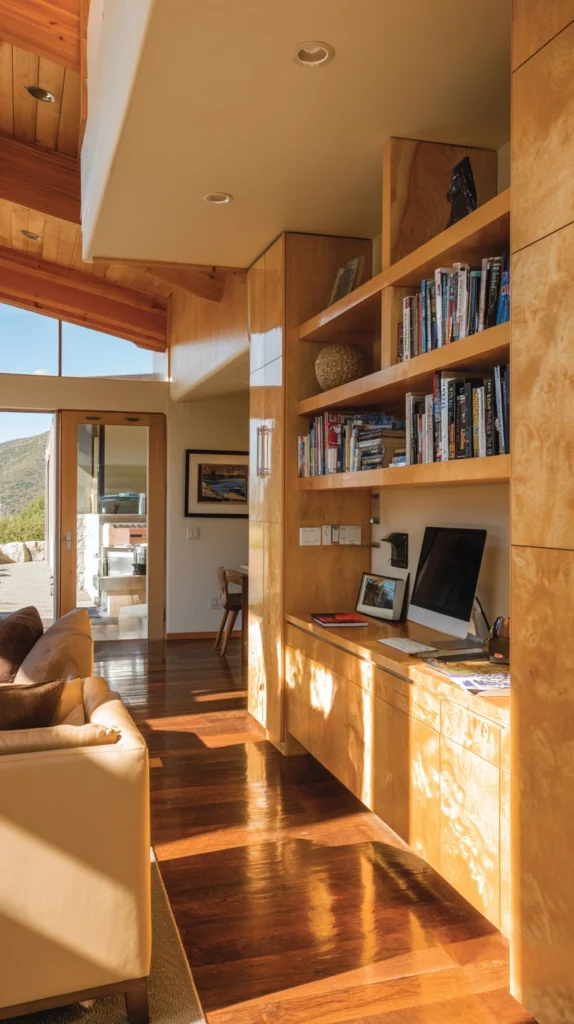
The final space-saving idea is the most important and the most transformative for the household whose individual space-saving interventions have improved specific organizational problems without creating the whole-home spatial quality that the small home’s complete design intelligence can achieve.
It is the commitment to designing the small home not as a collection of individual space-saving solutions applied where the most urgent problems are most apparent, but as a complete, unified spatial system whose every element is considered in relationship to every other element and to the overall goal of a home that functions with the completeness of a much larger dwelling within its actual dimensions.
The whole-home space-saving system begins with the honest and comprehensive assessment of every room’s spatial resources, the wall volumes, the ceiling heights, the furniture footprints, the door clearances, and the accumulated spatial inefficiencies of a home that has been organized through the accumulation of individual decisions rather than through the application of a unified spatial intelligence.
This assessment identifies the specific interventions of greatest consequence and sequences them in the order that creates the maximum cumulative benefit.
The small home designed as a complete space-saving system is not a smaller, less comfortable, or less beautiful version of the larger home. It is a home of specific and genuine excellence whose organization reflects the complete application of human intelligence to the specific challenge of creating the most habitable, most beautiful, and most functionally complete environment possible within the actual dimensions of the dwelling that the household occupies. The small home at its best is not a compromise.
It is the domestic design challenge at its most demanding and its most rewarding, and the home that meets this challenge with the complete intelligence it deserves is a home of considerable quality, considerable comfort, and the specific quiet pride of a space that works exactly as well as it possibly can.