
13 Fall Camper Bathroom Storage Solutions for Tight Spaces
My camper bathroom held exactly one small cabinet and a flat shelf above the sink for years, and every trip turned into the same scramble to fit toiletries, towels, and seasonal extras into a space barely large enough to turn around in.
Fall trips made it worse, with extra layers and cold-weather products added to an already maxed-out shelf. Tried adding one more plastic bin to the shelf once. It fit, barely, but slid forward every time the camper hit a bump, undoing any sense of actual organization within a day of travel.
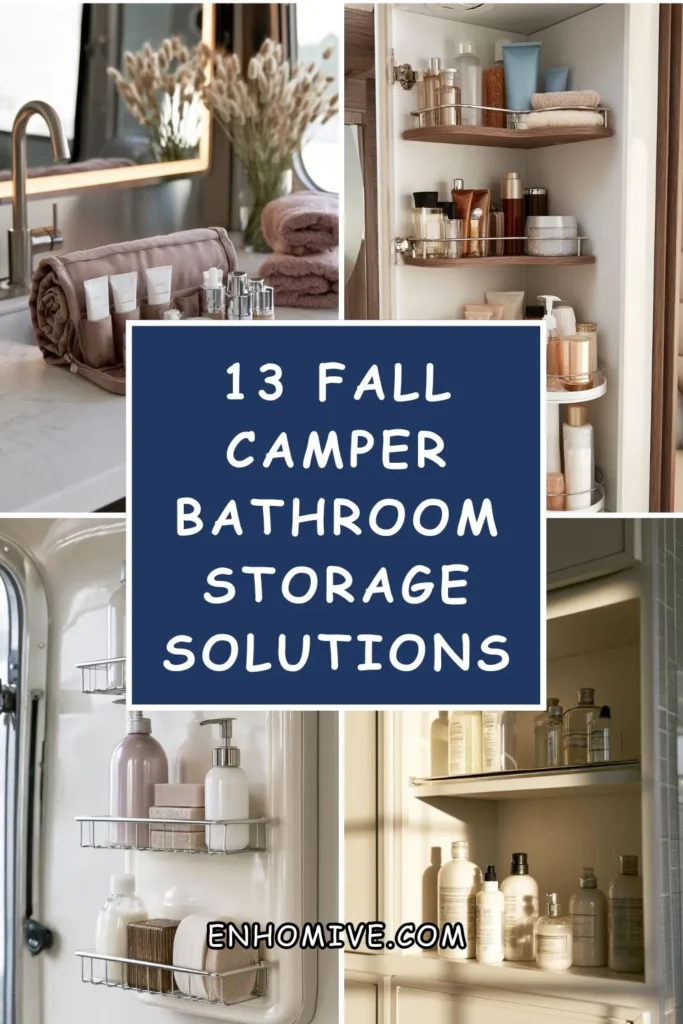
Then I stopped adding loose containers and started choosing storage specifically built to handle a moving vehicle’s tight, oddly shaped bathroom. The camper bathroom finally holds what a fall trip actually requires, securely, without anything sliding or tipping the moment the road gets rough.
Why Standard Home Storage Resists Working in a Camper Bathroom
The stationary-storage problem:
What home-style bathroom storage does in a camper:
- Assumes a flat, stable surface that never moves or vibrates
- Relies on weight and gravity alone to stay in place, fine in a house, risky on the road
- Often does not account for a camper bathroom’s unusually tight or irregular dimensions
- Resists the secured, travel-specific thinking a moving space actually requires
The secured-and-scaled principle:
- Every storage choice in a camper bathroom needs to survive actual driving conditions, not just sit nicely for a photo
- Measuring the room’s exact, often irregular dimensions matters more here than in a standard home bathroom
- This is a different category of problem than home bathroom organization, and a camper rewards that specific kind of solution
- A single appealing bin added without securing it can become a hazard, not just a mess, once the vehicle starts moving
My revelation: Camper bathroom storage needs to survive the road, not just look organized while parked. Every container and shelf addition has to be measured for the space and secured for travel before it actually solves anything.
1. A Tension Rod Shelf Divider Inside the Cabinet
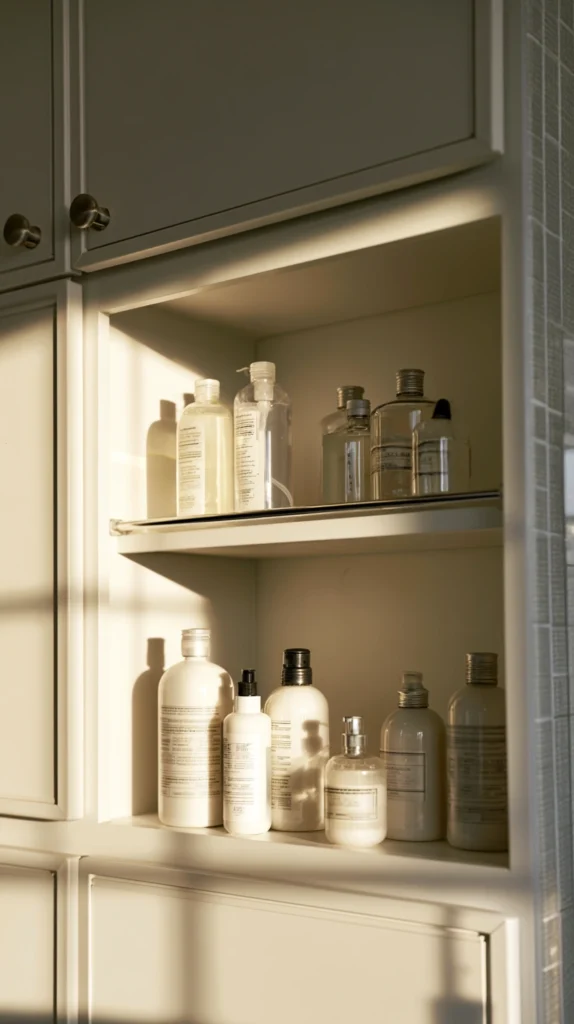
A simple spring-tension rod installed horizontally inside the existing under-sink cabinet, creating a stable shelf division without any drilling or permanent hardware.
Why a tension rod solves the most common camper cabinet problem
The no-drill-stability principle:
- Most camper bathroom cabinets offer one single open space, with items stacking unevenly and shifting during travel
- A tension rod wedged securely between the cabinet’s side walls creates an instant shelf division, with no permanent modification needed
- This is one of the lowest-cost, most reversible solutions on this entire list, ideal for both owned and rented camper units
Best tension rod placement
- Positioned roughly a third of the way up the cabinet, separating taller bottles below from smaller items above
- Tested for a secure, snug fit against both interior cabinet walls before loading any weight onto it
Budget: $8-15 for a basic spring-tension rod
My tension rod result
Wedging a simple tension rod inside my under-sink cabinet created an instant second shelf level, and items that used to tip over and slide together during travel now stay properly separated and upright.
Tension Rod Tips
Test the rod’s grip with a firm push before relying on it:
- A rod that is not snug enough can shift loose during a particularly rough stretch of road
- A firm test push in both directions before loading the shelf confirms it is actually secure
2. A Magnetic Spice Rack Repurposed for Small Toiletries
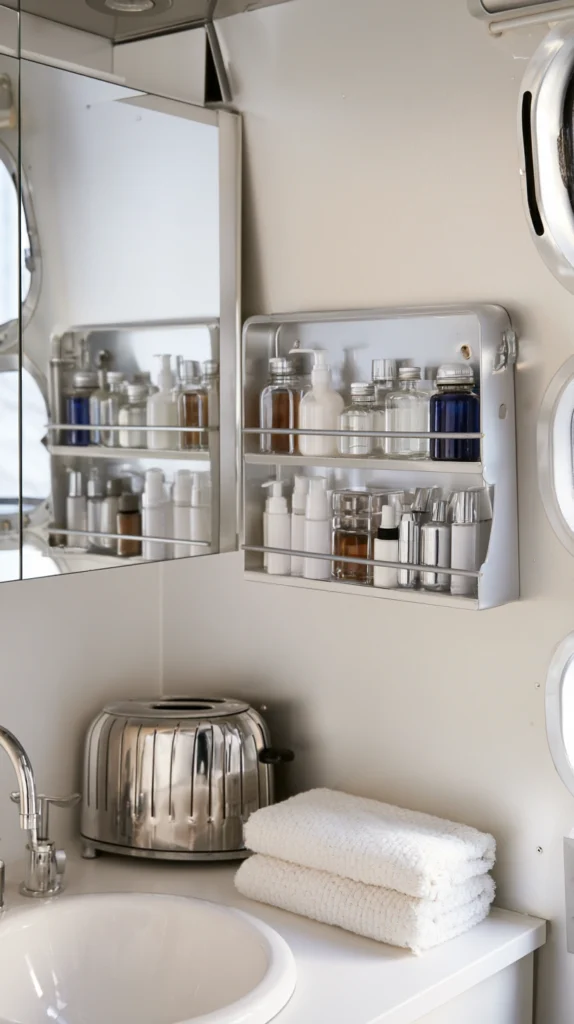
A small magnetic spice rack system, originally designed for a kitchen, mounted on a metal surface in the camper bathroom to hold small toiletry containers.
Why a magnetic system suits a moving vehicle specifically
The vibration-resistant principle:
- Items resting freely on a flat shelf are the most vulnerable to shifting or falling during travel
- A magnetic mounting system holds small metal-bottomed containers securely in place regardless of road vibration
- Repurposing a kitchen product for this use also tends to cost less than bathroom-specific organizational products of a similar function
Best magnetic rack applications
- Small magnetic tins for cotton swabs, bobby pins, or other loose small items
- A magnetic strip with small clip attachments for toothbrushes or razors
Budget: $15-30 for a basic magnetic spice rack kit, repurposed for the bathroom
My magnetic rack result
Mounting a small magnetic spice rack on the metal trim beside my camper bathroom mirror gave me a secure spot for cotton swabs and bobby pins that no longer slide into the sink or onto the floor during travel.
Magnetic Rack Tips
Confirm the mounting surface is genuinely magnetic before purchasing:
- Not every metal surface in a camper bathroom is magnetic; some trim is aluminum or another non-magnetic metal
- A quick test with any small magnet confirms the surface will actually hold the rack before any purchase is made
3. A Suction-Mounted Caddy for the Shower Wall
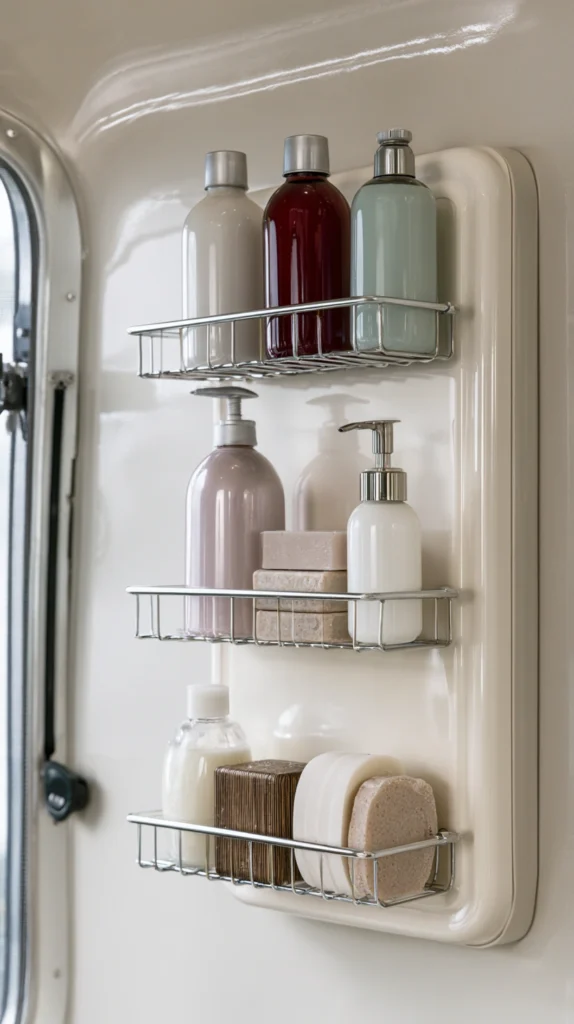
A suction-cup-based caddy or basket, mounted directly to the camper shower’s smooth wall surface, holding shampoo, soap, and razors.
Why suction mounting suits the shower specifically
The no-permanent-hole principle:
- Camper shower walls are typically a thin fiberglass or acrylic material not well suited to drilled hardware
- A suction-mounted caddy provides genuine storage without risking damage to this thin, water-exposed surface
- Modern suction systems have improved significantly and can hold a reasonable amount of weight when properly applied
Best suction caddy choices
- A caddy with multiple large suction cups rather than just one or two smaller ones
- A design with drainage holes, preventing water pooling inside the caddy itself
Budget: $12-25 for a quality suction-mounted shower caddy
My suction caddy result
A suction-mounted caddy on my camper shower wall holds shampoo and a bar of soap securely, and reapplying the suction cups every few weeks for a fresh, strong hold has kept it from ever slipping loose mid-shower.
Suction Caddy Tips
Clean and dry the wall surface thoroughly before applying suction cups:
- Any soap residue or moisture on the wall significantly weakens a suction cup’s hold
- A thorough wipe-down and full dry time before mounting noticeably extends how long the caddy stays securely attached
4. A Fabric Over-the-Door Organizer for the Bathroom Door
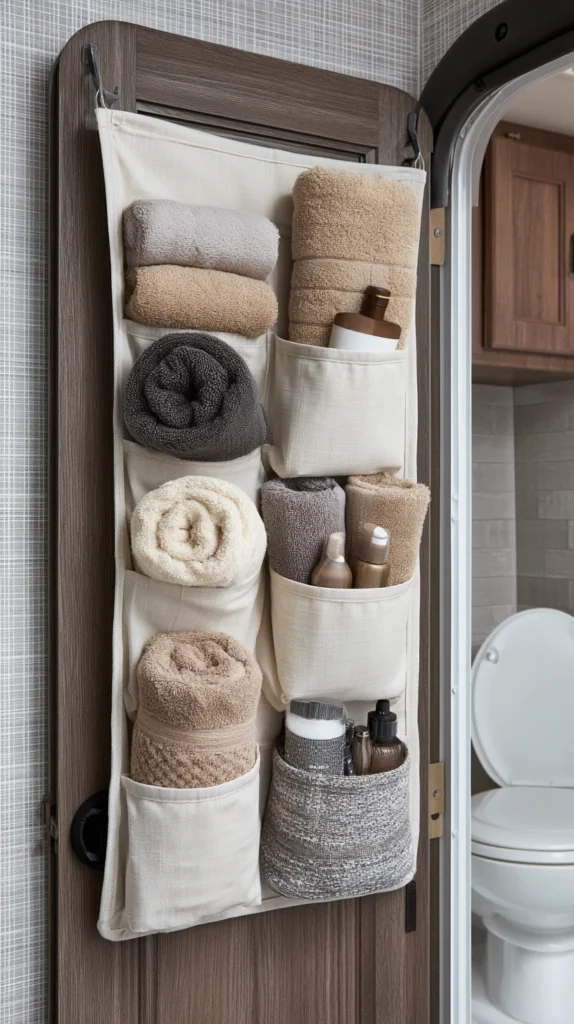
A fabric pocket organizer, hung over the top of the camper bathroom door, holding rolled towels, extra toilet paper, or seasonal items.
Why the back of the door is an underused storage opportunity
The vertical-surface principle:
- Camper bathroom doors are almost always left completely unused as storage space
- An over-the-door fabric organizer adds significant pocket storage without requiring any floor or counter space at all
- This is particularly valuable in fall, when extra cold-weather items like a heavier robe or additional towels need somewhere to go
Best over-the-door organizer choices
- A fabric organizer with multiple varied pocket sizes
- A clear-pocket version, allowing contents to be identified at a glance without opening each pocket
Budget: $12-25 for a basic over-the-door fabric organizer
My over-the-door result
Hanging a simple fabric pocket organizer over my camper bathroom door gave me storage for rolled hand towels and a spare roll of toilet paper that previously had no home anywhere else in the tiny space.
Over-the-Door Tips
Confirm the door’s actual thickness before purchasing:
- Camper interior doors are often thinner than standard home doors
- Checking the organizer’s compatible door thickness range before buying avoids a poor or unstable fit
5. A Stackable Drawer Organizer Sized to the Vanity Cabinet
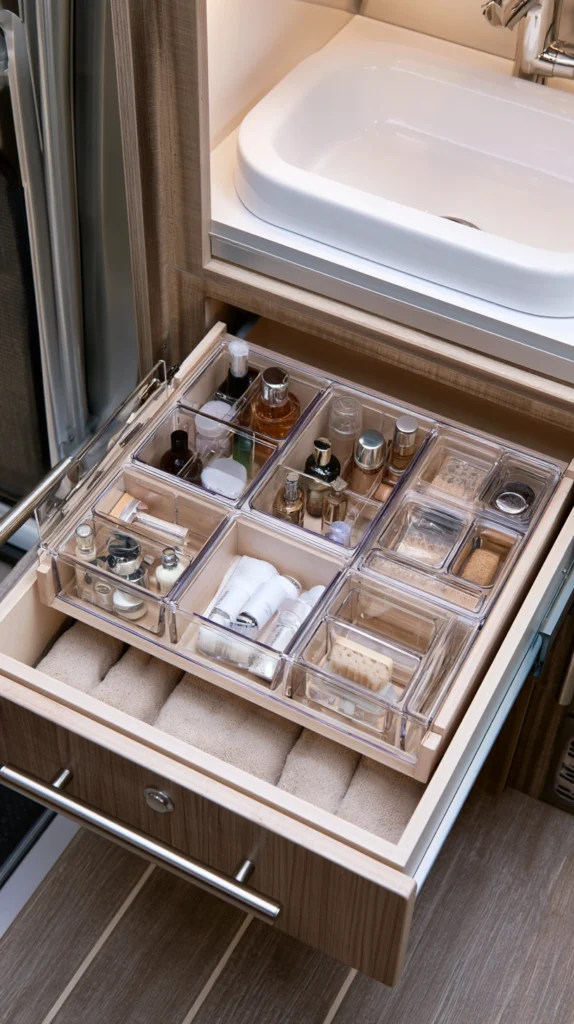
A small stackable drawer or bin system, measured precisely to fit the often-irregular dimensions of a camper vanity cabinet.
Why precise measurement matters more here than almost anywhere else
The irregular-dimension principle:
- Camper bathroom cabinets frequently have unusual depths, heights, or angled corners not found in standard home cabinetry
- A generic, off-the-shelf organizer often does not fit these irregular dimensions correctly, leaving wasted space or an unstable fit
- Measuring precisely and choosing a stackable system that can be configured to the actual available space solves this far more reliably than guessing
Best stackable organizer approaches
- Small modular stacking bins that can be combined in different configurations
- A combination of drawer dividers and bins, adjusted specifically to the measured cabinet interior
Budget: $20-40 for a set of small stackable bins suited to a camper vanity
My stackable organizer result
Measuring my camper vanity’s oddly shaped lower cabinet before buying anything, then choosing a small set of modular stacking bins configured to that exact space, solved a fit problem that two previous generic organizer purchases had never managed to address.
Stackable Organizer Tips
Measure at multiple points, not just the front opening:
- Many camper cabinets narrow or angle inward toward the back
- Checking depth and width at several points prevents ordering bins that fit the front but not the full interior
6. A Roll-Up Travel Organizer for Cold-Weather Skincare
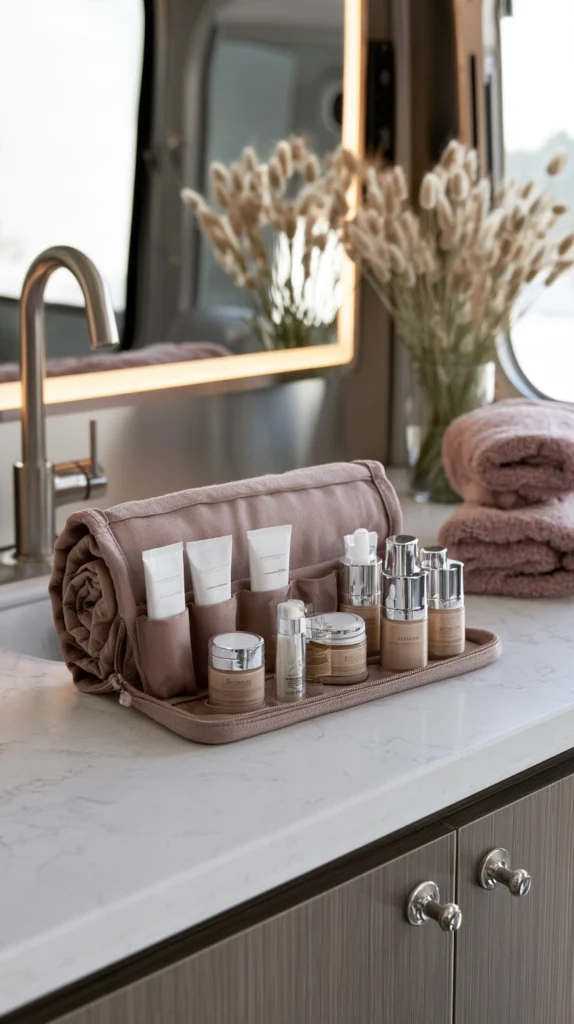
A roll-up fabric organizer, designed for travel toiletries, used specifically to hold heavier fall and winter skincare products separately from regular daily items.
Why a dedicated seasonal organizer helps in a tiny, shared space
The seasonal-separation principle:
- Fall trips often add extra products, heavier moisturizers, lip balm, hand cream, that a tiny camper cabinet was never sized to accommodate alongside regular items
- A roll-up organizer specifically dedicated to these seasonal additions keeps them contained and easy to identify, rather than mixed loosely among everyday toiletries
- This organizer can also roll up small enough to tuck into an otherwise unused gap when not actively needed
Best roll-up organizer choices
- A fabric roll with elastic loops sized for small tubes and jars
- A water-resistant lining, given the bathroom’s humidity
Budget: $15-30 for a quality roll-up toiletry organizer
My roll-up organizer result
Keeping a dedicated roll-up organizer just for fall skincare additions, hand cream, a heavier moisturizer, lip balm, meant these seasonal extras never crowded out my everyday products in the same small cabinet space.
Roll-Up Organizer Tips
Label the roll if storing multiple similar organizers:
- A camper bathroom may end up with more than one rolled organizer for different purposes
- A simple tag or label prevents confusion about which roll holds which category of items
7. A Tension-Mounted Curtain Rod for a Second Towel Bar
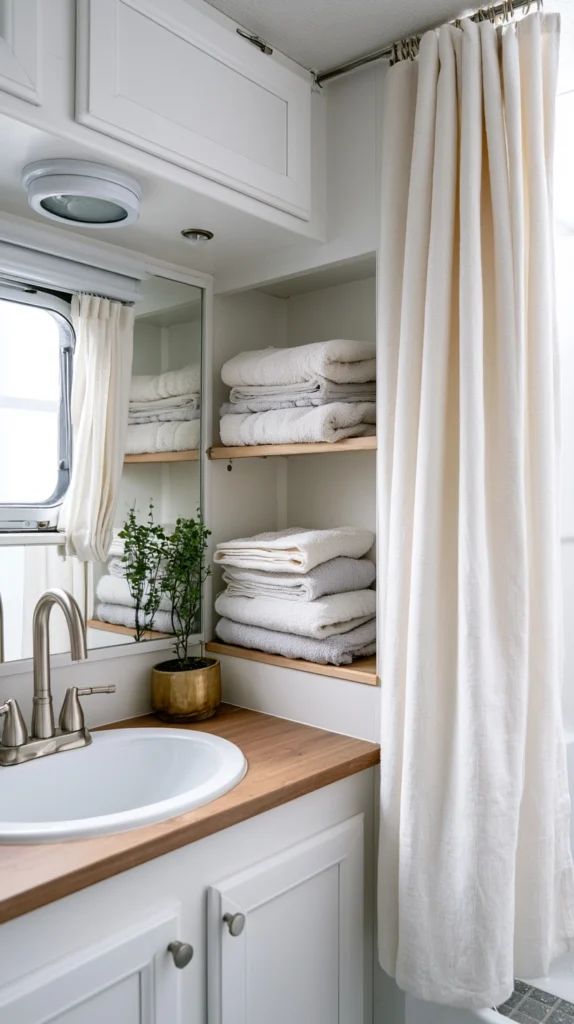
An additional spring-tension curtain rod, installed in an unused vertical gap, functioning as a second towel bar.
Why one towel bar is rarely enough in a camper bathroom
The single-bar-shortage principle:
- Most camper bathrooms come with only one small towel bar, insufficient for more than one or two people’s towels, especially with the bulkier towels fall weather often calls for
- A tension rod installed in any unused vertical gap, such as beside the shower or across a narrow alcove, instantly creates a second hanging option
- This solution requires no drilling and can be removed easily if the placement does not work as expected
Best placement for a second bar
- A narrow gap beside the shower entrance
- Across the inside of a closet or storage nook not otherwise in regular use
Budget: $8-15 for a basic tension rod suited to towel weight
My second towel bar result
Installing a tension rod across a narrow unused gap beside my camper shower gave me a second towel bar, finally allowing everyone using the bathroom to have their own designated spot rather than competing for the single original bar.
Second Towel Bar Tips
Choose a rod rated for sufficient weight if hanging damp, heavier towels:
- A lightweight curtain rod may not be rated to hold several wet towels at once
- Checking the rod’s weight rating before installation prevents it from bowing or slipping under the actual load
8. A Small Lazy Susan for the Vanity Corner
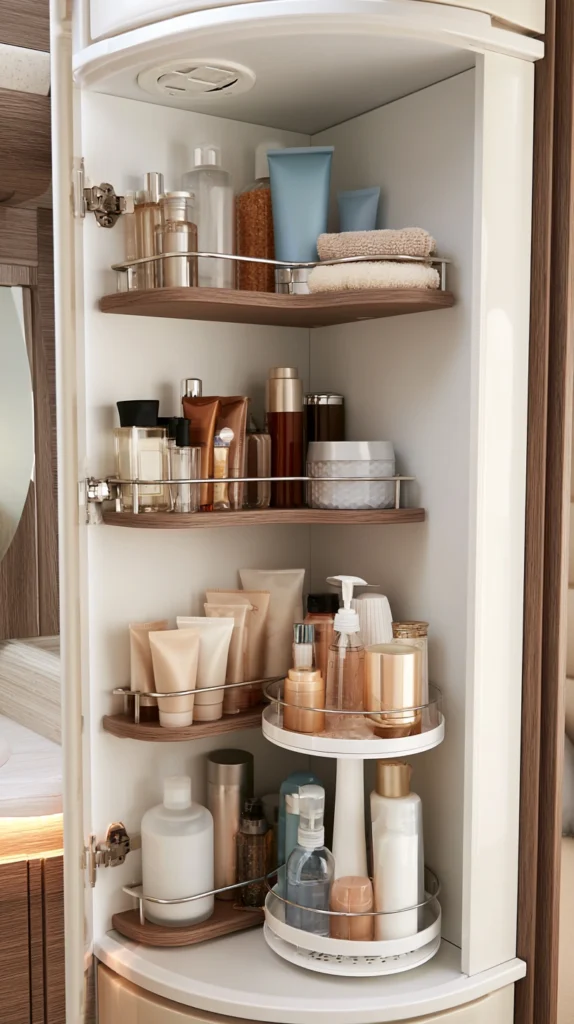
A compact lazy Susan turntable, placed in a corner of the vanity or cabinet, allowing easy access to items that would otherwise be pushed into an unreachable back corner.
Why a turntable solves a common dead-corner problem
The reachable-rotation principle:
- Camper vanity cabinets often have an awkward back corner that becomes a black hole for small items, especially in cabinets with limited depth access
- A small lazy Susan allows anything placed on it to rotate forward into reach, rather than getting permanently lost or forgotten
- This is a particularly useful solution for a cabinet corner that would otherwise go almost entirely unused
Best lazy Susan choices
- A small, non-slip turntable sized specifically to fit the available corner space
- A two-tier version if vertical clearance allows, doubling the usable corner storage
Budget: $10-20 for a small non-slip lazy Susan
My lazy Susan result
Adding a small lazy Susan to the back corner of my camper vanity cabinet means the items I used to forget entirely back there now rotate easily into reach with a simple spin.
Lazy Susan Tips
Choose a non-slip surface specifically, given the vehicle’s movement:
- A turntable without sufficient grip can spin unintentionally while the camper is in motion
- A textured or rubberized surface keeps items in place better than a smooth, slick turntable top
9. A Compression Strap System Inside the Medicine Cabinet
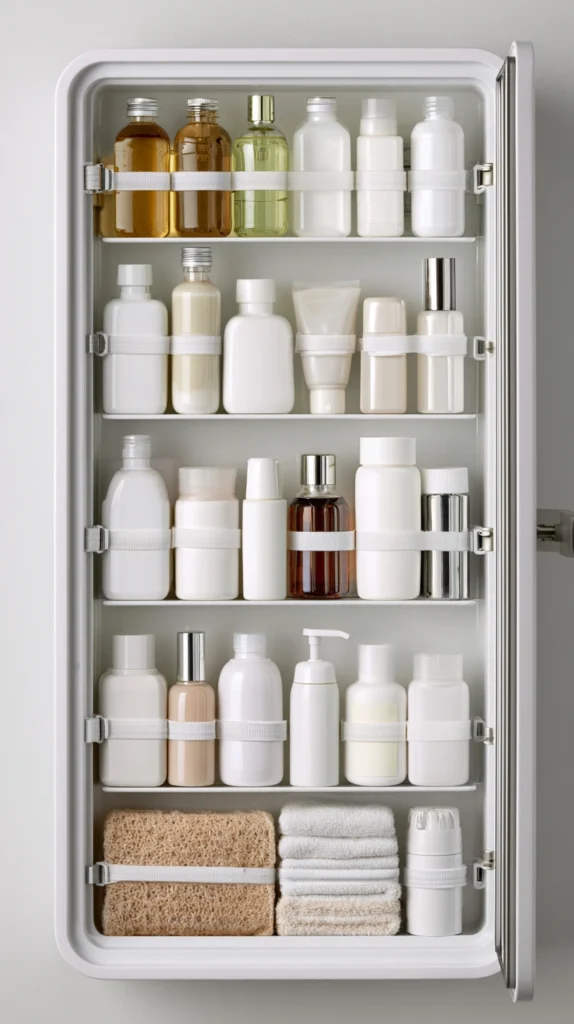
Small adjustable compression straps or elastic bands installed inside the medicine cabinet, securing bottles upright against shifting during travel.
Why securing items in place matters more than simply storing them
The travel-security principle:
- A medicine cabinet packed with loose bottles, however neatly arranged while parked, will likely shift and topple the moment the camper starts moving
- Compression straps or elastic bands hold each bottle upright and in its designated spot regardless of road conditions
- This small addition addresses a problem that organizing alone, without any securing mechanism, cannot solve in a moving vehicle
Best strap and band options
- Adjustable elastic straps with adhesive-backed anchor points
- A simple bungee-style cord threaded across multiple small shelves
Budget: $10-20 for a set of adjustable compression straps
My compression strap result
Adding small elastic compression straps inside my camper’s medicine cabinet has completely stopped the bottle-toppling chaos that used to greet me every time I opened that cabinet after a drive.
Compression Strap Tips
Test the straps with a full cabinet load before a long trip:
- A strap that holds two bottles securely may behave differently once the cabinet is fully loaded
- A short test drive with the cabinet at its expected full capacity confirms the system will hold before relying on it for an extended trip
10. A Slim Rolling Cart for Overflow Outside the Bathroom
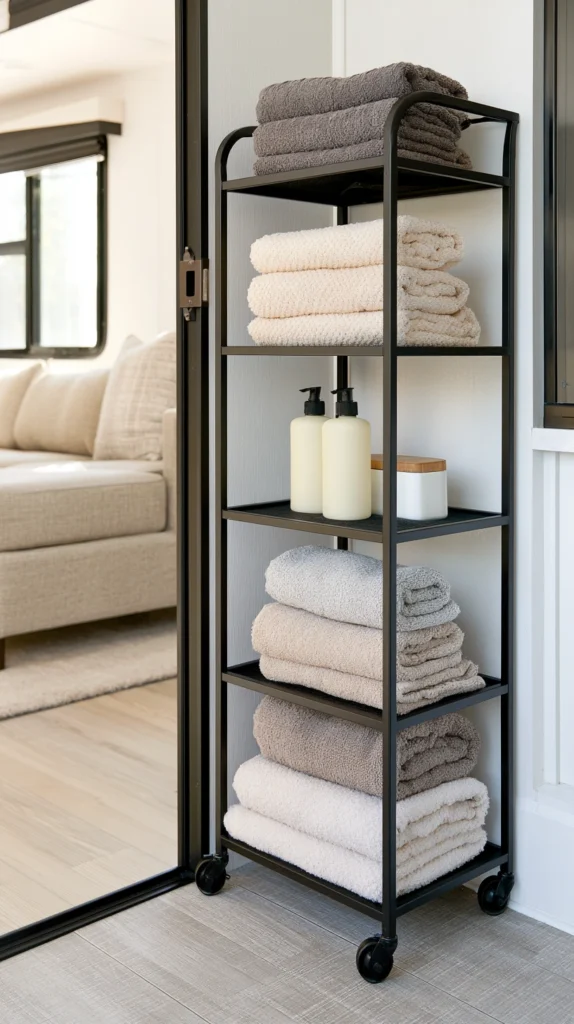
A narrow rolling cart, kept just outside the bathroom in a hallway or bedroom nook, holding overflow toiletries and extra towels that do not fit inside the bathroom itself.
Why overflow storage sometimes belongs just outside the room
The adjacent-space principle:
- Even with every interior storage solution maximized, some camper bathrooms simply do not have enough total space for everything a longer fall trip requires
- A slim rolling cart positioned just outside, in an adjacent hallway or nook, extends the bathroom’s effective storage without requiring any structural change to the room itself
- This cart can also roll into the bathroom briefly when needed, then back out of the main walkway the rest of the time
Best slim rolling cart choices
- A narrow metal cart designed specifically for tight gaps
- A cart with a secure top surface, in case items need to be set down briefly during use
Budget: $35-70 for a slim rolling cart suited to a narrow camper hallway
My rolling cart result
Keeping a slim rolling cart in the hallway just outside my camper bathroom, holding extra towels and overflow toiletries my bathroom cabinet simply cannot fit, solved a real storage shortfall without needing to alter the bathroom itself at all.
Rolling Cart Tips
Secure the cart’s wheels or anchor it lightly during travel:
- An unsecured rolling cart can shift significantly during driving
- Locking the wheels or using a simple strap to anchor it to a nearby fixed point prevents it from becoming a hazard on the road
11. A Waterproof Pouch System for Wet Items
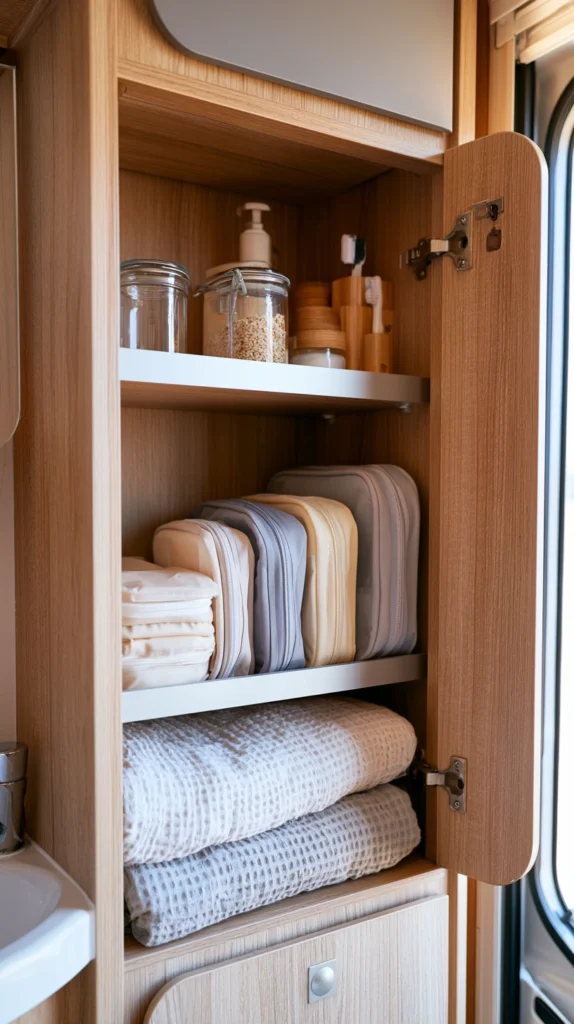
Small waterproof pouches, used to separate and store damp items like a used washcloth or a wet swimsuit, kept inside the bathroom cabinet rather than left loose.
Why wet-item separation matters in a tightly packed space
The moisture-containment principle:
- A camper bathroom’s already limited storage gets worse when damp items are mixed in among dry ones, risking mildew and a persistent damp smell throughout the cabinet
- Small waterproof pouches contain that moisture specifically, protecting everything else stored nearby
- This system is particularly useful in fall, when damp outdoor gear or a wet hat might also need a temporary home before fully drying
Best waterproof pouch choices
- A small set of zippered waterproof pouches in varying sizes
- A pouch with a clear front, allowing contents to be identified without opening it
Budget: $10-20 for a set of small waterproof pouches
My waterproof pouch result
Keeping a couple of small waterproof pouches in my camper bathroom cabinet for damp washcloths and swimsuits has eliminated the musty smell that used to develop whenever wet items got tucked loosely among my other stored toiletries.
Waterproof Pouch Tips
Empty and air out pouches promptly after each use:
- Even a waterproof pouch can develop odor if a damp item is left sealed inside for too long
- Emptying the pouch and letting both it and its contents air out as soon as reasonably possible prevents this buildup
12. A Small Cork or Felt Liner for Cabinet Shelves
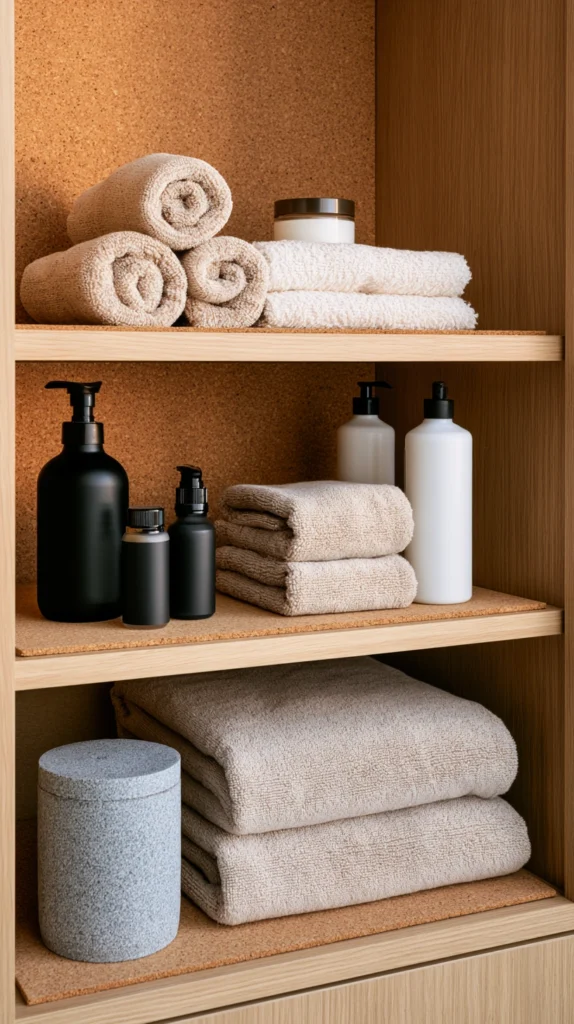
A thin cork or felt liner, cut to fit the cabinet shelves, added beneath stored items to reduce sliding and the resulting noise during travel.
Why a simple liner addresses a problem most people overlook
The friction-addition principle:
- Smooth factory cabinet shelving offers very little natural grip, allowing items to slide freely with every turn or bump
- A thin cork or felt liner adds just enough friction to meaningfully reduce that sliding, without requiring any straps or dividers
- This is one of the simplest and most affordable additions on this list, addressing the bathroom’s overall organization at the most basic shelf level
Best liner material choices
- A roll of adhesive-backed cork liner, cut to size
- A felt shelf liner for a softer, slightly more cushioned surface
Budget: $8-15 for enough cork or felt liner to cover most camper bathroom shelving
My shelf liner result
Adding a simple cork liner to my camper bathroom’s cabinet shelves noticeably reduced both the sliding and the rattling noise that used to accompany every turn or bump in the road.
Shelf Liner Tips
Cut the liner slightly smaller than the shelf’s exact dimensions:
- A liner cut to the precise edge can bunch or curl at the corners over time
- Trimming it just slightly smaller than the shelf allows it to lie flat and stay in place more reliably
13. A Fully Combined Travel-Secured Storage System
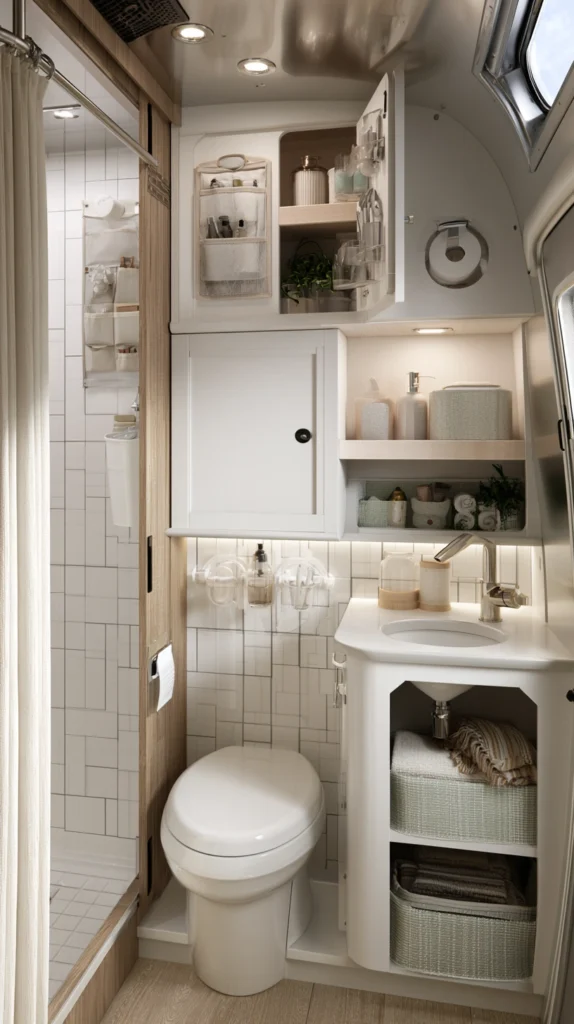
Combining a tension rod shelf, a suction shower caddy, an over-the-door organizer, compression straps, and a cork shelf liner into one complete, road-ready camper bathroom system.
Why combining several travel-specific solutions outperforms any single fix
The complete-mobile-system philosophy:
- Several of the ideas on this list (a tension rod shelf, a suction caddy, an over-the-door organizer, compression straps, a shelf liner) address different specific failure points that occur once a camper actually starts moving
- Relying on just one solution, however well chosen, leaves the rest of the bathroom’s storage exactly as vulnerable to shifting and disorganization as before
- This is the most complete and most genuinely travel-ready version of a camper bathroom storage overhaul on this list
How the combination works together
The tension rod shelf and cork liner (the foundation layer):
- Address the cabinet’s basic structure and the friction needed to reduce sliding at the source
The suction caddy and over-the-door organizer (the surface-expansion layer):
- Add genuinely new storage area without requiring any drilling or permanent modification
Compression straps and waterproof pouches (the securing-and-containing layer):
- Keep individual items from shifting or causing moisture problems once everything else is in place
Building the full combined system
- Start with the tension rod shelf and cork liner, since these address the cabinet’s basic stability first
- Add the suction caddy and over-the-door organizer to expand the room’s total usable storage
- Include compression straps and waterproof pouches for the final layer of security and containment
Budget: $80-180 for a fully combined travel-secured system, covering most of the ideas on this list
My fully combined result
Combining a tension rod shelf, a suction-mounted shower caddy, an over-the-door organizer, elastic compression straps in the medicine cabinet, and a cork shelf liner turned my camper bathroom from the most chaotic room after every single drive into one that opens up exactly as organized as it was when we left, regardless of how rough the road was along the way.
Full System Tips
Test the entire combined system on one full trip before assuming it is finished:
- Some combinations of solutions interact differently than expected once actually loaded and driven
- One full test trip, with attention to what shifted or held in place, helps identify any remaining adjustment needed before relying on the system long term
Choosing Your Camper Bathroom Storage Approach
By the specific problem to solve:
- Items sliding or toppling during travel: compression straps (idea 9), cork shelf liner (idea 12)
- Not enough total storage space: over-the-door organizer (idea 4), rolling cart overflow (idea 10)
- An awkward, unreachable cabinet corner: lazy Susan (idea 8)
By installation comfort level:
- No tools or drilling needed: tension rod shelf (idea 1), suction caddy (idea 3), over-the-door organizer (idea 4)
- Light measuring and fitting required: stackable drawer organizer (idea 5), cork liner (idea 12)
By budget level:
- Lower budget: tension rod shelf (idea 1), magnetic rack (idea 2), shelf liner (idea 12)
- Moderate budget: suction caddy (idea 3), roll-up organizer (idea 6), waterproof pouches (idea 11)
- Higher budget: rolling cart (idea 10), fully combined system (idea 13)
The non-negotiable rules across every option:
Always:
- Secure or test any new storage addition under actual driving conditions before fully relying on it
- Measure the camper bathroom’s actual, often irregular dimensions before purchasing any organizer or shelf system
- Address moisture and ventilation for any damp items stored in an enclosed pouch or cabinet
Never:
- Assume a home-style storage product will automatically hold up to a moving vehicle’s vibration and turns
- Leave loose bottles or items unsecured in a cabinet expected to survive regular travel
- Skip testing a suction or adhesive-based mount’s hold before relying on it for anything important
Remember: camper bathroom storage has to survive the road, not just look organized while parked, and the systems that actually hold up over a full season of fall trips are the ones built specifically around the space’s tight dimensions and constant motion, not simply borrowed from a standard home bathroom.