
15 Fall Laundry Room Storage Ideas That Actually Look Pretty
My laundry room held detergent jugs and a plastic basket on a metal shelf for years. Functional, fluorescent, forgettable the moment the door closed.
Tried swapping in one woven basket once. Sat next to the plastic jugs looking like a single nice thing in an otherwise utilitarian room. Then I stopped replacing single items and started building a complete storage system — containers, shelving, and warm materials all working together. The laundry room finally became a space I do not rush out of, fall or any other season.

Why Plastic Bins Resist Feeling Like a Finished Room
The utility-only problem:
What plastic and mismatched storage do:
- Read as purely functional, never as part of the home’s design
- Show every brand label and mismatched lid as visual clutter
- Create a room that feels like a back-of-house space rather than a finished one
- Resist the warmth and intention applied to every other room in the house
The cohesion principle:
- Matching or coordinated containers create the sense of a planned system rather than accumulated bins
- Warm materials (wicker, wood, glass, brass) absorb the room’s harsh task lighting the same way they soften any other space
- A laundry room benefits from the same design intention as a kitchen or entry, just suited to its specific function
- This is why a single pretty basket dropped into an otherwise mismatched shelf never fully transforms the room
My revelation: A laundry room storage system is a complete set of matched containers, labeling, and warm materials, not one attractive basket in an otherwise plastic room. Every container needs to agree before the room actually feels finished.
1. Woven Seagrass Bins for Open Shelving
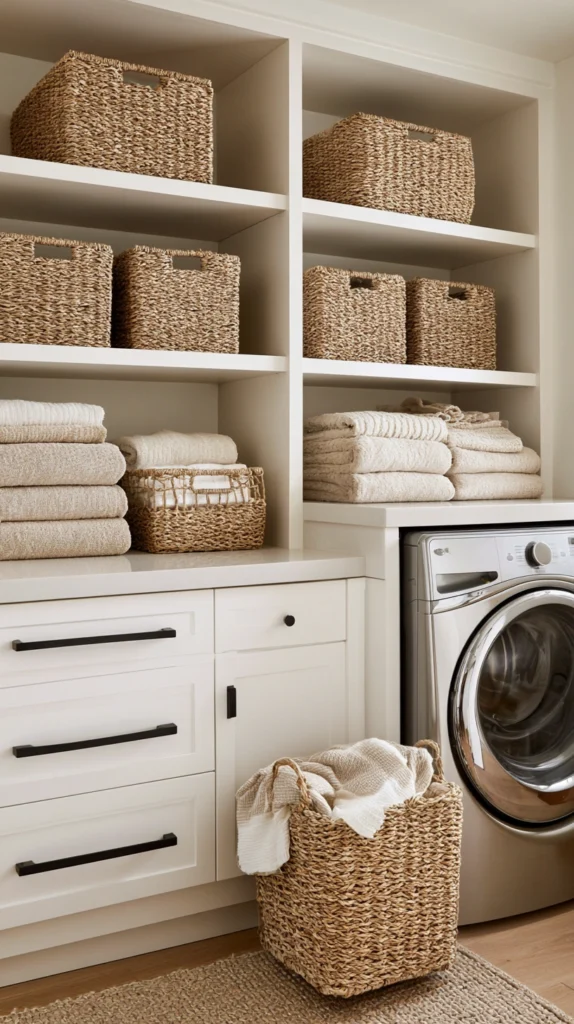
Natural seagrass or rattan bins replacing plastic baskets on open laundry room shelves.
Why woven texture works in a laundry room specifically
The texture-softening principle:
- Laundry rooms are full of hard, smooth surfaces: tile, metal, plastic, glass
- Woven natural fiber introduces the one textural element most laundry rooms are missing entirely
- This single material swap does more to soften the room’s utilitarian feeling than almost any other change
Best uses for seagrass bins
- Holding rolled hand towels or microfiber cloths
- Storing clothespins, lint rollers, and small laundry tools
- Organizing dryer sheets or wool dryer balls
Budget pick: seagrass bins from a big-box retailer, $12-25 each Splurge: handwoven rattan bins from a specialty home shop, $40-90 each
My seagrass bin result
Replacing three mismatched plastic bins with matching seagrass versions on the open shelf above my machines changed the entire feel of the room without touching the walls, the shelf finally reads as styled rather than just stocked.
Seagrass Bin Tips
Line bins holding anything that could leak:
- A simple fabric liner protects natural fiber from liquid detergent or bleach spills
- This single step extends the life of the bins significantly
2. Glass Apothecary Jars for Detergent and Pods
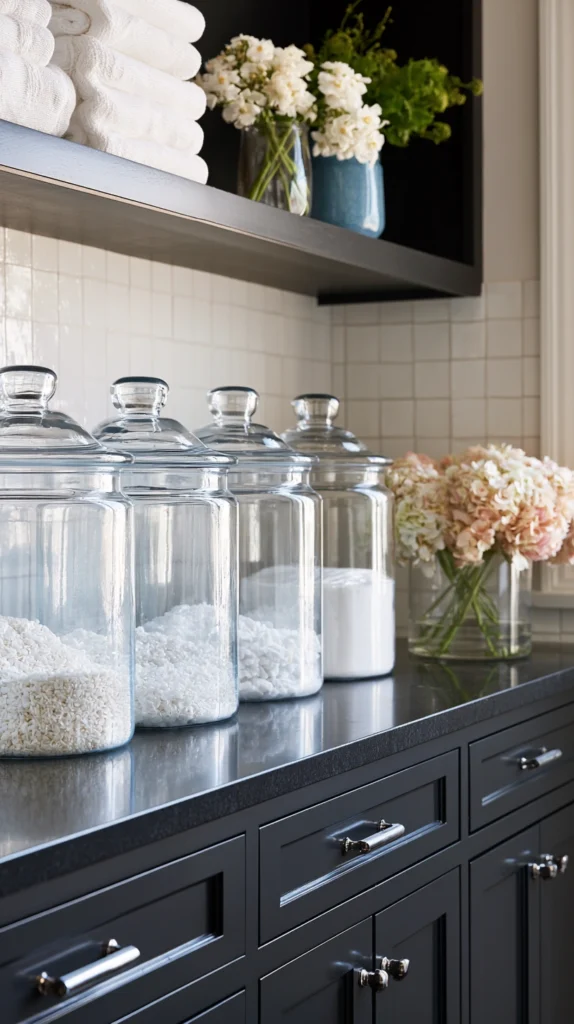
Clear or amber glass jars with lids, replacing branded plastic detergent containers on open shelves.
Why decanting matters more in laundry rooms than almost anywhere else
The label problem:
- Detergent, pod, and softener packaging is designed for shelf visibility in a store, not for a styled home
- Decanting into glass removes every loud logo and mismatched color from view at once
- This is one of the highest-impact single changes available in a laundry room
Best jars for this use
- Wide-mouth glass apothecary jars for pods and powder
- A glass pump dispenser for liquid detergent or fabric softener
- Amber glass specifically for anything light-sensitive, like certain stain treatments
Budget pick: basic glass apothecary jars, $8-18 each Splurge: etched or labeled glass jar sets, $40-80 for a matched set
My glass jar result
Decanting pods, powder, and liquid detergent into three matching glass jars removed every branded plastic container from the counter, and the room now looks intentional rather than like a stocked utility closet.
Glass Jar Tips
Label clearly despite the clear glass:
- A small etched or printed label prevents confusion between similar-looking powders or liquids
- This matters particularly with any product that should not be mixed or substituted
3. A Wood and Brass Ladder Shelf for Vertical Storage
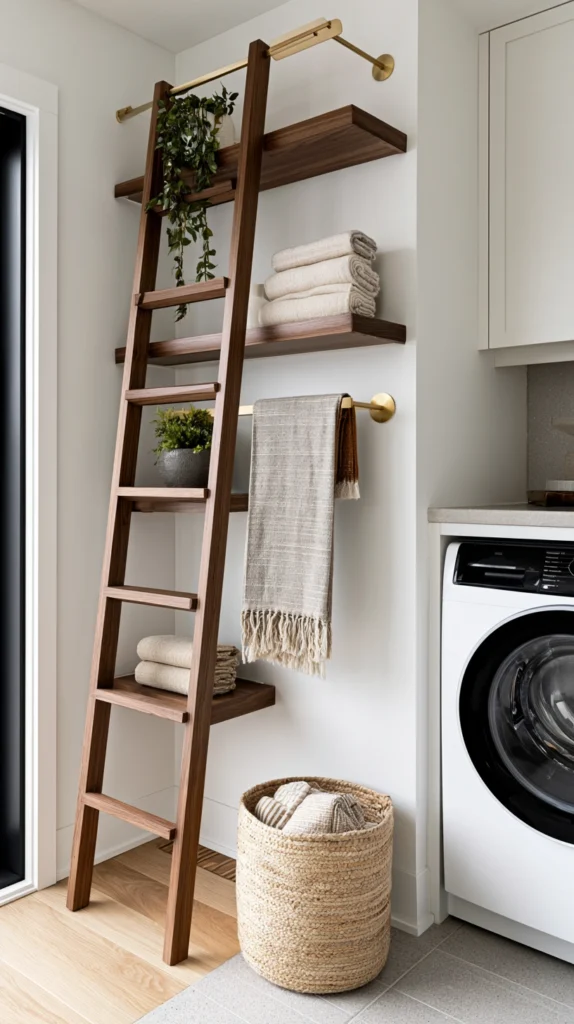
A slim wood shelving ladder with brass hardware, used in a narrow laundry room to add storage without floor footprint.
Why vertical storage suits fall styling specifically
The warmth-at-height principle:
- Most laundry room storage focuses on counter level or low shelves
- A ladder shelf draws the eye upward, adding warmth and styling opportunity in often-underused vertical space
- Wood and brass specifically read as warm and seasonal in a way that wire shelving units do not
Best ladder shelf styles
- Solid wood with simple, clean lines for a more modern fall feel
- Wood with leather strap hardware for a more rustic, traditional look
Budget pick: a basic wood ladder shelf, $50-110 Splurge: a custom-built wood and brass ladder shelf, $200-450
My ladder shelf result
A narrow wood ladder shelf tucked into the gap beside my dryer added three new shelves of storage in a space that previously held nothing, and the warm wood tone against the white walls became one of the room’s nicest details.
Ladder Shelf Tips
Anchor it if floor space is tight:
- A slim ladder shelf can be top-heavy when loaded with bins
- Securing it to the wall, even lightly, prevents tipping in a narrow space
4. Labeled Canvas Bins for Sorting
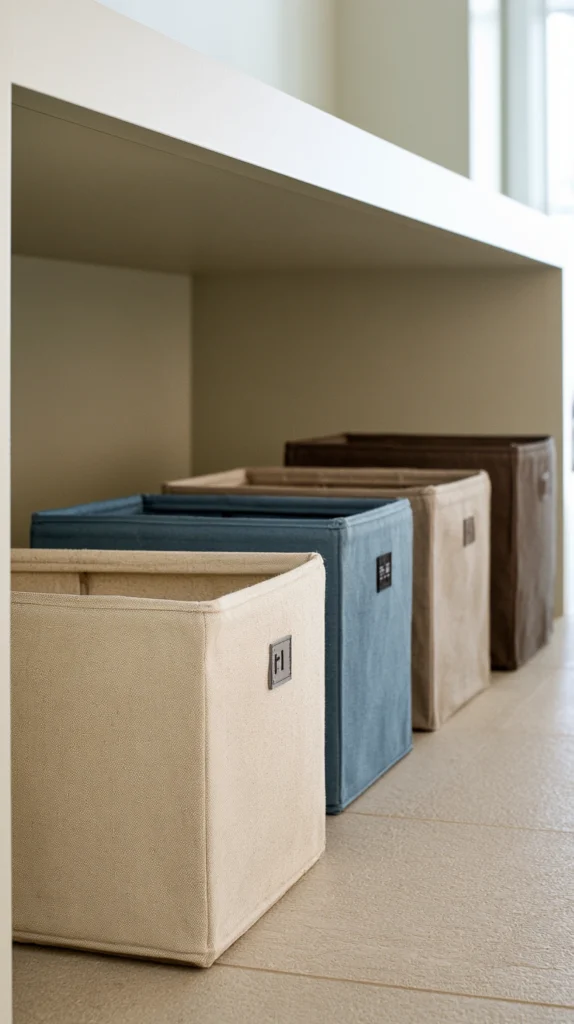
Sturdy canvas or cotton-blend bins with leather or fabric labels, used for sorting laundry by type or by household member.
Why fabric sorting bins outperform plastic hampers
The soft-structure principle:
- Canvas bins hold their shape while still feeling soft and warm rather than rigid and clinical
- Leather or fabric labels read as considered, unlike adhesive plastic labels on a hamper
- This sorting system doubles as both function and decor, rather than function alone
Best labeling approaches
- Leather tags with stamped or embroidered category names (darks, whites, delicates)
- Embroidered canvas labels sewn directly onto the bin
- A simple chalkboard-style fabric label that can be relabeled as needs change
Budget pick: canvas bins with printed labels, $20-40 each Splurge: custom leather-tagged canvas bins, $60-120 each
My canvas bin result
Three matching canvas bins labeled with leather tags for darks, whites, and delicates replaced a pile of loose laundry on the floor, and sorting now happens automatically as clothes go into the correct bin throughout the week.
Canvas Bin Tips
Choose a structured base:
- A reinforced or wire-framed base keeps canvas bins from collapsing when partially full
- Fully soft-sided bins without structure tend to slump and look unkempt over time
5. A Pegboard Wall in Stained Wood
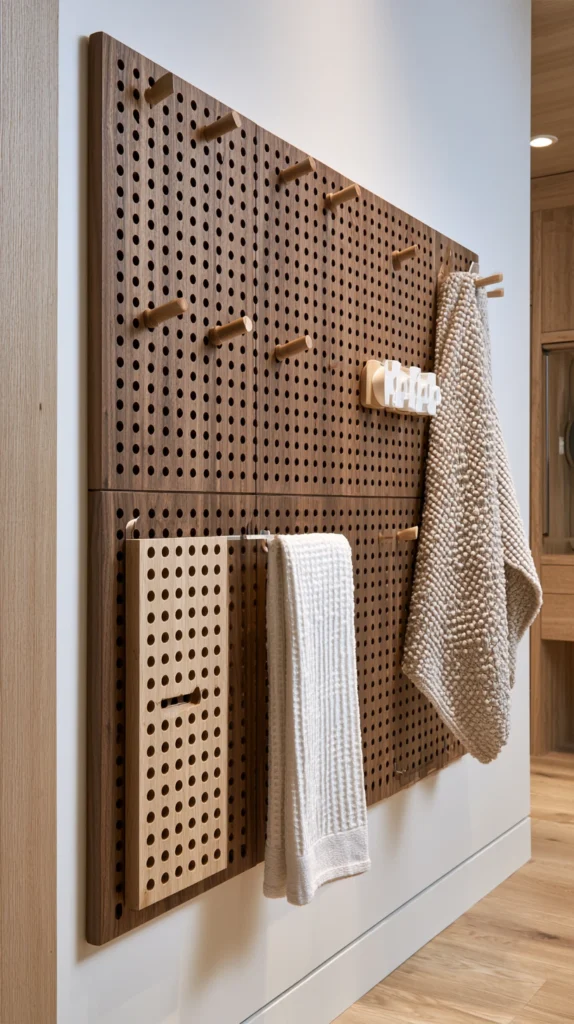
A stained wood pegboard panel mounted above a folding counter, holding hanging tools and small baskets.
Why pegboard works better in wood than in standard white
The material-warmth principle:
- Standard white pegboard reads as a garage or workshop fixture
- A stained wood version, particularly in a warm tone, reads as an intentional design feature instead
- The same flexible hanging function exists in both, but the material entirely changes the room’s character
What to hang on it
- Small woven baskets for clothespins or stain treatment supplies
- A wood-handled lint brush or garment steamer
- A folded ironing board, hung flat against the wall
Budget pick: a stained wood pegboard panel, $40-80 Splurge: a custom walnut or oak pegboard with brass pegs, $150-300
My pegboard result
A stained oak pegboard above my folding counter holds two small baskets and my garment steamer, and the warm wood tone against the pegs makes a purely functional wall feel like a deliberate design choice.
Pegboard Tips
Space pegs for actual tool sizes:
- Measure the tools intended for the wall before drilling peg holes
- A pegboard with holes spaced for the wrong tool sizes ends up underused
6. A Stacked Crate Shelving System
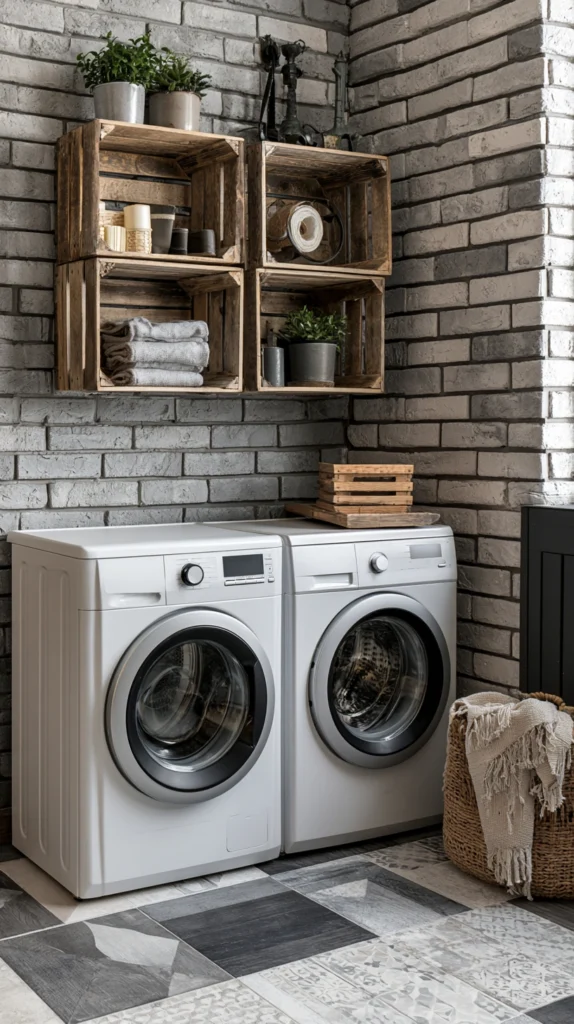
Wood or wire crates stacked and secured to form an open shelving unit, often using vintage or vintage-style produce crates.
Why stacked crates suit a laundry room’s working character
The honest-materials principle:
- A laundry room is fundamentally a working space, and stacked crates lean into that honestly rather than disguising it
- Vintage or vintage-style crates carry a worn, slightly imperfect character that fits a seasonal, grounded aesthetic
- This system is also highly modifiable: crates can be added, removed, or rearranged as storage needs shift
Best crate sourcing
- Vintage wood produce crates from flea markets or antique shops
- New reproduction crates sold specifically for shelving use
- Wire-and-wood hybrid crates for a slightly more refined version
Budget pick: reproduction wood crates, $15-30 each Splurge: genuine vintage crates with visible stamped branding, $30-70 each
My crate shelving result
Four stacked vintage crates secured to the wall above my washer hold folded towels and seasonal items, and the slightly weathered wood gives the room more character than any new shelving unit I considered.
Stacked Crate Tips
Secure every level to the wall:
- Stacked crates without wall anchoring can shift or tip when accessed from a low shelf
- A simple bracket or strap at the back of each crate prevents this without being visible from the front
7. A Brass or Bronze Hook Rail for Hanging Items
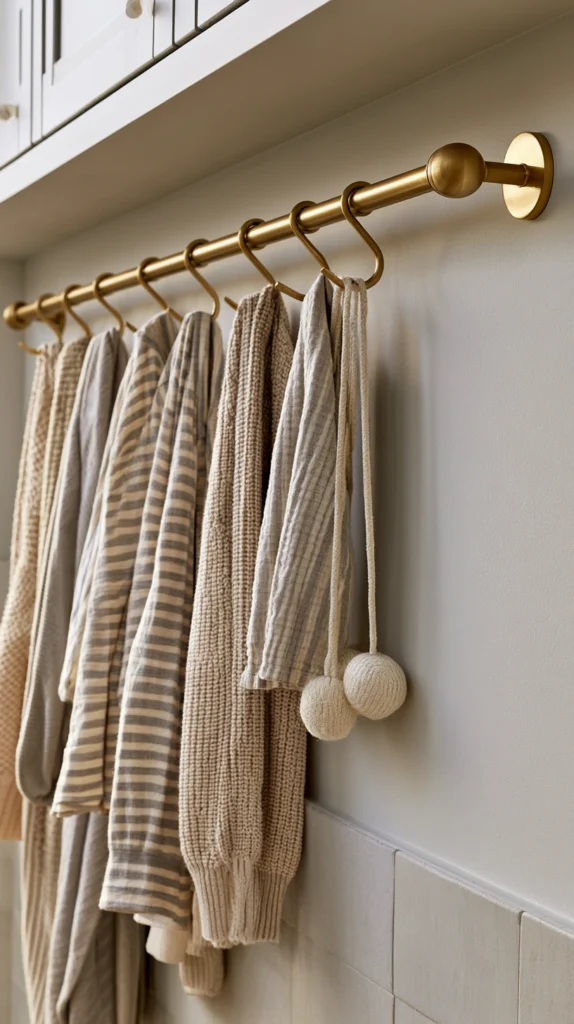
A wall-mounted rail of brass or bronze hooks, used for hanging garment bags, aprons, or items waiting to be ironed.
Why a hook rail solves the floor-pile problem
The vertical-holding principle:
- Items waiting for laundry attention (a garment to be steamed, a delicate to air dry) often end up piled on a counter or floor
- A hook rail gives these items a specific, visible home that also adds warmth to a bare wall
- Brass or bronze specifically reads as warmer and more intentional than chrome or matte black in this application
Best placement
- Beside the folding counter for items in transition
- Near the door for an apron or laundry bag in regular use
Budget pick: a basic brass-finish hook rail, $20-45 Splurge: a solid brass hook rail with an aged patina finish, $60-130
My hook rail result
A brass hook rail beside my folding counter now holds the canvas laundry bag and a linen apron I use for ironing, and having a defined spot for both means neither one ends up draped over the washer anymore.
Hook Rail Tips
Mount at a height that suits actual use:
- A rail mounted too high becomes inconvenient for daily use
- Test the height with the actual items intended to hang there before drilling
8. A Wallpapered Cabinet Interior Behind Closed Doors
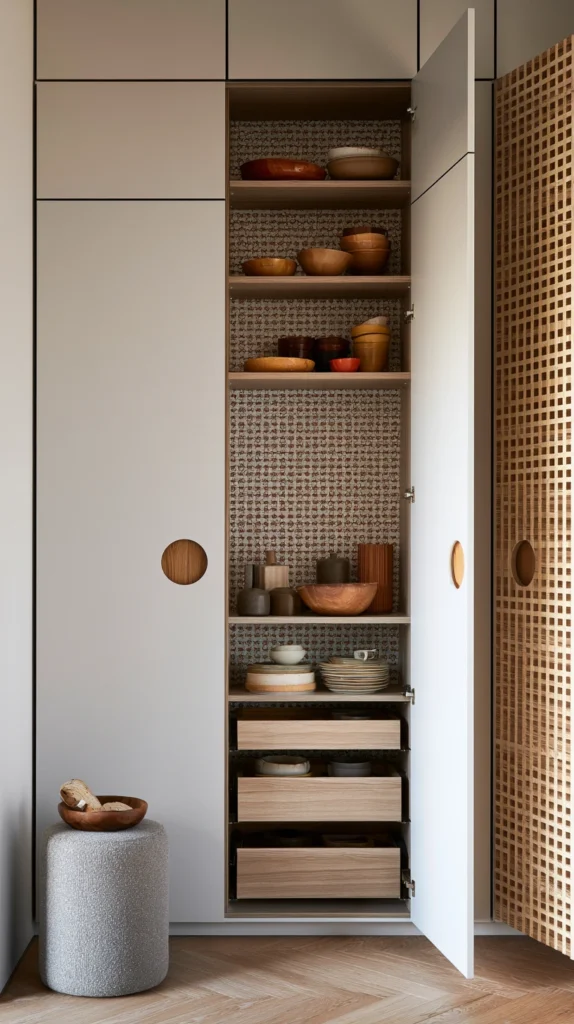
A patterned or seasonal wallpaper applied inside cabinet doors or shelving units, visible only when opened.
Why hidden styling still matters
The small-delight principle:
- Most laundry room storage sits behind closed cabinet doors for the majority of the day
- A wallpapered interior turns the simple act of opening a cabinet into a small, pleasant surprise
- This is one of the lowest-commitment ways to add seasonal pattern without affecting the room’s main visible surfaces
Best wallpaper choices for this use
- A warm, muted floral or botanical print for a fall-appropriate feel
- Peel-and-stick wallpaper for an easily changeable, low-commitment option
Budget: $15-40 for enough peel-and-stick wallpaper to line a few cabinet interiors
My wallpapered cabinet result
Lining the inside of my upper cabinet doors with a warm rust-toned botanical peel-and-stick paper turned an ordinary storage cabinet into the small detail every guest notices the first time they open it.
Wallpapered Cabinet Tips
Choose a removable option if renting:
- Peel-and-stick wallpaper specifically marketed as removable avoids any damage to cabinet finishes
- Test a small section in an inconspicuous spot before applying to a full cabinet door
9. A Marble or Wood Folding Counter Insert
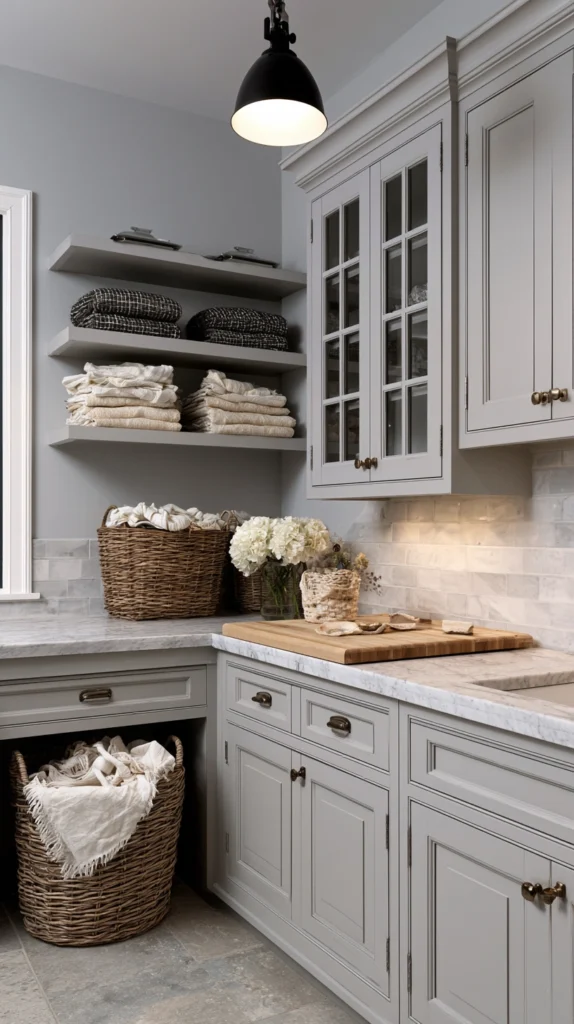
A slab of marble, butcher block, or stained wood inset directly into a laundry counter, replacing a plain laminate surface.
Why the folding surface deserves the same attention as a kitchen counter
The daily-use principle:
- The folding counter is touched and used more than almost any other surface in the room
- Laminate reads as purely functional; marble or stained wood reads as considered and finished
- This single surface upgrade often has the largest visual impact relative to its size in the entire room
Best material choices
- Marble or quartz remnants, often available affordably from a local fabricator
- Butcher block or stained wood for a warmer, more affordable alternative
Budget pick: a butcher block counter insert, $80-200 Splurge: a marble remnant counter insert, $150-400
My counter insert result
Replacing the plain laminate folding counter with a leftover marble remnant from a kitchen project transformed the single most-used surface in the room, and the cool stone against the warm wood shelving creates a balance I did not expect to like as much as I do.
Counter Insert Tips
Check remnant availability before committing to a design:
- Stone fabricators often sell remnants at a steep discount for exactly this kind of small project
- Calling ahead to ask about remnant inventory can save significantly over ordering a full custom slab
10. A Vintage Cart for Mobile Supply Storage
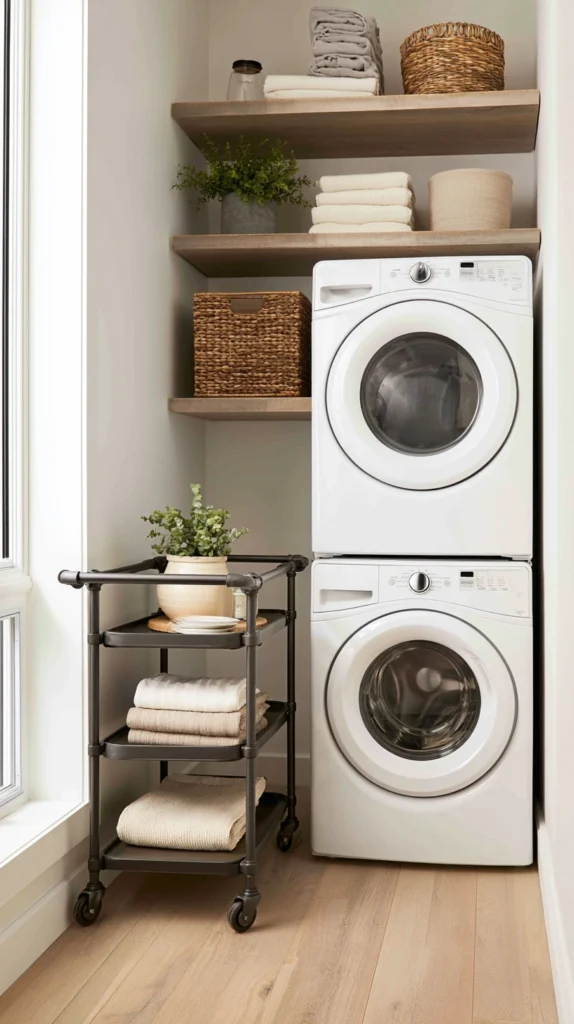
A vintage or vintage-style bar cart or kitchen cart, repurposed to hold laundry supplies and rolled away when not needed.
Why a mobile cart suits a small or multi-use laundry space
The flexibility principle:
- Many laundry rooms double as mudrooms, pantries, or hallway closets, leaving little dedicated storage
- A cart on wheels can roll out of the way entirely when the space is needed for another purpose
- This solves a storage problem that built-in shelving cannot address in a genuinely multi-use room
Best cart styles
- A vintage bar cart with a metal frame and glass or wood shelves
- A vintage-style kitchen cart with a single open shelf and a basket below
Budget pick: a new vintage-style cart, $80-180 Splurge: a genuine vintage cart sourced secondhand, $150-400
My vintage cart result
A small vintage brass-framed cart holds detergent, stain treatments, and a folded drying rack, and rolling it into a closet on weekends when the laundry nook becomes overflow pantry space solves a problem built-in shelving never could.
Vintage Cart Tips
Check wheel locks before relying on it daily:
- A cart without locking wheels can drift on an uneven floor
- This matters most in a laundry room, where the floor may have a slight slope toward a drain
11. A Chalkboard or Brass Label System for Bins
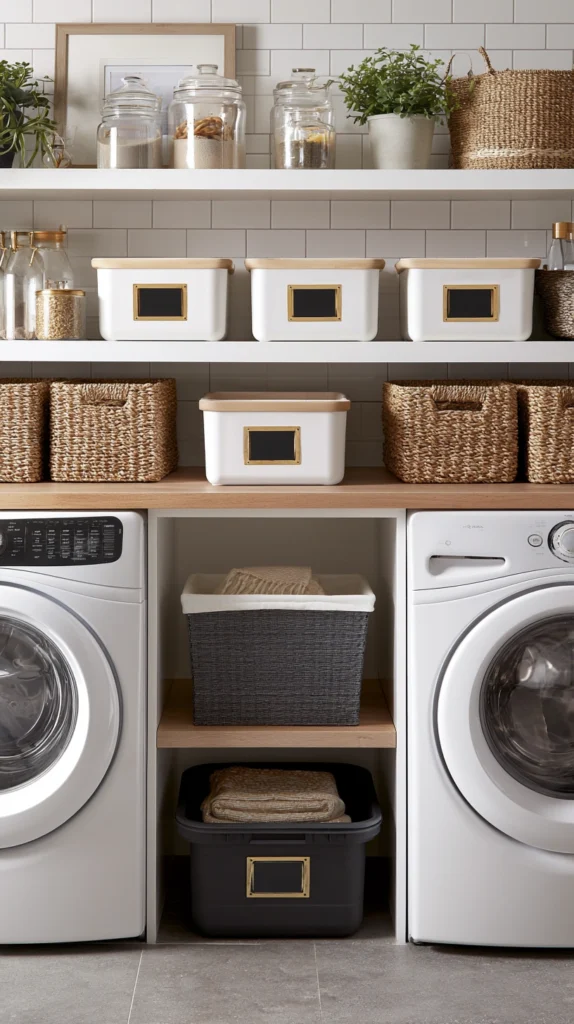
Small chalkboard tags or engraved brass labels affixed to every bin and jar throughout the room.
Why a consistent labeling system ties the whole room together
The unifying-detail principle:
- Individually pretty bins and jars can still look disconnected without a consistent labeling approach
- A single label style, repeated throughout the room, visually unifies storage that might otherwise come from several different sources
- This is a low-cost way to make a mismatched collection of containers read as one cohesive system
Best label materials
- Small chalkboard tags, rewritable as contents change
- Engraved brass tags for a more permanent, polished look
Budget pick: chalkboard label tags, $10-20 for a full set Splurge: custom engraved brass tags, $40-90 for a full set
My label system result
Adding matching brass tags to every jar and bin in the room, even ones purchased from different stores at different times, made the entire collection read as one intentional system rather than an accumulation of separate purchases.
Label System Tips
Keep wording simple and consistent:
- Short, consistent category names (powder, pods, softener) read more cleanly than long descriptive labels
- Consistency in wording style matters as much as consistency in the physical label material
12. A Built-In Bench With Underneath Basket Storage
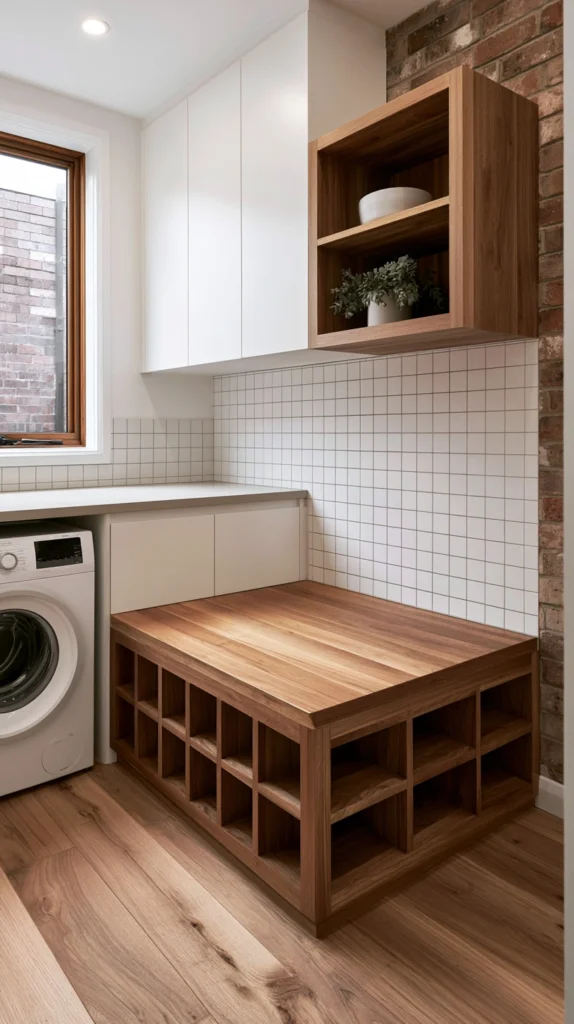
A simple bench seat with open cubbies or basket storage beneath, used for folding, sitting, or removing shoes near the laundry area.
Why a bench adds function beyond storage alone
The multi-purpose furniture principle:
- A bench gives the room a place to sit while folding, removing shoes, or simply pausing
- The cubby storage beneath solves the common problem of small laundry-adjacent items (off-season shoes, pet supplies) lacking a home
- This single piece often replaces what would otherwise require two separate furniture purchases
Best bench and cubby combinations
- A simple wood bench with three or four open cubbies beneath, each holding a basket
- A built-in version constructed to match existing cabinetry, if the budget allows
Budget pick: a freestanding wood bench with basket cubbies, $150-300 Splurge: a custom built-in bench matched to existing cabinetry, $600-1,500
My bench storage result
A simple wood bench with three woven baskets underneath gives me somewhere to sit while folding and a home for off-season shoes that previously cluttered the floor near the door.
Built-In Bench Tips
Match basket sizes to the cubby openings precisely:
- Baskets that are slightly too large or small for their cubby openings undermine the clean, built-in look
- Measure cubby openings before ordering baskets, rather than estimating
13. A Hanging Drying Rack With a Wood Frame
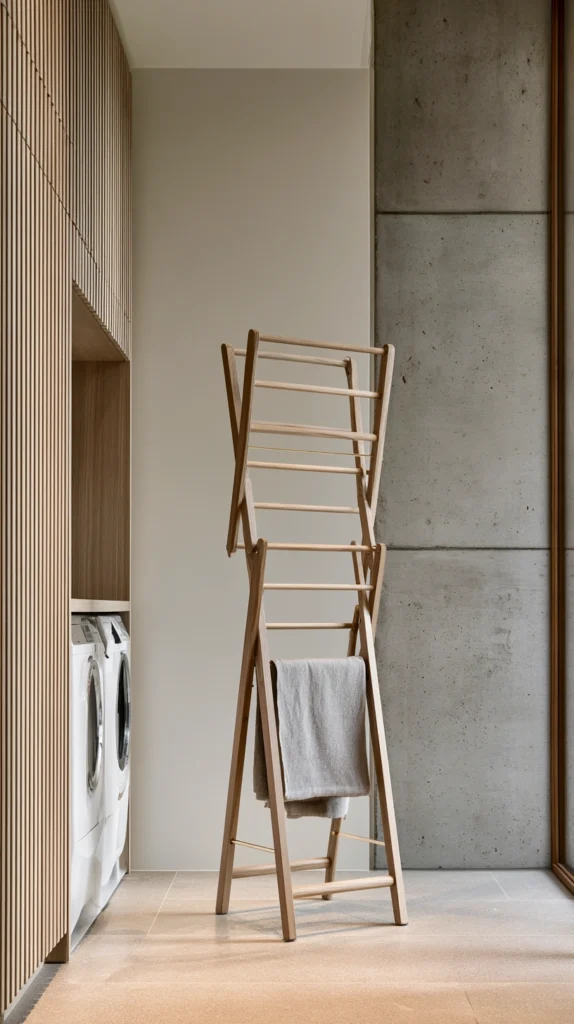
A foldable or fixed drying rack built with a wood frame rather than the standard white-coated wire version.
Why the drying rack deserves a material upgrade
The visible-equipment principle:
- A drying rack is often left out and visible for hours at a time, unlike most laundry equipment
- A wood-framed version reads as a piece of furniture even mid-use, rather than as a piece of equipment intruding on the room
- This upgrade has an outsized visual impact precisely because of how long the rack typically stays in view
Best wood drying rack styles
- A folding wood-framed rack that leans flat against the wall when not in use
- A ceiling-mounted wood and rope pulley rack for rooms with adequate height
Budget pick: a basic folding wood drying rack, $40-90 Splurge: a ceiling-mounted wood and rope pulley system, $120-250
My drying rack result
Switching from a white wire drying rack to a folding wood-framed version means the rack looks intentional even when left out mid-load, rather than like equipment that needs to be hidden the moment it is not in use.
Drying Rack Tips
Check the weight capacity before committing to wood:
- Some wood-framed racks have a lower weight capacity than equivalent wire versions
- Confirm the rack can handle a full load of heavier items like towels or jeans before relying on it as the primary drying method
14. A Curated Shelf of Seasonal Scent and Linen Display
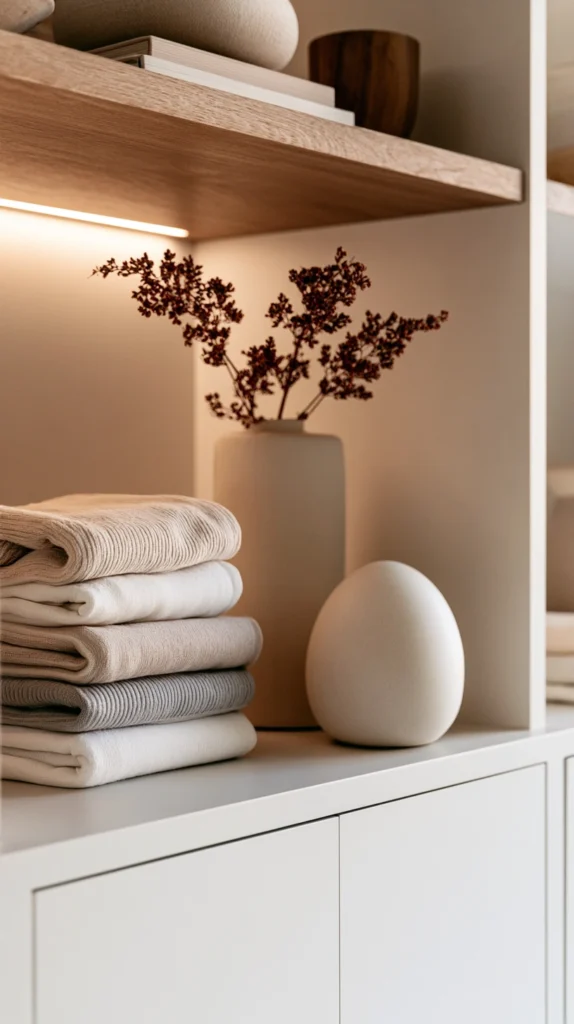
A small dedicated shelf or ledge styled with a fall-scented candle, a folded linen stack, and one or two small decorative objects.
Why a purely decorative shelf still belongs in a laundry room
The one-styled-moment principle:
- Not every shelf in the room needs to serve a storage function
- A single small area dedicated purely to styling gives the eye a place to rest among the otherwise functional surfaces
- This mirrors how a kitchen or entryway often includes one small vignette purely for visual pleasure
What to include
- A fall-scented candle in a ceramic or glass vessel
- A neatly folded stack of linen or waffle-weave towels
- One small seasonal object: a dried botanical stem, a small ceramic dish
Budget: $30-70 for a candle, folded linens, and a small accent object
My styled shelf result
A small shelf above my counter holding a folded stack of waffle towels, a ceramic candle, and a single dried eucalyptus stem gives the room one purely pretty moment among all the functional storage, and it is the first thing anyone comments on when they see the space.
Styled Shelf Tips
Refresh the seasonal object, not the whole shelf:
- Swapping just the candle scent or the dried botanical for the season keeps the shelf feeling current
- The folded linens and base styling can remain consistent year-round, with only the seasonal accent changing
15. A Full Coordinated System Combining Multiple Storage Types
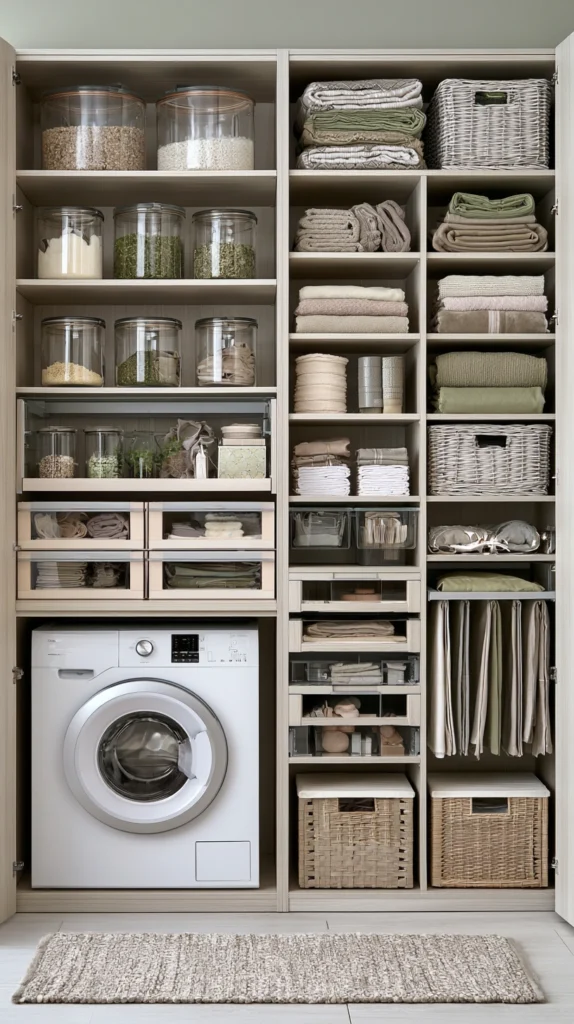
Combining woven bins, glass jars, a wood ladder shelf, and a consistent label system into one complete laundry room storage solution.
Why combining types outperforms any single solution alone
The complete-system philosophy:
- Several of the storage types on this list (woven bins, glass jars, wood shelving, consistent labeling) share enough warmth and material consistency to combine successfully
- Rather than choosing one storage solution, this approach layers multiple coordinated elements together
- This is the most complete and most cohesive setup on this list, suited to a full laundry room overhaul
How the combination works together
Woven bins (the soft texture layer):
- Hold soft goods like towels, cloths, and dryer balls
Glass jars (the visible product layer):
- Decant detergent, pods, and powder into a unified, label-friendly format
Wood shelving (the structural foundation):
- Provides warm, vertical storage in place of wire or laminate shelving
Consistent labeling (the unifying detail):
- Ties bins, jars, and cubbies together into one visually cohesive system
Building the full coordinated system
- Install wood shelving first, as the structural foundation for everything else
- Add woven bins for soft goods and glass jars for products
- Apply a single consistent label style across every container in the room
- Finish with one small styled vignette, as described in idea 14
Budget: $300-800 for a full coordinated laundry room storage overhaul
My full system result
Combining wood ladder shelving, woven seagrass bins, glass detergent jars, and matching brass labels throughout turned a room I used to rush through into one of the most consistently complimented spaces in the house, every container now feels like part of one plan rather than a separate purchase.
Full System Tips
Sequence the purchases by foundation first:
- Shelving and any built-in elements should be finalized before purchasing bins sized to fit them
- Buying containers before confirming shelf dimensions is the most common reason a coordinated system ends up with awkward gaps or overflow
Choosing Your Laundry Storage Approach
By commitment level:
- Lower commitment: glass apothecary jars (idea 2), chalkboard label system (idea 11)
- Full room commitment: wood ladder shelf (idea 3), full coordinated system (idea 15)
By room size:
- Small or multi-use space: vintage rolling cart (idea 10), wallpapered cabinet interiors (idea 8)
- Larger dedicated laundry room: built-in bench (idea 12), stacked crate shelving (idea 6)
By budget level:
- Lower budget: chalkboard labels (idea 11), seagrass bins (idea 1)
- Moderate budget: glass jars (idea 2), brass hook rail (idea 7), drying rack upgrade (idea 13)
- Higher budget: marble counter insert (idea 9), full coordinated system (idea 15)
The non-negotiable rules across every option:
Always:
- Decant or relabel anything with loud branded packaging before placing it on open shelving
- Match material tones (wood, brass, glass) throughout the room rather than mixing unrelated finishes
- Measure shelf and cubby dimensions before purchasing any containers meant to fit them
Never:
- Leave mismatched plastic containers on open shelving and expect a single pretty object to compensate
- Choose containers purely on individual appeal without checking how they will look beside the others already in the room
- Skip a liner or seal check on any natural fiber bin expected to hold anything that could leak
Remember: a laundry room storage system depends on every container, surface, and label agreeing with the others, not on any single pretty object placed into an otherwise mismatched room, and a small, consistent material choice repeated throughout does more than any one statement piece on its own.