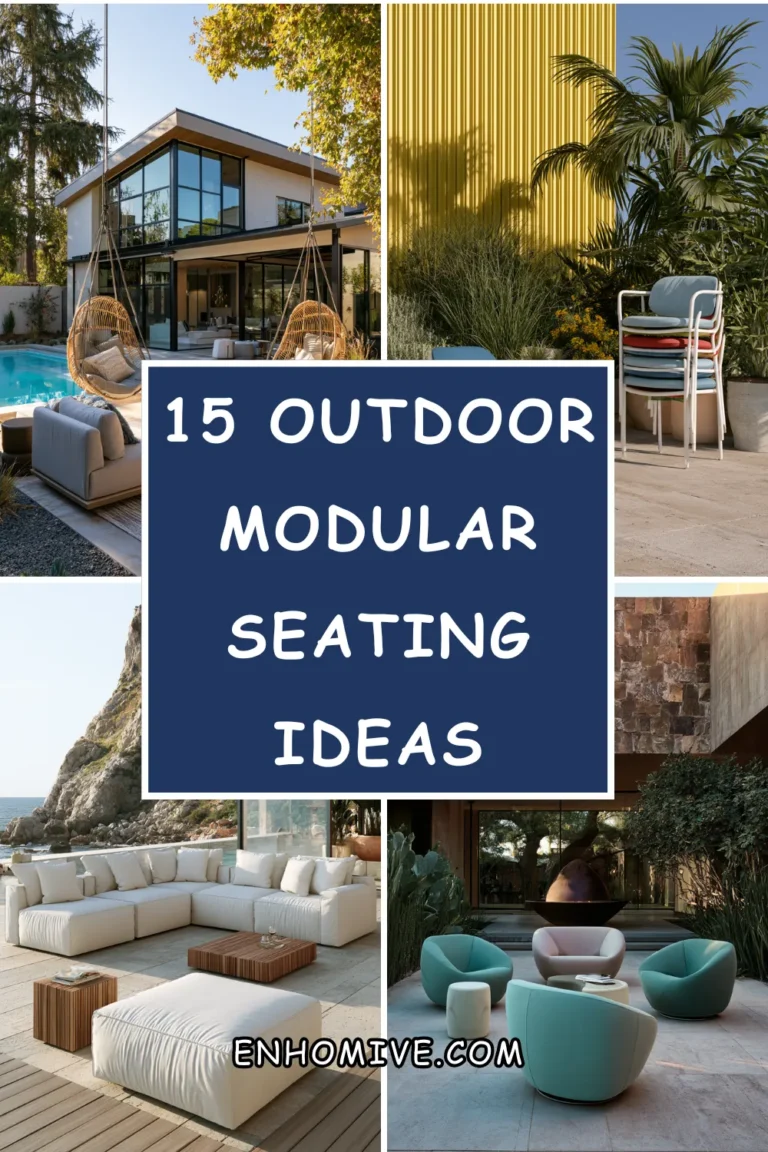

14 Natural Rock Waterfall Ideas for a Serene Outdoor Space
Water and stone are the two oldest materials in garden design — the combination that appears across every culture, every climate, and every garden tradition from the dry stone rills of Persian paradise gardens to the mossy cascade landscapes of Japanese temple gardens to the boulder streams of the contemporary naturalistic garden movement — because together they create something that neither achieves alone. Stone without water has mass, permanence, and geological beauty.
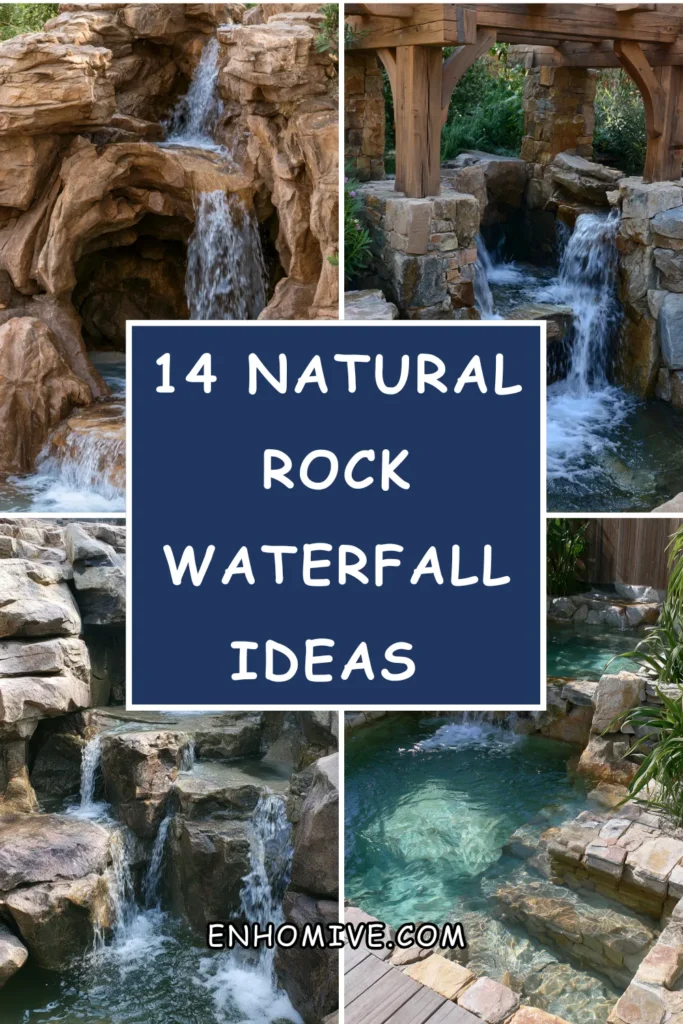
Water without stone has movement, sound, and reflective luminosity. Together they create the specific quality of natural serenity that makes a garden feel genuinely connected to the landscape beyond it — not a decorated outdoor room but a living piece of geography, a place where the forces that shaped the wider world are present and working in miniature.
The natural rock waterfall is the garden feature that most completely and most honestly captures this quality — not the manufactured fountain or the engineered water feature but the carefully composed arrangement of genuine stone through which real water moves in patterns that reference the natural watercourses that stone and water create when left to find their own relationship over geological time. These fourteen ideas demonstrate exactly how to achieve that quality in a residential garden at a range of scales and budgets.
1. The Boulder Cascade
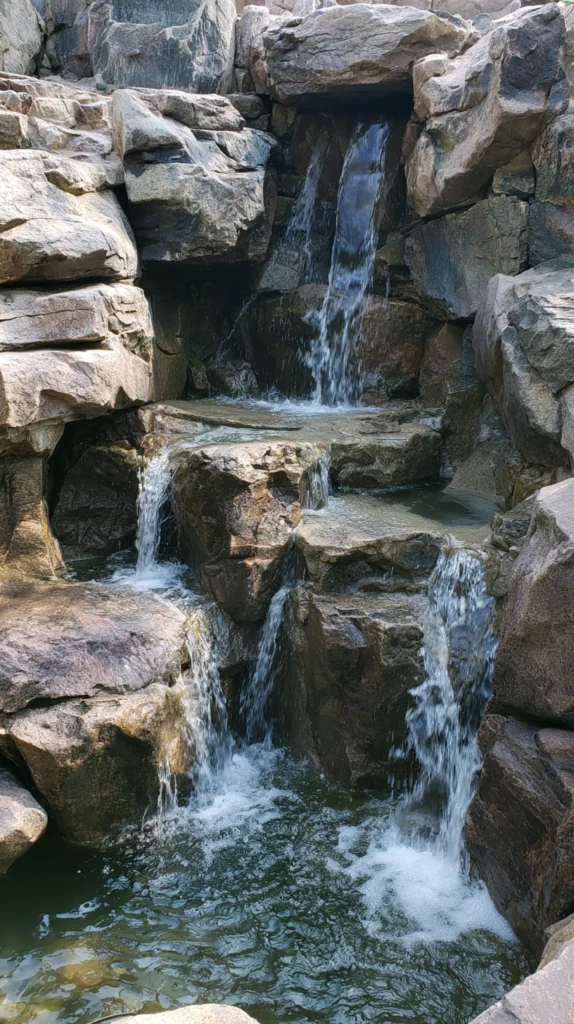
A boulder cascade — large, irregular stones of genuine scale arranged in a descending series, each positioned to direct the water flow over its face and onto the stone below, the cascade dropping through three or four distinct levels before reaching the pool or reservoir at its base — is the most dramatically beautiful and most completely naturalistic rock waterfall form available to a residential garden.
The key to the boulder cascade’s naturalistic quality is stone selection and stone placement — using stones of varying size and varying surface character rather than matched uniform pieces, positioning each stone at a natural angle as though deposited by water rather than placed by a gardener, and burying at least a third of each stone’s volume below the surrounding ground surface so the boulders read as emerging from the earth rather than sitting on top of it.
The sound of a well-constructed boulder cascade — the specific combination of the deep resonance of water falling onto a large flat stone surface and the lighter, more liquid sound of the thin water sheet flowing between stones — is one of the finest acoustic experiences available in a residential garden.
2. The Naturalistic Stream and Waterfall
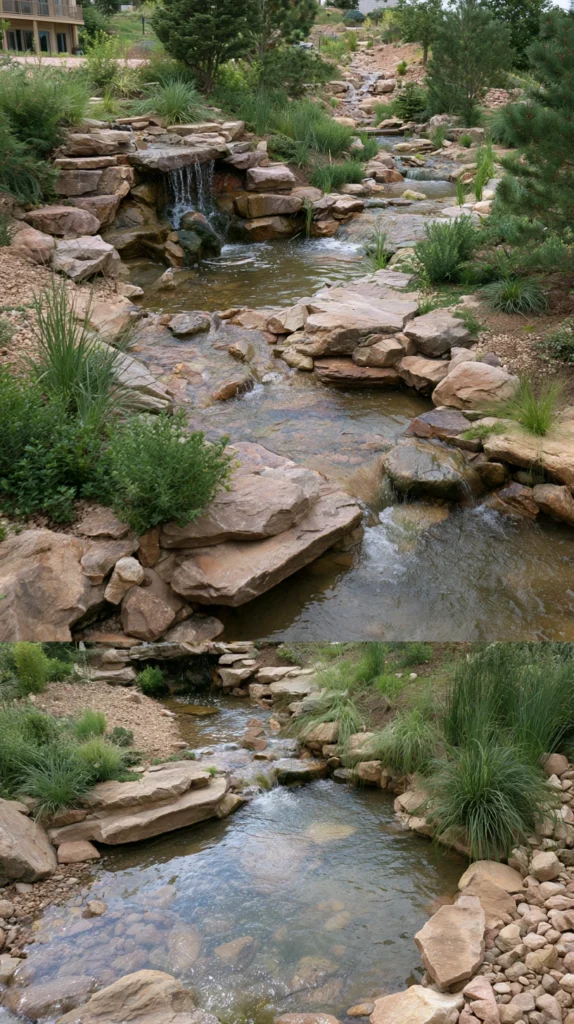
A garden stream that originates at a naturalistic waterfall source — a spring-like emergence of water from between boulders at the garden’s highest point — and flows through a carefully constructed streambed of varying stone sizes and varying channel widths, creating shallow rapids, deeper pools, and the occasional small secondary cascade along its course before reaching a terminal pond or pondless reservoir, is the rock waterfall form that most completely transforms the entire garden rather than creating a single focal point within it.
The naturalistic stream and waterfall requires the most planning, the most material investment, and the most construction skill of any water feature on this list, but the result — a garden through which water genuinely moves, in which the sound of flowing water is present at every point along the stream’s course, and in which the combination of stone, water, and the moisture-loving planting that the streambank supports creates a genuinely immersive natural environment — is the most extraordinary and most permanently satisfying garden water feature achievable at a residential scale.
3. The Japanese Tsukubai and Cascade
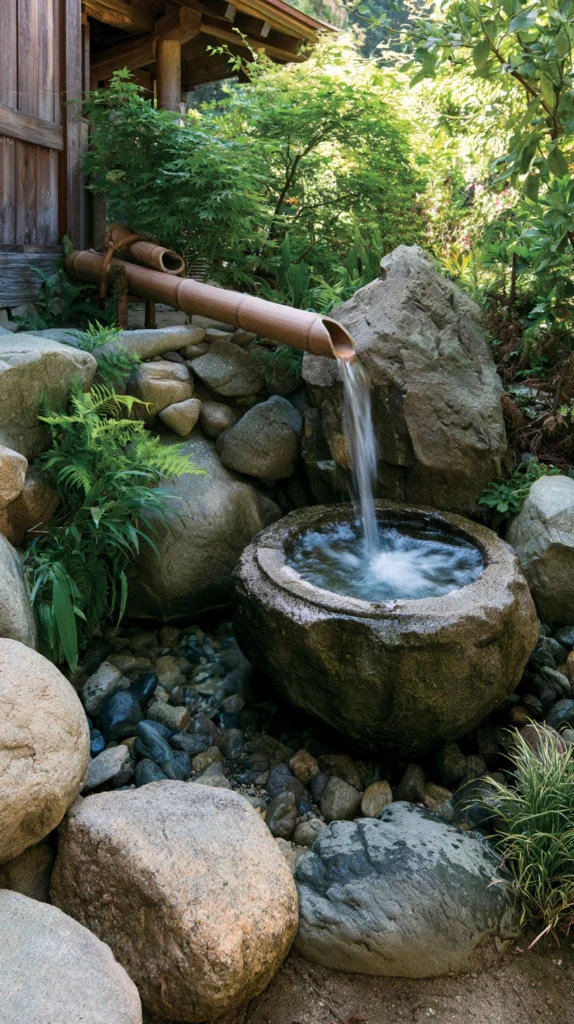
A Japanese-inspired water arrangement — a carved stone basin receiving water from a bamboo spout that is itself fed by a small cascade emerging from a carefully composed arrangement of moss-covered stones above — creates a water feature of extraordinary refinement and extraordinary spatial economy, its philosophical simplicity and its precise material relationships creating a garden moment of genuine meditative quality in a footprint of perhaps two square metres.
The tsukubai tradition combines the sound of falling water, the visual quality of moss-covered stone, and the ritual quality of moving water in a composition that is simultaneously the most minimal and the most complete water feature form in any garden design tradition.
Use genuine moss-covered stones collected from a local landscape or establish moss through deliberate cultivation on positioned stones — the moss covering is the detail that makes the Japanese waterfall composition feel genuinely aged and genuinely belonging to its garden position.
4. The Pondless Rock Waterfall
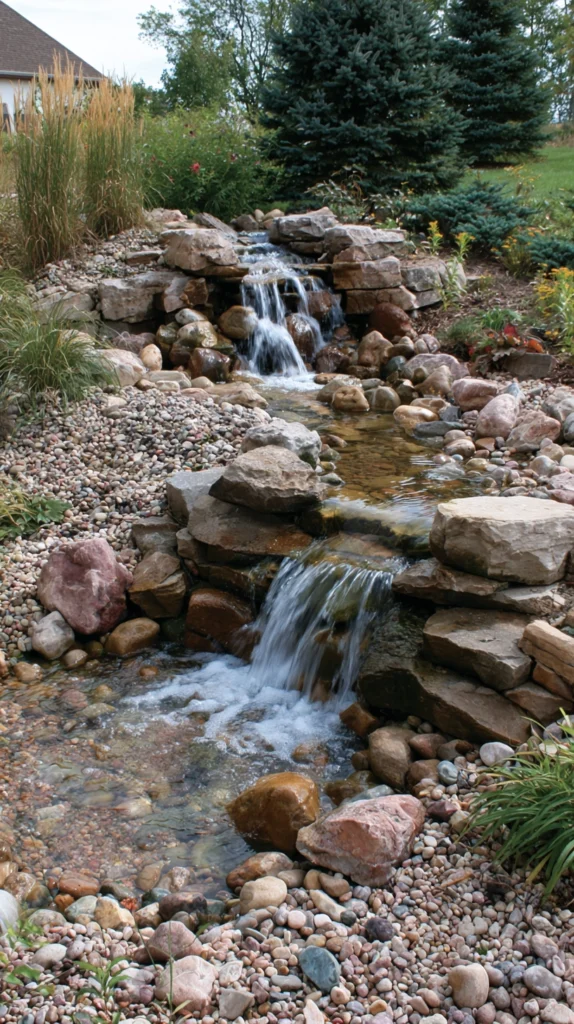
A pondless rock waterfall — its water emerging from between stones at the feature’s highest point, cascading over a composed arrangement of natural boulders and smaller stone, and disappearing into a gravel-filled reservoir basin concealed beneath the stone surface at the feature’s base — delivers the complete visual drama and complete acoustic pleasure of a traditional rock waterfall without the open water body that conventional waterfall features require.
The pondless configuration eliminates the safety concerns of an open pond, removes the mosquito management requirements of standing water, dramatically reduces the water loss through evaporation that open-surface water features produce in hot climates, and requires less structural excavation and less liner installation than a pond-based waterfall.
It is the rock waterfall form most appropriate for family gardens, for gardens in water-restricted climates, and for garden positions where the visual character of the waterfall is the primary design objective rather than the ecological habitat value of an associated pond.
5. The Moss-Covered Grotto Waterfall
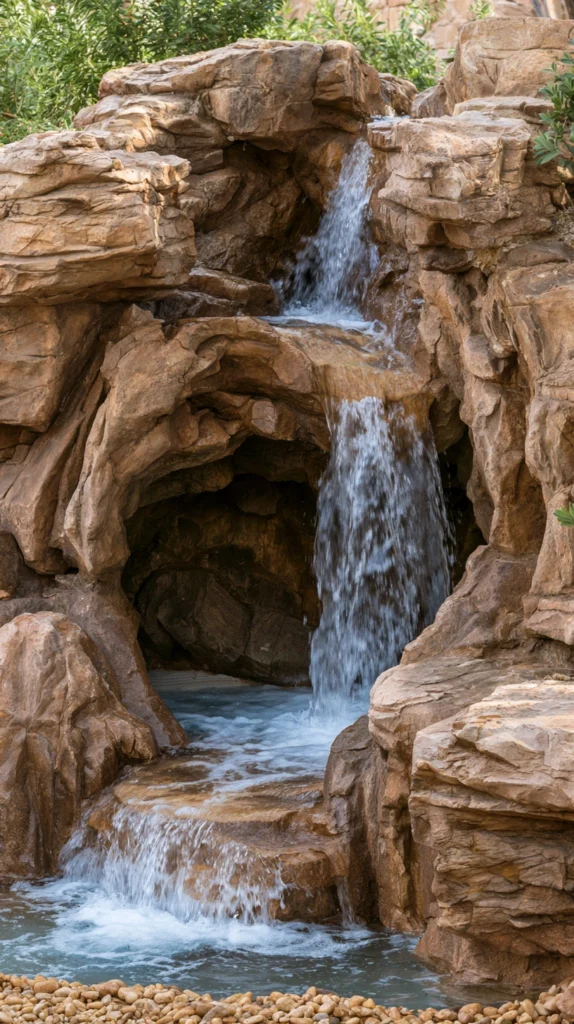
A waterfall emerging from a constructed rock grotto — a partially enclosed cave-like structure of stacked boulders whose interior surfaces support growing moss, ferns, and the moisture-loving plants that establish naturally in the cool, humid microclimate created by the constant presence of water and stone — creates a garden water feature of extraordinary botanical richness and extraordinary visual depth that rewards examination from multiple viewpoints and reveals new detail at every change of angle and every change of light.
The grotto’s interior — visible through the falling water curtain from the garden outside — glows with the warm green of established moss and fern against the cool grey stone, creating the particular quality of enclosed, living, moisture-rich botanical beauty that makes cave and grotto garden features so consistently compelling and so consistently difficult to walk past without stopping.
6. The Dry Creek Bed With Seasonal Waterfall
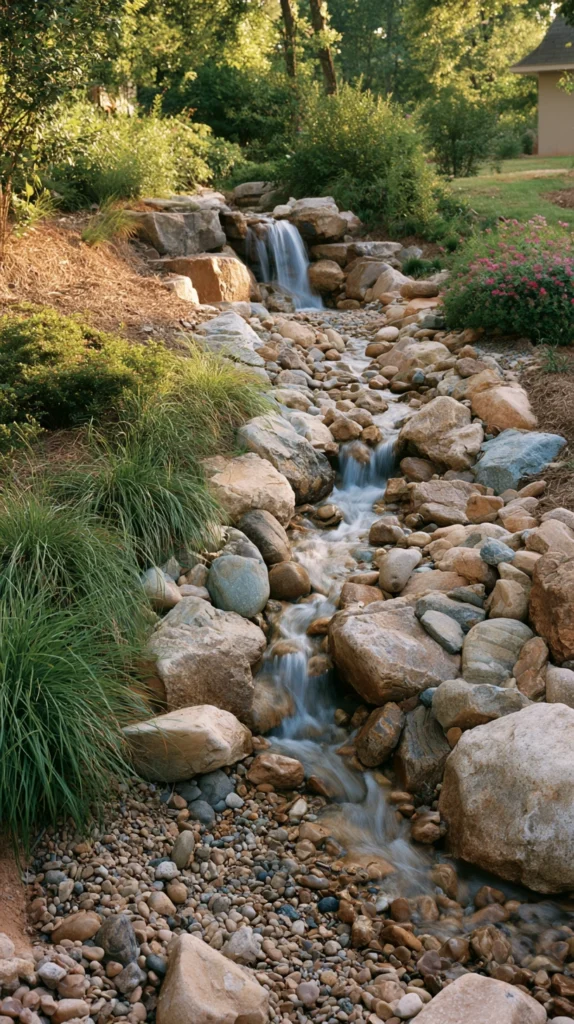
A dry creek bed — a naturalistic arrangement of rounded river stones in a channel that follows the garden’s natural gradient, its stone selection and arrangement referencing the watercourses that form in landscapes where seasonal rainfall creates temporary streams.
Positioned to receive water from a rock waterfall source that operates as a permanent feature while the creek bed itself flows only in response to rainfall or irrigation, creating a genuine hydrological event as heavy rain fills the creek and activates its stone arrangement in the way that a natural watercourse responds to seasonal precipitation.
The dry creek bed with its rock waterfall source creates a garden feature of four-season interest — beautiful as a composed stone arrangement in the dry season, dramatically animated when water flows through it during wet periods — and serves the practical function of managing garden drainage in sloped or poorly drained positions.
7. The Cliff Face Waterfall
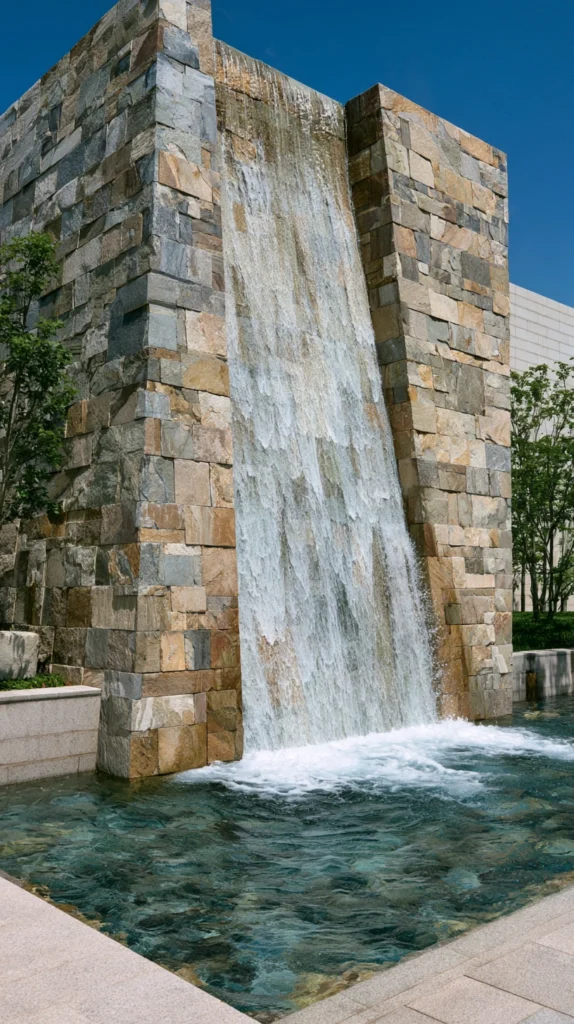
A vertical rock face — constructed from carefully selected flat stones laid in courses that reference the stratified cliff faces of natural geological formations, the water running in a thin, continuous sheet down the full height of the vertical surface rather than cascading over individual stones — creates a rock waterfall of dramatically different visual and acoustic character from the boulder cascade, its flat water sheet producing a hushed, continuous sound of considerable refinement against the more articulated, varied sound of a multi-level cascade.
The cliff face waterfall suits contemporary and minimalist garden aesthetics with particular precision — its geometric quality, its precise material layering, and the almost architectural character of its stone coursing connect to the clean-lined design vocabulary of modern outdoor spaces in a way that the irregular boulder cascade does not quite manage with the same naturalness.
8. The Rock Pool and Overflow Waterfall
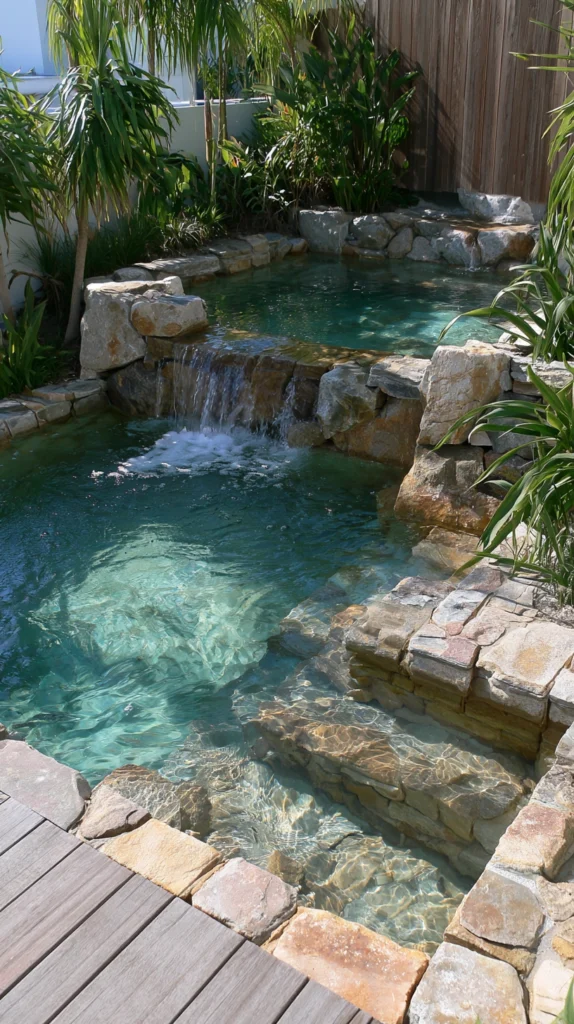
A natural rock pool — an excavated basin lined with carefully positioned stones whose irregular arrangement references the rock pools of coastal and riverside landscapes — receiving water from a waterfall above and overflowing at its lowest edge into a second pool or a stream channel below creates a water feature of genuine hydrological complexity and genuine visual richness, its multiple water bodies and its continuous overflow movement creating a living, dynamic system that feels genuinely natural rather than mechanically operated.
Plant the rock pool margins with moisture-tolerant native plants — ferns, rushes, water iris, marsh marigold — and the planted rock pool system becomes a genuine ecological habitat of real biodiversity value as well as a garden feature of extraordinary beauty and considerable acoustic pleasure.
9. The Hillside Rock Waterfall
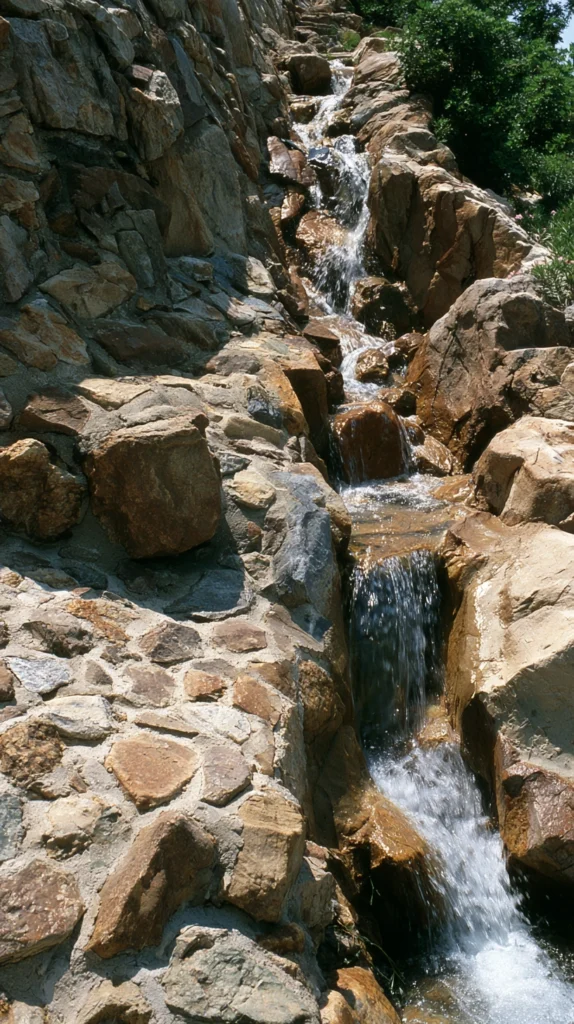
A natural or constructed hillside — its gradient providing the elevation change that drives the waterfall’s visual drama, its stone-covered surface creating the naturalistic landscape into which the waterfall is integrated as a naturally occurring element rather than an added feature .
It is the ideal site for the rock waterfall of greatest scale and greatest landscape ambition, the configuration that most completely eliminates the sense of a constructed water feature and most completely creates the impression of a natural watercourse encountered within a designed garden.
Position the pump chamber at the hillside’s base, run the supply pipe through the hillside’s interior rather than across its surface, and emerge the water supply between boulders at the hill’s summit in a way that replicates the spring emergence of a natural watercourse from the ground at a high point in the landscape.
10. The Rain Chain and Stone Basin
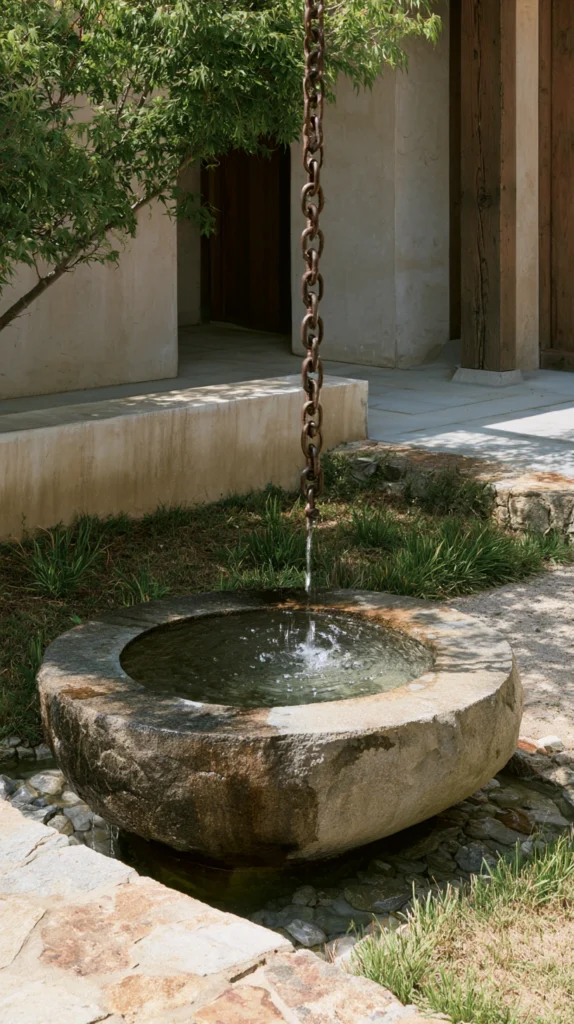
A rain chain — a series of linked cups, rings, or chains that guide rainwater from a roof gutter downward in a visible, decorative cascade rather than through a concealed downpipe — terminating in a stone basin of genuine quality positioned at the building’s base creates a waterfall feature that is activated by rainfall rather than by a pump, its operation the direct product of the garden’s natural water cycle rather than a mechanical simulation of it.
The rain chain and stone basin is the rock waterfall feature of greatest simplicity, greatest material honesty, and most complete integration with the garden’s natural hydrology — it operates without electricity, without a pump, and without any mechanical component beyond the chain itself, creating a water feature whose every operation is a genuine weather event rather than a designed simulation of one.
11. The Fern Gully Waterfall
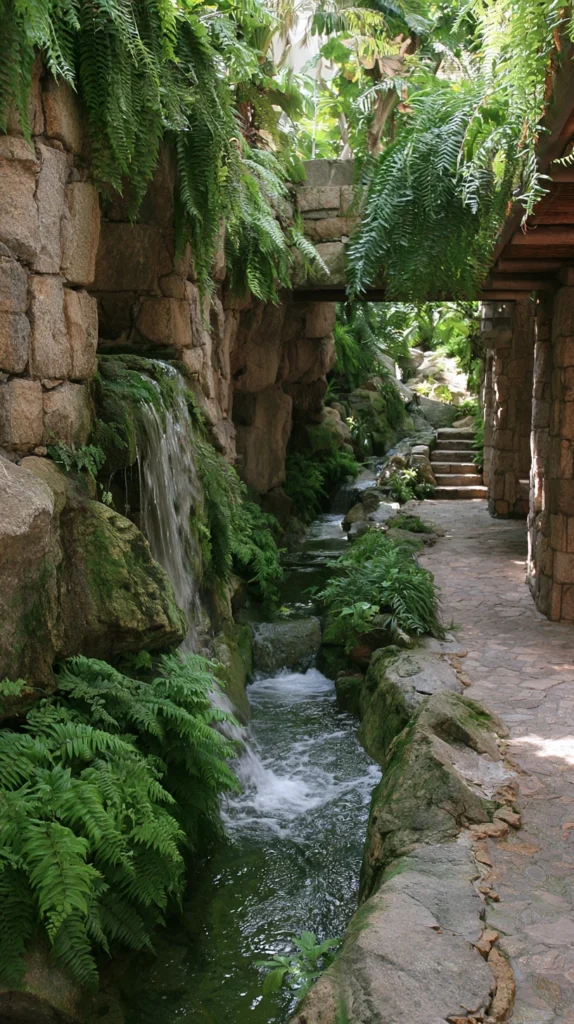
A shaded garden gully — a narrow channel between high planted banks, its atmosphere cool, moist, and deeply green with the ferns, mosses, and shade-tolerant plants that thrive in the humid microclimate created by its enclosed character and its constant water presence — with a rock waterfall at its upper end feeding a gentle stream through its length creates the most botanically immersive and most atmospherically distinctive garden water feature experience available in a shaded or partially shaded garden position.
The fern gully’s narrow enclosed character amplifies the sound of the waterfall at its head and creates the specific acoustic environment of a confined natural watercourse — the water sound bouncing between the planted banks and filling the gully’s entire length with the gentle, enveloping quality of moving water in an enclosed space.
12. The Rock and Timber Combination Waterfall
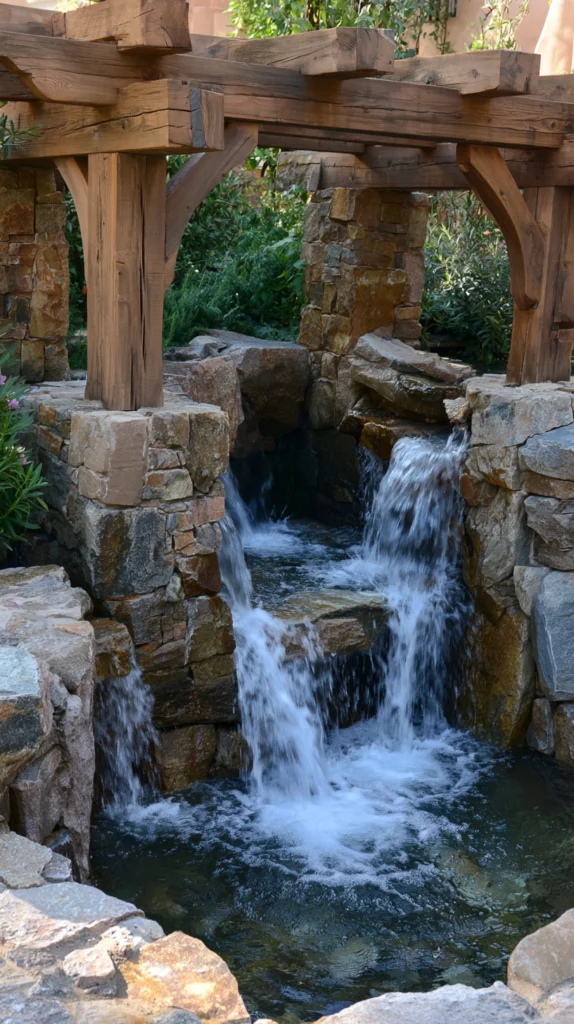
A waterfall feature that combines natural stone with carefully selected timber elements — a section of aged timber bridging two boulders across which water flows, a timber trough directing water onto a stone cascade below, or simply the warm presence of timber decking beside a rock pool waterfall — creates a water feature of genuine material warmth that all-stone waterfall features, beautiful as they are, sometimes lack.
The timber and stone combination references the natural association of fallen timber with streamside environments — the log across the creek, the weathered plank bridge above the cascade — in a way that reads as genuinely natural rather than decorative, and the warmth of aged timber against cool grey stone creates a material contrast of considerable beauty in both natural and artificial light.
13. The Raised Rock Waterfall Wall
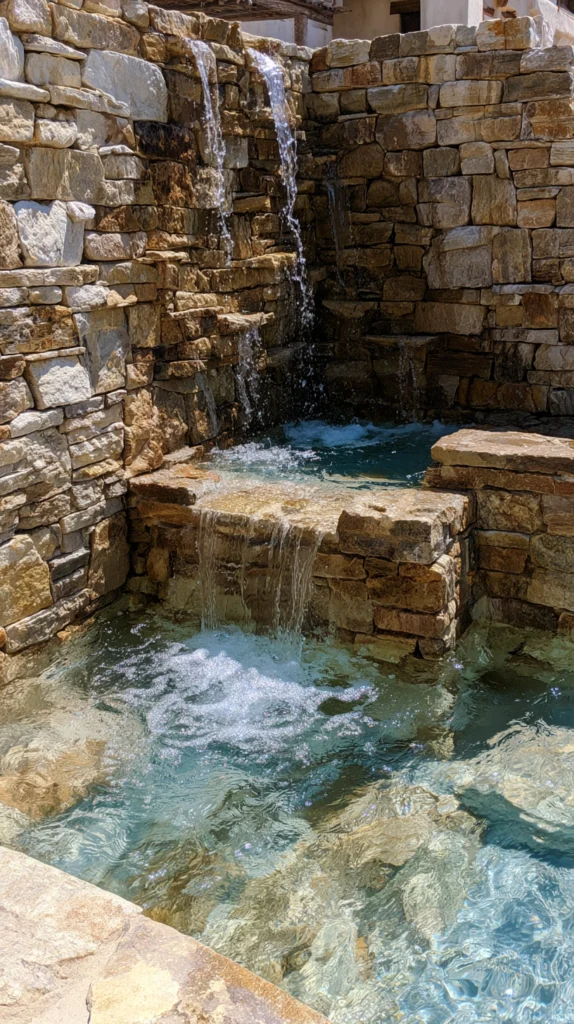
A raised retaining wall of natural stone — its face constructed from carefully selected and carefully arranged stone that creates a vertical garden surface of genuine geological character — with water emerging from between the stones at the wall’s top and flowing down its face in multiple thin rivulets that follow the irregular surface of the stonework to the channel or basin below creates a vertical rock waterfall of considerable architectural presence and considerable visual drama.
The raised rock wall waterfall is the form most suited to gardens where the primary entertaining and living area is at a different level from the surrounding garden — the wall retaining the level change while simultaneously providing the waterfall feature that animates the height difference and creates the acoustic and visual interest that a plain retaining wall entirely lacks.
14. The Wildlife Pond Waterfall
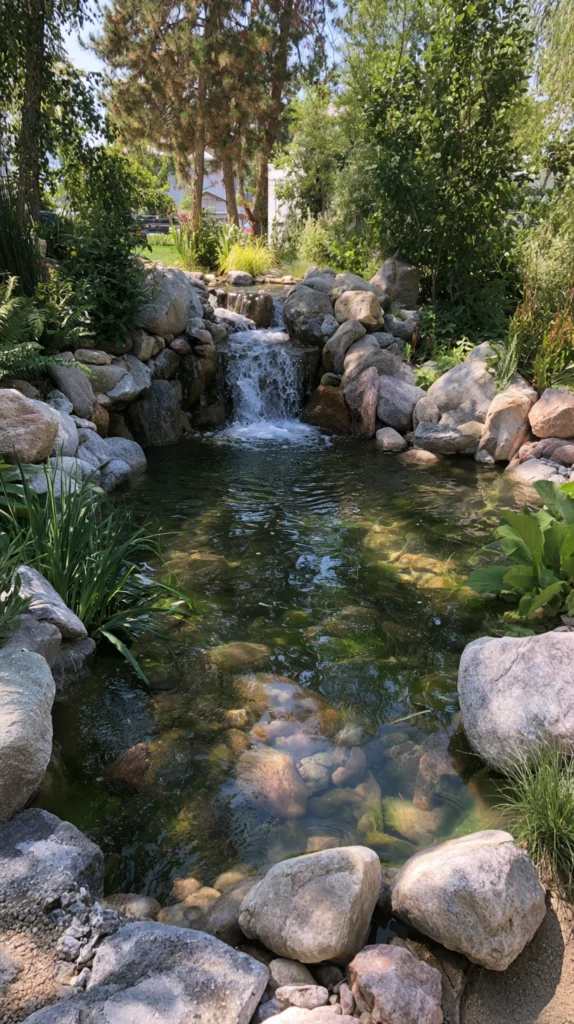
A wildlife pond — its margins planted with native aquatic and marginal plants, its shallow beaches providing access for drinking and bathing birds and mammals, its water quality maintained by the balance of plant, invertebrate, and microorganism life rather than by mechanical filtration — with a small rock waterfall providing the water movement and oxygenation that wildlife pond ecology benefits from creates the garden water feature of greatest ecological value and greatest long-term biological interest.
The wildlife pond waterfall keeps the pond water well-oxygenated for invertebrates and fish, creates the shallow, moving water conditions that many species of birds prefer for bathing, and provides the acoustic quality of a natural water environment that makes the garden feel genuinely alive with the presence of wildlife drawn to the water from the surrounding landscape.
Final Thoughts: Building a Rock Waterfall That Belongs to Its Garden
The natural rock waterfall that achieves genuine serenity rather than simply adding water to a garden is built with stone that belongs to the local geology, positioned where the garden’s natural grade supports the feature rather than requiring elaborate excavation and earthworks, and planted with the moisture-loving species that would naturally establish beside a watercourse in the surrounding landscape.
Invest in the stone quality before the pump quality — the finest pump in the world cannot compensate for poorly selected or poorly placed stone, while a modest pump delivering water through a beautifully composed stone arrangement creates a waterfall of genuine natural beauty.
Build slowly, assess the water flow at each stage before adding the next stone, and allow the feature the time it needs to develop the moss, the patina, and the planted margins that transform a constructed water feature into something that looks and sounds and feels genuinely, completely natural.