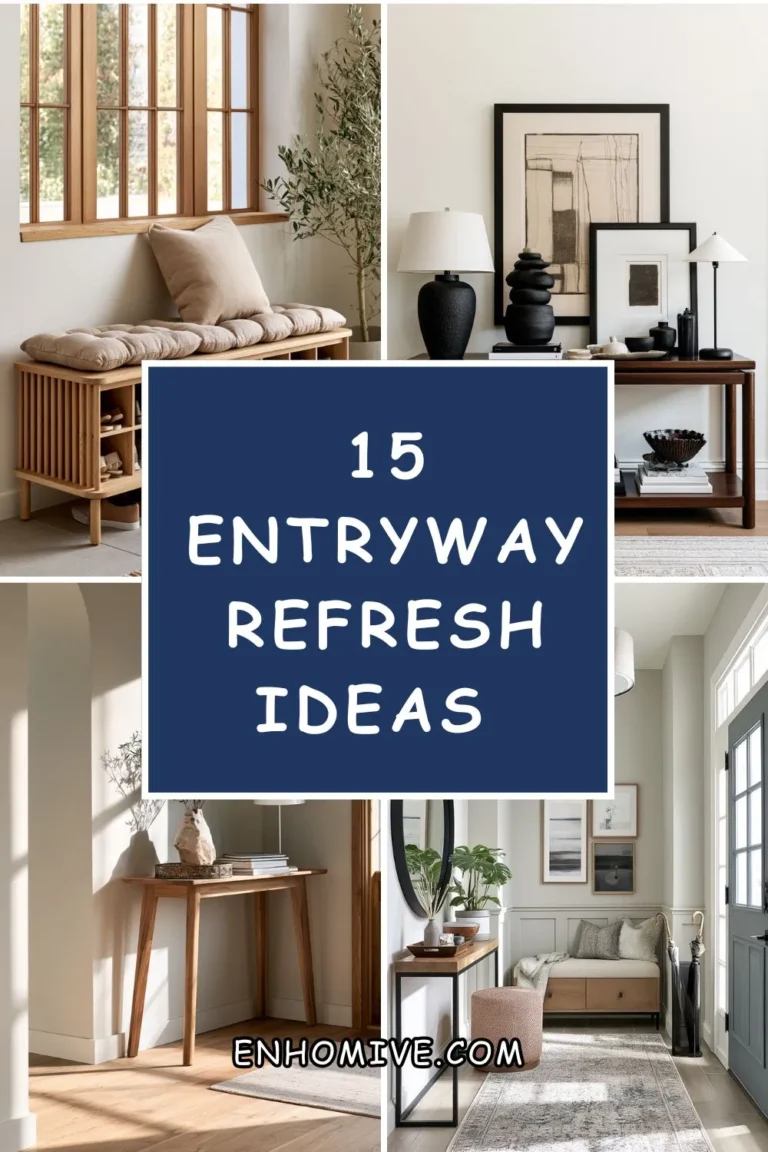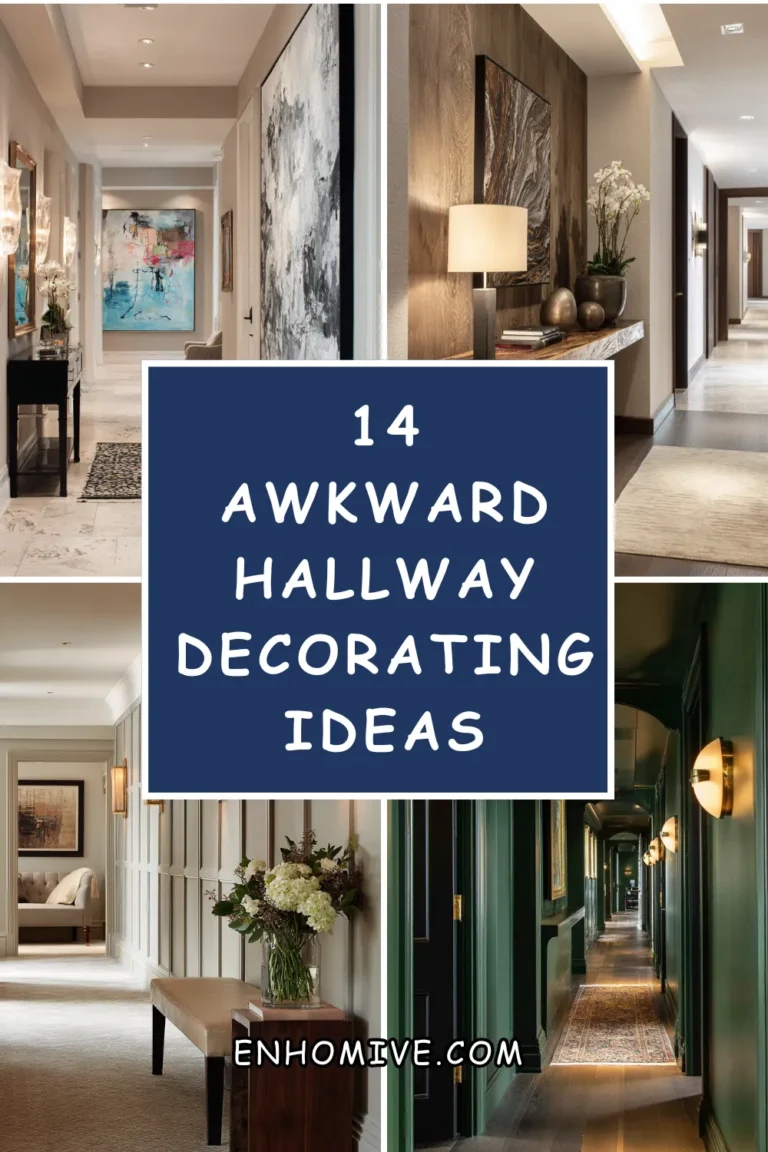

12 Seasonal Entryway Refresh Ideas That Transition Seamlessly Into Everyday Style
There is a particular kind of decorating frustration that arrives four times a year. The season changes, the entryway feels wrong, and the choice becomes either a complete overhaul that costs money and takes a weekend, or leaving everything as it is and watching the space feel increasingly out of step with the world outside the front door. Neither option is satisfying. The first is exhausting. The second is dispiriting.
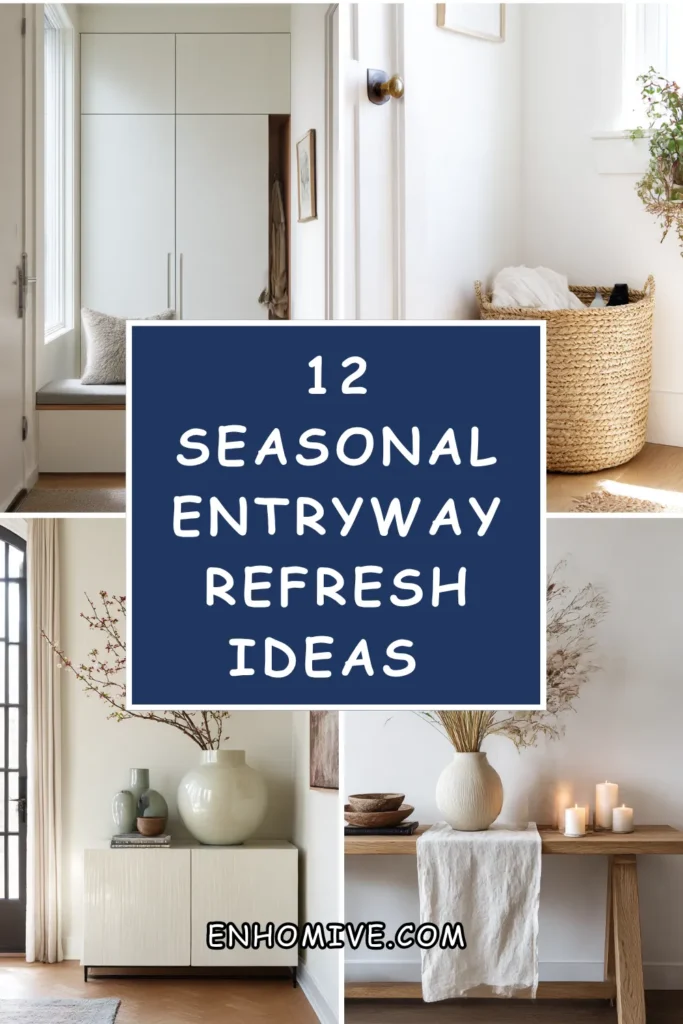
The better approach is to build an entryway that is designed for transition from the beginning — where the core elements are permanent and neutral enough to carry any season, and the seasonal layer sits on top lightly enough to be swapped in an afternoon without touching anything structural. The twelve ideas below are built on exactly this principle. Each one delivers a seasonal refresh that feels genuinely current without dismantling what came before, and each one is designed to live comfortably in the everyday register of a real home rather than the heightened atmosphere of a styled shoot.
1. The Rotating Botanical Wreath System
Budget: $40 – $200 per season
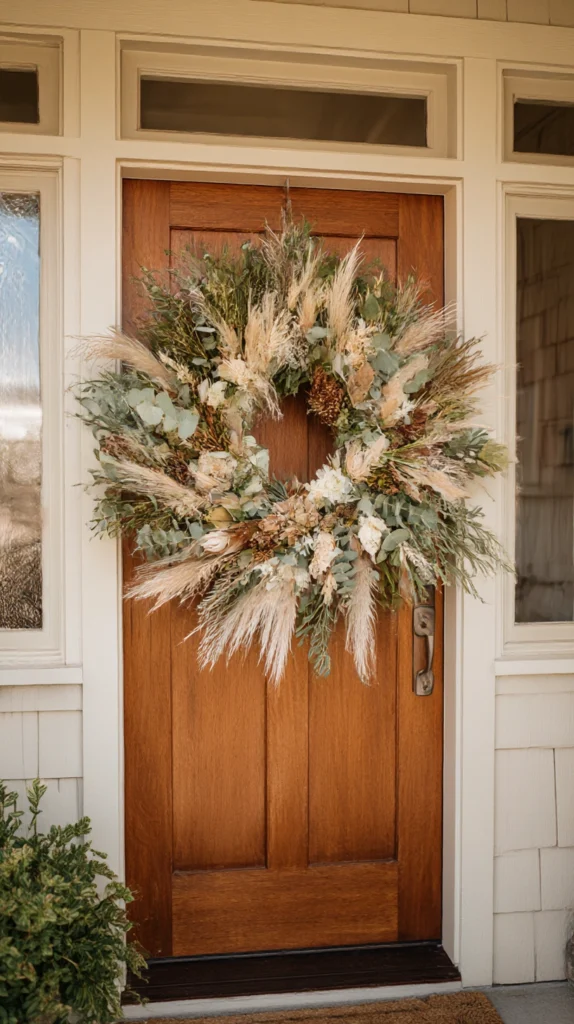
A wreath hook on the front door or the interior entryway wall is one of the most efficient seasonal refresh mechanisms available because it changes the first visual impression of the space without altering anything else. The hook stays. The wreath changes. In spring, dried ranunculus and eucalyptus in blush and sage. In summer, dried citrus slices, wheat stalks, and coastal grasses. In autumn, preserved oak leaves, dried berries, and cinnamon bundles. In winter, fresh pine, juniper, and dried orange.
Dried and preserved botanical wreaths cost $30 – $80 each depending on materials and size. A quality wreath hook rated for outdoor use runs $8 – $20 and lasts indefinitely. The wreath itself is the only recurring cost — and dried versions last a full season with minimal care, making the annual investment across four seasonal wreaths $120 – $320 for a refresh that happens at the door before a guest even crosses the threshold.
Decor tip: Store off-season wreaths in a large hat box or a round wreath storage container rather than hanging them in a cupboard or stacking them flat. Dried botanicals crush under their own weight over a storage season and emerge misshapen in ways that are difficult to reverse. A dedicated storage box maintains the form and extends the working life of each wreath by at least one additional season.
2. The Console Table Seasonal Vignette
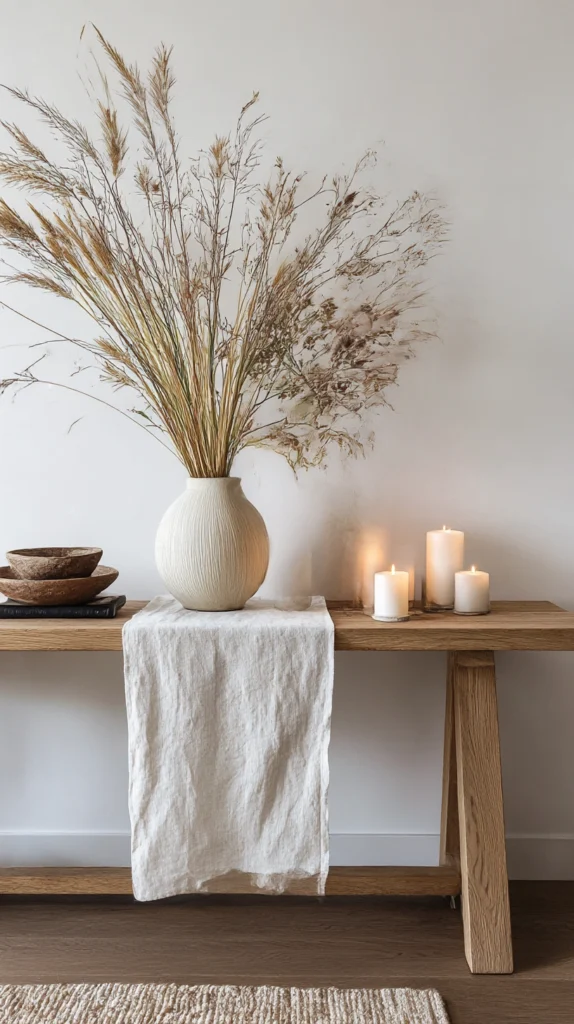
Budget: $30 – $150 per season
A console table in the entryway is the most versatile seasonal canvas in the home because its surface can be entirely reclothed without moving a single piece of furniture. The table stays. The objects on it change. A shallow linen table runner shifts with the season — undyed natural in summer, rust-toned wool in autumn, deep green velvet in winter, pale blush cotton in spring. The objects above the runner change in the same rhythm: a vase of dried grasses, a bowl of seasonal fruit, a cluster of candles at varying heights.
A quality console table in a neutral finish — pale oak, whitewashed pine, or matte black metal — costs $120 – $400 and serves as the permanent foundation. The seasonal layer on top costs $30 – $100 per transition, spread across a runner, a vase, and two or three objects chosen specifically for that time of year. The rule is to remove before adding — a console table that accumulates seasonal objects without editing becomes a surface of competing intentions rather than a considered vignette.
Decor tip: Limit the console table vignette to five objects at most, including the vase or bowl at the centre. Count the objects before stepping back to assess. A surface with more than five items almost always benefits from the removal of one — and the item removed is usually immediately obvious once the count is made explicit.
3. The Seasonal Scent Transition
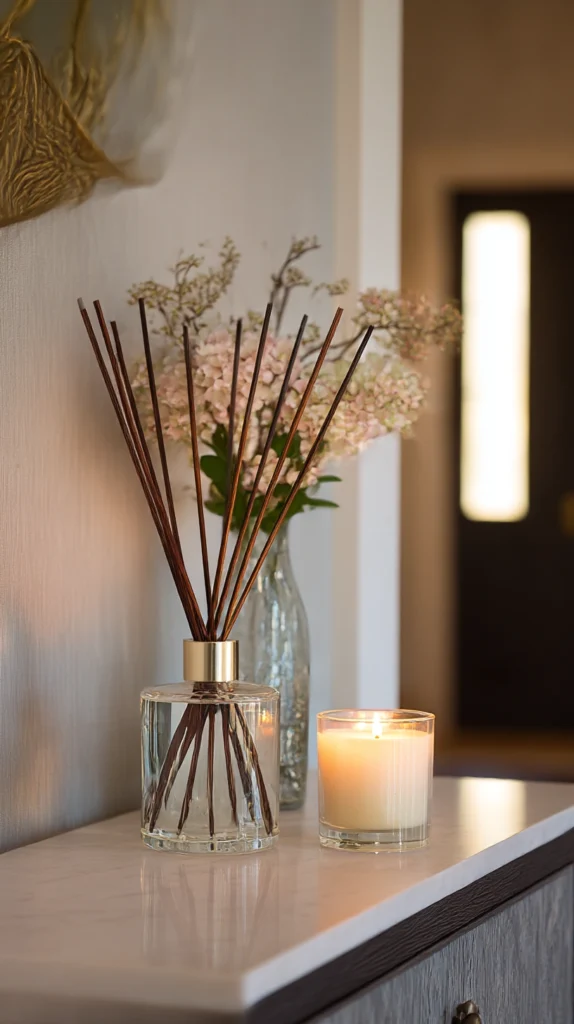
Budget: $20 – $100 per season
Scent is the most immediate and the most viscerally memorable aspect of an entryway, and it is the one most consistently overlooked in favour of visual decoration. A diffuser, a candle, or a simple bowl of botanical material placed near the entrance communicates the season before the eye has registered anything — and it does so in a register that goes directly to memory and emotion in a way that a wreath or a vignette object never quite reaches.
Spring calls for light green and white florals — lily of the valley, white tea, fresh cut grass. Summer runs to citrus, marine, and light woods — bergamot, sea salt, cedar. Autumn brings warmth and spice — clove, amber, sandalwood, smoked wood. Winter arrives with pine, frankincense, and vanilla. A quality reed diffuser costs $20 – $50 and lasts six to eight weeks. A scented candle in a seasonal fragrance runs $15 – $40. The transition from one season to the next costs a single purchase and takes thirty seconds.
Decor tip: Place the scent source at nose height rather than floor level — on a console table, a wall-mounted shelf, or a side table rather than on the floor beside the door. Fragrance disperses upward and outward from its source, and a diffuser at floor level fills the lower half of the entryway effectively while leaving the space at face level — where the first breath of a guest is taken — largely unscented.
4. The Seasonal Doormat Rotation
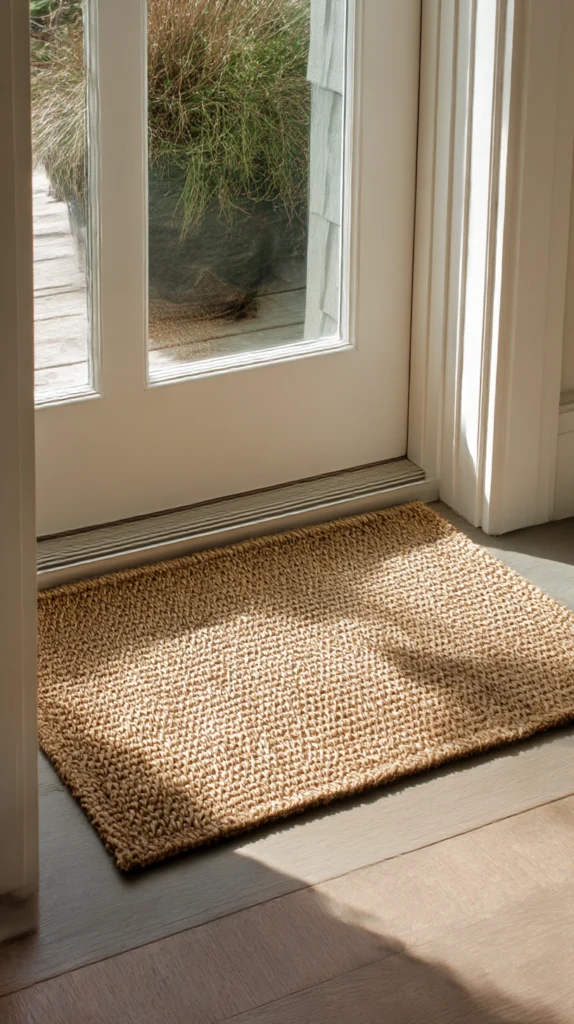
Budget: $20 – $80 per mat
A collection of four doormats — one per season — rotated at the threshold is one of the most practical seasonal refresh systems available because the doormat is already being replaced by wear and necessity on a regular cycle. Building seasonal intention into that cycle costs almost nothing extra and produces a front step that feels current and considered throughout the year.
Spring calls for a natural coir mat with a botanical stamped motif. Summer works well with a flatweave cotton stripe in a coastal colourway. Autumn suits a deep-toned overdyed coir or a jute mat with a warm amber border. Winter belongs to a rubber-backed mat in a dark, practical tone with a minimal geometric or typographic detail. Each mat costs $20 – $60. The full set of four runs $80 – $240 — roughly the cost of a single quality doormat replaced annually — and produces four distinct seasonal moments at the threshold.
Decor tip: Store off-season doormats flat in a dry location rather than rolled. Coir and jute doormats stored in a roll for several months develop a curve that prevents them from lying flat when returned to service. A flat storage position — under a bed, in the bottom of a wardrobe, or behind a door — maintains the mat’s contact with the floor surface and extends its usable life.
5. The Lighting Mood Shift
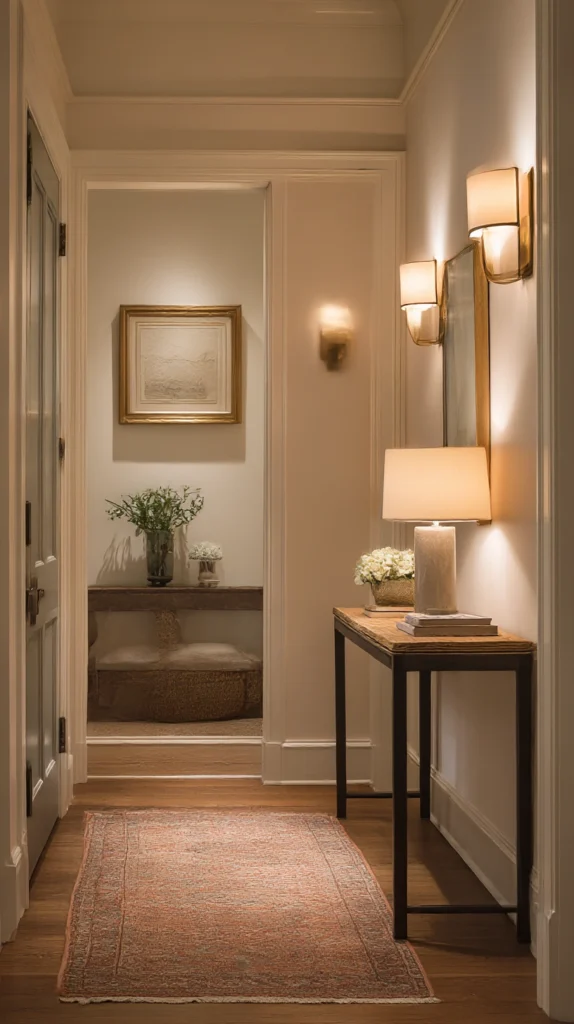
Budget: $30 – $200
The light in an entryway does more work than any decorative object placed within it, and changing the character of that light is the fastest and most impactful seasonal refresh available. In spring and summer, cool natural light from an uncovered window or a daylight-balanced bulb feels appropriate and energising. In autumn and winter, the same entryway benefits from a warmer, lower, more amber-toned light source that creates a sense of shelter and arrival rather than transit and exposure.
A smart bulb with adjustable colour temperature — switchable between 2700K warm amber and 4000K cool daylight — costs $10 – $25 and allows the seasonal light shift to happen without changing any fitting. A wall-mounted picture light above the console table adds $30 – $80 and provides a warm secondary light source that supplements the overhead fitting with a lower, more directional glow. In winter specifically, a cluster of candles in a fireproof holder beside the door costs almost nothing and produces a quality of welcome that no electric fitting replicates.
Decor tip: Dim the overhead entryway light in autumn and winter rather than relying on it at full brightness. A bright overhead light in a small entryway in winter produces a harsh, clinical quality that contradicts the warmth the season requires. A dimmed overhead light supplemented by a warmer secondary source — a picture light, a table lamp, or candles — produces the layered, atmospheric quality that makes a winter entryway feel genuinely welcoming.
6. The Seasonal Textile Swap
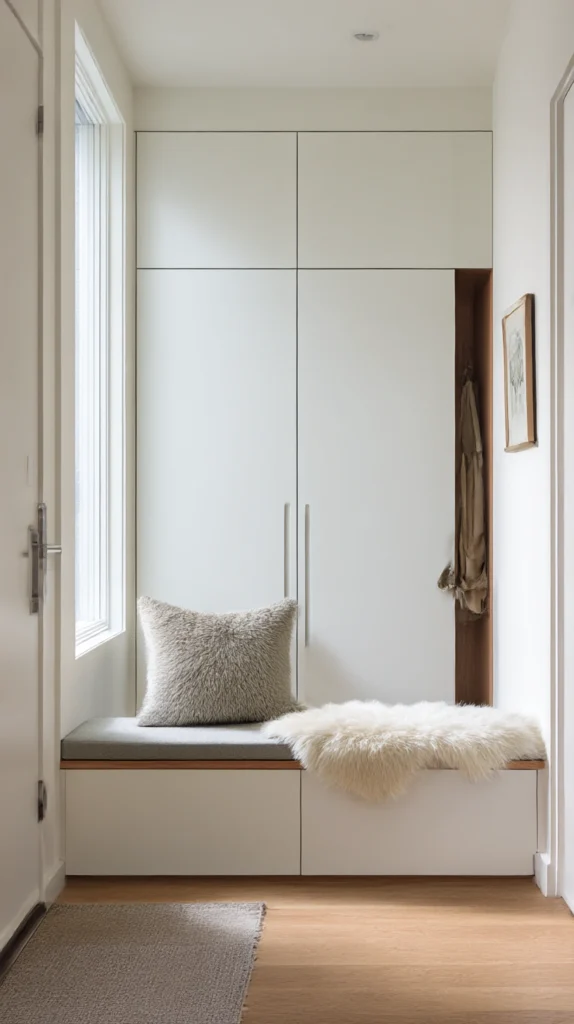
Budget: $30 – $150 per season
A set of hooks beside the door — for coats, bags, and seasonal accessories — is a functional entryway fixture in almost every home. Hanging a seasonal textile from one of those hooks, or draping a throw across a bench or stool beside the door, adds a soft, tactile layer that shifts with the season more naturally than any hard object can. In summer, a lightweight woven cotton throw in a faded coastal stripe. In autumn, a chunky wool blanket in a burnt orange or deep forest tone. In winter, a sherpa or fleece in a deep neutral. In spring, a linen throw in a soft botanical green or blush.
A quality seasonal throw costs $30 – $80 each. Four throws across the seasons run $120 – $320 total — less than the cost of a single piece of furniture — and produce a soft, changeable layer that communicates the season immediately on entering the space. The throw does not need to be new each season. A rotation of four existing throws from around the house, brought to the entryway in their season and returned to their origin room at the transition, costs nothing at all.
Decor tip: Fold the entryway throw in a specific way each season rather than draping it casually. A tightly folded rectangular throw on a bench reads as considered. A casually thrown blanket reads as left there by accident. The difference is in the fold — three folds to a neat rectangle, placed with the folded edge facing outward, takes ten seconds and produces a result that looks intentional rather than incidental.
7. The Living Plant Seasonal Anchor
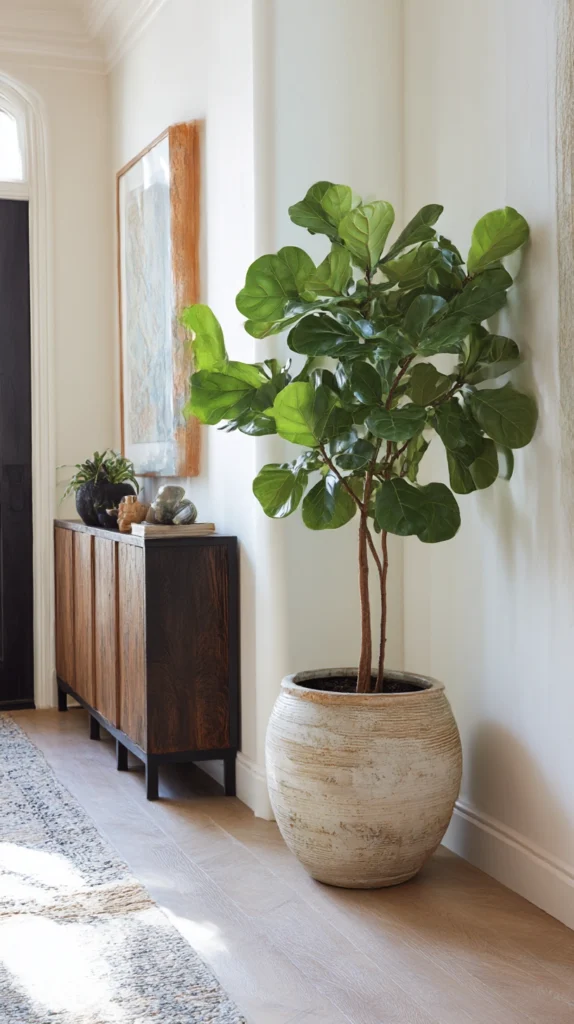
Budget: $20 – $150 per season
A living plant positioned in the entryway — changed or supplemented seasonally — brings an organic quality to the space that dried botanicals and printed textiles cannot replicate. The presence of something alive communicates care and attention in a register that objects alone do not reach, and a plant that is appropriate to the season reinforces the connection between the interior space and the world outside the front door.
Spring calls for forced bulbs in terracotta pots — hyacinth, narcissus, and tulip are all available cheaply and their scent fills an entryway effortlessly. Summer works with a large architectural plant — a monstera, a fiddle leaf fig, or a lemon tree in a statement pot that needs only light and occasional water. Autumn suits a potted chrysanthemum or a collection of small succulents in warm-toned ceramic pots. Winter belongs to a cyclamen, a paperwhite narcissus, or a branch of pine in a tall vessel.
Decor tip: Place the seasonal plant on a waterproof saucer rather than directly on the console table or floor. Overwatering is the most common cause of damage to both the plant and the surface beneath it, and a saucer that catches excess water protects the furniture while keeping the plant at the correct moisture level. A saucer that matches the pot material — terracotta under terracotta, ceramic under ceramic — looks like a deliberate pairing rather than a practical afterthought.
8. The Wall Art Rotation System
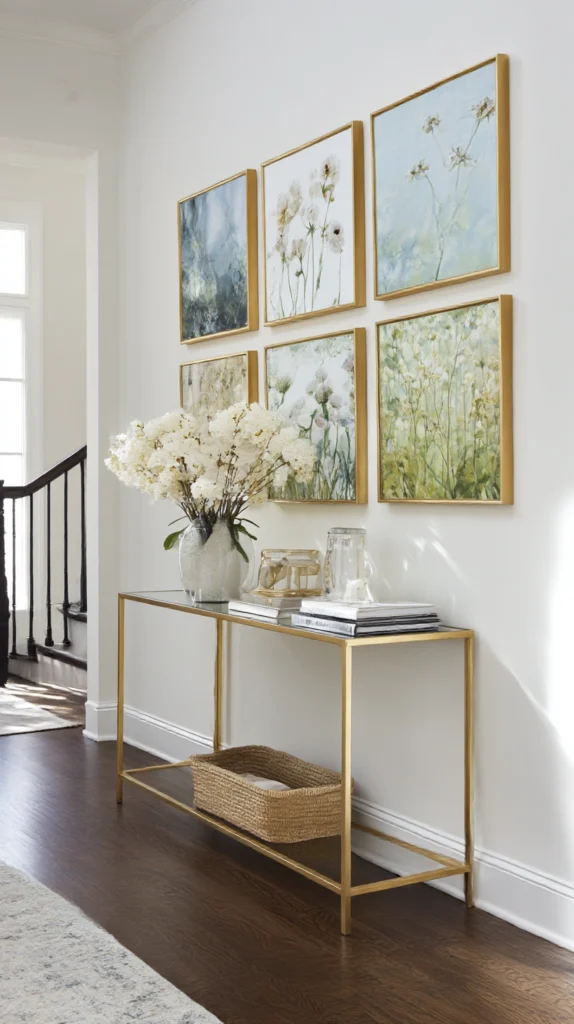
Budget: $40 – $200
A set of picture frames with interchangeable mounts — or a single large frame with a deep mount — positioned above the console table or on the entryway wall provides a permanent framing structure that holds seasonal artwork, botanical prints, or photography without requiring new hanging hardware at each transition. The frames stay. The contents change. A pressed botanical print in spring, a coastal watercolour in summer, a warm abstract in autumn, a graphic monoprint in winter.
A quality frame with an interchangeable mount costs $30 – $80 for an A2 or 50×70 centimetre size — large enough to read clearly in an entryway. Seasonal prints from independent printmakers or downloaded from public domain archives cost $0 – $20 per print and can be swapped in a minute without tools. A gallery of three frames at the same height, each with a seasonal print, costs $90 – $240 in framing and nothing in ongoing print cost if using free public domain sources.
Decor tip: Choose frames with a front-loading or clip-frame mechanism rather than frames that require the picture to be inserted from the back. A back-loading frame requires the removal of the wall hanging, the opening of clips or a backing board, the replacement of the print, and the rehang — a process that takes five minutes per frame. A front-loading clip frame allows the swap to happen in thirty seconds without taking the frame off the wall.
9. The Seasonal Basket and Storage Refresh
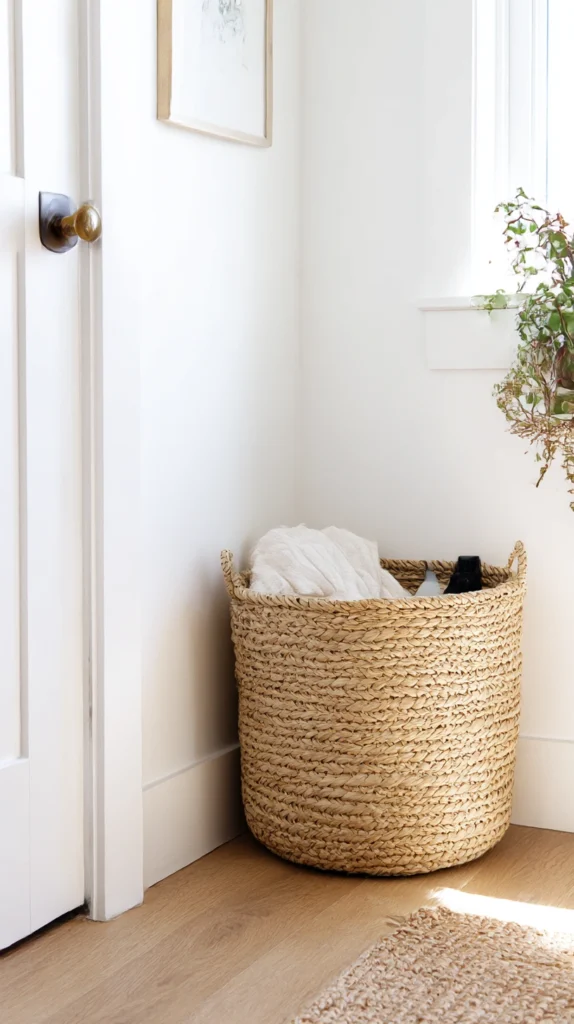
Budget: $20 – $100
The practical storage in an entryway — the basket for shoes, the vessel for umbrellas, the bowl for keys and post — is rarely thought of as a seasonal decorating opportunity, and yet it is one of the most visible and most used surfaces in the space. Swapping a practical storage basket for a seasonal equivalent costs almost nothing and changes the character of the entryway in the same way that changing a lampshade changes the character of a lamp.
Summer calls for a light, open-weave rattan basket for sandals and beach bags. Autumn works with a dense wicker or dark woven seagrass vessel. Winter suits a felt, wool, or galvanised metal bin for boots and gloves. Spring invites a whitewashed wicker or pale woven cotton basket for lighter footwear and fresh air. Each seasonal storage piece costs $20 – $60. The practical function remains identical throughout the year — only the material and tone changes.
Decor tip: Label the inside of each seasonal storage basket with the season it belongs to before putting it into off-season storage. Four baskets retrieved from a cupboard six months later are genuinely difficult to distinguish from each other once their seasonal context is removed, and labelling eliminates the confusion of assigning the wrong basket to the wrong time of year.
10. The Seasonal Mirror Surround
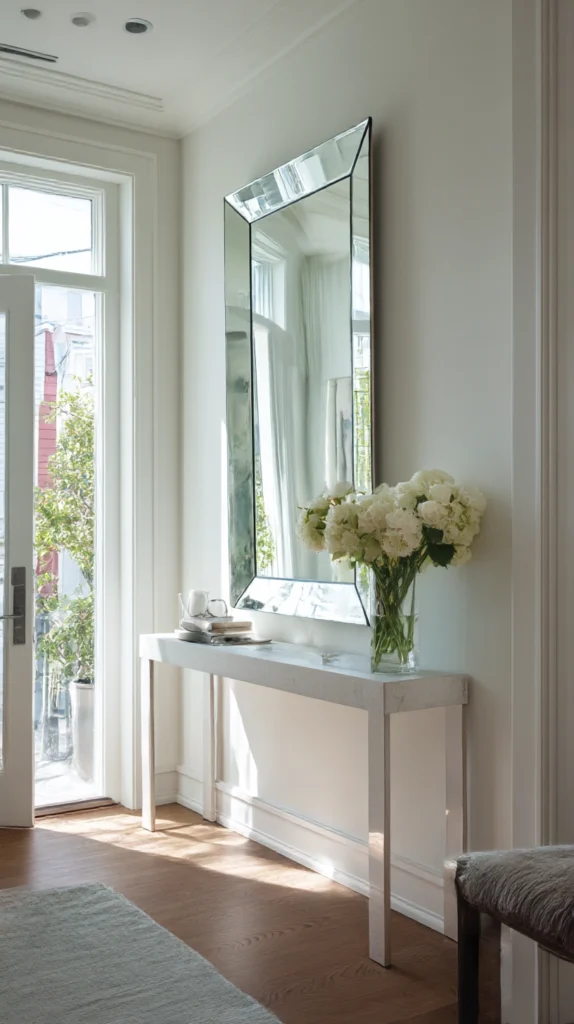
Budget: $20 – $120 per season
A mirror in the entryway is a functional fixture — for the last-look before leaving — and a decorative one, reflecting light and creating the impression of greater space. Decorating around the mirror frame with seasonal botanical material — pinned, hung, or leaned — creates a changing surround that makes a permanent fixture feel seasonally current without touching the mirror itself.
In spring, fresh or faux cherry blossom branches leaned against the mirror frame on both sides. In summer, dried pampas and coastal grasses tucked behind the frame at the top corners. In autumn, dried seed heads, preserved leaves, and berry sprigs arranged around the lower frame. In winter, fresh or faux pine, eucalyptus, and dried orange slices layered at the top and sides. Each seasonal surround costs $15 – $50 in materials and takes twenty minutes to arrange.
Decor tip: Use small adhesive hooks or museum putty to attach lightweight botanical material to mirror frames rather than tape, which leaves residue on frame finishes and damages gilded or painted surfaces on removal. Museum putty holds dried botanicals securely, removes cleanly, and leaves no mark — it is the correct tool for this application and costs under $5 for a pack that lasts years.
11. The Colour Temperature Rug Rotation
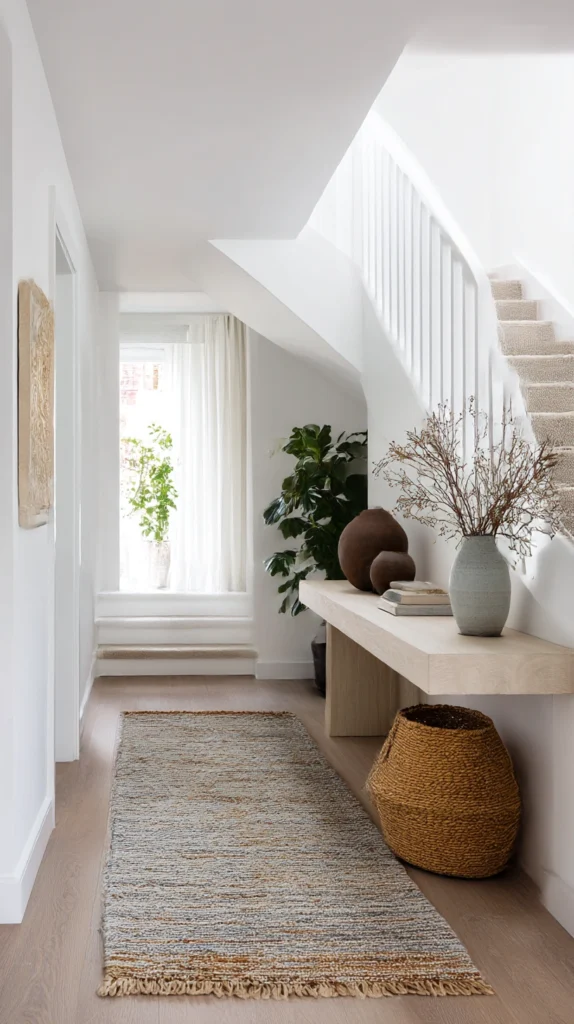
Budget: $40 – $200 per rug
A set of two or three entryway runners — rotated not just seasonally but also in response to the changing light quality of different times of year — gives the floor of the entryway a seasonal sensitivity that most decorating approaches never reach. A cool, pale, bleached runner in summer reflects the longer, brighter light of the season. A warm, spiced-toned, deeply coloured runner in winter absorbs the shorter, lower light and returns warmth that the season otherwise removes.
A pale natural linen or bleached cotton runner for spring and summer costs $40 – $120. A warm terracotta, rust, or deep jewel-toned runner for autumn and winter runs $50 – $150. Two runners rotated on a twice-yearly basis cost $90 – $270 total and produce a floor that responds to the season as instinctively as a deciduous tree responds to the changing light — without any visible mechanism, just an appropriate result at the right time of year.
Decor tip: Clean and treat the off-season runner before storing rather than after retrieving it. A runner stored dirty — with dust, surface soil, and any moisture — deteriorates in storage in ways that are difficult to reverse. A runner stored clean, rolled with the pile inward, and wrapped loosely in a breathable cotton bag emerges from storage in the same condition it went in.
12. The Year-Round Neutral Foundation With a Seasonal Accent Colour
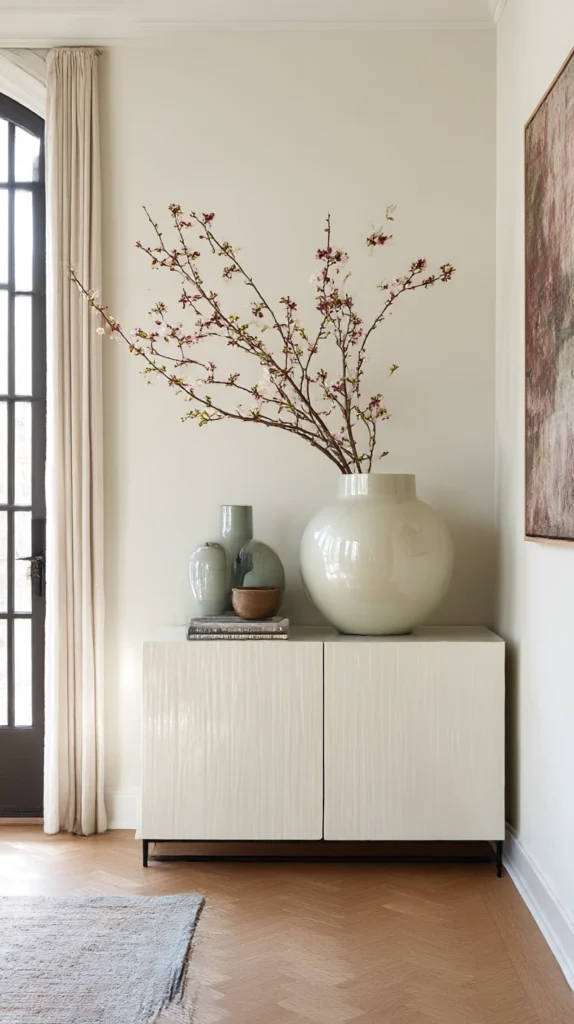
Budget: $50 – $300 initial setup, minimal per season thereafter
The most sustainable and the most elegant seasonal refresh system is not a set of four entirely different entryways but a single entryway with a permanent neutral foundation — pale walls, natural timber or stone floor, a clean-lined console, a simple mirror — onto which a single accent colour is introduced and changed seasonally. The foundation costs once. The accent costs almost nothing to shift.
The accent colour arrives through a single object — a ceramic vase, a cushion on a bench, a throw, a candle holder — in the seasonal tone. Blush and sage in spring. Warm coral and faded blue in summer. Burnt amber and deep ochre in autumn. Midnight green and warm ivory in winter. One object, changed four times a year, costs $15 – $40 per transition. The entryway reads as seasonally current throughout the year without a single permanent element being touched.
Decor tip: Choose the seasonal accent object in a material that is appropriate to the season as well as the colour. A terracotta vase in an autumn amber tone works because both the colour and the material communicate the same season. A plastic vase in the same amber tone communicates only the colour — and colour alone, without the material reinforcement, is a thinner and less convincing seasonal signal than the two working together.
Whatever approach you take from these twelve ideas, the principle that holds them all together is the same: a seasonally responsive entryway is not rebuilt four times a year — it is designed once, with transition built in. The permanent elements carry the space. The seasonal layer sits above them lightly, changes quickly, and costs modestly. The result is an entryway that always feels current, always feels cared for, and always communicates that the person who lives in the house is paying attention to the world outside it.
Build the foundation carefully. Keep the seasonal layer simple. Change it on time rather than late. The entryway will do the rest.