
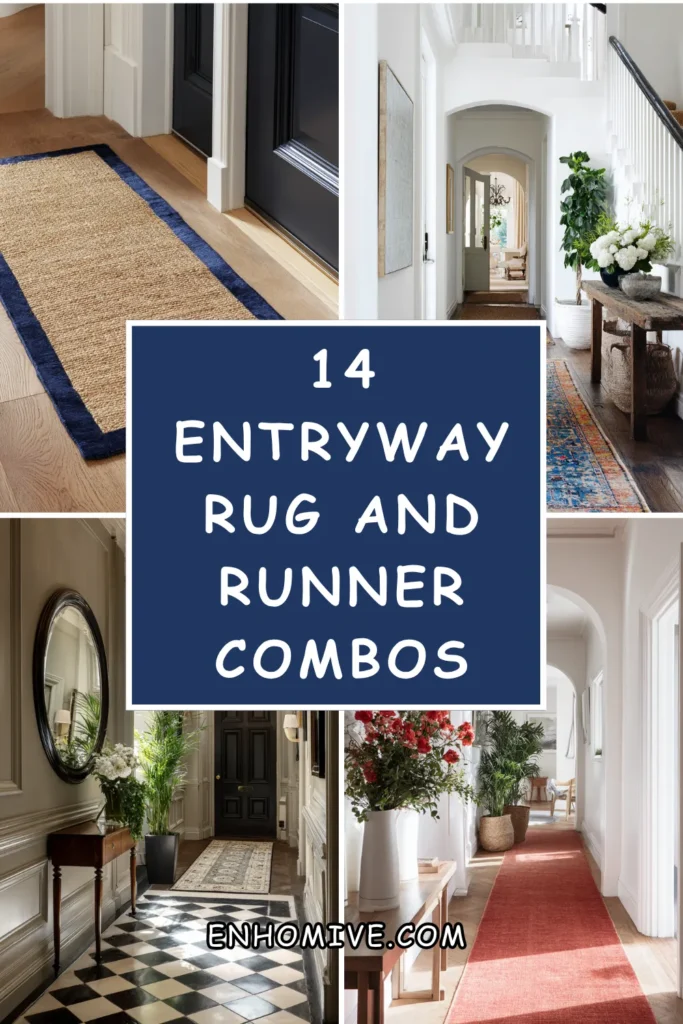
14 Entryway Rug and Runner Combos That Lay the Red Carpet for Guests
There is a case to be made that the entryway rug is the single most important textile in the house. It is the first thing a guest steps onto, the last thing they see on the way out, and the surface that works harder than any other — absorbing dirt, defining the threshold between outside and inside, and communicating the aesthetic of everything that follows before a single interior wall has been seen.
Most entryways treat this surface as a purely functional decision. A rubber-backed mat from a hardware store, a plain coir rectangle, something dark enough to hide the dirt. The result is a first impression that communicates nothing except indifference.
The fourteen ideas below treat the entryway rug and runner as what they actually are — the opening statement of the home, the welcome before the welcome — and give them the consideration they deserve. Each combo covers what you will need, what it will cost, and a practical tip to make it genuinely work in a real entryway rather than a styled photograph.
1. The Coir Base and Kilim Layer Combo
Budget: $50 – $200
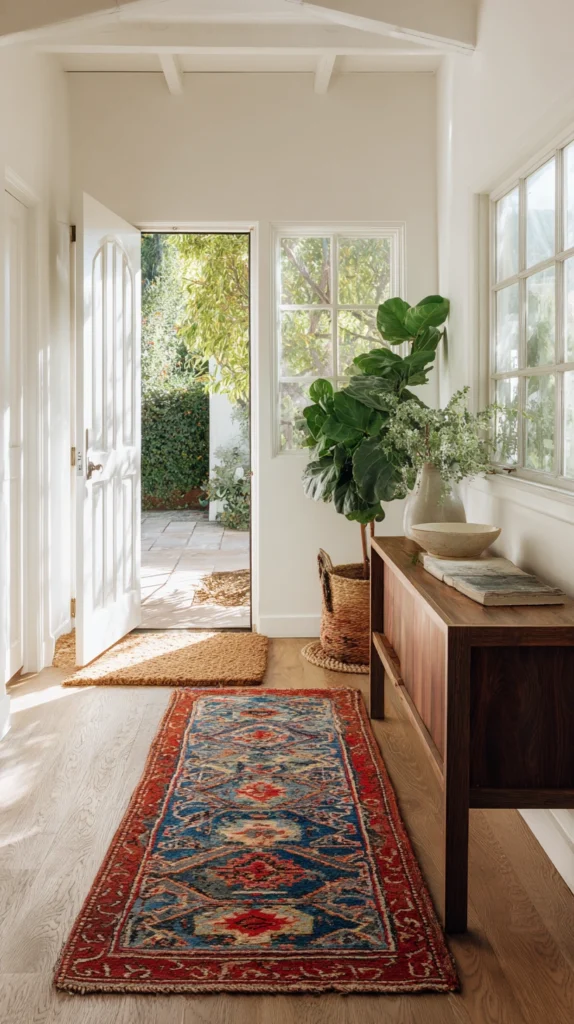
The most practical and the most versatile entryway combination available pairs a flat natural coir mat at the door — doing the heavy work of trapping dirt from incoming feet — with a layered kilim or flatweave cotton runner behind it, transitioning the space from functional threshold to decorative interior. The coir handles everything that comes off a shoe. The kilim handles everything that comes after.
A quality natural coir mat in a standard doorstep size costs $20 – $50. A cotton or wool kilim runner in a complementary colour family runs $40 – $150 depending on length and provenance. The two pieces do not need to match — they need to coexist. A natural coir base pairs well with almost any kilim colour because its tone is neutral enough to act as a bridge between the outdoor world and the interior palette.
Decor tip: Leave a deliberate gap of two to three centimetres between the coir mat and the kilim runner rather than pushing them together. A visible separation between the two pieces reads as a considered layering decision. Pieces pushed tightly together look as though they ran out of floor space, which is a different impression entirely.
2. The Monochrome Graphic Runner
Budget: $40 – $200
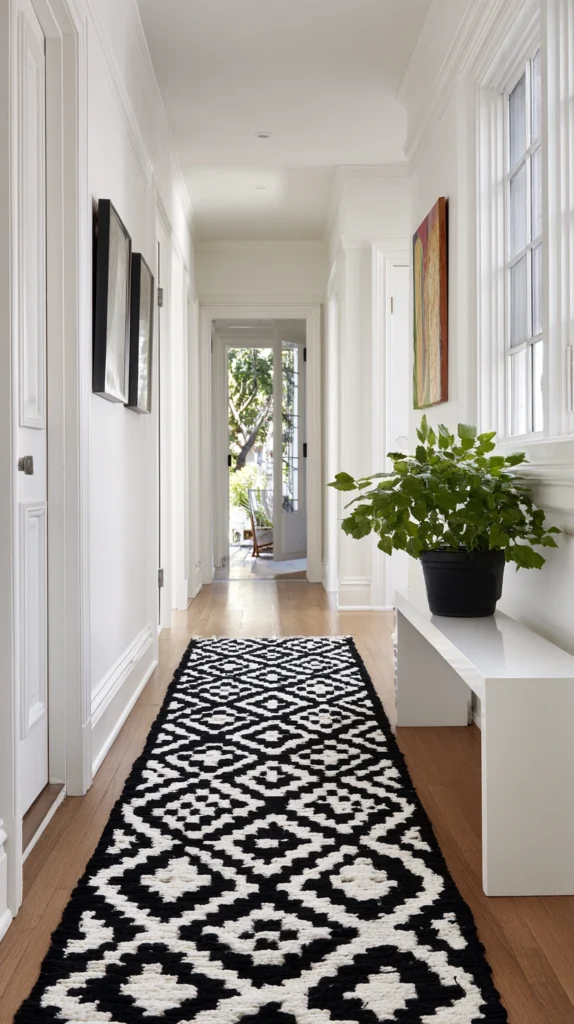
A long runner in a bold black and white geometric — a chequerboard, a high-contrast stripe, a Greek key border, a simple diamond repeat — makes an entryway feel designed from the very first step. The monochrome palette works with almost every interior colour scheme because it does not compete with wall colours, door paint, or furniture — it simply states that the floor has been considered, which is itself enough to elevate the space.
Black and white geometric runners in cotton or polypropylene cost $40 – $120 for a standard hallway length. Wool versions run $80 – $250 and have a weight and depth of colour that synthetic alternatives do not approach. The pattern should be bold enough to read clearly at a glance — a very small repeat in a long hallway dissolves into texture rather than registering as pattern, which wastes the graphic potential of the choice.
Decor tip: Choose a runner length that leaves an equal border of bare floor at each end rather than running the textile to the full length of the hallway. A runner that terminates at a wall or a door frame with no breathing room looks too small for the space even when the dimensions are correct. An equal border at each end — 20 to 30 centimetres — reads as intentional framing.
3. The Natural Linen Runner With Fringe Detail
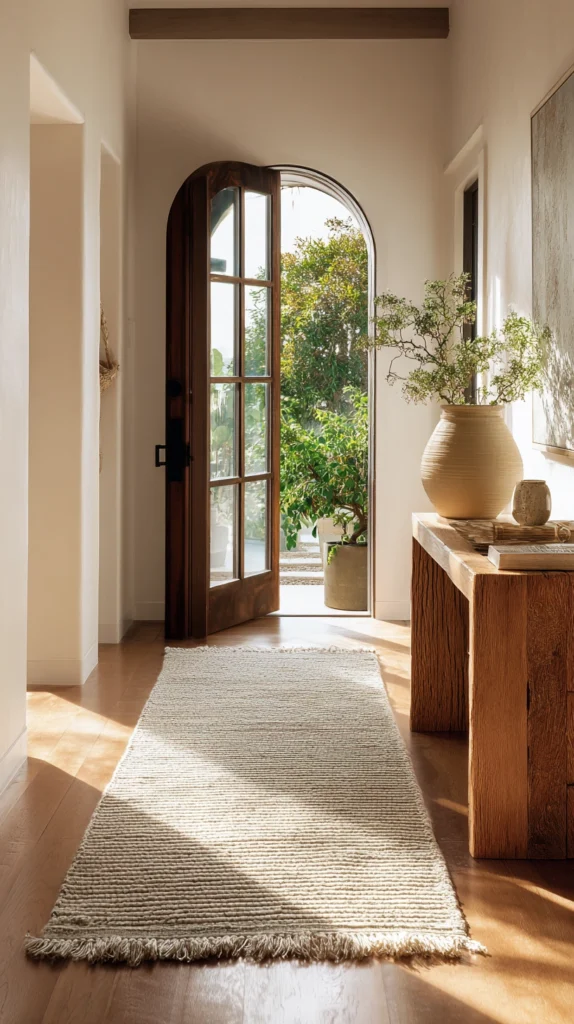
Budget: $50 – $250
A linen or linen-blend runner with a natural fringe along the short edges brings a softness and a quiet elegance to an entryway that harder-wearing synthetics cannot replicate. It is not the most practical choice for a high-traffic threshold with muddy boots, but for entryways that see moderate traffic and want to communicate warmth and refinement rather than durability and practicality, a fringed linen runner is genuinely beautiful.
Handwoven linen runners with fringe detail cost $60 – $180 depending on length and fibre quality. Machine-washable linen-cotton blends run $40 – $120 and offer better practicality for everyday use. The fringe detail — whether knotted, twisted, or plain — should be kept in its natural undyed state to maintain the honest, unpretentious quality that makes linen work so well in this context.
Decor tip: Trim any fringe irregularities with sharp scissors before laying the runner — unevenly cut fringe draws the eye immediately and gives an otherwise elegant piece a slightly unfinished quality. Lay the runner flat, smooth the fringe across a cutting mat, and trim to a consistent length in one clean pass. The difference is immediate and costs nothing.
4. The Vintage Persian Over Coir Stack
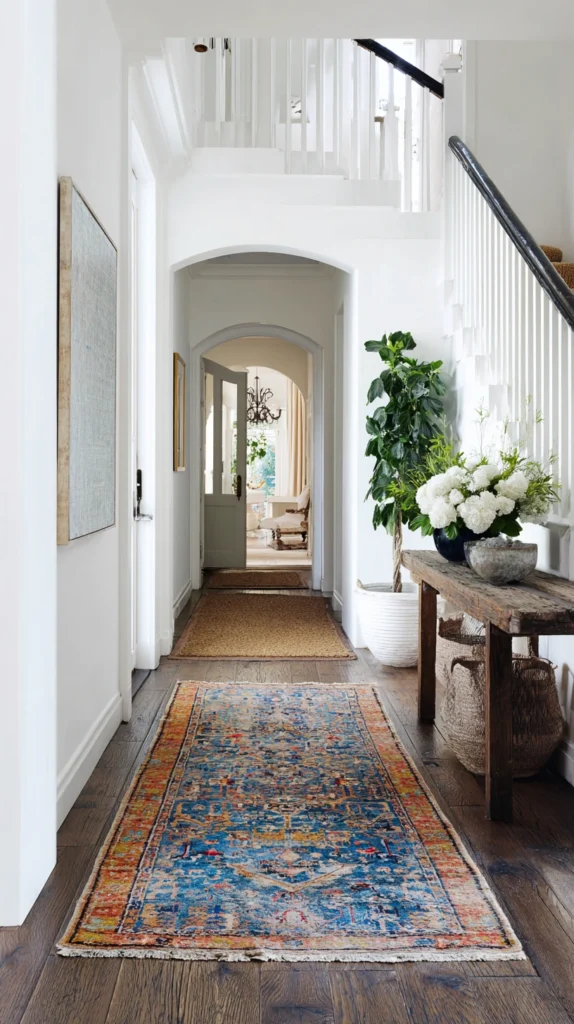
Budget: $60 – $400
A genuine or vintage-style Persian rug — even a small one, even a worn one — placed over a coir base in an entryway immediately communicates that the home within is considered, curated, and confident in its aesthetic choices. The worn areas of a genuine antique Persian are not flaws. They are evidence of use and time, and in an entryway they are entirely appropriate. This is a surface that is going to be walked on. It might as well carry its history honestly.
Genuine vintage Persian rugs in small entryway sizes cost $80 – $400 depending on age, condition, and provenance — online auction platforms and estate sales are the most reliable sources for accessible pricing. High-quality reproduction Persian runners in wool or viscose run $60 – $200 and are visually convincing at floor level where the detail of hand-knotting is not the primary consideration.
Decor tip: Rotate a vintage Persian runner 180 degrees every six months in a directional entryway where traffic consistently moves in one direction. Foot traffic wears pile in the direction of movement, and rotating the runner distributes this wear evenly across the full length rather than creating a worn channel along the most-used approach line.
5. The Striped Awning Runner
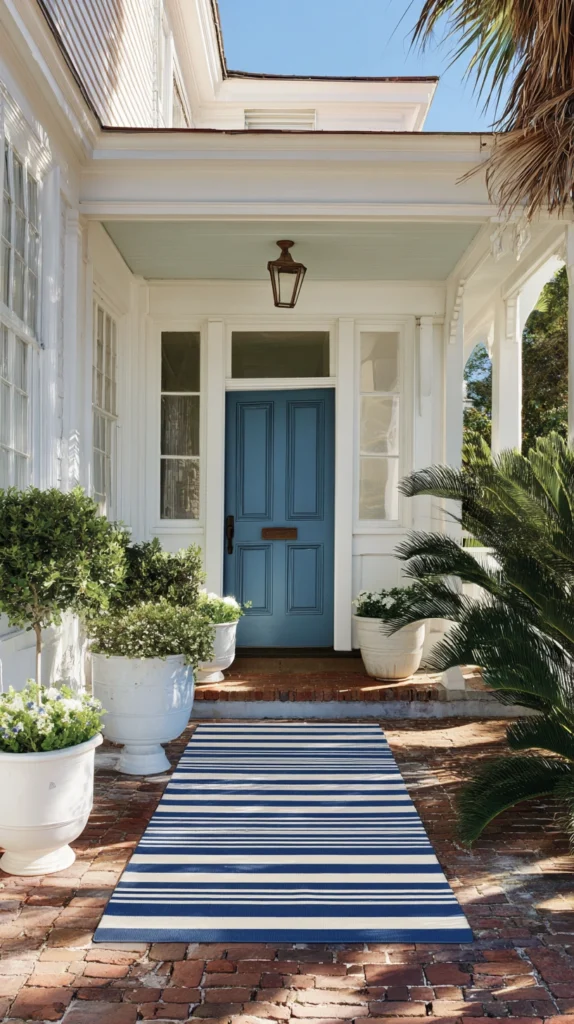
Budget: $40 – $180
A bold horizontal stripe runner — the kind associated with beach huts, awnings, and the cheerful certainty of summer — brings an immediate warmth and optimism to an entryway that more restrained patterns cannot match. In navy and white, terracotta and cream, or forest green and natural, the awning stripe communicates welcome in a register that feels both classic and current. It is impossible to walk onto a well-chosen stripe runner without feeling that the house beyond it is going to be a good place to be.
Cotton or polypropylene awning stripe runners cost $40 – $120 for standard hallway lengths. Outdoor-grade versions — highly practical for entryways that open directly onto gardens or have high moisture exposure — run $30 – $100 and can be hosed clean rather than vacuumed. The stripe width matters: wide stripes in a narrow hallway can make the space feel shorter, while a fine stripe reads as a texture rather than a pattern from a distance.
Decor tip: Orient the stripe perpendicular to the direction of travel — running across the width of the hallway rather than along its length. A stripe that runs the length of a hallway draws the eye forward and makes the space feel longer. A stripe across the width creates a series of visual anchors that give the hallway rhythm and make it feel more considered rather than simply extended.
6. The Moroccan Tile Print Runner
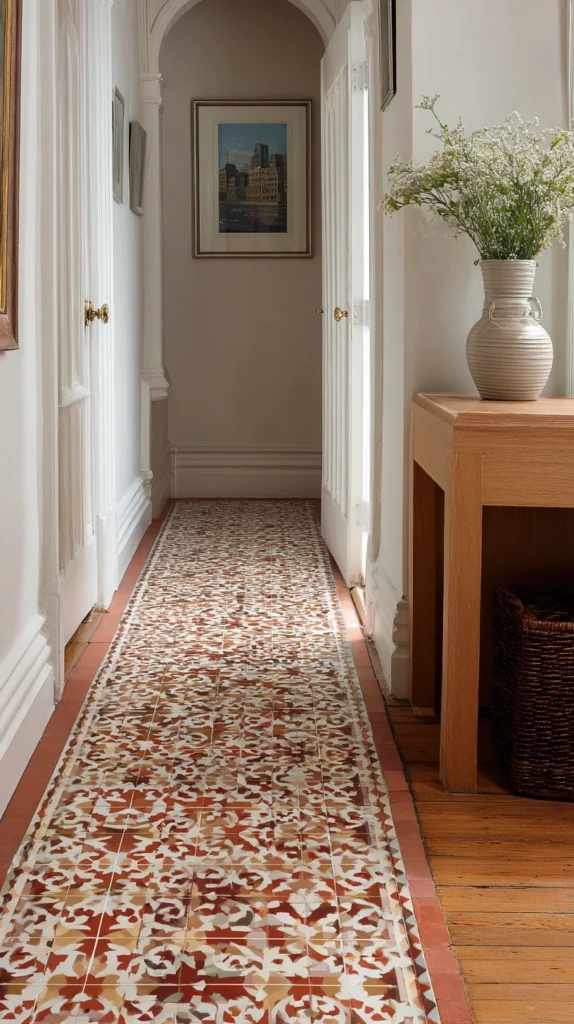
Budget: $30 – $200
A runner printed or woven with a Moroccan tile pattern — the repeating geometric stars and interlocking polygons of traditional zellige tilework — brings the colour and the craft intelligence of North African design into an entryway at a cost that genuine encaustic cement tiles would multiply tenfold. The pattern is bold enough to stand alone without additional decoration and complex enough to reward closer inspection, which is precisely what an entryway surface should offer.
Polypropylene flatweave runners with Moroccan tile print cost $30 – $80 for a standard length. Wool or cotton woven versions with a genuine geometric repeat run $80 – $200 and have a texture that printed versions cannot replicate. The colour palette within the Moroccan geometric tradition is broad — from the terracottas and ochres of Marrakech to the cool blues and whites of the coastal riads — making it straightforward to find a version that works with an existing interior scheme.
Decor tip: Keep all other surfaces in the entryway simple when using a Moroccan tile pattern runner. A patterned runner, a patterned wallpaper, and a patterned console table styling produces a visual competition that the entryway — a transitional space that should feel welcoming rather than busy — cannot resolve comfortably. The pattern on the floor works best when the surfaces above it are calm.
7. The Double Runner Parallel Lay
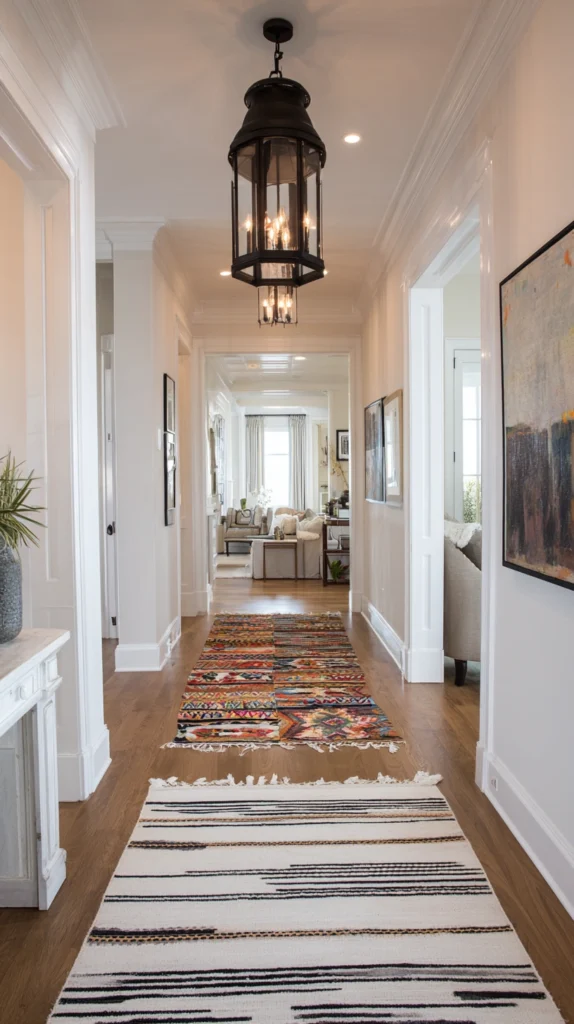
Budget: $60 – $300
In an entryway wide enough to accommodate two parallel runners — one on each side of a central bare floor strip — the double runner layout creates a formal, almost processional quality that a single central runner rarely achieves. The bare floor between the two runners becomes an intentional negative space, the runners frame it symmetrically, and the overall effect is of an entryway that has been designed with genuine architectural awareness. It is an unusual choice that rewards the confidence required to make it.
Two matching runners in the same pattern and colourway cost twice the price of a single runner — budget $60 – $300 for a quality pair. The runners do not need to be identical in pattern but should share a colour family closely enough that the pairing reads as deliberate. A symmetrical arrangement requires the runners to be precisely parallel — use a tape measure from the wall to each runner edge at multiple points to ensure the geometry holds.
Decor tip: Use a matching non-slip underlay beneath both runners cut to exactly the same dimensions as each textile. Runners that shift independently of each other over time create an asymmetry that undermines the entire premise of the double-runner layout. Locked underlays keep both pieces in position and maintain the formal symmetry that makes the arrangement work.
8. The Jute and Velvet Trim Runner
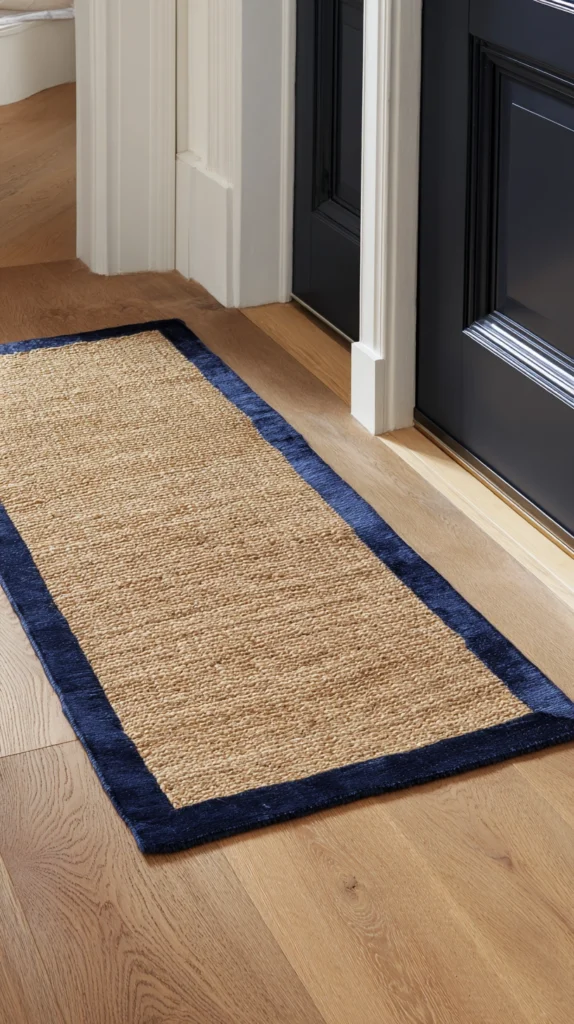
Budget: $60 – $280
A natural jute runner edged with a velvet tape border — in a deep jewel tone, a soft dusty rose, or a classic navy — is one of those combinations where two relatively simple elements produce something considerably greater than the sum of their parts. The jute is honest, textural, and unpretentious. The velvet trim is refined, soft, and quietly luxurious. Together they produce a runner that reads as both grounded and considered — which is exactly the register a well-designed entryway should strike.
Plain natural jute runners cost $30 – $80. Velvet ribbon tape in a complementary colour — $5 – $15 per metre — is stitched or fabric-glued along all four edges to create the border. A standard runner requires approximately three to four metres of tape. The total cost of a custom-bordered jute runner sits well under $100 and produces a piece that would cost $150 – $300 purchased as a finished retail product.
Decor tip: Choose a velvet trim colour that is already present somewhere in the entryway — in the front door paint, the console table accessories, or the art on the wall. A border colour that references something existing in the space reads as part of a coordinated scheme. A border colour chosen in isolation from the rest of the room reads as an addition rather than an integration.
9. The Abstract Painterly Runner
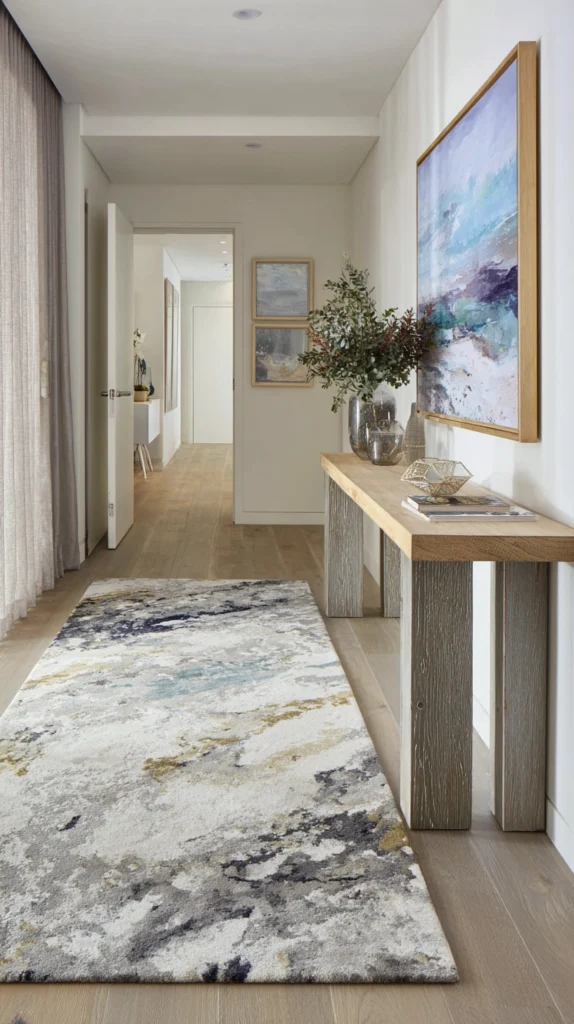
Budget: $60 – $350
A runner with an abstract, painterly pattern — loose brushstroke marks, watercolour-style washes, gestural organic shapes — brings an artistic confidence to an entryway that more traditional geometric patterns do not attempt. It communicates that the home has an aesthetic sensibility rather than simply following convention, and it pairs well with both contemporary and eclectic interiors where the art on the walls sets a similarly expressive tone.
Abstract painterly runners in wool or cotton cost $80 – $250 for a standard hallway length. Polypropylene versions — more practical for high-traffic entryways — run $60 – $150. The colour palette within the pattern should connect to at least one element of the entryway — the wall colour, the door colour, or a piece of art — to prevent the runner from looking like a beautiful object that arrived from a different house.
Decor tip: Lay an abstract runner so that its dominant visual movement — the direction in which the brushstroke pattern implies motion — runs toward the interior of the house rather than toward the front door. A pattern that visually pulls guests inward reinforces the physical direction of travel. A pattern oriented outward creates a subtle visual tension that works against the welcoming function of the space.
10. The Checkerboard Tile Effect Runner
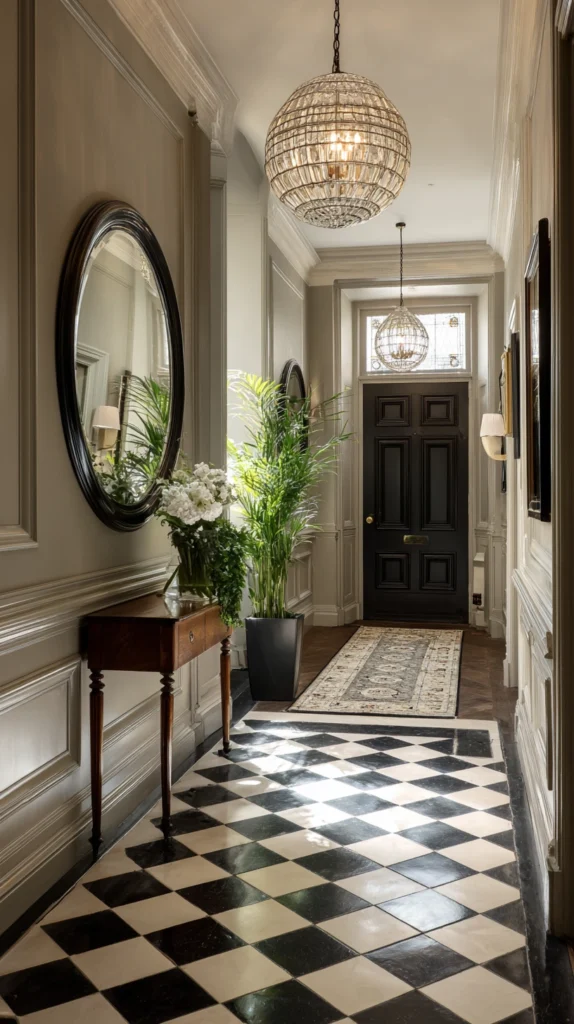
Budget: $40 – $200
A runner that replicates the look of a classic chequerboard tile floor — alternating squares in black and white, cream and terracotta, or sage and natural — brings a sense of permanence and architectural intention to an entryway floor that genuine tiled installation would cost many times more to achieve. It reads as a design decision made at the building stage rather than a decorative addition made after the fact, which is the highest compliment a runner can receive.
Flatweave cotton runners in chequerboard patterns cost $40 – $120. Tufted versions with a low pile — which more convincingly suggest tile depth — run $60 – $180. The scale of the square within the chequerboard should relate to the proportions of the hallway — a large square in a narrow hallway looks oversized, while a very small square in a wide entryway disappears into texture rather than reading as pattern.
Decor tip: Echo the chequerboard colour combination somewhere else in the visible entryway — a black door handle against a white door, a cream console against dark walls, or a monochrome print on the wall. Repetition of the two colours in the chequerboard across multiple surfaces in the same space creates a cohesive scheme rather than a rug that simply happens to be in the room.
11. The Layered Sheepskin and Sisal Entrance
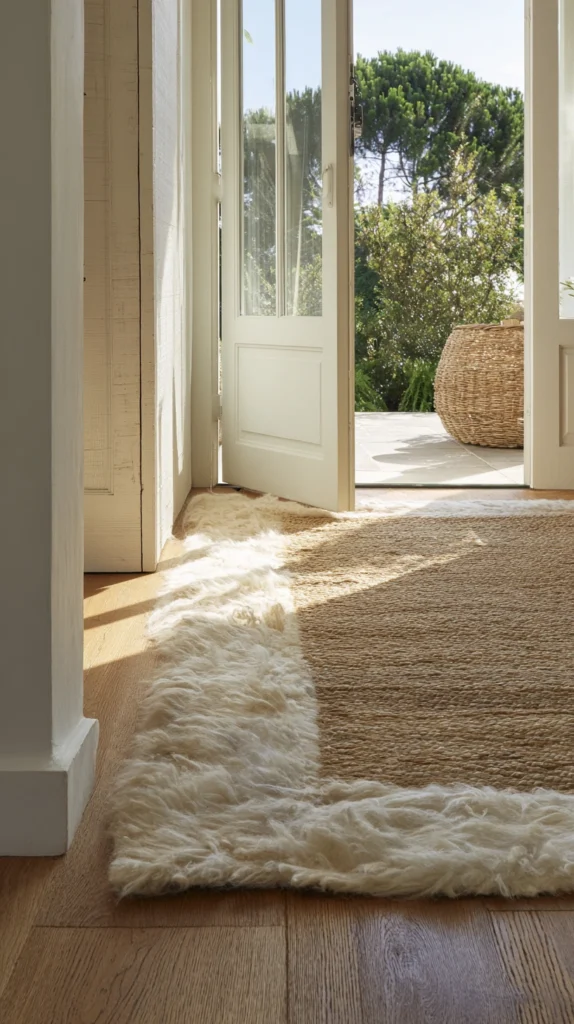
Budget: $80 – $400
A natural sisal or seagrass mat as the base layer, with one or two natural sheepskin rugs laid across it in a casual, slightly asymmetric arrangement — one sheepskin centred, one positioned slightly to the side — creates an entryway that feels deeply tactile and genuinely welcoming. The coarse texture of the sisal and the soft depth of the sheepskin are as different as two natural materials can be, and it is precisely that contrast that makes the combination so immediately satisfying underfoot.
A natural sisal or seagrass mat in an entryway size costs $40 – $120. Natural sheepskin rugs — genuine short-wool versions rather than synthetic alternatives — cost $40 – $120 each depending on size. Two sheepskins layered across a sisal base creates a generous, layered entrance for a total investment of $120 – $360. The arrangement should look placed rather than positioned — an adjustment of a few centimetres toward casual asymmetry is always more effective than perfect geometric centering.
Decor tip: Shake sheepskin rugs outdoors once a month and allow them to air in natural light for a few hours. Sheepskin holds dust and ambient odour more readily than woven textiles, and regular airing — rather than washing, which can damage the backing — keeps them fresh and maintains the loft of the wool over time.
12. The Printed Cotton and Brass Rod Stair Runner
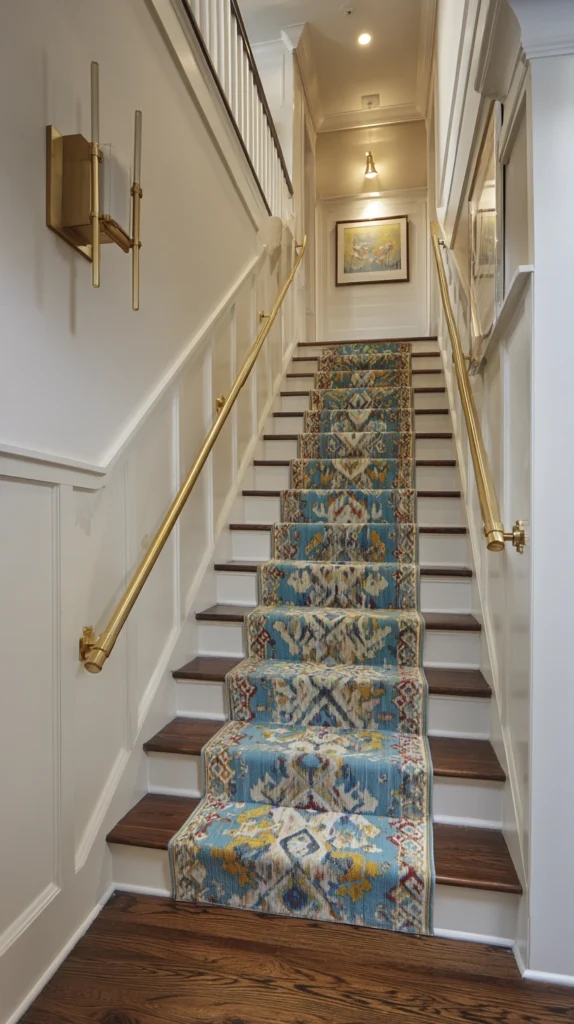
Budget: $80 – $600
Where an entryway includes a staircase — even a short flight of three or four steps — a stair runner in a printed cotton or wool pattern, held in place with brass rod stair clips at each riser, transforms what is often the most prominent surface in the entrance hall into a genuine design feature. The brass rod detail is particularly important: it is the difference between a runner that looks stapled in place and one that looks installed with intention.
Stair runners in printed cotton or flatweave wool cost $15 – $40 per metre — a standard flight of twelve steps requires approximately five to seven metres. Brass stair rod clips cost $5 – $15 each — a flight requires one per step plus one at the top landing. A full stair runner installation with brass rods runs $100 – $400 in materials for a standard staircase and is a half-day DIY project with basic tools.
Decor tip: Choose a stair runner pattern with a small or medium repeat scale rather than a very large one. A large pattern repeat on a staircase rarely aligns symmetrically across each step — the pattern falls at a different point on each tread as it climbs the flight, which creates a visually restless quality. A small repeat or an all-over texture papers the stairs evenly and consistently regardless of where the pattern falls on each individual tread.
13. The Natural Grass Cloth and Leather Border Runner
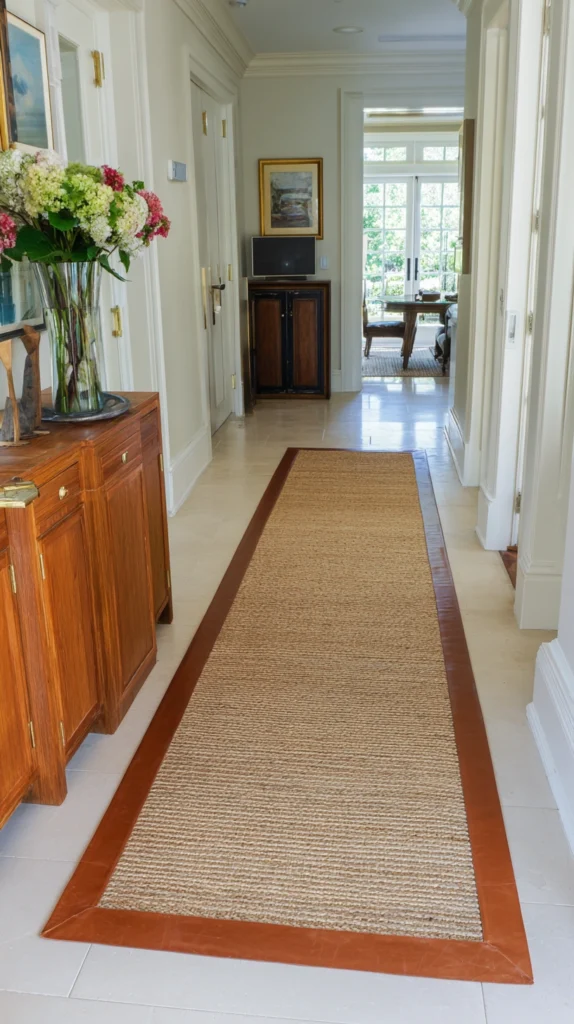
Budget: $100 – $500
A grass cloth or seagrass runner with a leather border edge — either a slim leather tape stitched along all four sides or a wider leather panel at each short end — is one of those combinations that reads as expensive and artisanal regardless of what it actually cost to produce. The natural fibre and the natural leather occupy the same material family, and their combination has an honesty and a coherence that feels immediately resolved rather than assembled.
Natural grass cloth or seagrass runners cost $40 – $120. Leather border tape in a natural tan, deep cognac, or matte black — $10 – $25 per metre — is stitched by a local leather goods repairer or a cobbler at a cost of $20 – $60 for the stitching work. The finished piece has a bespoke quality that manufactured alternatives at twice the price rarely match.
Decor tip: Match the leather border tone to one metal finish already present in the entryway — brass hardware pairs with cognac leather, brushed nickel pairs with natural tan, matte black pairs with very dark leather. A leather colour that echoes an existing metal tone ties the floor to the fixtures in a way that creates genuine material cohesion across the space.
14. The Bold Colour Block Statement Runner
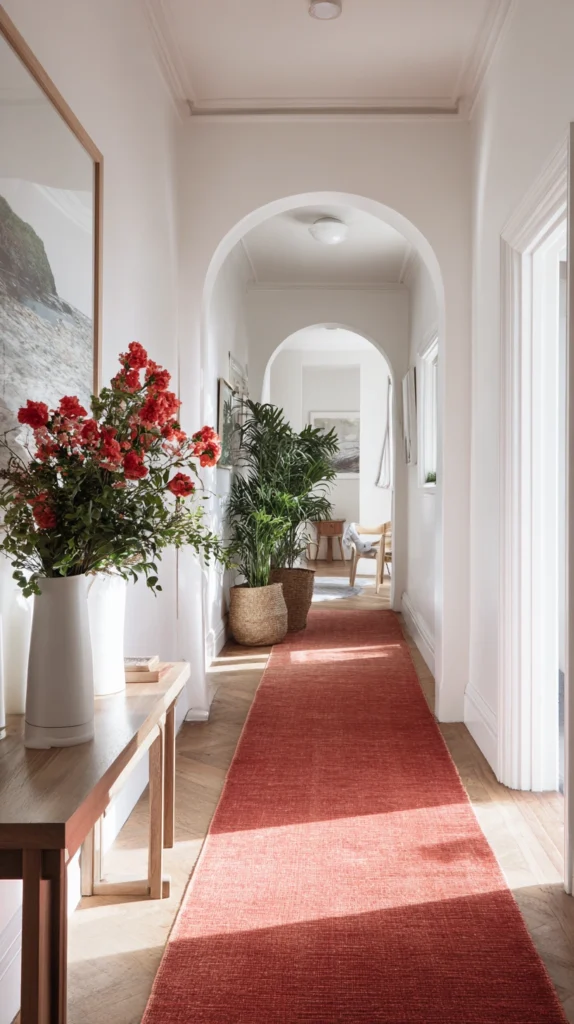
Budget: $50 – $300
A runner in a single bold, saturated colour — a deep terracotta, a rich forest green, a warm cobalt, a dusty rose — chosen to lead the eye toward the interior and anchor the entryway with chromatic confidence is the simplest and the most direct statement on this list. No pattern, no layering, no texture combination. Just colour, laid flat, in a quality material, making a clear and unapologetic case for itself from the moment the front door opens.
Solid colour wool runners cost $80 – $200 for standard hallway lengths. Cotton flatweave in solid jewel tones runs $50 – $120. Polypropylene solid-colour runners — practical, fade-resistant, and easily cleaned — cost $40 – $100. The colour should be chosen in relation to the front door, the wall colour, and the light quality of the entryway — a dark runner in an already dark hallway deepens the mood further, while a saturated colour in a light, white-walled entrance creates a vivid focal point that draws guests immediately inward.
Decor tip: Test a large fabric swatch of your chosen colour in the entryway at the time of day when the space receives the most use — typically early morning and early evening. Entryways often receive limited natural light, and a colour that reads as rich and warm in a well-lit shop can read as dark and heavy in a north-facing hallway. The swatch test costs nothing and removes all uncertainty before the purchase is committed.
Whatever combination you choose from these fourteen options, the principle that runs through all of them is the same: the entryway deserves a rug that was chosen for it, not one that was left over from somewhere else. A runner selected with the proportions, the light, and the first impression of a specific space in mind will always outperform a beautiful rug placed without that consideration.
Choose the surface that the house opens onto as carefully as you choose the art that hangs above it. The guests who step across it may not be able to say exactly why the entrance feels so welcoming — but they will feel it from the very first step, and that is entirely the point.