
13 Stair Landing Decor Ideas Most Homes Completely Ignore
The stair landing is the residential interior’s most consistently overlooked opportunity — a space that exists in almost every multi-storey home, that every person in the household passes through multiple times daily, and that receives almost universally less design attention than any other space of comparable visibility and comparable traffic. Most stair landings are treated as transitional non-spaces.
Places where movement pauses briefly between floors and where design intention, if it exists at all, extends no further than a coat of paint in whatever colour was used on the adjacent walls and perhaps a single framed print hung at an awkward height that suggests it was placed there to fill the wall rather than because anyone genuinely considered what should go there.
The stair landing done properly is something completely different — a designed pause in the vertical journey through the house, a moment of genuine spatial interest that makes the daily experience of moving between floors something richer and more pleasurable than simple transit.
It is a space with genuine design potential: typically more generous in ceiling height than the rooms it connects, often flooded with natural light from a landing window, and uniquely positioned to create a visual moment that is seen from below on ascent and from above on descent simultaneously. These thirteen ideas demonstrate exactly what is possible when the stair landing finally receives the attention it deserves.
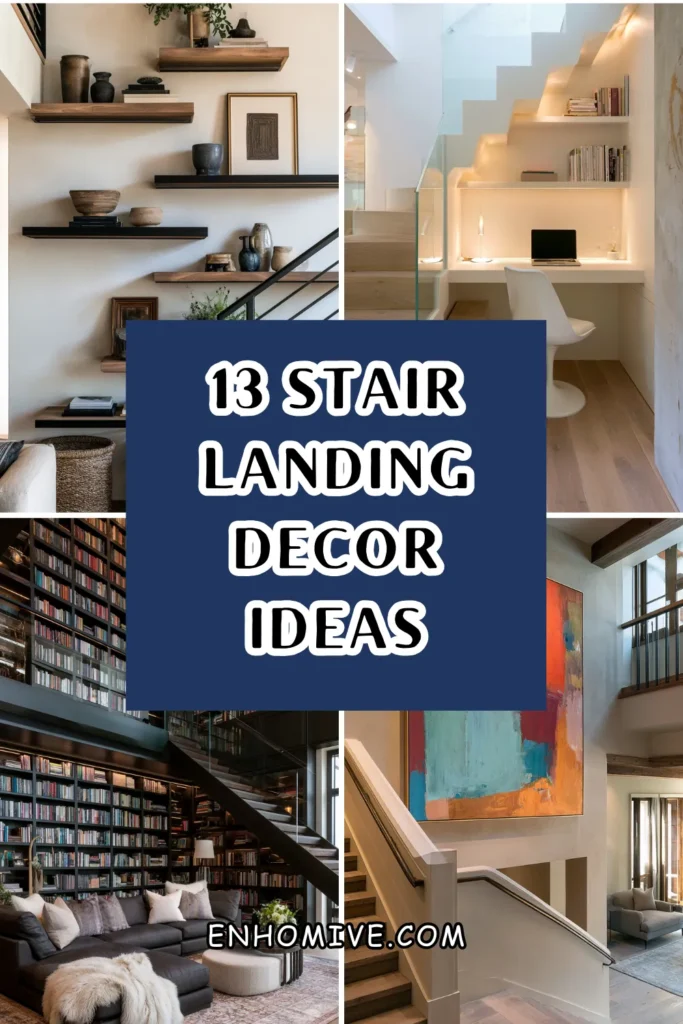
1. Create a Full Library Wall on the Landing
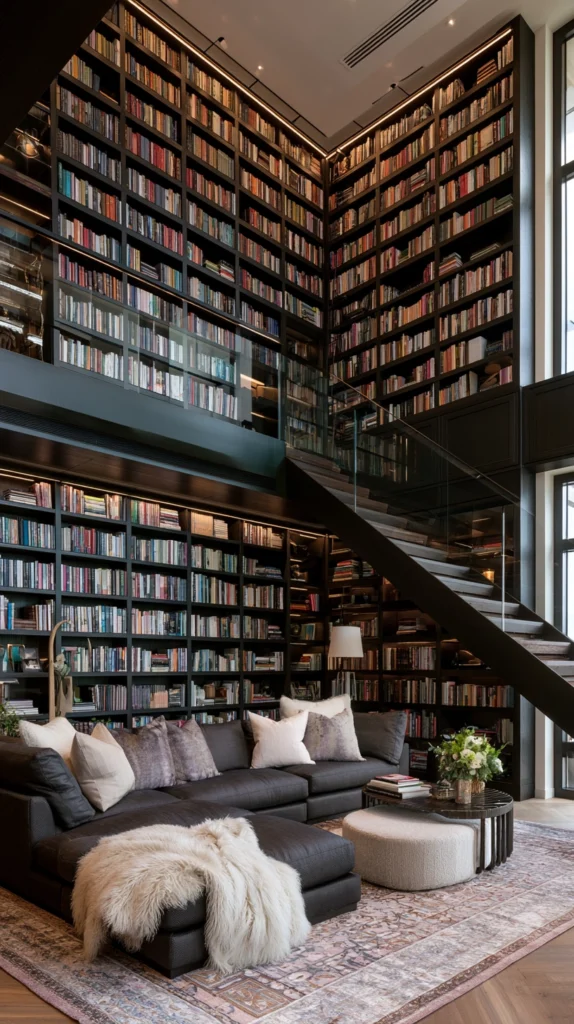
A floor-to-ceiling bookshelf covering the primary wall of a generous stair landing — its shelves filled with genuinely read books, its surface becoming the house’s most dramatically positioned library — is the landing transformation that delivers the most complete combination of architectural ambition, practical function, and visual impact available to the space.
The library landing works because the stair landing’s typically generous wall height — taller than standard room ceiling heights in most houses — allows shelving of a scale and verticality that creates a genuinely monumental book wall rather than simply a large bookshelf, and the view of it from the staircase below, seen in its full height as one ascends, is one of the most satisfying interior views a house can contain.
Commission bespoke joinery painted in the same tone as the surrounding walls for a seamless architectural quality, or install modular shelving in a complementary finish for a more accessible budget approach.
2. Install a Statement Pendant Light That Descends Through the Stairwell
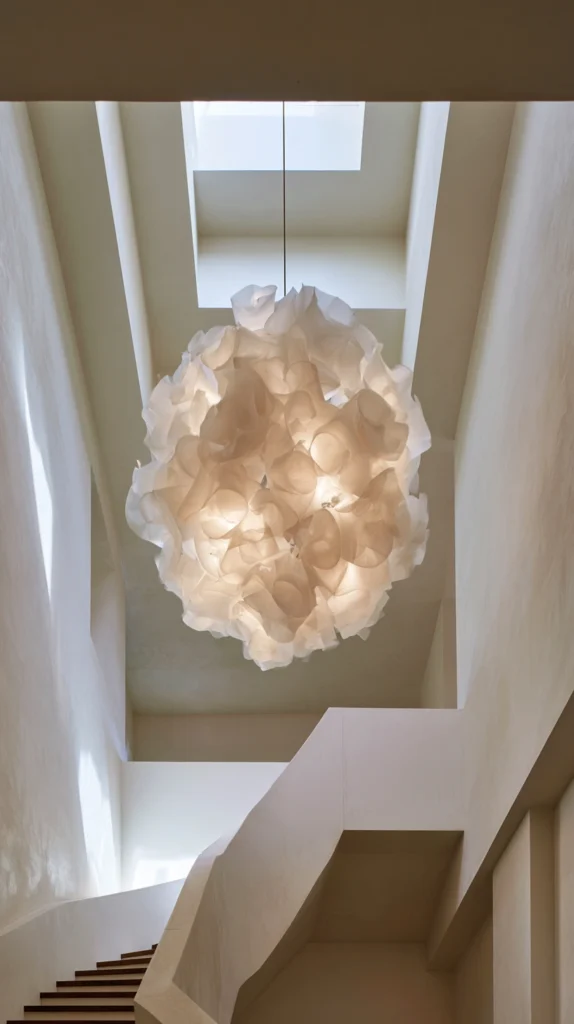
A pendant light of genuine scale and genuine beauty — hung from the stairwell ceiling at its highest point and descending through the full vertical height of the stairwell to a position at landing level — creates a lighting installation of extraordinary drama that transforms the stairwell from an architectural necessity into the house’s most visually compelling interior moment.
The oversized pendant works in the stairwell because the vertical space available — typically two to three full floor heights — accommodates a scale of fixture that would be completely disproportionate in any standard room, and the fixture hanging at eye level on the landing while its suspension travels upward into the ceiling void above creates a sense of scale and architectural ambition that makes every other space in the house feel more considered by association.
Choose a fixture in natural materials — rattan, hand-blown glass, woven wire, or sculptural ceramic — that rewards close inspection at landing level while reading clearly from the ground floor below.
3. Design the Landing as a Dedicated Reading Corner
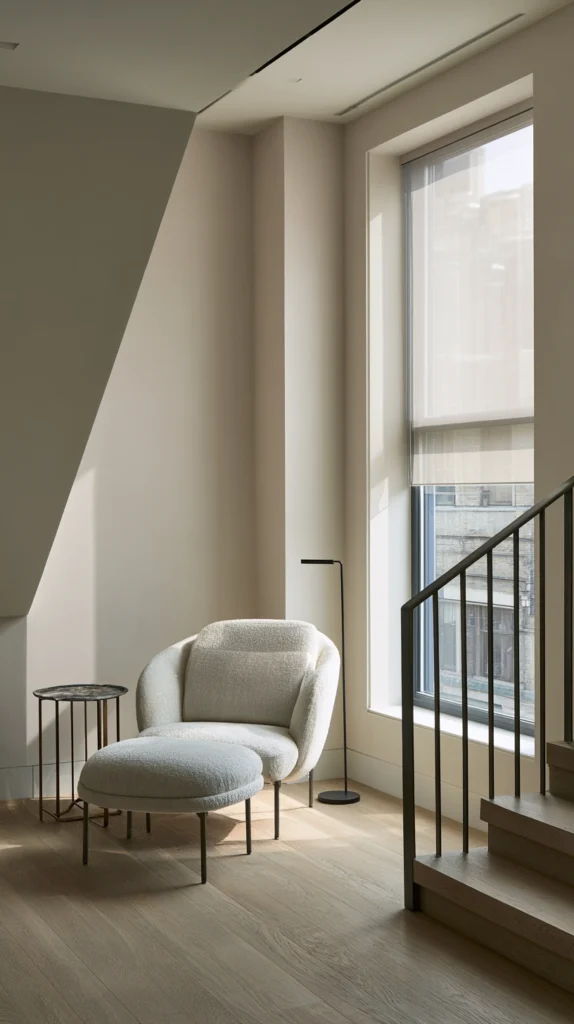
A landing of sufficient size — and many landings, particularly in older houses with generous stair proportions, are larger than they initially appear — is an ideal location for a dedicated reading corner, separated from the main rooms of the house by its transitional position and naturally lit by the landing window that most houses provide.
A built-in window seat with storage beneath, or a single deep armchair positioned to face the landing window with a side table and a floor lamp beside it, creates a reading space of considerable charm and considerable practical value.
A quiet, slightly removed corner that is neither entirely private nor entirely public, and that benefits from the particular quality of borrowed calm that landing spaces carry as naturally transitional zones between the active spaces of the house. The reading corner landing is consistently among the most used and most loved spaces in any house that has one.
4. Hang a Large-Scale Artwork as a Landing Focal Point
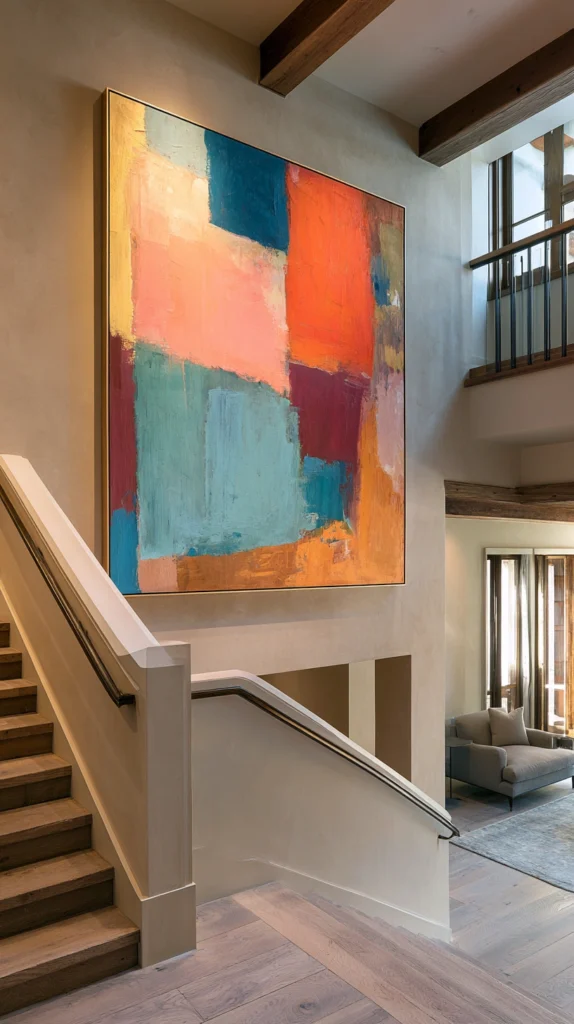
A single large artwork — a canvas, a framed print, a textile work, or a photographic image of genuine scale — positioned on the primary wall of the landing at a height calculated to be seen clearly both from the landing itself and from the top of the staircase below, creates a focal point of considerable visual authority that organises the landing’s entire design around it.
The landing is the ideal location for the piece of art that is too large for any room in the house — the scale that would overwhelm a standard room reads perfectly against the taller-than-standard wall heights of most landing spaces, and the artwork is seen from two viewpoints simultaneously.
From the ascending staircase and from the landing itself, create a composition that rewards approach and arrival in a way that wall-mounted art in a standard room cannot achieve. Choose work of genuine quality and genuine personal resonance rather than a decorative print selected to fill the wall — the landing artwork is too prominently and too repeatedly seen to be anything less than something genuinely loved.
5. Use the Landing to Display a Sculpture or Three-Dimensional Object
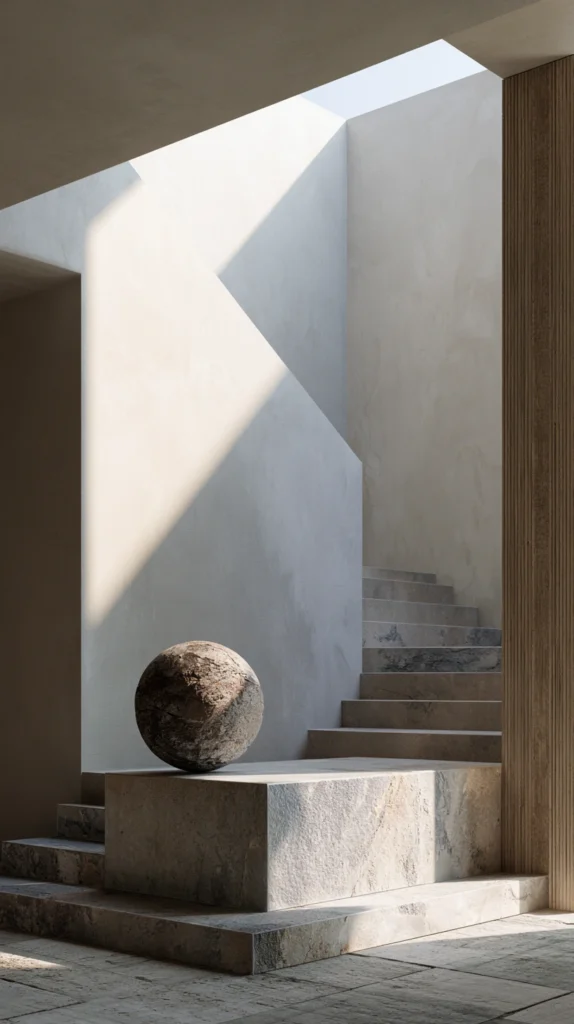
The stair landing is the location in the house best suited to the display of three-dimensional objects — sculpture, ceramics, found natural objects, or crafted pieces of sufficient scale — because it is one of the few interior spaces where objects can be seen in the round, from multiple viewpoints simultaneously, as one approaches from the staircase and as one moves through the landing space itself.
A single large ceramic vessel, a piece of sculptural timber, a stone carving, or a collection of interesting objects on a low plinth or console: the landing’s unique quality of being experienced from multiple angles makes it the natural home for the three-dimensional piece that would be seen only from the front against a wall in any standard room. Position the object where it is visible from the top of the staircase as well as from the landing, and allow it enough surrounding space to be fully appreciated from every approach angle.
6. Create a Gallery of Family Photography in a Consistent Format
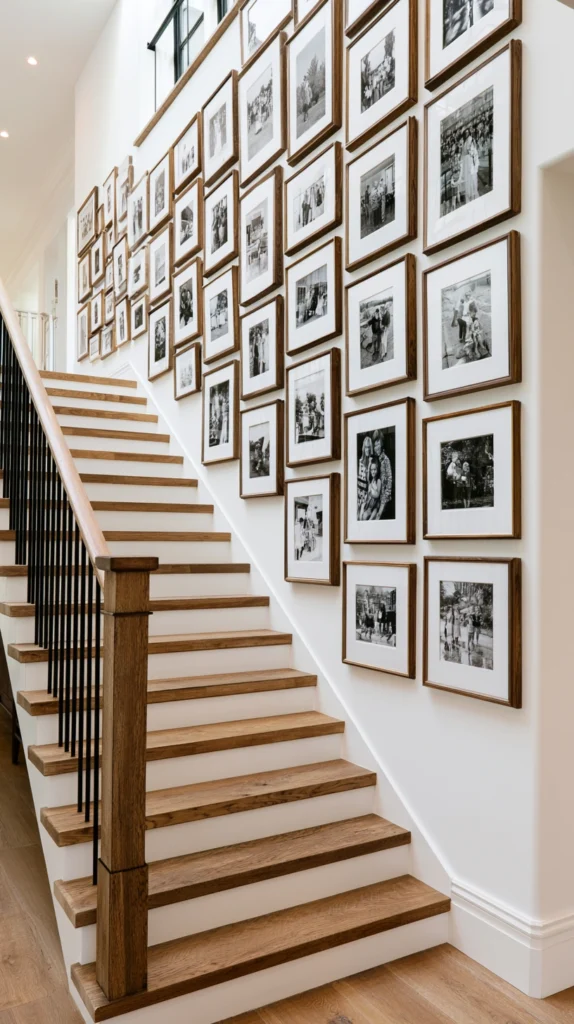
A landing wall dedicated to family photography — images printed at consistent sizes, framed in identical or closely related frames, hung in a precise geometric arrangement that covers the wall from dado height to ceiling — creates a family archive of considerable emotional warmth and considerable visual coherence that suits the landing’s transitional character perfectly.
The family photography gallery works on a landing because it is a space experienced in movement — photographs glimpsed and registered as one passes through rather than studied at length — and a consistent format and arrangement allows individual images to be absorbed quickly without requiring the close reading that more complex artwork demands. The landing gallery also grows naturally over time, with new images added as the family’s life develops, creating a living archive rather than a static decoration.
7. Install Dramatic Wallpaper on the Landing Walls and Ceiling
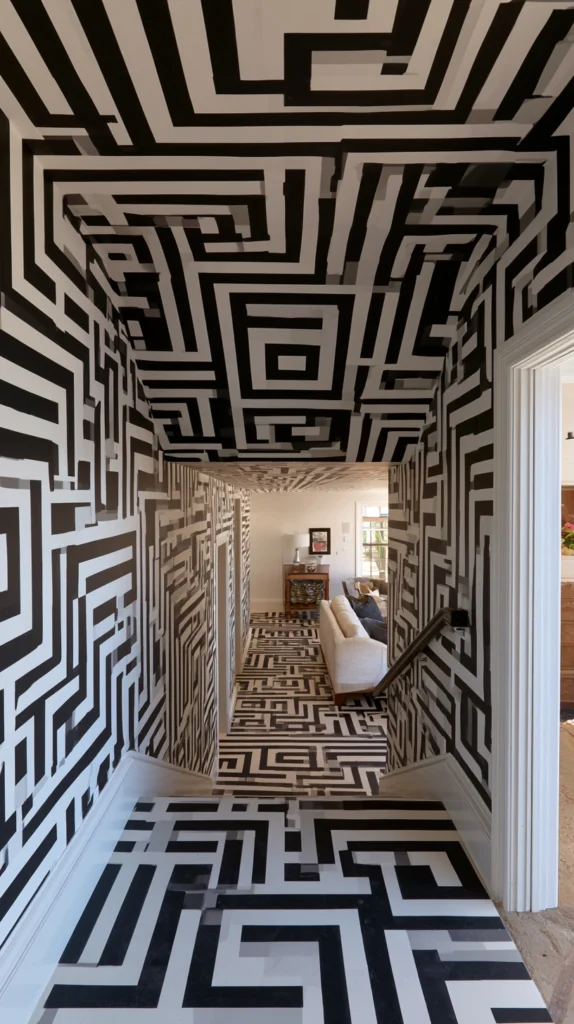
A landing wrapped in a bold, pattern-forward wallpaper — covering the walls, the ceiling above, and perhaps the upper section of the stairwell walls visible from the landing — creates an immersive decorative environment of extraordinary impact at the house’s most spatially dramatic vertical point. The landing is the ideal location for the wallpaper that is too bold, too complex, or too visually demanding for a room where it would be seen for extended periods.
On a landing, a dramatic pattern is experienced in passing, its full impact registered in the few seconds of transition through the space, and the intensity of a pattern that might be exhausting in a living room is precisely appropriate to the brief, heightened quality of a well-designed landing moment. Choose a botanical, geometric, or scenic pattern with genuine visual complexity and install it with the precision and care that the prominent position demands.
8. Build a Display Shelf System for a Curated Collection
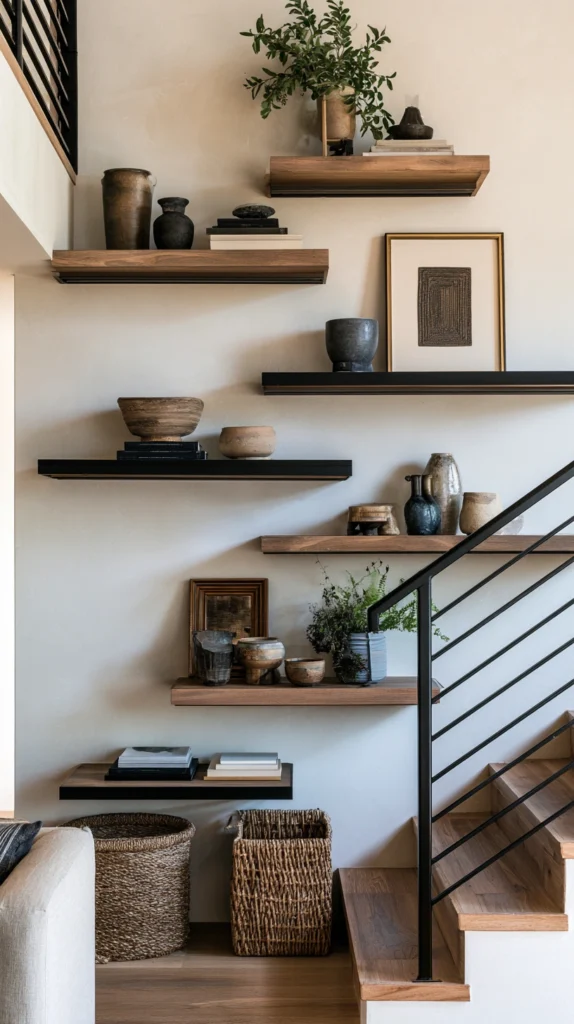
A series of floating shelves — arranged in a deliberate geometric pattern on the landing wall, each one carrying a curated selection of objects from a specific collection — converts the landing into a gallery space for whatever the household collects most passionately and most consistently.
Books, ceramics, vintage cameras, collected stones, miniature sculptures, framed botanical specimens, or the accumulation of small meaningful objects that most households possess but rarely display with genuine intention: the landing shelf system provides a dedicated, well-considered display location for the collection that is currently scattered through drawers and shelves throughout the house without coherence or visibility.
Design the shelf arrangement itself as a geometric composition rather than a purely functional storage solution — the pattern of the shelves on the wall is part of the display, as important to the overall visual effect as the objects placed upon them.
9. Use the Landing Window as a Greenhouse Moment
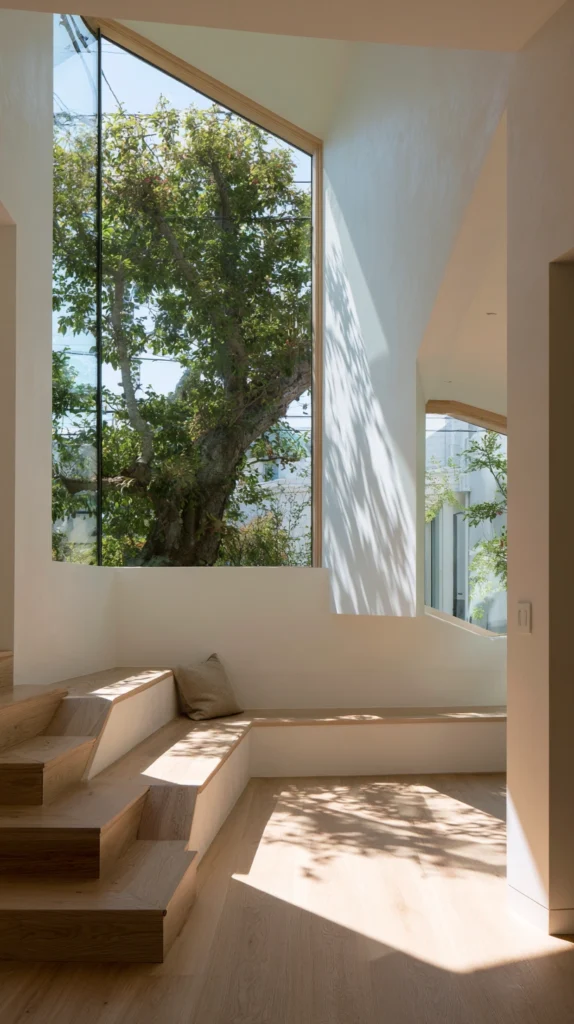
A landing window — typically larger than standard bedroom windows, often south-facing, and uniquely positioned to receive light from an angle that the rooms below and above do not access.
It is one of the best natural light sources in the house for plant growing, and a landing treated as a small greenhouse or plant display space brings a quality of lush botanical abundance to the house’s vertical circulation that makes every journey between floors a genuinely pleasant sensory experience.
A collection of plants in terracotta pots arranged on the windowsill and on shelves beside the window, their foliage filling the landing space with green and their collective transpiration creating a quality of slightly humid, oxygen-rich air that is noticeably different from the drier air of the rooms beyond: this is the landing transformation that costs the least and delivers the most immediate and most daily quality of pleasure of any idea on this list.
10. Install a Mirror That Reflects the Stairwell’s Natural Light
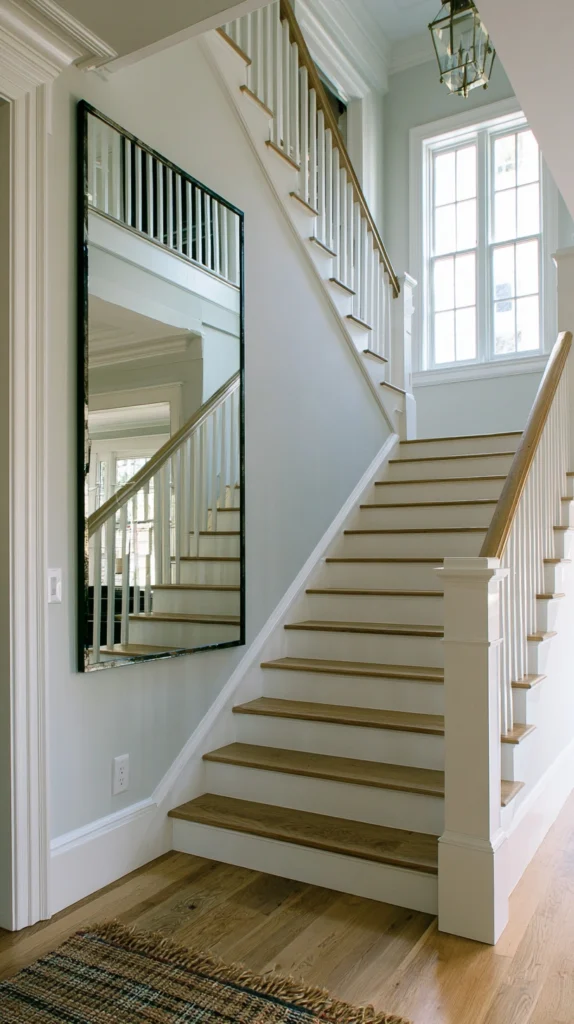
A large mirror — full-length, or as wide as the landing wall accommodates — positioned on the landing wall directly opposite the landing window reflects the natural light source back through the space and down the stairwell, distributing the landing’s typically generous natural light into the stairwell below and the adjacent spaces around it in a way that improves the light quality throughout the house’s central vertical circulation.
The landing mirror also creates the spatial doubling effect that makes the landing feel significantly more generous than its actual dimensions — a generous landing becomes a dramatic one, and a modest landing becomes a liveable one — and provides the full-length mirror function that most multi-storey houses locate inefficiently in a bedroom rather than at the point in the house where it is most naturally and most frequently used.
Frame the mirror simply and substantially — a thin frame disappears against the wall, while a frame of genuine visual weight makes the mirror read as the intentional design feature it should be.
11. Create a Desk or Study Area on a Generous Landing
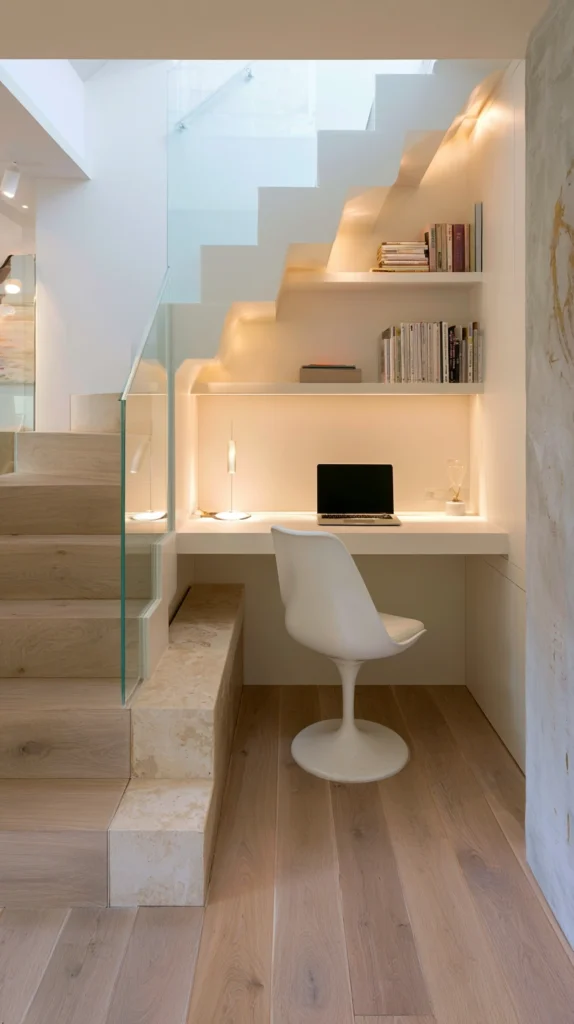
A landing of genuine size — found in many Victorian, Edwardian, and larger post-war houses where the staircase and its associated landing were designed with considerably more spatial generosity than contemporary building allows.
It is large enough to accommodate a compact desk and study area that benefits from the landing’s natural light, its relative quiet between the active floors of the house, and the slight sense of separation from both the upstairs and downstairs living spaces that makes it surprisingly effective as a focused working zone.
A wall-mounted fold-down desk, a slim built-in desk in a landing alcove, or a freestanding writing table positioned beside the landing window with a simple chair: any of these configurations creates a study moment of genuine utility that the landing’s architectural position supports naturally and that no other space in the house provides quite as effectively.
12. Design a Dramatic Colour Moment on the Landing Alone
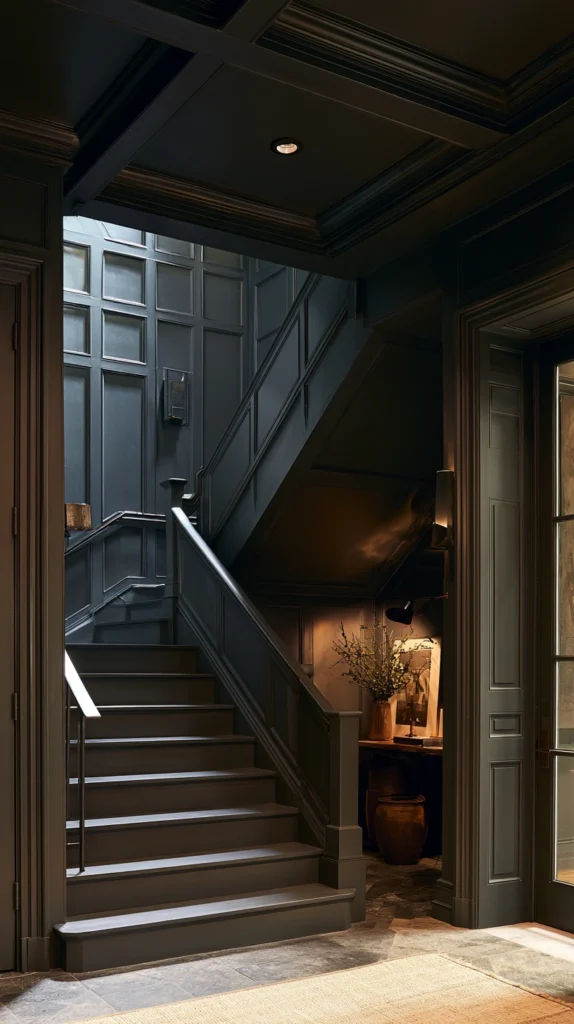
A landing painted in a single deep, dramatic colour — applied to walls, ceiling, and woodwork in one continuous envelope of rich tone — while the adjacent rooms and staircase remain in a lighter, more neutral palette creates a colour moment of genuine surprise and genuine impact at the house’s vertical centre, the experience of stepping from the pale staircase onto a richly colour-drenched landing functioning as a designed reveal that makes the journey between floors something genuinely worth making.
The landing colour moment works because the contained dimensions of the space allow a depth of colour that would be overwhelming in a larger room, and the brevity of the time spent in the space — seconds rather than hours — makes an intensity of colour appropriate that could not be sustained in a room of extended occupation.
Choose a colour with genuine depth and warmth — a forest green, a deep terracotta, a rich navy, an ochre yellow — and paint everything, without exception, in the same tone.
13. Add Underfoot Interest With a Statement Landing Rug
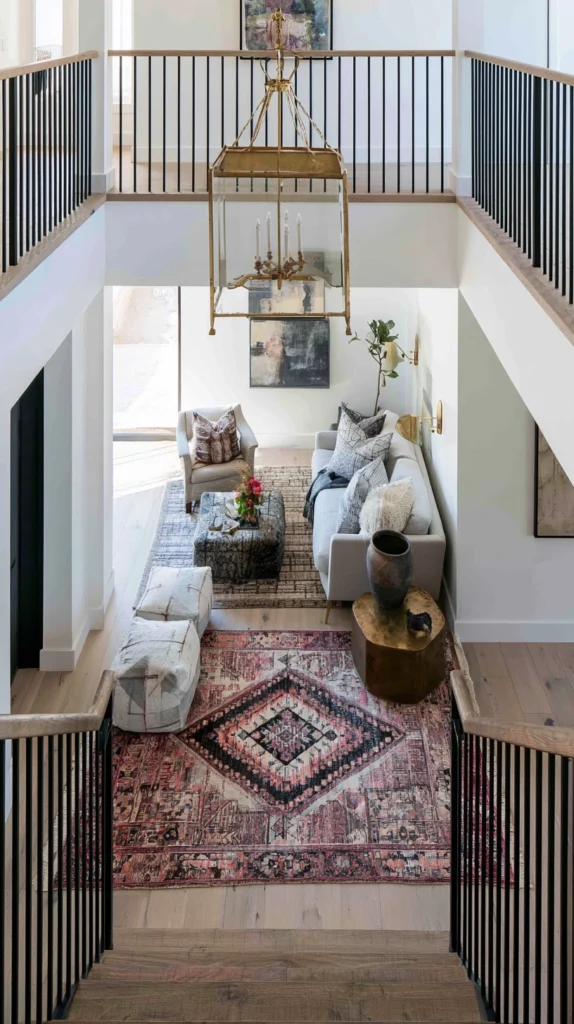
A landing rug — sized to cover the majority of the landing floor surface, chosen for its pattern and its quality as a primary decorative element rather than as a purely practical floor covering.
It is the landing transformation that requires the least construction, the least commitment, and the least design expertise while delivering a visual impact disproportionate to its simplicity. The landing rug works because the landing floor is a surface seen from above — from the top of the staircase looking down — as well as from within the landing itself, and a beautiful rug viewed from above has a quality of composed, framed beauty that no other floor treatment achieves quite as naturally.
Choose a rug of genuine quality — an antique or vintage piece with the colour depth and pattern complexity that only age produces, or a contemporary design of equivalent visual richness — and size it generously enough to cover the landing’s floor area to within a consistent margin of the skirting boards on all sides.
Final Thoughts: Treating the Landing as the Space It Actually Is
The stair landing that finally receives the design attention it has always deserved is the one treated not as a transitional non-space but as a genuine room — a room with unusual proportions, unusual light, and an unusual relationship to the spaces around it, but a room nonetheless, deserving of the same intention, the same material investment, and the same design ambition applied to every other space in the house.
Choose one idea that suits the landing’s actual dimensions and the house’s actual design language, commit to it with genuine conviction, and execute it with the care and the quality that the landing’s prominent and repeated visibility demands.
The stair landing seen multiple times daily by every person in the household is not the place for half-measures or provisional solutions. It is the place for the design decision that is made with full confidence and full commitment — and the reward for getting it right is a house that feels more considered, more complete, and more beautifully designed at every level, from the ground floor to the top.