
15 Laundry Closet Ideas for Tiny Apartments (Hidden and Stylish)
The laundry closet in a tiny apartment is one of those spaces that most people treat as a purely functional necessity — a door to be kept closed, a space to be ignored as long as the machines inside it are working, a corner of the apartment that receives none of the design attention lavished on the kitchen, the living room, or even the bathroom.
This approach is understandable but fundamentally mistaken, because the laundry closet in a small apartment is a space that is opened and used multiple times every week, that is frequently visible from adjacent living areas when in use, and that — when designed with genuine intelligence and genuine care — can contribute meaningfully to the overall organisation, efficiency, and visual coherence of a small home rather than simply housing two appliances behind a closed door.

The laundry closet done well is hidden when it should be hidden, beautiful when it cannot be hidden, and organised to a standard of efficiency that makes the weekly laundry routine genuinely pleasant rather than merely manageable.
These fifteen ideas demonstrate exactly how to achieve all three qualities within the specific constraints of the tiny apartment — limited square footage, restricted ventilation options, often-challenging original installations, and the particular design challenge of making a functional utility space look as considered as every other part of a small, carefully designed home.
1. Install Bifold Doors That Disappear Completely When Closed
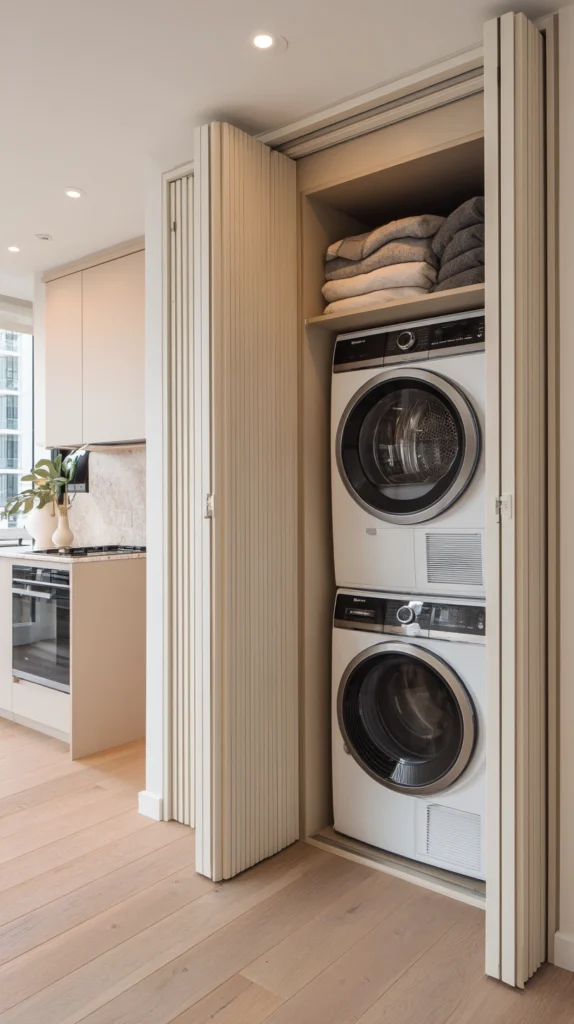
The bifold door is the standard laundry closet closure for good reason — its folding mechanism requires minimal clearance in front of the opening, making it ideal for the tight corridor and living area positions where most apartment laundry closets are located, and its full-width opening provides complete access to the machines and storage within when open.
The design upgrade that transforms a standard bifold installation is the door finish — replacing the hollow-core, flat-panel bifold doors that most apartments supply with solid-core doors in a shaker profile, a fluted surface, or a full-height mirror finish that reads as an intentional design element rather than a utility closure when the closet is not in use.
Mirror-fronted bifold doors perform double duty — concealing the laundry space completely while serving as the apartment’s full-length mirror, a particularly valuable function in a small apartment where dedicated mirror space is typically limited.
2. Use Stackable Washer-Dryer Units to Maximise Vertical Space
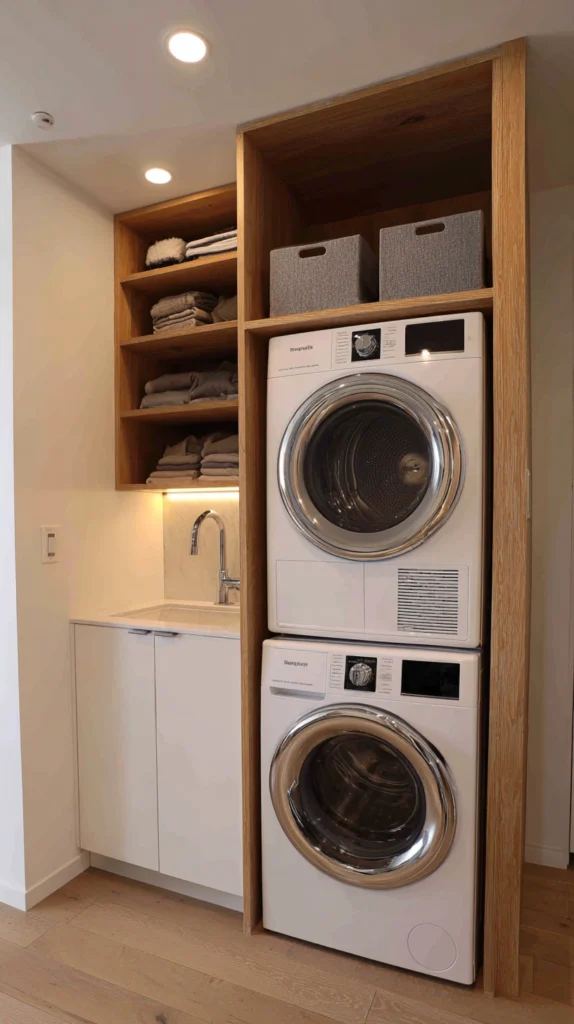
The stackable washer-dryer combination — a full-size washer with a dryer mounted directly above it on a manufacturer-approved stacking kit — is the single most effective space-saving configuration available for an apartment laundry closet, reducing the footprint of two full-size appliances to the floor space of one while maintaining full washing and drying capacity.
The vertical space freed by stacking the appliances — the area beside the stacked units that would have been occupied by the dryer in a side-by-side configuration — becomes available for a full-height shelving unit, a pull-out laundry hamper system, or a combination of both that dramatically increases the closet’s storage capacity and organisational potential.
Choose appliances in a consistent finish — white, matte black, or stainless steel — and align their control panels at a consistent height for the clean, intentional appearance that makes a utility space look designed rather than assembled.
3. Build a Folding Station Above the Machines
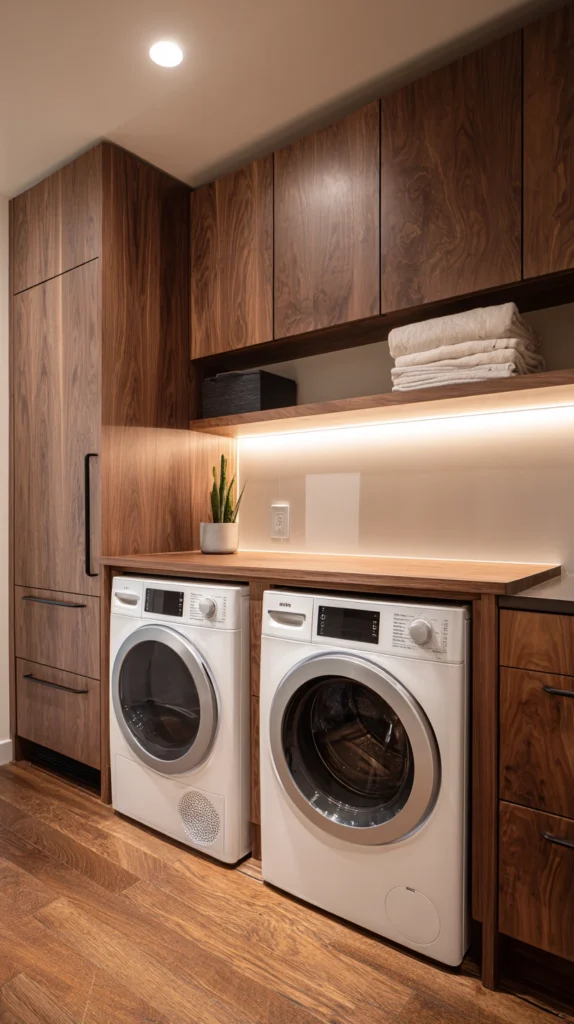
The absence of a dedicated folding surface is the practical frustration that makes apartment laundry routines most consistently inconvenient — without a surface at the right height within the laundry space itself, clean laundry migrates to the bed, the sofa, the dining table, and every other flat surface in the apartment before being folded and put away.
A timber or laminate shelf installed above stackable machines at a comfortable standing working height — typically 90 to 95 centimetres from the floor — creates a dedicated folding station that keeps the laundry routine entirely within the closet space and eliminates the spread of clean laundry through the adjacent living area.
Extend the shelf the full width of the closet opening, add a thin foam mat on the surface for gentle handling of delicate items, and the folding station becomes the detail that makes the laundry closet genuinely functional rather than merely containing the machines.
4. Add Pull-Out Hamper Drawers for Sorted Laundry
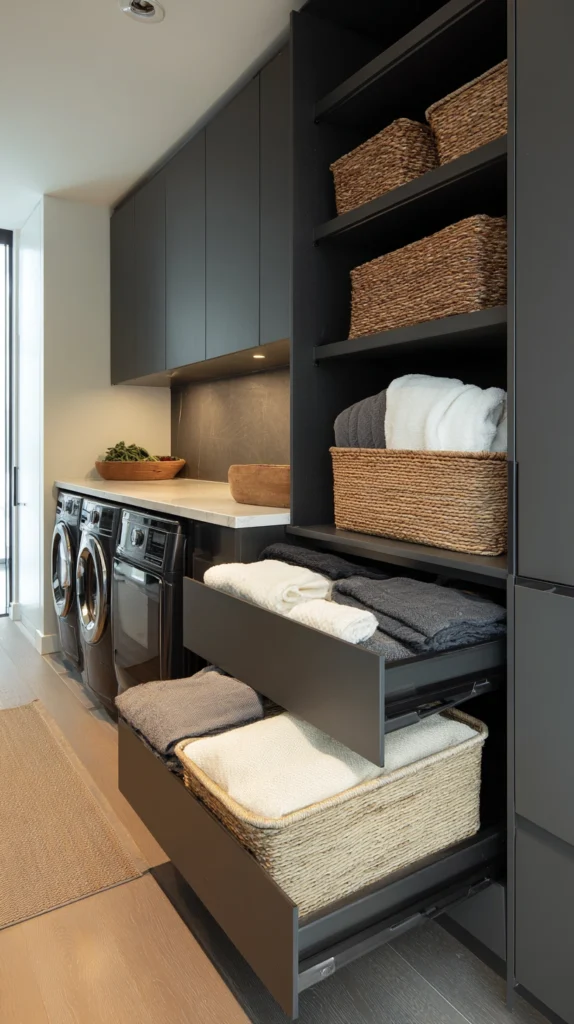
The laundry hamper that sits on the closet floor — occupying valuable floor space, requiring the entire contents to be lifted and carried to the machine, and providing no opportunity for pre-sorting by wash temperature or fabric type — is the least efficient laundry storage solution available and the one most easily improved by a simple custom or semi-custom alternative.
Pull-out hamper drawers — fabric-lined timber or wire-frame drawers mounted on full-extension slides beneath the folding station or beside the machines — allow laundry to be sorted at the point of deposit rather than before washing, eliminate the floor space occupied by freestanding hampers, and make loading the machine a matter of pulling out the relevant drawer and tipping its contents directly in. Install two or three drawers for dark, light, and delicate sorting, label each clearly, and the pre-washing organisation that most people find most tedious is effectively automated.
5. Install Open Shelving for Beautifully Organised Supplies
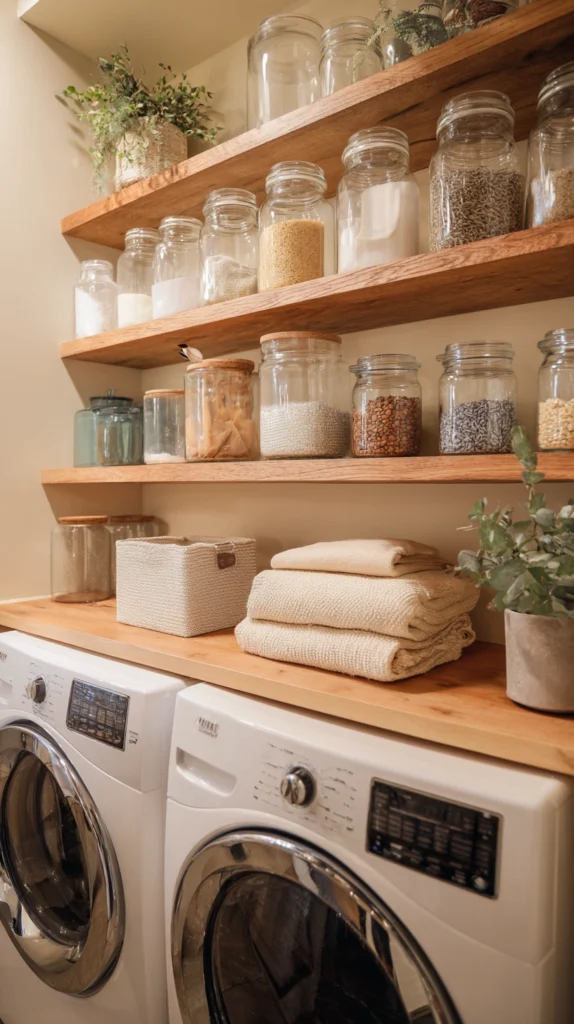
Laundry supplies — detergent, fabric softener, stain remover, dryer sheets, and the collection of specialist products that accumulate in any active household — are conventionally stored in whatever configuration they arrived in from the supermarket, creating the visual chaos of mismatched packaging that makes even a well-organised laundry closet look messy when the doors are open.
Replacing the original packaging with consistent glass or ceramic canisters and transferring powder detergents into apothecary-style vessels, liquid products into pump dispensers, and dryer sheets into a simple timber or ceramic box creates a supply display of genuine visual coherence that makes the open shelving above the machines look curated rather than utilitarian.
Choose vessels in a consistent colour family — all clear glass, all white ceramic, all natural timber — and label with simple printed or handwritten labels that maintain the visual consistency of the scheme.
6. Use Wallpaper or Bold Paint Inside the Closet
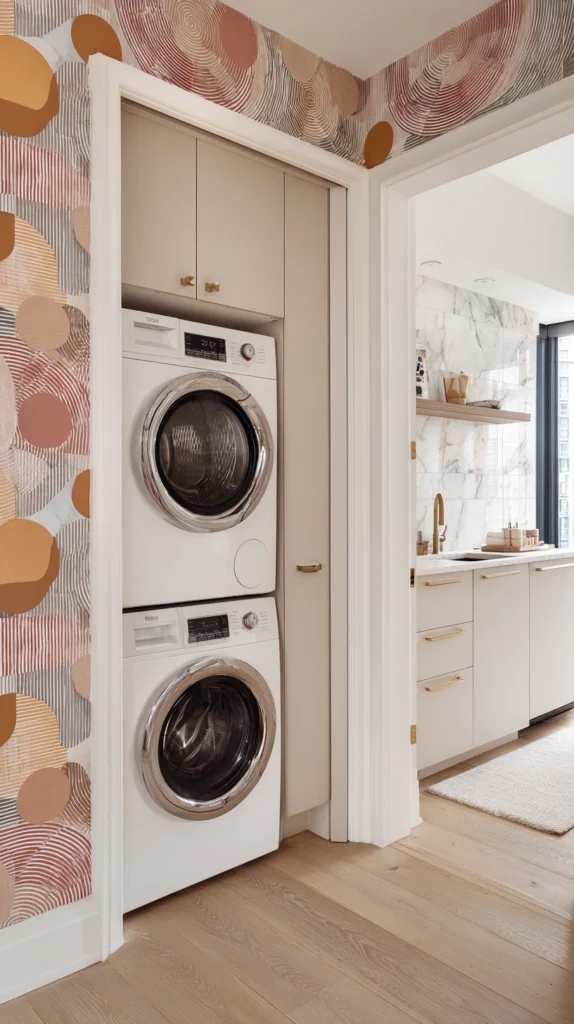
The interior of a laundry closet — the back wall and the side walls visible when the doors are open — is a small, contained surface that can absorb a bold decorative treatment without overwhelming the apartment around it, and the visual surprise of opening a closet door to reveal a beautifully wallpapered or dramatically painted interior is one of the small design moments that makes a carefully considered small apartment feel genuinely extraordinary rather than merely functional.
A graphic geometric wallpaper, a botanical print, a deep colour-drenched paint in a tone that would be too intense for a full room: these treatments work perfectly within the contained boundaries of a closet interior, visible only when the door is open and contributing a moment of genuine delight to a routine that has very few of them. The wallpapered laundry closet is the apartment detail that guests notice, comment on, and remember after every visit.
7. Conceal the Closet Behind Curtains Instead of Doors
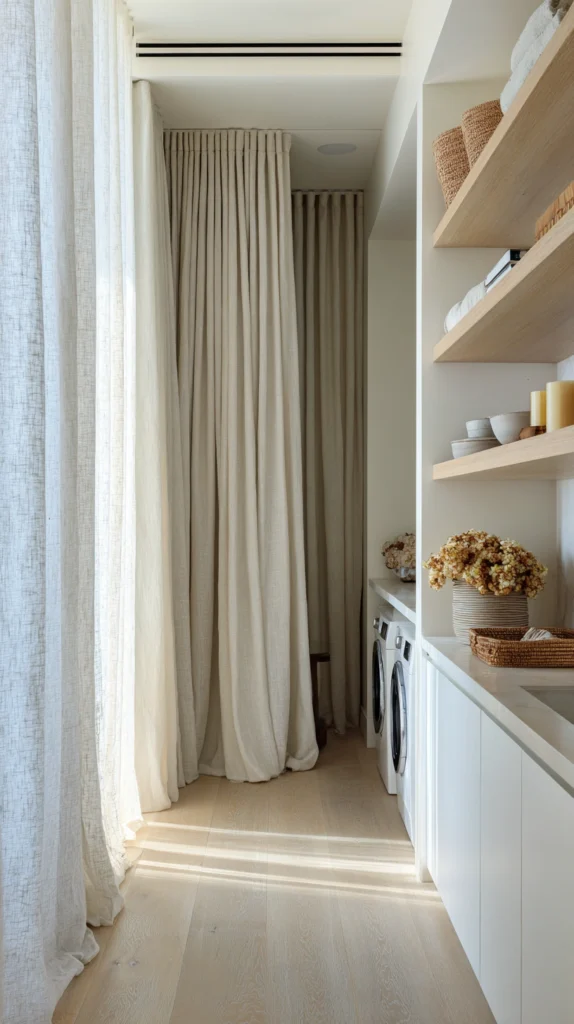
A floor-to-ceiling curtain in a quality fabric — linen, cotton canvas, or a heavier weave in a pattern or colour that connects to the adjacent room’s palette — hung from a ceiling-mounted track or a tension rod conceals the laundry closet completely when drawn and requires no clearance for opening, making it the ideal closure solution for laundry spaces positioned in locations where bifold or sliding door clearance is genuinely problematic.
The curtain closure has the additional advantage of being completely customisable — the fabric can be changed when the apartment’s palette changes, the curtain can be partially drawn to allow ventilation while maintaining partial visual concealment, and the installation requires no permanent modification to the apartment structure beyond a ceiling track or a tension rod. Choose a fabric with enough weight and opacity to conceal the machines completely when drawn, and hem it to floor level for a clean, intentional appearance.
8. Create a Combined Laundry and Linen Closet
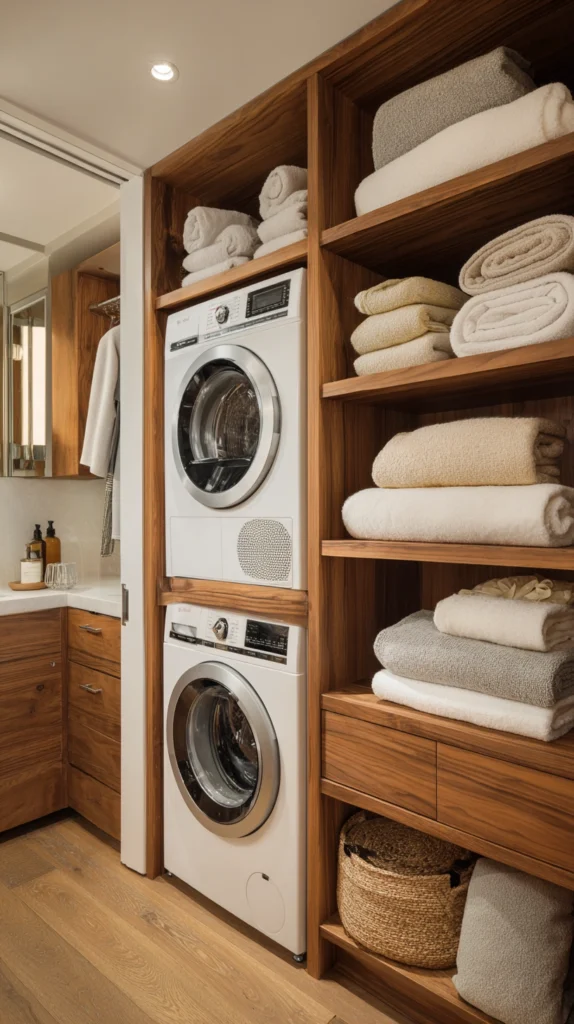
The laundry closet that also functions as the apartment’s primary linen storage — towels, bed linen, spare blankets, and the textile inventory of the household, organised on shelving above and beside the machines — is a significantly more valuable and significantly more functional space than a closet dedicated exclusively to laundry appliances and their associated supplies.
The combination makes spatial sense because clean laundry and stored linen occupy the same general category of household textile management and benefit from proximity — sheets removed from the dryer can be folded and shelved immediately without leaving the closet, and towels can be retrieved from the same space where they were washed and dried.
Design the shelving to accommodate both functions explicitly — dedicated zones for linen above, laundry supplies beside, machines below — with a consistent organisational logic that makes the combined closet genuinely easy to use and genuinely easy to maintain.
9. Install Retractable Drying Racks for Air-Drying
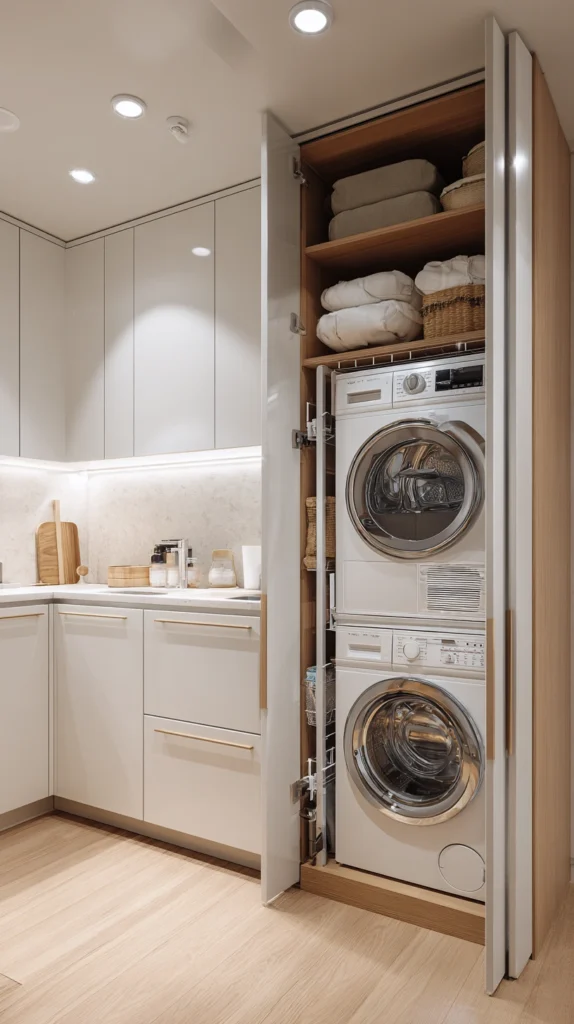
A retractable wall-mounted drying rack — installed on the closet’s back wall or side wall, extending horizontally when in use and folding flush against the wall when not — provides the air-drying capacity that delicate fabrics require without occupying any permanent floor space within the closet or any floor space in the adjacent living area.
The retractable rack is the laundry closet addition that most directly improves the practical laundry experience for anyone who washes delicate items regularly, eliminating the portable drying rack that occupies living room or bathroom floor space for twenty-four hours after every delicate wash cycle.
Install a retractable rack with sufficient arm length and arm count to handle a full, delicate wash load, position it at a height that allows the longest hanging items to clear the machine tops below, and choose a finish that matches the other hardware in the closet for visual consistency.
10. Add Task Lighting Inside the Closet
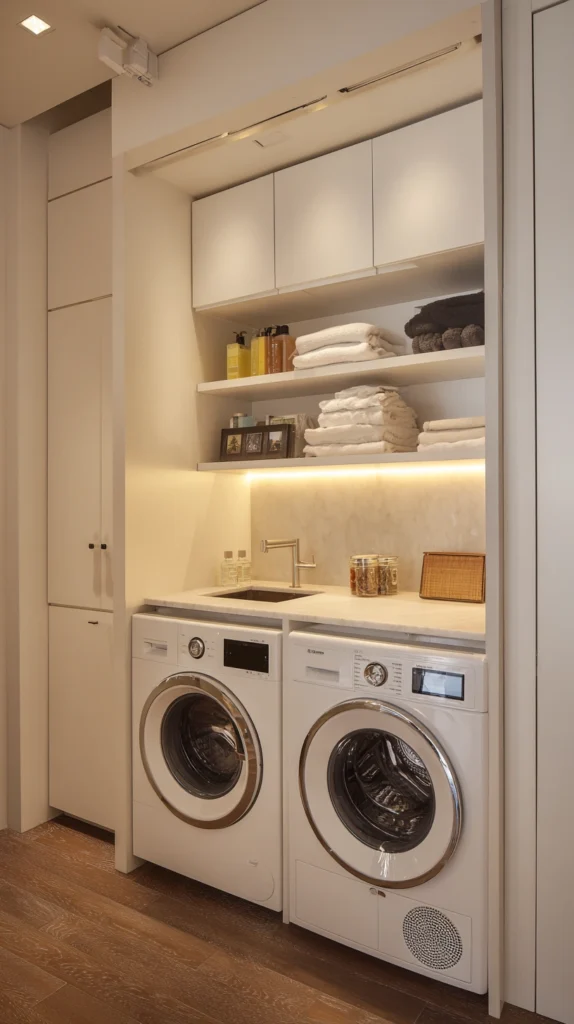
A laundry closet without interior lighting — relying on whatever ambient light enters from the adjacent room when the doors are open — is a closet where stain treatment is guesswork, where sorting by colour is unreliable, and where the machine controls can only be read clearly if the person stands at precisely the right angle to the doorway.
A simple LED strip light installed beneath the folding station shelf, illuminating the machine controls and the closet interior, or a small surface-mounted fixture on the closet ceiling connected to a switched circuit, transforms the working conditions within the laundry space from inadequate to genuinely good.
Motion-activated LED strip lights are a practical and cost-effective solution for apartment laundry closets where running a dedicated switched circuit is not feasible — they activate on opening and deactivate after a set period of inactivity, consuming minimal energy and requiring no switch installation.
11. Use the Closet Door Backs for Additional Storage
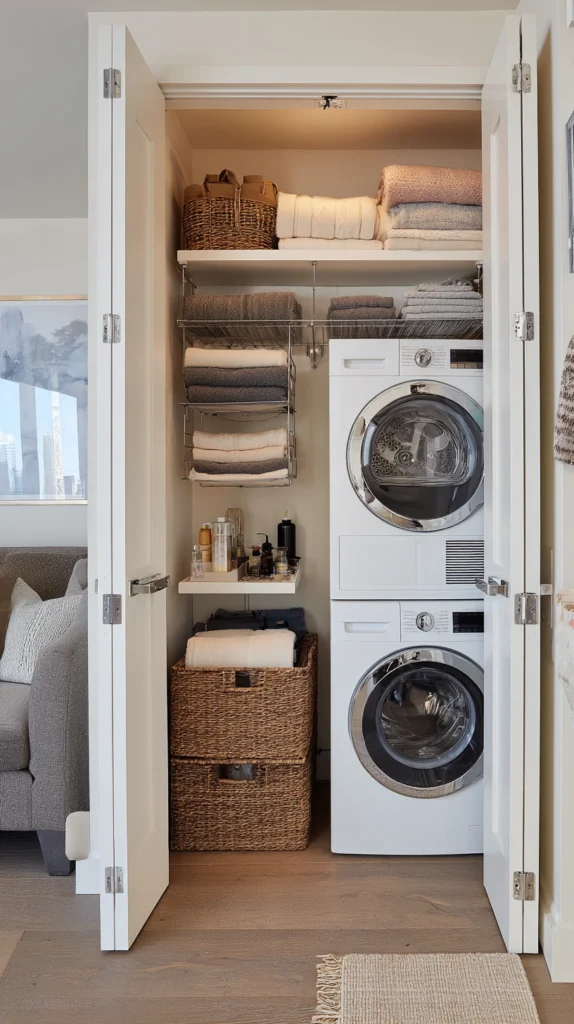
The back surface of a laundry closet door — a flat, frequently unused surface of considerable area — is one of the most valuable and most consistently overlooked storage locations in a small apartment, capable of accommodating over-door organisers, hooks, small shelving units, and the miscellaneous storage that the closet interior itself cannot comfortably contain.
Over-door organisers in wire or fabric holding ironing supplies, clothespins, small cleaning tools, and the various small items that accumulate around a laundry space keep these items accessible and organised without consuming any of the closet’s interior shelf or floor space.
Mount a small mirror on the back of the closet door to serve as a laundry-check mirror for examining garments for stains or damage before and after washing, and the door back becomes a genuinely functional surface rather than a wasted plane of flat timber that opens and closes without contributing anything to the closet’s utility.
12. Choose Appliances in a Matte Black or Coloured Finish
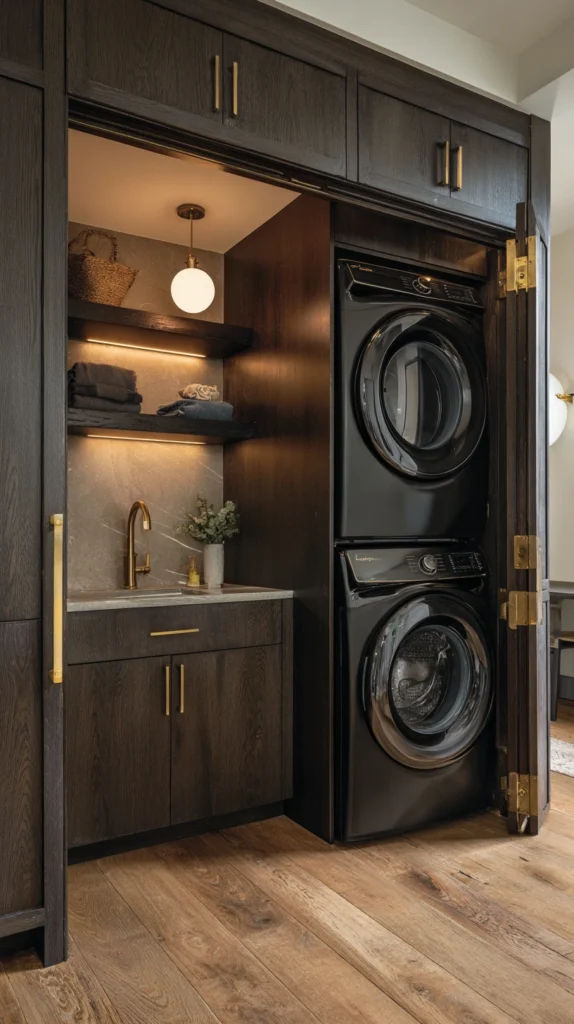
The white appliance — the default specification for washing machines and dryers across most of the residential market — reads as institutional and purely functional in a way that makes no contribution to the visual character of the laundry closet and that requires consistent cleaning to maintain its appearance.
Choosing appliances in a matte black, slate grey, or — for the genuinely adventurous — a coloured finish in terracotta, sage green, or deep navy treats the machines as design objects within the space rather than purely functional equipment to be concealed, and in a laundry closet where the appliances are the dominant visual elements, this distinction matters significantly to the overall appearance of the space when the doors are open.
Several major appliance manufacturers now offer premium product lines in non-white finishes that match the quality and feature specifications of their standard ranges while delivering a visual character that suits a deliberately designed small apartment considerably better.
13. Build a Slim Ironing Centre Into the Wall
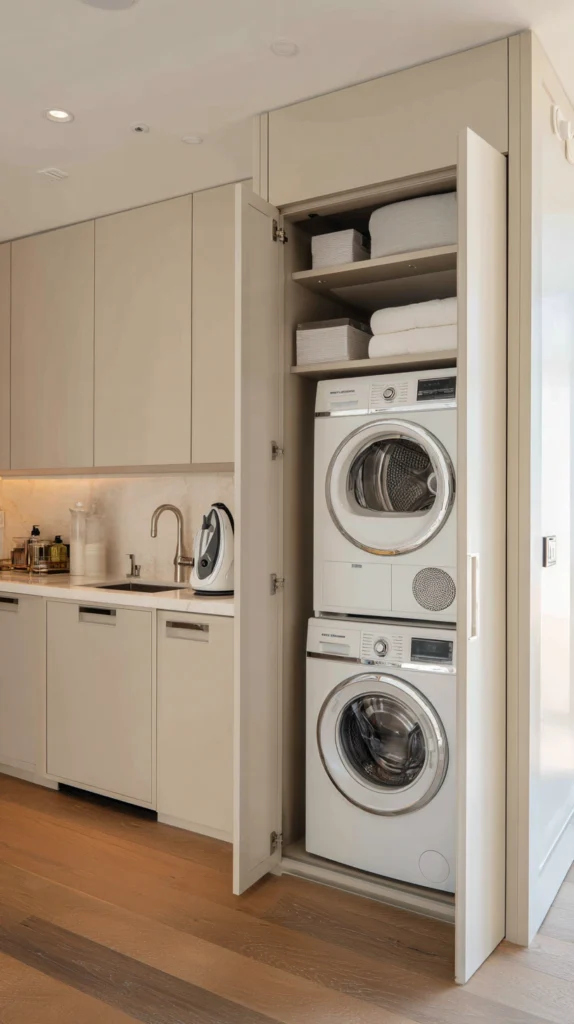
An ironing board that folds out from a slim cabinet recessed into the wall beside the laundry closet — its door closing flush with the wall surface when the board is stowed, the board extending at a pre-set working height when the door is opened — eliminates the portable ironing board that occupies floor space in a small apartment whenever it is in use and storage space in a cupboard when it is not.
The wall-recessed ironing centre is a small apartment utility solution of considerable elegance — the problem of the ironing board, which is one of the larger and more spatially disruptive pieces of equipment in any small home, is resolved completely and permanently without consuming any floor space.
Combine with a retractable power outlet inside the recess and a small shelf for the iron itself, and the complete ironing station is contained within a wall cavity of approximately 15 centimetres depth and the standard width of a single cabinet door.
14. Design the Exterior to Match the Rest of the Room
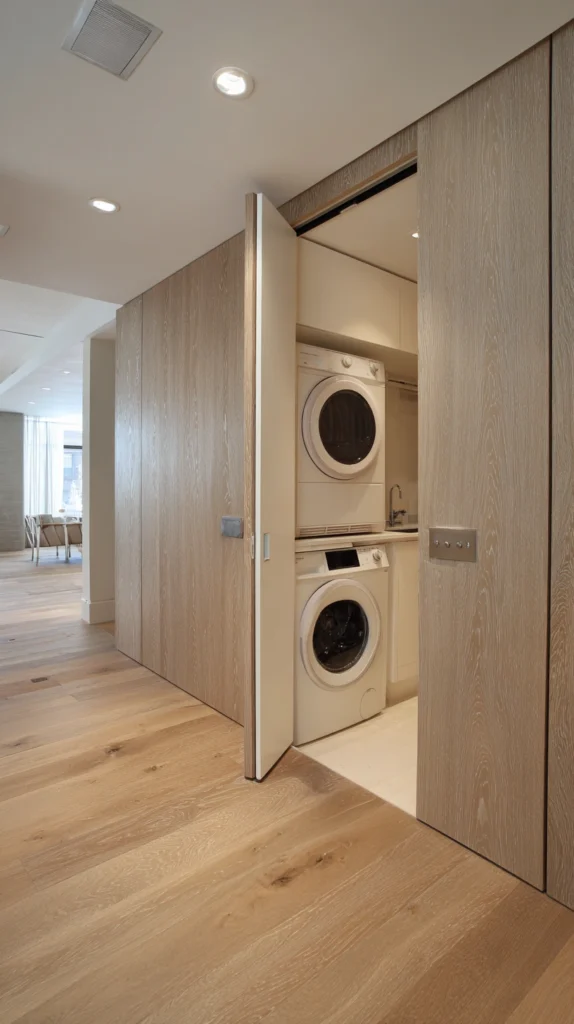
The laundry closet that reads as a designed element of the adjacent room — its doors matching the other cabinetry in the space, its exterior surface contributing to the room’s overall visual coherence rather than interrupting it — is the laundry closet that disappears most successfully into the apartment when closed, achieving the hidden quality that is the primary design goal of every apartment laundry installation.
Paint the closet doors in the same colour as the adjacent walls for the seamless, architectural effect that makes the closet invisible when closed. Match the door profile and hardware finish to the kitchen cabinetry if the closet is located in or adjacent to the kitchen.
Install the same flooring material inside the closet as outside it so the transition between the closet interior and the adjacent room is visually uninterrupted when the doors are open. The laundry closet that belongs to the surrounding room is the one that most completely achieves the hidden and stylish brief simultaneously.
15. Add a Scent Element to Make the Space Genuinely Pleasant
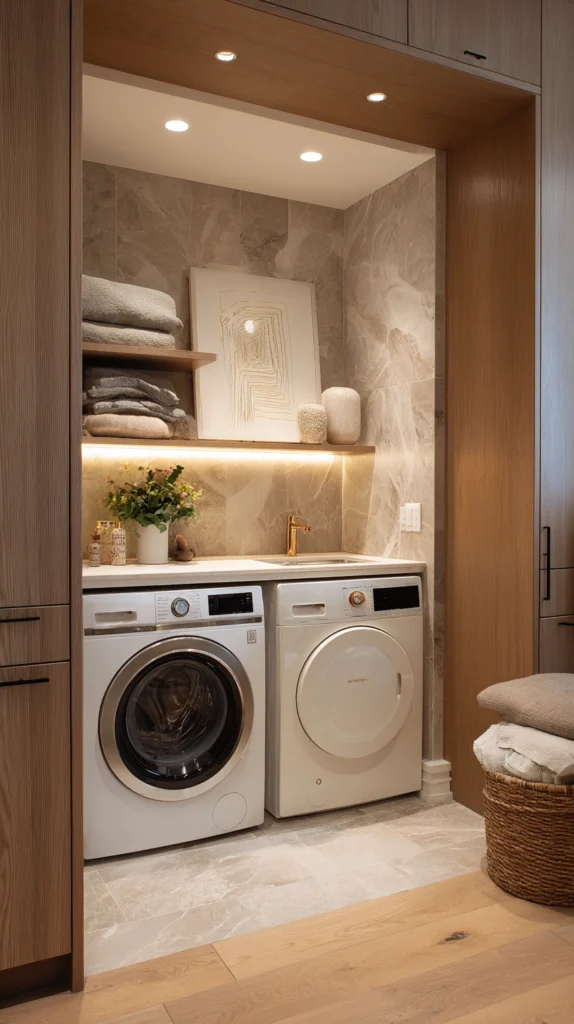
The laundry closet that smells genuinely good — of clean linen, of lavender, of the warm, slightly sweet quality of a well-maintained utility space — is a closet that is more pleasant to open, more pleasant to spend time in while sorting and folding, and more pleasant in its relationship to the adjacent living area whose air it shares when the doors are open. A small ceramic diffuser on the supply shelf releasing a clean, simple fragrance — eucalyptus, clean cotton, white linen.
A sachet of dried lavender tucked between the folded linens on the upper shelves, or a natural beeswax candle placed on the folding station and lit briefly after each laundry session: these small scent interventions cost almost nothing and contribute a quality of sensory pleasantness to a routine that is rarely associated with pleasure. The laundry closet that smells as good as it looks and functions as well as it is organised is the small apartment utility space done completely and done properly.
Final Thoughts: Designing the Laundry Closet That Earns Its Square Footage
The tiny apartment laundry closet that is genuinely hidden when it should be and genuinely stylish when it cannot be is the product of the same design thinking applied to every other space in a well-considered small home — honest assessment of the space’s constraints, intelligent use of every available surface, and the discipline to finish every detail rather than treating the utility space as one where second-best decisions are acceptable because the door is usually closed.
Measure the space precisely before purchasing any storage solution or appliance, design the organisation system around the actual laundry habits of the household rather than an idealised version of them, and invest in the visual details — the wallpaper, the vessel decanting, the matching door finish.
That makes the difference between a functional closet and a genuinely beautiful one. The laundry closet that is worth opening is the apartment detail that makes the whole home feel more considered, more cared for, and more completely designed than it would without it.