
13 Pathway Lighting Ideas for a Front Yard That Looks Like the Walk to the Pitch
There is a particular feeling that comes from walking toward something well-lit at night. The path is clear, the light is warm, and something about the journey from gate to front door feels considered rather than accidental. Most front yards never achieve this. A single overhead porch light throws a flat, harsh circle at the entrance and leaves everything between the gate and the door in relative darkness. The walk to your own front door should feel better than that.
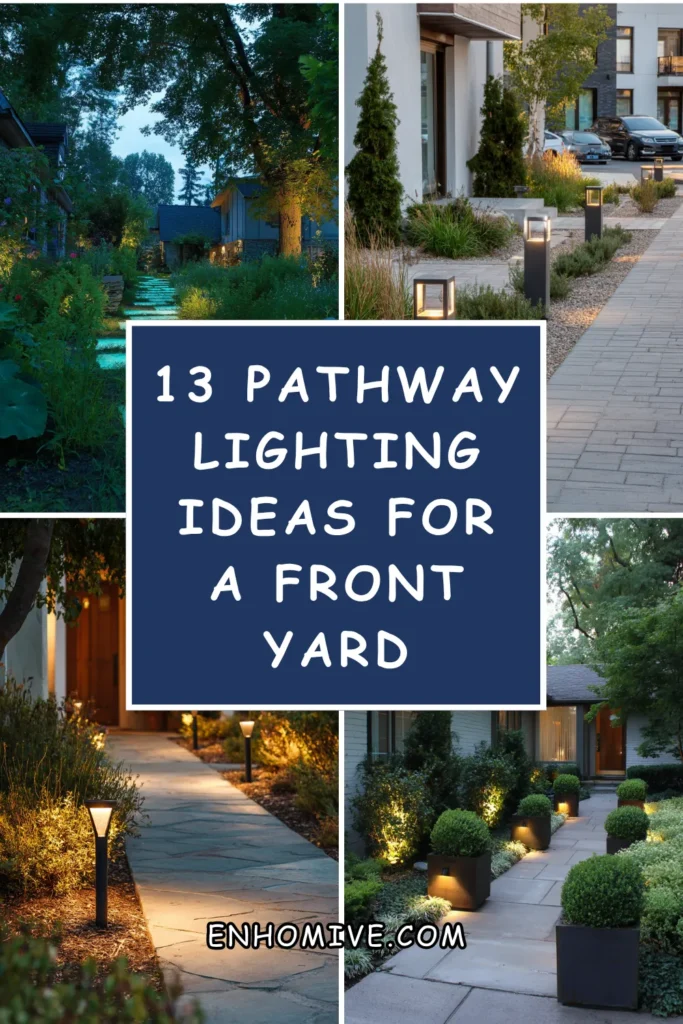
The thirteen ideas below treat the front yard pathway as what it actually is — a curated approach, a first impression, a nightly ritual — and give it the lighting it deserves. Each idea covers what you will need, what it will cost, and a practical tip to make it genuinely work in an outdoor space rather than a showroom display.
1. The Solar Stake Light Avenue
Budget: $30 – $150
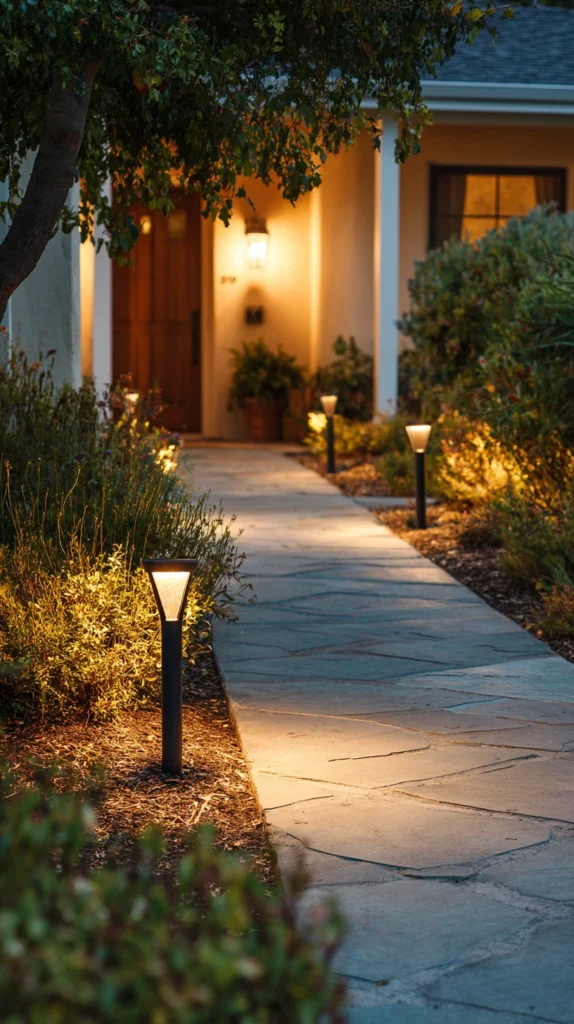
A row of solar stake lights placed at equal intervals along both sides of a front path is the entry-level version of this idea and, done with the right fittings, it looks considerably more intentional than its price point suggests. The key distinction is in the fitting itself — a slim, matte black or brushed steel stake with a warm amber LED reads as architectural. A plastic mushroom-shaped solar light in fake brushed bronze does not. The shape and finish of the stake matters as much as the light it produces.
Slim architectural solar stake lights in matte black or steel cost $8 – $20 each. A path requiring ten stakes — five per side — costs $80 – $200 in total. Warm white LEDs at 2700K colour temperature are essential — cool white solar stakes produce a blue-toned light that flattens the landscape and removes all warmth from the approach. Look for fittings with a stated lumen output of at least 10 lumens per stake for a path that is genuinely lit rather than merely suggested.
Decor tip: Push stakes into the ground at a consistent distance from the path edge — 15 centimetres is a reliable standard — and use a measuring tape rather than estimating. Even spacing is what separates a considered avenue of lights from a scattering of stakes that happen to be roughly linear. The geometry is everything in this application.
2. The Low-Voltage Brass Bullet Uplights
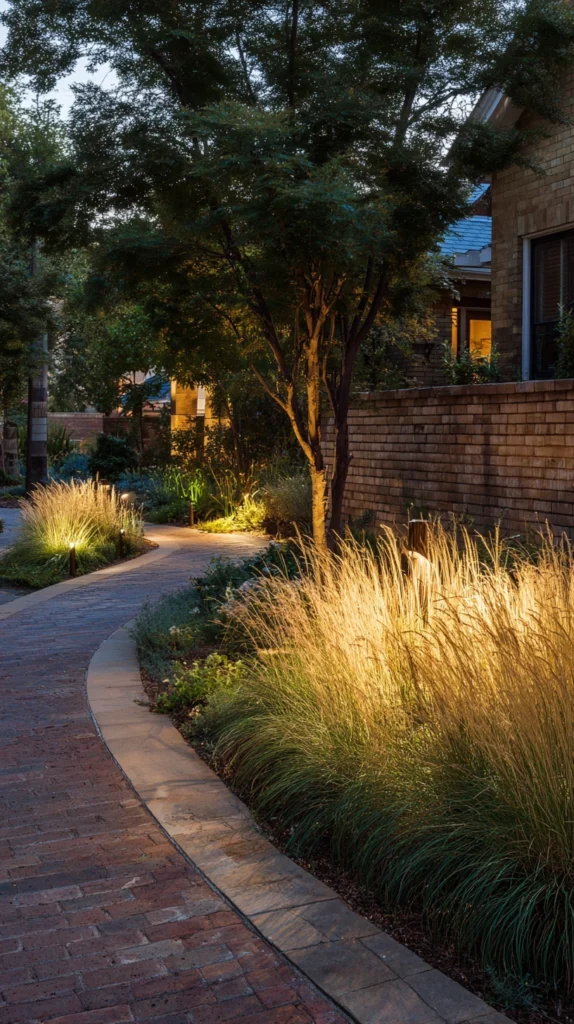
Budget: $100 – $500
Brass or copper bullet uplights set low into the ground beside the path and angled upward to graze the face of a garden wall, illuminate a specimen plant, or wash light across a fence panel produce the kind of layered, directional lighting that professional landscape designers use on high-budget projects. The fittings are small, the light they produce is focused and intentional, and the warm tone of brass or aged copper improves significantly as it weathers — which almost no other outdoor fitting can claim.
Low-voltage brass bullet uplights cost $20 – $60 each. A transformer to power a run of six to ten fittings runs $40 – $100. Low-voltage cable buried just below the soil surface adds $10 – $30 for a standard front path run. The installation is a half-day project for a competent DIY approach and requires no electrician for the low-voltage side of the circuit — only the transformer connection to the mains supply.
Decor tip: Angle bullet uplights to graze surfaces at a shallow angle rather than pointing them straight upward. A light aimed directly at the sky produces a cone of glare. A light aimed at 30 to 45 degrees from vertical washes across a surface and reveals texture — brickwork, timber grain, plant foliage — in a way that straight uplighting never achieves.
3. The Recessed Ground Light Path
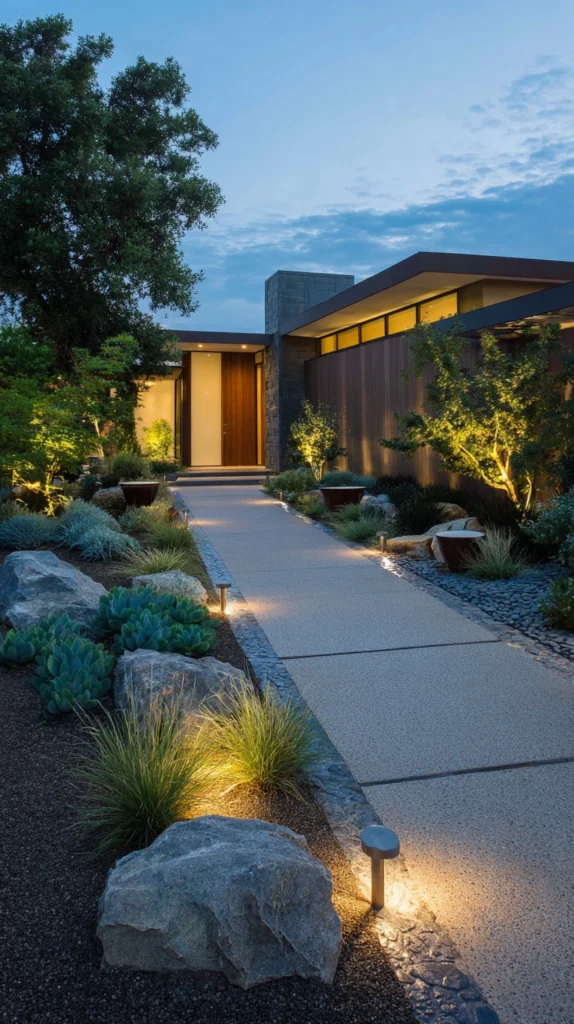
Budget: $150 – $800
Recessed ground lights — flush-mounted fittings set into the path surface itself so that the light source is at foot level and the fitting sits flush with the paving — produce the most dramatic and the most minimal pathway lighting available. There is nothing above the surface to look at, no fixture to trip over, no stake to catch a lawnmower blade. Just warm light emerging from the ground at regular intervals, defining the path by illuminating it from within.
Recessed in-ground LED path lights in stainless steel or brass cost $30 – $80 each. A path requiring eight fittings — four per side or eight inline — runs $240 – $640 in fittings alone. Installation requires cutting into existing paving or laying fittings during new paving work, which is most economically done as part of a wider landscaping project. Waterproofing to IP67 standard is the minimum rating for any ground-level outdoor fitting.
Decor tip: Use recessed ground lights on paved paths rather than on gravel or loose-laid surfaces. A flush fitting on a paved surface is secure and permanent. The same fitting on gravel shifts over time, admits moisture at the edges, and becomes unreliable within a season. Surface-mounted fittings are the correct choice for loose-laid paths.
4. The Lantern Post Avenue
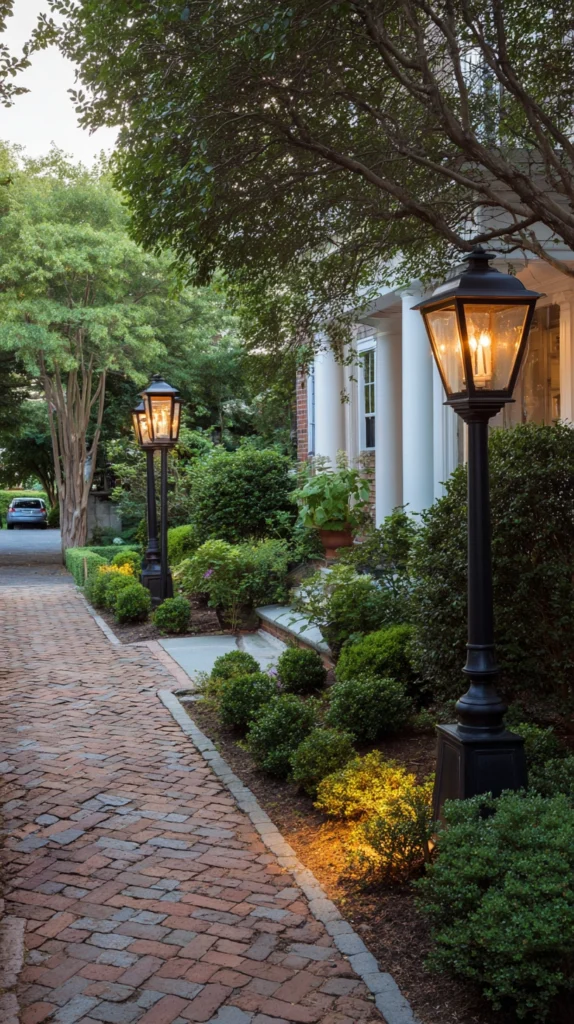
Budget: $120 – $600
Tall post lanterns — the kind that recall gas-lit Victorian streets or the entrance drives of manor houses — placed at intervals along a front path create a sense of formal arrival that no stake light or recessed fitting can replicate. The height matters: a lantern at 1.2 metres illuminates the path from a position that also casts light across the face and the entrance planting, producing a layered effect that low-level fittings cannot achieve.
Cast iron or aluminium post lanterns in a period or contemporary style cost $40 – $150 each. A mains-powered post requires electrical cable buried in conduit and connection by a qualified electrician — budget $100 – $300 for installation depending on cable run length. Solar post lanterns at $30 – $80 each avoid the electrical requirement entirely, though the light output is lower and the runtime on overcast winter days can be unreliable.
Decor tip: Choose a lantern style that matches the architectural period of the house rather than working against it. A Victorian cast iron lantern on a mid-century modern house creates a visual conflict that neither element wins. A simple, unadorned post with a clean geometric shade works with almost any architecture and dates far more slowly than period-specific styles.
5. The String Light Canopy Approach
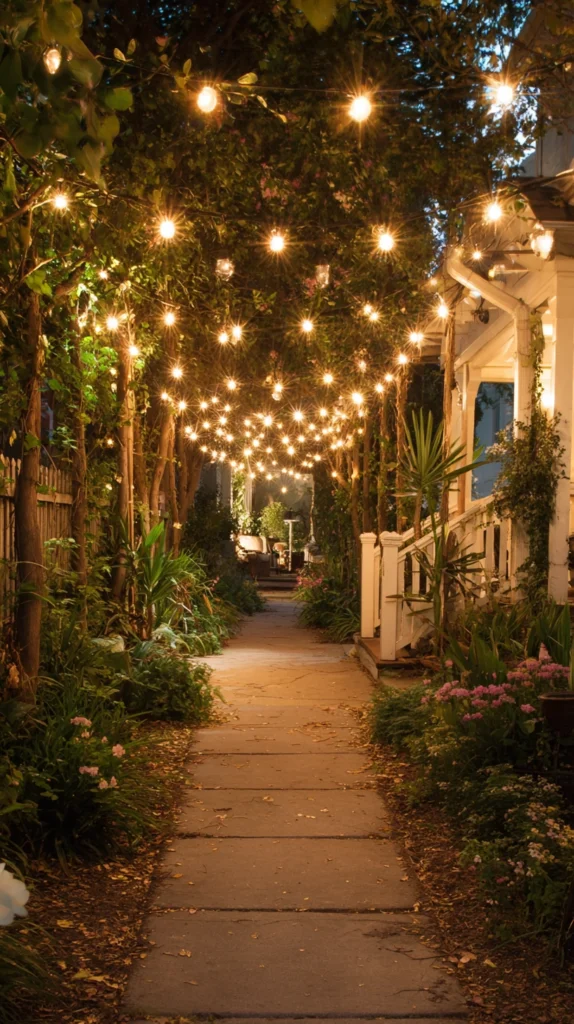
Budget: $40 – $250
String lights strung between two parallel posts or along a pergola structure above the front path create a canopy of warm light that turns the approach to the front door into something genuinely magical in the evening. The effect is well-established in garden restaurants and outdoor events, but it is equally appropriate — and relatively rare — in residential front yards, where the sense of being welcomed under a lit canopy is immediate and warm.
Outdoor-rated string lights with large globe bulbs cost $20 – $60 per 10-metre length. Timber or metal posts to suspend the string from cost $20 – $60 each installed. For a path with an existing pergola or overhead structure, the installation requires only cable, hooks, and a power connection — total materials under $80. Warm filament-style bulbs at 2200K produce a golden glow that is significantly warmer and more welcoming than standard warm white LEDs.
Decor tip: Use string lights with individually replaceable bulbs rather than integrated LED strings. When a single bulb fails on an integrated string, the repair options are limited and the replacement often involves buying a new string entirely. Individual screw-fit bulbs cost $1 – $3 each to replace and extend the useful life of the string indefinitely.
6. The Bollard Light Formation
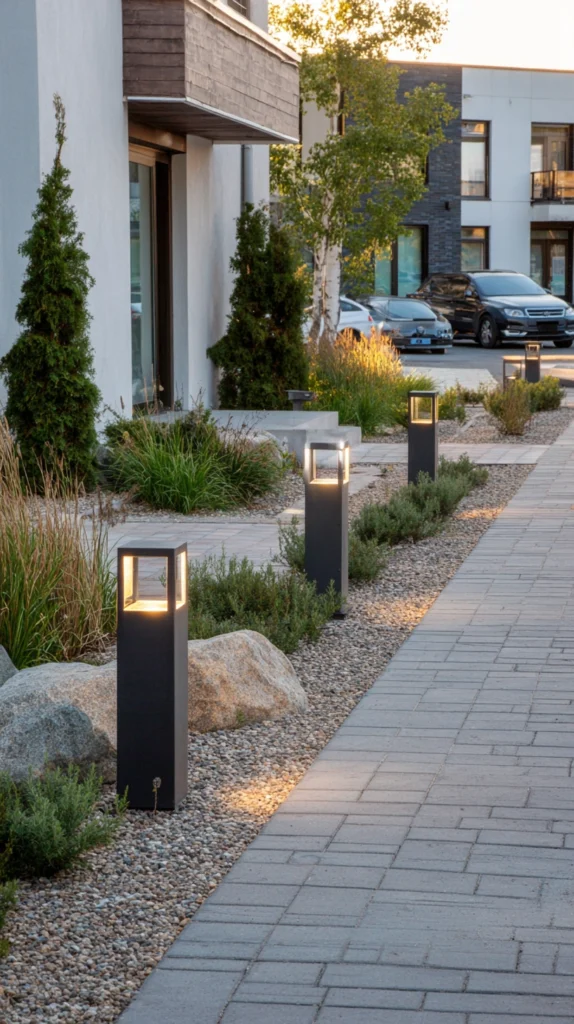
Budget: $100 – $600
Bollard lights — short, self-contained cylindrical or square fittings on a ground-mounted post — are the most robust and the most weather-resistant of all pathway lighting options. They are designed for public realm applications where fittings must survive vehicle impact, vandalism, and decades of outdoor exposure, which means in a residential front yard they are effectively indestructible. Contemporary bollard designs in corten steel, matte black aluminium, and concrete are genuinely beautiful objects in daylight as well as functional light sources at night.
Contemporary bollard lights in matte black or corten steel cost $40 – $150 each. A mains-powered run of four to six bollards along a front path requires cable burial and electrical connection — budget the installation accordingly. Solar bollard lights in architectural finishes run $30 – $80 each and are entirely self-contained, removing all electrical complexity from the project.
Decor tip: Choose bollard lights with a full or partial cutoff — a design that directs light downward and outward rather than upward and in all directions. Bollards without cutoffs produce glare at eye level when approached along the path, which is both uncomfortable and counterproductive in a fitting whose purpose is to make the approach more pleasant.
7. The Moonlighting Effect From Above
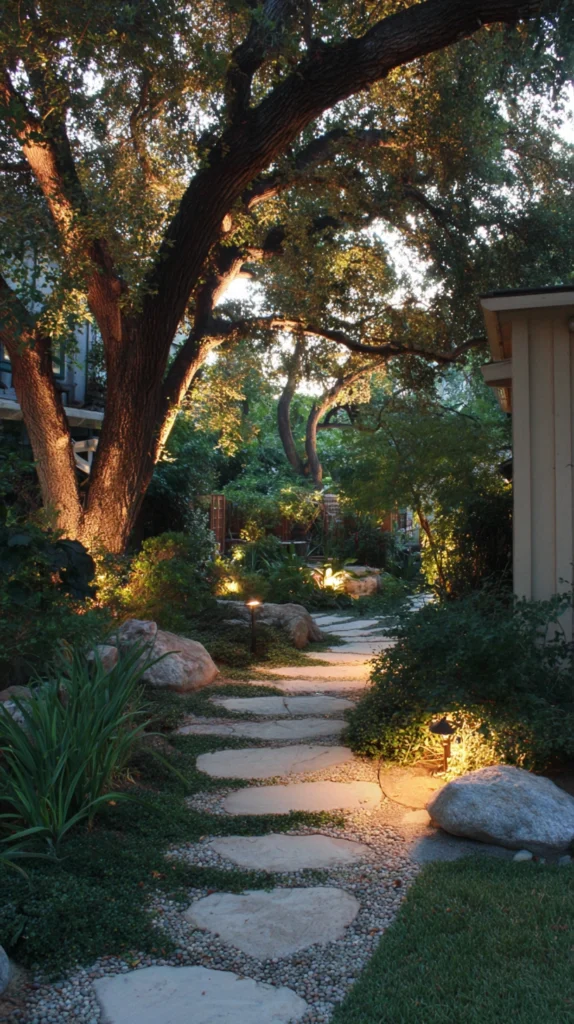
Budget: $80 – $400
Moonlighting — the technique of placing downlights high in trees or on tall posts and angling them to shine down through foliage onto the path below — produces the most naturalistic and the most romantically beautiful pathway lighting effect available. The light filters through leaves and branches, casting dappled, moving shadows across the path surface that suggest moonlight in a way no ground-level fitting can approach. It is the technique used in the finest landscape lighting schemes and it is achievable at a domestic scale.
Weatherproof downlight fittings suitable for tree or post mounting cost $20 – $60 each. Mounting on an existing tree requires only a non-damaging strap bracket — $5 – $15 — to avoid screwing into live wood. A tall post alternative runs $30 – $80 installed. The electrical run from the house to the tree or post is the main cost variable — a short run of 10 metres adds $30 – $60 in cable and conduit.
Decor tip: Use a very low lumen output — 200 to 400 lumens — for moonlighting fittings. The effect depends on subtlety. A high-output downlight aimed through tree foliage simply illuminates the canopy harshly rather than filtering softly through it. The most convincing moonlighting effect comes from fittings that are barely perceptible as light sources but produce a pool of gentle illumination on the surface below.
8. The Step Light Integration
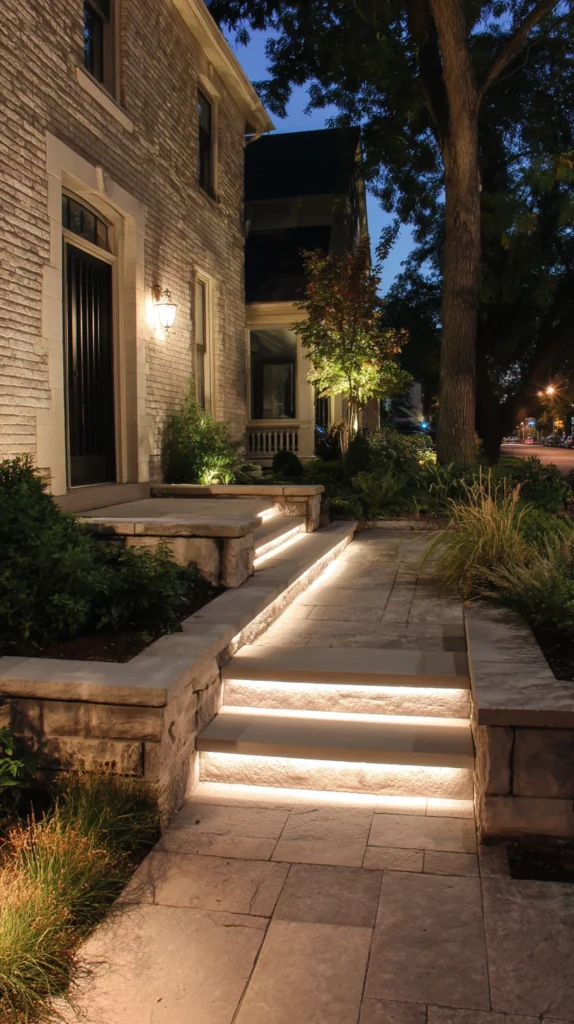
Budget: $60 – $400
Where a front path includes steps — even one or two risers between levels — integrating lights into the riser face of each step is one of the most safety-conscious and most elegant solutions available. The light source is invisible from above — you walk on a lit surface and see no fitting — and the effect is a series of gently glowing horizontal lines that define the level changes clearly without producing any glare.
Recessed LED step lights in brushed steel or matte black cost $15 – $40 each. A flight of four steps requires four fittings — one per riser — at a total fitting cost of $60 – $160. Installation into existing step risers requires cutting a rectangular recess and running cable through the step structure — straightforward on hollow concrete or timber steps, more complex on solid stone or brick which may require professional cutting tools.
Decor tip: Wire step lights on a separate circuit from the rest of the pathway lighting so they can remain on throughout the night as a permanent safety feature regardless of whether the decorative path lights are on a timer or sensor. A step that cannot be seen is a hazard — step lights should be treated as safety infrastructure first and decorative element second.
9. The Garden Torch and Flame Effect Path
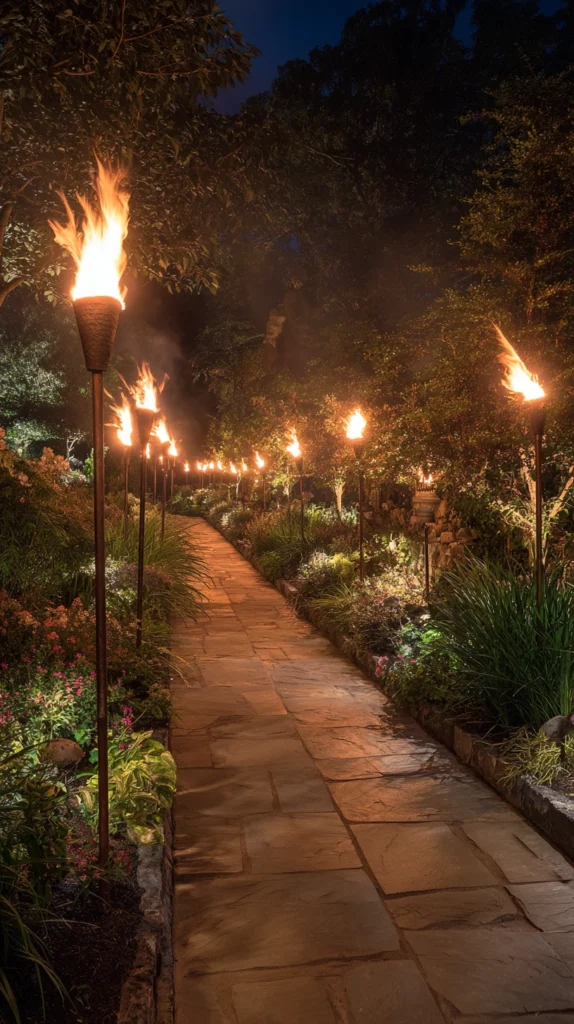
Budget: $40 – $300
Tall garden torches — either real flame oil torches or high-quality LED flame-effect versions — placed at intervals along the path create an approach that feels genuinely ceremonial. The flickering, the warmth, and the height all contribute to an atmosphere that electric fittings rarely produce. For evenings with guests, a lit torch path transforms the front yard into something that communicates welcome immediately and without ambiguity.
Real flame garden torches with an oil reservoir cost $15 – $40 each. Garden torch oil at $8 – $15 per litre provides several evenings of burn time per torch. LED flame-effect torches — which use a realistic flickering LED mechanism rather than real fire — cost $20 – $60 each and run on rechargeable batteries, removing the fire management entirely. A path requiring six torches — three per side — costs $90 – $360 in total depending on the type chosen.
Decor tip: Extinguish real flame torches fully before leaving them unattended and store them in a dry location when not in use. An open flame torch left burning in a front yard overnight is a genuine fire hazard, particularly near timber fencing, dry planting, or buildings with timber cladding. LED alternatives remove this concern entirely and are the more practical choice for regular use.
10. The Illuminated Planter Approach
Budget: $80 – $500
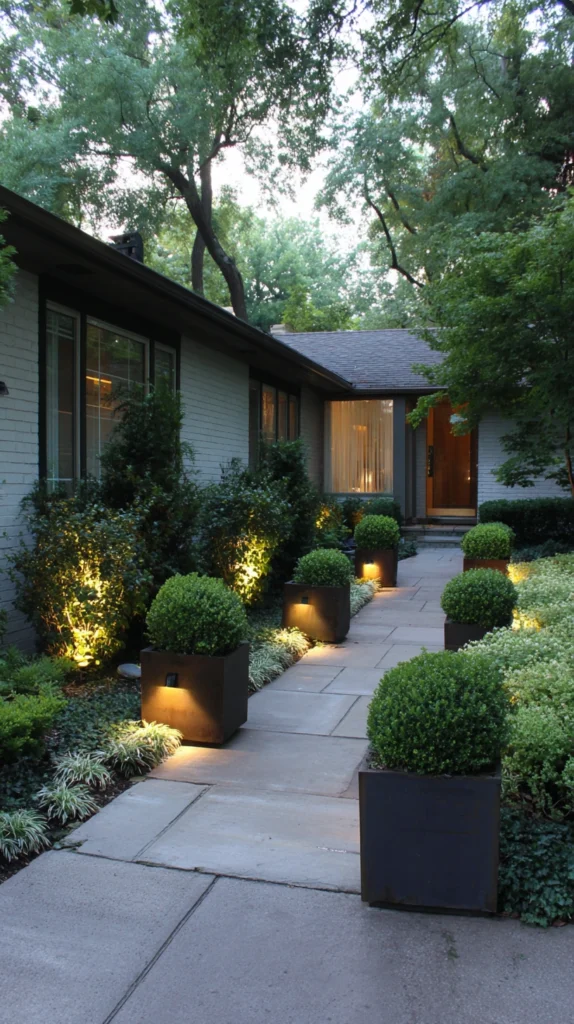
Large planters with integrated LED lighting — or standard planters fitted with a discreet uplight inside the pot aimed at the plant above — placed as anchors at regular intervals along the path combine the function of pathway lighting with the decorative contribution of structured planting. An illuminated box hedge, a glowing olive tree, or a lit architectural agave beside the path at night looks considerably more considered than a path lined exclusively with dedicated light fittings.
Planters with integrated LED lighting in fibreglass or polyethylene cost $60 – $200 each. Standard terracotta or fibreglass planters paired with a small waterproof uplight inside the pot — $15 – $30 per fitting — achieve a similar effect at lower cost. Solar uplights placed inside or beside a planter run $10 – $20 each and require no wiring, making this a genuinely simple installation for any front yard.
Decor tip: Choose plants with structural architectural form for illuminated planters — box balls, standard bays, columnar cypress, or ornamental grasses. Loose, spreading plants lose their definition under direct lighting and can look untidy. A plant with a clear, geometric or sculptural shape reads beautifully when lit from below and becomes a focal point rather than simply a softening element.
11. The Colour-Changing Smart Path Lights
Budget: $100 – $600
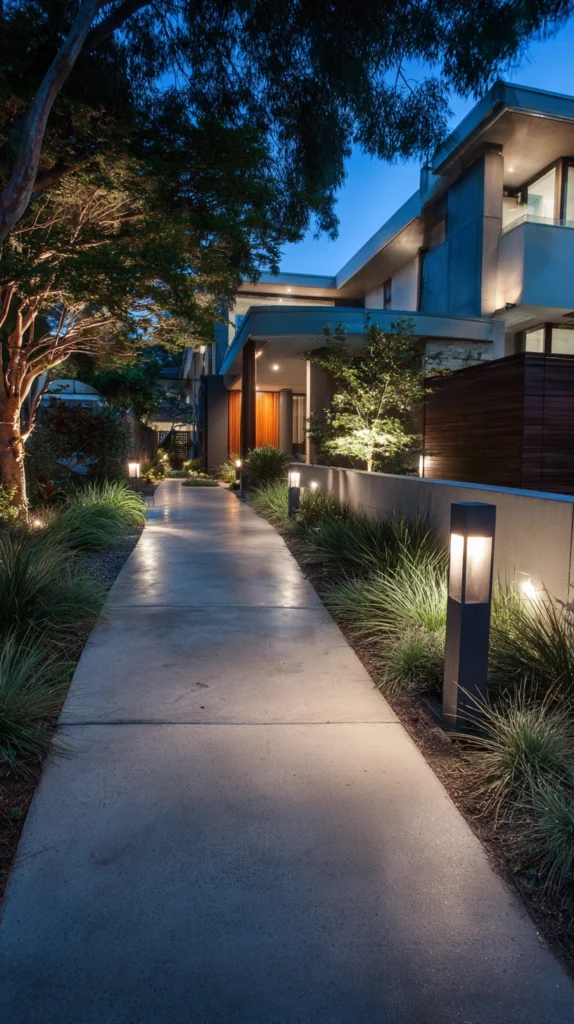
Smart pathway lights — connected to a home automation system or a dedicated app and capable of shifting colour temperature, dimming, and cycling through a spectrum of colours — are the most technically sophisticated option on this list and also the one with the most day-to-day flexibility. A pathway that glows warm amber on a summer evening, shifts to cool white when the front door sensor is triggered, and cycles through seasonal colours for particular occasions is a genuinely useful piece of infrastructure as well as a decorative one.
Smart outdoor path lights compatible with standard home automation platforms cost $20 – $60 each. A hub or bridge to connect the system runs $30 – $80 if not already installed. A full smart path lighting setup for a standard front yard sits at $200 – $500 in total. The ongoing running cost is negligible — LED smart lights consume less power than almost any other form of path lighting.
Decor tip: Set your default colour temperature to 2700K warm white for everyday evening use rather than using the colour-changing features as a regular setting. The novelty of coloured garden lighting fades quickly and a front yard cycling through green, blue, and red has a commercial rather than residential quality that works against the welcoming atmosphere the installation is intended to create.
12. The Reflective Water Feature Path Edge
Budget: $100 – $800
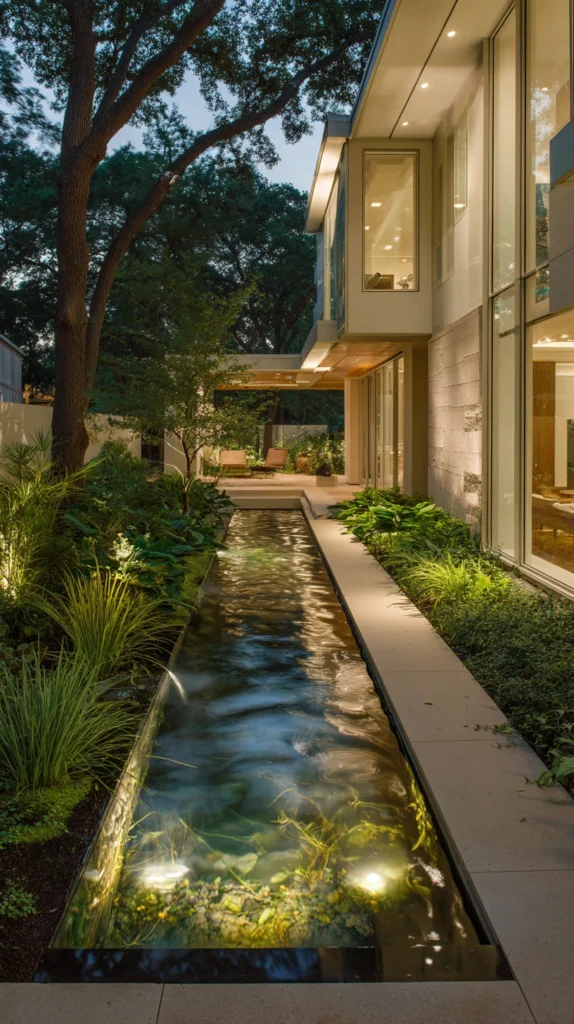
A narrow rill or linear water feature running parallel to the front path — lit from within by submersible LEDs — provides pathway lighting in its most indirect and most beautiful form. The water surface reflects and multiplies the light, the movement of water adds a dynamic quality that no static fitting can replicate, and the sound of gently moving water at the front of a house communicates a quality of environment that immediate neighbours will notice and visitors will comment on.
A pre-formed narrow rill or canal water feature kit costs $80 – $300. Submersible LED strip lighting for a one-metre rill run costs $20 – $50. A small recirculating pump runs $20 – $60. The installation requires a shallow trench beside the path, a waterproof liner, and a power connection for the pump and LEDs. The result — a line of quietly lit, gently moving water beside the front path — is one of the most genuinely distinctive front yard features achievable at this price point.
Decor tip: Use warm white submersible LEDs rather than cool white or coloured options inside a water feature. Cool light in moving water looks clinical rather than serene. Warm light in gently moving water looks like candlelight reflected on a river surface — which is precisely the atmospheric quality the feature is designed to produce.
13. The Glow Paver and Phosphorescent Path Insert
Budget: $60 – $400
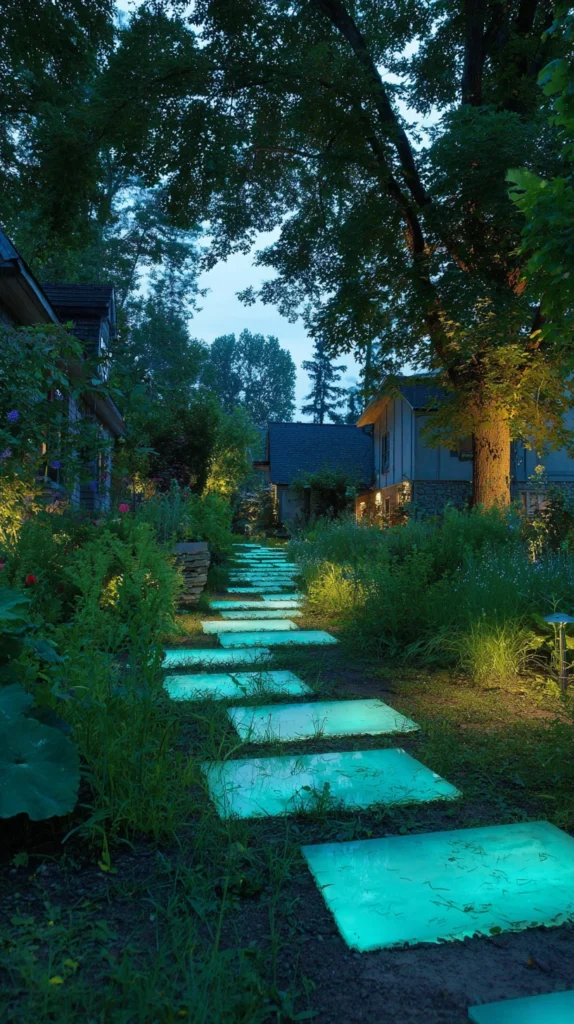
Glow-in-the-dark path inserts — either phosphorescent pebbles mixed into a resin path surface, self-contained glow pavers that charge during the day and emit light at night, or luminescent aggregate mixed into concrete — produce pathway lighting with no electrical component whatsoever. The path charges passively throughout the day and glows for four to eight hours after dark, producing a soft, cool-toned light that is genuinely unlike anything an electrical fitting can produce.
Phosphorescent glow pebbles for path surfacing cost $20 – $60 per kilogram — a standard path requires two to four kilograms mixed into the surface layer. Pre-cast glow pavers in standard sizes run $10 – $30 each. Luminescent aggregate added to a concrete mix costs $15 – $40 per bag. The light output is lower than electrical alternatives and not suitable as the sole pathway lighting solution, but as a supplement to other fittings or as a decorative feature in its own right, it is quietly extraordinary.
Decor tip: Maximise the daytime charging of phosphorescent path materials by keeping the path surface free of leaf litter, moss, and debris that shade the material from direct light. A phosphorescent surface that charges in full sun for six hours produces significantly more light output than one that charges in partial shade or through a layer of accumulated material. Clear the path regularly and the nighttime performance improves accordingly.
Whatever combination of these thirteen ideas you bring to your front yard, the underlying principle remains the same: the path from gate to door is not a utility corridor, it is a designed experience. The light that lines it, the shadows it casts, and the warmth or coolness of its colour temperature all communicate something about the house before the front door is even reached.
Approach your front path as a landscape designer would — as a sequence of moments, each lit with intention — and the result will be a front yard that feels genuinely welcoming at every hour, in every season, and from the very first step inside the gate.