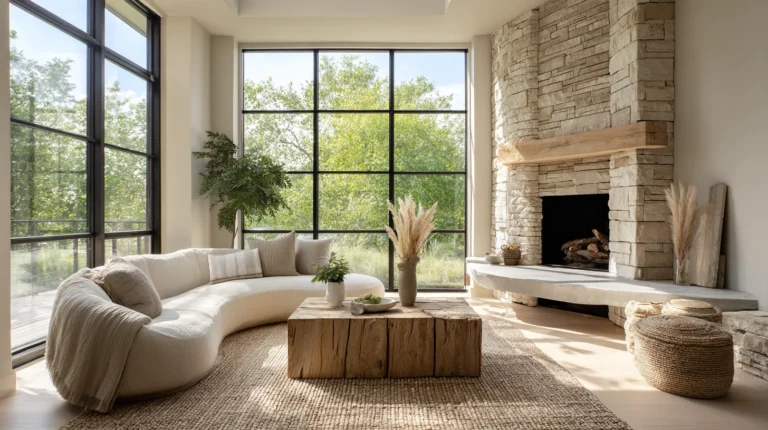

14 Summer Ceiling Decor Ideas That Add Character to Any Room
There is a surface in every room that almost nobody decorates. It covers the same square footage as the floor, it sits within eyeline whenever you lie down or look up from a sofa, and yet it is painted white in the overwhelming majority of homes and left entirely alone.

The ceiling is the room’s most consistently wasted opportunity — and in summer especially, when light is longer and the mood of a space matters more, it deserves considerably better treatment than a coat of trade white and a pendant fitting.
The fourteen ideas below treat the ceiling as what it actually is: the fifth wall, the overhead canvas, the surface that, when given even modest attention, transforms the character of a room in ways that no floor rug or gallery wall can replicate. Each idea covers what you will need, what it will cost, and a practical tip to make it genuinely work.
1. The Whitewashed Timber Beam Installation
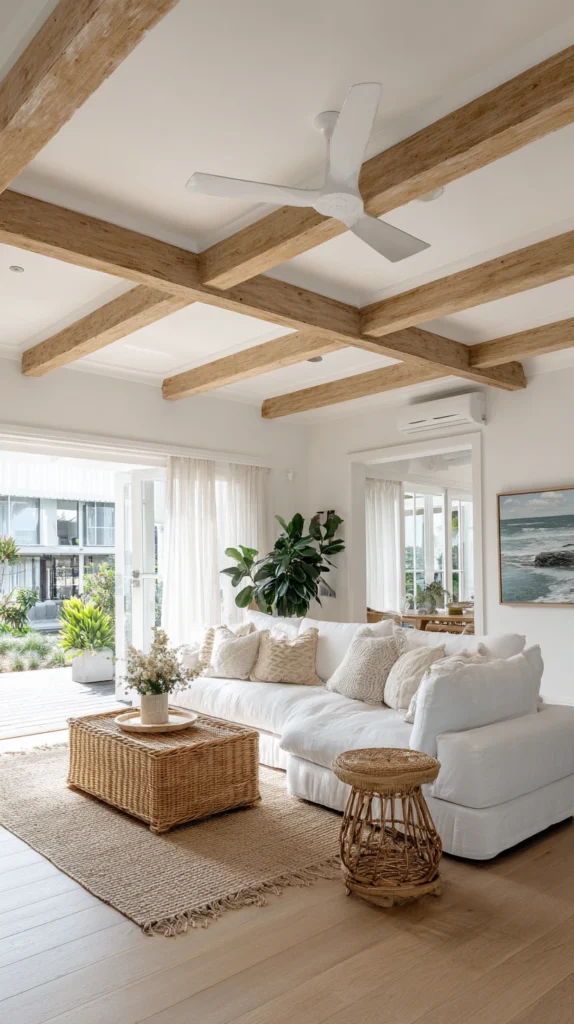
Budget: $80 – $600
Exposed ceiling beams — or beams that appear to be structural but are in fact decorative — add more architectural character to a room than almost any other single intervention. Whitewashed or limewashed, they carry the coastal and rural aesthetic into urban interiors without requiring a sympathetic building to start from. A plain plasterboard ceiling fitted with three or four evenly spaced decorative beams in pale timber looks like a room that was built with intention rather than one that was finished in a hurry.
Hollow decorative beam casings in lightweight polyurethane — far easier to install than solid timber — cost $30 – $80 per metre. Solid pine or oak beams run $20 – $60 per metre raw and require cutting, sanding, and finishing before installation. A whitewash finish applied with a dry brush and wiped back immediately costs $15 – $30 in materials and produces a sun-bleached result that reads as authentic regardless of the beam material beneath.
Decor tip: Space decorative beams at equal intervals and align them with a structural feature of the room where possible — running parallel to the longest wall, or centred above a dining table or sofa. Beams placed without reference to the room’s architecture look applied rather than integral, and the difference is immediately visible.
2. The Statement Ceiling Colour
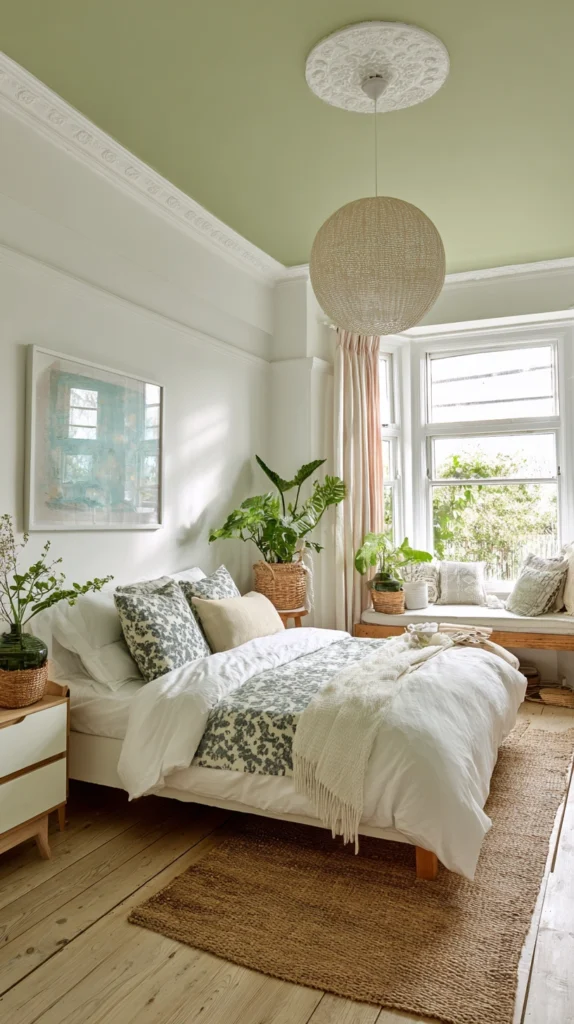
Budget: $30 – $150
Painting the ceiling a colour — a proper, considered colour rather than the standard white — is one of the most effective and most underused decorating moves available. A ceiling painted in soft sage, faded denim blue, warm terracotta, or deep navy does something that no wall colour can: it creates an enveloping quality that makes the room feel simultaneously more intimate and more interesting. In summer, pale watery blues and soft greens read as sky and canopy, bringing outdoor associations indoors without a single plant or natural material required.
Ceiling paint in specialist low-sheen finish costs $15 – $40 per litre — a standard bedroom ceiling requires one to two litres. An angled cutting-in brush for clean edges at the cornice costs $8 – $20. A good quality roller on an extension pole covers the field quickly and avoids the neck strain of working from a short-handled roller on a standard step ladder.
Decor tip: Go darker on the ceiling than instinct suggests. The eye consistently underestimates how a colour will read overhead because the ceiling receives less direct light than walls and reads approximately two shades lighter in practice than it does on a paint chip held at eye level. Choose the shade you want, then go one tone deeper.
3. The Hanging Rattan and Wicker Pendant Collection
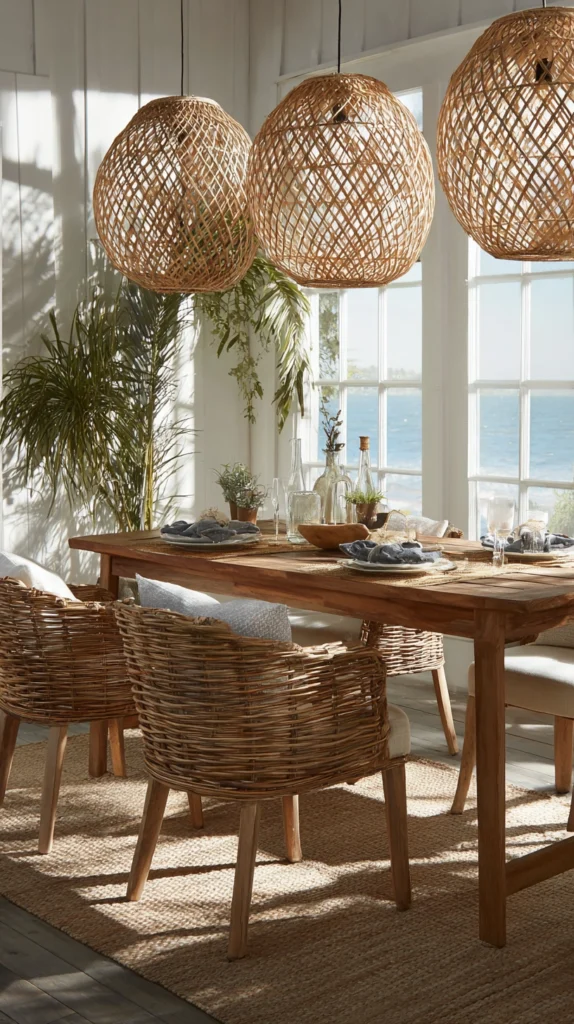
Budget: $60 – $400
A cluster of rattan, wicker, or woven pendant shades suspended at varying heights from the ceiling is one of the defining lighting moments of the coastal summer interior. The material filters light warmly, casts intricate shadow patterns across walls and ceilings, and has a visual texture that glass and metal fittings simply cannot produce. A single large rattan pendant is beautiful. Three of them clustered at different heights over a dining table or in a living room corner is genuinely arresting.
Individual rattan pendant shades cost $25 – $80 each. Pendant cord sets with ceiling roses and bulb holders run $10 – $25 per fitting. A warm-toned Edison or globe bulb at $5 – $15 each completes the fitting and maintains the warmth of the material rather than contradicting it with a cool white light source. Three pendants clustered together require three separate ceiling roses or a multi-pendant canopy fitting available for $20 – $50.
Decor tip: Hang clustered pendants at three distinct heights rather than two. A grouping at two heights reads as a pair with an extra. A grouping at three heights reads as a considered arrangement. The visual difference between the two is disproportionate to the effort required to achieve it.
4. The Macramé Ceiling Hanging
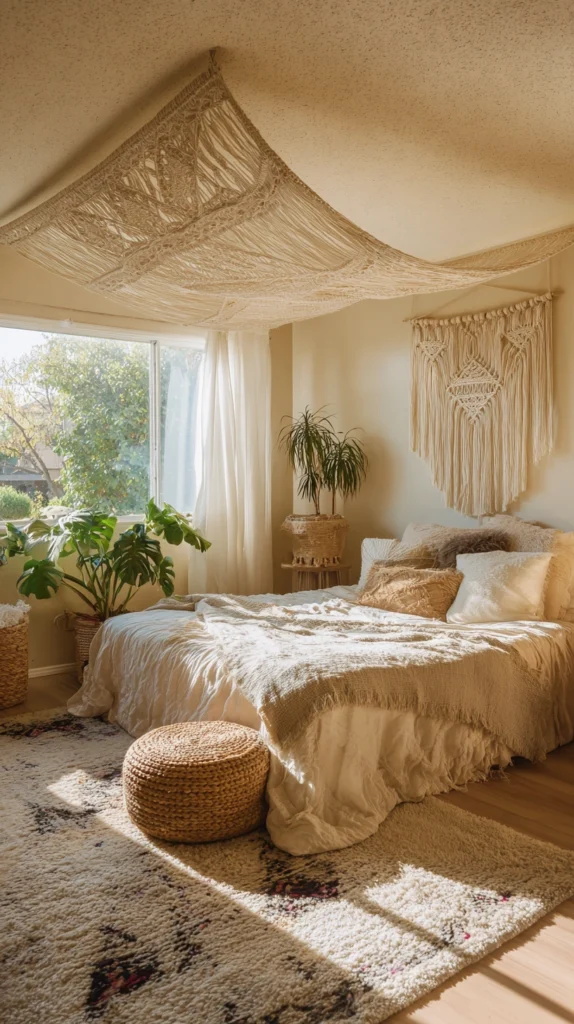
Budget: $30 – $200
A large macramé wall hanging repositioned as a ceiling installation — suspended horizontally from two points and allowed to drape naturally — creates a textile canopy effect that is deeply summer in character. It softens the hard plane of the ceiling, introduces natural cotton fibre into the overhead space, and casts gentle shadow patterns when light passes through its open weave. Above a bed, it functions as a bohemian alternative to a fabric canopy. Above a dining table, it frames the space from above without enclosing it.
Large macramé wall hangings suitable for ceiling installation cost $40 – $150. Natural cotton macramé cord for a DIY version runs $15 – $30 for a project quantity, and beginner-level ceiling hanging patterns are widely and freely available. Two ceiling hooks rated for light textile loads cost $5 – $15 total and are the only additional hardware required.
Decor tip: Suspend the macramé at a height that clears standing head height by at least 20 centimetres in any area where people will walk beneath it. A ceiling textile that catches hair or brushes shoulders consistently is a source of irritation rather than pleasure, and the elegant overhead effect is lost entirely the moment it becomes a physical obstacle.
5. The Dried Flower and Botanical Ceiling Installation
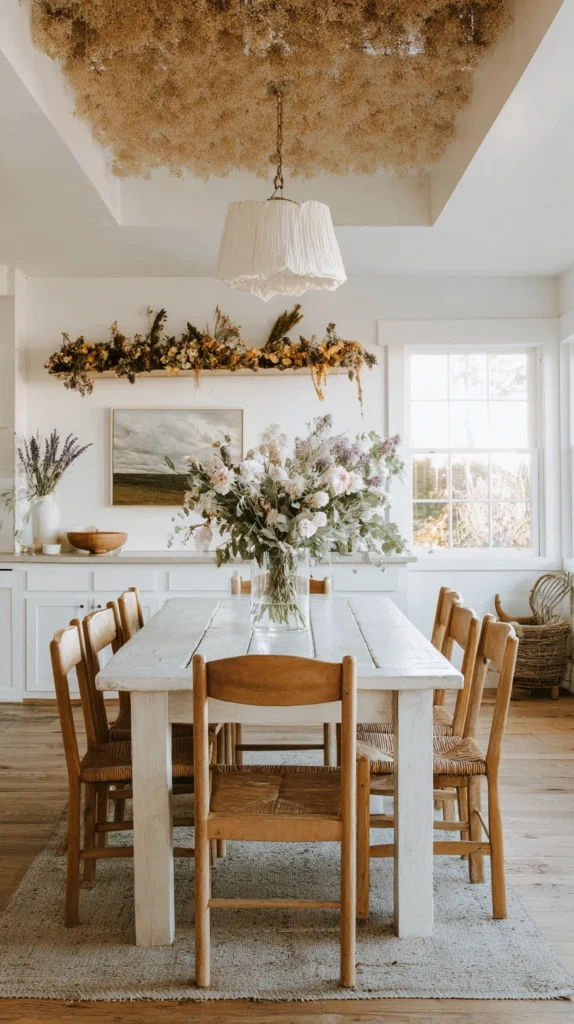
Budget: $20 – $150
Bundles of dried lavender, pampas grass, eucalyptus, wheat stalks, and wildflowers suspended upside down from the ceiling — either in a single generous cluster above a table or in smaller bundles distributed across ceiling hooks throughout a room — is one of the most romantically beautiful and least expensive ceiling treatments available. The scent of drying lavender or eucalyptus fills a room slowly over weeks, and the visual effect is somewhere between a farmhouse kitchen and a Provençal garden room.
Dried lavender bundles cost $5 – $15 each. Mixed dried botanical bundles run $10 – $30. Ceiling hooks rated for light loads — the bundles are lighter than they look — cost $3 – $10 for a pack. Natural jute twine to bind and suspend the bundles adds $5 – $10. The whole installation for a generous ceiling cluster costs under $50 in materials and takes an afternoon to arrange.
Decor tip: Hang dried botanicals away from air conditioning vents and ceiling fans. Moving air accelerates moisture loss and causes dried flowers to become brittle and shed far more quickly than they would in still conditions. A bundle that lasts six months in a calm room may last six weeks directly beneath a fan running on its summer setting.
6. The Ceiling Fan Upgrade
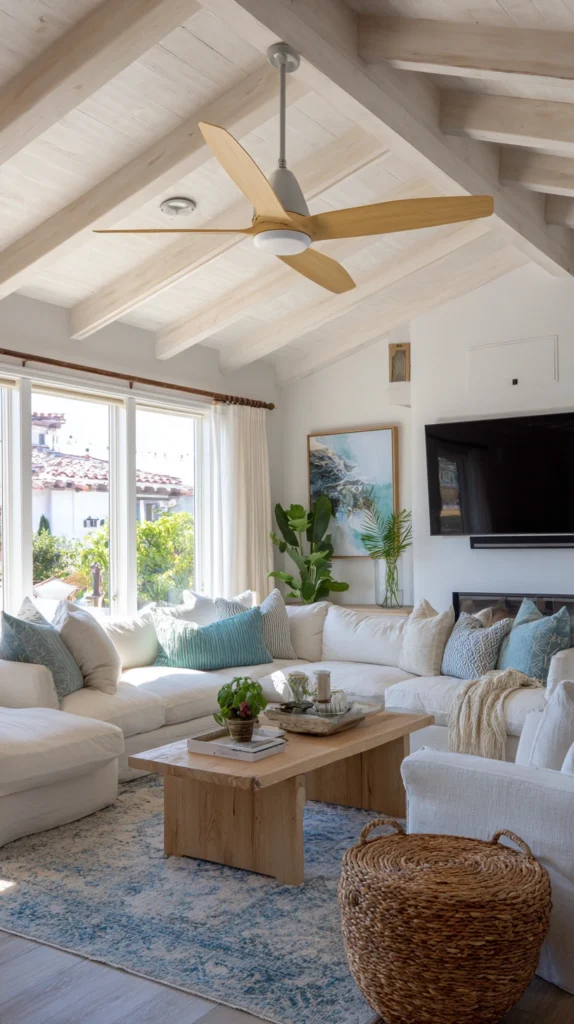
Budget: $80 – $500
The standard ceiling fan fitted in most homes is a functional object with no aesthetic intention whatsoever. It moves air competently and looks as though that is all it was ever expected to do. Replacing it with a design-led ceiling fan — rattan blades, matte black with cane details, pale wood with a minimal profile, or a sculptural palm-leaf style — transforms a purely functional fitting into a genuine design statement that also happens to cool the room. In summer, this is the ceiling intervention with the highest practical return.
Design-led ceiling fans with rattan or timber blade styling cost $80 – $300. Remote-controlled models with adjustable speed and direction run $120 – $500. Installation by a qualified electrician where required adds $50 – $150 but ensures safe wiring and correct directional setup — a fan running in the wrong direction in summer pushes warm air down rather than drawing it up, which defeats the purpose entirely.
Decor tip: Switch your ceiling fan to run counter-clockwise in summer. This creates a downdraft that produces the direct cooling effect needed on warm days. Clockwise rotation at low speed — the winter setting — redistributes warm air that has risen to the ceiling but produces no cooling sensation whatsoever.
7. The Canopy of Fairy Lights
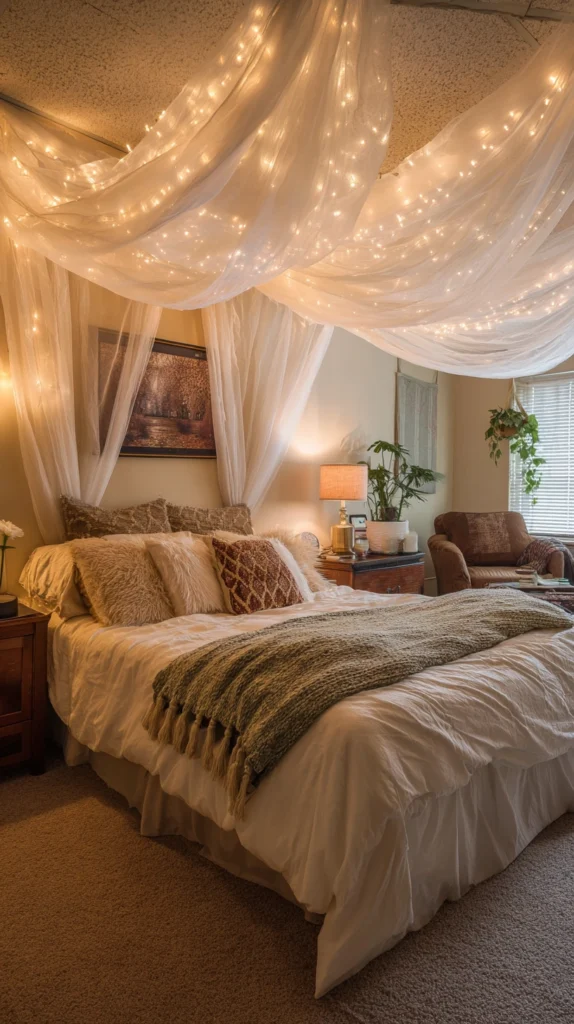
Budget: $20 – $120
Warm fairy lights strung across a ceiling in loose, undulating drapes — pinned at the perimeter and allowed to sag gently in the centre — turn an ordinary ceiling into something that resembles the underside of a forest canopy or the inside of a lit marquee. The effect in the evening, when the overhead lights are off and the fairy lights are the only source of illumination, is one of the most atmospheric available at any price point. It works in bedrooms, in dining rooms, and on covered outdoor terraces with equal effect.
A 10-metre reel of warm white fairy lights costs $8 – $20. Adhesive ceiling clips rated for light cable loads run $5 – $15 for a pack. Two or three reels draped across a ceiling provide enough coverage for a standard bedroom at a total cost under $60. Battery-operated reels remove the need for a power cable running visibly down a wall — relevant in rooms without a conveniently placed ceiling socket.
Decor tip: Use warm white lights — around 2700K colour temperature — rather than cool white or multicoloured. Cool white fairy lights produce a clinical, commercial feel that is entirely at odds with the warm, intimate atmosphere the installation is trying to create. Warm white is the only colour temperature that reads as genuinely cosy overhead.
8. The Fabric Ceiling Drape
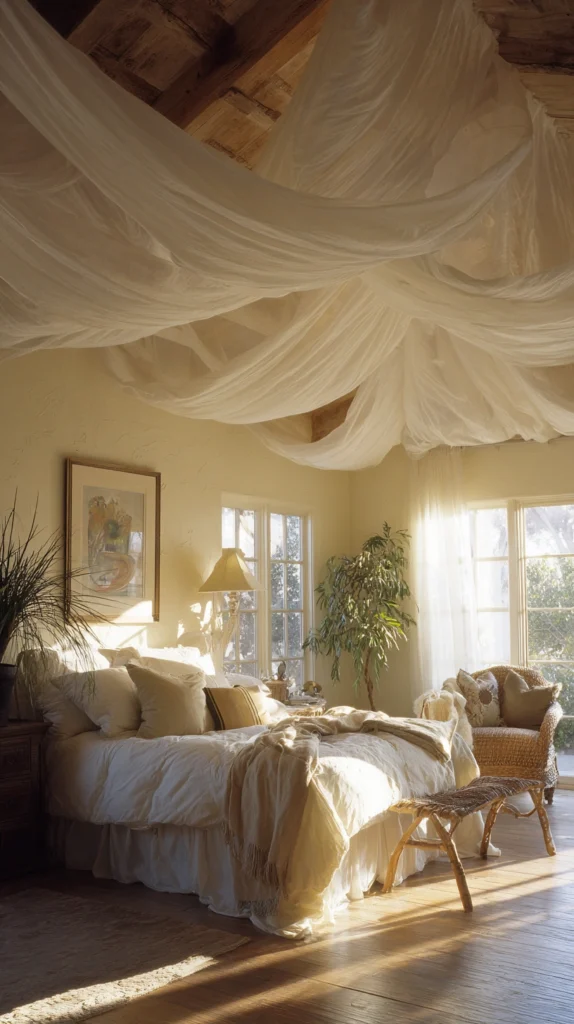
Budget: $40 – $300
Lengths of sheer cotton, muslin, or lightweight linen draped from a central ceiling point and pinned at the four corners or along the walls create a tented ceiling effect that transforms a room’s sense of height and enclosure. It is the indoor equivalent of a Bedouin tent or a pavilion ceiling, and it works particularly well in bedrooms, where the draped fabric overhead creates an immediate sense of retreat and shelter. In summer whites, naturals, and pale blues, the effect is romantic without being heavy.
Sheer cotton muslin by the metre costs $3 – $8 per metre — a standard bedroom requires 10 to 15 metres for a generous drape. A central ceiling ring and hook to gather the fabric runs $5 – $15. Adhesive hooks or small cup hooks along the walls to anchor the fabric at the perimeter add $5 – $20. The total material cost for a full bedroom ceiling drape sits comfortably under $100.
Decor tip: Pre-wash all fabric before draping to remove any stiffness from the manufacturing process. Unwashed muslin or cotton holds a fold memory that makes the drape look pressed and artificial rather than soft and natural. A single machine wash and a gentle tumble dry removes this completely and allows the fabric to fall with the ease the installation requires.
9. The Botanical Wallpaper Ceiling
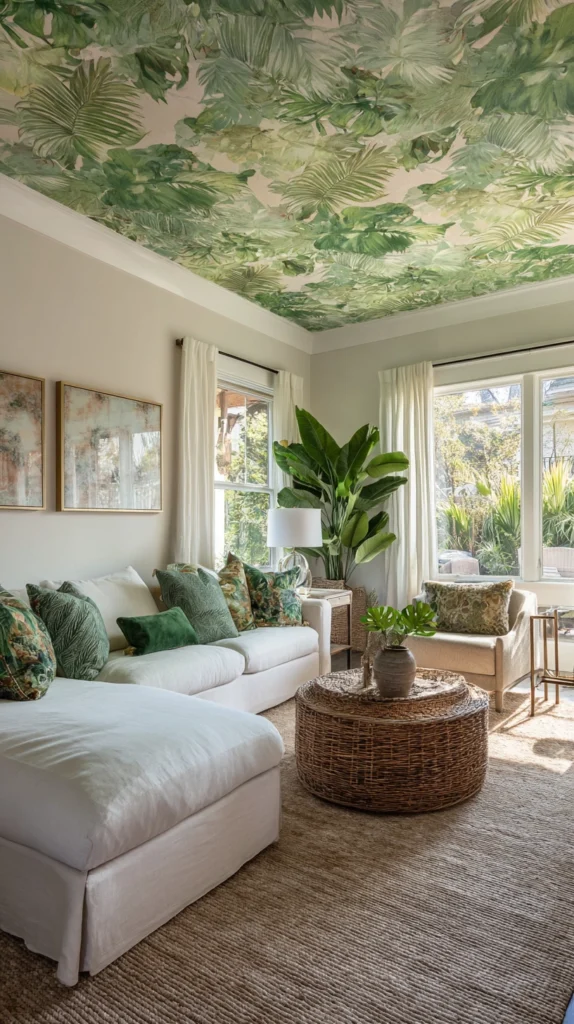
Budget: $40 – $250
Wallpaper is not exclusively a wall material. Applied to a ceiling — a flat, uninterrupted surface that is far simpler to paper than a wall full of sockets, switches, and architraves — it creates an overhead pattern that changes the entire character of the room below. A large-scale botanical print, a tropical leaf pattern, a watercolour floral, or a simple geometric in summer tones on a ceiling makes a room feel designed from the inside out rather than decorated from the edges in.
Ceiling wallpaper in a bold botanical or tropical print costs $15 – $50 per roll — a standard bedroom ceiling requires three to five rolls depending on pattern repeat. Wallpaper paste and a ceiling brush add $15 – $30. The application process is physically awkward but technically straightforward, and the result is dramatic enough to justify the effort considerably.
Decor tip: Choose a wallpaper with a small or no pattern repeat for a ceiling application. Large pattern repeats require careful matching across ceiling drops and produce significant offcut waste — a small repeat or an all-over print papers cleanly and economically with far less complexity.
10. The Wisteria or Trailing Vine Faux Installation
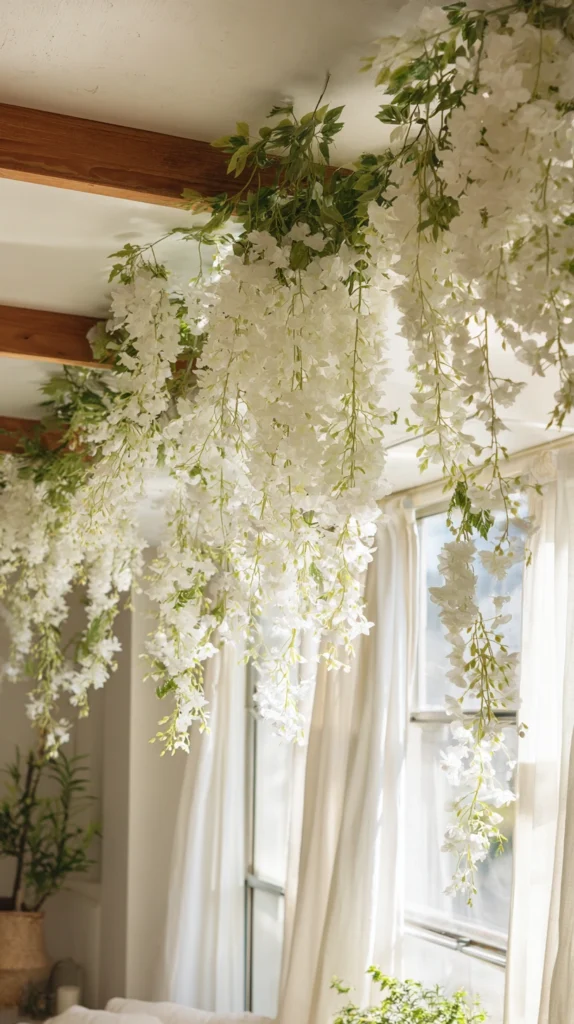
Budget: $30 – $200
Artificial wisteria, trailing ivy, or climbing rose garlands fixed along ceiling beams, wound around pendant cords, or draped across curtain tracks create an overhead garden effect that is genuinely beautiful when done with quality materials. The key distinction is between cheap plastic foliage — which reads as fake from any distance — and high-quality silk or fabric botanicals, which, in the dappled light of a summer room, are remarkably convincing.
High-quality artificial wisteria garlands cost $15 – $40 per two-metre length. Trailing silk ivy in realistic leaf shapes runs $10 – $30 per strand. Four to six garlands across a ceiling or along a beam creates a generous, immersive effect for under $150 in total. Fix with small adhesive hooks rated for light loads — the garlands are lighter than they appear and standard adhesive hooks hold them without difficulty.
Decor tip: Mix two or three varieties of artificial foliage rather than using a single type throughout. All-wisteria or all-ivy reads as uniform and artificial. A combination of wisteria, trailing leaf, and occasional flower clusters reads as natural abundance — which is precisely the effect the installation is pursuing.
11. The Painted Sky or Cloud Ceiling Mural
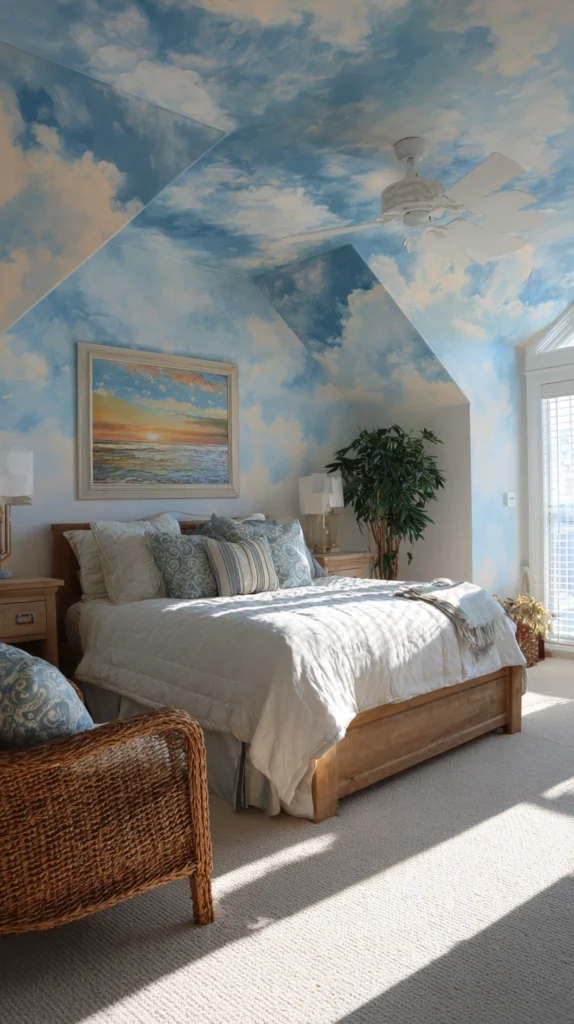
Budget: $30 – $300
A ceiling painted to suggest sky — pale cerulean blue fading to white at the edges, with soft cloud shapes blended in with a barely loaded sponge — is one of the oldest and most enduringly effective ceiling treatments in interior design. It is equally at home in a child’s bedroom and in an adult dining room, and the technique requires no particular painting skill — only patience, the right colours, and a willingness to blur rather than define.
Sky blue ceiling paint costs $15 – $35 per litre. Titanium white for cloud blending adds $8 – $15. A natural sea sponge — the correct tool for cloud blending — costs $5 – $15 and produces the soft, irregular edges that a brush cannot replicate. The entire material cost for a standard room ceiling sits under $60. For those who prefer a more detailed or ambitious mural, a local muralist runs $150 – $600 depending on complexity and ceiling size.
Decor tip: Work the clouds while the blue base coat is still slightly tacky rather than fully dry. Blending white into a completely dry blue produces hard edges that look painted. Blending into a tacky surface allows the two colours to merge softly at the boundaries, producing the gradual, atmospheric quality that makes the technique convincing.
12. The Hammock or Swing Chair Suspended From the Ceiling
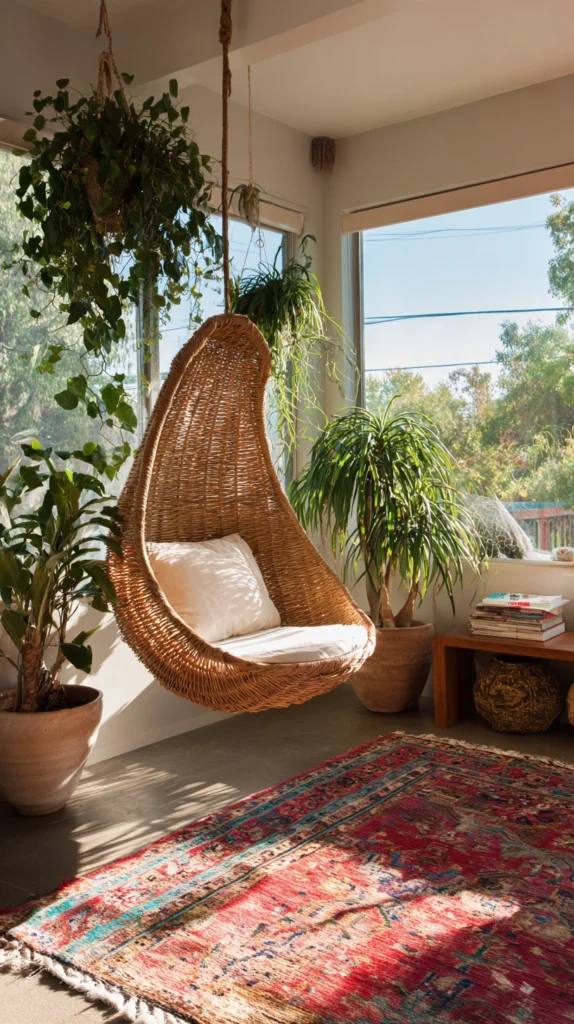
Budget: $60 – $400
A hammock chair suspended from a properly anchored ceiling joist turns the ceiling into an active, load-bearing part of the room’s furniture layout rather than a passive overhead surface. It changes the way people use the room, introduces an element of movement that no floor-standing furniture can provide, and signals immediately that the space is designed for relaxation rather than productivity. In summer especially, a gently swaying ceiling-hung chair is one of the most desirable seats a room can contain.
Cotton rope hammock chairs cost $40 – $120. A heavy-duty ceiling swivel hook rated for human loads — essential, not optional — costs $10 – $30. Professional installation into a structural joist by a carpenter or builder runs $50 – $150 where self-installation is uncertain. A swivel hook allows the chair to rotate freely without twisting the suspension cord, which significantly extends the life of the rope and improves the comfort of the swing.
Decor tip: Test the ceiling anchor with a static load before sitting in the chair. Hang a bag of equivalent weight — approximately 100 kilograms for an adult — from the hook for 24 hours before using it as a seat. Any movement in the fixing during this period indicates inadequate anchoring that must be corrected before the chair is used by a person.
13. The Pendant Light Cluster at Varying Heights
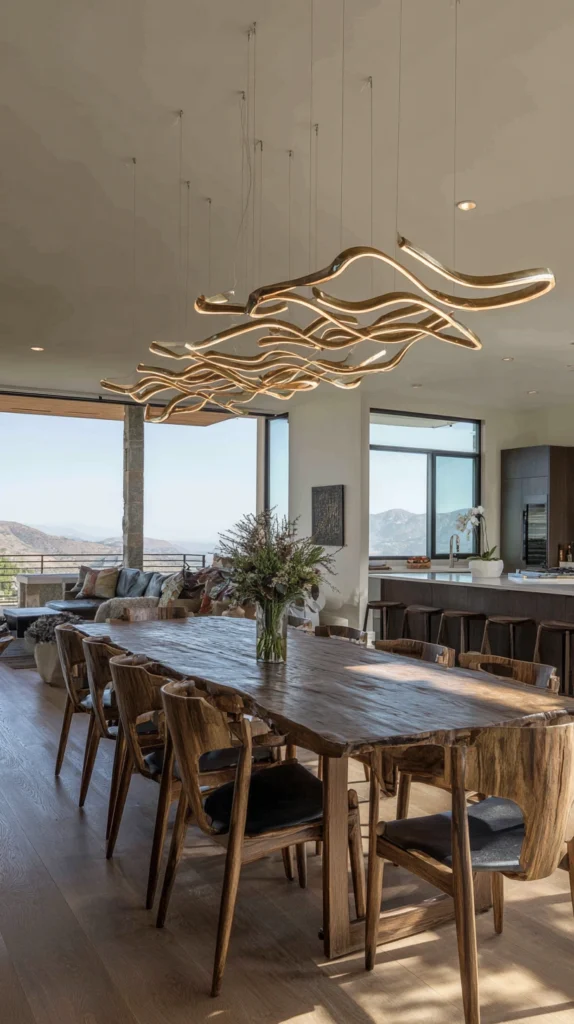
Budget: $80 – $500
A single pendant light is a functional decision. A cluster of five or seven pendants suspended at genuinely different heights — some low, some mid, some close to the ceiling — becomes a sculptural installation that changes the entire overhead character of the room. The cluster works best when the individual pendants share a material or colour family but vary in size and shape, creating cohesion without uniformity.
Individual glass, ceramic, or rattan pendant shades cost $20 – $80 each. A multi-pendant ceiling canopy that allows five to seven individual cords from a single ceiling rose costs $30 – $80 and removes the need for multiple electrical connections. Bulb type is critical — warm filament bulbs at $5 – $15 each maintain the warmth of the cluster, while LED equivalents in the same warm colour temperature offer the same aesthetic at lower running cost.
Decor tip: Stagger pendant heights by a minimum of 20 centimetres between each level to create a clear sense of depth. Pendants hung within 5 to 10 centimetres of each other read as a group at the same level — which defeats the visual interest that height variation is there to provide.
14. The Ceiling Medallion and Vintage Rose Feature
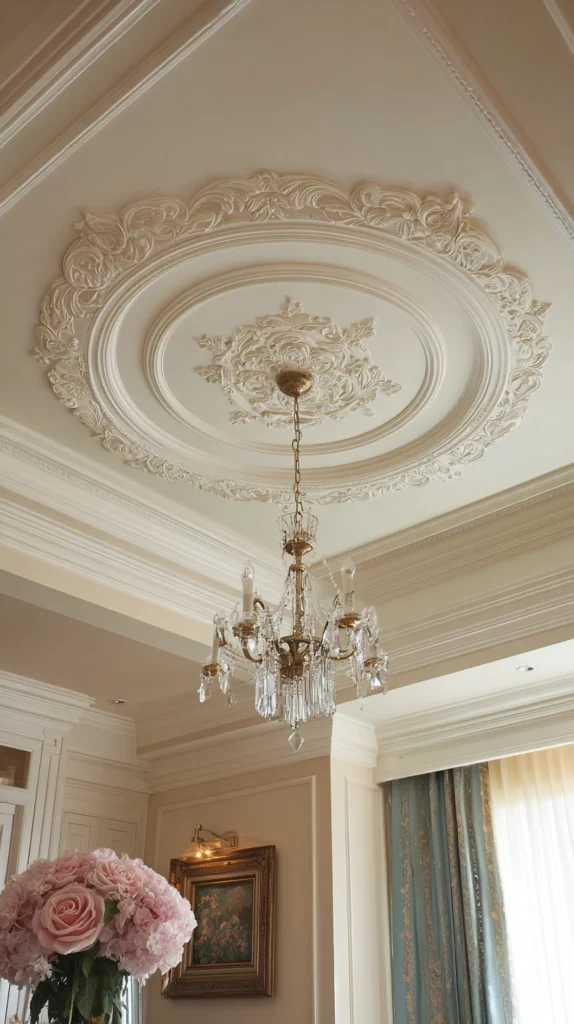
Budget: $20 – $200
Ceiling roses and medallions — the ornamental plaster rings that historically surrounded light fittings in period homes — are available today in lightweight polyurethane versions that adhere directly to any flat ceiling surface without specialist skills or tools. A large ceiling rose painted in the same colour as the ceiling reads as architectural detail. Painted in a contrasting tone — white on a coloured ceiling, or gold on white — it becomes a focal point that anchors the room from above.
Polyurethane ceiling roses in standard sizes cost $15 – $60 depending on diameter and detail level. Construction adhesive suitable for the application costs $8 – $15. A 50-centimetre rose painted in soft gold, aged bronze, or simply in a shade two tones deeper than the ceiling colour creates an overhead focal point that costs under $80 in total and looks entirely original.
Decor tip: Centre the ceiling rose over the room’s focal point rather than over the geometric centre of the ceiling. In most rooms these are the same thing, but in rooms where the furniture is arranged off-centre — a bed pushed to one side, a dining table positioned toward a window — centring the rose over the activity rather than over the room produces a more resolved result.
Whatever ceiling you are working with — high or low, plain or corniced, rented or owned — the same principle applies across all fourteen ideas: the ceiling is not a given, it is a choice. Leaving it white and bare is as much a decision as painting it sage green or hanging it with rattan and dried lavender. The difference is that one of those decisions was made consciously and the other was simply never made at all.
Look up at your ceiling now and decide what it should be doing for the room. Then give it the same consideration you would give the wall behind the sofa or the surface of the dining table. The room will thank you in ways you will notice every day.