
15 Summer Decor Ideas Inspired by Coastal Beach Houses
There is a particular kind of ease that coastal homes carry. The light moves differently in rooms close to water, the colours feel washed and unhurried, and even the furniture seems to have been chosen without anxiety.

That atmosphere — relaxed, airy, quietly beautiful — is not exclusive to houses with an ocean view. It can be brought into any room in any home with the right choices, and it costs far less than most people assume.
Whether you live minutes from the shore or hours inland, the fifteen ideas below translate the coastal beach house aesthetic into practical, achievable changes. Each one covers what you will need, what it will cost, and a tip to make it work in a real room rather than a styled photograph.
1. The Whitewashed Wood Foundation
Budget: $40 – $200
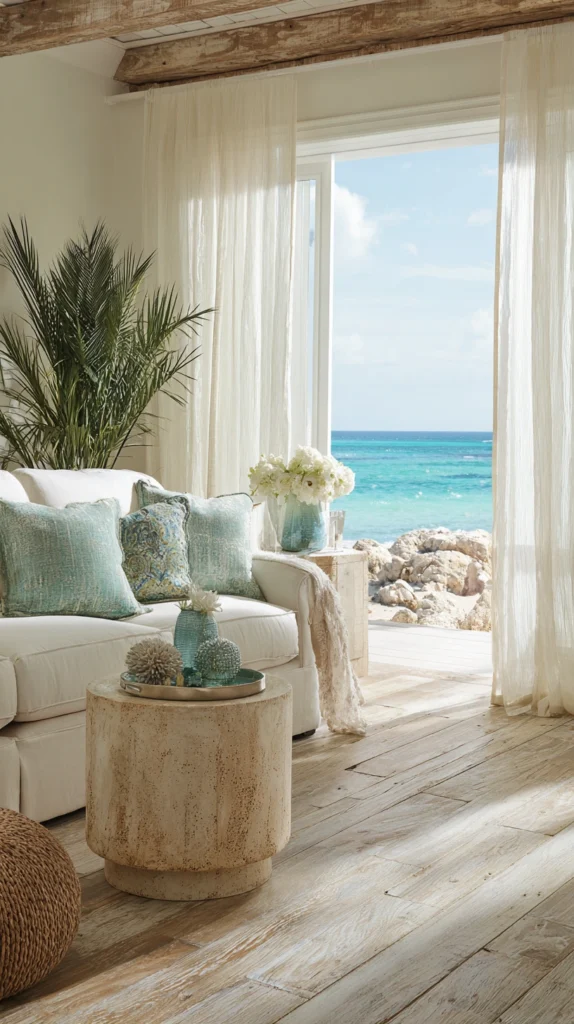
The single material that defines coastal interiors more than any other is whitewashed or limewashed wood. It appears on floors, on wall panelling, on furniture, and on picture frames, and its effect is to make a room feel simultaneously older and lighter — as though the sun has been working on it for decades. You do not need to replace your existing furniture to achieve this. A whitewash technique applied to an existing pine shelf, side table, or wooden frame costs almost nothing and transforms the piece entirely.
Whitewash paint or limewash in diluted form costs $15 – $40 for a tin that covers multiple pieces. A natural bristle brush and fine sandpaper add $10 – $20. Apply in the direction of the wood grain, wipe back immediately with a damp cloth, and the result is a muted, sun-bleached finish that reads immediately as coastal. Apply a second coat more sparingly for a deeper effect.
Decor tip: Whitewash works best on raw or lightly stained wood. Heavily lacquered or painted surfaces need a light sand first to open the grain — skipping this step produces a patchy, uneven result that looks accidental rather than deliberate.
2. The Linen and Cotton Slipcover Refresh
Budget: $60 – $300
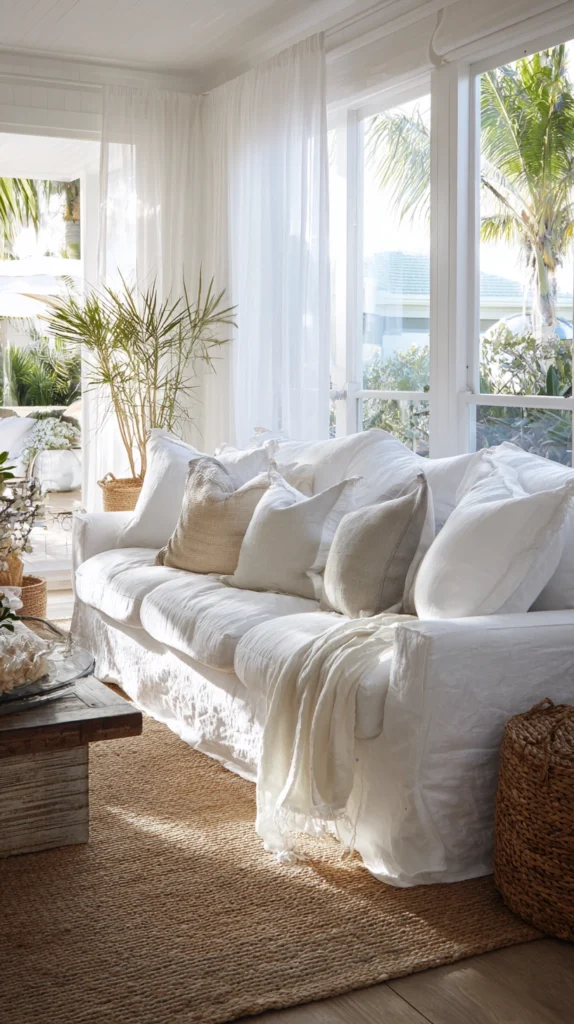
Coastal interiors are defined by fabric as much as by colour. Heavy velvets, dark wools, and structured upholstery belong to other aesthetic worlds entirely. The coastal palette runs to loose linen slipcovers, cotton throws in natural undyed tones, and lightweight curtains that move in a breeze even when the windows are closed. Replacing or covering your existing sofa and armchair upholstery with slipcovers in washed linen is one of the fastest transformations available to any room.
Ready-made linen sofa slipcovers cost $60 – $180 depending on size. Loose cotton throws in oatmeal, sand, and bleached white run $20 – $60 each. Sheer cotton or linen curtain panels — $25 – $80 per pair — replace heavier drapes immediately and allow natural light to fill the room in a way that heavier fabrics never will.
Decor tip: Buy slipcovers a size larger than your sofa dimensions and tuck the excess into the cushion gaps. The slightly oversized, casually tucked look is far more authentically coastal than a tightly fitted cover, which reads as formal rather than relaxed.
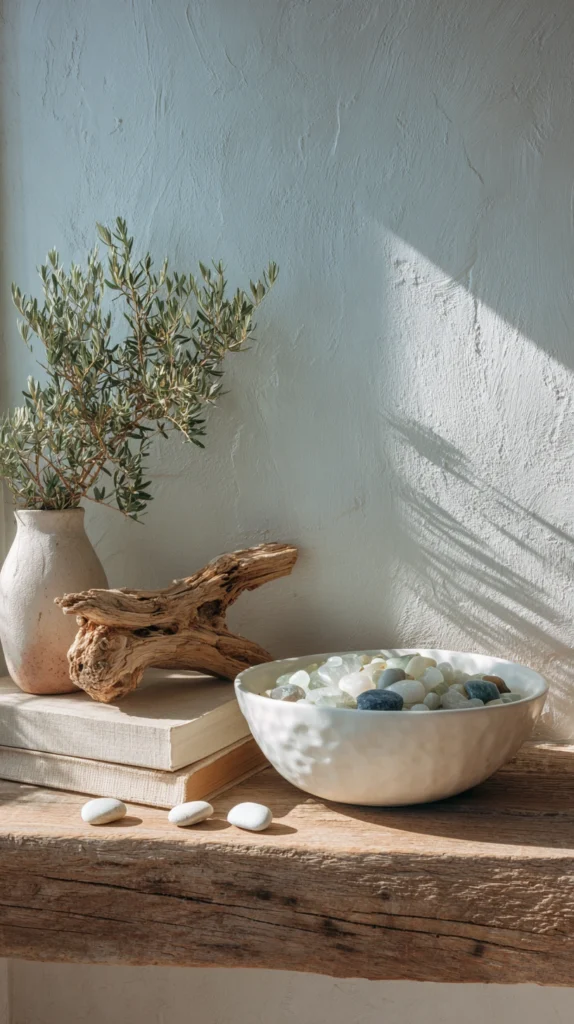
3. The Seaglass and Driftwood Vignette
Budget: $10 – $80
A windowsill, mantelpiece, or shelf arranged with pieces of sea glass in a shallow bowl, one or two pieces of driftwood, and a small succulent or air plant in a terracotta pot costs almost nothing to assemble and anchors the coastal mood of any room with remarkable efficiency. These are not decorative items that require explanation — they communicate immediately and without effort.
Sea glass can be collected or purchased in bags for $8 – $20 online. Driftwood pieces cost $5 – $25 depending on size and source. A shallow ceramic or terracotta bowl to hold the glass runs $8 – $20. Air plants cost $5 – $15 each and require almost no maintenance — a weekly misting is sufficient for most varieties.
Decor tip: Limit the vignette to three to five objects and leave space around each one. Coastal interiors breathe. A windowsill covered edge to edge with decorative items reads as cluttered regardless of how beautiful each individual piece is.
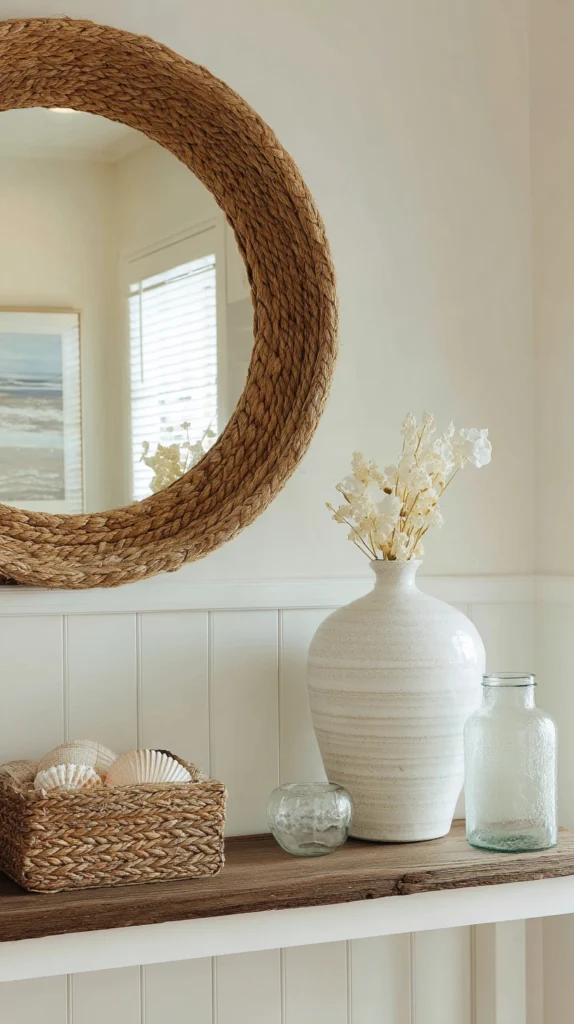
4. The Rope and Nautical Texture Layer
Budget: $20 – $120
Natural rope is the coastal interior’s most versatile texture. Wrapped around a plain mirror frame, knotted into a simple curtain tieback, used as a base for a pendant light shade, or coiled in a bowl as a decorative object in its own right, it adds immediate coastal character to any surface it touches. Manila and jute rope both work well — manila is coarser and more rustic, jute is finer and slightly more refined.
A 10-metre coil of natural manila rope costs $8 – $20. Woven jute placemats, baskets, and rope-handled storage boxes add texture throughout a room for $15 – $50 in total. A rope-wrapped mirror frame can be made at home with a plain mirror, strong adhesive, and an afternoon — total cost $20 – $50 — and is indistinguishable from retail versions costing four times as much.
Decor tip: Combine rope with at least one smooth, refined surface nearby — a ceramic vase, a polished shell, a glass carafe. Without contrast, a room full of rope and jute reads as rustic rather than coastal, and the two aesthetics are different in ways that matter.
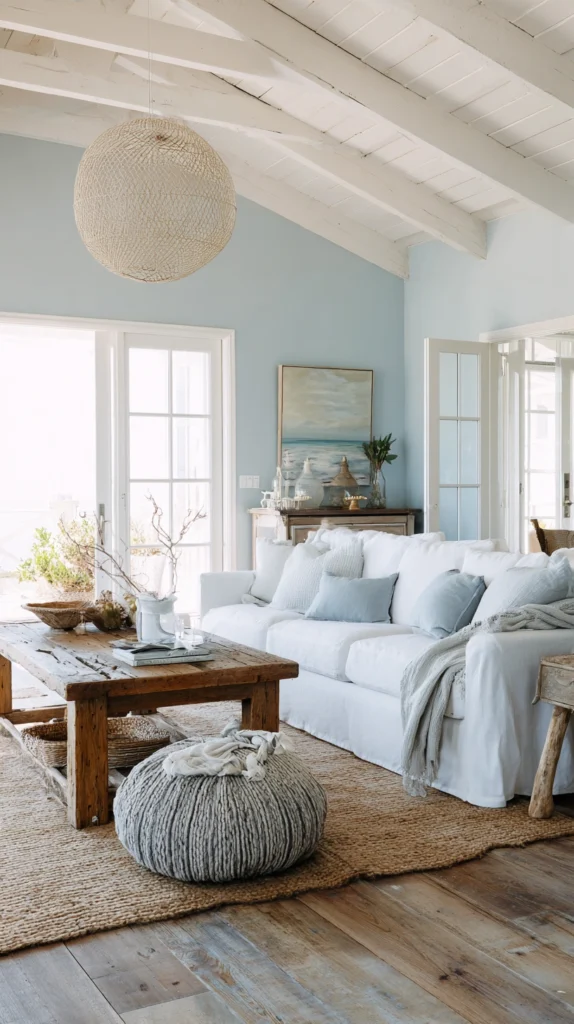
5. The Coastal Colour Palette Repaint
Budget: $50 – $200
The coastal palette runs from the palest cloud white through warm sand, soft sage, washed denim blue, and the faded green of sea-worn glass. It avoids anything saturated or sharp. A single wall or an entire room repainted in one of these tones does more work than any accessory or textile change, and a litre of quality paint goes further than most people expect.
Coastal whites and sandy neutrals in a litre tin cost $15 – $35. A 2.5 litre tin for a full room runs $30 – $60. Faded denim blue and soft sage are the two most versatile accent colours in the coastal palette — both work on a single feature wall without overwhelming the room. Eggshell finish reflects light softly and is more forgiving than flat matt in rooms that see regular use.
Decor tip: Test paint colours in a large square — at least 30 centimetres — directly on the wall and observe them at different times of day before committing. Coastal blues look greenish in morning light and grey in the evening, and the wrong observation time leads to choices that disappoint once the full wall is painted.
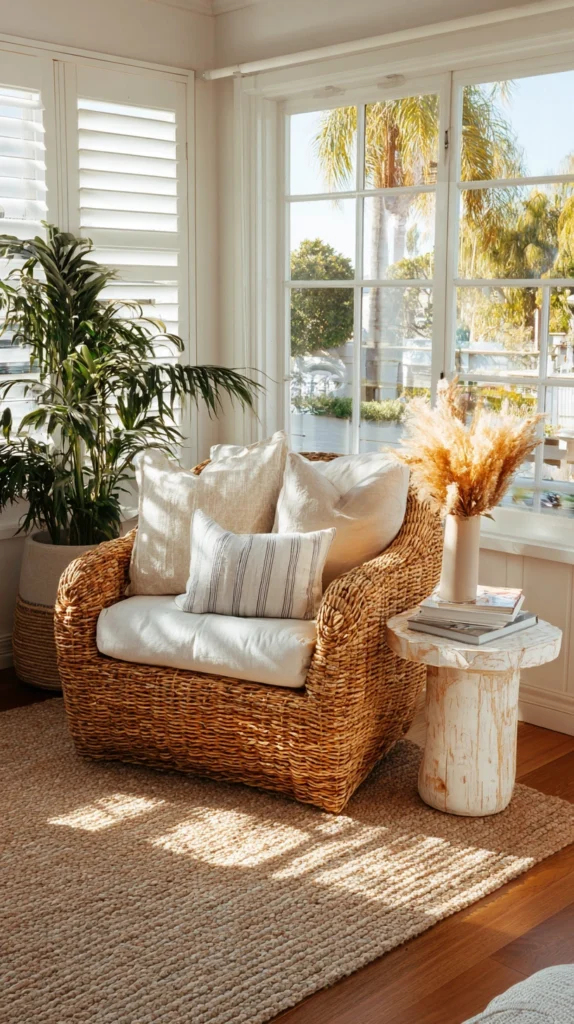
6. The Woven Rattan and Cane Furniture Piece
Budget: $80 – $600
Every coastal beach house contains at least one piece of rattan or cane furniture — a chair, a headboard, a side table, a hanging basket chair suspended from a ceiling beam. The material is irreplaceable in this context because it is simultaneously lightweight, warm in tone, and visually interesting without being heavy or dominant. A single rattan piece in a room that otherwise has none signals the coastal aesthetic immediately.
A rattan side table or accent chair runs $80 – $250. A cane or rattan headboard costs $100 – $400 depending on size. Hanging rattan pendant lamp shades — one of the most effective and affordable single changes available — cost $25 – $80 each and transform the quality of light in a room as well as adding texture overhead.
Decor tip: Mix rattan with white-painted wood and linen rather than combining it with dark timber or metal. Rattan placed alongside heavy, dark materials loses its coastal lightness and reads as bohemian or vintage instead — which may be a different direction entirely from the one you are heading.
7. The Gallery Wall of Ocean Prints and Maps
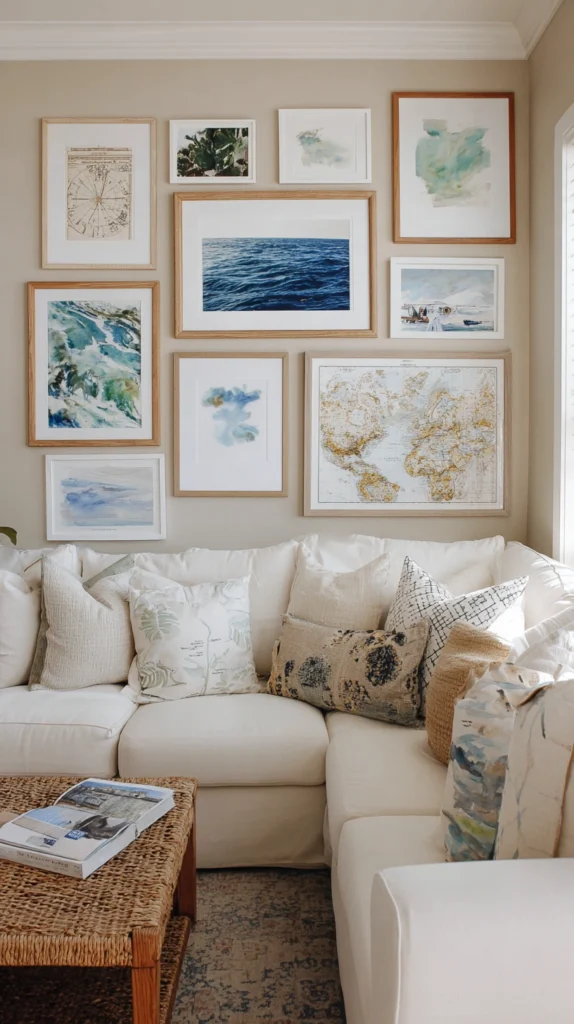
Budget: $30 – $150
A wall of framed ocean photography, vintage nautical charts, botanical coastal prints, and watercolour seascapes tells a story without a word. It is also one of the most affordable decorative changes available because the prints themselves cost very little — free-to-download vintage maps and botanical illustrations from public domain archives print beautifully at home or at a local print shop for pennies.
Frames in white, natural wood, or bleached finish cost $5 – $20 each from discount homeware stores. A set of six matching frames creates a cohesive gallery wall for $30 – $120 total. Print a mix of sizes — one large anchor piece, several medium prints, and two or three smaller ones — for a wall arrangement that has rhythm rather than uniformity.
Decor tip: Lay your gallery wall arrangement on the floor before committing anything to the wall. Photograph it from above and use that image as a guide when hanging. This avoids the painful process of filling unnecessary holes and repositioning frames multiple times.
8. The Oversized Ceramic Vase With Dried Pampas
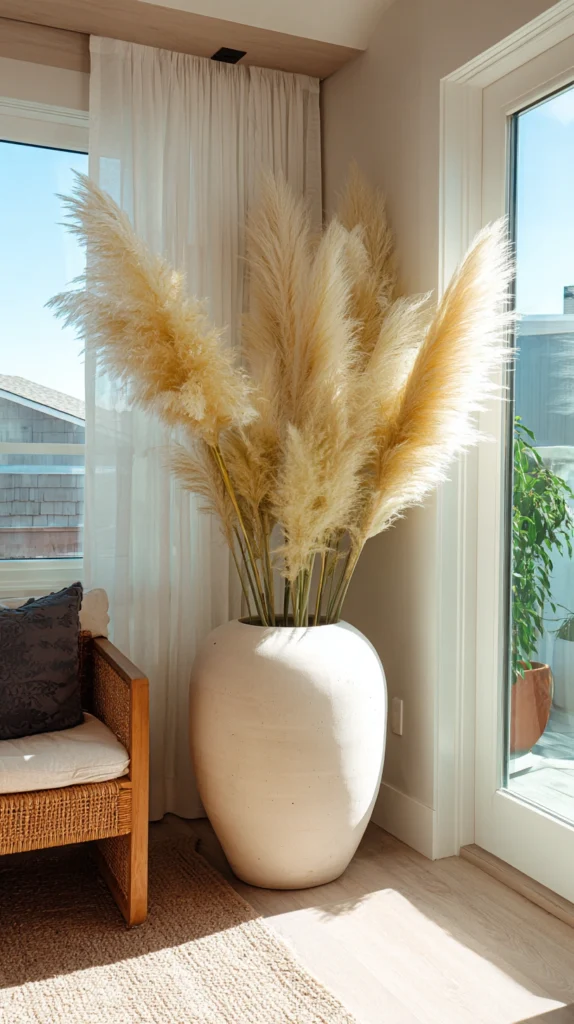
Budget: $40 – $180
A tall ceramic vase in white, cream, or pale blue placed in a corner or beside a fireplace and filled with dried pampas grass, bleached wheat stalks, or dried coastal grasses brings the outside in with a scale that smaller arrangements cannot achieve. The oversized format is important — a large vase with a generous arrangement commands a room in the way that a small vase on a shelf simply cannot.
Tall ceramic floor vases run $30 – $120 depending on height and finish. Dried pampas grass bundles cost $15 – $40 and last for years with minimal care. Bleached or natural dried grasses and seed heads from a florist or garden add $10 – $25 to the arrangement. Avoid faux versions where possible — dried naturals have a texture and movement that synthetic materials cannot replicate.
Decor tip: Shake dried pampas gently before arranging to release any loose fluff, and give the plumes a light misting with hairspray once arranged to reduce shedding. Without this step, pampas can shed significantly over the first few weeks, particularly in rooms with air conditioning or moving air.
9. The Bleached Shell and Coral Display
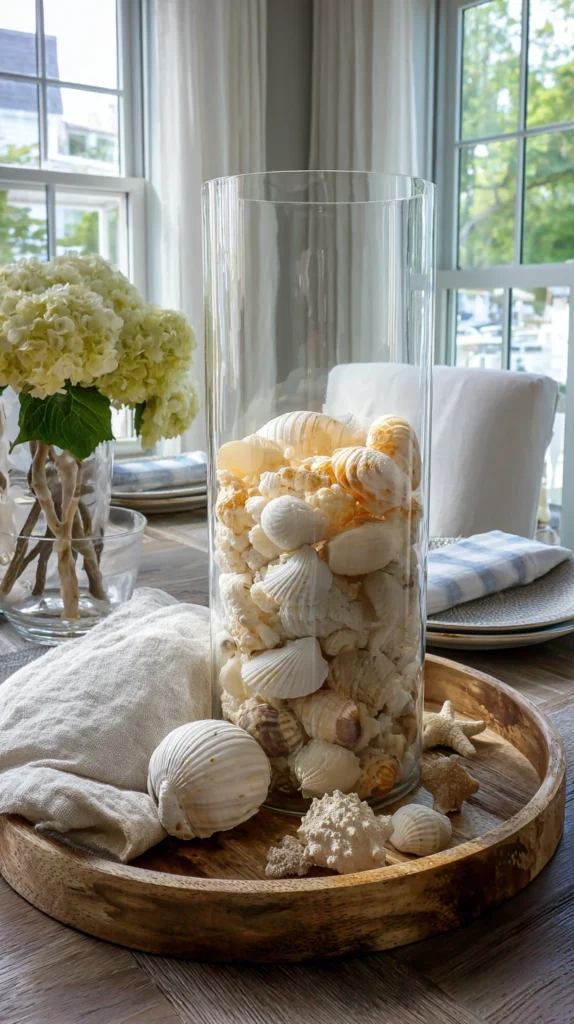
Budget: $15 – $100
Shells have appeared in coastal homes for as long as there have been coastal homes, and they work as well today as they ever have because they are the real thing — objects gathered from a real place that carry the memory of water and light. Displayed thoughtfully in glass cylinders, stacked on wooden trays, or arranged in ceramic bowls, a shell collection becomes a quiet focal point that costs nothing if gathered yourself.
Glass cylinder vases for shell displays cost $10 – $30 each. A flat wooden display tray runs $15 – $40. If purchasing rather than collecting, curated shell assortments are available for $15 – $50 online. Bleach very lightly in a diluted solution before displaying to remove any lingering organic matter — a ten-minute soak followed by thorough drying is sufficient.
Decor tip: Group shells by colour rather than by type. A bowl of all-white shells reads as curated and intentional. A bowl of mixed colours and sizes reads as a collection of things picked up and put down. The distinction between the two is entirely in the editing.
10. The Outdoor Shower Aesthetic Bathroom
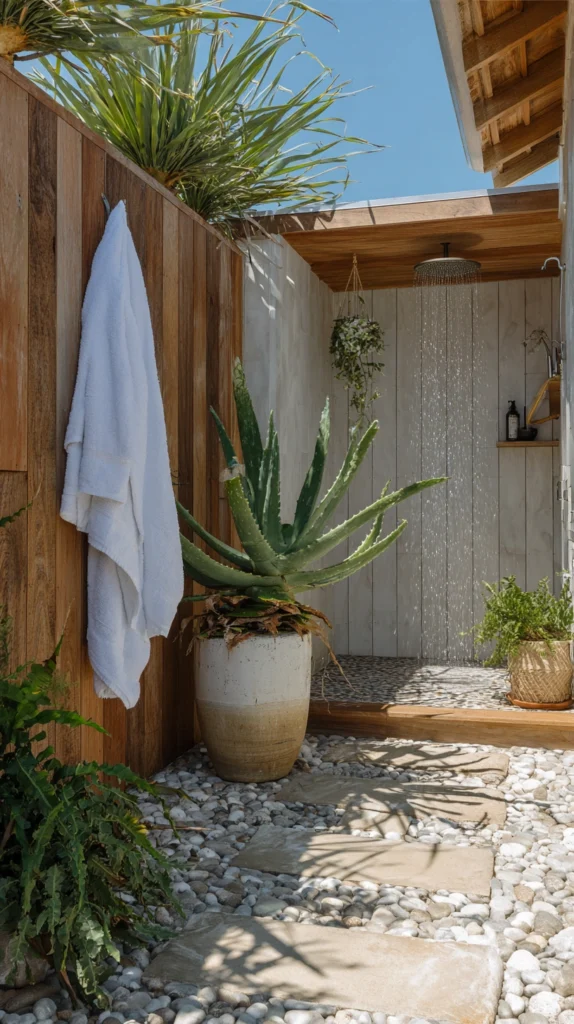
Budget: $50 – $250
The outdoor shower is one of the defining fixtures of the coastal beach house — and its aesthetic can be brought entirely indoors. Teak shower boards, a natural sea sponge on a rope hook, a bamboo towel ladder, a large aloe vera plant in the corner, and stone-effect tiles or a river pebble bath mat collectively create a bathroom that feels connected to the outside in a way that conventional bathroom design never achieves.
A teak shower board costs $40 – $100. A bamboo towel ladder runs $30 – $80. River pebble bath mats — genuine stone pebble mosaics on a mesh backing — cost $20 – $60 per mat and last indefinitely. A large aloe vera or monstera deliciosa in a terracotta pot adds $10 – $30 and thrives in the humidity of a bathroom environment.
Decor tip: Replace your standard shower curtain with a plain white linen or cotton voile panel if your shower allows. The slight transparency, the way it moves, and the way it hangs are all significantly more coastal than a standard shower curtain, and the cost difference is negligible.
11. The Hammock or Hanging Chair Corner
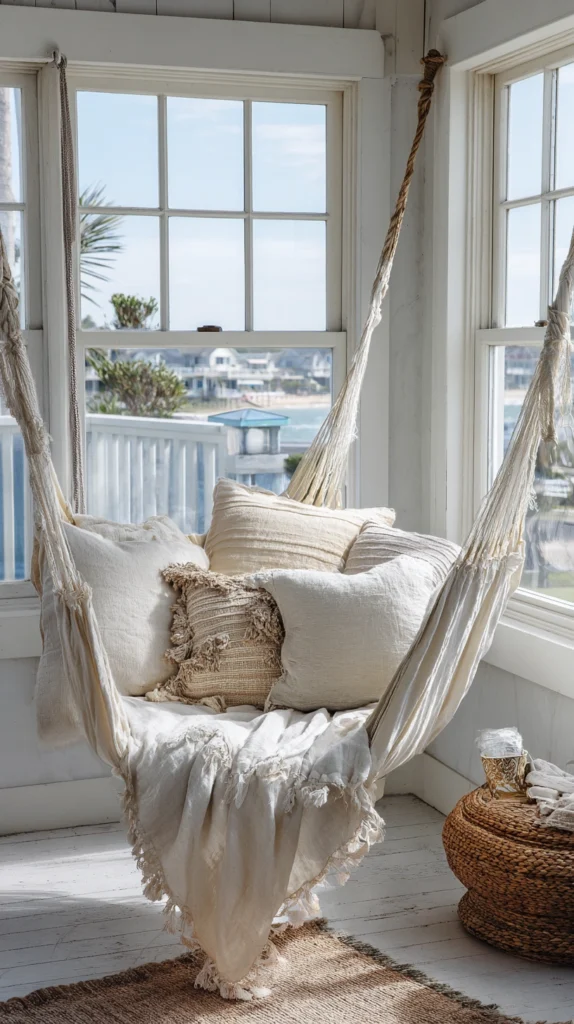
Budget: $60 – $400
A hammock chair suspended from a ceiling joist or a freestanding hammock stretched between two anchor points in a living room or bedroom brings the entire sensory language of a beach house veranda into a domestic interior. It is genuinely unusual — few pieces of furniture communicate the coastal spirit as directly as a hammock — and it is used far more often than people expect once it is in place.
A cotton rope hammock chair costs $40 – $120. A ceiling-mounted hammock chair bracket with appropriate fixings runs $15 – $40. A full hammock with a freestanding frame costs $80 – $300 and requires more floor space but no ceiling fixings. Add a linen cushion and a light throw over the edge and the corner becomes the most desirable seat in the house.
Decor tip: Check your ceiling joists carefully before mounting a hanging chair — plasterboard alone will not support the load. A stud finder costs $10 – $20 and removes all uncertainty. A ceiling-mounted chair that pulls a joist from the ceiling is both dangerous and expensive to repair.
12. The Coastal Kitchen With Open Shelving
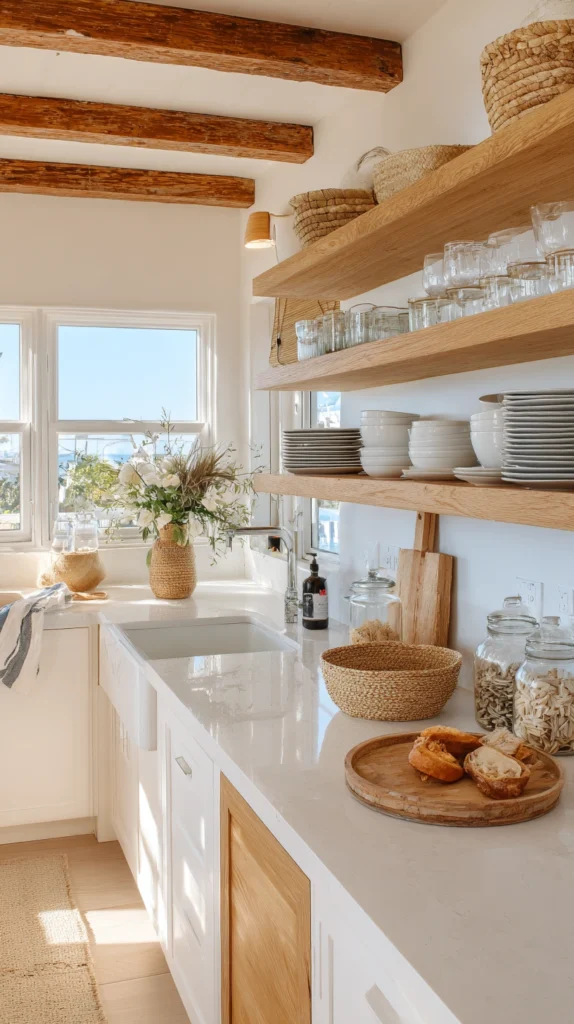
Budget: $60 – $300
Open shelving in a kitchen removes the visual weight of upper cabinetry and replaces it with a display of everyday objects — ceramic plates in white and cream, glass jars of pasta and grains, wicker baskets holding fruit, a row of terracotta herb pots along the back. It is the kitchen equivalent of leaving a window open. Nothing is hidden, nothing is precious, and the room immediately feels more honest and more coastal.
Floating wooden shelves in raw pine or whitewashed finish cost $20 – $60 each installed. Matching white ceramic dishware in a set runs $30 – $80. Clear glass storage jars in graduated sizes cost $15 – $40 for a set. The investment is modest — the visual change is one of the most dramatic achievable in a kitchen without structural work.
Decor tip: Edit the shelves ruthlessly before opening them up to display. Open shelving shows everything with equal emphasis — a beautiful ceramic bowl and an old margarine container sit at the same visual level. Anything that does not contribute to the display belongs in a cupboard below, not on an open shelf above.
13. The Blue and White Stripe Textile Story
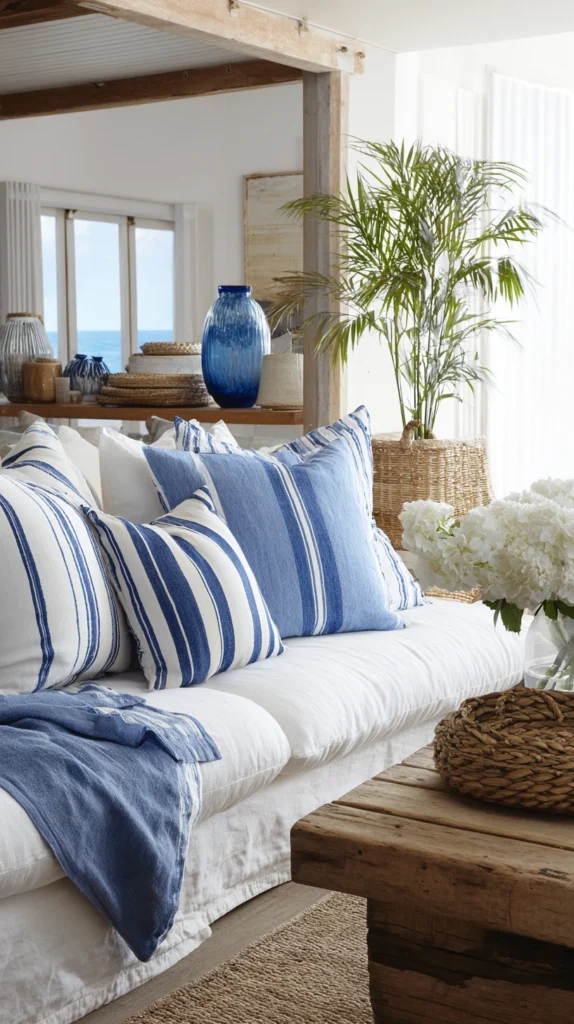
Budget: $40 – $200
The blue and white stripe is the most enduring pattern in coastal interior design. It appears on cushion covers, on shower curtains, on tablecloths, on deckchair fabric, and on ceramic mugs, and it never ages because it is rooted in something real — the colours of water and sky and the painted timber of old boat hulls. A room that introduces the stripe through two or three textiles rather than covering every surface in it uses the pattern with the restraint it deserves.
Blue and white striped cushion covers cost $15 – $40 each. A striped cotton tablecloth runs $20 – $60. Striped linen napkins — a detail that elevates any outdoor table — cost $15 – $30 for a set of four. The key is consistency of scale: use the same width stripe throughout the room rather than mixing narrow, medium, and wide stripes, which produces visual noise rather than a cohesive story.
Decor tip: Anchor the stripe with plenty of solid-coloured pieces around it — white, natural linen, raw wood. The stripe works as punctuation in a room, not as the main text. When it covers too much surface area it becomes a theme rather than a detail, and the two feel very different.
14. The Lantern and Candlelight Evening Setup
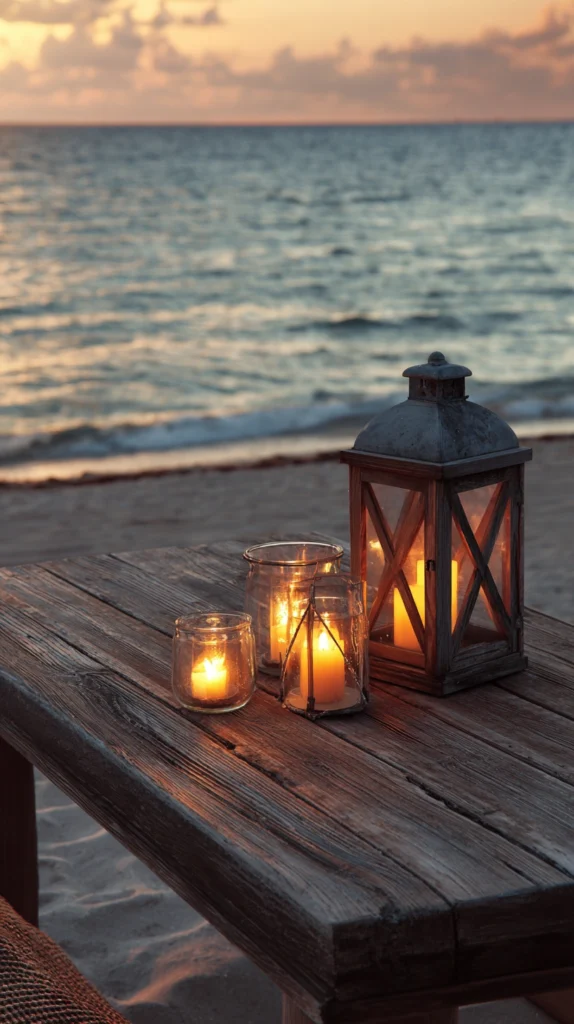
Budget: $30 – $180
Coastal homes rely on candlelight in the evenings in a way that urban interiors rarely do. Lanterns on a porch, glass hurricanes on a dining table, pillar candles in a fireplace — the warmth and movement of flame is irreplaceable in a space that is trying to feel relaxed and connected to the natural world. A collection of lanterns in different heights, grouped together or spaced across a surface, creates evening light that no electric fixture can match.
Wicker, rattan, or weathered metal lanterns cost $15 – $50 each. Glass hurricane holders for pillar candles run $10 – $30. Driftwood candle holders — available to make or to buy — add $10 – $40. Use unscented or lightly scented pillar candles in white, cream, or sand tones to keep the palette cohesive. Citronella versions double as insect deterrents for outdoor use.
Decor tip: Group lanterns in odd numbers — three or five rather than two or four. Even-numbered groupings read as symmetrical and formal. Odd numbers feel organic and relaxed, which is precisely the register that coastal evening light should hit.
15. The Indoor Plant Coastal Garden
Budget: $40 – $250
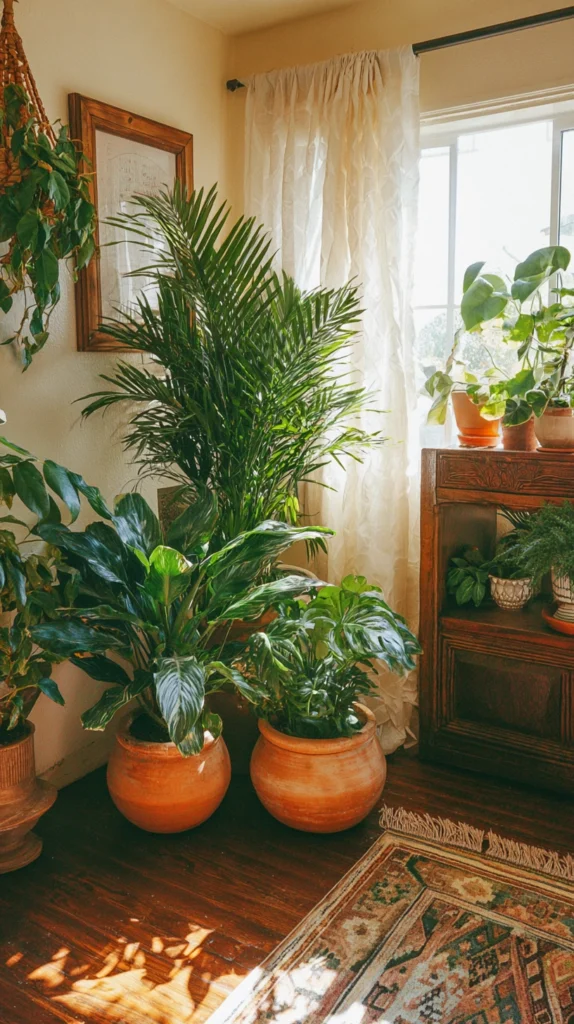
The coastal garden is defined by plants that have spent time in salt air and bright light — succulents, agaves, trailing pothos, snake plants, large-leafed tropical varieties, and the ever-reliable monstera. Grouped together in terracotta, raw concrete, or woven basket pots, these plants bring humidity, oxygen, and the visual language of an outdoor terrace into any interior space.
Terracotta pots in graduated sizes cost $5 – $20 each. A large monstera deliciosa runs $20 – $80 depending on maturity. Snake plants and pothos — both extremely low-maintenance — cost $8 – $20 each. Group them in a corner, on a plant stand at varying heights, or along a windowsill, and the collection reads as a considered indoor garden rather than a scattering of individual pots.
Decor tip: Use the same pot material throughout your plant grouping rather than mixing terracotta, ceramic, plastic, and wicker all in the same cluster. A cohesive set of six terracotta pots looks like a garden. Six pots in six different materials looks like the garden centre aisle at a hardware store.
Whatever combination of these ideas you bring into your home, the underlying principle remains the same throughout: lightness, restraint, and an honest connection to natural materials. The coastal beach house is not a maximalist space. It is a room that has been edited down to what is necessary, what is beautiful, and what feels genuinely good to be inside. Pursue those three things and the aesthetic follows without much further effort.
Start with one idea rather than fifteen, live with it for a few weeks, and then add the next. The homes that feel most authentically coastal are rarely the ones that were decorated all at once — they are the ones that accumulated their character slowly, the way the sea shapes a piece of glass, a little at a time.