
14 Dark Academia Living Room Ideas for a Cozy Bookish Fall
The bookshelf wall changed how my living room got used more than any furniture upgrade ever did. Not the new sofa. Not the reading lamp. Not the rug or the rearranged seating or the extra cushions.
The books.
Because a room full of spines did something no single piece of furniture could. Before it: a living room built around a television, evenings spent half-watching something while scrolling a phone. After it: a room that asks to be read in, the shelves themselves suggesting an evening spent differently than the one before.
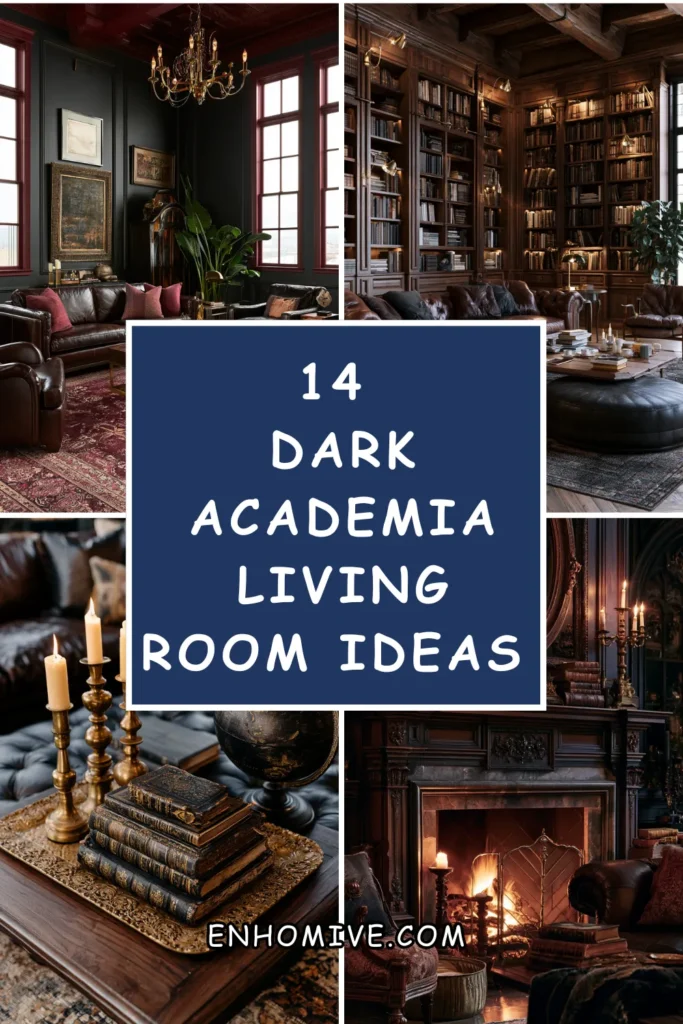
Dark academia is not a costume for a room. It is an atmosphere built from real materials — old books, dark wood, brass, leather, candlelight — that happen to look exactly like the reading room a person imagines when they picture getting lost in a novel on a cold evening. The room: no longer background to a screen, but a space built around the quiet, focused pleasure of reading.
Here are 14 dark academia living room ideas for a cozy bookish fall — from the simplest shelf styling to the most fully committed room — built on that understanding.
Why Dark Academia Suits Autumn Specifically
The seasonal alignment
Dark academia’s palette — burgundy, forest green, mustard, chocolate brown, aged brass — is, almost coincidentally, the exact palette of autumn leaves and October light. The aesthetic and the season were never really separate ideas.
The candlelight logic
Without the aesthetic:
Overhead lighting, flat and even, in a room meant for evening reading.
The room: functional, but without any sense of occasion.
With the aesthetic:
Warm, low, layered lighting — lamps, candles, sconces — closer to 2700K than daylight white.
The room: lit the way a study or a library reading room is lit, because that is precisely the reference point.
The material logic
Dark academia depends on real texture more than any single color choice. Leather, aged brass, dark wood, and heavy wool all read correctly; anything glossy, plastic, or bright breaks the illusion immediately.
The book-as-decor principle
Unlike most aesthetics, this one treats an object most households already own — books — as its primary decorative material. A dark academia room is, in large part, simply a room that takes its books seriously as decor rather than storing them out of sight.
The Five Ways to Build the Dark Academia Look
Before choosing any design:
Paint and wall color (the full commitment)
Deep, saturated wall color — burgundy, forest green, or chocolate brown.
The most transformative option and the hardest to reverse without repainting.
Sets the tone every other element responds to.
Bookshelves and books
Floor-to-ceiling shelving, filled with real, well-worn books.
The single most important element of the aesthetic.
Works even without touching the walls at all.
Furniture
Leather armchairs, dark wood tables, tufted upholstery.
The most flexible entry point for renters or anyone avoiding paint.
Suits a room built up piece by piece over time.
Lighting
Brass lamps, candles, warm bulbs, layered rather than overhead-only.
The lowest-cost, highest-impact single change.
Transforms the mood of an existing room without any furniture changes at all.
Textiles and objects
Leather-bound books, globes, vintage frames, heavy wool throws.
The finishing layer, applied last, once the larger elements are in place.
Small, collectible, and easy to build gradually.
1. The Floor-to-Ceiling Bookshelf Wall
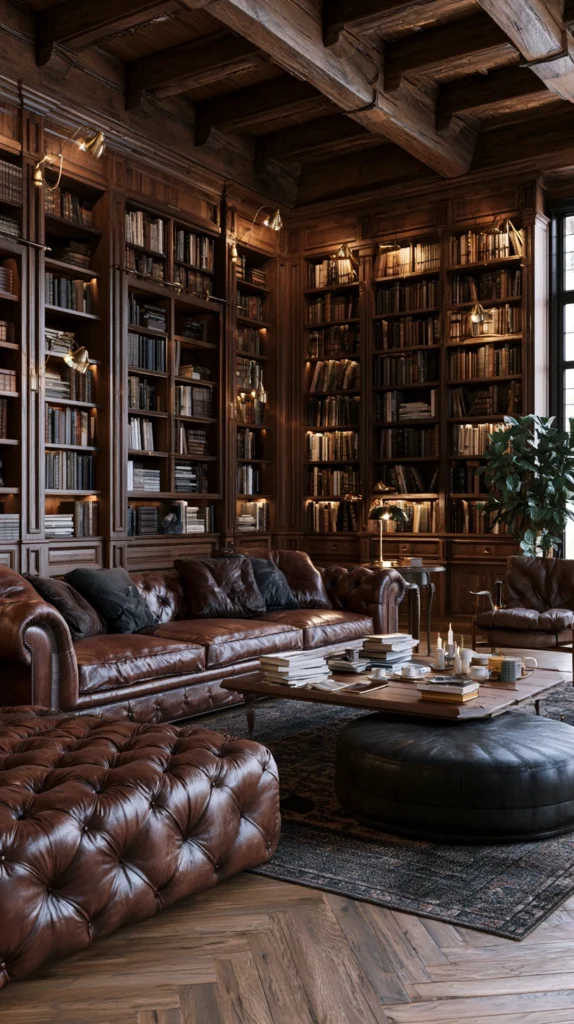
A full wall of built-in or freestanding shelving, packed with books from floor to ceiling, becoming the room’s dominant visual feature.
Why the bookshelf wall is the essential starting point
Every other element on this list supports the aesthetic; the bookshelf wall defines it. A room without substantial visible books cannot fully read as dark academia, regardless of what else is done.
The shelving
Built-in units where possible, or a tall freestanding bookcase system arranged to read as continuous rather than as separate pieces.
Dark wood — walnut, mahogany, or a deep stained oak — rather than pale or unfinished wood.
The book arrangement
Mixed heights and depths, some books stacked horizontally, others vertical, avoiding a uniform, color-coordinated look that reads as staged rather than genuinely well-read.
The gaps
Small objects — a globe, a framed print, a small plant — filling occasional gaps between book groupings, rather than every inch packed with spines alone.
The lighting
A picture light or a small clip lamp mounted at one section of the shelving, casting warm light across the books in the evening.
Cost breakdown: Bookshelf unit (built-in or freestanding): $200–800 Books (secondhand, assorted): $30–100 Small styling objects: $30–60 Total: $260–960
2. The Burgundy or Forest Green Accent Wall
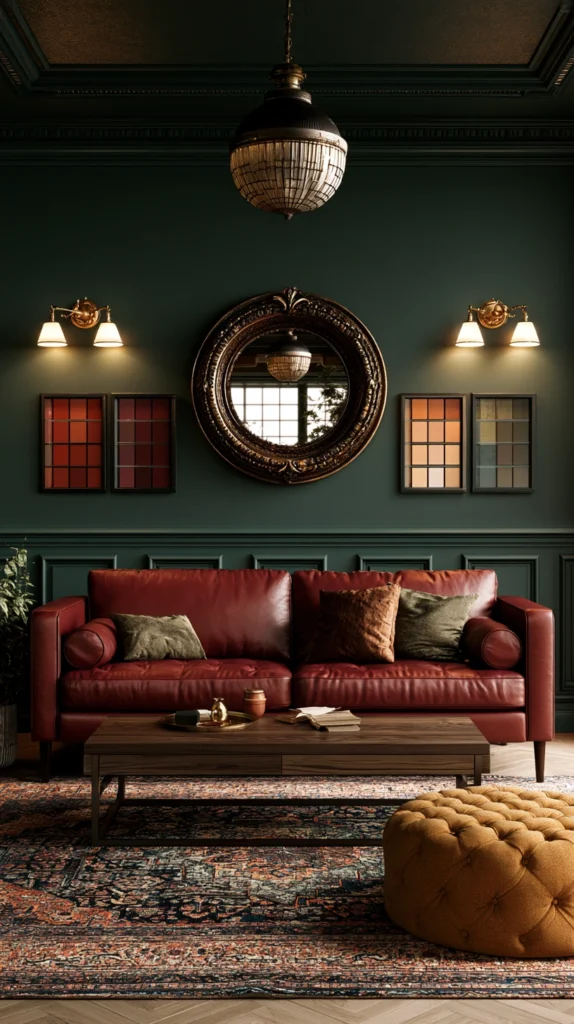
A single wall painted in a deep burgundy or forest green, positioned behind the main seating or the bookshelf, anchoring the room’s color palette.
Why a single deep wall works better than painting the whole room
Dark academia depends on contrast between deep, saturated color and warm wood and leather tones. One deep wall against warmer neutral walls elsewhere preserves that contrast, where four dark walls can start to feel heavy rather than rich.
The wall selection
Behind the primary seating, or behind the bookshelf if the shelving itself is the room’s focal point, rather than a wall with little furniture in front of it.
The paint
True burgundy or hunter green, not a muted or greyed-down version — the saturation is part of what makes the color read correctly against dark wood.
A matte or eggshell finish, avoiding any sheen that would look more contemporary than academic.
The trim
Left in a warm off-white or painted a deep brown to match the wood furniture, rather than left in a stark white that would feel too clean against the aesthetic’s worn, aged character.
The furniture in front
Leather or dark wood furniture, which reads richest against this depth of wall color.
Cost breakdown: Paint (one wall): $40–70 Total: $40–70
3. The Leather Armchair Reading Corner
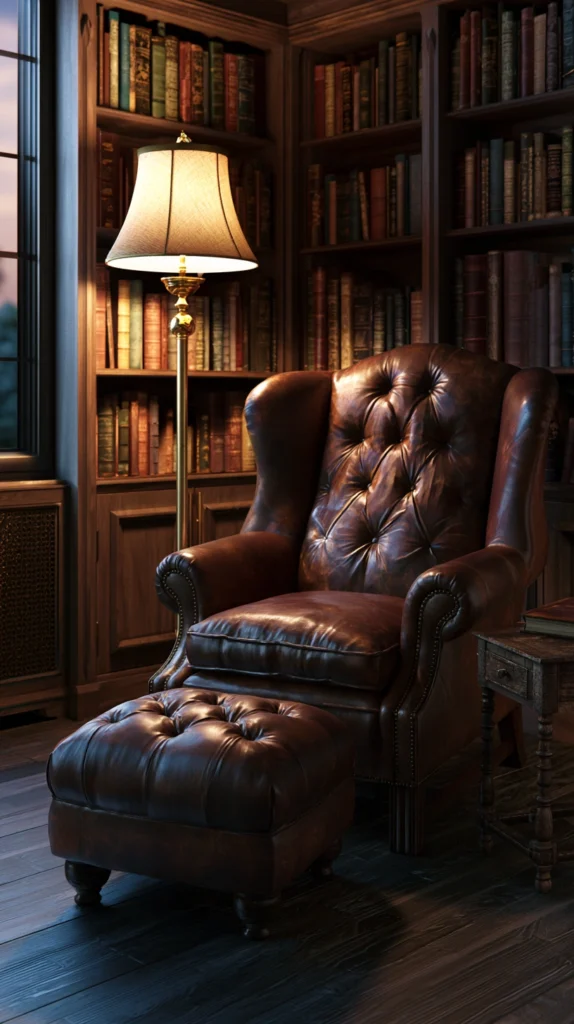
A single leather armchair, positioned beside a bookshelf and a floor lamp, forming the room’s most identifiably dark academia corner even in an otherwise ordinary room.
Why leather is close to essential here
No other material signals this aesthetic as immediately as worn leather. A single leather chair does more visual work toward the look than several smaller decorative choices combined.
The chair
A chesterfield, wingback, or club chair in a deep brown, oxblood, or cognac leather, ideally with visible wear rather than a pristine finish.
The placement
Beside a bookshelf or window, angled slightly rather than facing straight into the room, for the enclosed, private feeling the aesthetic depends on.
The lamp
A brass floor lamp with a fabric or glass shade, positioned just behind the shoulder for reading light.
The footrest
A small leather or wood-framed ottoman, low enough not to crowd the chair.
The finishing detail
A small side table holding a stack of current reading and a single teacup or glass, kept visibly in place rather than tidied away.
Cost breakdown: Leather armchair: $200–600 Brass floor lamp: $50–120 Ottoman: $40–100 Total: $290–820
4. The Dark Wood and Brass Coffee Table Vignette
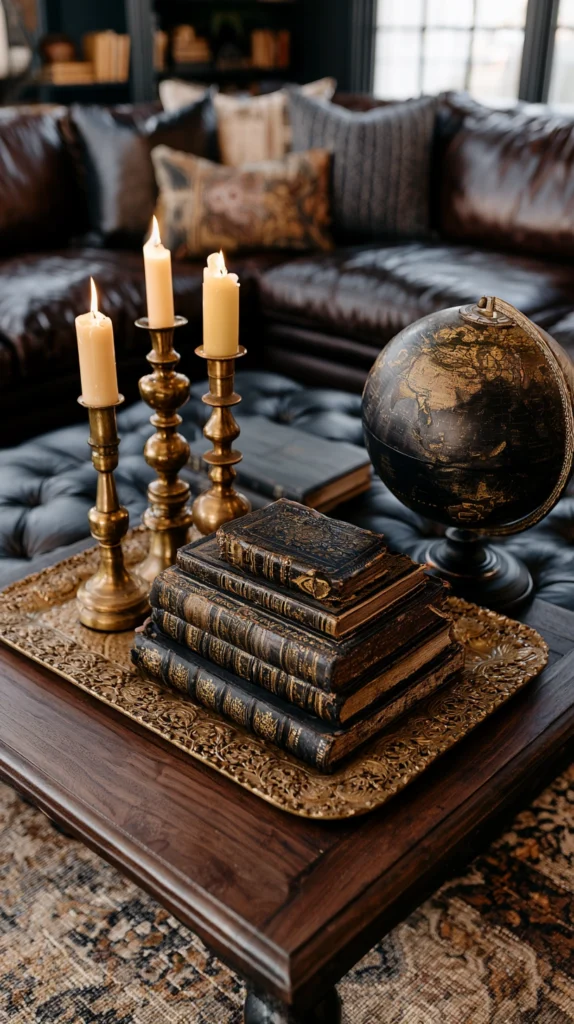
A coffee table styled specifically with the dark academia object language — stacked books, a small globe, a brass tray, a candle — rather than left bare or styled with contemporary decor.
Why the coffee table is a high-value styling opportunity
It sits at the center of the room’s main sightline, visible from every seat, making it one of the most efficient places to concentrate the aesthetic without touching walls or furniture at all.
The table
Dark wood, ideally with some age or patina already visible, rather than a glossy or pale contemporary table.
The book stack
Three to five hardcover books, stacked horizontally, chosen for spine color and texture as much as content — a mix of leather-bound and cloth-bound volumes reads best.
The brass elements
A small brass tray beneath the stack, and a brass candlestick or small object placed beside it.
The candle
An unscented or subtly scented candle, lit in the evening, contributing both to the visual styling and the room’s actual atmosphere.
The single live element
A small plant or a bowl of pinecones or chestnuts in season, the one organic note among the more formal materials.
Cost breakdown: Dark wood coffee table (existing or new): $0–250 Books for styling (secondhand): $15–30 Brass tray and candlestick: $25–50 Candle: $10–20 Total: $50–350
5. The Library Ladder Bookshelf
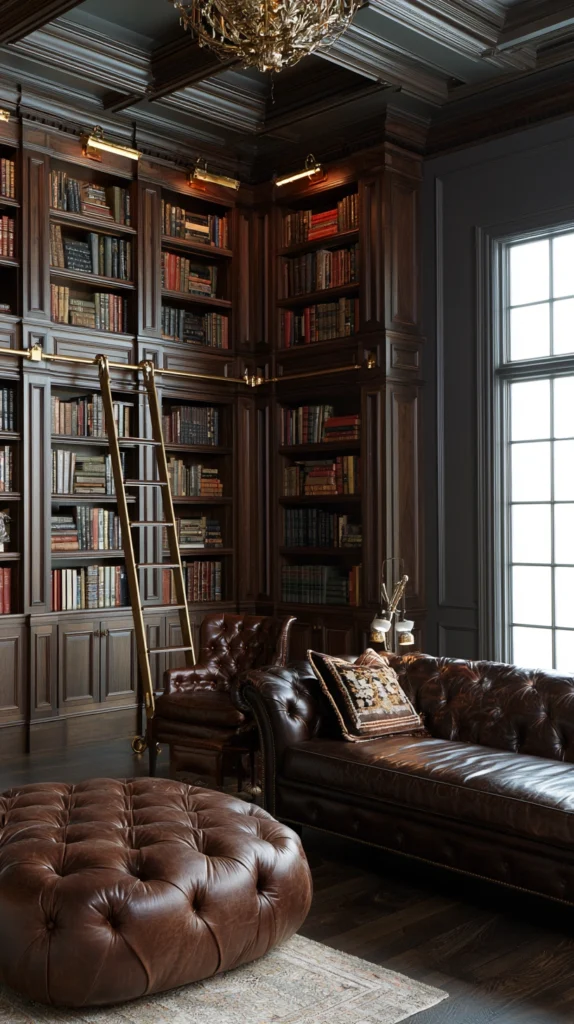
A tall bookshelf fitted with a rolling library ladder, adding both function and one of the aesthetic’s most recognizable architectural details.
Why the ladder is worth the added cost
Beyond its practical use for reaching upper shelves, a library ladder is one of the most immediately recognizable dark academia signifiers, evoking a private study or an old university library more directly than almost any other single object.
The shelving height
Built or purchased tall enough to genuinely require the ladder — at least 8 feet — since a short shelf with a ladder attached reads as decorative rather than functional.
The ladder
A rolling brass or dark metal library ladder mounted to a horizontal rail at the top of the shelving unit.
The rail
Solidly mounted, since the ladder needs to bear real weight safely if it will actually be climbed rather than serving as decoration alone.
The shelving material
Dark stained wood, matching or complementing the ladder’s metal tone.
The books
Filled with genuine variety in height and depth, taking full advantage of the shelf’s unusual height to create visual interest from floor to ceiling.
Cost breakdown: Tall bookshelf unit: $300–800 Library ladder and rail kit: $200–500 Total: $500–1,300
6. The Antique Map and Globe Display
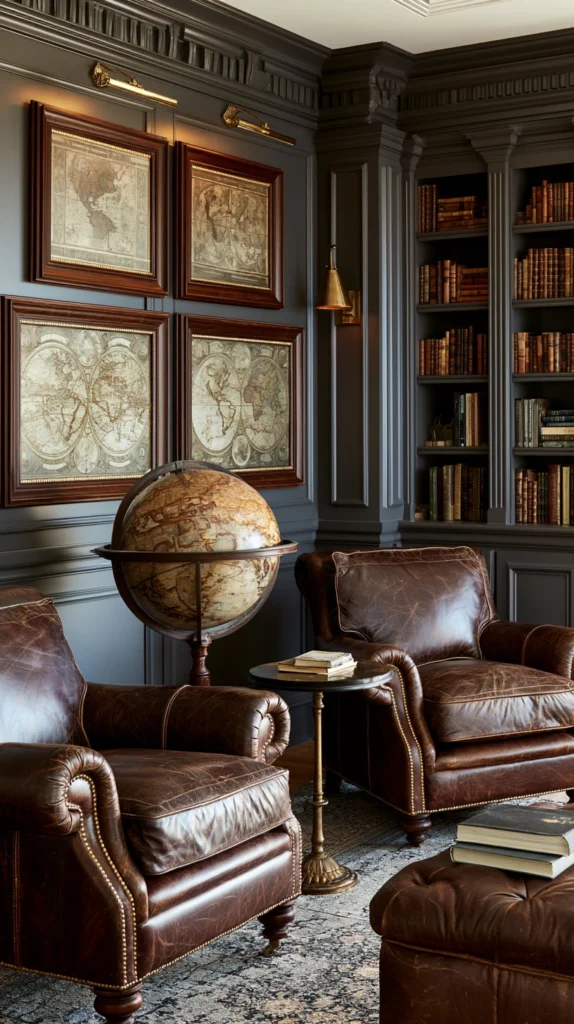
A small collection of vintage or vintage-style maps and a standing globe, displayed as the room’s secondary focal point alongside the books themselves.
Why maps and globes are a natural extension of the bookish theme
Both objects share the same intellectual, exploratory quality as a well-stocked bookshelf, extending the room’s sense of curiosity beyond fiction and into geography and history.
The globe
A standing or tabletop globe, ideally with a visibly aged finish rather than a bright, modern-looking version.
The maps
One or two framed antique or antique-style maps, hung at a modest scale rather than as oversized statement pieces.
The frame choice
Dark wood or aged brass frames, matching the room’s broader material palette rather than a contemporary black or white frame.
The placement
Near the bookshelf or reading chair, reinforcing the sense that this is a corner built around learning and exploration rather than scattered randomly through the room.
The lighting
A small picture light over the framed maps, similar to the treatment given the bookshelf itself.
Cost breakdown: Standing or tabletop globe: $40–120 Framed maps (2): $40–100 Picture light: $30–60 Total: $110–280
7. The Tartan and Tweed Textile Layer
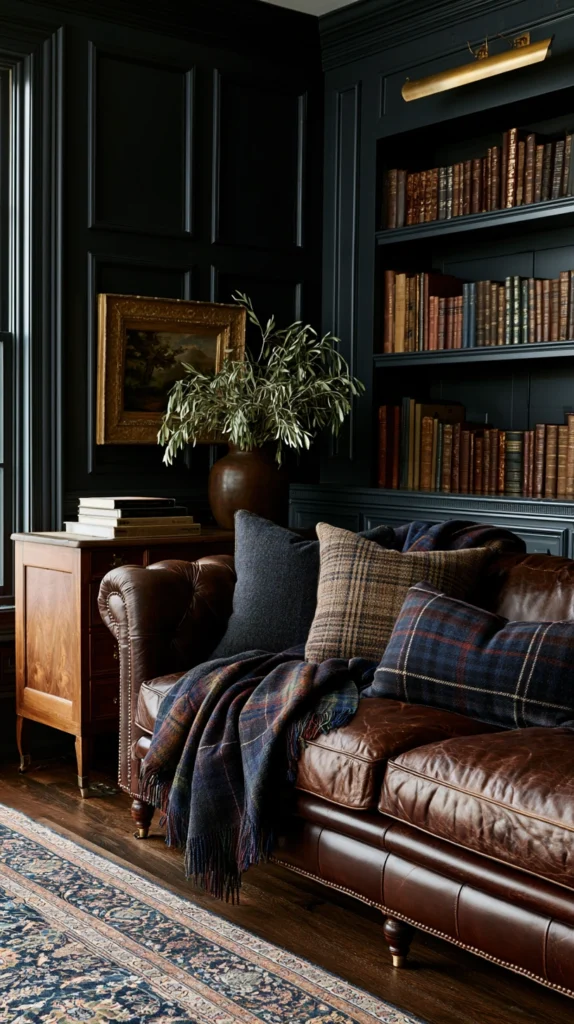
Tartan throw blankets and tweed or houndstooth upholstery introduced across the room’s seating, adding the traditional textile patterns closely associated with the aesthetic.
Why these specific patterns matter
Tartan and tweed carry strong associations with traditional academic institutions and countryside estates, reinforcing the aesthetic through pattern and texture in a way solid colors alone cannot.
The throw blankets
Wool tartan throws, draped over the arm of the leather chair or folded at the end of a sofa, in a deep burgundy, forest green, or navy plaid.
The upholstery
A single chair or ottoman reupholstered in tweed or houndstooth, rather than every seat in the room, to keep the pattern from overwhelming the space.
The cushions
Two or three cushions in a coordinating plaid or herringbone weave, layered among solid-colored cushions rather than replacing them entirely.
The scale
Smaller-scale patterns for smaller objects like cushions; larger-scale plaid reserved for the throw blankets, where there is more surface area for the pattern to read clearly.
Cost breakdown: Tartan throw blankets (2): $50–100 Tweed cushions (3): $45–90 Total: $95–190
8. The Brass Picture Rail Gallery
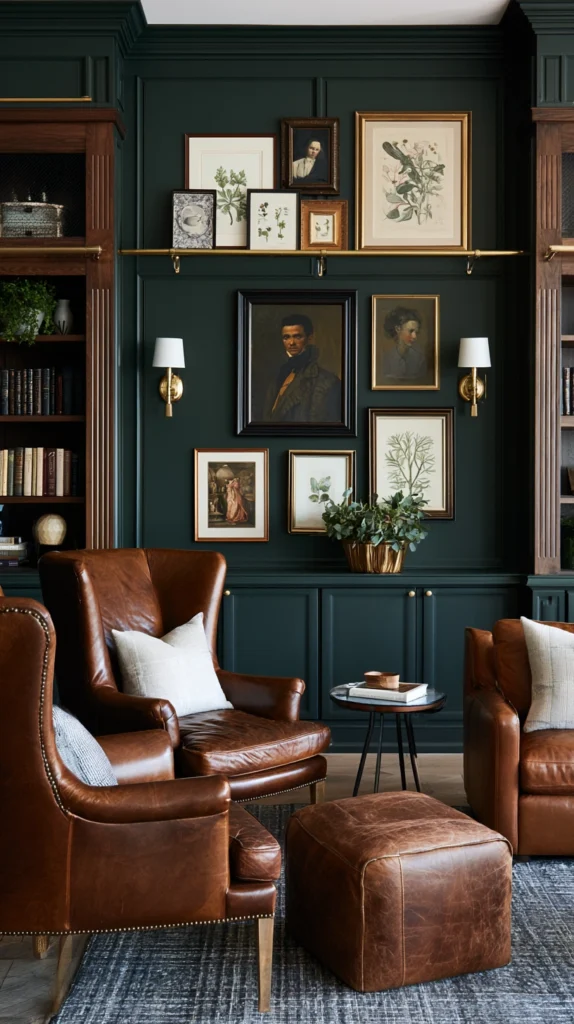
A gallery of framed portraits, botanical prints, and etchings, hung using a brass picture rail system rather than individually nailed frames — the traditional library display method.
Why a picture rail suits this aesthetic specifically
Picture rail hanging is the historically accurate method used in old libraries, studies, and academic institutions, and it allows frames to be adjusted or added to over time without new wall damage.
The rail
A brass or dark bronze picture rail mounted near the ceiling, with hanging wire or chain dropping down to each frame.
The frame selection
Ornate or simple dark wood and brass frames, mixed in scale and slightly mismatched, rather than a uniform matching set.
The art choice
Portraits, botanical illustrations, or old etchings and engravings, favoring subject matter that feels collected over generations rather than recently purchased as a matching set.
The arrangement
A loose, salon-style cluster rather than a precise grid, reinforcing the sense of an accumulated rather than curated display.
Cost breakdown: Picture rail system: $30–70 Frames and art (secondhand, assorted): $60–150 Total: $90–220
9. The Dark Academia Fireplace Mantel
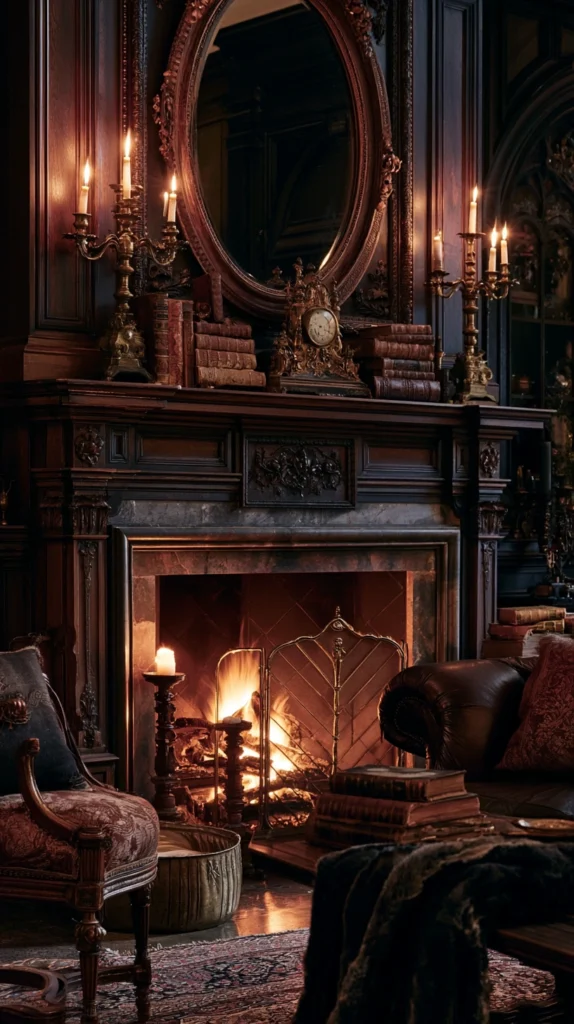
An existing fireplace mantel styled with the aesthetic’s signature objects — candlesticks, leather books, a clock, dried botanicals — turning it into the room’s most detailed vignette.
Why the mantel deserves particular attention
A fireplace is already the room’s natural focal point; styling it deliberately, rather than leaving it sparse or generically decorated, concentrates the aesthetic exactly where the eye already goes.
The base layer
A pair of tall brass or dark metal candlesticks at either end of the mantel, providing height and symmetry.
The central piece
A vintage or vintage-style clock at the center, one of the aesthetic’s recurring motifs, evoking the passage of studious hours.
The books
A small stack of leather-bound books off to one side, breaking the mantel’s symmetry slightly for a more natural, collected look.
The botanicals
A small arrangement of dried eucalyptus, wheat, or pampas grass in a dark vase, softening the mantel’s more formal objects.
The mirror or art above
An aged or antiqued mirror, or a single piece of art in a dark wood frame, hung above the mantel as the vignette’s visual anchor.
Cost breakdown: Candlesticks (pair): $30–60 Vintage-style clock: $30–70 Dried botanical arrangement: $20–40 Mirror or art above mantel: $50–150 Total: $130–320
10. The Chesterfield Sofa Centerpiece
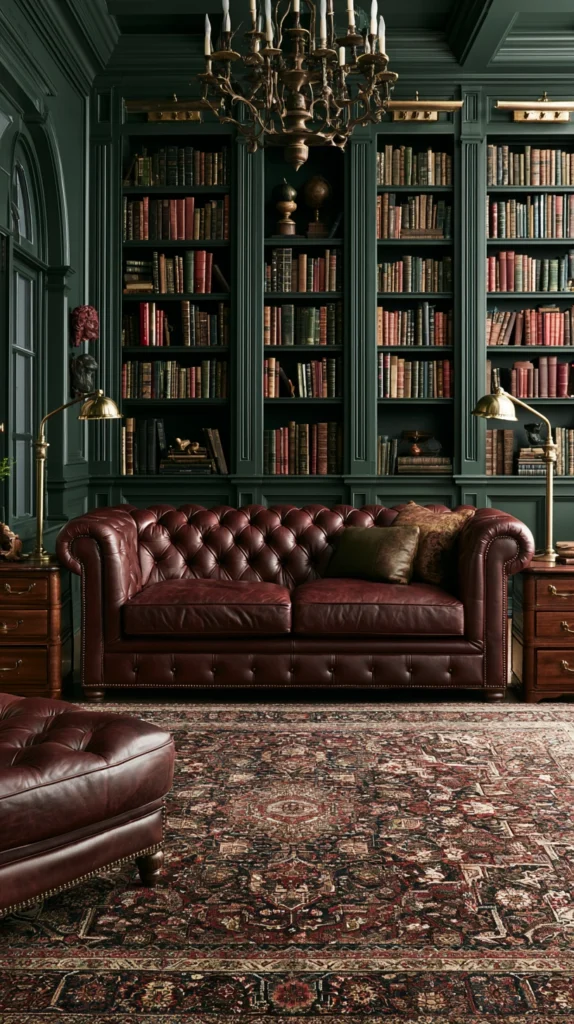
A tufted leather chesterfield sofa as the room’s primary seating, replacing a contemporary sofa and immediately shifting the whole room’s character.
Why the chesterfield is worth the investment for the whole room
As the largest single piece of furniture in most living rooms, the sofa disproportionately shapes the room’s overall feel. A chesterfield does more to establish the aesthetic than nearly any other single purchase.
The sofa
A rolled-arm, deep-buttoned leather chesterfield, in oxblood, deep brown, or forest green leather.
The placement
Positioned as the room’s clear anchor, with other seating arranged in relation to it rather than as an equal counterpart.
The cushions
Minimal additional cushions, since the chesterfield’s tufted structure already provides visual interest without needing to be layered heavily.
The surrounding furniture
Dark wood side tables and a matching or complementary armchair, avoiding lighter woods or contemporary metal finishes that would clash with the sofa’s traditional silhouette.
The upkeep
Leather conditioning every six to twelve months keeps the material supple and prevents cracking, a small ongoing task worth planning for with a leather piece this size.
Cost breakdown: Leather chesterfield sofa: $800–2,000 Leather conditioner: $15–25 Total: $815–2,025
11. The Study Desk Corner
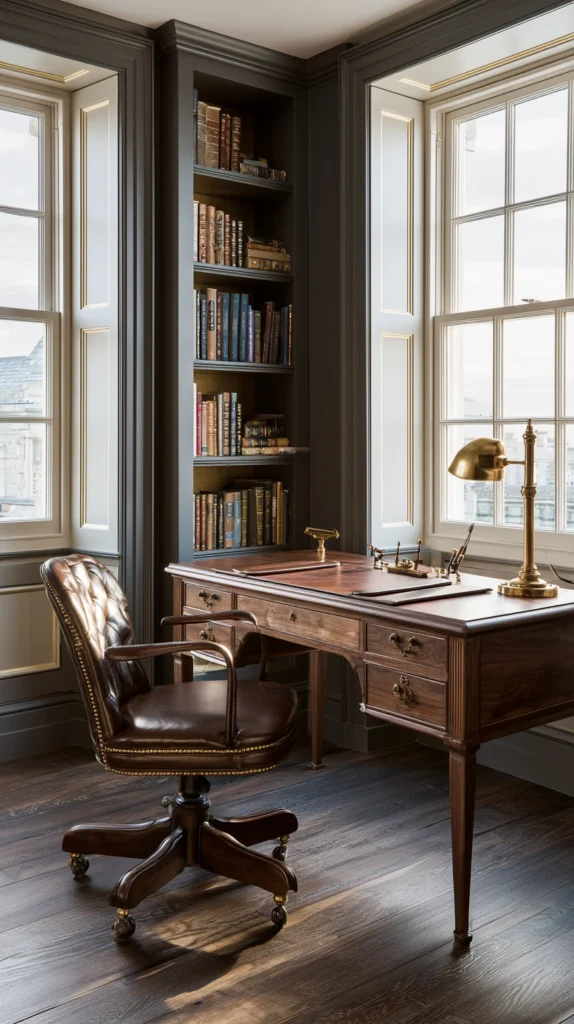
A writing desk positioned in a corner of the living room, fitted with a desk lamp, a blotter, and a small collection of writing instruments, adding a working academic function to the room.
Why a desk deepens the aesthetic beyond pure decor
A desk implies actual use — writing, studying, correspondence — giving the room’s theme a functional basis rather than existing purely as a visual style.
The desk
A dark wood writing desk or partner’s desk, ideally with some age or patina, rather than a modern flat-pack option.
The chair
A leather-seated wood chair, matching the desk’s material and era rather than a contemporary office chair.
The lamp
A brass banker’s lamp with a green glass shade, one of the aesthetic’s most recognizable single objects.
The desk accessories
A leather blotter, a fountain pen or two, and a small stack of stationery, kept genuinely in use rather than purely decorative.
The placement
Near a window if possible, for natural light during the day, supplemented by the banker’s lamp for evening use.
Cost breakdown: Writing desk: $150–400 Wood and leather chair: $80–200 Brass banker’s lamp: $40–90 Desk accessories: $20–50 Total: $290–740
12. The Deep Jewel-Tone Rug
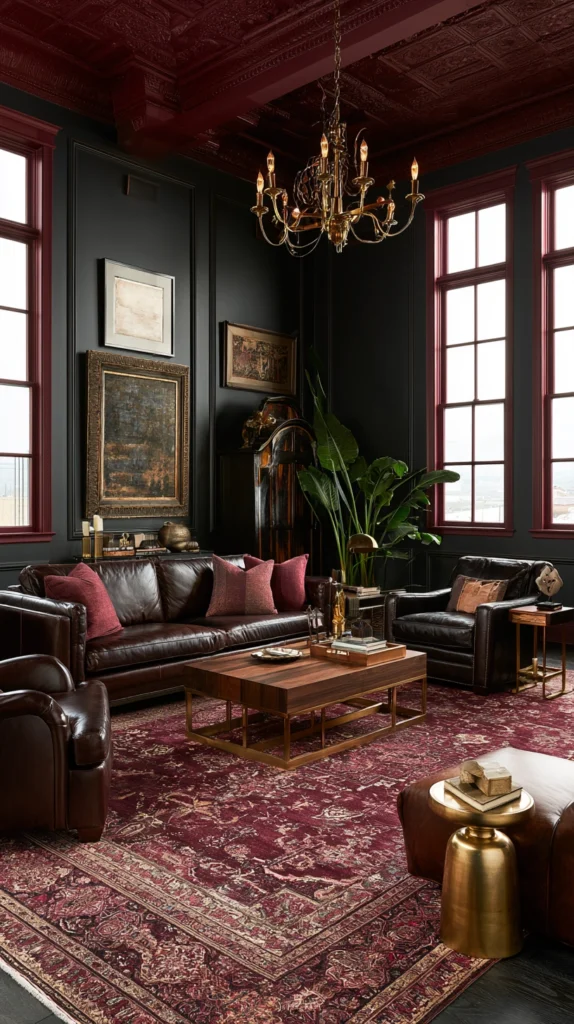
A large area rug in a deep jewel tone — burgundy, emerald, or navy — with an intricate traditional pattern, grounding the room’s furniture and adding another layer of the aesthetic’s characteristic richness.
Why the rug matters as much as the walls or furniture
A rug covers a significant visual portion of the room and is often the piece that ties together furniture of otherwise varied wood tones and fabrics into one cohesive look.
The color
Deep, saturated jewel tones, avoiding pastel or muted versions of the same colors, which would undercut the aesthetic’s characteristic richness.
The pattern
A traditional Persian, Turkish, or Oriental-style pattern, whether an authentic vintage piece or a contemporary reproduction, rather than a plain or geometric contemporary rug.
The sizing
Large enough that all the room’s major furniture pieces sit at least partially on the rug, rather than a small rug floating in the center of the room.
The layering option
A smaller vintage-style rug layered on top of a larger neutral jute rug, for additional texture and a more collected, gathered-over-time appearance.
Cost breakdown: Large area rug (deep jewel tone, patterned): $150–500 Or vintage rug: $200–600 Total: $150–600
13. The Candlelit Evening Lighting Scheme
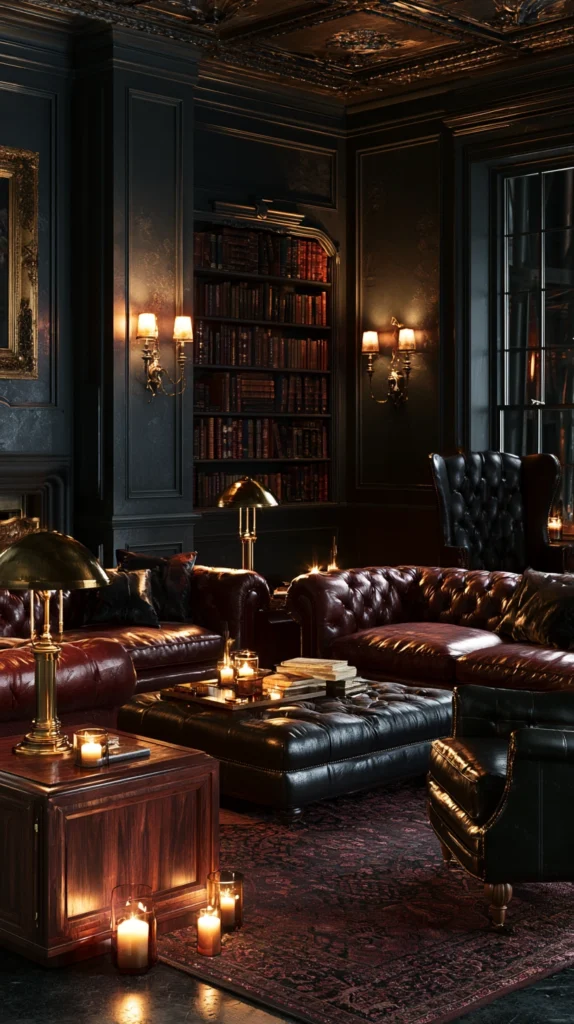
A full lighting overhaul favoring candles, brass lamps, and warm low bulbs throughout the room, eliminating reliance on any single overhead source.
Why lighting alone can transform an otherwise ordinary room
A room can have every other dark academia element in place and still feel wrong under bright, even overhead light. Lighting is frequently the single detail most responsible for whether a room actually reads as intended in the evening.
The lamps
At least two to three brass table or floor lamps positioned around the room, each with a warm bulb rated 2700K or below.
The candles
Grouped in twos and threes on the mantel, coffee table, and bookshelf, rather than a single candle in isolation.
The dimmer
A dimmer switch installed on any overhead fixture that remains, allowing it to be used at low levels rather than full brightness or off entirely.
The shade choice
Fabric or amber glass lamp shades, which diffuse light more warmly than a clear or white shade.
The evening ritual
Lamps and candles lit together at dusk, rather than flipping on a single overhead switch, treating the transition into evening as its own small occasion.
Cost breakdown: Brass lamps (2–3): $100–250 Candles (assorted): $25–50 Dimmer switch installation: $30–80 Total: $155–380
14. The Complete Dark Academia Living Room (The Fully Committed Room)
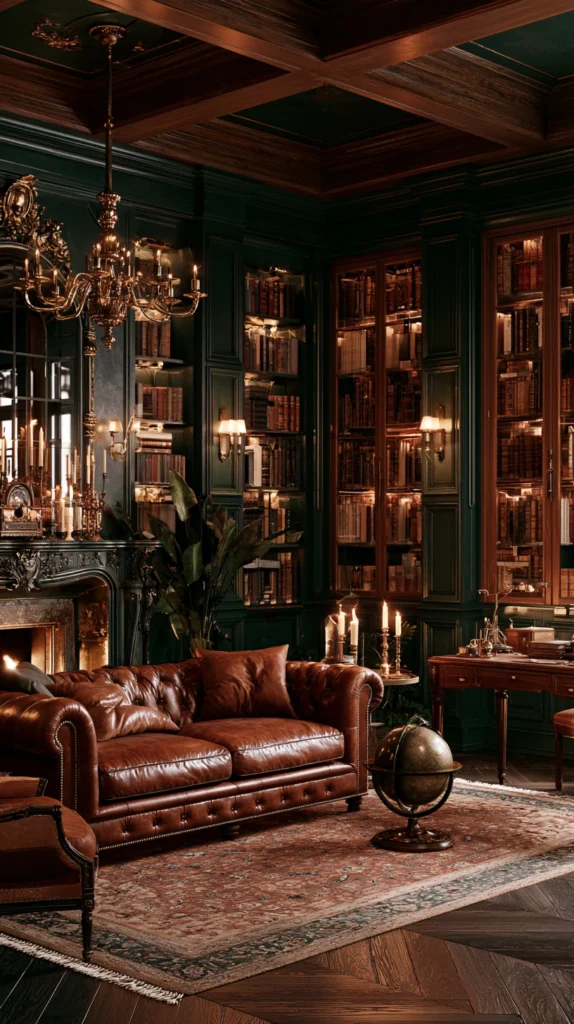
A living room designed around the dark academia aesthetic as the base note of every decision — walls, shelving, furniture, and lighting all working from the same richly bookish, candlelit palette.
What separates the complete room from a single styled shelf
A single styled bookshelf: an accent. A complete dark academia living room: an atmosphere. The difference is whether every other choice in the room was made in response to the aesthetic, or made separately from it.
The elements of the complete dark academia living room
The walls
A deep accent wall in burgundy or forest green, or full commitment across every wall, paired with warm off-white trim.
The bookshelves
Floor-to-ceiling shelving, genuinely filled with a wide-ranging book collection built up over time.
The seating
A leather chesterfield or armchair as the anchor piece, supported by dark wood and tweed or tartan accents.
The metals
Brass consistently across lighting, hardware, and frames, never mixed with cooler silver tones.
The lighting
Layered entirely in warm, low light — lamps and candles rather than a single bright overhead source.
The textiles
A deep jewel-tone rug, tartan throws, and tweed or velvet cushions, mixed in pattern and texture rather than matched precisely.
The finishing objects
A globe, framed maps or portraits, a writing desk corner, and a styled mantel or coffee table vignette.
The complete design in action
A rainy October evening:
6pm: The lamps and candles lit together, the last of the daylight fading through the window.
6:15pm: A book pulled from the shelf, the leather chair already warm from an earlier afternoon in it.
7pm: Rain against the window, the room lit only by lamp and candlelight, the television never once considered.
9pm: Still reading, the room exactly as suited to that hour as it was to the first.
The complete dark academia living room: not a room decorated to look bookish, but a room genuinely built for reading, evening after evening.
Cost breakdown for the complete room: Assuming a starting point of a neutral room: Paint (accent wall or full room): $40–250 Bookshelf and book collection: $260–960 Leather chesterfield or armchair: $200–2,000 Rug: $150–600 Brass lighting (3–4 pieces): $150–350 Textiles (throws, cushions): $95–190 Finishing objects (globe, frames, mantel styling): $150–400 Total: $1,045–4,750
Phased over two or three seasons:
Season one ($300–700): An accent wall A single leather armchair with a floor lamp Beginning the book collection
Season two ($400–1,200): Full bookshelf wall A jewel-tone rug Additional brass lighting
Season three ($400–2,500): A chesterfield sofa A writing desk corner Framed maps, gallery wall, and mantel styling
The dark academia living room: not a weekend project but a bookish atmosphere built with intention over time.
The Question Before Any Dark Academia Design
Before choosing a wall, a piece of furniture, a lighting scheme:
What is the primary reason for wanting this atmosphere in the room?
If the answer is: full transformation — the accent wall paired with the full bookshelf and chesterfield is the answer.
If the answer is: testing the aesthetic first — the reading corner or the coffee table vignette.
If the answer is: atmosphere without any furniture changes — the lighting overhaul alone.
If the answer is: the simplest possible — one lamp, one stack of books, one corner of the room reconsidered.
The design follows the level of commitment available. Every dark academia idea on this list serves that same bookish mood at a different scale. The question is which scale is right for this room and this household.
The single stack of books and one brass lamp in the right spot: still better than no atmosphere at all. The full room, done with intention: an evening ritual that lasts well past the first cold night.
That ritual: the whole point of the aesthetic.
Getting Started This Weekend
The immediate dark academia solution:
Pull every book already owned onto one shelf or one stack.
Not a new purchase. Not a curated collection. What is already in the house, gathered in one visible place.
Swap one overhead bulb for a warm, low one, and add a single lamp.
The room will already feel different before anything else has changed.
Light a candle on the coffee table this evening.
Small, immediate, and the detail that signals the shift from ordinary evening to something closer to the atmosphere intended.
Sit in the room and read for twenty minutes, television off.
The rest of the design: the elaboration of this moment.
The books: the beginning. The dark academia living room: what grows around them.