
15 Dark Green Living Room Ideas for a Moody, Intimate Fall Feel
The dark green wall changed how my living room felt more than any other single decision I have made in that room. Not the new sofa. Not the rug. Not the lighting or the artwork or the rearranged furniture.
The color.
Because dark green did something none of the furniture changes did. Before it: a room that looked fine in every season and felt like nothing in particular. After it: a room that closes in around a person the moment they sit down, especially once the light drops in October.
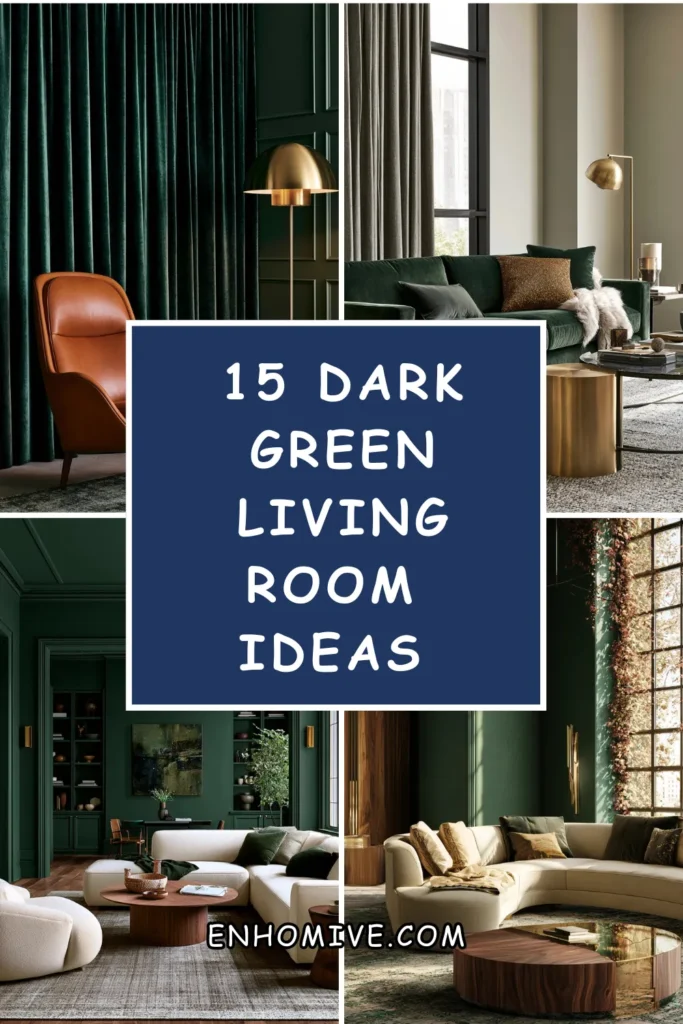
Dark green is not a paint choice. It is an atmosphere decision. A pale room reflects light and stays open. A dark green room absorbs light and pulls close. The room: no longer just a space to pass through, but a space that holds a person in it.
Here are 15 dark green living room ideas — from the simplest accent to the most fully committed room — built on that understanding.
Why Dark Green Works Specifically in Fall
The light equation
Without dark green:
A white or pale living room in October.
The low autumn light: bounces around the room, thin and cool.
The room: bright, but not warm.
With dark green:
The same October light.
The deep pigment: absorbs rather than reflects, so what light remains reads as amber and gold against it.
The room: dim, but warm.
The forest association
Dark green is one of the few colors the human eye reads as both sheltering and alive. A pale room feels empty when unlit. A dark green room, even dim, still feels occupied by the color itself.
The contrast advantage
Dark green is the ideal backdrop for the warm materials of a fall room — brass, walnut, rust textiles, candlelight. Every warm object in a dark green room reads brighter than it would against white.
The year-round justification
Unlike a strictly seasonal color, dark green does not need to be undone in January. The room that gets moodier and cozier for fall settles into the same identity for winter, and softens again only once spring light returns.
The Five Ways to Bring In Dark Green
Before choosing any design:
Paint (the full commitment)
Every wall, floor to ceiling.
The most transformative option, and the hardest to reverse without repainting.
The deepest, most enveloping version of the trend.
Paneling or wainscoting
Painted or stained dark green millwork on the lower half of the wall.
Adds texture and architectural interest, not just color.
A gentler commitment than full paint.
Accent wall
A single wall in dark green, the rest left neutral.
The lowest-risk entry point into the trend.
Works well behind a sofa or fireplace as a focal backdrop.
Furniture and textiles
No wall paint at all — the color carried entirely by a sofa, curtains, or a large rug.
The most flexible and least permanent option.
Suits renters and anyone hesitant to commit to paint.
Cabinetry and built-ins
Dark green on bookshelves, media units, or a bar cart.
Concentrates the color into furniture-scale objects rather than the whole room.
Pairs naturally with brass or gold hardware.
1. The Full Envelope (Walls, Trim, and Ceiling)
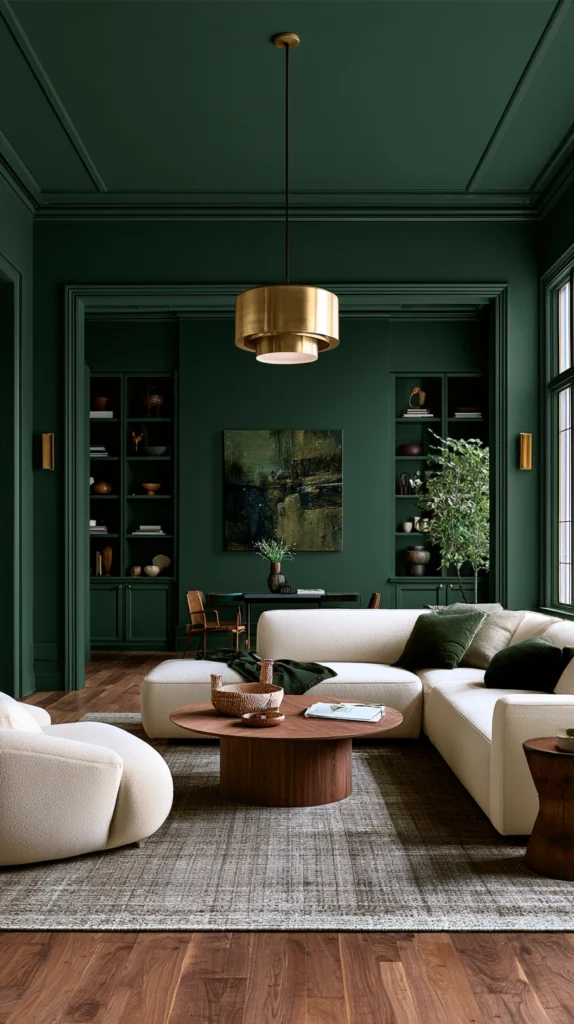
Every surface of the room — walls, trim, and ceiling — painted the same dark green, for the most complete and enveloping version of the look.
Why full envelope is the most dramatic choice
When trim and ceiling match the walls, the room loses its visual edges. There is no white line to remind the eye where the wall ends and the ceiling begins.
The paint
A true dark green, not a muted sage — forest, bottle, or hunter green reads correctly for this effect.
A matte or eggshell finish, which absorbs light rather than bouncing it.
The ceiling
Painted the same color, or one shade lighter to avoid a completely flat effect from below.
The ceiling: the step most people skip, and the one that makes the room feel like a cocoon rather than a box.
The trim
Painted to match, not left white. White trim against dark green walls breaks the enclosed feeling this look depends on.
The lighting
Because the room absorbs so much light, layered lamp lighting is essential — overhead light alone will read as dim and flat rather than moody.
Cost breakdown: Paint (walls, trim, ceiling): $150–300 Additional lamps (2–3): $80–160 Total: $230–460
2. The Dark Green Accent Wall Behind the Sofa
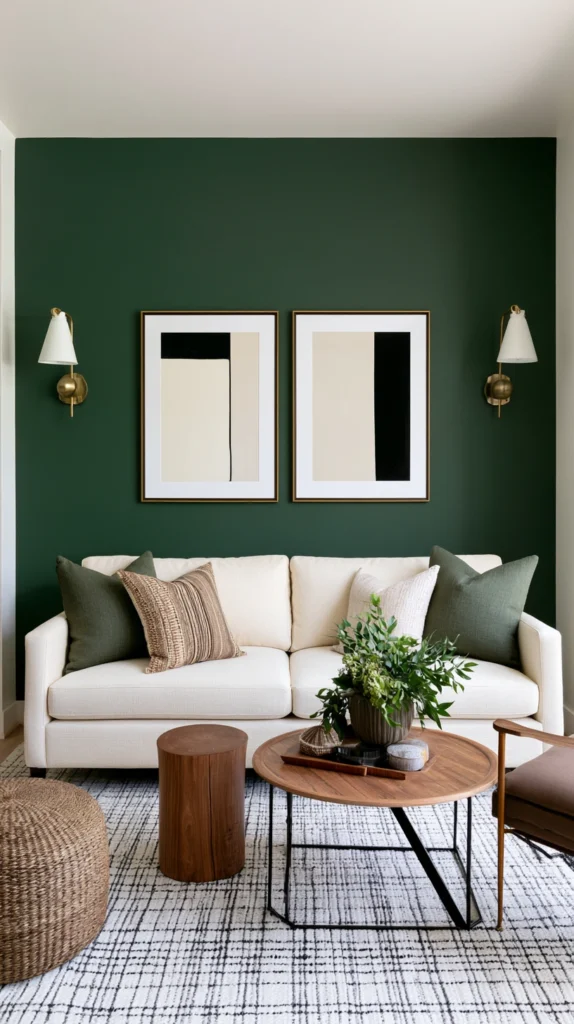
A single wall painted dark green directly behind the main seating, used as a backdrop rather than a full room treatment.
Why the sofa wall is the natural first choice
The wall behind the sofa is the one most visible from the room’s main sightline — from the doorway, from the kitchen, from anywhere else in an open-plan space.
The wall selection
Choose the wall the eye lands on first entering the room, not necessarily the largest one.
The furniture in front
A light or neutral sofa against the dark wall creates the strongest contrast.
Brass or wood-framed furniture reads especially well against dark green.
The art
One or two pieces in gold or warm-toned frames, hung slightly lower than typical gallery height for an intimate feel.
The lighting
A picture light or a pair of wall sconces flanking the art, adding a warm glow directly onto the green.
Cost breakdown: Paint (one wall): $40–70 Wall sconces (2): $60–120 Total: $100–190
3. The Dark Green Velvet Sofa
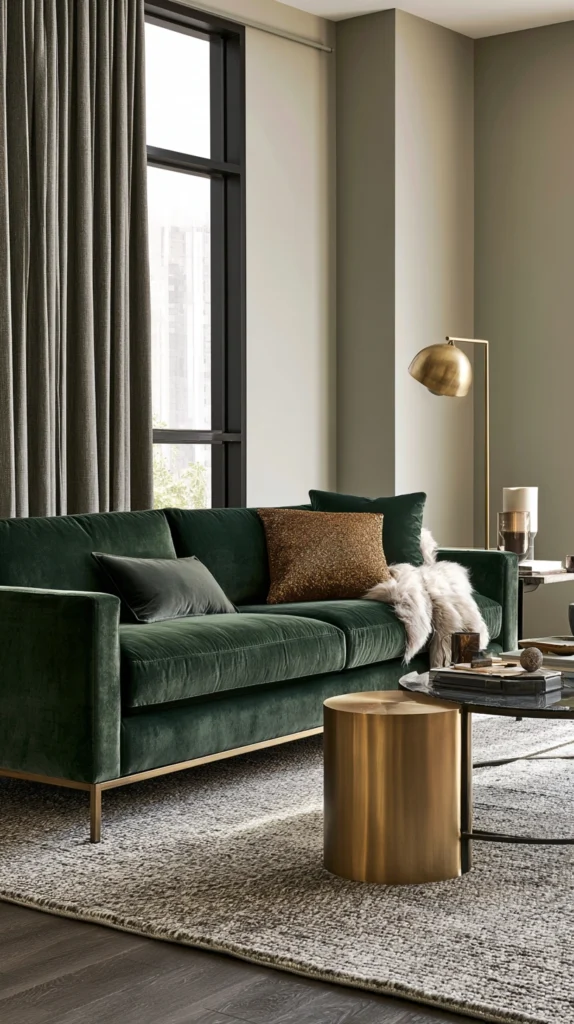
A single dark green velvet sofa as the anchor of the room, with walls left neutral — the fastest way into the trend without touching paint.
Why velvet matters here
Velvet catches and shifts light across its pile, so a dark green sofa never reads as a flat block of color the way a matte fabric would.
The sofa
Deep forest or emerald velvet, in a low, rolled-arm or channel-tufted silhouette for a vintage-leaning feel.
The neutral backdrop
Cream, warm white, or light oatmeal walls, so the sofa is the room’s clear focal point.
The supporting pieces
Brass legs or brass hardware on nearby furniture, echoing the sofa’s formality.
A jute or wool rug beneath, in a warm neutral tone.
The cushions
Two to three cushions in rust, mustard, or burnt orange, for the fall palette against the green base.
Cost breakdown: Velvet sofa: $600–1,400 Cushions (3): $60–90 Total: $660–1,490
4. The Dark Green Built-In Bookshelves
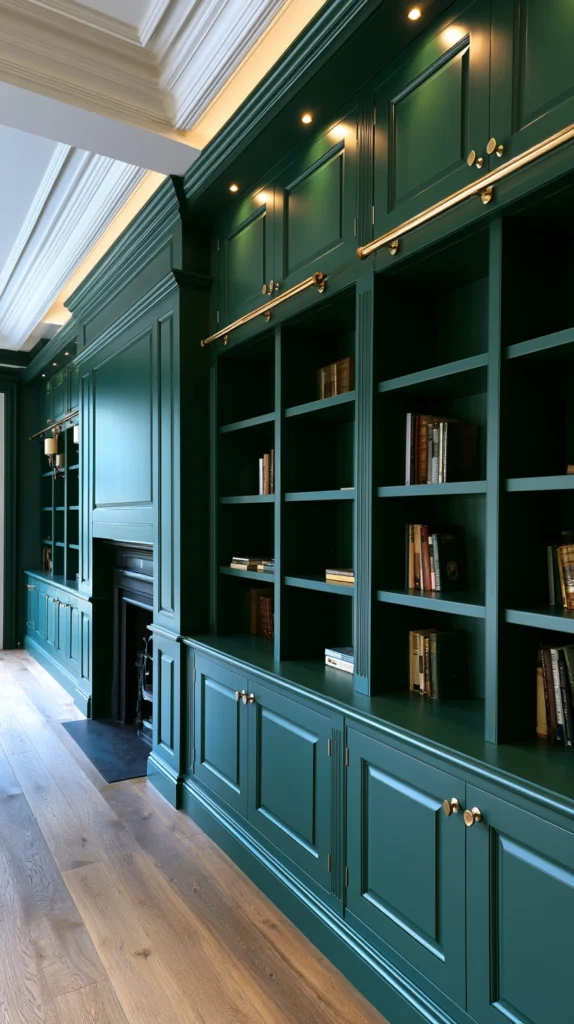
Floor-to-ceiling built-in shelving painted dark green, flanking a fireplace or a window — the trend applied to furniture rather than walls.
Why built-ins carry the color well
Shelving has depth and shadow already, from the books and objects stacked on it. Dark green paint deepens that shadow rather than flattening it the way a plain wall would.
The construction
Existing shelving repainted, or new built-in units constructed to flank a fireplace or window.
The interior back panel painted the same dark green as the frame, so the shelves read as a solid block of color from across the room.
The styling
Books arranged by color as well as height, with warm-toned spines grouped to stand out against the green backdrop.
A small lamp on one shelf, for evening warmth without overhead light.
The hardware
Brass or aged gold pulls on any cabinet doors within the unit.
Cost breakdown: Paint for existing shelving: $40–70 Or new built-in construction: $400–1,200 Small shelf lamp: $30–60 Total: $70–1,260
5. The Dark Green and Terracotta Pairing
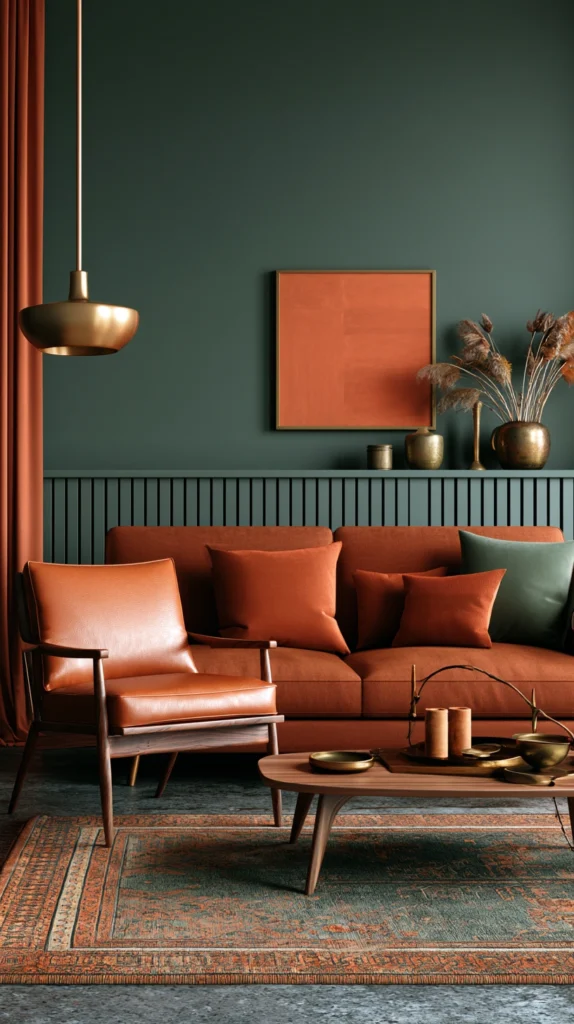
Dark green walls or furniture paired deliberately with terracotta and rust textiles — the color combination that reads most distinctly as autumn.
Why this pairing works
Green and terracotta sit opposite each other on the color wheel, in the same warm-earth family that defines the fall palette. Neither competes with the other; each makes the other look richer.
The base
Dark green as the wall or the largest furniture piece.
The terracotta layer
A terracotta or rust-colored area rug, or a set of terracotta ceramic vases on a side table.
Burnt orange or clay-colored cushions on a green sofa, or the reverse if the sofa itself is neutral.
The connecting material
Woven natural materials — rattan, jute, unfinished wood — bridge the two colors and keep the pairing from feeling too saturated.
The plants
A trailing plant in a terracotta pot, positioned against the dark green wall, doubles the depth of both colors.
Cost breakdown: Terracotta rug: $100–250 Cushions (4): $60–100 Terracotta pots and vases: $30–60 Total: $190–410
6. The Dark Green Fireplace Surround
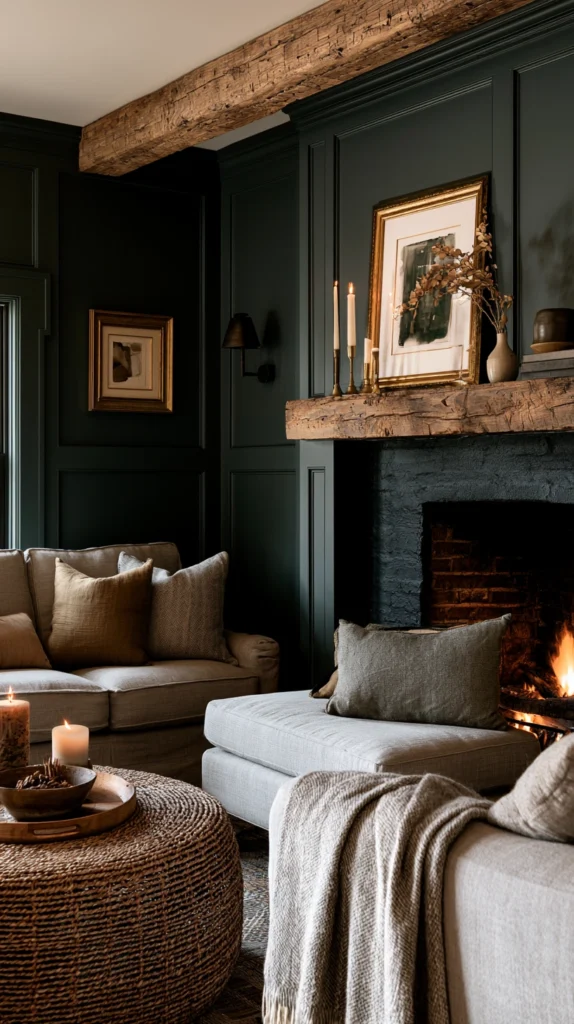
The wall or mantel surrounding a fireplace painted or tiled in dark green, making the fire the visual and literal warm center of the room.
Why the fireplace wall is the ideal candidate
The fireplace is already the room’s natural focal point. Dark green concentrated there intensifies that role rather than competing with it.
The surround
Painted plaster or brick, or dark green tile for a more permanent and formal treatment.
The mantel left in a contrasting material — natural wood or white-painted trim — for definition against the dark backdrop.
The mantel styling
Candles in varying heights, unlit during the day and lit in the evening.
A single piece of art or a mirror, framed in brass or aged wood.
The hearth
If tiled, extend the same dark green tile slightly onto the hearth floor for continuity.
The firelight effect
The combination of an actual flame and dark green surrounding it: the amber light reads more vivid against the deep color than it would against a pale wall.
Cost breakdown: Paint for surround: $30–50 Or tile for surround: $150–400 Mantel styling (candles, art): $40–80 Total: $70–530
7. The Moody Green Reading Corner
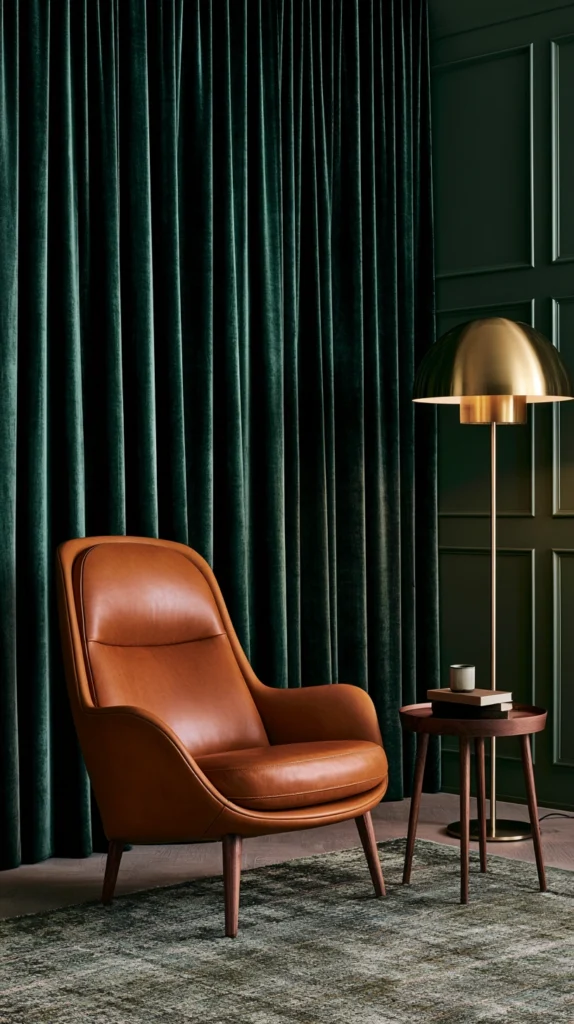
A single armchair and lamp positioned against a dark green wall or curtain, creating a self-contained pocket of atmosphere within a larger room.
Why a corner treatment works without full commitment
Not every room needs, or can accommodate, a full dark green wall. A single corner gives the same mood in miniature.
The backdrop
A dark green curtain hung floor to ceiling behind the chair, rather than paint — removable, and adjustable if the room is rearranged later.
Or a narrow section of wall, if an accent nook already exists.
The chair
A leather or wool-upholstered armchair in a warm neutral tone, for contrast against the green.
The lamp
A brass floor lamp with a warm bulb, positioned just behind the shoulder.
The finishing layer
A small side table, a stack of books, and one plant — enough to make the corner feel complete without crowding it.
Cost breakdown: Dark green curtain: $50–100 Armchair (existing or new): $0–300 Floor lamp: $50–100 Total: $100–500
8. The Dark Green Dining Nook Within an Open-Plan Living Room
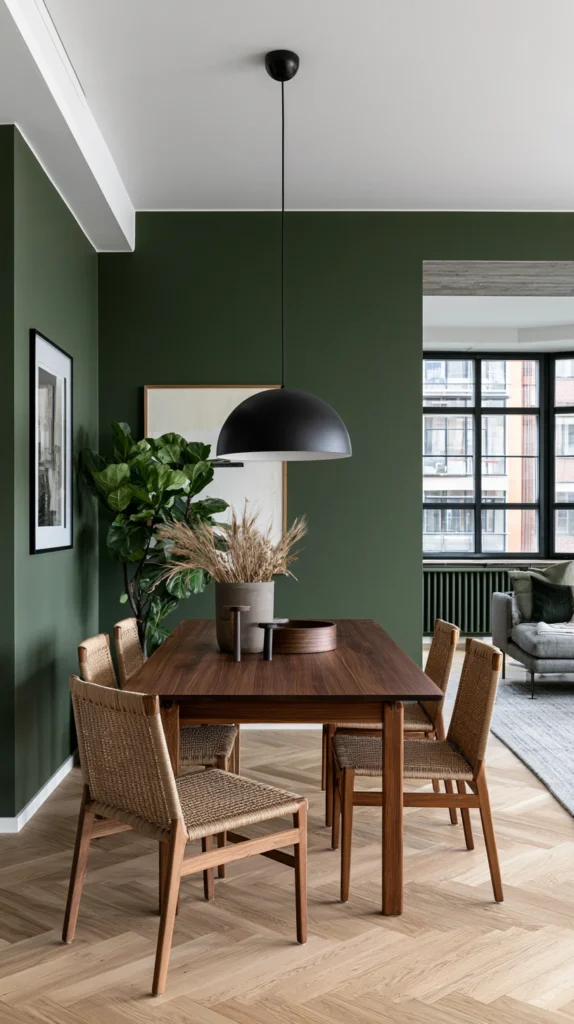
In an open-plan space, the dining or breakfast nook section painted dark green while the living area stays neutral — a way to zone the room using color rather than furniture.
Why zoning with color works
In an open floor plan, color is one of the few tools available to signal that one function of the room ends and another begins.
The wall selection
The wall or alcove directly behind the dining table, not the full perimeter of the space.
The table and chairs
A dark wood table reads naturally against the green backdrop; rattan or cane chairs lighten the pairing.
The lighting
A pendant light in brass or matte black, hung low over the table, becomes the visual anchor of the zoned area.
The transition
Where the green wall meets the neutral living area, a change in flooring material or a rug edge reinforces the zoning without needing a physical divider.
Cost breakdown: Paint (nook wall): $30–50 Pendant light: $60–150 Total: $90–200
9. The Dark Green Curtains
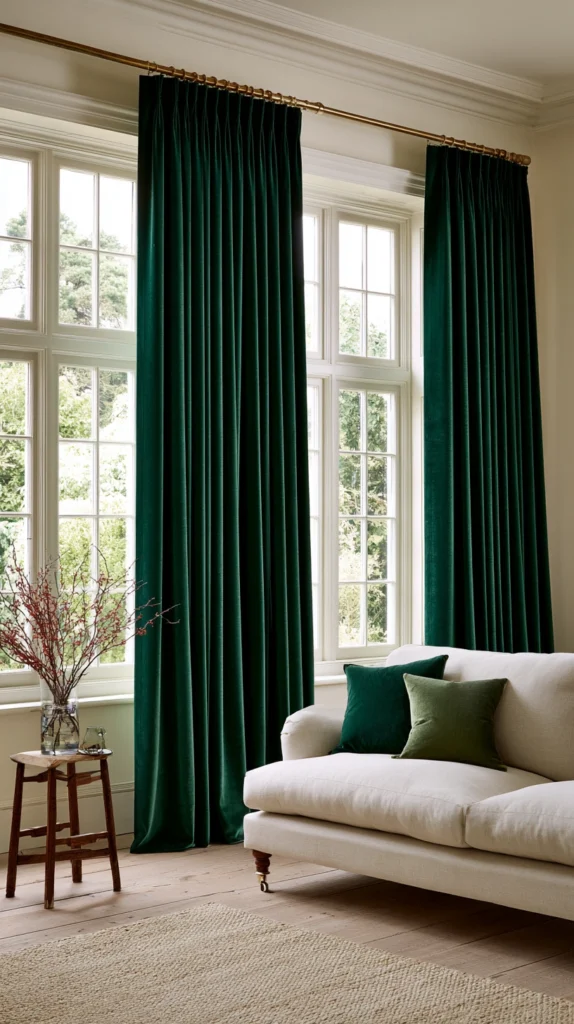
Floor-length dark green curtains as the primary source of the color, with walls left untouched — the softest and most reversible version of the trend.
Why curtains carry weight beyond the window
Full-length curtains, especially in a heavier fabric, act almost like a wall themselves once drawn. Dark green curtains change the character of a room even when the walls stay pale.
The fabric
Velvet or heavy linen, hung from ceiling height rather than just above the window frame, to maximize the sense of drama.
The hardware
A brass or matte black curtain rod, visible rather than hidden, adds a finishing detail.
The layering
Curtains left mostly open during the day for natural light, and drawn in the evening — the room shifting mood with the time of day.
The repeat
A dark green throw or cushion elsewhere in the room echoes the curtain color without requiring a second large purchase.
Cost breakdown: Velvet or linen curtains: $80–200 Curtain rod: $30–60 Total: $110–260
10. The Dark Green Ceiling (Walls Left Neutral)
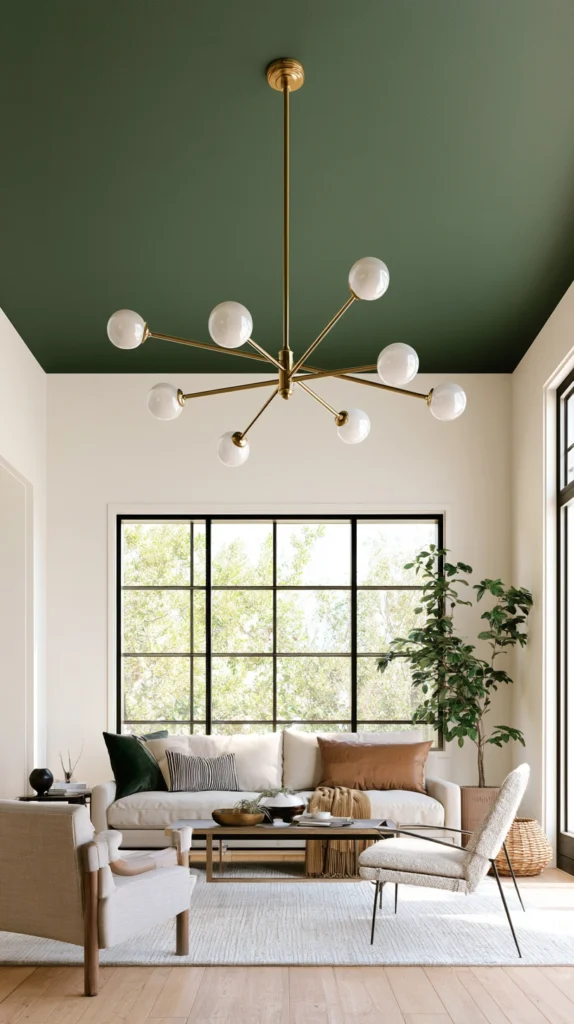
Only the ceiling painted dark green, with the walls left in a pale or neutral tone — an unexpected version of the trend that lowers the room without darkening it entirely.
Why the ceiling alone is worth considering
A dark ceiling draws the eye upward and gives a room a sense of intimacy and height at once, without the full commitment of dark walls.
The paint
The same dark green used elsewhere in the home, for consistency, applied in a matte finish to avoid glare from overhead lighting.
The trim line
A crisp line where ceiling meets wall is essential here — any bleed makes the effect look accidental rather than intentional.
The lighting fixture
A statement pendant or chandelier stands out more clearly against a dark ceiling than a pale one.
The room below
Pale walls and light furniture keep the room from feeling heavy, while the ceiling alone supplies the mood.
Cost breakdown: Paint (ceiling only): $40–70 Statement light fixture: $80–200 Total: $120–270
11. The Dark Green Kitchen-Living Room Sightline
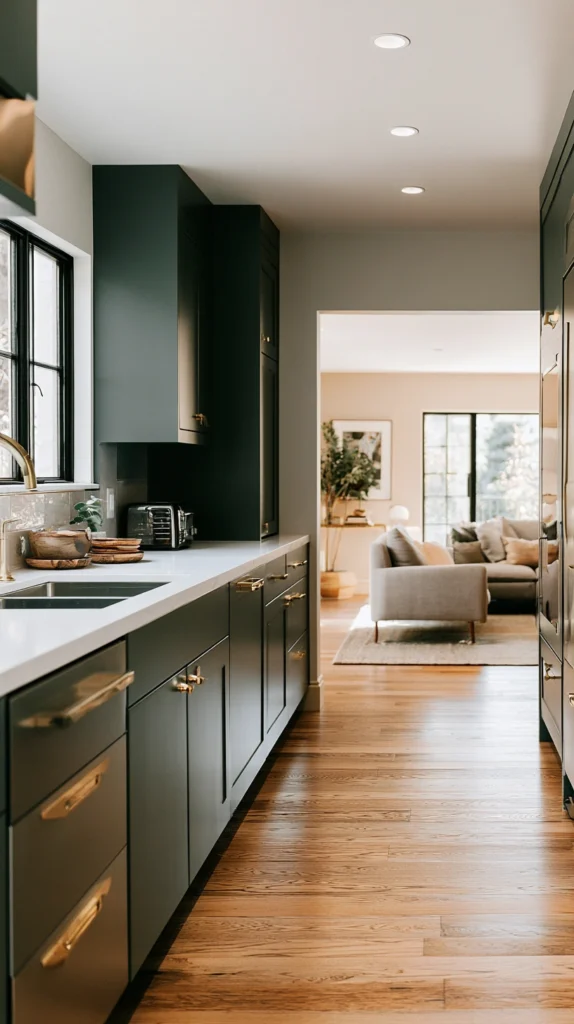
In homes where the kitchen and living room share a sightline, dark green cabinetry in the kitchen visually connects to dark green elements in the living space beyond it.
Why the sightline matters
Even without touching the living room walls, dark green kitchen cabinetry visible from the living area extends the mood into a room it never physically enters.
The kitchen side
Dark green lower cabinets, left in place if already painted, or newly painted for the seasonal refresh.
Brass or unlacquered hardware for warmth against the cabinet color.
The living room side
A single dark green object — a vase, a book stack, a cushion — placed on the living room side of the sightline, echoing the cabinet color without repainting anything.
The connecting material
Warm wood tones (open shelving, a dining table, flooring) used on both sides of the sightline tie the two spaces together.
Cost breakdown: Cabinet paint (if needed): $60–120 Living room accent object: $20–50 Total: $80–170
12. The Dark Green Gallery Wall Backdrop
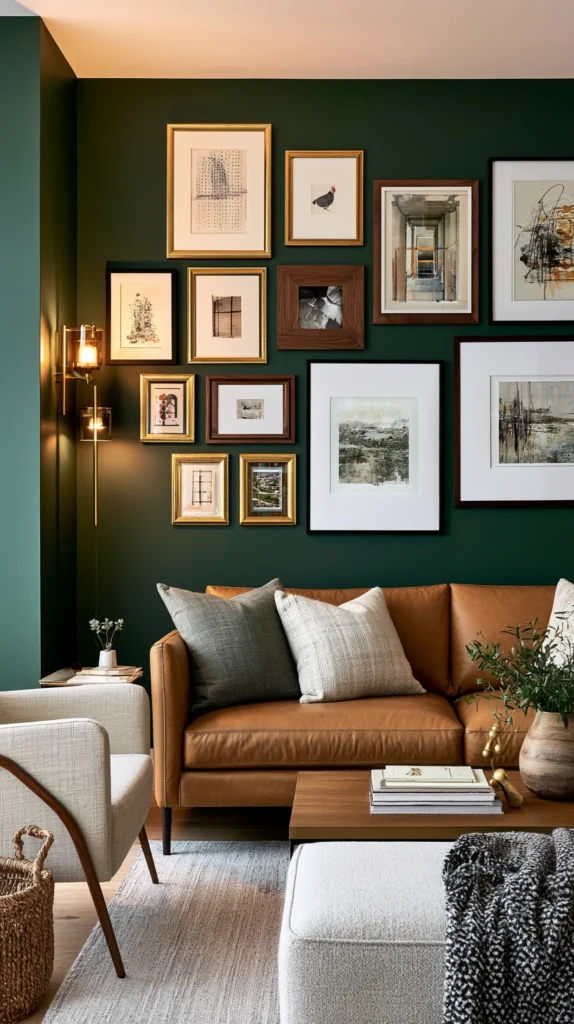
A dark green wall used specifically as the backdrop for a gallery wall of framed art or photography — the trend applied as a display surface rather than a full room statement.
Why dark green suits a gallery wall
Frames, especially gold, brass, or dark wood ones, separate more clearly from a dark green wall than from a white one, where they can blur together.
The wall
One wall, ideally without windows, for an uninterrupted display surface.
The frame selection
Mixed frame tones — brass, walnut, black — read as intentional against dark green, whereas the same mix can look chaotic against white.
The arrangement
A loose grid or salon-style cluster, with consistent spacing (2–3 inches) between frames for cohesion.
The lighting
A single picture light over the central or largest frame, rather than lighting the whole wall evenly.
Cost breakdown: Paint (one wall): $40–70 Frames (assuming existing art): $50–150 Picture light: $30–60 Total: $120–280
13. The Dark Green Home Bar or Drinks Cabinet
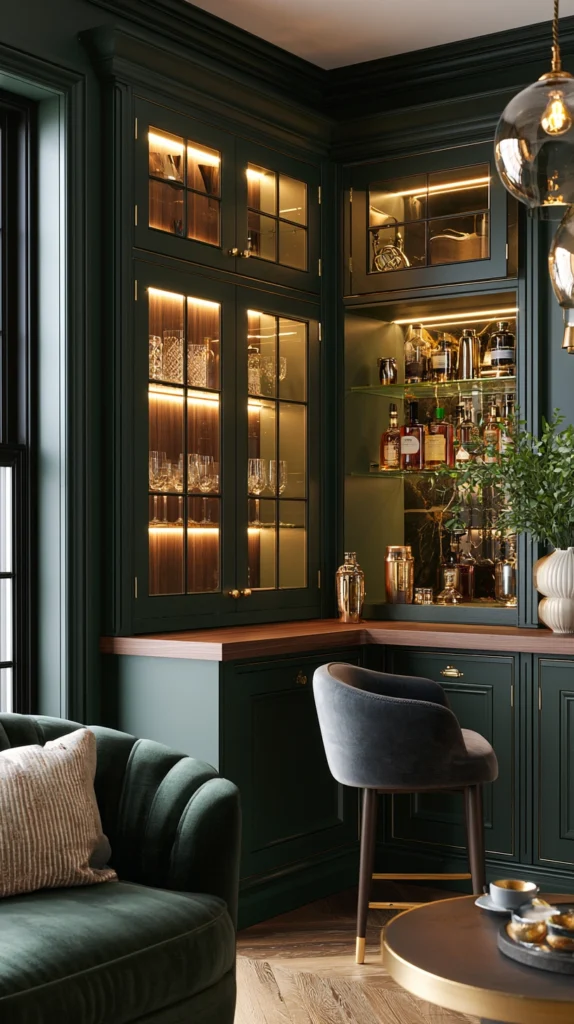
A bar cart or built-in cabinet painted dark green, positioned in a corner of the living room, becoming a small concentrated dose of the trend.
Why a bar cabinet is an easy entry point
Furniture-scale color commitment costs less, in money and in risk, than a wall or a room, while still bringing real atmosphere to the space.
The piece
An existing cabinet repainted, or a small dark green bar cart or cabinet purchased new.
Brass rails, handles, or trim on the piece itself reinforce the warm-and-dark pairing.
The styling
Glassware arranged with some negative space, rather than tightly packed — the dark green backdrop is part of the display.
The lighting
A small lamp or a strip of warm LED lighting inside a cabinet with glass doors, so the piece glows even when the room’s main lights are off.
Cost breakdown: Paint for existing cabinet: $25–40 Or new dark green bar cart: $120–300 Small lamp or LED strip: $20–40 Total: $45–380
14. The Dark Green Statement Ceiling Rose and Molding
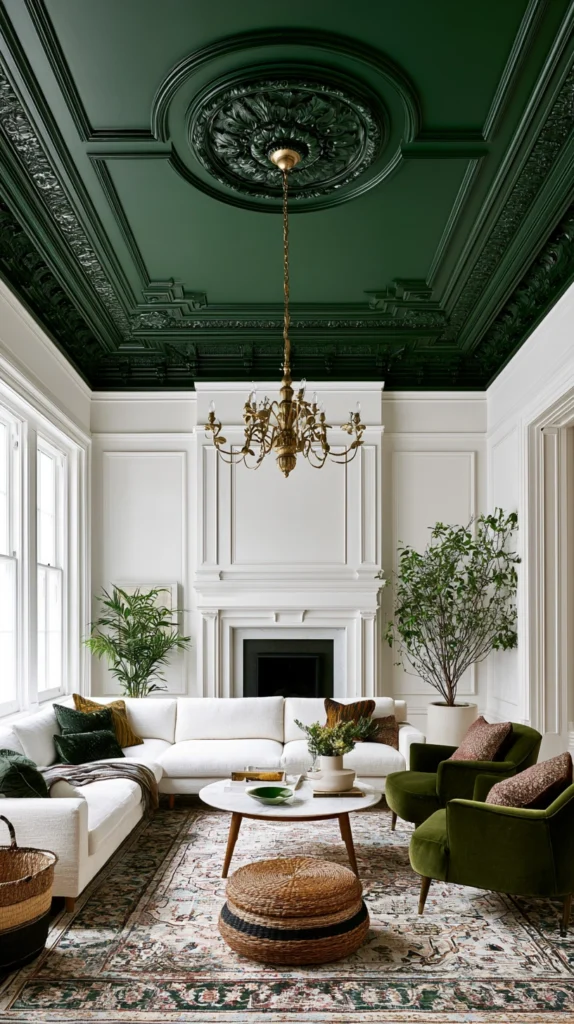
Dark green paint applied specifically to ceiling molding, a ceiling rose, or decorative trim, left as the only dark element in an otherwise pale room.
Why architectural detail deserves the color
Existing molding is often painted the same white as the walls and effectively disappears. Dark green picks it out and gives it presence for the first time.
The detail work
A fine brush or detail roller for ceiling roses, cornicing, or picture rails, painted in the same dark green used elsewhere in the home.
Patience over speed — this is a slow, precise task rather than a large-surface one.
The contrast
Pale walls and ceiling make the dark green detailing read as a deliberate flourish rather than an accident.
The result
A room that looks classically detailed rather than heavily colored, with the mood carried entirely by architectural line rather than surface area.
Cost breakdown: Paint (small quantity): $15–25 Detail brushes: $10–15 Total: $25–40
15. The Complete Dark Green Living Room (The Fully Committed Room)
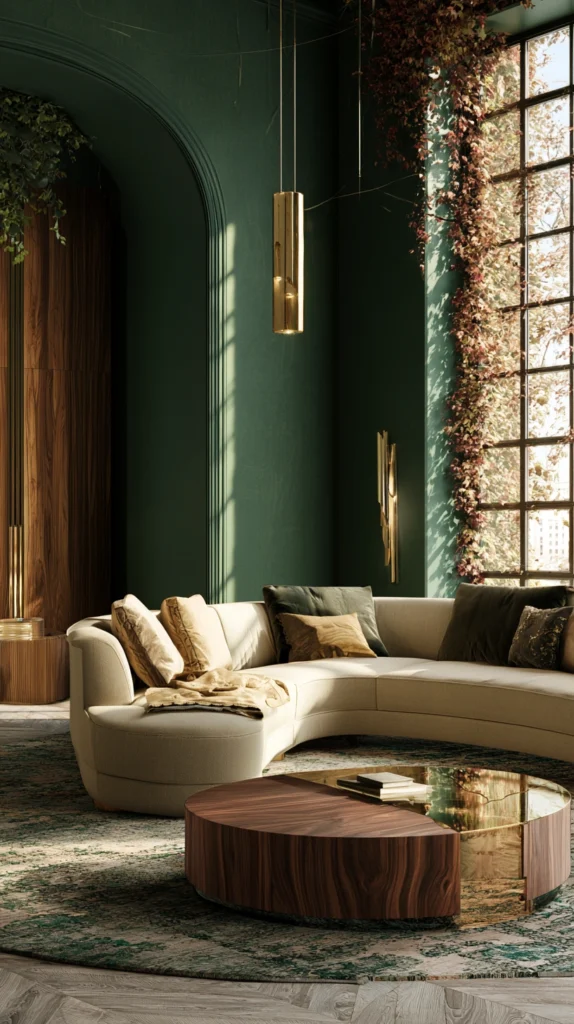
A living room designed around dark green as the base note of every decision — walls, furniture, lighting, and styling all working from the same deep, warm palette.
What separates the complete room from a single accent
A single dark green wall: an accent. A complete dark green room: an atmosphere. The difference is whether every other choice in the room was made in response to the color, or made separately from it.
The elements of the complete dark green living room
The walls
Full dark green paint, or a dark green accent wall paired with warm neutral walls elsewhere in the room.
The furniture
At least one large piece — sofa, sectional, or a pair of chairs — in a warm neutral or leather tone, to keep the room from feeling too saturated.
A second dark green piece, smaller in scale, such as a chair or ottoman.
The metals
Brass or aged gold consistently across lighting, hardware, and frames — a single metal tone throughout, rather than mixed silvers and golds.
The lighting
Layered: one floor lamp, one table lamp, and one overhead fixture, none of them relied on alone.
The textiles
A warm-toned rug (rust, camel, or deep gold), cushions in two or three coordinating fall tones, and at least one heavy throw.
The plants
Two or three plants of varying height, positioned to soften the room’s hard architectural lines.
The complete design in action
An October evening:
5pm: The lamps switched on before the light has fully faded, the room already reading warm rather than dim.
6pm: The fireplace, if there is one, lit — the amber light doubling against the dark green backdrop.
7pm: A guest arriving remarks on the room before saying anything else. The color: doing more work than any single piece of furniture in it.
9pm: The room still feels occupied even with only one lamp left on, because the color itself holds the atmosphere.
The complete dark green living room: not a room that needs constant restyling through the fall season, because the base note is already the right one.
Cost breakdown for the complete room: Assuming a starting point of a neutral room: Paint (walls or accent wall): $40–300 Neutral sofa or sectional (existing or new): $0–1,200 Second dark green furniture piece: $150–500 Brass lighting (3 fixtures): $150–350 Rug: $100–300 Cushions and throw: $100–180 Plants (3): $60–120 Total: $600–2,950
Phased over two or three seasons:
Season one ($150–350): An accent wall A dark green cushion set One brass lamp
Season two ($250–500): A second dark green furniture piece A rug in a warm fall tone Plants
Season three ($200–600): Full paint commitment if not already done Additional brass lighting A gallery wall or fireplace treatment
The dark green living room: not a weekend project but a mood built with intention over time.
The Question Before Any Dark Green Design
Before choosing a wall, a fabric, a piece of furniture:
What is the primary reason for wanting this feeling in the room?
If the answer is: full transformation — the full envelope of walls, trim, and ceiling is the answer.
If the answer is: testing the trend first — the accent wall or the velvet sofa.
If the answer is: atmosphere without any paint — the curtains or the reading corner.
If the answer is: the simplest possible — one dark green cushion, one lamp, one corner of the room reconsidered.
The design follows the level of commitment available. Every dark green idea on this list serves that same mood at a different scale. The question is which scale is right for this room and this household.
The single dark green cushion in the right spot: still better than no dark green at all. The full room, done with intention: an atmosphere that lasts well past the first cold evening.
That atmosphere: the whole point of the color.
Getting Started This Weekend
The immediate dark green solution:
Choose one wall, or one piece of furniture, to commit to first.
Not the whole room. Not the largest wall. The one already closest to being right.
Buy one can of a true dark green — not sage, not muted.
Forest, bottle, or hunter green: the depth is the point.
Add brass or warm gold somewhere nearby.
A lamp, a frame, a handle — already in the house, or inexpensive to add.
Turn off the overhead light and turn on a lamp instead.
The room will already feel different before the paint has even dried.
The rest of the design: the elaboration of this moment.
The color: the beginning. The dark green living room: what grows around it.