

15 Farmhouse Fall Living Room Inspiration
Most farmhouse living rooms look like the same room photographed from different angles. Shiplap, a buffalo check throw, a wreath on a plank-wood sign, the word “gather” somewhere near the mantel. The individual pieces are often nice enough. The whole reads as assembled from a single mood board rather than built up over time by people who actually live there.
The farmhouse aesthetic at its best is not a collection of trending objects. It is a set of materials — reclaimed wood, linen, galvanized metal, worn leather — arranged with an emphasis on warmth and use rather than visual display. Fall pushes this aesthetic to its most appropriate season, because the whole premise of farmhouse style — abundance, texture, a connection to the natural world, a fireplace burning at the center of gathering — is exactly what autumn calls for.

A farmhouse fall living room done well looks like it was there before the catalog was made. The patina on the wood came from decades of use, not a distressing tool. The throw blanket is on the armchair because someone used it last night, not because it coordinates with the pillows. The seasonal decoration is mostly natural material that came from somewhere outside rather than a purchase that came from a box.
Here are 15 ideas for a farmhouse fall living room that earns the adjective rather than just borrowing it.
Why Farmhouse Fall Styling Plays by Different Rules Than Generic Seasonal Decorating
The rules are not the same for a farmhouse-styled room as for a generically decorated one:
Generic Seasonal Decorating Advantages:
- Consistent, easily available templates across stores and catalogs
- Clear signposting — orange pumpkins, fall leaves in a vase — that communicates the season immediately
- Low time investment, since the components are designed to be dropped in and removed without integration with the existing room
The generic comparison: plug-in seasonal objects against a neutral background
Farmhouse Fall Styling Advantages and Realities:
- The integration of the seasonal layer into the room’s permanent materials, so the room looks specifically fall rather than “had fall objects added to it”
- A palette and texture language that is already close to fall’s own — warm wood, aged metal, dried natural material — making the seasonal shift feel like an amplification rather than an overlay
- A more demanding standard, where the room’s overall character depends on material quality and arrangement rather than the seasonal objects alone carrying the moment
The key insight:
- Generic fall decorating asks the seasonal objects to do all the work
- Farmhouse fall decorating asks the room itself to be nearly right, so the seasonal layer only needs to deepen what’s already there
- These are different relationships between room and season, not the same room with different objects
The Material and Texture Reality
The most important principle in farmhouse fall styling:
The material hierarchy:
- Natural, aged, and found materials always outperform manufactured-to-look-aged alternatives in a room aiming for genuine farmhouse character
- A single piece of genuinely old barn wood does more for the room’s authenticity than a room full of distressed shiplap installed last month
- Know this — it governs which purchases are worth making and which compromise the room’s overall character rather than improving it
The “texture before color” calculation:
- Farmhouse fall style achieves its warmth primarily through texture — rough linen, worn leather, aged wood, a chunky knit — rather than through saturated color
- Color plays a secondary role, deepening and shifting toward amber, rust, and warm cream rather than adding bold contrast
- Work from texture outward rather than from color inward, since a room rich in natural texture with a muted color palette reads as farmhouse, while the reverse reads as Halloween
Most farmhouse fall rooms build on a permanent foundation, not a seasonal one:
- The materials that create farmhouse character — the wide-plank floors, the exposed beams, the linen sofa, the brick fireplace — are there year-round
- Fall styling adds to a foundation that already exists rather than creating that foundation temporarily for the season
- If the foundation isn’t in place, the first investment is in the permanent pieces, not the seasonal accents
1. The Warm Neutral Palette Shift (Amber, Cream, and Warm White Over Cool Gray)
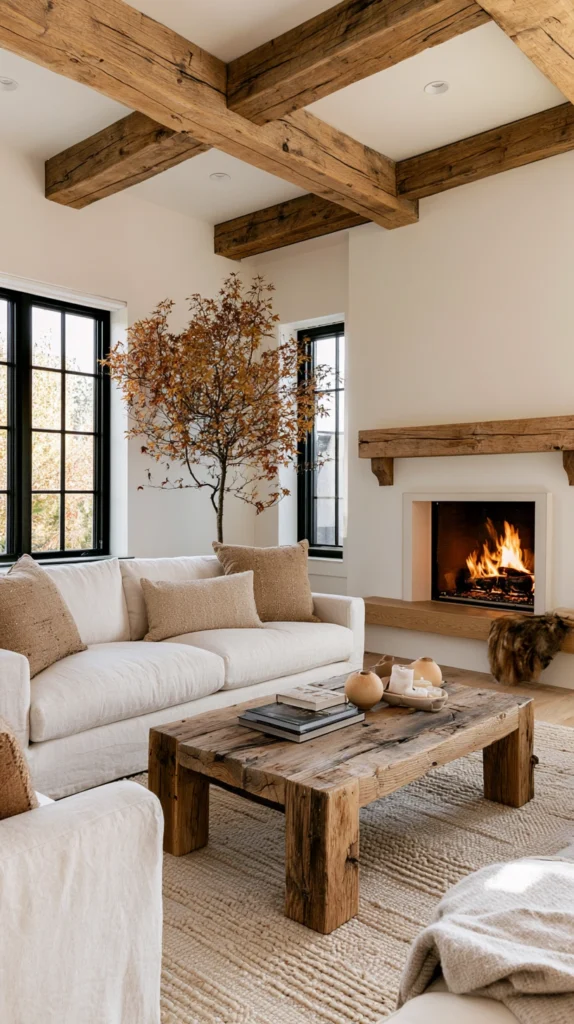
A deliberate shift in the living room’s color story from whatever it currently is toward the warmer end of the neutral spectrum — retiring any cool grays, crisp whites, or blue-toned linens and replacing them with amber, warm cream, and the colors of natural undyed fiber.
Why the palette foundation matters more than any single object
- The all-surfaces presence of a palette decision: unlike a single throw or a specific decoration, a color palette touches the sofa, the pillows, the curtains, the rug, and the wall simultaneously, meaning a correct palette shift improves everything in the room at once rather than adding one element
- The farmhouse-specific need for warmth in tone as much as texture: farmhouse rooms done in cool grays and bright whites read as Scandinavian or coastal, not farmhouse; the specific warmth of undyed wool, aged linen, and sun-bleached cream is the palette base that all other farmhouse choices depend on
- The low effort of implementing this shift at the level of removable objects: replacing a cool gray throw with a warm-toned oatmeal one and switching a white cushion cover for one in a warm cream or muted rust is a free or near-free adjustment that changes the room’s temperature dramatically without buying anything substantial
The options
- Warm white walls rather than the cool white that reads as modern, leaning toward cream and away from blue-toned white
- Undyed linen or oatmeal wool as the primary soft furnishing material, replacing any cool or synthetic fiber fabric in the main pieces
- Rust, amber, and muted mustard as accent colors in cushion covers and smaller textiles, rather than orange or red which push toward a more Halloween-specific reading
- Aged cream and warm beige as the room’s base neutrals, with richer colors reserved for smaller accents
The practical execution
- Remove any noticeably cool-toned soft furnishings for the fall season specifically — gray cushions, blue-toned throws — rather than introducing more warm-toned pieces on top of cool-toned ones that fight each other
- Test any proposed wall paint color in warm evening light, since farmhouse rooms are primarily experienced in lamplight and firelight rather than in full daylight
- Resist the urge to introduce too many distinct colors at once, since farmhouse fall styling reads as warm and rich specifically because of its limited, internally consistent palette rather than its variety
Cost breakdown
- Cushion cover swap (4–6 covers): $60–150
- Throw blanket in warm oatmeal or amber: $30–60
- Total: $90–210
The warm palette settled into the room before a single specifically fall object is added: the foundation that makes every other choice on this list land correctly.
2. The Mantel Layered Vignette (The Living Room’s Single Most Visible Surface)
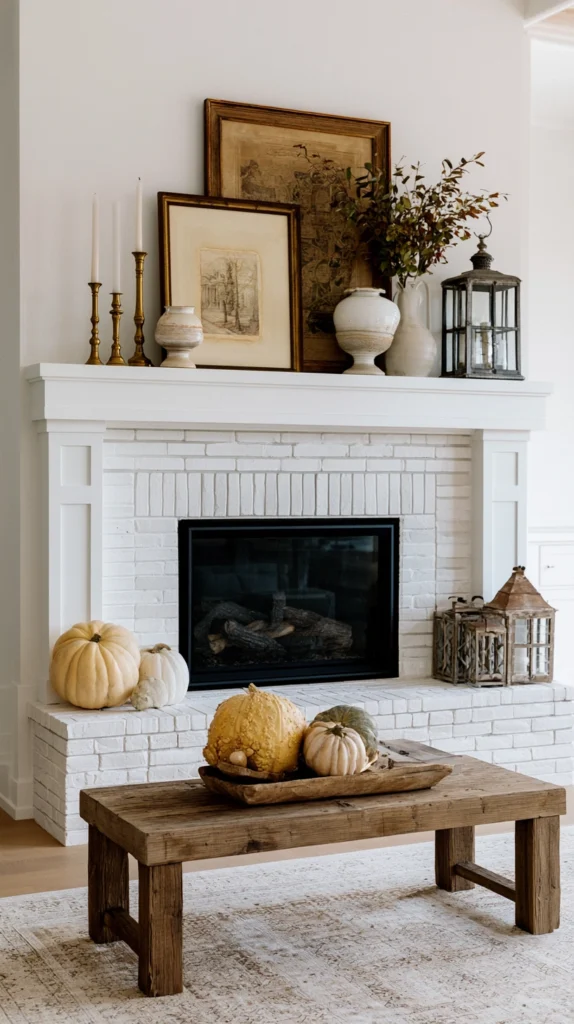
A fall-specific arrangement on the mantel — layering candles, natural objects, simple framed pieces, and a few well-chosen fall accents — the surface display that does more to change how the living room reads for the season than any furniture adjustment could.
Why the mantel is the most important surface in a farmhouse fall living room
- The eye-level, room-spanning visibility that a mantel commands from every seated position in the room: a well-arranged mantel is always in the primary sightline from the main sofa, making it the room’s natural gallery and the most noticed surface in the space
- The fireplace context that amplifies its seasonal relevance: a mantel above a working fireplace in fall is seen in the context of an actual fire beneath it, and fall mantel styling that acknowledges that context — warm-toned candles, natural materials, nothing that fights the flame’s color temperature — works more powerfully than one that ignores it
- The layering opportunity a mantel specifically provides: unlike a flat shelf or console, a mantel typically includes a combination of the mantel surface, the firebox surround, and the wall above, giving a layered display more architectural depth to work within
The options
- A layered arrangement mixing heights: tall candlesticks at one end, a medium framed print or botanical print propped in the center, small gourds and a short lantern at the other end
- A single long element spanning the mantel’s width: a eucalyptus garland laid flat along the surface with candles and small objects nestled within it
- A symmetrical arrangement: matching lanterns or candle holders flanking a centered mirror or clock, with seasonal accents symmetrically placed
- An asymmetric, deliberately unbalanced arrangement: all the visual weight on one side, with open space on the other, for a more contemporary take on the traditional mantel display
The practical execution
- Vary heights within the arrangement using books laid flat as risers beneath smaller objects, rather than purchasing additional stands or shelves
- Include at least one natural material — a piece of driftwood, a dried branch, a pumpkin, a bundle of wheat — to connect the farmhouse character to the seasonal layer
- Keep the arrangement slightly behind the mantel’s front edge so objects aren’t in danger of falling forward, particularly important in a home with pets or children nearby
Cost breakdown
- Candles and a lantern: $20–45
- Natural material accents: $10–25
- Total: $30–70
3. The Linen and Wool Textile Layer (The Softest Change With the Biggest Impact)
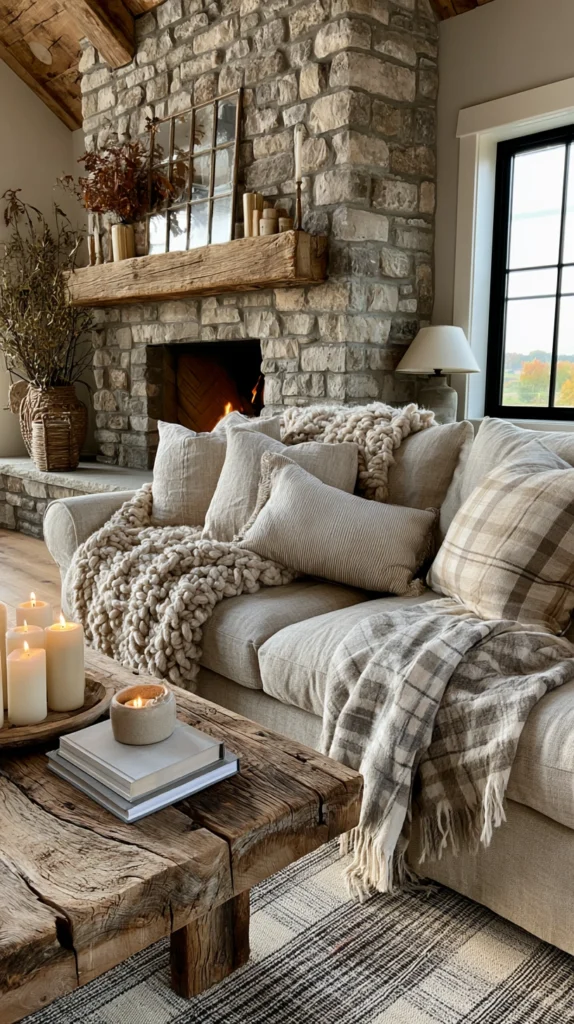
New cushion covers and a throw blanket in linen, heavy cotton, or wool, chosen for texture and fall-appropriate tone — the textile layer that changes how the sofa and main seating feels as much as how it looks.
Why textiles are the most important seasonal investment in a farmhouse living room
- The tactile change that affects the room’s experience, not just its appearance: a heavy linen cushion cover and a chunky wool throw change the physical feel of the sofa in fall in a way that purely visual decorating can’t, and a room that feels as warm as it looks is categorically different from one that only looks the part
- The material contribution to farmhouse character: rough-weave linen, dense-knit wool, and worn cotton are the textiles that belong in a farmhouse room the way galvanized metal and reclaimed wood belong in its material language, and getting these textiles right does more for the room’s character than almost any other single decision
- The reversibility that makes textile investment particularly sensible as a seasonal purchase: cushion covers come off and are stored, throws get folded away, and the summer version of the room returns without any permanent change having been made
The options
- Linen cushion covers in oatmeal, warm gray, rust, or mustard, replacing any summer-specific or cool-toned versions
- A chunky-knit wool or wool-blend throw, for both the visual texture and the genuine warmth of a heavy wool throw rather than a lighter alternative
- A woven cotton or jute throw, for a flatter texture alternative to the chunky knit that works in a room already full of heavier textures
- Buffalo check in rust and cream rather than the more common black and white, for a print that reads as specifically fall rather than year-round
The practical execution
- Choose cushion cover materials that actually feel good when handled, since the tactile quality of a linen cushion is part of its contribution to the room’s overall texture character
- Layer multiple textiles on the sofa rather than one careful placement: three cushions with covers in two different textures, plus a throw draped casually rather than folded neatly, reads as genuinely lived-in rather than staged
- Wash linen covers before their first use, since linen softens noticeably after washing and the softer version is considerably more pleasant against the face than the stiff new version
Cost breakdown
- Linen cushion covers, a set of 4–6: $60–140
- Chunky knit throw: $40–90
- Total: $100–230
4. The Reclaimed Wood Coffee Table or Surface (The Material That Defines the Style)
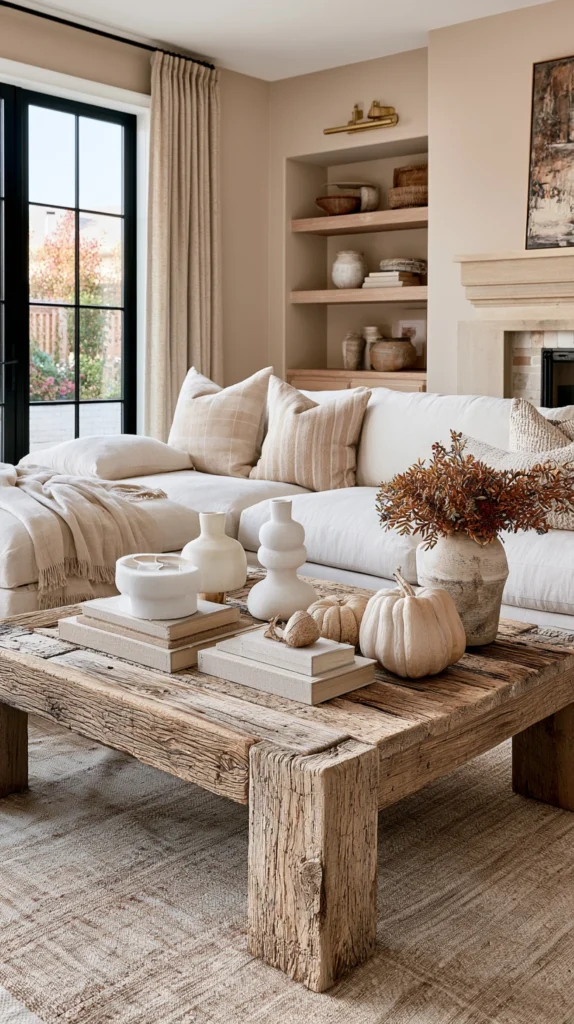
A coffee table or console table made from reclaimed or live-edge wood — or the addition of a reclaimed wood element where the room currently has something more manufactured — the material choice that establishes farmhouse character at the living room’s central, most-used surface.
Why reclaimed wood makes the single biggest farmhouse character contribution per piece
- The authenticity that genuinely old wood carries over any distressed alternative: the grain pattern, the old nail holes, the natural variation in color across a board that has been something else before being a table — these are qualities that cannot be added to new wood and that are immediately recognizable as different from manufactured distressing
- The physical center-of-the-room placement that makes a coffee table the piece in the highest proportion of photographs and the most immediate close-range experience in the living room
- The material continuity it creates with autumn’s color palette: the warm brown, amber, and sometimes silver-gray of reclaimed wood is the furniture equivalent of a fall landscape, creating a seasonal connection that a glass or lacquered surface doesn’t have
The options
- A full reclaimed wood coffee table, the most complete version of this idea
- A slice of live-edge wood as a tray or board on top of an existing table, for a lower-cost material presence where replacing the whole table isn’t practical
- A reclaimed wood console behind the sofa, for a room where the coffee table is already right but the console or entry surface needs material updating
- A crate or wooden box repurposed as a low side table, for an inexpensive way to introduce the material quality without a furniture purchase
The practical execution
- Seal any reclaimed wood table surface with a hard wax oil rather than a film finish, since wax allows the wood’s natural texture to remain tactile while protecting it from drink rings and daily use
- Source from genuine salvage or reclamation yards rather than furniture companies marketing “reclaimed” pieces that are often new wood distressed and stained, since the two read differently at close range
- Choose a table height appropriate to the sofa’s seat height, which for most modern sofas means a coffee table between 15 and 18 inches, since a beautiful table at the wrong height defeats its own purpose
Cost breakdown
- Reclaimed wood coffee table: $200–600
- Live-edge wood board as table tray: $40–120
- Total: $40–600, depending on approach
5. The Cowhide or Natural Fiber Rug Layer (Grounding the Room at Fall’s Most Natural Level)
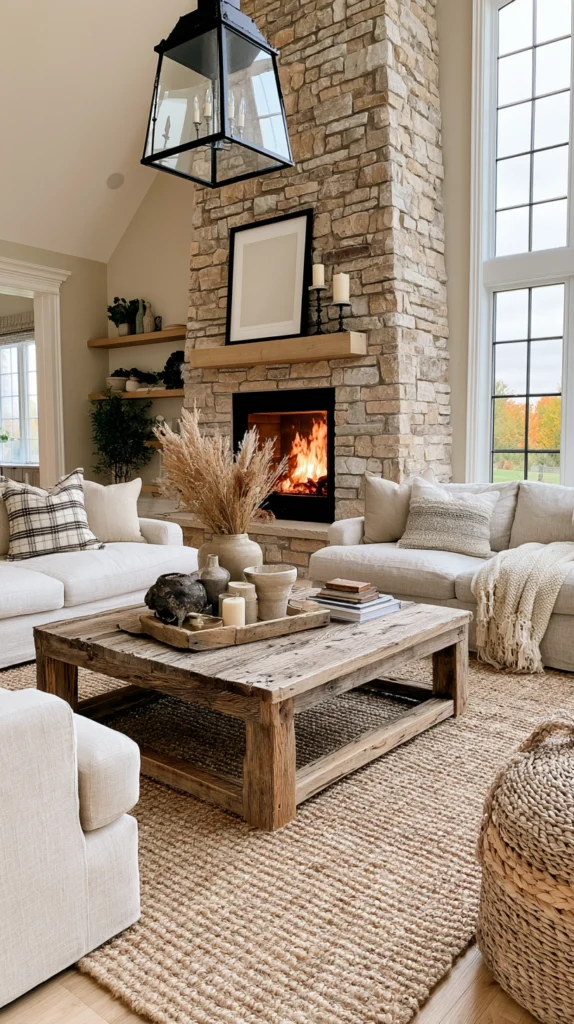
A cowhide rug or a natural fiber rug in jute, sisal, or seagrass, either as the primary floor covering or as a layer beneath a softer rug — the grounding material that anchors the living room’s seating area in the most farmhouse-appropriate flooring available.
Why the floor layer is more important to farmhouse character than most people account for
- The large-format material statement a rug makes across the room’s largest visible surface: a jute rug beneath a farmhouse living room’s seating group signals the room’s material direction from the moment anyone enters, before the sofa, the mantel, or any specific decoration is registered
- The natural fiber quality that synthetic alternatives don’t replicate: jute, sisal, and seagrass have a specific, rough, natural texture that is immediately identifiable as a real plant-based material, distinct from any woven synthetic attempting to look similar
- The layering opportunity that a natural fiber base creates beneath a second, softer rug: a jute base with a worn Persian or a simple woven accent rug on top combines the farmhouse material integrity of the natural fiber with the color and softness that a second piece adds
The options
- A jute or sisal area rug as the primary floor covering, in a simple herringbone or simple weave
- A cowhide rug laid flat or angled over a hardwood or tile floor, for a more distinctive material statement than plant-based fiber
- A layered combination, with a jute base beneath a smaller, more colorful woven or vintage rug
- A braided cotton rug, for a softer material that still reads as farmhouse natural fiber at a lower price than jute or cowhide
The practical execution
- Size the rug so the front legs of the main sofa and chairs rest on it, since a rug that doesn’t reach the furniture looks undersized regardless of its other qualities
- Use a non-slip rug pad appropriate to the floor surface underneath, since a large, heavy jute rug on a wooden floor can still shift without adequate grip
- Vacuum natural fiber rugs in the direction of the weave rather than against it, since natural fiber is more susceptible to pilling and fiber damage from against-the-grain vacuuming than synthetic alternatives
Cost breakdown
- Jute or sisal area rug, large: $100–350
- Cowhide rug: $150–400
- Total: $100–400
6. The Vintage-Style or Antique Element (The Piece That Breaks the New-Room Problem)
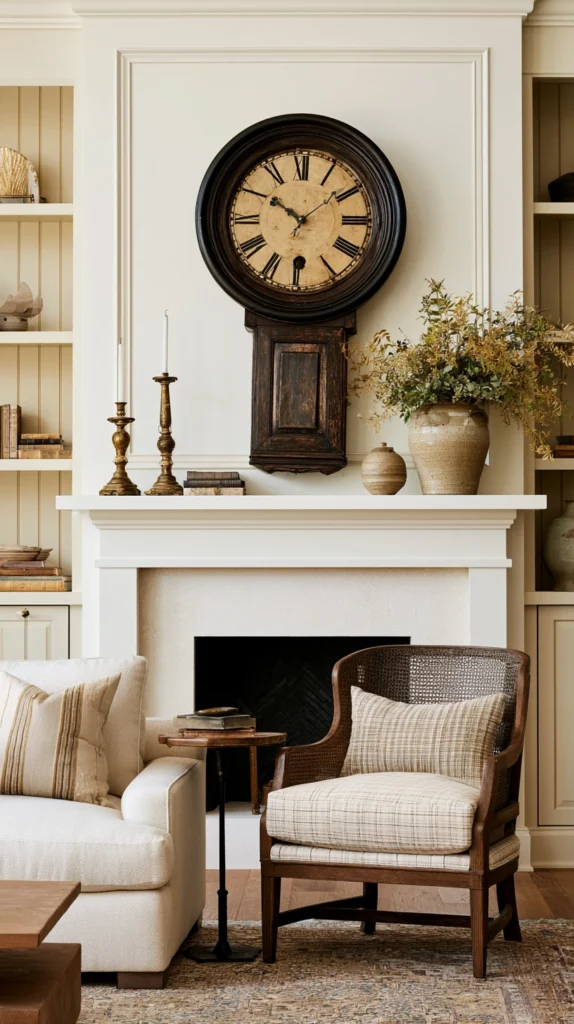
A single genuinely old piece — a clock, a basket, a lantern, a wooden crate, an antique piece of pottery — incorporated into the room’s styling as a counterpoint to everything else that’s purchased new.
Why one genuinely old object changes the whole room’s credibility
- The specific visual quality of actual age versus simulated age: an object that has genuinely been used, been stored, been forgotten, and been found again has a surface quality that manufactured distressing doesn’t achieve — it looks old because it is old, and that reads differently at close range
- The story potential a found or inherited object carries: an old clock that was someone’s grandmother’s, a vintage pottery piece found at an estate sale, a wooden crate from an old general store — these objects have a provenance that new objects don’t, and that provenance contributes to the room’s sense of accumulated character
- The contrast that makes the room’s other, newer pieces read as more considered by association: a room with one genuinely old piece and several new ones that have been chosen to complement it reads as collected, while a room full of uniformly new “vintage-style” pieces reads as a catalog order
The options
- An antique mantel clock, for the room’s central surface
- A genuine vintage basket or grain sack, for a textile element with actual age and provenance
- A found piece of ironwork or agricultural hardware, repurposed as a decorative object
- A vintage or secondhand pottery piece, sourced from an estate sale or thrift shop rather than purchased new
The practical execution
- Source from antique markets, estate sales, and secondhand shops specifically rather than shops selling “vintage-style” reproductions, since the two categories produce very different objects at very similar price points
- Choose objects at a scale appropriate to the room’s existing proportions — an antique clock on a full-size mantel needs to be substantial enough to read, while a small vintage bottle on a coffee table disappears against stronger visual competition
- Let genuinely old objects be slightly imperfect — a clock face with some patina, a basket with a repaired section — since aggressive cleaning and restoration removes the very quality that makes old objects valuable in this context
Cost breakdown
- Antique or vintage object: $15–150, depending on type and source
- Total: $15–150 — often less than a new “vintage-style” equivalent
7. The Exposed Wooden Beam or Plank Feature (The Architectural Element That Cannot Be Faked at Any Price)
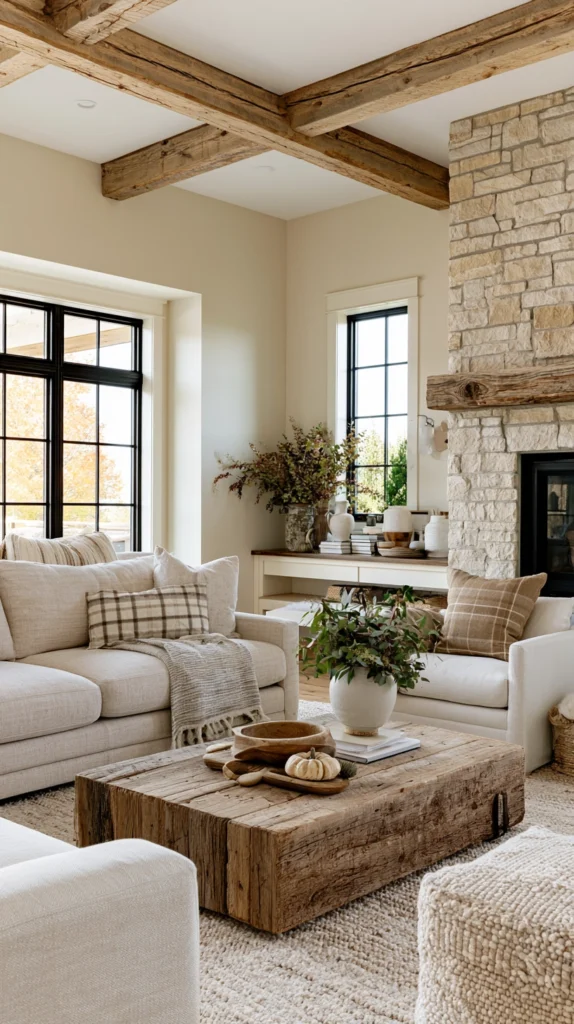
An exposed wooden beam, wide-plank ceiling, or shiplap wall that is part of the room’s permanent architecture — or, where it doesn’t exist, a thoughtful plan for a single accent wall where the addition of board-and-batten or a simple wood treatment would cost relatively little.
Why the architectural element is categorically more impactful than any decoration
- The room-defining permanence of a structural feature: a genuine exposed beam or wide-plank wall defines the room’s character in every season and under every arrangement of furniture, in a way that a decoration sitting on a surface never quite does
- The specific warmth that aged wood overhead or on a wall provides year-round but especially in fall: a room with a visible wooden ceiling or beam is already a more autumnal room than one with smooth white drywall, regardless of what’s placed in it
- The long-term value relative to cost: a board-and-batten accent wall done in simple pine, painted to match the surrounding walls or in a contrasting color, costs a fraction of most living room furniture purchases and changes the room’s character permanently rather than seasonally
The options
- Genuine exposed beams, either original to the structure or salvaged and added as structural elements
- Faux beam additions, lightweight polyurethane beams that provide the visual character without structural engineering requirements
- Shiplap or board-and-batten on one accent wall, adding architectural texture to an otherwise smooth-walled room
- Wide-plank hardwood or engineered flooring, for rooms where the ceiling and walls are fixed but the floor offers a material upgrade opportunity
The practical execution
- Install board-and-batten vertically rather than horizontally for a taller-feeling room, or horizontally for a room where width is more available than height
- Paint board-and-batten in the same color as the surrounding wall for a more subtle, tone-on-tone effect, or in a contrasting color if a statement accent wall is the goal
- Stain any genuine beam or wide-plank floor in a warm medium tone rather than a dark espresso, which can make a room feel heavy rather than warm
Cost breakdown
- Board-and-batten on one wall, materials only: $150–400
- Faux beam installation, materials: $200–600
- Total: $150–600
8. The Dried and Fresh Natural Materials (Botanical Elements That Belong to the Season)
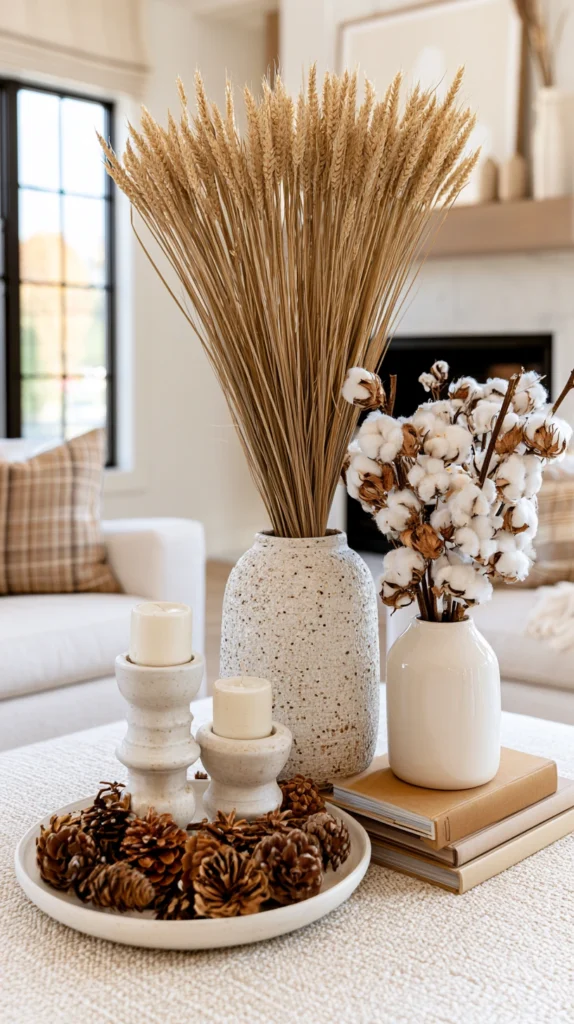
Dried botanicals — wheat, cotton stems, pampas grass, dried magnolia leaves, preserved eucalyptus — combined with one or two genuinely fresh seasonal elements like small gourds, pine cones, or branches with turning leaves, arranged throughout the room rather than concentrated in a single spot.
Why distributing natural material through the room works better than concentrating it
- The ambient seasonal presence that distributed natural material creates: a small dried bundle near the window, a pine cone in the coffee table tray, a single stem of dried cotton on the mantel — none of these alone would define the room’s seasonal character, but together across multiple surfaces they create a pervasive fall atmosphere that concentrated decoration in one place can’t match
- The connection to the farmhouse’s ostensible relationship with the natural world: dried wheat, preserved cotton bolls, and bundled herbs are materials that make sense in a room whose style is rooted in agricultural tradition, fitting naturally into the aesthetic in the way a bowl of glass beads or an abstract print wouldn’t
- The cost efficiency of natural material relative to purchased seasonal decoration: a bunch of dried wheat from a florist, a bag of pine cones from the yard, a few dried magnolia leaves from a fallen branch together cost a fraction of the equivalent in manufactured fall decorations and look considerably more genuine
The options
- Dried wheat in a simple ceramic or galvanized metal vessel, on the mantel or a console
- Preserved eucalyptus or olive branches, layered into the mantel arrangement from Idea #2
- A bundle of dried cotton stems, for the white boll’s specific farmhouse connotation
- Fallen branches with autumn leaves still attached, foraged from the yard and arranged loose in a heavy pitcher or vase
The practical execution
- Rotate natural material as it loses its color or texture — dried wheat and pampas hold well for months, while fresh fallen leaves last only a few days before curling and drying unevenly
- Avoid overdoing any single material: three dried cotton stems in a vessel are elegant; twenty create a display that reads as overstocked
- Use the same vessels and containers that hold the room’s non-seasonal decorations for natural material arrangements, rather than introducing dedicated seasonal vases that themselves look temporary
Cost breakdown
- Dried wheat and cotton stems: $10–25
- Preserved eucalyptus: $8–20
- Total: $18–45
9. The Fireplace as the Room’s Focal Point (Making the Season’s Most Appropriate Feature the Visual Center)
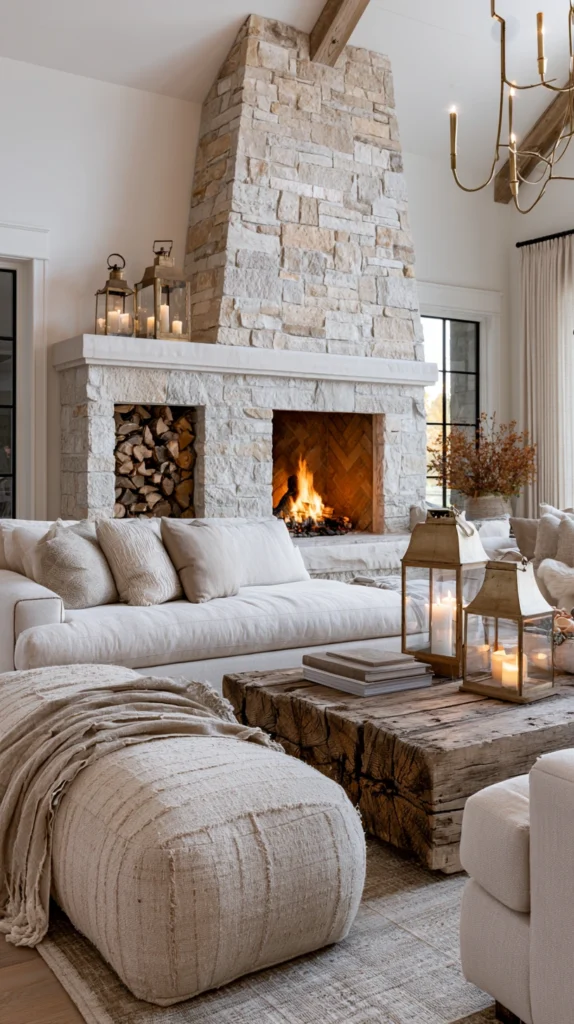
A functioning fireplace — lit, maintained, and styled to be the room’s primary focal point rather than an incidental feature the room happens to include — the element that makes a farmhouse fall living room categorically different from any room without one.
Why a lit fireplace changes the whole room in ways decoration cannot
- The light quality that a working fire introduces, distinct from any lamplight: the specific flickering, warm, orange-amber light of a wood fire changes the color temperature of everything in the room — the throw blanket reads differently, the mantel looks different, even the occupants look different — in a way that no artificial light source fully replicates
- The sound and scent dimension that a working fireplace adds that no decorating choice touches: the crackle of a burning log and the wood-smoke scent that permeates the room after a fire are sensory experiences that no fall decoration can contribute in the same way
- The social reconfiguration that a lit fire creates: people in a room with a working fireplace orient themselves differently than people in a room without one, turning toward the fire in a way that restructures conversation and gathering in the room’s most specifically autumn-appropriate way
The options
- A wood-burning fireplace, for the most authentic experience in terms of fire quality and scent
- A gas fireplace with a realistic flame, for a working fire without the log management and ash handling
- A wood-burning stove insert, for a fireplace opening that’s been converted from an open hearth
- A well-styled unlit fireplace, for rooms where the fireplace is non-functional, using a log arrangement, candle grouping, or large botanical arrangement in the firebox as a visual focal point that acknowledges the space’s intended function
The practical execution
- Service the chimney and firebox at the start of the season rather than after the first fire, since a season-opening fire in an uninspected chimney is the primary cause of residential chimney fires
- Lay the fire so it’s ready to light before guests arrive, since a fireplace laid with wood and kindling reads as prepared and welcoming even unlit
- Choose wood for both its burning quality and its fragrance: apple and cherry wood burn fragrant and clean, oak burns long, and the combination of both makes for a more complete fire experience than pine alone
Cost breakdown
- Firewood for the season: $100–300
- Chimney sweep service: $150–300
- Total: $0 additional if the room already has a fireplace, $250–600 for seasonal preparation
10. The Gallery Wall of Botanical Prints or Vintage Farm Art (Personality on the Living Room’s Blank Wall)
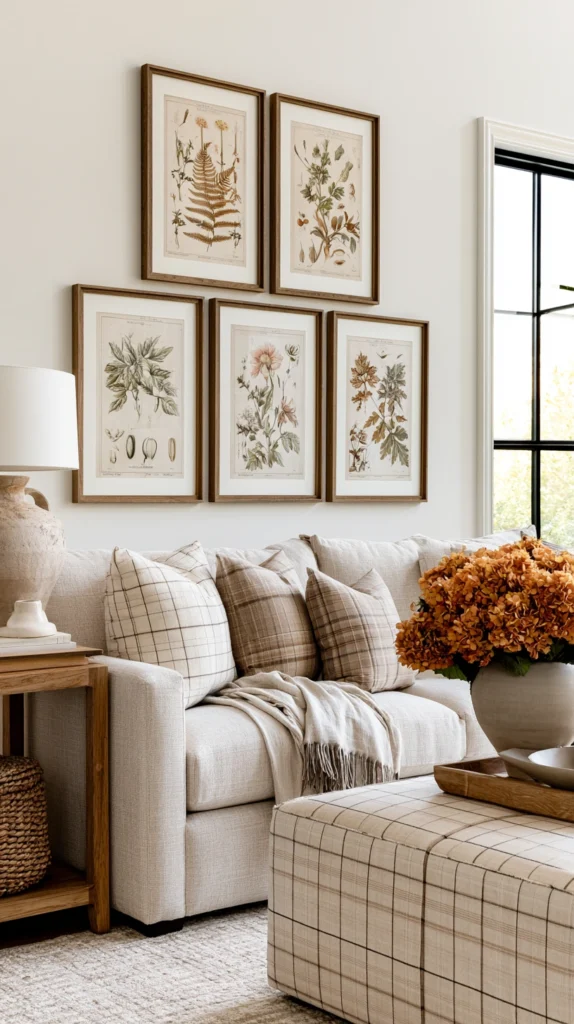
A curated wall of botanical prints, vintage farm scenes, hand-lettered signs, or landscape paintings, arranged as a gallery — the wall treatment that gives the farmhouse living room a specific, collected identity rather than a generic one.
Why gallery wall content matters as much as the gallery’s arrangement
- The specificity that the right content brings relative to generic inspiration: a gallery wall of actual botanical illustrations, a few small vintage agricultural prints, and one or two pieces of hand-lettered or map-style folk art reads as a collection gathered over time, while a set of “farmhouse-themed” prints purchased together reads as a kit
- The fall-specific color palette that botanical and landscape prints naturally contribute: autumn botanical illustrations, harvest scenes, and November landscapes bring the season’s palette — amber, ochre, rust, dark green — into the wall-art layer without any dedicated seasonal decoration
- The long-term stability of a gallery wall as a design investment: unlike seasonal decoration that gets stored between seasons, a well-chosen gallery wall stays year-round and simply looks more autumnal in fall because of how its colors and subjects read against the season’s general atmosphere
The options
- Antique botanical prints, sourced from old books or printed reproductions of genuine vintage illustrations
- Vintage agricultural prints or seed catalog covers, for content with a direct connection to farm culture
- Hand-lettered sayings in a simple, unpretentious style — one or two pieces, not an entire wall of words
- A combination of art and objects: small framed pieces mixed with a small mirror, a mounted piece of ironwork, or a small mounted antler
The practical execution
- Lay the full arrangement on the floor and adjust it before drilling a single hole, since a gallery wall that’s been planned visually on the floor rarely needs significant adjustment when transferred to the wall
- Choose frames in a consistent material — all dark wood, all antique gold, all plain black — rather than mixing multiple frame finishes, which can make an otherwise cohesive gallery feel unresolved
- Center the gallery arrangement at seated eye level, roughly 57–60 inches to the arrangement’s midpoint, rather than positioning it higher where it will read as too removed from the people sitting beneath it
Cost breakdown
- Botanical or vintage prints (6–9 pieces, mixed sizes): $60–200
- Matching frames for the set: $50–150
- Total: $110–350
11. The Warm Lamp Layer (The Lighting That Makes a Farmhouse Room Glow at Dusk)
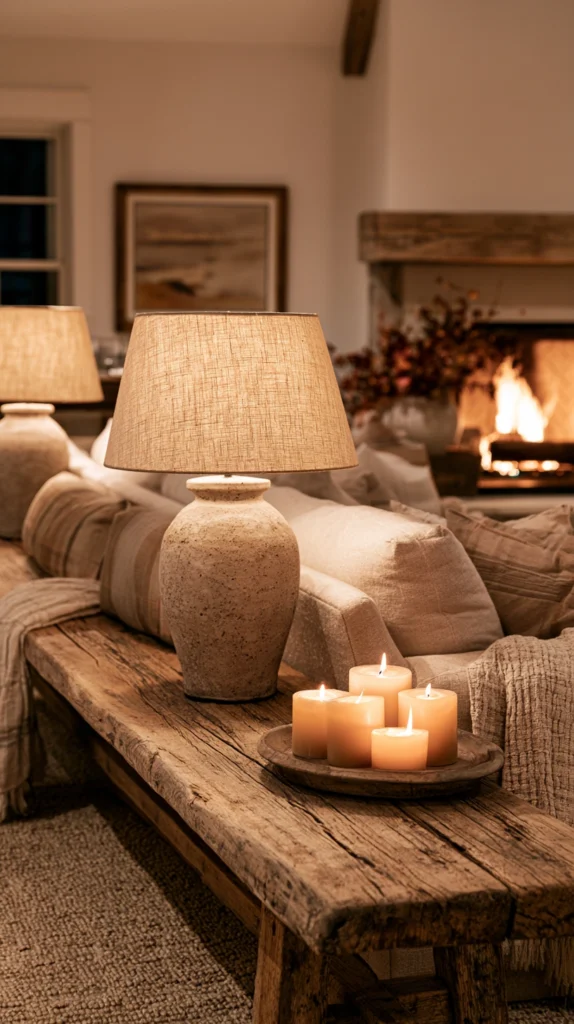
Warm-toned table and floor lamps replacing or supplementing the room’s overhead lighting — the change that makes the difference between a fall living room that looks right in photographs and one that actually feels right to be in as the day’s light fades.
Why lamp quality is more important in fall than in any other season
- The early-sunset reality that fall creates in every living room: by October in most regions, the room is in lamplight for four or more hours before anyone goes to bed, which means lamp quality — their warmth, their shade quality, their placement — determines how the room feels for a meaningful proportion of every evening
- The fireplace-adjacent character that warm lamps reinforce: a room with a lit fireplace and warm, low-wattage lamps in two or three positions feels completely different from the same room with a single overhead light, even if the fireplace is equally present in both scenarios
- The specific farmhouse-appropriate lamp styles that exist at every price point: industrial-influenced task lamps, simple pottery-base table lamps, and aged-brass or oil-rubbed-bronze floor lamps all fit within the farmhouse material palette in ways that chrome, white-lacquered, or obviously modern lamp designs don’t
The options
- A warm-toned ceramic or pottery-base table lamp, paired with a linen shade rather than a white fabric or paper shade
- An aged-brass or oil-rubbed-bronze pharmacy or task lamp, for a more industrial-farmhouse take on the same warm-lamp function
- A simple iron floor lamp with a warm-shaded pendant, for providing standing lamp light at the main sofa seating’s perimeter
- Battery-powered flameless candles in amber glass vessels, for lamplight-adjacent warmth on surfaces where an actual lamp can’t be positioned
The practical execution
- Replace any LED bulbs running cooler than 2700K throughout the living room before the fall season, since the difference between 2700K and 4000K illumination is the difference between a room that glows amber and one that reads as a clinical workspace
- Position lamps at roughly seated eye level for the primary sofa seating — table lamps should be at a height where their shade’s lower edge is at roughly shoulder level when seated
- Use a dimmer on any overhead fixture that remains in use, since even a good overhead light benefits from being dropped to 30–50% of its full output during evenings when lamps and the fireplace are already providing most of the room’s light
Cost breakdown
- Ceramic or pottery-base table lamp: $60–150
- Replacement warm bulbs throughout the room: $15–40
- Total: $75–190
12. The Layered Throw and Pillow Arrangement (The Sofa’s Fall Transformation)
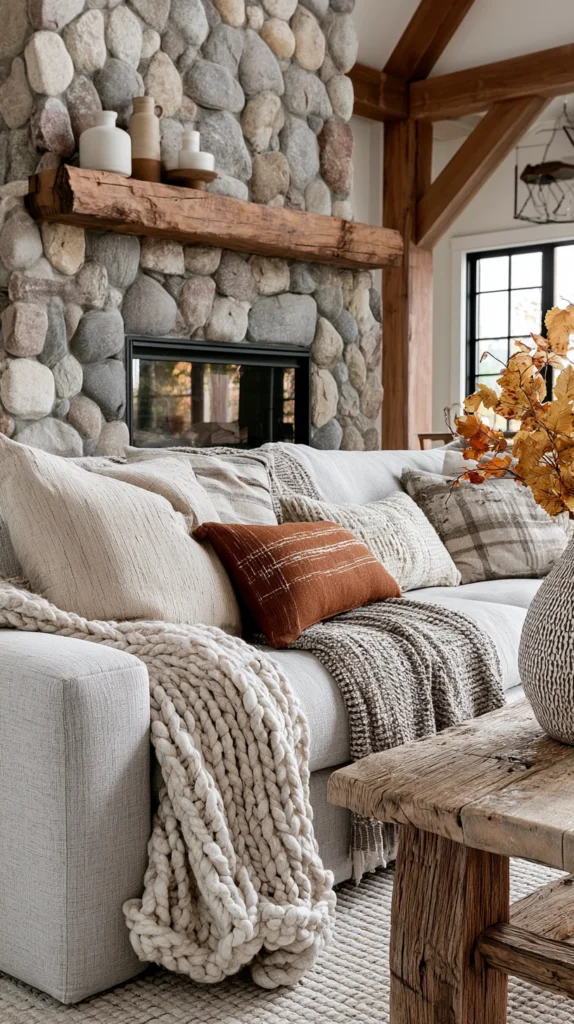
Multiple throws and a refreshed set of pillow covers arranged on the main sofa, layered with the deliberate un-tidiness of a room that’s actually used — the textile arrangement that changes the sofa from a sitting surface to a gathering point.
Why the sofa’s arrangement is as important as its cover
- The gathered, inhabited quality that an arrangement of throws and pillows creates versus a bare or minimally dressed sofa: a sofa with a throw draped across one arm, a second one folded at a corner, and several pillows at varied heights looks like people sit there, which is precisely the quality a farmhouse living room should project
- The fall-specific texture intensification that multiple layered textiles provide: one throw at a time reads as seasonal decoration; three throws in coordinating weights and textures together read as an entire season’s accumulated textile warmth, which is a different thing altogether
- The invitation quality that a generously dressed sofa sends: an abundant sofa with good cushions and accessible blankets invites longer sitting and slower evenings in a way that a neatly maintained sofa with two pillows squared doesn’t
The options
- A linen cushion cover layer: three or four covers in coordinating fall tones as the sofa’s base pillow arrangement
- A chunky wool or knit throw, the heaviest and most textural piece, draped loosely over one arm or back corner
- A lighter woven cotton throw, folded and placed at the sofa’s opposite end, providing a second layer that reads as genuine readiness for use rather than display
- A small lumbar pillow in a contrasting material — a grain-sack stripe, a printed check, a simple embroidered piece — as an accent that ties the arrangement together without dominating it
The practical execution
- Arrange throws to look as though they’ve just been put down after use rather than as though they’ve been placed for a photograph, since the lived-in quality is what makes a farmhouse arrangement work
- Layer cushions at varying sizes and heights rather than all at the same, since matching cushion arrangements of identical size and height at precise intervals read as staged rather than settled
- Invite actual use specifically: remove the perfect photograph arrangement after documenting it if necessary, since a sofa arrangement that feels too precious to sit on undermines the whole point of the farmhouse living room aesthetic
Cost breakdown
- Cushion cover set (4–6 covers): $60–140
- Chunky knit throw: $40–90
- Second woven throw: $25–50
- Total: $125–280
13. The Gathered Grain Sack or Vintage Textile Accent (The Piece That Shows the Room Has an Eye)
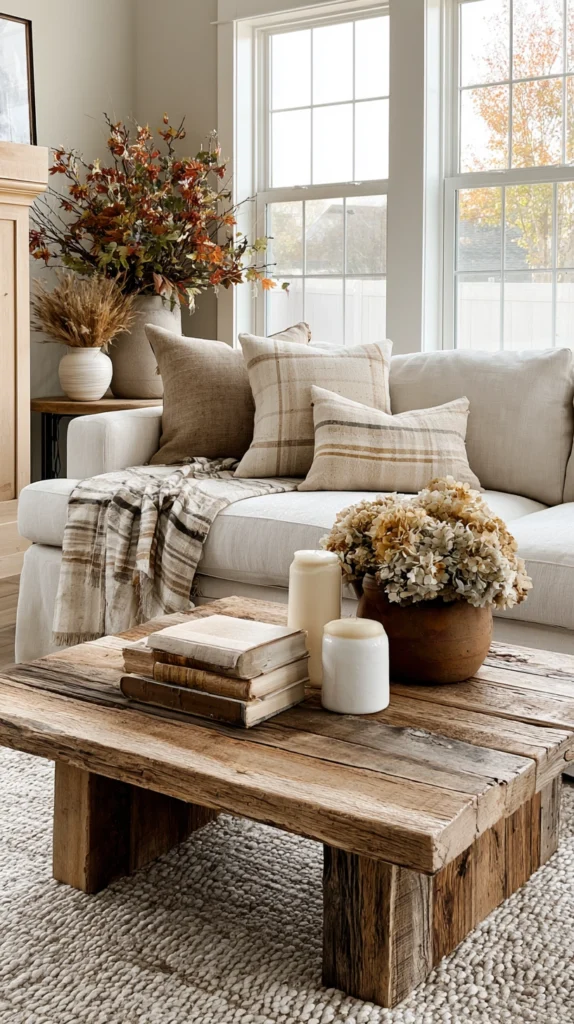
A genuine grain sack, feedbag textile, French ticking, or similar vintage printed fabric — used as a cushion cover, a table runner, or a small displayed object — the piece that shows the room’s styling was shaped by a real aesthetic preference rather than a seasonal purchase.
Why a single distinctive textile changes the whole room’s credibility
- The material rarity that a genuine vintage textile carries: a real grain sack or vintage ticking has a specific weight, hand-feel, and slightly uneven print that any reproduction — however well made — doesn’t quite replicate, and that difference reads immediately to anyone who touches or looks closely
- The point-of-view signal that a specifically chosen item communicates: choosing a grain sack as a cushion cover rather than a print one says something specific about what the room values, and that specificity is exactly what separates a room with genuine farmhouse character from a generically rustic one
- The low cost relative to the character it contributes: genuine antique grain sacks and feedbag textiles are available at estate sales and secondhand shops at prices often lower than a well-made reproduction, since their vintage textile status is not universally known as valuable
The options
- A genuine grain sack made into a cushion cover, for the most direct material use of this textile
- A length of French ticking as a table runner, for a more understated use of the same vintage-adjacent material category
- A vintage feedbag textile, framed or displayed flat, for a room where the textile’s condition or dimensions make it more appropriate as a wall piece than a functional one
- A reproduction grain sack in genuinely high-quality linen, for a room where genuine vintage isn’t available but material quality is still the priority
The practical execution
- Source from estate sales, antique markets, and thrift stores specifically, rather than buying through online marketplaces where pricing for “vintage grain sacks” has inflated beyond their actual estate-sale value
- Wash carefully with a gentle detergent before use, since vintage textiles often carry dust and odors from storage that make them unpleasant as soft furnishing material until cleaned
- Let the material’s imperfections — slight fading, a small repair, uneven printing — remain visible, since these qualities are what makes the piece an authentic textile rather than a reproduction
Cost breakdown
- Genuine vintage grain sack or feedbag: $10–35 at an estate sale
- Reproduction linen grain sack fabric: $20–50
- Total: $10–50
14. The Pumpkin Display Scaled to a Living Room (Not a Porch)
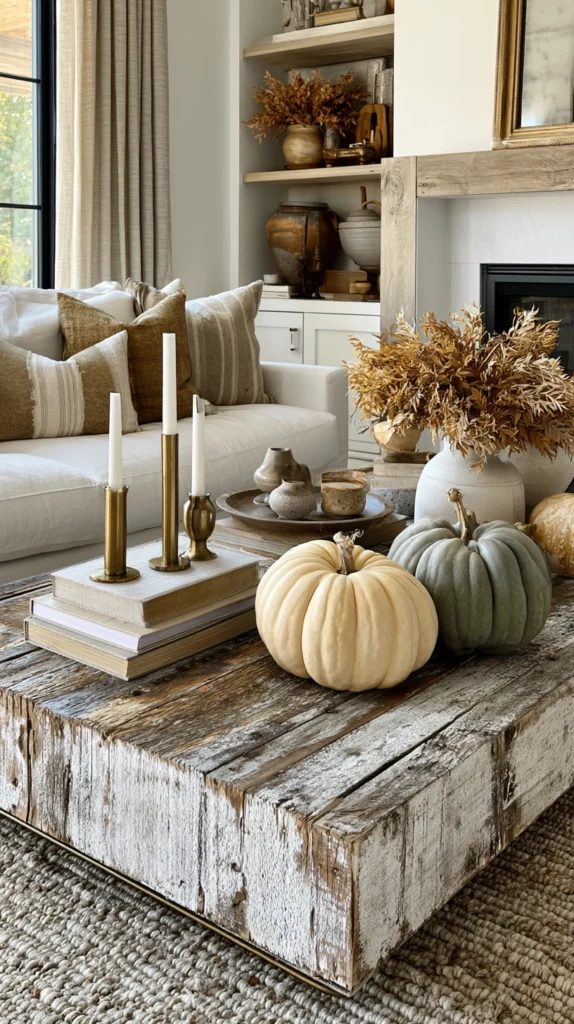
A small grouping of pumpkins — specifically edited for the indoor scale of a living room rather than reprising the front porch display inside — placed on the coffee table, the hearth, or a corner of the floor, in a quantity and style appropriate to an interior.
Why interior pumpkin displays need different rules than exterior ones
- The scale difference between indoor and outdoor viewing: a pumpkin that reads clearly from 30 feet on a porch step becomes enormous on a coffee table 3 feet away, which means interior pumpkin styling requires smaller varieties and more restrained groupings than exterior porch displays use
- The material quality opportunity that indoor display allows: heirloom pumpkins in cream, blue-gray, and deep orange that would be barely visible from the street are at their best as interior coffee table objects seen at close range where their surface texture, color variation, and shape can be appreciated
- The farmhouse-specific aesthetic that a restrained indoor pumpkin display supports: two or three heirloom pumpkins on a coffee table arranged with a candle and a small piece of natural material reads as farmhouse; twelve pumpkins of mixed sizes on the living room floor reads as the wrong room for the right impulse
The options
- Two or three heirloom pumpkins in varied colors on the coffee table, styled as part of the existing vignette there
- A single large heirloom pumpkin on the hearth, beside the fireplace, for a more architectural placement that works with the fireplace’s own visual weight
- A small cluster at the room’s corner, grouped on the floor rather than on a surface, for a ground-level seasonal note that doesn’t compete with table styling
- One pumpkin used as a vase, with a small floral arrangement placed in a carved-out opening, for a more elaborate and deliberately crafted version of the same idea
The practical execution
- Choose varieties with genuinely flat bases so they sit without wobbling, and test each one before purchasing
- Avoid placing real pumpkins directly on wooden surfaces without a protective mat or dish beneath them, since moisture from the pumpkin’s bottom can mark and stain
- Replace any pumpkin that begins to soften, since a decaying pumpkin at indoor temperatures — warmer and drier than a porch — softens faster than the same pumpkin outside and produces an unpleasant odor if left too long
Cost breakdown
- Heirloom pumpkins for interior display: $15–40
- Total: $15–40
15. The Reading Nook or Corner Chair Setup (The One Spot in the Room Made for Staying)
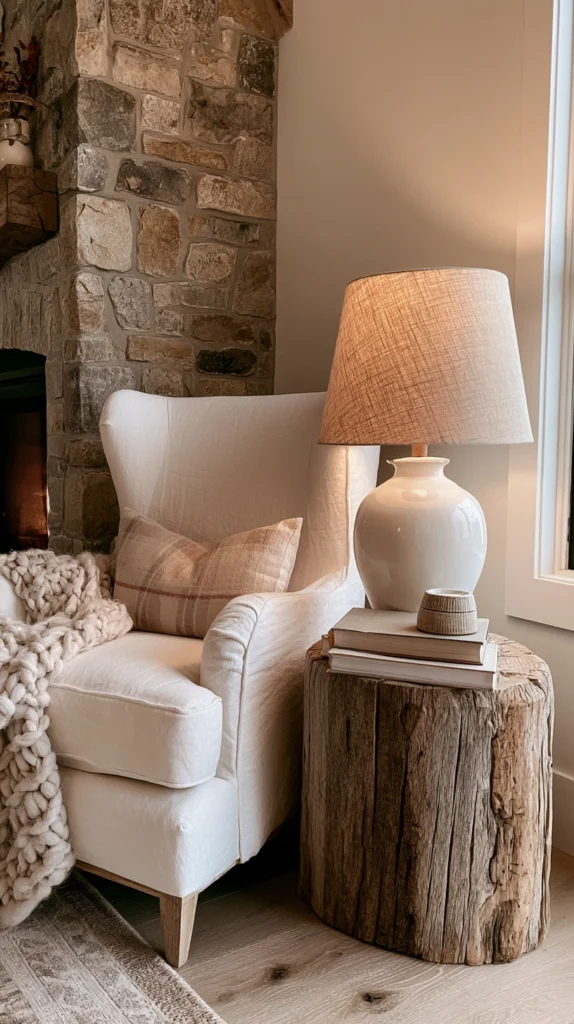
A deliberate corner of the living room — a well-chosen armchair, a good lamp, a small side table, and a stack of books — that exists specifically as a destination for solo reading, slow mornings, and long evenings, giving the farmhouse fall living room a particular purpose beyond general seating.
Why a reading corner completes a farmhouse fall living room that seating alone doesn’t
- The specific-use invitation it creates: a reading chair with a lamp and a side table says “sit here and stay” in a way that the main sofa, which is shared and general-purpose, can’t quite say in the same personal way
- The autumn-specific coziness association that a reading chair beside a fire carries: this is the living room feature most directly associated with the particular fall fantasy of staying in — a warm chair, a good book, the fire going, rain on the window — and having the physical setup for that experience makes it genuinely available rather than simply imagined
- The compositional addition it makes to the room’s overall arrangement: a reading corner adds an element at the room’s periphery that gives the eye somewhere to travel beyond the sofa-and-coffee-table axis, enriching the room’s visual layout
The options
- A deep armchair in linen or worn leather, for a material that suits both the farmhouse style and the long sitting a reading chair invites
- A rocking chair, for a farmhouse-specific seat type that has no equivalent in other interior styles
- A wingback chair, for the enclosure it creates around its occupant — the drafts-blocking original purpose that remains a real fall comfort
- A slipcovered chair in a washable linen slipcover, for maximum flexibility between summer and fall textiles and between household members’ changing uses of the chair
The practical execution
- Position the chair to take advantage of natural light for daytime reading, even if the chair also sits near enough to a lamp for evening use, since a reading chair that requires the lamp on during the day loses its daytime appeal
- Add a genuinely functional side table at the right height — typically between 26 and 28 inches — rather than a purely decorative one that doesn’t comfortably hold a teacup and a book simultaneously
- Stack three or four actual books on the side table or the floor beside the chair, since a reading corner with no books reads as staged and a reading corner with the books someone is actually reading reads as inhabited
Cost breakdown
- Armchair in linen or leather: $400–1,200
- Rocking chair: $150–400
- Side table and lamp: $80–200
- Total: $230–1,400, depending on what the room already includes
The reading chair in its corner, with a lamp lit and a book at its side: the room’s smallest room within a room, the one seat that says this house understood what fall was actually for.
The Farmhouse Fall Living Room Roadmap
The work, sequenced:
Phase One (the foundation, done before any seasonal addition):
- The warm neutral palette shift (#1)
- The linen and wool textile layer (#3)
- The warm lamp layer (#11)
Phase Two (the room’s permanent character elements):
- The reclaimed wood coffee table or surface (#4)
- The exposed wooden beam or plank feature (#7)
- The cowhide or natural fiber rug layer (#5)
- The fireplace as the room’s focal point (#9)
Phase Three (the fall-specific styling):
- The mantel layered vignette (#2)
- The dried and fresh natural materials (#8)
- The layered throw and pillow arrangement (#12)
- The pumpkin display scaled to a living room (#14)
Phase Four (the identity and character layer):
- The vintage-style or antique element (#6)
- The gallery wall of botanical prints (#10)
- The gathered grain sack or vintage textile accent (#13)
- The reading nook or corner chair setup (#15)
Getting Started This Weekend
The immediate-impact fall living room refresh:
One Saturday, three changes:
- Swap cushion covers to warm linen or fall-toned alternatives (Idea #3)
- Replace any cool-toned light bulbs with 2700K warm LEDs throughout the room (Idea #11)
- Arrange a small dried natural material grouping on the mantel alongside a few candles (Ideas #2 and #8)
Total cost: $80–200. Time: about two hours. The room will already feel specifically autumnal by the time the afternoon light begins to fade.
The structural investment (the next big project):
A reading chair (Idea #15) and a reclaimed wood coffee table (Idea #4) together give the farmhouse fall living room two distinct, purposeful pieces of furniture — one at the room’s center, one at its periphery — that change how the room functions rather than simply how it looks. Once both are in place, every seasonal addition from the mantel vignette to the throw arrangement has a room worth adding to.
What a genuinely styled farmhouse fall living room provides that a generically decorated one can’t:
The warmth that comes from material, not from season-specific objects:
- Natural fiber rugs and linen cushions that belong in the room regardless of season
- Reclaimed wood that was warm in character before fall arrived and will be warm after it leaves
- A fireplace that does more than any decoration could in the category of making a room feel specifically, physically appropriate for October
The inhabited quality that takes a season of daily use to achieve:
- A reading chair that looks like someone is in the middle of something when they’re not
- A sofa arrangement with throws placed as though they were last used last night
- A vintage textile accent that has already been somewhere before it landed in this room
The specific accumulation of natural material that connects the room to the world outside:
- Dried wheat on the mantel that came from a farmers market and not a box
- Heirloom pumpkins on the coffee table whose color and shape merited a closer look before they were bought
- A branch with autumn leaves in a pitcher because someone picked it up on the way inside and couldn’t leave it
A farmhouse fall living room doesn’t need to announce itself. The right materials in the right arrangement, lit by the right lamps with the fire going, announce it. What the room says at that point — warm, gathered, specifically of this season and this place — is more than any fall decoration could have said if the room itself wasn’t already saying most of it first.