
15 Summer Corner Styling Ideas for Empty Spaces
There is a specific kind of space that every room eventually develops and no interior design article ever seems to address directly. Not a wall, not a floor, not a surface — but the corner. The angle where two walls meet and form, by the logic of architecture rather than by any decision of the occupant, a zone that is structurally present but functionally undefined.
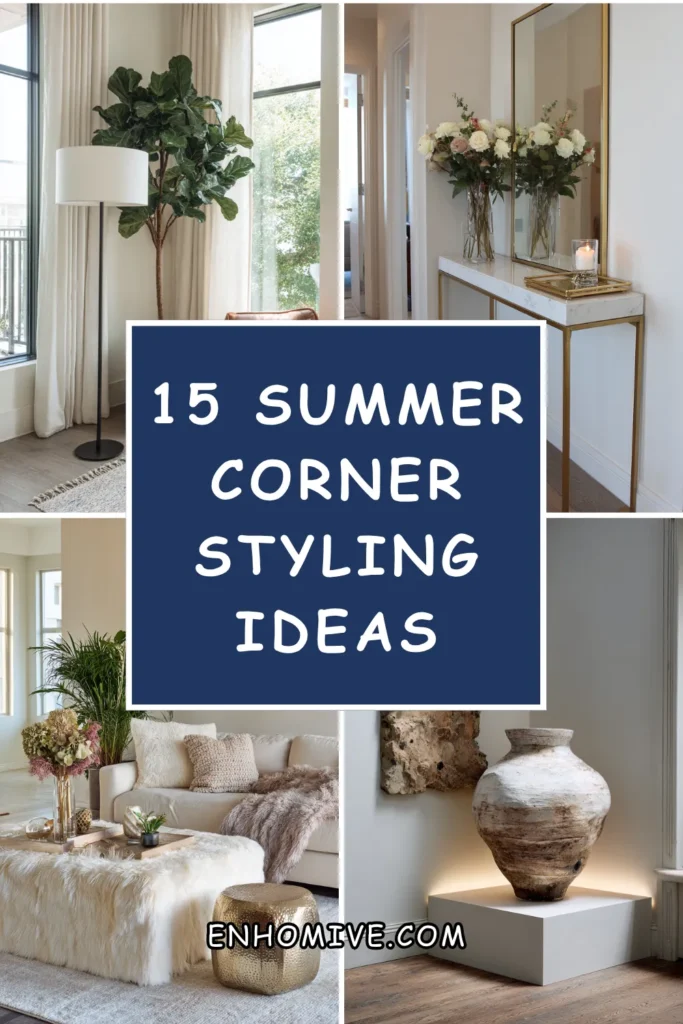
A corner that has been empty long enough stops being noticed as empty and starts being accepted as architectural background, and the transformation from empty corner to considered corner is one of the most satisfying small improvements a room can receive.
In summer, the corner has additional potential. The longer light, the open windows, the particular quality of afternoon sun that enters at a low angle and illuminates dust and bare walls with equal democracy — all of these make the empty corner more noticeable in summer than in any other season, and more worth addressing.
Each idea below turns a specific kind of empty corner into a specific kind of considered space. Each includes what you will need, what it will cost, and a practical tip to make the whole thing work through the summer and beyond.
1. The Floor Lamp and Chair Corner
Budget: $60 – $300
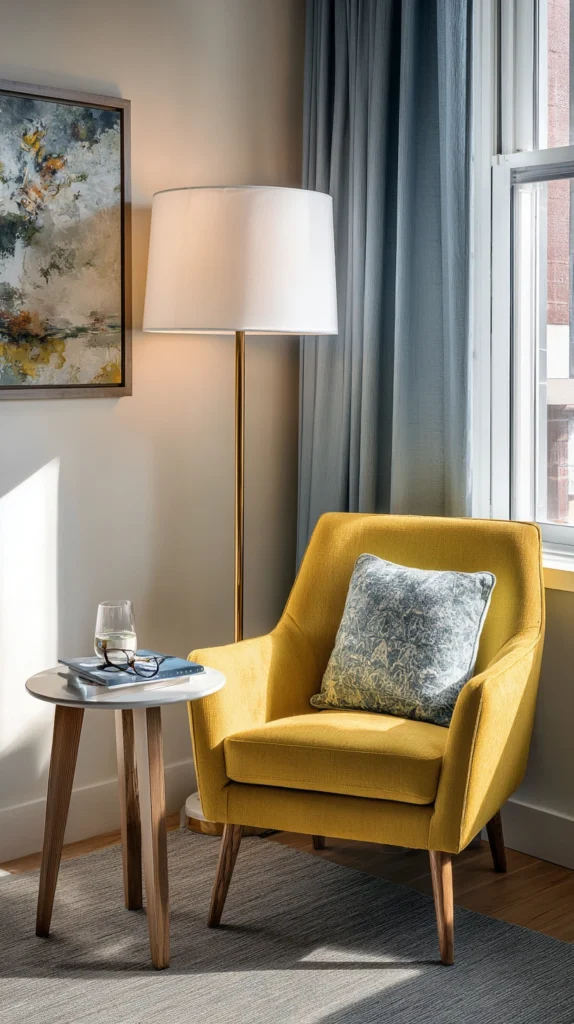
A single comfortable chair angled into the corner — not parallel to the wall but at 45 degrees, facing into the room — with a floor lamp beside it and a small side table within reach creates the most complete and most enduring corner transformation on this list. It is not decorating a corner; it is furnishing one. The chair with a light beside it is a place, and a place is what every empty corner is waiting to become.
A quality accent chair costs $80–$250. A floor lamp in a simple design runs $40–$120. A small side table costs $20–$60. Position the floor lamp so the light falls from the left or right of the chair rather than from directly behind — a lamp directly behind a chair illuminates the top of the occupant’s head rather than the reading surface, which is the positioning error that makes a reading corner functionally inadequate regardless of how good it looks.
Style tip: Angle the chair so it faces the most interesting view the room offers — the window, the fireplace, the door — rather than facing the corner itself. A chair that faces a corner is a chair turned away from the room; one angled outward is a chair positioned for occupancy, and the distinction between the two determines whether the corner is used as a retreat or avoided as an alcove.
2. The Indoor Tree Corner
Budget: $40 – $200
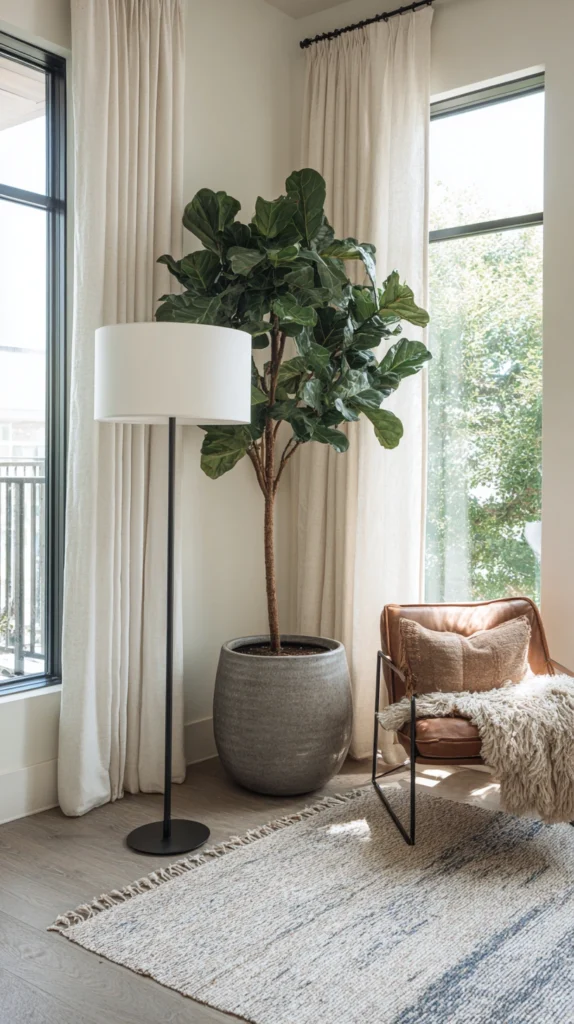
A large indoor tree — a fiddle-leaf fig, a rubber plant, an olive tree brought inside for summer, a tall dracaena or a dragon tree — positioned in a bare corner fills the vertical space that no other furnishing element addresses and gives the room a scale of living presence that a small plant on a shelf cannot provide. A corner with a tree in it is a corner that has been resolved.
A fiddle-leaf fig in a 20-litre pot costs $40–$100. A rubber plant of 1.5 metres in height runs $50–$120. An indoor olive tree costs $40–$80. A ceramic or fibreclay pot of at least 30 centimetres in diameter — proportional to the plant size — costs $20–$60. Choose a tree that suits the specific light conditions of the corner honestly — a fiddle-leaf fig in a dark corner declines steadily regardless of how well it was chosen for the room.
Style tip: Place the indoor tree pot on a felt-padded saucer rather than directly on the floor. The saucer catches drainage water that would otherwise mark the floor, and the felt pads allow the pot to be rotated — turning the tree a quarter turn every two weeks to ensure even light exposure on all sides — without scratching the floor surface. A tree that is never rotated develops an asymmetric growth toward the light source that is visible within a single season.
3. The Gallery Wall Corner
Budget: $20 – $120
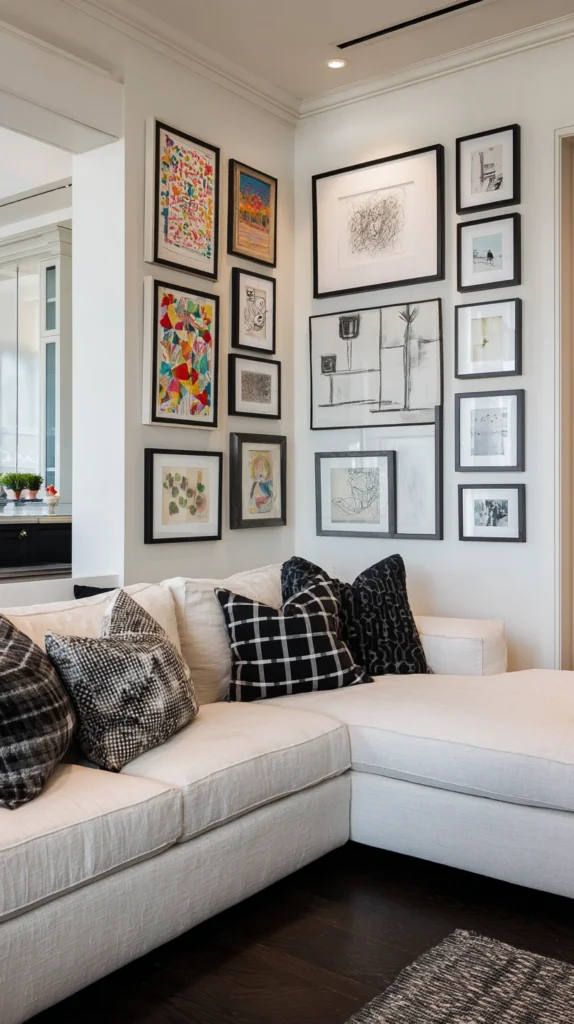
Extending a gallery wall arrangement around the corner — continuing the arrangement from one wall onto the adjacent one rather than stopping at the corner — creates one of the most dynamic and most architecturally interesting uses of corner wall space available. A gallery that turns a corner reads as confident and deliberate; one that stops exactly at the corner reads as cautious about committing to the full space.
Prints and frames for a corner gallery cost $20–$80 depending on the number and quality of pieces. Use the same frame style throughout the corner arrangement — a consistent frame across two walls reads as a single gallery that happens to occupy two surfaces; mixed frames on two walls read as two separate arrangements that meet at the corner. Hang the corner piece first — the one that bridges the two walls — and build outward from it.
Style tip: Use a small shelf or ledge at the corner itself — fixed at the same height as the bottom rail of the surrounding frames — rather than attempting to hang a frame directly in the corner where the wall meets. A frame in the exact corner is difficult to hang straight, impossible to see from most positions in the room, and a corner shelf at the same level as the surrounding gallery reads as an intentional three-dimensional element of the display.
4. The Wicker Basket Collection
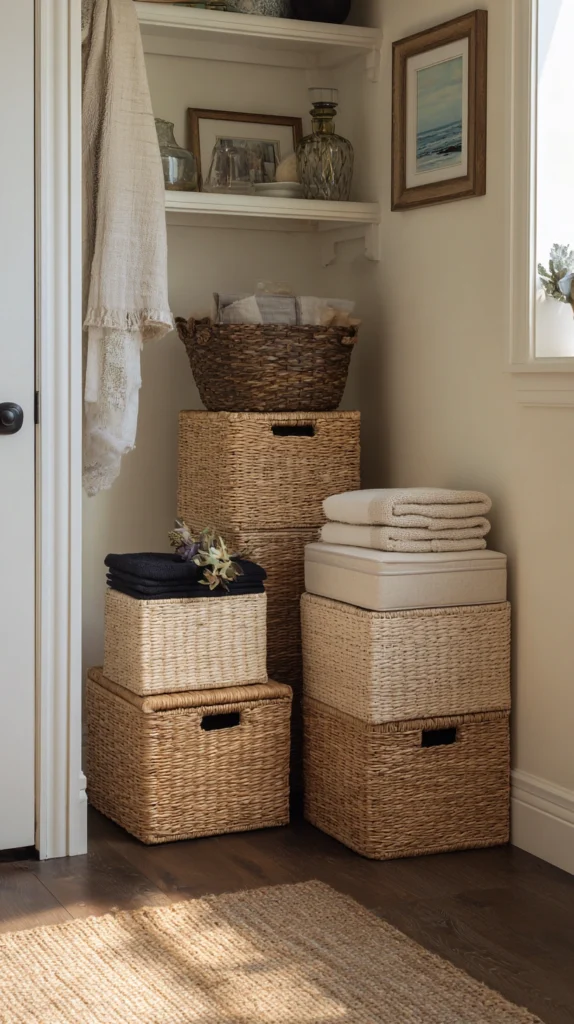
Budget: $20 – $100
A collection of wicker, rattan, or seagrass baskets — in varying heights and widths but a consistent natural material — arranged in a corner at floor level creates a textural, warm, and entirely functional corner treatment that costs almost nothing and looks considerably more considered than the bare corner it replaces. Baskets store blankets, books, plants, and the miscellaneous objects that accumulate in corners anyway, and a basket that stores something is always more resolved than a floor that collects the same things.
Individual wicker baskets cost $8–$25 each. A collection of five in varying sizes runs $40–$100. The key is consistency of material — all wicker, all seagrass, or all rattan — rather than consistency of size or height. A collection where each basket is a different size but made from the same material reads as gathered; a collection where each basket is a different material reads as accumulated.
Style tip: Fill each basket with something specific and keep it that way — blankets in the tall one, magazines in the wide flat one, children’s toys in the medium one. A basket collection where each basket has a designated purpose is storage as design; one where everything goes in whichever basket has space is storage as management, and the difference in the quality of the corner they produce is considerable.
5. The Summer Reading Stack
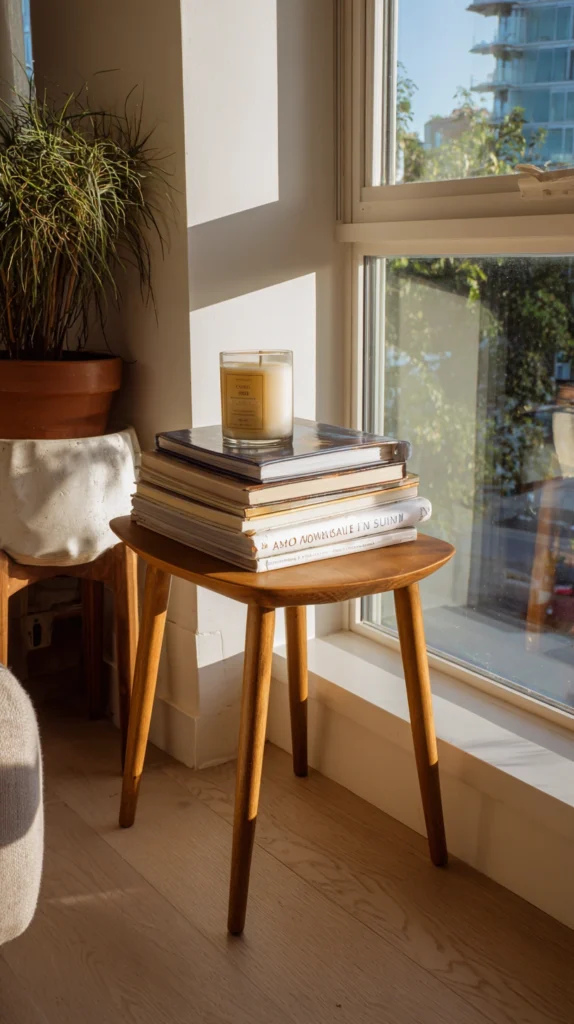
Budget: $10 – $50
A stack of books — five to eight, chosen for their summer relevance and their visual quality — placed in a corner at floor level or on a low stool creates a corner detail of genuine warmth and personality. Books stacked horizontally in a corner read differently from books shelved vertically on a shelf: they are more accessible, more present, more clearly in current use rather than in permanent storage.
Books already owned cost nothing. New summer reading costs $8–$15 per paperback. A low wooden stool as a book platform ($15–$40) elevates the stack from the floor and gives it the quality of furniture rather than a pile. Place one object on top of the stack — a smooth stone, a small plant, a candle — to weigh the arrangement and give it a finished quality that a plain book stack lacks.
Style tip: Arrange the books with the most visually interesting cover facing outward — on top of the stack or placed against the wall beside it. A book whose cover is beautiful becomes part of the corner display; one shelved spine-out contributes only its title. Summer reading with good cover design is a corner decoration as well as a reading list.
6. The Corner Plant Grouping
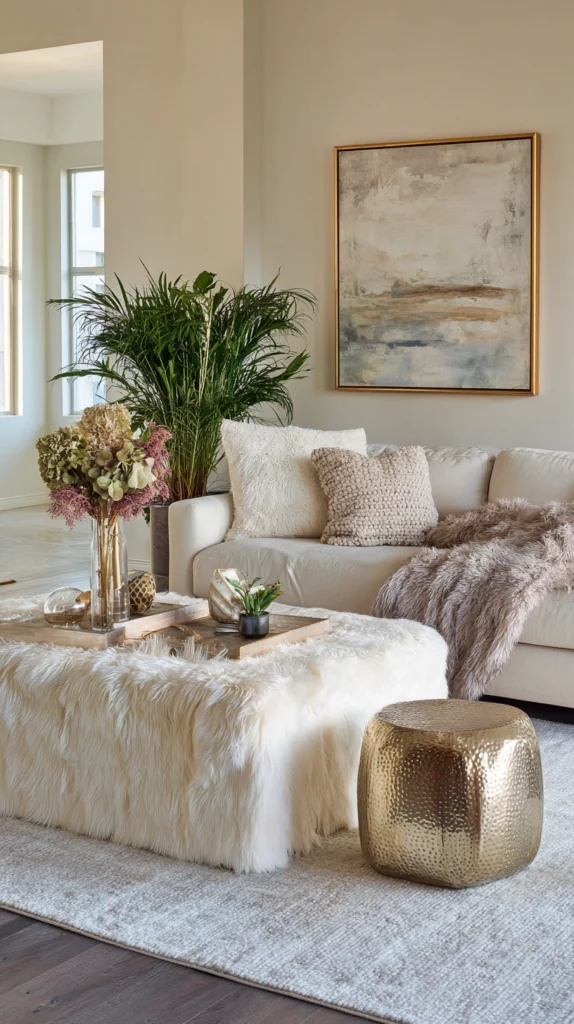
Budget: $30 – $150
Three to five plants in varying heights and textures — grouped in a corner rather than distributed individually across the room — creates a planted corner of genuine lushness that isolated plants on individual surfaces cannot produce. The grouping effect is transformative: three plants in a corner read as a garden; the same three plants on separate windowsills read as separate plants.
A tall background plant — snake plant, dracaena, or monstera — costs $20–$60. Medium plants for the middle layer run $15–$40 each. Small trailing plants for the front and edges cost $8–$20. Position the tallest plant at the back of the corner and the shortest at the front, with height decreasing consistently from back to front — the tiered arrangement creates depth and allows each plant to be seen without being obscured by the one in front of it.
Style tip: Group plants with compatible care requirements rather than complementary aesthetics — drought-tolerant plants together, moisture-loving plants together. A corner grouping where half the plants need daily watering and half need weekly water produces a consistent overwatering or underwatering of one group regardless of how carefully the occupant tries to manage both. Compatible care requirements make the corner self-managing in a way that mixed requirements never allow.
7. The Corner Shelf System
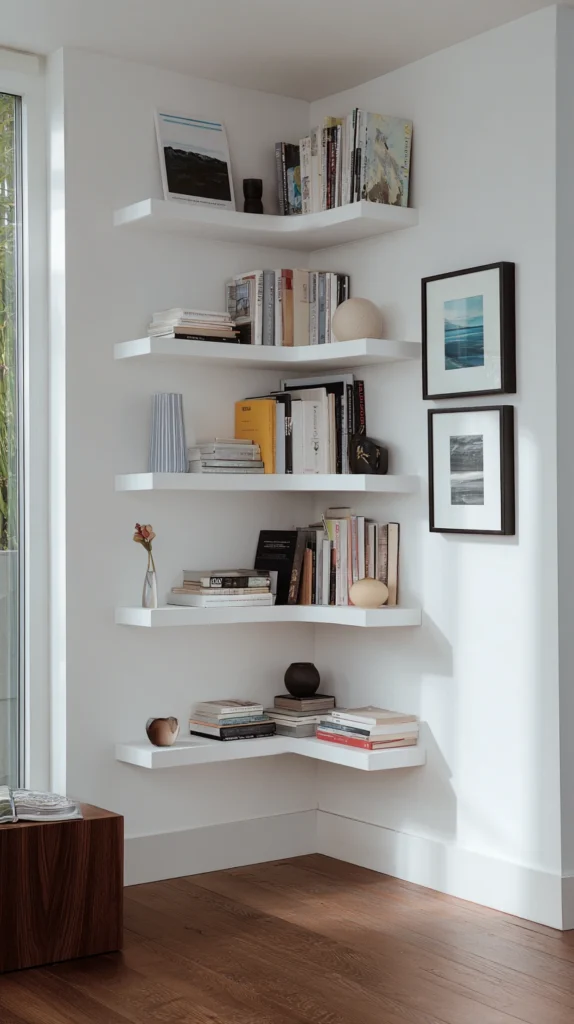
Budget: $40 – $200
A set of corner shelves — fixed shelves that use the corner angle as their structural support, with brackets fixed to both walls — fills the vertical space of a corner with functional storage and display surface at a cost considerably lower than any freestanding furniture of equivalent capacity. Corner shelves use the one space in a room that is structurally certain to be clear — no foot traffic, no furniture conflict — and turn it into the most space-efficient storage in the room.
Corner shelf brackets cost $5–$15 each. Timber shelves of 25 by 20 centimetres per board run $5–$15 per metre. A set of four corner shelves stacked from waist height to near the ceiling costs $40–$100 in materials. Paint the shelves in the same colour as the wall — or in a contrasting colour if the corner is intended as a feature — before fixing. Shelves painted after installation always show paint marks on the wall at the bracket fixing points.
Style tip: Leave one shelf entirely empty rather than filling all shelves to capacity. An empty shelf in a corner shelf system reads as restraint and confidence; a fully loaded set of shelves reads as storage that ran out of room. The empty shelf is the visual breathing space that makes the occupied shelves worth looking at.
8. The Candle and Lantern Corner
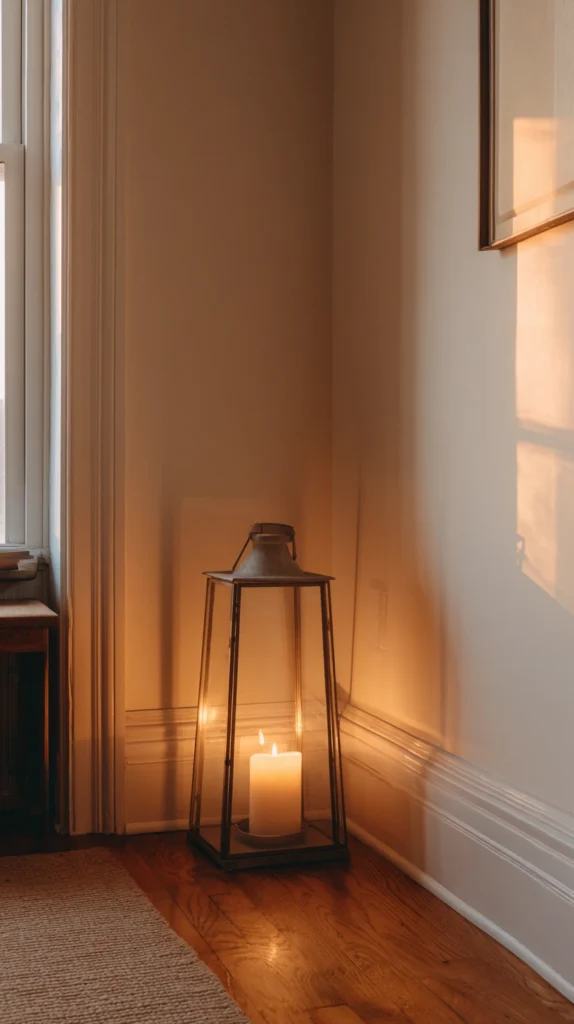
Budget: $20 – $100
A grouping of candles and lanterns at floor level in a corner — varying heights, consistent material family, lit in the evening to create a warm glow that rises from the corner into the room — is the simplest and most atmospheric corner treatment available. A corner lit from floor level with warm candlelight becomes the most inviting spot in the room after dark without any furniture, any planting, or any structural change.
Floor lanterns in varying heights cost $10–$30 each. Pillar candles run $3–$10 each. A grouping of five lanterns and candles at three distinct heights costs $40–$100. Cluster them in the corner with the tallest at the back — against the actual angle — and the smallest at the front, distributed across a 60 by 60 centimetre floor space. A corner candle grouping that is too spread out loses the intimate, concentrated quality that makes it effective.
Style tip: Use LED flameless candles in floor lanterns that are difficult to access for relighting. A floor-level candle grouping in a corner is visually perfect and practically inconvenient to relight individually each evening — LED candles in the lanterns on timers ($8–$15 each) produce the same warm flicker and activate automatically without requiring the host to kneel in the corner every evening before guests arrive.
9. The Corner Desk Nook
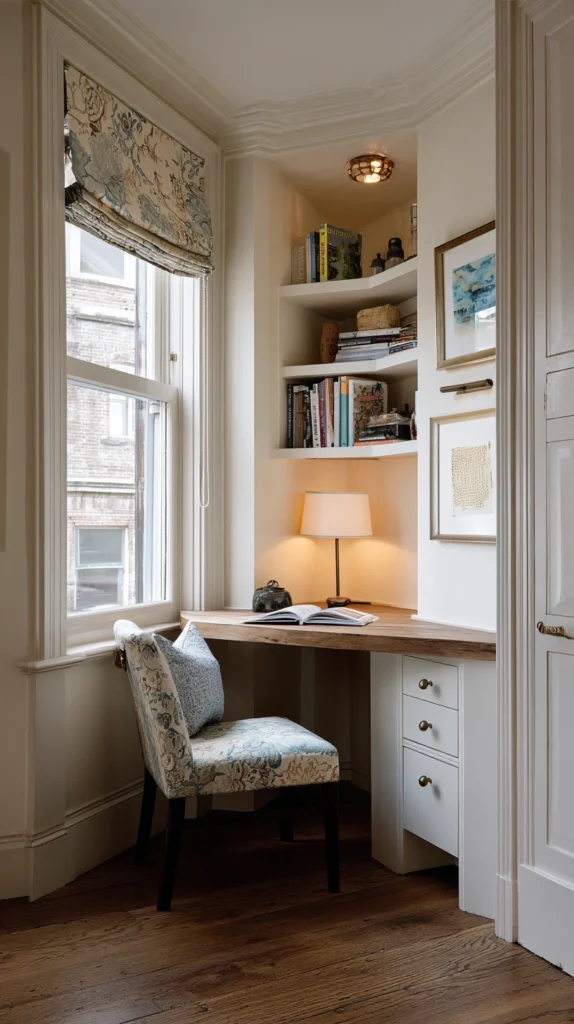
Budget: $60 – $300
A corner desk — a purpose-built corner unit, a wall-mounted fold-down surface, or a simple plank fixed between two walls — creates a working nook in space that was previously serving no purpose and transforms the corner from empty to essential. A corner desk nook in a summer-dressed room — with a plant, a lamp, a simple tray of stationery — has the quality of a considered workspace that a desk in the middle of a room never quite achieves.
A corner desk unit costs $60–$150. A wall-mounted fold-down desk runs $40–$100. A timber plank between two wall-fixed brackets costs $15–$40 in materials. An accent chair suitable for desk use costs $60–$200. The corner desk nook requires the corner to be clear of both walls — at least 90 centimetres of clear wall on each side — to be functional rather than decorative, and that requirement rules out some corners and perfectly suits others.
Style tip: Manage the cable from the desk lamp before styling the corner rather than after. A beautifully styled corner desk nook with a visible power cable trailing to the nearest socket is a corner desk nook that is 90 percent finished and looks it. A cable managed with adhesive clips along the wall-desk junction and disappearing behind the desk before the lamp is positioned is a corner desk nook that is complete.
10. The Mirror and Console Corner
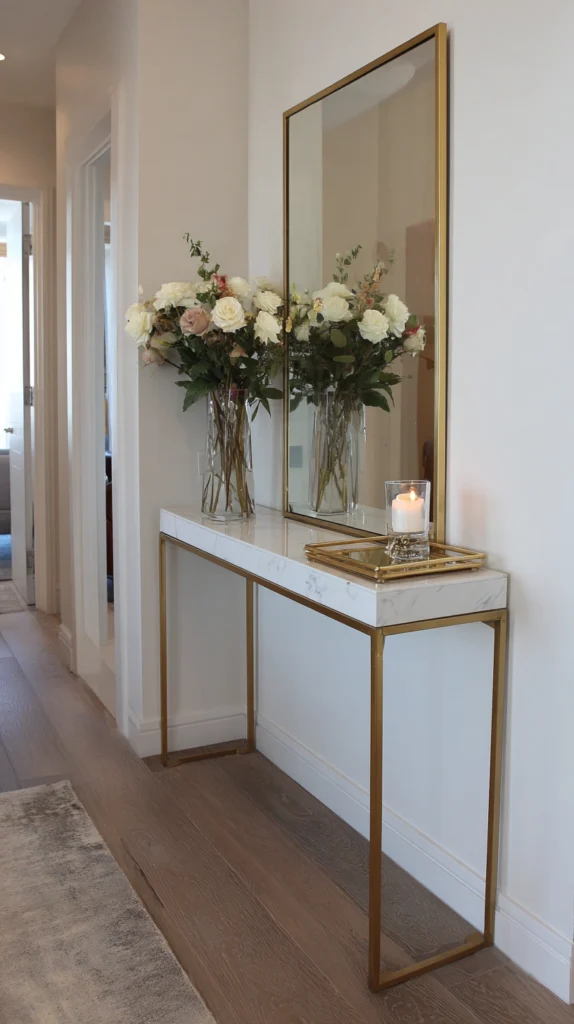
Budget: $40 – $200
A console table placed against one wall of the corner — not spanning both walls, but using one wall as a backdrop — with a large mirror leaned against the adjacent wall at an angle creates a corner arrangement of considerable visual depth. The mirror reflects the room back into itself from a new angle, the console provides a display surface, and the combination of furniture and reflection makes the corner feel like a designed zone within the larger room.
A console table costs $50–$150. A large leaning mirror runs $40–$150. A small arrangement on the console — a plant, a candle, a tray of objects — completes the display for $15–$40. Lean the mirror at the same angle as an artwork leaned against a wall — slightly forward from vertical, not flat against the wall — so it reflects the ceiling and the room at the angle that makes the corner feel largest rather than the angle that makes it most convenient to store.
Style tip: Position the console table off-centre in the corner — pushed toward one wall rather than centred between the two — and the leaning mirror against the other. The asymmetric arrangement of console and mirror creates a dynamic composition that a centred console with a centred mirror directly above it lacks; the off-centre placement produces the visual tension that makes the corner worth looking at.
11. The Textile Corner
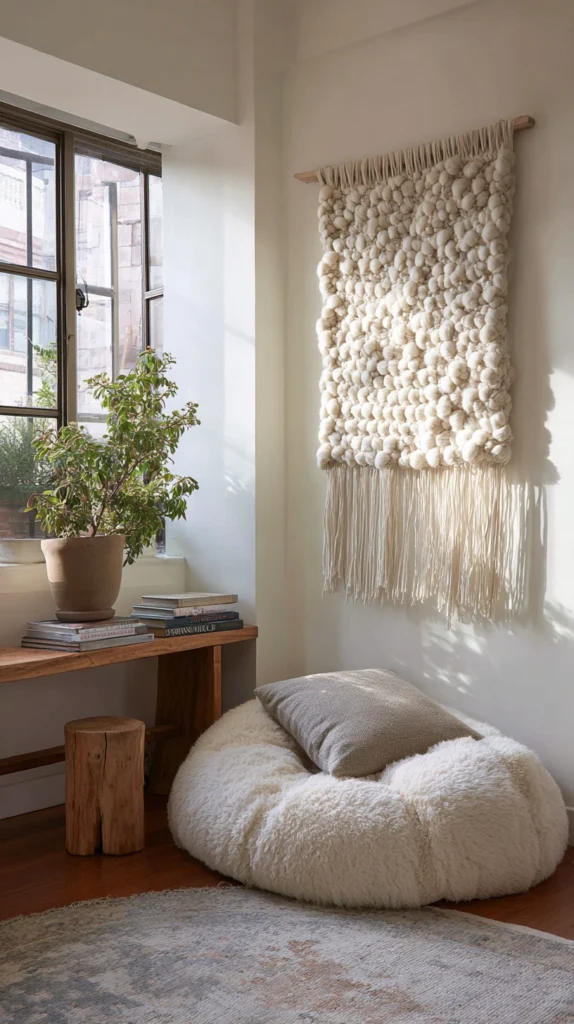
Budget: $30 – $150
A corner filled with a single large textile element — a macramé wall hanging spanning the corner from wall to wall, a tapestry hung on one wall with a complementary rug below, a large floor cushion with a woven throw draped over it — gives the corner a warmth and a handmade quality that no hard-surfaced furnishing element achieves. Summer textiles in natural materials — cotton, linen, jute, rattan — cool the visual temperature of the corner in a way that is specific to the season.
A large macramé wall hanging costs $40–$120. A woven tapestry runs $25–$80. A floor cushion in a woven or textured fabric costs $20–$60. A woven throw runs $20–$50. The textile corner requires no wall fixings beyond a single hook or a curtain rod at the corner apex — a macramé hung from a rod spanning the corner angle fills the space without touching either wall fully.
Style tip: Choose a textile in a colour that is already present elsewhere in the room rather than introducing a new colour specifically for the corner. A corner textile that echoes the sofa cushions, the rug, or the curtain tone reads as part of the room’s palette; one that introduces a new colour reads as an addition that has not yet found its relationship to the room it is in.
12. The Bar Cart Corner
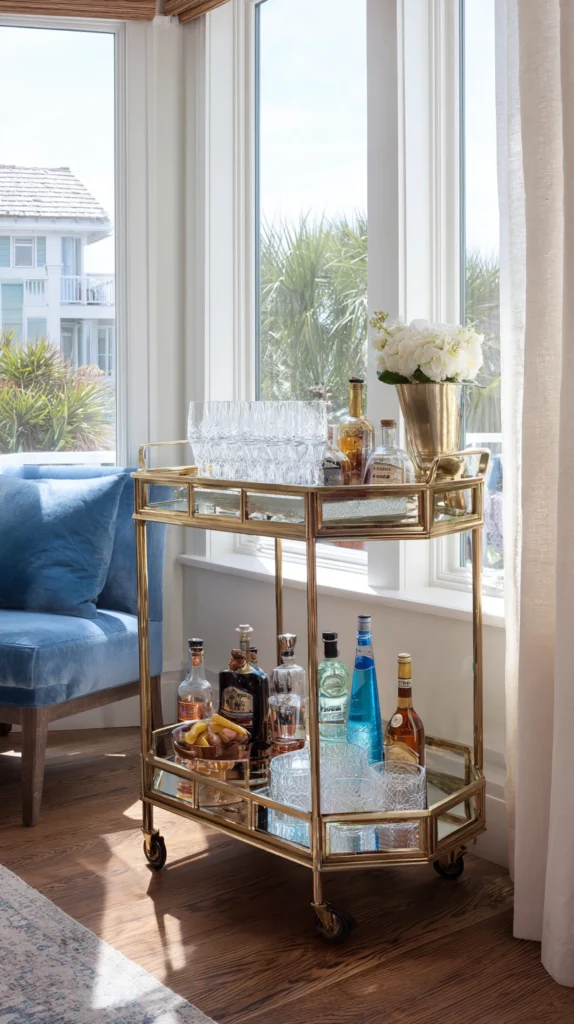
Budget: $50 – $200
A bar cart positioned in a living room corner — stocked with glasses, bottles, a cocktail shaker, and a small plant or a cluster of candles on the top tier — turns the empty corner into the most social element in the room. A corner bar cart is not merely storage for drinks; it is the signal that the room was set up for an evening, that guests are expected, and that the person who lives here takes the pleasures of a well-made drink seriously.
A bar cart in gold, black, or natural timber costs $60–$150. Bar tools — shaker, jigger, muddler, strainer — run $20–$40 for a set. Glasses cost $15–$40 per set of four. A small plant or a cluster of candles on the top tier costs $10–$25. Keep the bar cart stocked rather than depleted — a bar cart with empty shelves and a single bottle is a bar cart that has been used; one that is consistently maintained reads as a feature of the room rather than a piece of equipment in it.
Style tip: Position the bar cart so it is accessible without rearranging any other furniture in the room. A corner bar cart that requires moving a chair to reach it is a bar cart that is consulted rather than used, and the difference between a consulted bar cart and a used one is the difference between a corner that is styled and a corner that is lived in.
13. The Cosy Corner Window Seat
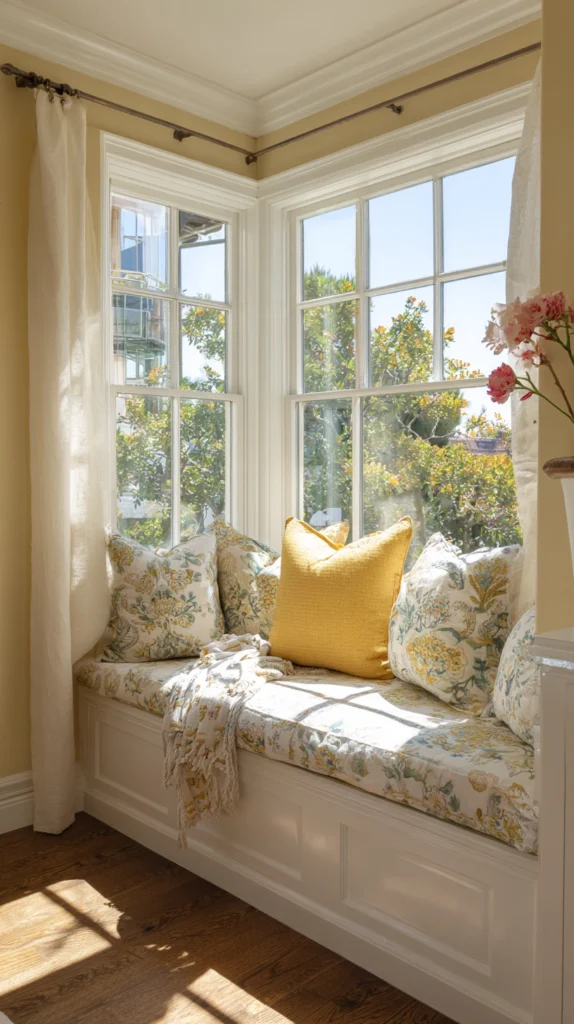
Budget: $50 – $250
A corner window seat — a cushioned platform built at sill height between two windows that meet at a corner, or a single wide windowsill furnished with a fitted cushion and bookended by cushions on each side — creates the most desirable seating in any room for the specific hours of summer when the light comes in at a low angle and the window is the best place to be. The window seat is architecture in the sense that it makes the corner specific — it is not merely a corner with a seat in it but a corner designed for exactly this position in relation to the light.
A cushion fitted to a window seat sill costs $30–$80. Built-in shelf storage beneath a raised window seat platform costs $80–$200 in materials. Bolster cushions for each side run $20–$40 each. A small side table or a built-in shelf at the end of the seat for a drink and a book costs $20–$50. The window seat corner is the one idea on this list that requires a corner with a window — or two windows — and is therefore site-specific rather than universally applicable, but where the right corner exists, nothing else on this list makes better use of it.
Style tip: Choose a cushion fabric that is washable rather than dry-clean-only for a window seat. A window seat is used in the summer with sun cream, cold drinks, and the particular combination of outdoor activity and indoor lounging that produces stains at a higher frequency than any other piece of upholstery in the room. A washable cover maintained at weekly intervals looks better through the full summer than a dry-clean cover that is treated with increasing care and decreasing frequency as the season progresses.
14. The Sculptural Object Corner
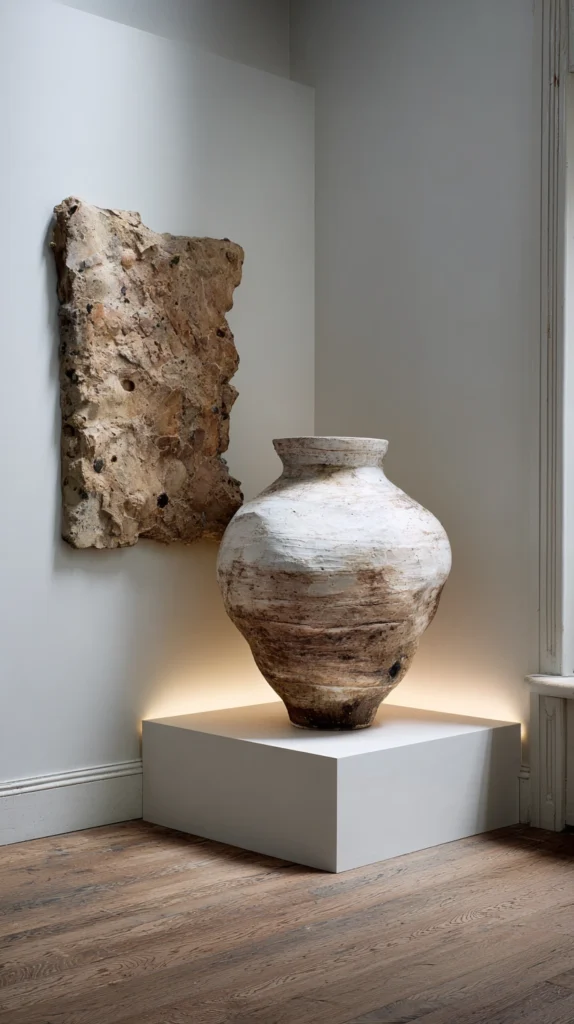
Budget: $20 – $150
A single sculptural object — a large ceramic vessel, a piece of driftwood on a low plinth, a carved wooden bowl, a stone sculpture — placed in a corner at floor level or on a low plinth creates a corner that has been resolved without being furnished, decorated without being styled. One object, well-chosen, at the right scale for the corner, reads as more considered than a full arrangement of smaller pieces and costs less in total while occupying the space more authoritatively.
A large ceramic vessel costs $30–$100. A piece of driftwood from a beach costs nothing. A low plinth made from a timber offcut painted in the wall colour costs $5–$15. The scale of the object relative to the corner is the critical decision — an object that is too small for the corner looks placed rather than positioned; one that is large enough to hold the space looks inevitable, as if the corner was always waiting for it.
Style tip: Light the sculptural corner object with a single uplight at its base ($8–$20) rather than relying on the general room lighting to illuminate it. An object lit from below at night is revealed in a way that daylight and overhead lighting never achieve — the uplight creates shadow and form that the object’s three-dimensional quality is designed to produce, and a sculptural object unlit at night is an object that exists only in the daytime.
15. The Summer Entertaining Corner
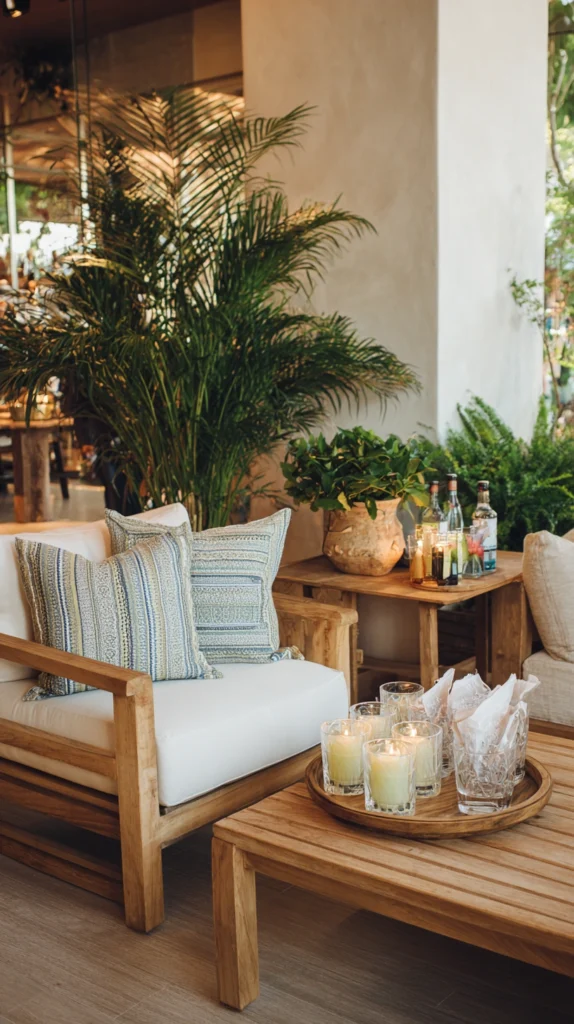
Budget: $30 – $150
A corner prepared specifically for summer entertaining — a drinks tray on a low table, a cluster of candles ready to light, a small vase of cut flowers, and a stack of cocktail napkins — creates the corner that signals the room is ready for guests before any guest has arrived. The prepared corner is not a decoration; it is a statement of intent, and a room with a prepared entertaining corner communicates hospitality in a way that a room where drinks are produced from the kitchen when requested does not.
A drinks tray costs $15–$35. A low table runs $20–$60. Candles in glass holders cost $10–$25. Cut flowers from the garden or a florist run $8–$20. The entertaining corner works because it is permanently ready rather than assembled when needed — the flowers are changed weekly, the tray is restocked after each use, the candles are replaced when they burn low. A corner that is maintained as a permanent feature of the room rather than a temporary arrangement for specific occasions is a corner that changes the character of the room every day rather than only on the days when guests arrive.
Style tip: Keep the entertaining corner visually consistent with the rest of the room’s palette rather than introducing elements chosen specifically for the corner. A drinks tray and candle cluster in the same tones as the sofa cushions and the rug reads as part of the room; one assembled from whatever was available reads as a corner that was styled independently of the space it occupies. The entertaining corner is most effective when it looks as if it has always been there, which requires only that its components were chosen with the room in mind rather than in isolation.
The best corner styling is not the most complex or the most completely furnished — it is the one that makes the corner feel as if it always belonged to the room rather than having been added to it. The chair that was positioned for occupancy, the tree that fills the height, the candles that come on at dusk — small things that turn an architectural afterthought into the part of the room that is missed when it is empty and appreciated without analysis when it is not.
Find the emptiest corner in the room, decide what it is for, and give it one good thing. The corner will tell you what it needs next.