

15 Witchcore Fall Porch Ideas for a Moody, Enchanting Entrance
The porch changed how it felt to come home more than any interior change I have made in years. Not the new welcome mat. Not the seasonal wreath. Not the pumpkin lineup or the string lights or the swept front steps.
The atmosphere.
Because building an actual mood on the porch did something a few scattered decorations never could. Before it: a front step with a pumpkin or two, pleasant enough but forgettable the moment the door closed behind me. After it: an entrance that feels like walking into something, dried botanicals and candlelight and dark, layered color turning a two-second walk to the door into its own small experience.

Witchcore is not a costume applied to a porch for one month a year. It is an atmosphere built from materials that already belong outdoors in fall — dried herbs, twisted branches, aged lanterns, deep jewel tones — arranged with enough intention that the porch reads as enchanted rather than simply decorated. The entrance: no longer a functional threshold, but the first hint of the mood the whole house carries into autumn.
Here are 15 witchcore fall porch ideas for a moody, enchanting entrance — from the simplest lantern to the most fully committed porch — built on that understanding.
Why Witchcore Suits the Front Porch Specifically
The threshold logic
A porch is the one part of a home seen by everyone, resident and visitor alike, before anything else. The mood set at the threshold colors the expectation for everything beyond it.
The natural material advantage
Witchcore depends on materials that already look correct outdoors and weather naturally with the season — dried grasses, aged wood, wrought iron, real pumpkins left to soften and slump. Nothing about this aesthetic asks a porch to look artificially preserved; the slight decay is part of the intended effect.
The candlelight and lantern principle
Without layered evening light:
A porch lit by a single bright bulb, functional but flat.
The mood: absent the moment the sun goes down.
With layered evening light:
Lanterns, string lights, and candles at multiple heights, none of them a single harsh source.
The mood: strongest precisely at dusk, when the porch is most likely to be seen.
The color and texture case
Witchcore leans into deep, saturated color — black, deep purple, burgundy, forest green — paired with rough, natural texture: dried grasses, raw wood, aged metal. The palette reads as autumn taken to its most atmospheric extreme, rather than autumn softened for a broad audience.
The Five Ways to Build a Witchcore Porch
Before choosing any design:
Lighting (the foundational layer)
Lanterns, candles, and string lights, layered rather than relying on a single porch light.
The lowest-cost, highest-impact single change.
Transforms the mood of an existing porch without touching any furniture.
Botanicals
Dried grasses, twisted branches, herb bundles, and wheat sheaves.
The most immediately seasonal and lowest-cost entry point.
Adds texture and a sense of gathered, foraged materials.
Color
Deep, saturated tones — black, burgundy, forest green, deep purple — in place of the more common pumpkin-orange palette.
Sets the porch apart from a standard cheerful fall display.
Works through paint, textiles, or simply the choice of pumpkin and gourd varieties.
Vessels and vintage objects
Cauldrons, aged lanterns, iron candle holders, apothecary-style bottles.
The objects most specifically associated with the aesthetic.
Sourced secondhand for both cost and authentic wear.
Structure and furniture
Weathered wood, wrought iron furniture, a dark-painted door.
The most permanent and highest-cost layer.
Worth committing to only once the smaller layers have been tested.
1. The Layered Lantern Entryway
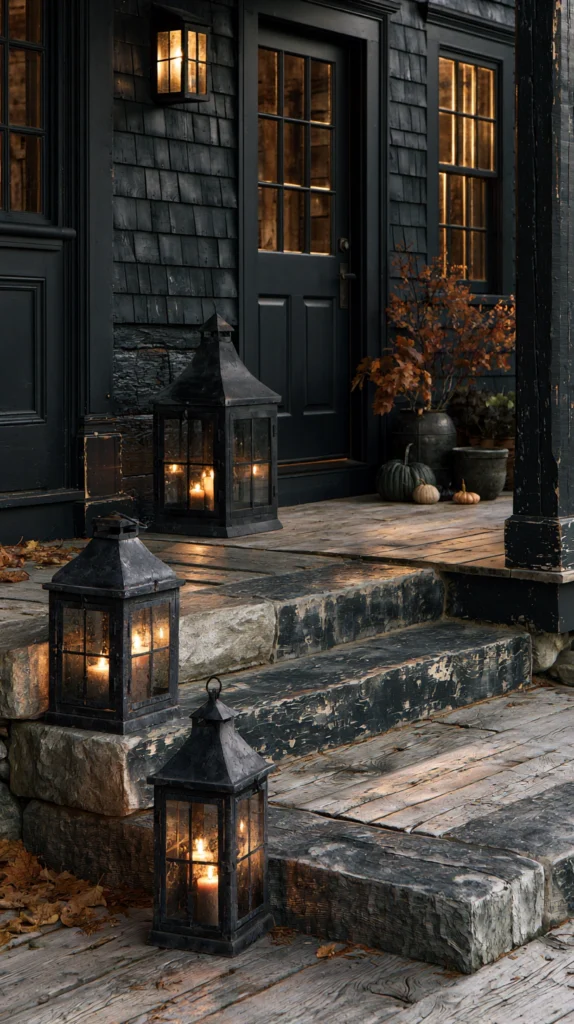
A collection of lanterns in varying heights and styles, clustered along the porch steps and flanking the front door, replacing or supplementing a single porch light.
Why lanterns are the essential starting point
More than any other single change, layered lantern light shifts a porch from merely lit to genuinely atmospheric, and the effect is strongest at exactly the time the porch gets used most.
The lantern types
A mix of black metal lanterns, aged glass hurricanes, and one or two larger floor lanterns, varied in height rather than a matching set.
The candle choice
Flameless LED candles for safety and convenience in an outdoor setting, or real candles for gatherings when the porch is directly supervised.
The placement
Clustered in groups of three along the steps, rather than evenly spaced single lanterns, echoing the same odd-number grouping principle used in interior styling.
The color of light
Warm amber or candlelight-toned bulbs, never a cool white or blue-toned LED, since the warmth of the light is central to the mood.
The evening ritual
Lit at dusk each evening through the season, turning the transition into evening into its own small occasion at the threshold.
Cost breakdown: Lanterns (4–5, assorted): $40–100 Flameless candles: $15–30 Total: $55–130
2. The Dried Grass and Wheat Sheaf Bundles
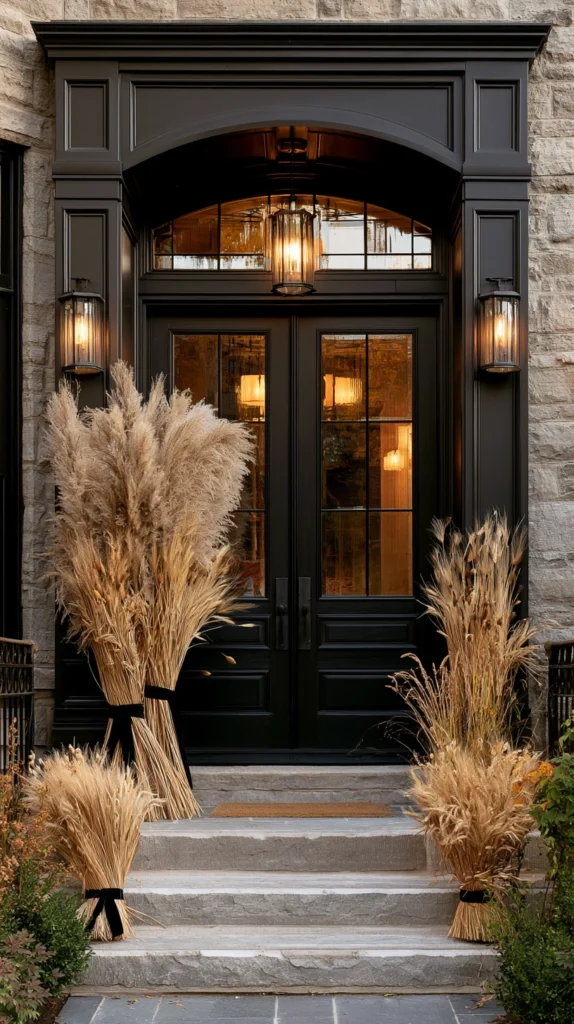
Bundles of dried pampas grass, wheat, and other tall grasses, gathered and tied, leaned against the porch railing or door frame.
Why dried grasses read as more atmospheric than fresh florals
Dried material carries a sense of time passed, of something gathered rather than purchased fresh — a texture and implication fresh flowers cannot replicate, and one central to the aesthetic’s overall mood.
The grasses
Pampas grass, wheat, dried oat grass, or bunny tail grass, gathered into loose, generous bundles rather than tight, formal arrangements.
The tying
Twine or a dark ribbon, wrapped several times and left with trailing ends rather than trimmed precisely, for a slightly wild, foraged look.
The placement
Leaned in large urns or vessels flanking the door, or tied directly to the railing at intervals along the steps.
The color variation
Natural tan alongside darker dyed or naturally deep-toned grasses, mixing lighter and richer tones within the same bundle for depth.
The longevity
Dried material lasts the full season and often well into winter, making this one of the lowest-maintenance elements on the porch once initially arranged.
Cost breakdown: Dried grass bundles (3–4): $20–50 Vessels or urns (if needed): $20–60 Twine or ribbon: $5–10 Total: $45–120
3. The Black and Deep Purple Pumpkin Display
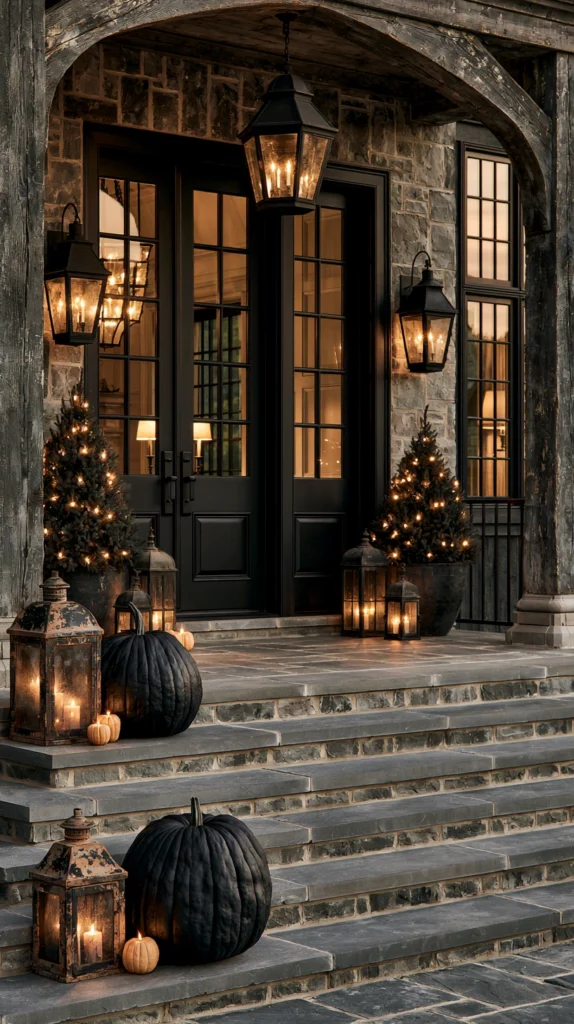
A grouping of pumpkins and gourds chosen specifically in black, deep purple, and near-black varieties, rather than the traditional orange palette.
Why unconventional pumpkin colors set the tone immediately
A porch full of standard orange pumpkins reads as cheerfully seasonal. Black and deep purple varieties immediately signal a different, more atmospheric intention, without requiring any additional decoration.
The pumpkin varieties
Black Kat, Porcelain Doll (deep pink-purple), and naturally dark heirloom varieties, sourced from a farm stand or specialty pumpkin patch rather than a standard grocery display.
The arrangement
Varied sizes stacked and clustered rather than lined up uniformly, with the largest pumpkins at the base and smaller gourds tucked into gaps.
The natural aging
Left in place through the season, softening and slumping slightly as October progresses — an expected and even desired part of the display’s evolution, not a sign of neglect.
The accent pieces
A few small white or ghost-pale pumpkins mixed in among the darker ones, providing contrast within the otherwise deep, saturated grouping.
The placement
Clustered at the base of the steps or flanking the door, at a scale generous enough to read clearly from the street.
Cost breakdown: Black and deep purple pumpkins (varied sizes): $30–70 Accent white pumpkins: $10–20 Total: $40–90
4. The Cauldron Planter
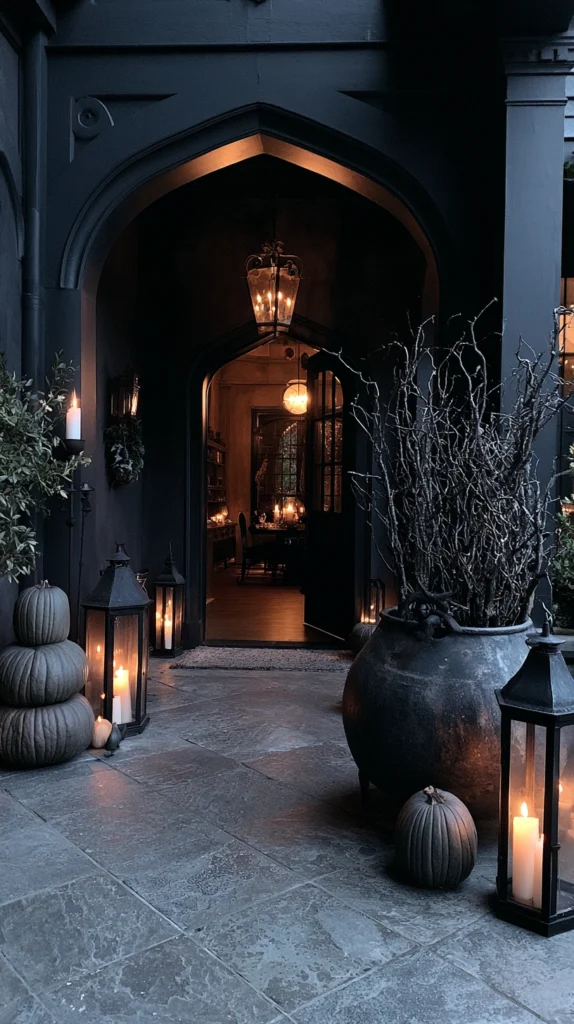
A cast iron or iron-look cauldron, repurposed as a planter or a display vessel for seasonal botanicals, positioned prominently on the porch.
Why the cauldron is one of the aesthetic’s most direct visual signifiers
Few single objects communicate this specific mood as immediately and recognizably as a cauldron, making it one of the highest-impact individual purchases on this list.
The cauldron
A genuine or reproduction cast iron cauldron, or a lighter-weight resin version finished to resemble aged iron for easier handling and lower cost.
The planting
Filled with black mondo grass, dark coleus, or a mix of dried botanicals rather than traditional bright mums, continuing the deeper color palette.
The placement
Positioned centrally on the porch or at the base of the steps, given enough surrounding space to stand as its own focal feature.
The finishing touches
A few dried branches or twisted twigs emerging from the planting, adding height and a slightly wild, untamed silhouette above the cauldron’s rim.
The lighting
A small lantern or candle placed beside, rather than inside, the cauldron, since the vessel itself photographs and reads best when its own form remains visible rather than obscured by direct lighting.
Cost breakdown: Cauldron planter: $30–80 Plants or dried botanicals: $20–40 Total: $50–120
5. The Dark-Painted Front Door
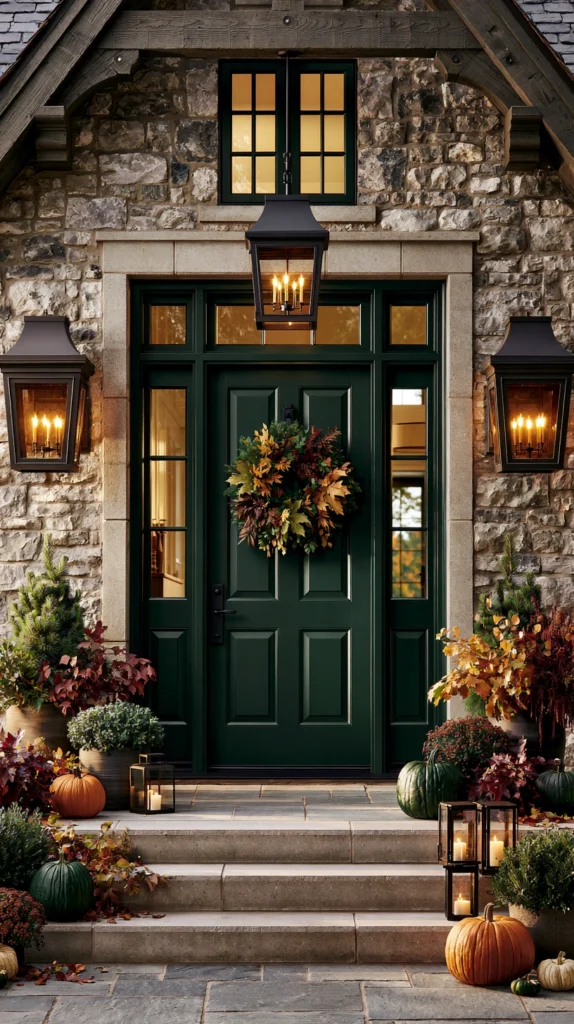
The front door repainted in a deep, saturated color — black, deep plum, forest green, or oxblood — replacing a lighter or more conventional door color.
Why the door color anchors the entire porch composition
The door is the porch’s largest single surface and its clear focal point. Every other element on the porch is arranged in relation to it, making the door color the decision every subsequent choice responds to.
The color
True black, deep plum, forest green, or oxblood red, chosen for maximum saturation rather than a muted or greyed-down version of the same hue.
The hardware
Aged black iron or dark bronze hardware, replacing brighter brass or chrome fixtures that would clash with the door’s new depth of color.
The finish
A satin or semi-gloss finish, durable enough for exterior exposure while still reading rich rather than flat under both daylight and lantern light.
The surrounding trim
Left in a neutral tone or painted to match the door for a fully enveloped, monochromatic threshold, depending on the desired level of commitment.
The seasonal versus permanent decision
A door repaint is a genuinely permanent change, worth considering as a year-round choice this palette can support, rather than a purely seasonal decoration to be undone.
Cost breakdown: Exterior door paint: $30–60 New hardware: $30–80 Total: $60–140
6. The Twisted Branch and Dried Vine Archway
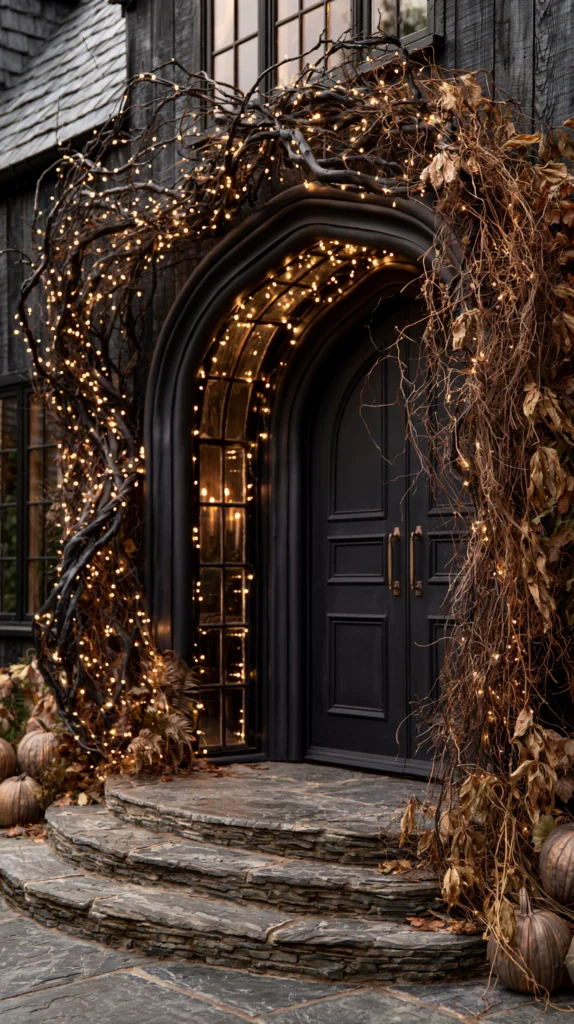
Bare, twisted branches and dried vines woven together to form a loose archway or frame around the front door, adding height and a slightly gothic architectural gesture.
Why an archway of natural material elevates the whole entrance
A porch decorated only at ground level misses the vertical dimension. A branch archway draws the eye upward and frames the doorway itself as a threshold worth noticing, rather than simply a door among decorated pots.
The branches
Bare, twisted branches — curly willow, contorted hazel, or simply gathered deadfall — wired or tied together into a loose arch shape spanning the top of the doorway.
The vines
Dried grapevine or bittersweet vine woven through and around the branch structure, adding density and a slightly wild, tangled quality.
The mounting
Secured to the door frame or porch overhang with sturdy wire or hooks, tested for stability before leaving in place through the full season, particularly in areas with regular wind.
The added botanicals
Small bundles of dried herbs or a few dark dried flowers tucked into the woven structure, adding color and texture within the more monochromatic branch-and-vine base.
The lighting
A string of small warm lights woven through the archway, activated at dusk, adding a soft glow to the structure’s silhouette after dark.
Cost breakdown: Branches (gathered or purchased): $0–30 Dried vine: $10–25 Wire and mounting hardware: $10–20 String lights: $15–30 Total: $35–105
7. The Apothecary Bottle Display
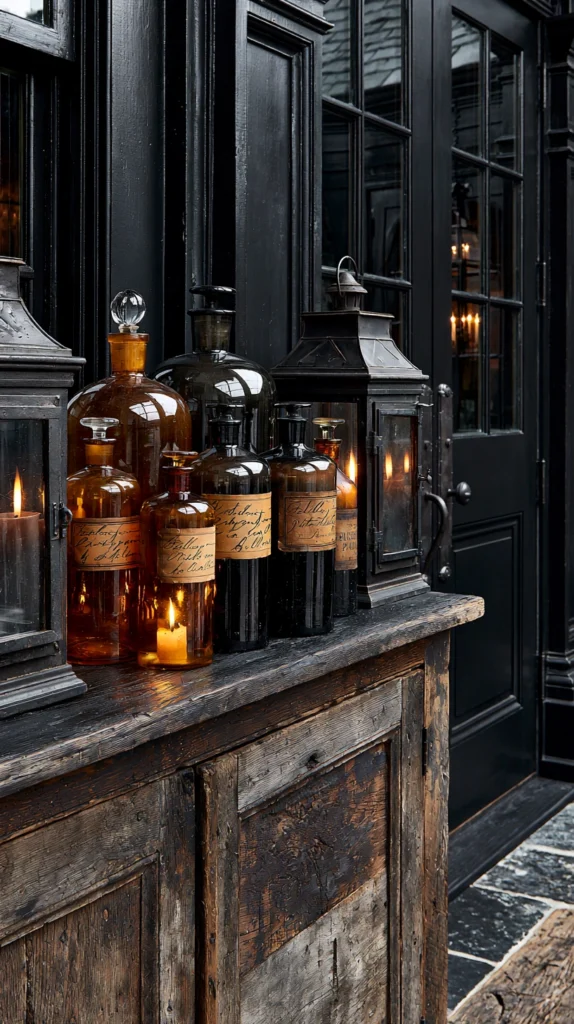
A collection of dark glass apothecary-style bottles, some filled with dried herbs or colored liquid, arranged on a small table or shelf near the door.
Why apothecary bottles suit this aesthetic precisely
The visual language of old apothecary glass — dark amber or cobalt glass, aged labels, varied bottle shapes — carries an air of old herbal knowledge and quiet ritual central to the witchcore mood.
The bottles
Dark amber, cobalt blue, or smoked glass bottles, varied in height and shape, sourced from antique shops or secondhand markets for genuine age and character.
The contents
Dried herbs, cinnamon sticks, or a colored liquid (cranberry juice or diluted food coloring in water) visible through the glass, giving each bottle its own small visual interest.
The labeling
Small handwritten or printed labels, evoking an old herbalist’s shelf, though kept legible rather than illegibly ornate for genuine charm rather than costume-store kitsch.
The display surface
A small weathered wood table or a section of the porch railing, with the bottles clustered rather than spread thinly across a larger area.
The lighting
Positioned where a nearby lantern or string light catches the glass, since these bottles depend on light passing through or reflecting off them for their full visual effect.
Cost breakdown: Apothecary-style bottles (5–6, secondhand): $15–40 Dried herb or liquid fillings: $10–20 Total: $25–60
8. The Wrought Iron Porch Furniture
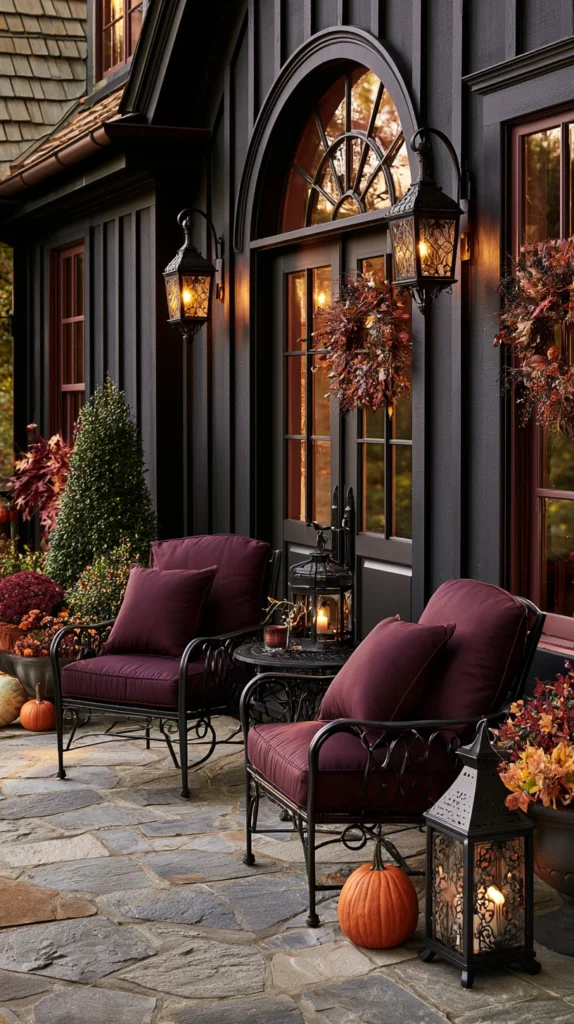
A pair of wrought iron chairs or a small bench, replacing lighter wicker or plastic porch furniture, adding weight and material darkness to the seating area.
Why iron furniture suits the aesthetic’s material language
Iron’s dark, substantial, slightly rough quality reinforces the same mood established by lanterns and cauldrons, in a way that pale wicker or plastic furniture works against.
The furniture
A pair of wrought iron chairs, or a single iron bench, in a matte black or aged bronze finish.
The cushions
Deep burgundy, plum, or forest green cushions, in a weather-resistant fabric, continuing the porch’s color palette into the seating itself.
The placement
Positioned to one side of the door rather than blocking the main walking path, creating a small seating vignette within the larger porch composition.
The side table
A small matching iron side table between the two chairs, holding a lantern or a small seasonal arrangement.
The weatherproofing
Wrought iron requires occasional rust treatment, particularly in humid or rainy climates, worth factoring into the furniture’s ongoing care.
Cost breakdown: Wrought iron chairs (2): $150–350 Weather-resistant cushions: $40–80 Small side table: $40–90 Total: $230–520
9. The Raven and Crow Silhouette Accents
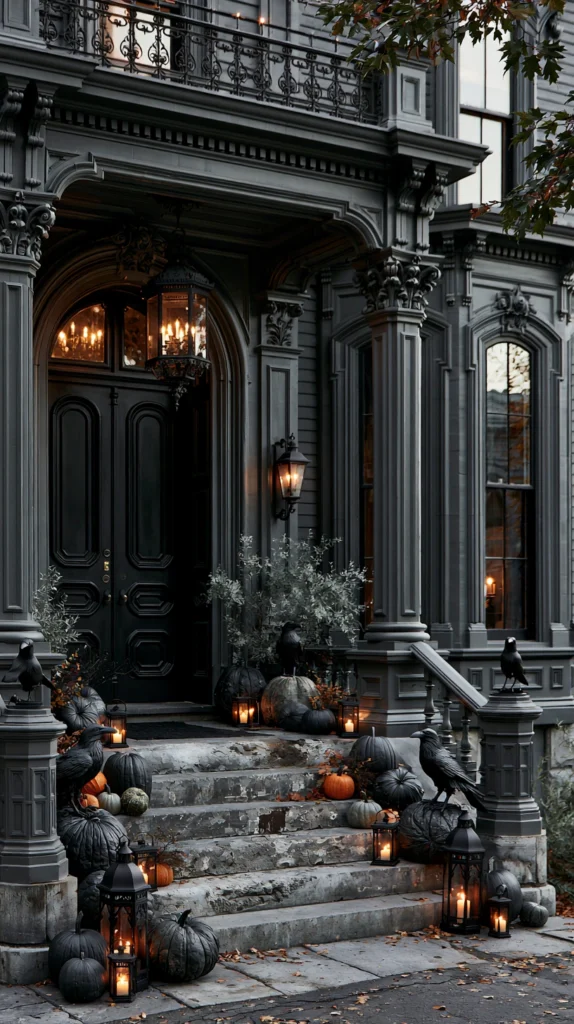
Small black silhouette figures — ravens, crows, or a single larger perched bird — placed among the porch’s other decorations for a subtle, recognizable seasonal nod.
Why a small, restrained touch of this motif works better than an obvious one
One or two well-placed silhouettes read as intentional and atmospheric; a dozen scattered throughout can tip into costume territory. Restraint here matters more than in almost any other element on this list.
The material
Matte black metal or resin figures, avoiding glossy plastic finishes that would look cheap against the porch’s otherwise natural material palette.
The placement
One perched on a lantern, one tucked among the dried grasses, rather than lined up in a row or repeated at every corner of the porch.
The scale
A single larger figure often reads better than several small ones scattered widely — one substantial raven perched prominently can carry more weight than five small silhouettes spread thin.
The material harmony
Chosen in the same matte black finish as the door hardware or the wrought iron furniture, so the accent feels connected to the rest of the porch rather than an isolated seasonal add-on.
The seasonal storage
Easily removed and stored for the off-season, since this is one of the porch’s more overtly seasonal, rather than year-round, decorative choices.
Cost breakdown: Raven or crow silhouettes (1–2): $15–40 Total: $15–40
10. The Deep Jewel-Tone Outdoor Rug
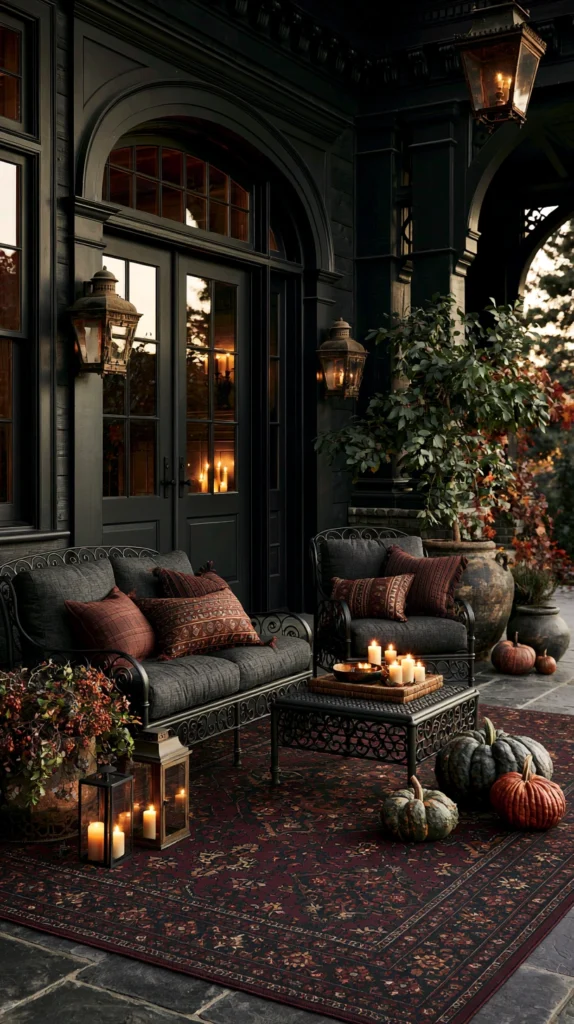
A weather-resistant outdoor rug in a deep jewel tone — burgundy, forest green, or deep plum — layered on the porch floor beneath the seating or at the entrance itself.
Why a rug grounds the whole porch composition
Without a rug, a porch’s decorations exist as scattered individual objects on bare wood or concrete. A rug provides a defined base the eye reads as one cohesive zone, the same grounding effect a rug provides indoors.
The material
Polypropylene or another weather-resistant outdoor fiber, able to withstand moisture, temperature swings, and regular foot traffic without deteriorating quickly.
The color and pattern
A deep jewel tone, either solid or in a subtle traditional pattern, avoiding bright, cheerful prints that would work against the porch’s overall mood.
The sizing
Large enough to anchor the full seating area or the immediate entrance zone, rather than a small mat that reads as an afterthought.
The placement
Directly in front of the door, or beneath the wrought iron seating grouping, depending on which zone of the porch most needs visual grounding.
The seasonal care
Rolled and stored during particularly harsh winter weather in colder climates, extending the rug’s usable lifespan across multiple fall seasons.
Cost breakdown: Outdoor rug (deep jewel tone): $50–150 Total: $50–150
11. The Dried Herb and Chili Ristra
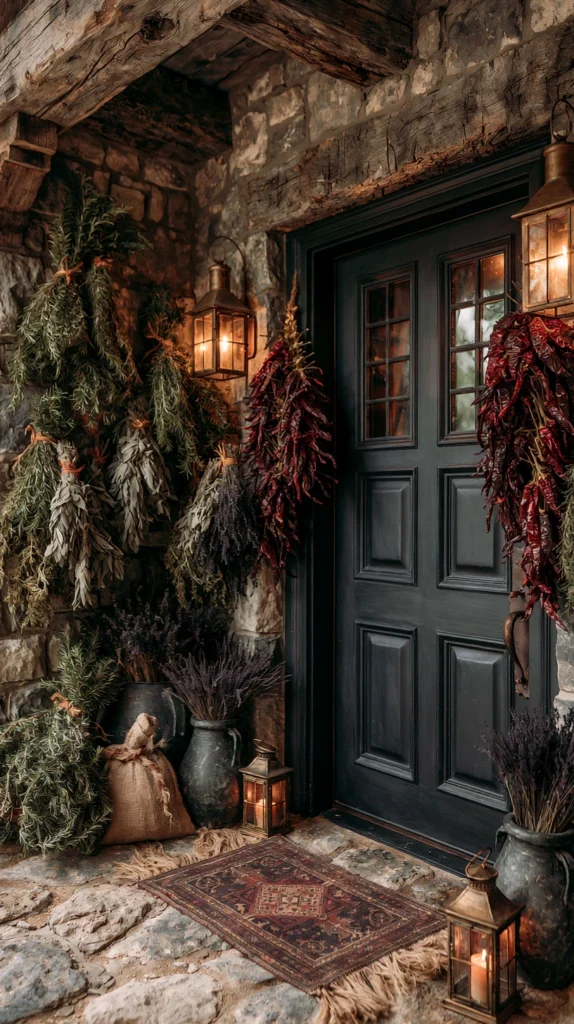
Bundles of dried herbs and a string of dried chili peppers, hung near the door, combining an old preservation tradition with a rustic, textural accent.
Why this detail adds warmth alongside the porch’s darker elements
A porch built entirely from black, iron, and deep jewel tones risks feeling one-note. A ristra’s warm red and the herb bundles’ muted green and grey introduce a different, complementary texture and color.
The herbs
Rosemary, sage, and lavender, tied into small bundles and hung near the door, both for visual texture and a subtle, pleasant scent as guests pass by.
The chili ristra
A string of dried red chili peppers, hung alongside or just below the herb bundles, adding a warm red note against the porch’s otherwise cooler and darker palette.
The hanging method
A hook or small nail near the door frame, positioned at a height where the bundles are visible without brushing against anyone entering or exiting.
The natural drying
Continuing to dry further once hung outdoors, developing a slightly more muted, aged color over the following weeks — part of the intended, evolving display rather than a flaw.
The seasonal refresh
Replaced or supplemented as the season progresses, keeping the display from looking too sparse by late October.
Cost breakdown: Herb bundles: $0–15 Dried chili ristra: $8–15 Total: $8–30
12. The Weathered Wood Sign or Plaque
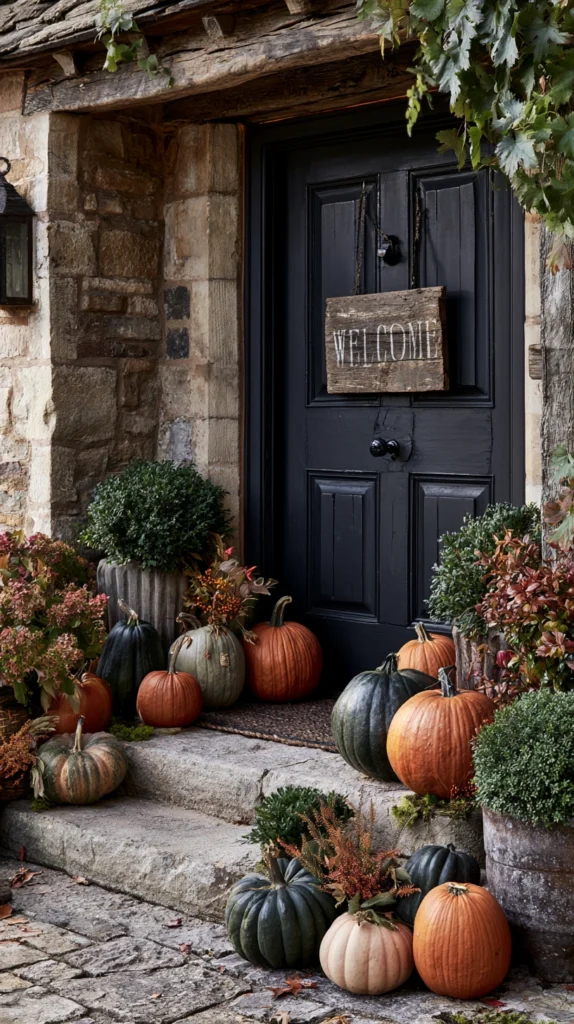
A hand-lettered or carved wood sign, in a slightly worn or reclaimed finish, hung near the door with a short seasonal phrase or symbol.
Why a sign adds a personal, narrative layer to the porch
Most of the porch’s other elements are purely visual and textural. A sign introduces language, giving the porch a small note of personality or humor within the broader atmospheric display.
The material
Reclaimed or intentionally distressed wood, rather than smooth new lumber, continuing the aesthetic’s broader embrace of visible age and wear.
The lettering
Hand-painted or wood-burned text, in a simple serif or slightly rustic script, avoiding an overly polished, machine-cut appearance.
The phrase or symbol
A short seasonal phrase, a moon phase illustration, or a simple botanical motif, kept understated rather than overly literal or costume-like.
The hanging method
A length of jute rope or a small wrought iron bracket, continuing the material language established elsewhere on the porch.
The placement
Beside the door or above it, at a scale that complements rather than overwhelms the door itself as the porch’s primary focal point.
Cost breakdown: Weathered wood sign (existing or handmade): $0–40 Or purchased finished sign: $25–60 Total: $0–60
13. The String Light Canopy
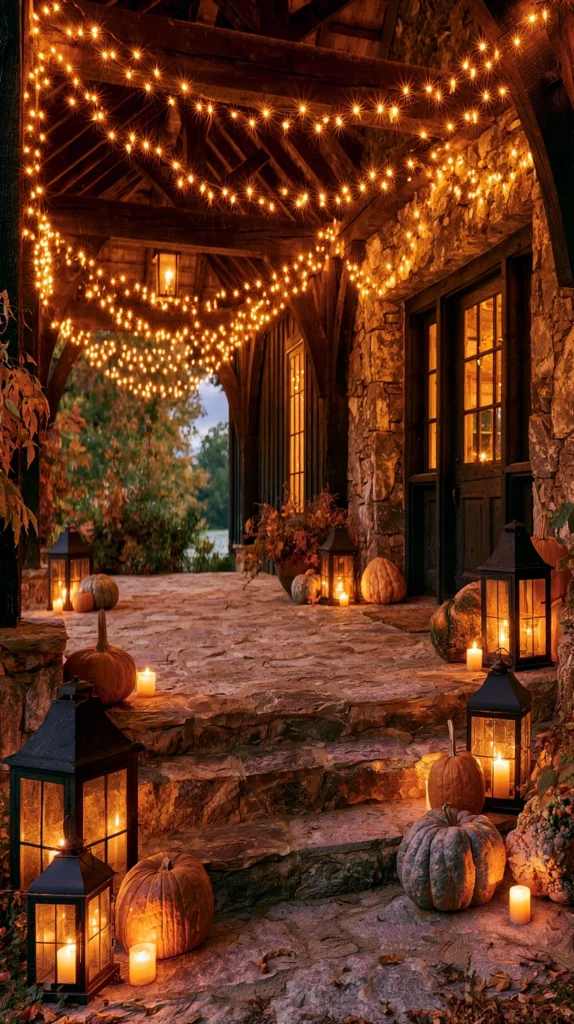
Warm string lights strung overhead across the porch ceiling or between posts, providing an ambient wash of light above the more concentrated lantern and candle light below.
Why overhead lighting completes the layered lighting scheme
Lanterns and candles provide light at low and mid heights. A string light canopy adds the missing overhead layer, completing a full-height lighting scheme rather than leaving the porch’s upper space in shadow.
The lights
Warm white or amber-toned string lights, avoiding cooler white or multicolor options that would clash with the rest of the porch’s warm palette.
The pattern
Strung in a loose crisscross or draped swag pattern across the porch ceiling, rather than a single straight line, for a fuller, more atmospheric canopy effect.
The mounting
Small hooks installed into the porch ceiling or the tops of support posts, removed or left in place year-round depending on the porch’s overall design commitment.
The timer
An outlet timer, switching the lights on automatically at dusk, ensuring the canopy effect is active during the evening hours it matters most without requiring a manual switch each day.
The integration with other lighting
Dimmer or lower-wattage bulbs than a standard string light set, so the canopy remains a soft backdrop rather than competing with the lanterns and candles below for visual attention.
Cost breakdown: Warm string lights (2–3 sets): $30–70 Mounting hooks: $10–20 Outlet timer: $10–20 Total: $50–110
14. The Spellbook-Style Welcome Table
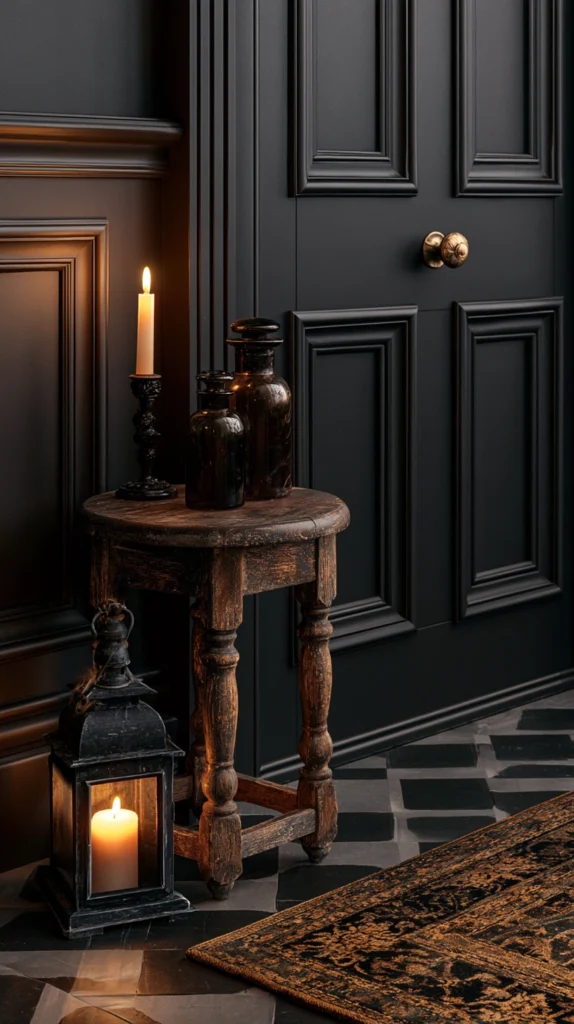
A small weathered table near the door, styled with a leather-bound book, a candle, and a scattering of dried botanicals, functioning as a small still-life vignette.
Why a dedicated small vignette adds detail without cluttering the whole porch
Rather than spreading decoration evenly and thinly across the entire porch, concentrating one detailed, layered vignette in a single spot gives the porch a point of genuine visual richness without requiring that same density everywhere.
The table
A small weathered wood or wrought iron side table, positioned to one side of the door rather than blocking the main entry path.
The book
A worn or leather-bound book, real or a styled prop, left partially open, evoking a sense of quiet ritual or old knowledge.
The candle
A single substantial candle in an aged iron or dark glass holder, positioned beside the book.
The botanicals
A small scattering of dried leaves, a sprig of dried herbs, or a few acorns arranged loosely around the base of the candle and book, rather than in a tidy, formal arrangement.
The overall composition
Kept to three or four objects maximum, following the same restrained styling principle used in interior vignettes, so the display reads as considered rather than cluttered.
Cost breakdown: Small table: $30–70 Book (secondhand or styled prop): $5–20 Candle and holder: $15–30 Botanical accents: $5–15 Total: $55–135
15. The Complete Witchcore Porch (The Fully Enchanted Entrance)
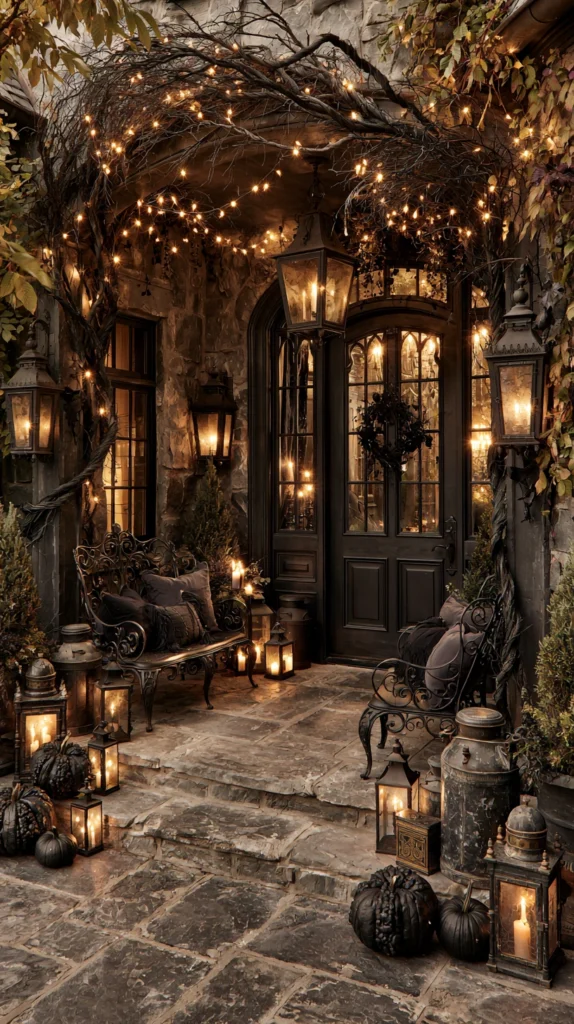
A complete porch combining several of the approaches above — layered lighting, dried botanicals, a dark color palette, vintage vessels, and considered furniture — designed as one cohesive, atmospheric threshold.
What separates the complete porch from a single lantern
A single lantern by the door: a start. A complete witchcore porch: an immersive small environment, where every layer — light, color, texture, and object — contributes to one unified, enchanting mood.
The elements of the complete witchcore porch
The lighting
Layered lanterns at step level, a string light canopy overhead, and candles within vignettes, all in warm, amber-toned light.
The color
A dark-painted door as the anchor, extended through black and deep purple pumpkins, jewel-toned cushions, and a matching outdoor rug.
The botanicals
Dried grass bundles, a herb and chili ristra, and a twisted branch archway, layering texture at multiple heights.
The vessels and objects
A cauldron planter, an apothecary bottle display, and a small welcome table vignette, each contributing its own detailed moment.
The furniture
Wrought iron seating, grounded by the deep-toned rug beneath it.
The finishing touch
A single raven silhouette and a weathered wood sign, adding restraint and personality without tipping into costume.
The complete design in action
An October evening:
6pm: The string light canopy and lanterns switching on together at dusk, the porch glowing amber against the darkening street.
6:15pm: A guest climbing the steps past the black pumpkins and dried grass bundles, the scent of rosemary and dried chili drifting from the door frame.
6:30pm: Seated briefly in the wrought iron chairs before heading inside, the small welcome table’s candle still burning beside them.
The complete witchcore porch: not a porch decorated for a single month, but an entrance that turns the walk to the door into its own small, enchanting occasion.
Cost breakdown for the complete porch: Assuming a starting point of a plain, undecorated porch: Layered lanterns and string lights: $105–240 Door paint and hardware: $60–140 Pumpkin and gourd display: $40–90 Dried botanicals (grass, ristra, archway): $80–190 Cauldron and apothecary display: $75–180 Wrought iron furniture and rug: $280–670 Welcome table vignette: $55–135 Finishing accents (sign, silhouette): $15–100 Total: $710–1,745
Phased over two or three seasons:
Season one ($150–350): Lanterns and string lights Dark pumpkin display Dried herb bundles
Season two ($200–500): Door repaint Cauldron planter Apothecary bottle display
Season three ($300–900): Wrought iron furniture and rug Branch archway Welcome table vignette and finishing accents
The witchcore porch: not a weekend project in its fullest form, but an enchanting threshold built with intention, season after season.
The Question Before Any Witchcore Porch Design
Before choosing a color, a light source, a vintage object:
What is the primary reason for wanting this atmosphere at the entrance?
If the answer is: full transformation — the dark door paired with layered lighting and dried botanicals is the answer.
If the answer is: testing the aesthetic first — the lantern display or the black pumpkin grouping.
If the answer is: atmosphere without any permanent changes — the dried botanicals, apothecary bottles, and welcome table vignette.
If the answer is: the simplest possible — one lantern, one dark pumpkin, one bundle of dried herbs.
The design follows the level of commitment available. Every witchcore idea on this list serves that same enchanted mood at a different scale. The question is which scale is right for this porch and this household.
The single lantern and one dark pumpkin in the right spot: still better than a bare, undecorated step. The full porch, done with intention: an entrance that sets the whole house’s mood before the door even opens.
That mood: the whole point of the atmosphere.
Getting Started This Weekend
The immediate witchcore porch solution:
Choose one layer to commit to first — lighting, color, or botanicals.
Not the whole porch. Not the biggest purchase. The one already closest to being right.
Swap the porch bulb for a warm, amber-toned one and add a single lantern.
The porch will already feel different before anything else has changed.
Source one or two black or deep purple pumpkins instead of the usual orange.
Small, immediate, and the detail that signals the shift in mood most clearly from the street.
Tie one bundle of dried herbs and hang it by the door.
The rest of the design: the elaboration of this moment.
The lantern: the beginning. The witchcore porch: what grows enchanted around it.