
14 Autumnal Maximalist Dining Room Ideas Layered With Texture and Color
The dining room stopped being the room nobody used the moment I stopped trying to keep it neutral. Not the new table. Not the better chairs. Not the fresh coat of safe, sellable white.
The layering.
Because piling on color and pattern and texture did something restraint never managed. Before it: a dining room in careful greige, technically correct and completely forgettable, used twice a year for occasions that felt obligatory. After it: a room that announces itself the moment the door opens, every dinner in it feeling like an event rather than an errand.
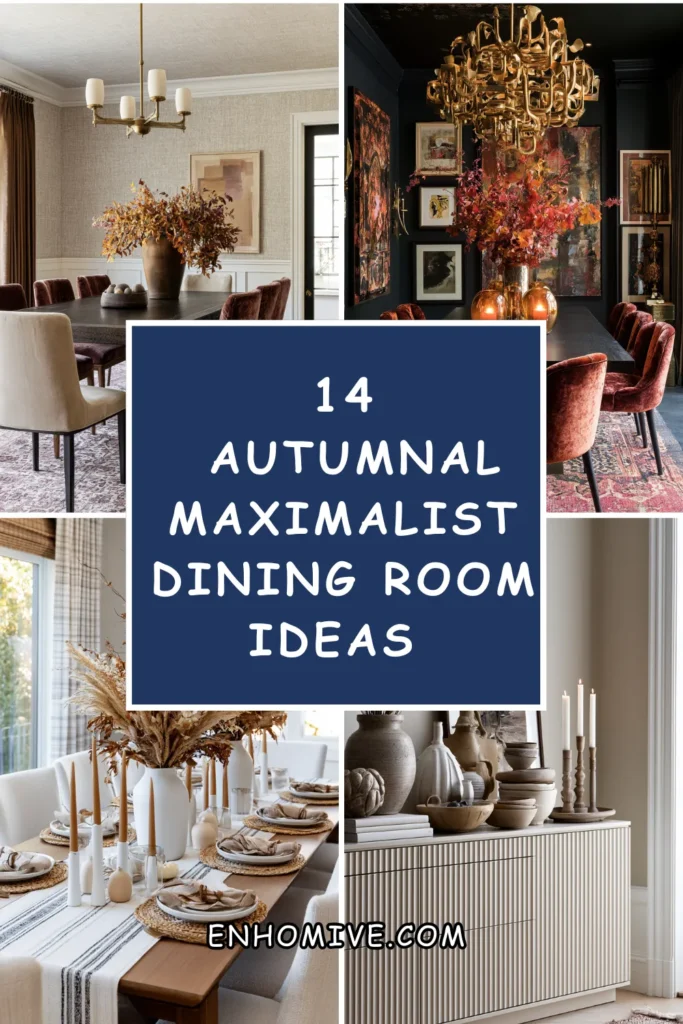
Maximalism is not clutter. It is a design philosophy that trusts more rather than less — more pattern, more color, more texture, more objects with a story — arranged with enough intention that the abundance reads as rich rather than chaotic. The dining room: no longer the house’s most restrained space, but its most alive one.
Here are 14 autumnal maximalist dining room ideas layered with texture and color — from the simplest single-pattern commitment to the most fully layered room — built on that understanding.
Why Maximalism Suits the Dining Room Specifically
The occasion logic
A dining room is used for gathering, for meals that matter more than a weeknight plate on the sofa. A room that looks like an occasion encourages the room to be used like one.
The autumn palette advantage
Maximalism depends on a confident, cohesive palette to keep abundance from tipping into chaos. Autumn’s natural palette — rust, mustard, burgundy, forest green, chocolate brown — is already a built-in color story, making this the easiest season of the year to layer boldly without the result looking random.
The texture equation
Without layered texture:
A room in flat color and matching finishes, visually busy but tactilely uniform.
The eye: given plenty to look at, but nothing to genuinely feel.
With layered texture:
Velvet, wood grain, woven rattan, and patterned wallpaper together, so the richness comes from touch as much as sight.
The room: layered in a way a photograph only partly captures.
The confidence principle
Maximalism fails when it is timid — a single bold wallpaper on an otherwise bare room reads as unfinished, not abundant. The rooms that succeed commit fully: pattern on pattern, color against color, restraint applied only to the overall palette, never to the quantity of elements.
The Five Layers of a Maximalist Dining Room
Before choosing any design:
The wall treatment
Bold paint, wallpaper, or a mural, setting the room’s foundational color and pattern.
The layer every other choice responds to.
Worth committing to fully rather than partially.
The table and seating
A statement table paired with mismatched or patterned chairs.
The room’s functional centerpiece, and a major opportunity for texture.
Where wood, velvet, rattan, and metal can all coexist.
The lighting
An oversized or sculptural chandelier or pendant.
Often the room’s single boldest object.
Sets the scale for how much else the room can hold.
The textiles
Table linens, a patterned rug, and window treatments.
The softest layer, and the easiest to change seasonally.
Where pattern-on-pattern gets tested most directly.
The collected objects
Art, ceramics, candlesticks, and gathered pieces on display.
The finishing layer, applied last.
Built gradually, piece by piece, rather than purchased all at once.
1. The Deep Botanical Wallpaper Statement
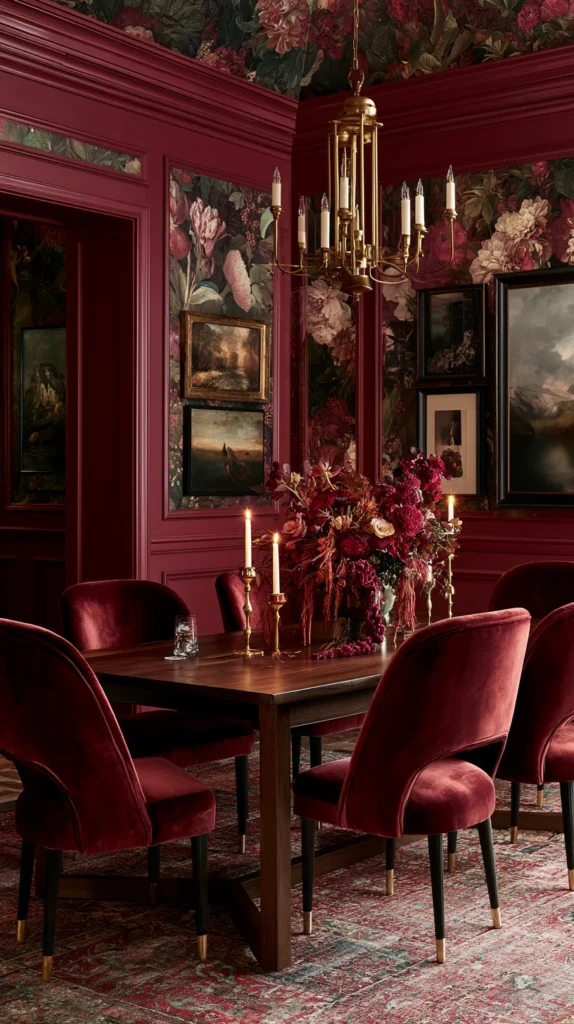
Every wall covered in a richly patterned botanical or floral wallpaper in a deep autumnal colorway, establishing the room’s full commitment from the outset.
Why wallpaper is the strongest possible starting move
A single accent wall of bold pattern reads as decoration. Wallpaper on every wall reads as atmosphere, immersing the room fully rather than offering pattern as an accessory to an otherwise plain space.
The pattern
Large-scale botanical, floral, or bird motifs, in a deep colorway — burgundy, forest green, or chocolate ground with rust and gold detailing.
The scale
A large repeat pattern, which tends to read as more confident and less busy in a full room application than a small, tight print.
The trim
Painted a deep, complementary solid color rather than left white, so the trim does not create a stark, distracting line against the pattern.
The ceiling
Left plain in a warm neutral or painted to match the trim, giving the eye one resting surface amid the patterned walls.
The furniture against it
Solid-colored furniture in rich materials — velvet, leather, dark wood — providing contrast against the wallpaper’s pattern rather than competing with more pattern.
Cost breakdown: Botanical wallpaper (full room): $200–500 Trim paint: $30–50 Total: $230–550
2. The Mismatched Vintage Chair Collection
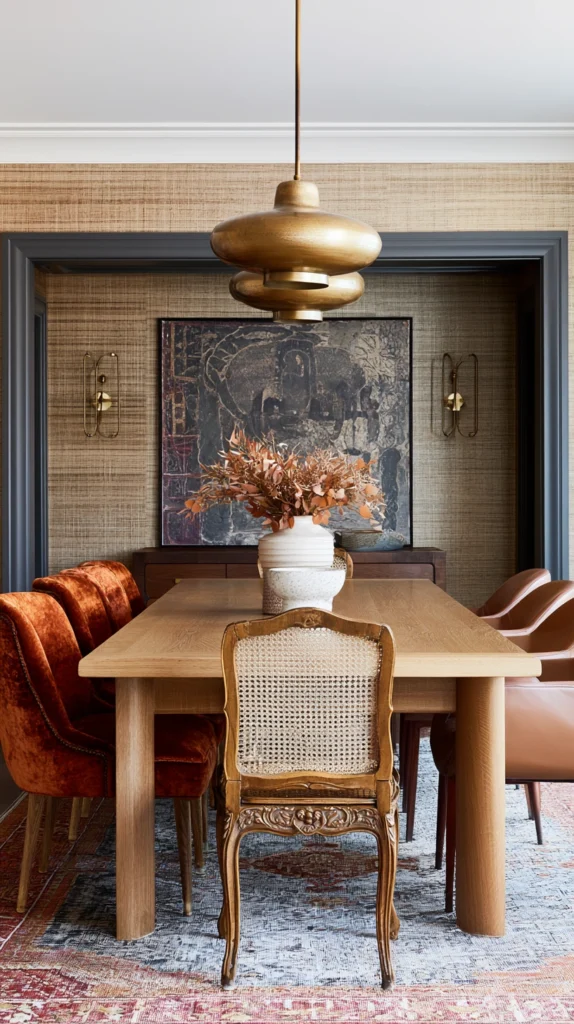
A dining table surrounded by chairs collected individually rather than purchased as a matching set, each one different in wood tone, upholstery, or silhouette.
Why mismatched chairs are a maximalist essential
A matching chair set reads as coordinated and safe. A collection of individually chosen chairs signals abundance and personality, the visual equivalent of a room built up over years rather than a single shopping trip.
The sourcing
Antique shops, estate sales, and secondhand marketplaces, gathered over time rather than acquired all at once.
The unifying thread
A single connecting element — the same wood tone, a shared upholstery color family, or consistent chair height — keeps a genuinely mismatched set from reading as accidental rather than intentional.
The upholstery
Reupholstering a few of the chairs in coordinating jewel-toned velvets, tying an otherwise disparate collection together through fabric even when the frames differ.
The head chairs
Two slightly more substantial or ornate chairs at either end of the table, distinguishing the head positions within the broader mismatched collection.
The arrangement
Chairs placed with deliberate variety around the table, rather than grouped by type on each side, so the mix reads throughout rather than in two separate halves.
Cost breakdown: Vintage chairs (6–8, secondhand): $120–400 Reupholstery (2–3 chairs): $150–350 Total: $270–750
3. The Oversized Statement Chandelier
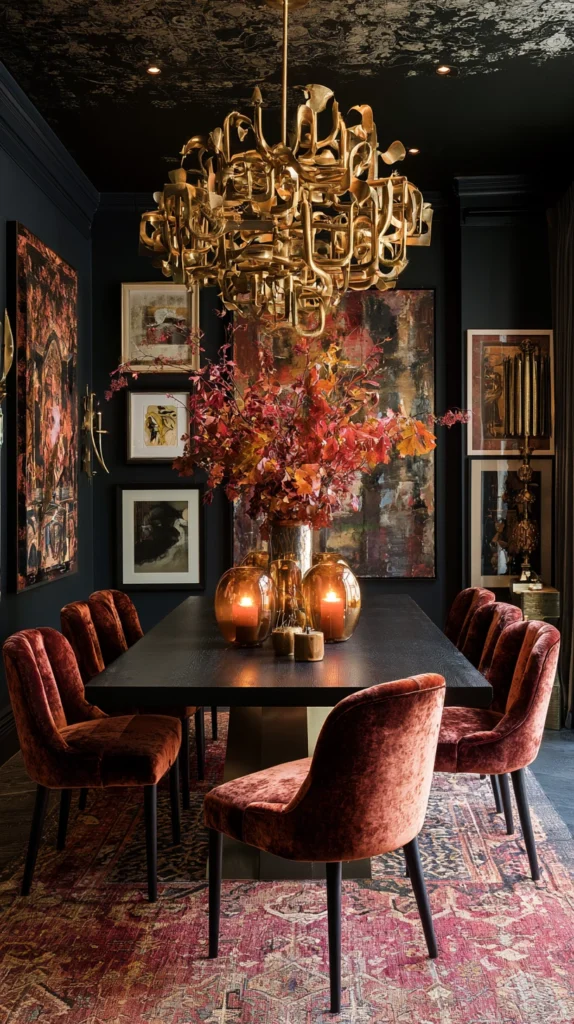
A large, sculptural chandelier — brass, wrought iron, or a mix of materials — hung above the table as the room’s boldest single object.
Why the lighting fixture can carry the whole room
In a maximalist space, the chandelier often does more visual work than any other single piece, its scale and material announcing the room’s ambition before a guest even sits down.
The scale
Sized generously relative to the table, since an undersized fixture is one of the most common mistakes in an otherwise well-designed dining room — err toward larger rather than smaller.
The material
Aged brass, wrought iron, or a mixed-material design incorporating glass, crystal, or wood elements, chosen to complement rather than clash with the room’s other metals.
The height
Hung low enough to feel intimate over the table, typically 30 to 36 inches above the tabletop, while still clearing sightlines across the table when seated.
The bulb choice
Warm, low-wattage bulbs throughout, since a maximalist room depends on layered, moody lighting rather than bright, even illumination.
The dimmer
A dimmer switch, allowing the chandelier’s full presence to be softened for everyday meals and turned up for larger gatherings.
Cost breakdown: Statement chandelier: $200–600 Dimmer switch installation: $30–80 Total: $230–680
4. The Rich Jewel-Tone Paint With Contrasting Trim
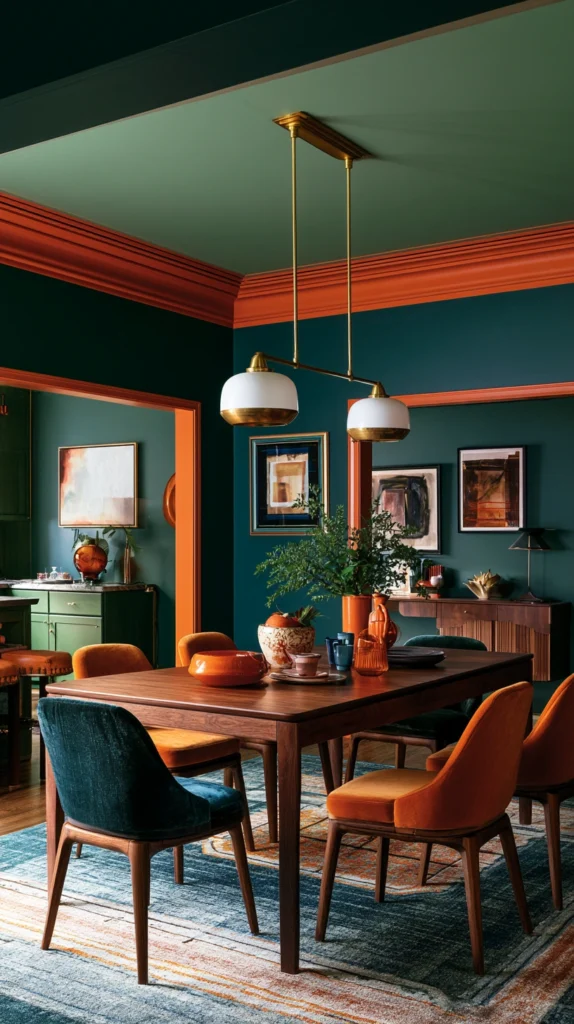
Walls painted in a deep jewel tone — emerald, sapphire, or burgundy — with contrasting trim in a second bold color rather than a safe white.
Why contrasting trim matters more here than in a simpler room
White trim against a jewel-toned wall can feel like a modern, restrained choice — appropriate for a minimalist room, but a missed opportunity in a maximalist one. A second bold trim color doubles the room’s color commitment rather than diluting it.
The wall color
A single deep jewel tone — emerald green, sapphire blue, or deep burgundy — applied to all four walls.
The trim color
A contrasting but complementary tone, such as a deep mustard trim against emerald walls, or a burnt orange trim against sapphire.
The ceiling
Painted in a third, lighter tone from the same palette family, completing what designers sometimes call full color-drenching, rather than leaving it plain white.
The finish
A soft eggshell or satin on the walls, with a slightly higher sheen on the trim to distinguish the two surfaces further.
The furniture
Wood and metal pieces that read warm against the cool jewel tones, preventing the overall palette from feeling too cold despite the saturated color choice.
Cost breakdown: Paint (walls, trim, ceiling): $100–200 Total: $100–200
5. The Layered Persian and Kilim Rug Combination
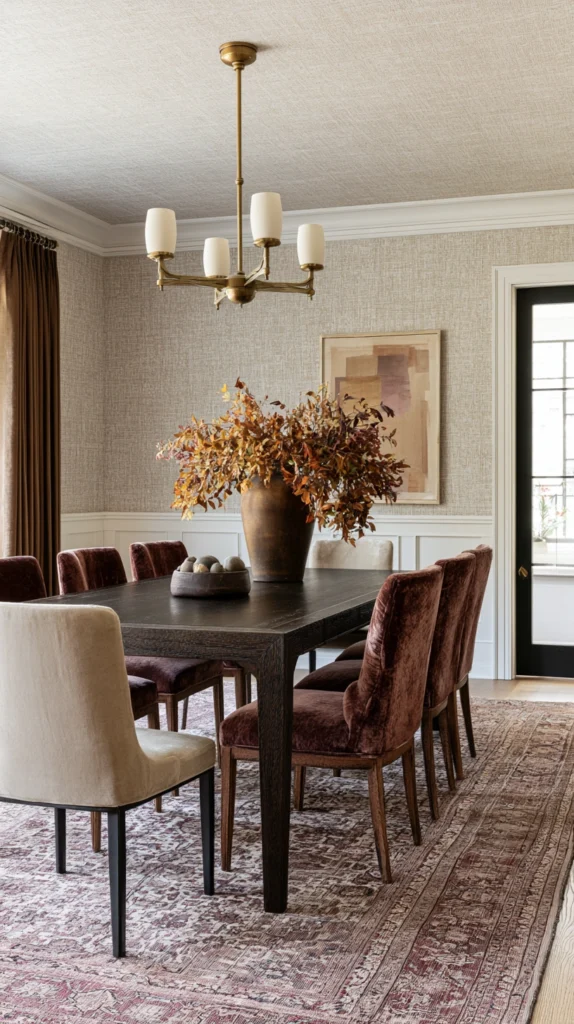
Two rugs layered together beneath the dining table — a large neutral or jute base rug topped with a smaller, more richly patterned Persian or kilim rug.
Why layering two rugs outperforms a single one
A single rug, however patterned, is still one flat plane of color. Two layered rugs of different texture and scale add genuine dimension underfoot, echoing the layered approach used throughout the rest of the room.
The base rug
A large jute, sisal, or plain wool rug, sized generously enough to extend well beyond the table and chairs on all sides.
The top rug
A smaller, more richly patterned Persian, kilim, or vintage-style rug, centered beneath the table itself, offering the room’s boldest floor-level pattern.
The pile height
A flatweave top rug over the base, rather than two thick-pile rugs stacked together, which avoids an unstable or overly bulky surface for chairs to slide across.
The color relationship
The top rug’s palette drawn from the same family as the walls or curtains, tying the floor layer back into the room’s overall color story rather than introducing an unrelated new one.
The furniture placement
Chair legs sitting fully on the layered rugs when pulled out, avoiding a rug sized so tightly that seating falls off the edge during use.
Cost breakdown: Base rug (jute or wool): $80–200 Top patterned rug: $100–300 Total: $180–500
6. The Gallery Wall of Mismatched Frames and Art
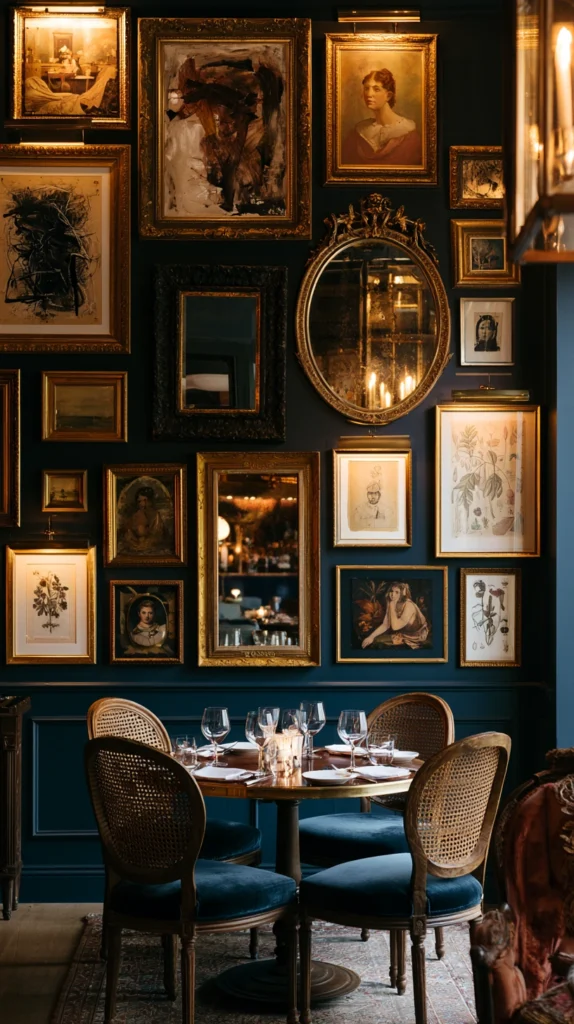
A dense gallery wall covering one full wall of the dining room, mixing frame styles, art subjects, and scales into a single layered display.
Why the gallery wall is a core maximalist technique
A single piece of art, however striking, reads as a decorative choice. A dense, mixed gallery reads as an accumulated collection, reinforcing the sense of abundance the rest of the room is built on.
The frame mix
Ornate gold, simple dark wood, and a few unframed canvases, mixed deliberately rather than matched, echoing the mismatched chair philosophy applied to the wall.
The art selection
A range of subjects and styles — botanical prints, portraits, abstract pieces, and a few small mirrors — rather than a single cohesive theme throughout.
The density
Frames spaced closely, 2 to 4 inches apart, filling the wall with minimal negative space, since a maximalist gallery wall depends on density more than a typical curated arrangement.
The layout method
Arranged on the floor first, adjusted until the composition feels balanced, then transferred to the wall, rather than hung piece by piece directly.
The lighting
A picture light over the largest or most central piece, adding a focal point within the broader dense arrangement.
Cost breakdown: Frames and art (secondhand and new, assorted): $100–300 Picture light: $30–70 Total: $130–370
7. The Velvet and Rattan Material Mix
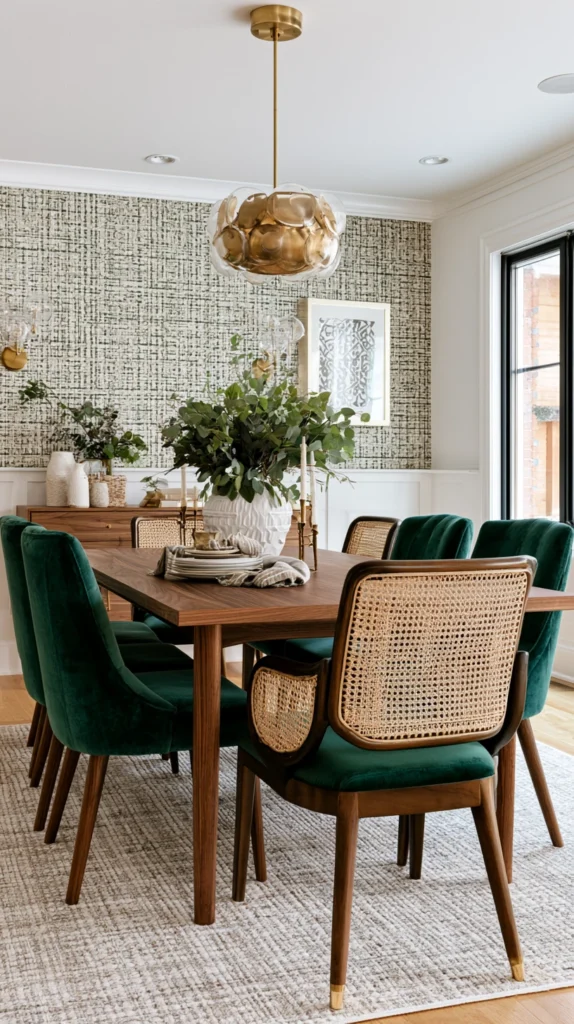
Dining chairs and accent furniture combining jewel-toned velvet upholstery with natural rattan and cane detailing, layering a formal material against a casual, textural one.
Why mixing formal and casual materials adds richness
A room in velvet alone can feel heavy and overly formal. A room in rattan alone can feel too casual for a dining space. Combined, the two materials balance each other while still reading as deliberately layered rather than plain.
The velvet elements
Dining chair seats or a bench upholstered in a deep jewel-toned velvet — emerald, burgundy, or sapphire.
The rattan elements
Chair backs, a sideboard front, or a set of pendant light shades in natural woven rattan or cane, introducing warm texture against the velvet’s richness.
The wood tones
Chair frames and table legs in a warm wood, bridging the two material families visually.
The placement
Velvet concentrated where people sit and touch most directly; rattan used more for visual texture on secondary pieces, so neither material overwhelms the room.
The metal accents
Brass hardware and light fixtures, continuing the warm-material theme across every finish in the room.
Cost breakdown: Velvet reupholstery (4–6 chairs): $200–450 Rattan accent pieces (sideboard or pendant shades): $100–300 Total: $300–750
8. The Botanical Mural Feature Wall
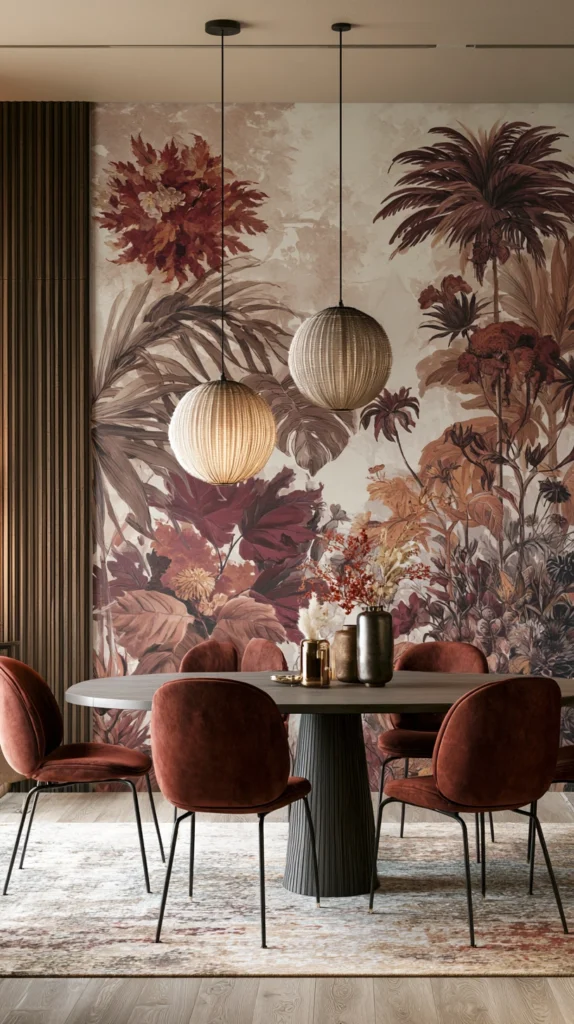
A single wall painted or papered with a large-scale hand-painted or printed botanical mural, functioning as an oversized piece of art rather than a repeating pattern.
Why a mural differs from standard patterned wallpaper
A mural is a single continuous image rather than a repeating print, giving the wall a sense of scale and narrative that patterned wallpaper, however bold, does not achieve in quite the same way.
The subject
Large botanical branches, autumn foliage, or a woodland scene, rendered in a rich, saturated palette matching the room’s overall color story.
The application
A printed mural panel for a more accessible installation, or a hand-painted version for a fully custom, one-of-a-kind result.
The wall selection
The wall most visible from the room’s main entry point, or the wall behind the table’s head position, where the mural becomes the backdrop for every meal.
The surrounding walls
Left in a complementary solid color, so the mural remains the room’s singular focal point rather than one of several competing patterns.
The furniture
Kept relatively simple in front of the mural, allowing the wall’s detail to be fully visible rather than obscured by heavily patterned furniture layered in front of it.
Cost breakdown: Printed mural panel: $150–400 Or hand-painted mural (commissioned): $500–2,000 Total: $150–2,000 depending on approach
9. The Curated Ceramic and Candlestick Sideboard Display
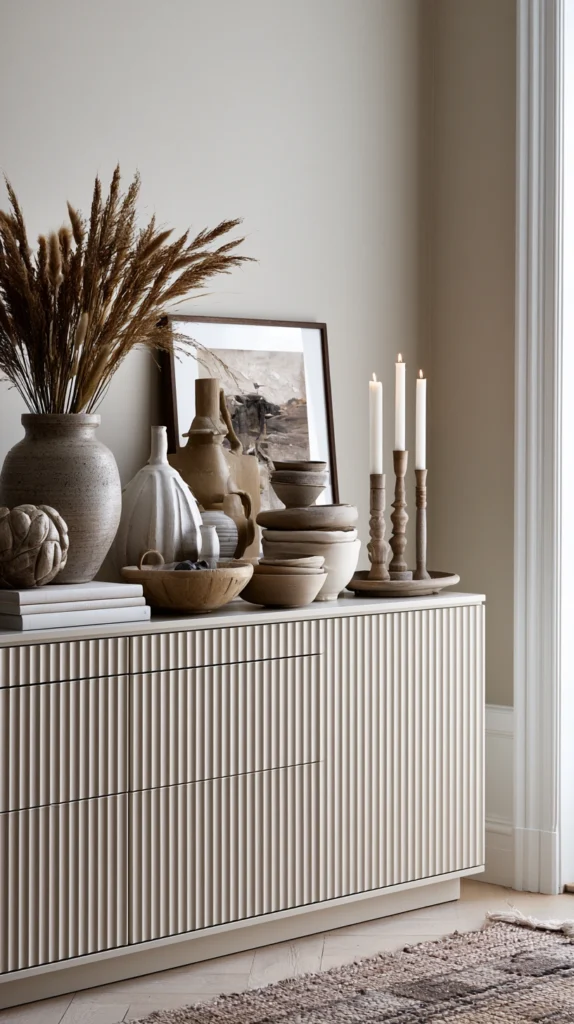
A sideboard or buffet styled with a dense, layered collection of ceramics, candlesticks, and small objects, treating the surface as a curated still life rather than simple storage.
Why the sideboard is an underused maximalist opportunity
Many dining rooms treat the sideboard purely as storage, topped with one plain vase. A densely styled sideboard adds an entire additional layer of color, texture, and height variation to the room.
The base layer
A patterned table runner or a piece of fabric beneath the display, adding one more layer of pattern to the vignette.
The ceramics
A mix of vases, bowls, and vessels in varying heights, finishes, and colors, gathered rather than matched, echoing the room’s broader collected character.
The candlesticks
Brass or ceramic candlesticks in varying heights, clustered rather than placed symmetrically, for visual movement across the surface.
The seasonal layer
Dried grasses, small pumpkins, or autumn branches added among the permanent objects, refreshing the display for the season without replacing the whole arrangement.
The density
Objects placed close enough together to read as a full, rich display, while leaving enough negative space that the eye has somewhere to land.
Cost breakdown: Table runner: $20–40 Ceramics and vessels (assorted, secondhand and new): $50–150 Candlesticks (3–4): $30–70 Seasonal additions: $15–30 Total: $115–290
10. The Patterned Curtain and Tablecloth Layering
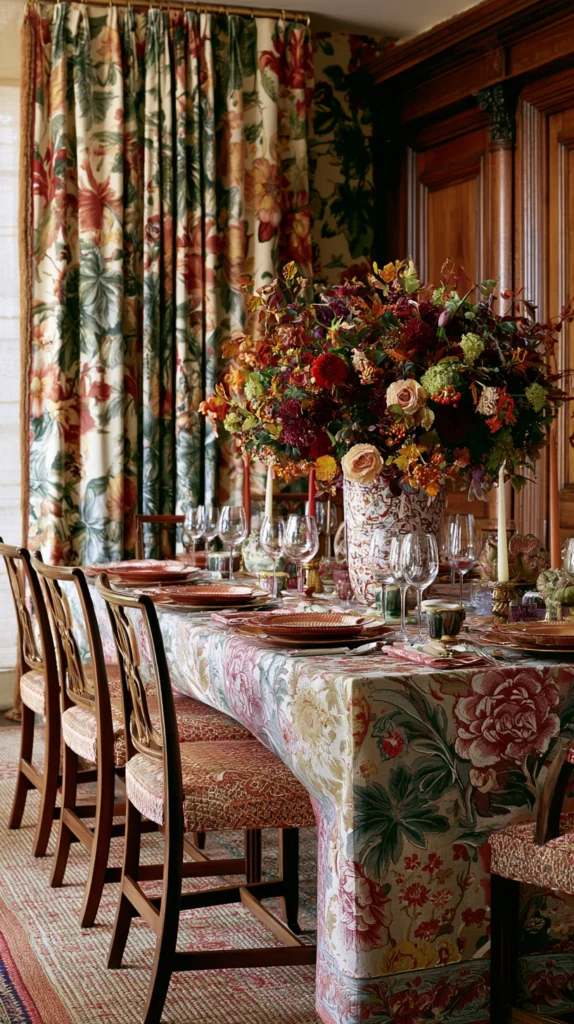
Curtains and a tablecloth in two different but complementary patterns, layering fabric pattern against fabric pattern rather than reserving pattern for the walls alone.
Why fabric-on-fabric pattern is a genuine maximalist technique
Where a more restrained room might use one patterned element and keep everything else solid, maximalism intentionally layers multiple patterns together, trusting a shared color palette to keep the combination cohesive.
The curtains
A botanical or paisley print in the room’s core palette, hung floor to ceiling for maximum visual presence.
The tablecloth
A different but complementary pattern — a stripe, a check, or a smaller-scale floral — sharing at least two colors with the curtain fabric.
The scale relationship
One large-scale pattern paired with one smaller-scale pattern, since two patterns of similar scale can compete rather than layer successfully.
The napkins
A third, simpler pattern or a solid color drawn from the palette, providing a small visual rest amid the two larger patterned fabrics.
The seasonal swap
The tablecloth and napkins changed seasonally, while the curtains — a larger investment — remain constant through the year, allowing some flexibility within the layered approach.
Cost breakdown: Patterned curtains: $60–150 Tablecloth: $30–60 Napkins (set of 6): $20–40 Total: $110–250
11. The Dark Wood Table With a Bold Runner and Place Settings
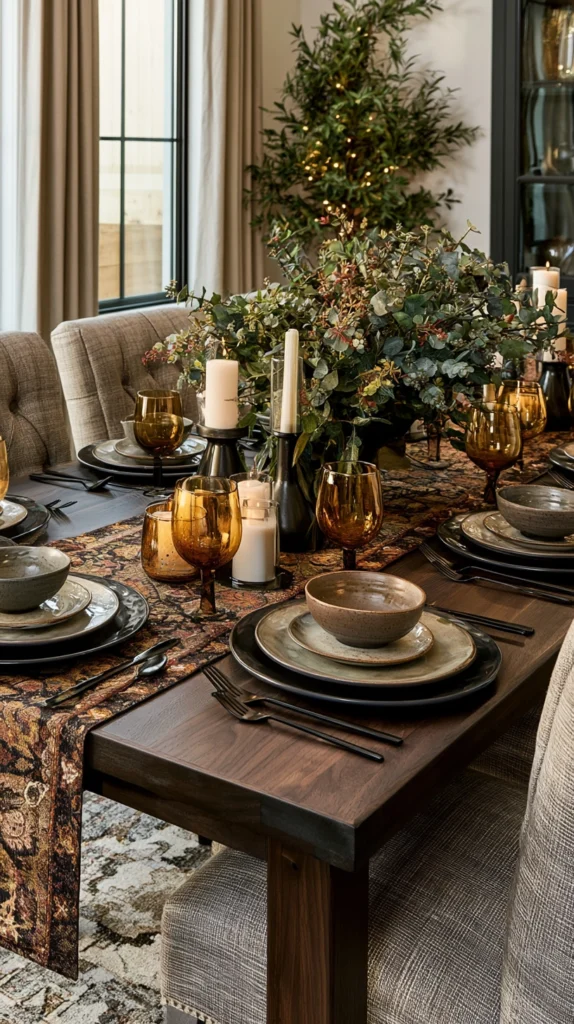
A solid dark wood table styled with a boldly patterned runner and richly colored place settings, turning the set table itself into one of the room’s primary maximalist displays.
Why the table setting deserves the same attention as the walls
A dining room is judged, in large part, by how the table looks when set for a meal. Applying the maximalist approach to place settings, not just the room’s fixed elements, completes the layering rather than stopping short of it.
The table
A dark wood table, ideally with visible grain, providing a rich, neutral base for the more colorful layers placed on top.
The runner
A bold patterned runner running the table’s length, in a fabric or weave that contrasts texturally with the wood beneath it.
The place settings
Mismatched or patterned dinnerware, layered plate upon plate — a base plate, a patterned salad plate, a solid-colored bread plate — building height and pattern into each individual place setting.
The glassware
Colored or vintage glassware, adding another layer of hue at each place setting beyond the plates themselves.
The napkins and rings
Patterned or richly colored napkins, folded and secured with a decorative napkin ring, completing each setting as its own small composition.
Cost breakdown: Table runner: $25–50 Layered dinnerware (place settings for 6–8): $60–180 Napkins and rings: $30–60 Total: $115–290
12. The Botanical Ceiling Treatment
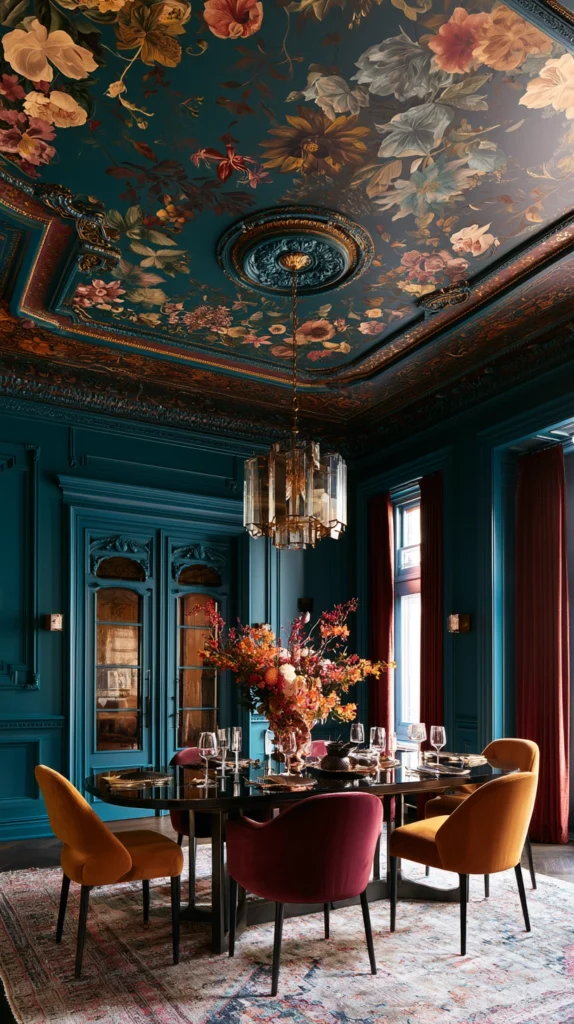
The ceiling itself painted, papered, or stenciled with a pattern or color, extending the room’s maximalist layering to the one surface most rooms leave entirely blank.
Why the ceiling is worth the extra effort here
A patterned or colored ceiling, sometimes called the “fifth wall,” completes a fully enveloped maximalist room in a way that stops just short at the crown molding cannot.
The treatment
Wallpaper matching or complementing the walls applied to the ceiling, or a rich solid color if the walls themselves already carry a pattern.
The application difficulty
Ceiling wallpapering is more physically demanding than wall application — worth hiring out for a large room, or attempting only with adequate help and patience for a smaller one.
The lighting relationship
The chandelier or pendant fixture chosen to complement rather than clash with the ceiling’s new pattern or color, since the two will be viewed together constantly.
The wall relationship
Either a matching pattern for a fully immersive, single-pattern room, or a contrasting solid color for a slightly more structured, two-toned envelope.
The overall effect
A room that surrounds the diner completely, pattern and color present on every surface rather than confined to eye level and below.
Cost breakdown: Ceiling wallpaper or paint: $80–200 Professional installation (if hiring out): $150–400 Total: $80–600 depending on approach
13. The Autumn Foliage and Dried Botanical Centerpiece Layering
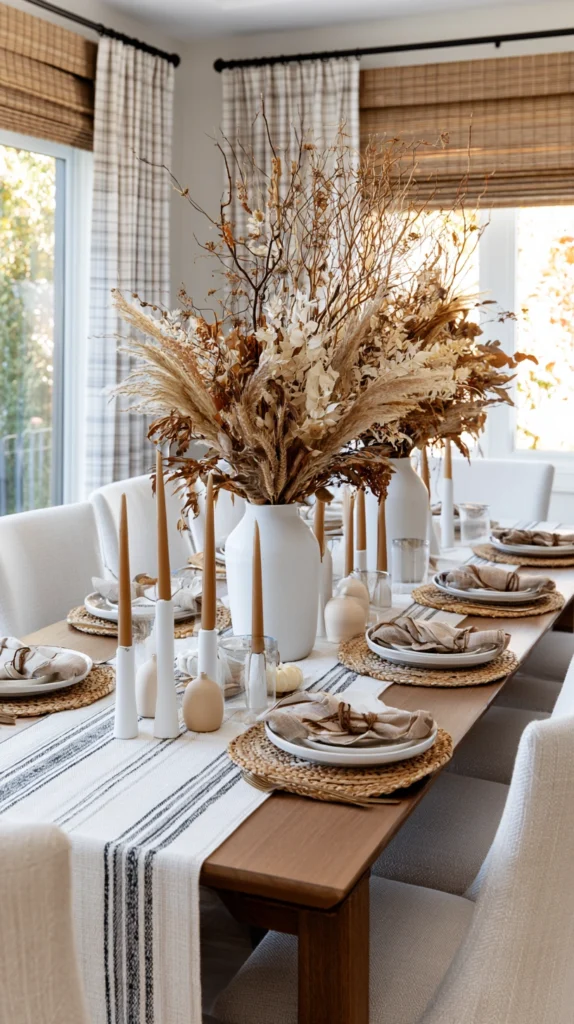
A dense, layered table centerpiece combining fresh or dried autumn foliage, candles at varying heights, and small decorative objects, running the length of the table rather than confined to a single vase.
Why a running centerpiece suits a maximalist table
A single central vase reads as restrained. A centerpiece running the table’s length, built from multiple layered elements, matches the room’s overall philosophy of abundance rather than a single focal object.
The base layer
Dried or fresh autumn branches, magnolia leaves, or eucalyptus, laid loosely along the table’s center rather than confined to a container.
The height variation
Candlesticks of varying heights, interspersed along the greenery, creating visual rhythm rather than a flat, uniform line.
The small objects
Mini pumpkins, pinecones, and a scattering of chestnuts or acorns tucked among the greenery and candles.
The vessels
Two or three small bud vases with single stems, rather than one large arrangement, adding punctuation along the length of the display.
The width consideration
Kept narrow enough down the table’s center that diners can still see and speak across the table comfortably, despite the display’s length and density.
Cost breakdown: Foliage and branches: $15–35 Candlesticks and candles (varying heights): $30–60 Small pumpkins and natural accents: $10–20 Bud vases: $15–30 Total: $70–145
14. The Complete Autumnal Maximalist Dining Room (The Fully Layered Room)
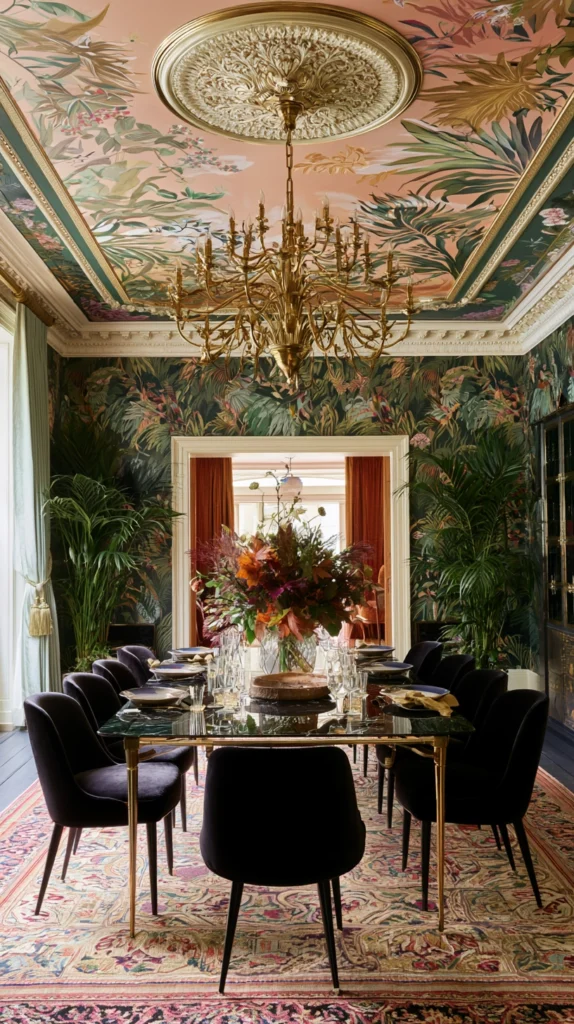
A dining room designed around maximalist layering as the base note of every decision — walls, furniture, lighting, textiles, and styling all working together in a rich, confident autumnal palette.
What separates the complete room from a single bold choice
A single patterned wallpaper wall: a start. A complete maximalist dining room: an immersive layered environment, where every surface and object contributes to a cohesive abundance rather than standing alone.
The elements of the complete autumnal maximalist dining room
The walls
Bold wallpaper, a jewel-toned paint with contrasting trim, or a botanical mural, committed to fully rather than as a single accent.
The ceiling
Painted or papered to complement the walls, completing the room’s full envelope.
The table and chairs
A dark wood table surrounded by a collection of mismatched chairs in varied materials — velvet, rattan, wood — unified by a shared color thread.
The lighting
An oversized, sculptural chandelier, hung low and dimmable, as the room’s central object.
The floor
Two layered rugs, a neutral base beneath a richly patterned top layer.
The walls (secondary)
A dense gallery wall on at least one surface, or a fully styled sideboard, adding a second layer of collected visual interest.
The table setting
Patterned linens, layered dinnerware, and a running centerpiece of foliage and candles, extending the maximalist approach to the table itself.
The complete design in action
A dinner party in late October:
6pm: The chandelier dimmed low, candles lit along the table’s running centerpiece, the wallpaper catching the warm light from every angle.
6:30pm: Guests seated in a genuinely mismatched set of chairs, each one slightly different, the room already feeling like an occasion before the first course arrives.
8pm: Conversation carrying easily across a table layered in pattern, color, and texture, the room doing as much to set the evening’s tone as the meal itself.
The complete autumnal maximalist dining room: not a room that plays it safe and hopes the food carries the evening, but a room built to feel like an event on its own.
Cost breakdown for the complete room: Assuming a starting point of a plain neutral dining room: Wallpaper or paint (walls and ceiling): $200–700 Table (existing or new): $0–800 Mismatched chairs (6–8): $270–750 Statement chandelier: $200–600 Layered rugs: $180–500 Gallery wall or sideboard styling: $130–370 Table linens and dinnerware: $115–290 Centerpiece: $70–145 Total: $1,165–4,155
Phased over two or three seasons:
Season one ($400–900): Bold wallpaper or paint A statement chandelier Table linens refresh
Season two ($400–1,200): Mismatched chair collection Layered rugs A gallery wall or styled sideboard
Season three ($300–2,000): Ceiling treatment Reupholstered velvet and rattan pieces Full centerpiece and place-setting layering
The autumnal maximalist dining room: not a weekend project but a rich, layered room built with intention over time.
The Question Before Any Maximalist Dining Room Design
Before choosing a wallpaper, a chair collection, a color palette:
What is the primary reason for wanting this level of abundance in the room?
If the answer is: full transformation — the wallpaper or color-drenched walls paired with a statement chandelier is the answer.
If the answer is: testing the approach first — the mismatched chair collection or the layered centerpiece.
If the answer is: richness without touching the walls — the layered rugs, textiles, and sideboard styling.
If the answer is: the simplest possible — one bold centerpiece, one layered place setting, one wall reconsidered.
The design follows the level of commitment available. Every maximalist idea on this list serves that same richness at a different scale. The question is which scale is right for this room and this household.
The single bold centerpiece in the right spot: still better than a bare table. The full room, done with intention: a space that turns every dinner into something worth remembering.
That richness: the whole point of the approach.
Getting Started This Weekend
The immediate maximalist solution:
Choose one layer to commit to first — the table, the walls, or the lighting.
Not the whole room. Not the safest choice. The one already closest to being right.
Pull together a mismatched place setting for the next meal.
Different plates, different glasses, a patterned napkin — the smallest possible test of the whole philosophy.
Add height and density to whatever centerpiece already exists.
More candles, more foliage, more small objects — abundance is the point, not restraint.
Light every candle in the room at once for one dinner.
The room will already feel different before anything else has changed.
The rest of the design: the elaboration of this moment.
The layer: the beginning. The maximalist dining room: what grows around it.