
15 Fall Cottagecore Kitchen Ideas With Warm Wood and Dried Botanicals
The dried herb bundle changed how my kitchen felt more than any appliance upgrade ever did. Not the new stand mixer. Not the matching canister set. Not the reorganized pantry or the fresh grout or the polished hardware.
The bundle hanging by the window.
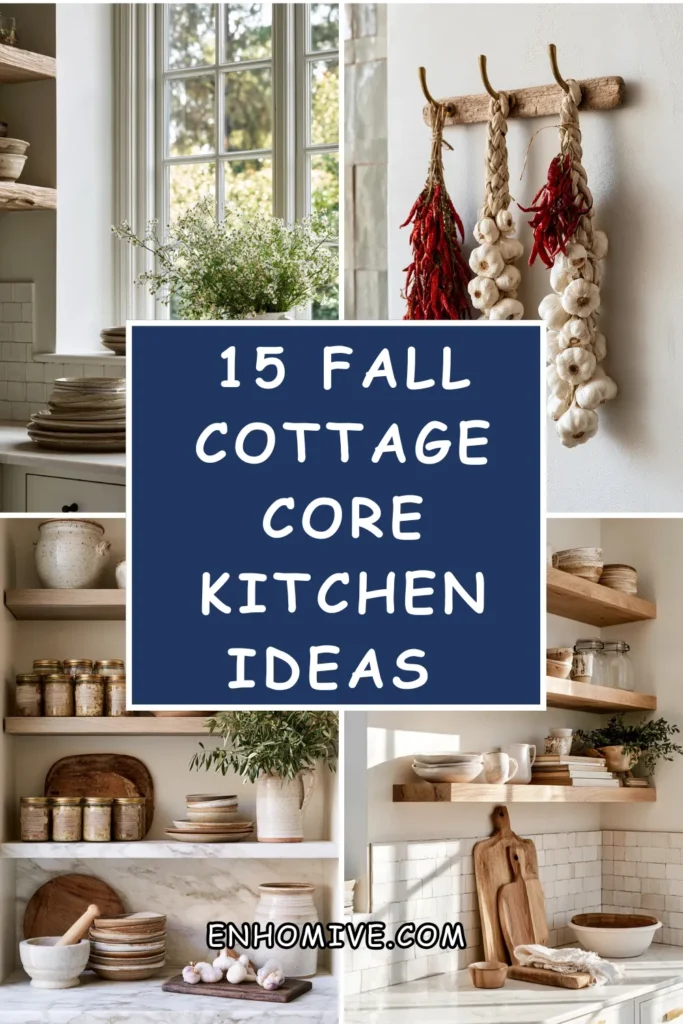
Because something simple and unfussy did what none of the purchased upgrades managed. Before it: a kitchen that looked clean and modern and slightly cold, every surface hard and reflective. After it: a kitchen that felt like it had grown into itself, warm wood and dried lavender doing more for the room’s character than any single new object.
Cottagecore is not a costume for a kitchen. It is a return to materials that age well and objects that were once purely functional — herb bundles, wooden spoons, open shelving — displayed rather than hidden. The kitchen: no longer a showroom, but a room that looks lived in, cooked in, and gathered in.
Here are 15 fall cottagecore kitchen ideas with warm wood and dried botanicals — from the simplest herb bundle to the most fully committed room — built on that understanding.
Why Cottagecore Suits the Fall Kitchen Specifically
The harvest logic
Cottagecore borrows its core imagery from the farmhouse kitchen at harvest time — dried herbs hung to preserve them, root vegetables stored in open baskets, preserves lined up on open shelves. Autumn is the season this aesthetic was always describing.
The warmth equation
Without warm wood and natural materials:
A kitchen in cool white and stainless steel, efficient but visually cold.
The room: functional, but without any sense of season.
With warm wood and dried botanicals:
Open wood shelving, woven baskets, and dried herb bundles introducing warmth and texture that stainless steel and laminate alone cannot.
The room: reading as autumn even before anything is actually cooking.
The preservation principle
Drying herbs, hanging braided garlic, storing squash in open baskets — these are not purely decorative choices. Every visible object in a cottagecore kitchen traces back to an actual preservation or cooking function, which is part of why the look reads as authentic rather than staged.
The imperfection allowance
Unlike many design aesthetics that demand precision, cottagecore embraces visible wear, mismatched pieces, and a slightly overgrown, gathered-rather-than-purchased quality. The kitchen does not need to be new to work; it often works better if it is not.
The Five Ways to Bring In Cottagecore
Before choosing any design:
Open shelving (the full commitment)
Removing upper cabinets in favor of open wood shelves.
The most transformative option and the hardest to reverse.
Puts every dish and jar on permanent display, requiring some curation.
Dried botanicals
Hanging herb bundles, wheat sheaves, and dried flowers throughout the kitchen.
The lowest-cost, most immediately seasonal entry point.
Adds warmth and texture without touching any cabinetry.
Wood and natural materials
Butcher block counters, wood cutting boards, woven baskets.
Concentrates the aesthetic into furniture-scale and countertop-scale objects.
Suits renters and anyone hesitant to renovate.
Vintage and secondhand pieces
A farmhouse table, mismatched chairs, antique crockery.
The most character-driven and often lowest-cost approach.
Builds gradually rather than all at once.
Textiles
Gingham curtains, linen tea towels, a woven table runner.
The softest and most easily changed layer.
Works even in a fully modern kitchen as a seasonal accent.
1. The Open Wood Shelving Wall
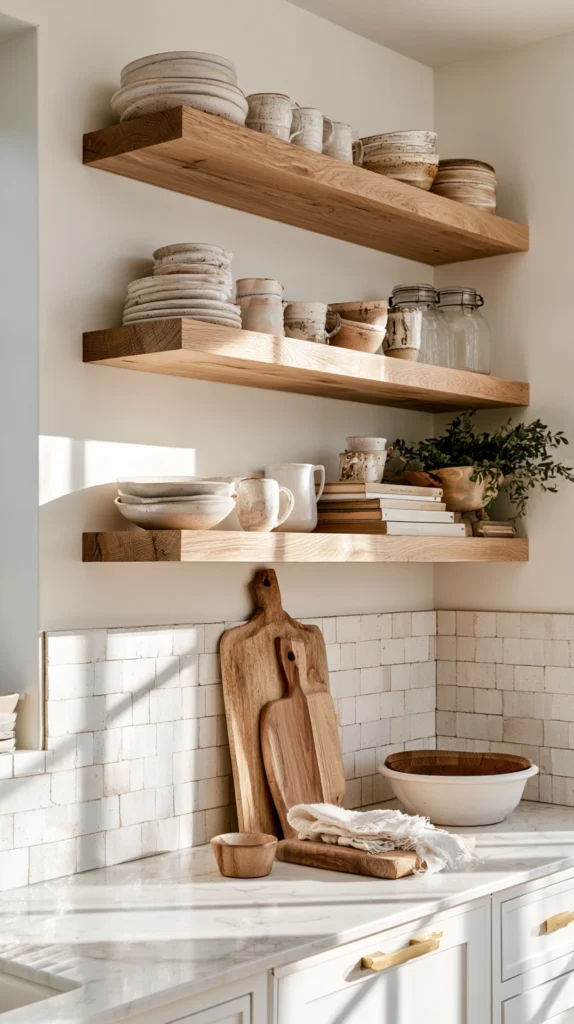
Upper cabinets removed or never installed, replaced with simple wood shelves displaying dishware, jars, and cookbooks openly.
Why open shelving is the aesthetic’s defining move
Cottagecore depends on visible, well-used objects rather than hidden storage. Open shelving is the single change most responsible for that shift, more than any paint color or decorative object.
The shelves
Solid wood boards, either raw and sealed or lightly stained, mounted on simple iron or wood brackets.
The height
Positioned at a comfortable reaching height, with the lowest shelf no higher than typical countertop-adjacent cabinet height for genuine daily use.
The styling
Mismatched ceramic and stoneware, mason jars of dried goods, and a small stack of well-worn cookbooks, arranged with visible variation in height and color rather than uniform matching sets.
The curation
Only the pieces actually used regularly, since open shelving exposes everything to dust and requires more frequent tidying than closed cabinets.
The gaps
A dried herb bundle or a small vase tucked between larger objects, breaking up any section that reads too uniformly.
Cost breakdown: Wood shelving and brackets: $80–200 Styling (jars, ceramics, if needed): $40–100 Total: $120–300
2. The Hanging Dried Herb Bundle Window
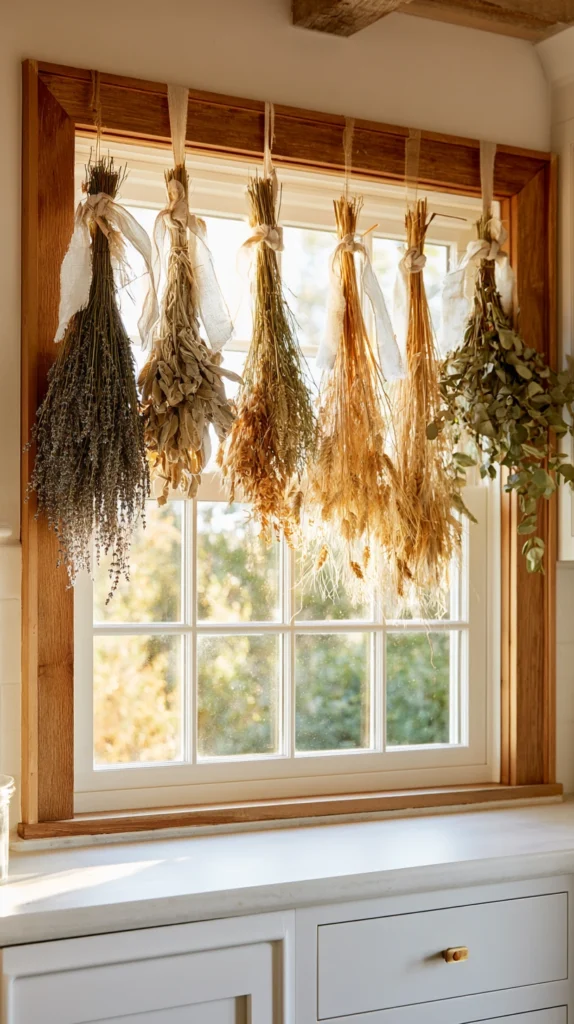
Bundles of drying herbs — lavender, rosemary, sage — hung upside down along a curtain rod or exposed beam near the kitchen window.
Why hanging herbs is the lowest-cost, highest-impact addition
A single bundle costs almost nothing and can often be grown or gathered from an existing garden, yet it introduces both the color and the scent most associated with the aesthetic.
The herbs
Lavender, rosemary, sage, or thyme, tied in small bundles with kitchen twine or a thin ribbon, and hung upside down to dry properly.
The hanging method
A thin rod, a row of small hooks, or simply string strung across the window frame, holding several bundles at slightly varied heights.
The drying time
Two to three weeks for full drying, during which the bundles continue to look attractive while completing the actual preservation process.
The rotation
Older, fully dried bundles moved to a shelf or wall display once complete, making room for a fresh round hung in their place.
The seasonal swap
Wheat sheaves or dried grasses added alongside the herbs specifically for fall, distinguishing the seasonal display from a year-round herb-drying setup.
Cost breakdown: Herb bundles (grown or purchased): $0–15 Twine or ribbon: $3–8 Hooks or rod: $5–15 Total: $8–38
3. The Farmhouse Table Centerpiece
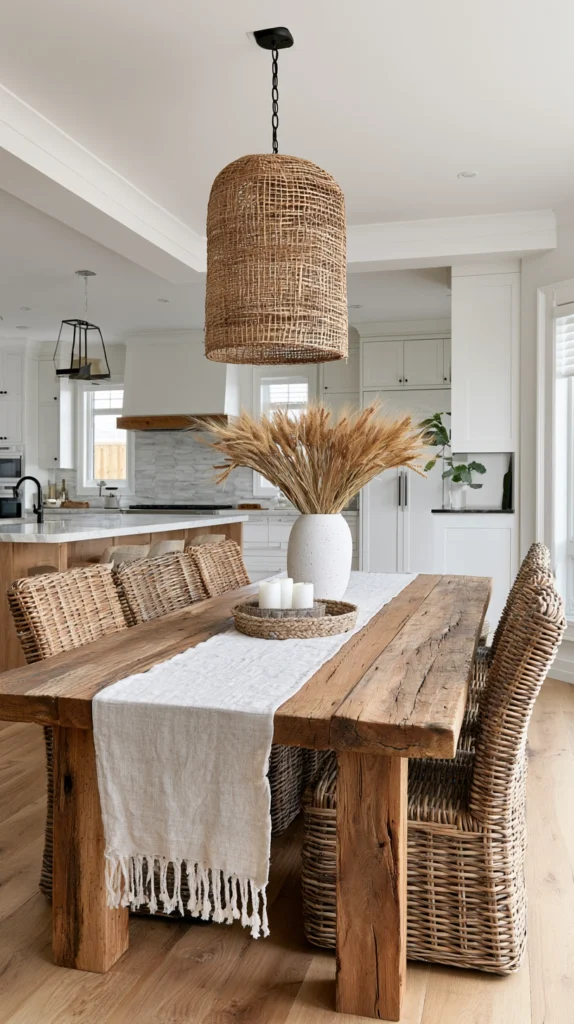
A long wood farmhouse table, or an existing table styled with a runner and seasonal centerpiece, becoming the kitchen’s central gathering point.
Why the table matters as much as any cabinet or counter
In a cottagecore kitchen, the table is where the gathering happens — meals, baking projects, morning coffee — making it worth as much design attention as any surface built into the room.
The table
A solid wood farmhouse table, ideally with visible grain and some age or patina, rather than a glossy or veneered surface.
The runner
A linen or woven cotton table runner in a warm neutral or muted plaid, running the table’s length rather than covering it entirely.
The centerpiece
A low arrangement of dried wheat, pinecones, and small gourds, kept low enough not to block sightlines across the table during meals.
The chairs
Mismatched wood chairs, gathered rather than purchased as a matching set, for the collected-over-time character the aesthetic depends on.
The everyday use
Left set for use rather than styled purely for photographs — a bowl of fruit, a stack of napkins — signaling the table’s real daily function.
Cost breakdown: Farmhouse table (existing or secondhand): $0–400 Table runner: $20–40 Centerpiece materials: $15–30 Total: $35–470
4. The Butcher Block Countertop
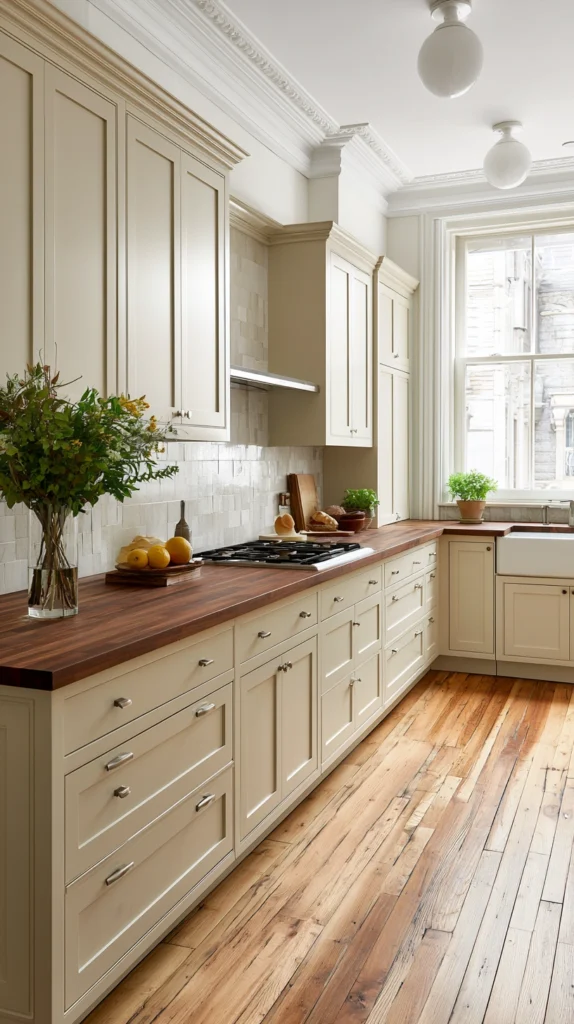
Existing counters replaced or overlaid with a butcher block wood surface, adding warmth exactly where the kitchen’s coldest material — stone or laminate — usually sits.
Why the countertop is worth the investment
Counters cover a significant visual area of any kitchen, and their material more than almost any other single choice determines whether the room reads as warm or clinical.
The material
Solid wood butcher block, in maple, walnut, or oak, sealed with a food-safe finish for durability around food preparation.
The application
A full counter replacement for a larger renovation budget, or a butcher block overlay or a single island top for a smaller, targeted update.
The maintenance
Regular oiling, roughly every one to three months depending on use, keeps the wood sealed against water damage and maintains its appearance over time.
The wear
Knife marks, water rings, and general use marks are expected and generally add rather than detract from the material’s character, unlike a stone or laminate surface where the same wear would read as damage.
The pairing
A farmhouse sink or apron-front sink pairs particularly well visually with a butcher block counter, both leaning into the same traditional kitchen character.
Cost breakdown: Butcher block counter (full replacement): $600–1,800 Or single island overlay: $150–400 Food-safe sealant: $15–30 Total: $165–1,830 depending on scope
5. The Open Basket Produce Storage
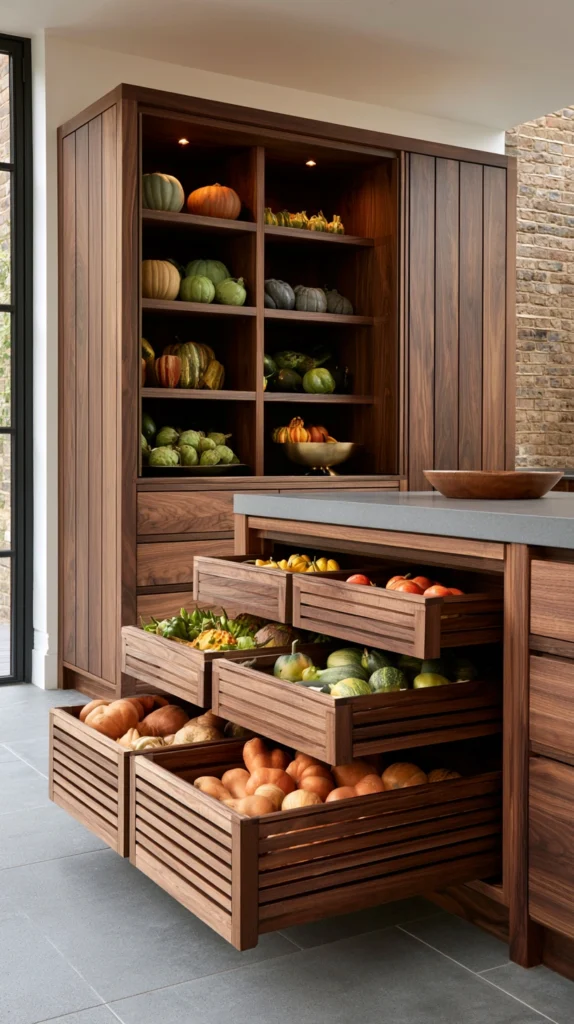
Woven baskets holding onions, garlic, squash, and root vegetables, displayed openly on a counter or in a dedicated corner rather than stored in a pantry out of sight.
Why open produce storage is both functional and decorative
Root vegetables and alliums store best in a cool, ventilated, dark-ish spot rather than a refrigerator, making open basket storage a genuinely correct method rather than a purely aesthetic choice.
The baskets
Woven rattan, wicker, or wire baskets, varied in size to suit different produce, stacked or arranged together on a counter or a dedicated shelf.
The produce selection
Winter squash, onions, garlic, and potatoes — all suited to open, cool storage — rather than produce that actually requires refrigeration.
The placement
Away from direct sun and heat sources, which can hasten spoilage despite the produce being suited to open storage generally.
The rotation
Used in the order stored, with older produce toward the front, functioning as an actual working kitchen system rather than static decor.
The seasonal display
Small pie pumpkins and ornamental gourds mixed in among the edible produce for a fall-specific styling touch, kept visually separate enough to avoid confusion about which pieces are meant for cooking.
Cost breakdown: Woven baskets (2–3): $30–70 Produce: $15–30 (ongoing, as used) Total: $45–100
6. The Braided Garlic and Onion Display
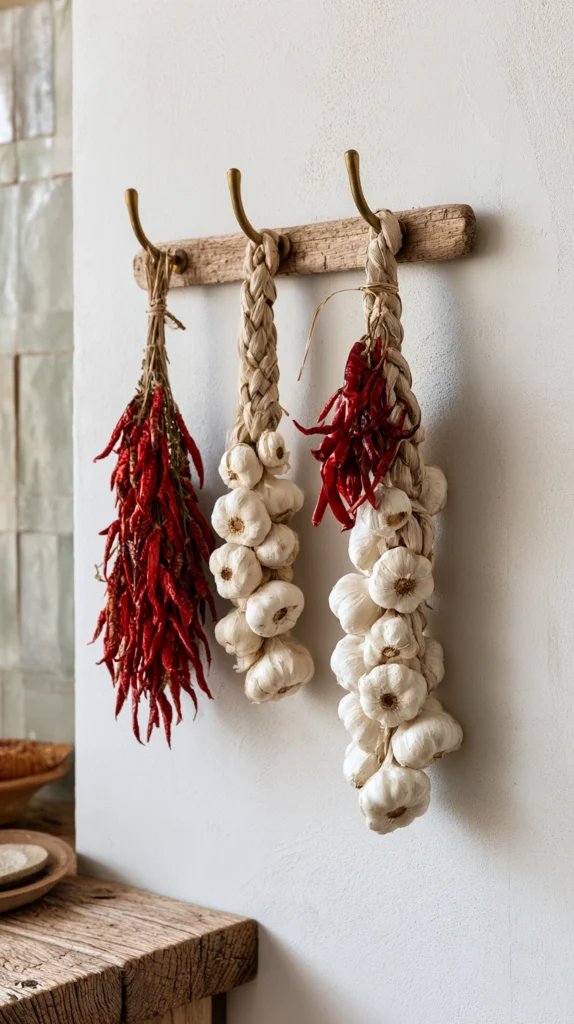
Braided ropes of garlic and onion, a traditional preservation and display method, hung in the kitchen as both functional storage and rustic decor.
Why braiding is a genuinely traditional cottagecore reference point
This is one of the aesthetic’s most historically grounded elements — an actual centuries-old preservation technique, not a decorative invention designed to look old.
The braiding
Garlic or onion braided while the stems are still pliable, using the natural stem material rather than added string or wire where possible.
The hanging location
A cool, dry spot away from direct stove heat, which preserves the braid longer while still keeping it visible and accessible.
The size
A single small braid for a starting effort, since braiding technique takes some practice; a fuller, more dramatic braid as skill and confidence develop.
The complementary bundles
Dried chili pepper ristras hung alongside the garlic and onion braids, adding a second traditional preservation display with a different color and texture.
The practical use
Cloves and bulbs removed from the braid as needed for cooking, keeping the display in active rotation rather than purely decorative and untouched.
Cost breakdown: Garlic and onions (for braiding): $8–20 Chili peppers for ristra (optional): $8–15 Total: $8–35
7. The Vintage Enamelware Collection
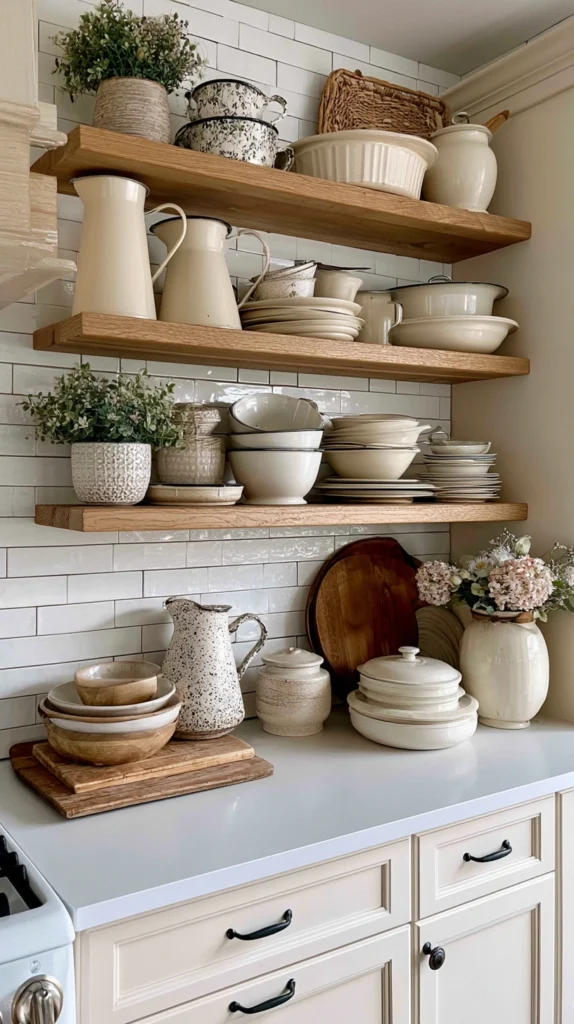
A curated collection of vintage or vintage-style enamelware — pots, pitchers, and bowls in cream, sage, or faded red — displayed on open shelving or hung on the wall.
Why enamelware fits the aesthetic so precisely
Enamelware was, historically, genuine everyday farmhouse kitchenware, giving it the same authentic, function-first origin as dried herbs and open baskets rather than a purely decorative invention.
The sourcing
Thrift stores, flea markets, and estate sales, where mismatched vintage pieces are typically far less expensive than new reproduction enamelware.
The color palette
Cream, sage green, faded red, or light blue, avoiding bright or overly saturated modern enamelware colors that would clash with the room’s warmer palette.
The display
A mix of hung pieces — using the pot’s own handle over a hook — and shelved pieces, rather than every item displayed the same way.
The use
Larger pieces kept in genuine rotation for actual cooking, while smaller or more delicate pieces serve a primarily decorative role.
The wear
Chips and worn spots, common in genuinely vintage enamelware, are part of the material’s appeal here rather than a flaw to seek out replacements for.
Cost breakdown: Vintage enamelware pieces (5–6, thrifted): $20–60 Wall hooks: $5–15 Total: $25–75
8. The Gingham and Linen Textile Layer
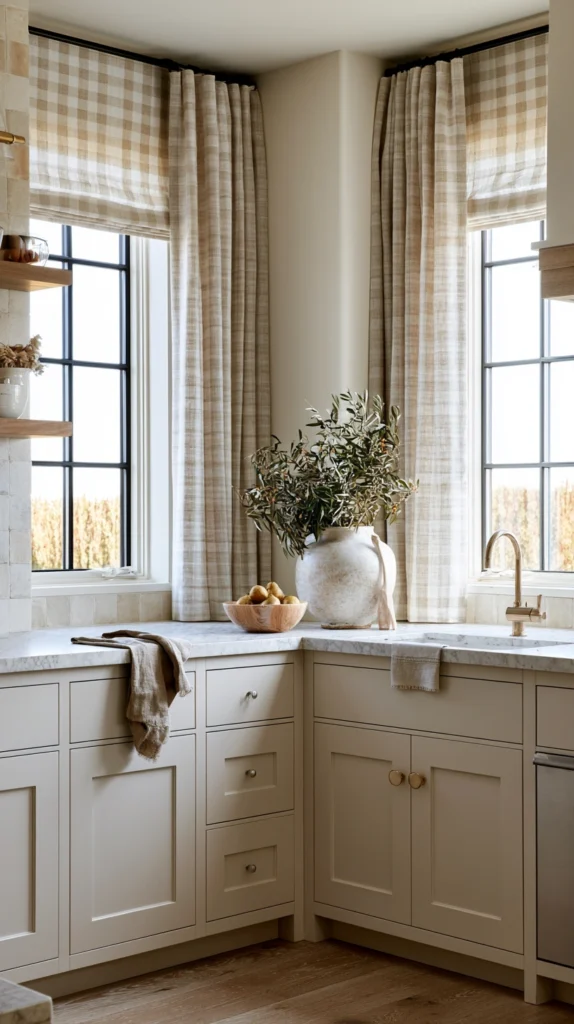
Gingham curtains, linen tea towels, and a woven or checked tablecloth introduced throughout the kitchen, softening hard surfaces with pattern and natural fiber.
Why textiles carry more of the aesthetic than expected
Curtains, towels, and a tablecloth are all inexpensive, easily changed, and collectively cover a meaningful amount of visual surface area, especially in a smaller kitchen.
The curtains
Gingham or small floral print, hung at the window in a warm color — rust, mustard, or sage — rather than the more common blue or classic red-and-white.
The tea towels
Linen or waffle-weave cotton, kept visibly hung on the oven handle or a hook rather than tucked away in a drawer.
The table linens
A checked or woven tablecloth for the farmhouse table, or a simple linen runner if a full tablecloth feels too formal for daily use.
The mixing
Two or three coordinating but not identical patterns, rather than a single matched set throughout, for the gathered-over-time character the aesthetic favors.
The rotation
Textiles swapped seasonally — a heavier plaid or wool-blend option for fall and winter, a lighter cotton for warmer months.
Cost breakdown: Curtains: $30–60 Tea towels (3–4): $20–35 Tablecloth or runner: $20–40 Total: $70–135
9. The Exposed Wood Beam Ceiling Detail
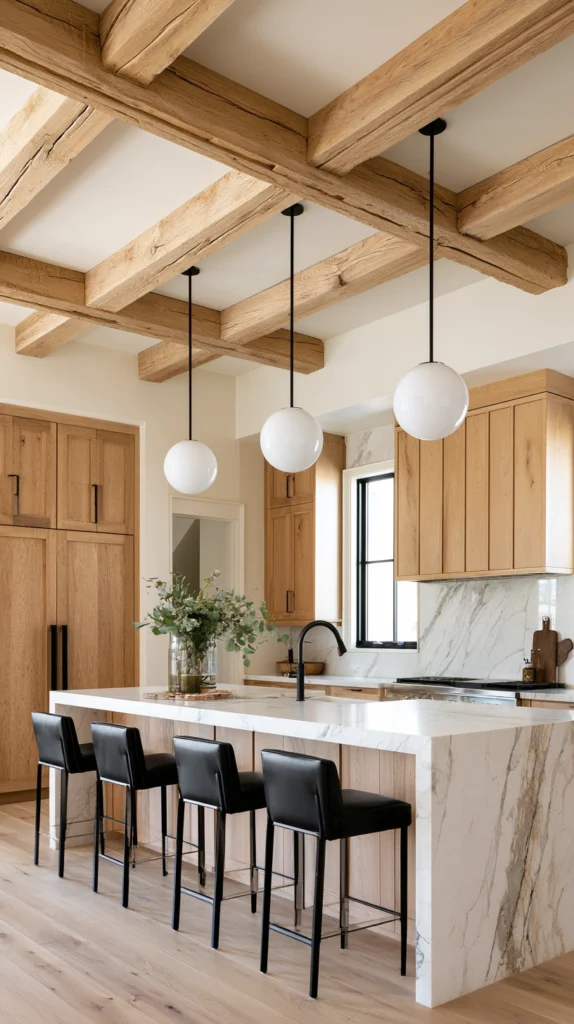
Faux or real wood beams added across the kitchen ceiling, introducing warmth and rustic architectural character overhead.
Why the ceiling is an underused opportunity in most kitchens
Most kitchens leave the ceiling entirely blank, missing an opportunity that a beam treatment fills without consuming any floor or counter space.
The beam material
Real reclaimed wood beams for a more permanent, authentic treatment, or lightweight faux beams (hollow, often polyurethane or thin wood veneer) for a lower-cost and easier installation.
The spacing
Two or three beams spanning the kitchen’s width, spaced evenly rather than clustered to one side, for a balanced overhead effect.
The finish
Left in a natural or lightly stained tone, matching or complementing other wood elements already in the kitchen, such as open shelving or a butcher block counter.
The lighting integration
Pendant lights or small sconces mounted directly to or near the beams, using the architectural detail as a natural hanging point.
The room proportion
Best suited to kitchens with adequate ceiling height, since beams in a already-low room can make the space feel more cramped rather than more characterful.
Cost breakdown: Faux wood beams (3): $150–400 Or reclaimed real wood beams: $300–800 Installation hardware: $30–60 Total: $180–860
10. The Copper Pot Rack Display
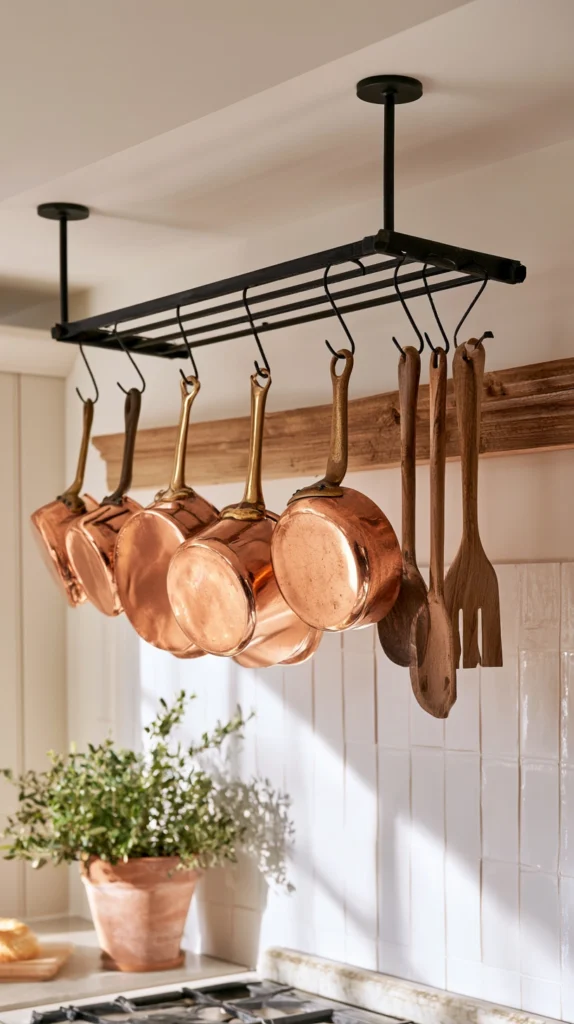
Copper pots and pans hung from a rack or exposed rail above an island or stove, combining genuine kitchen function with warm, reflective color.
Why copper suits the warm-wood palette so well
Copper’s warm tone bridges naturally between the cooler stainless steel of most modern appliances and the warm wood elsewhere in a cottagecore kitchen, tying the two material worlds together.
The rack
A wrought iron or wood-and-metal pot rack, mounted from the ceiling above an island, or a simple rail mounted to the wall above the stove.
The cookware
Copper pots and pans, whether a matched set or gathered individually over time from secondhand sources, hung with the interior facing outward or inward depending on personal preference for showing the cooking surface versus the polished exterior.
The maintenance
Copper develops a natural patina over time, which some households prefer to let develop, while others polish regularly to maintain a bright shine — either approach suits the aesthetic.
The mixed hanging
A few wooden spoons or a small bunch of dried herbs hung alongside the copper pieces, breaking up a purely metal display with warmer, softer texture.
The practical use
Pieces genuinely used for cooking rather than purely decorative, taken down and rehung as part of the kitchen’s actual daily rhythm.
Cost breakdown: Pot rack: $50–150 Copper cookware (secondhand or new): $60–250 Total: $110–400
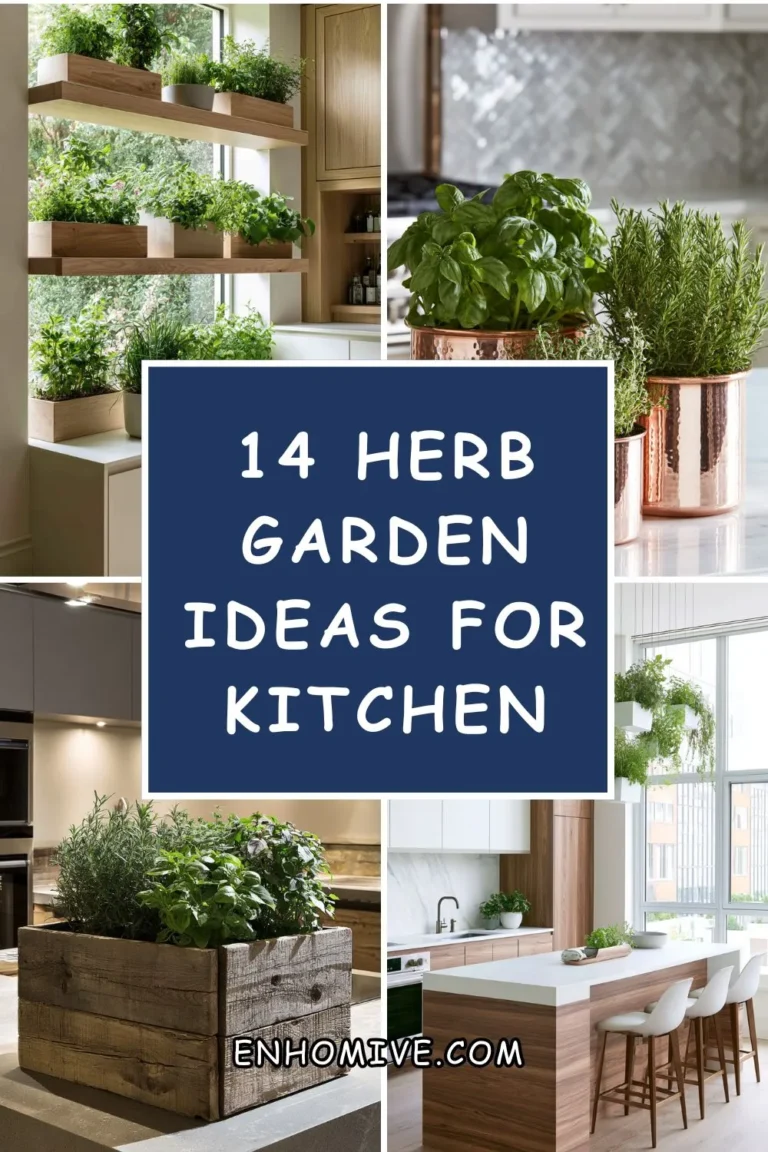
11. The Herb Garden Windowsill
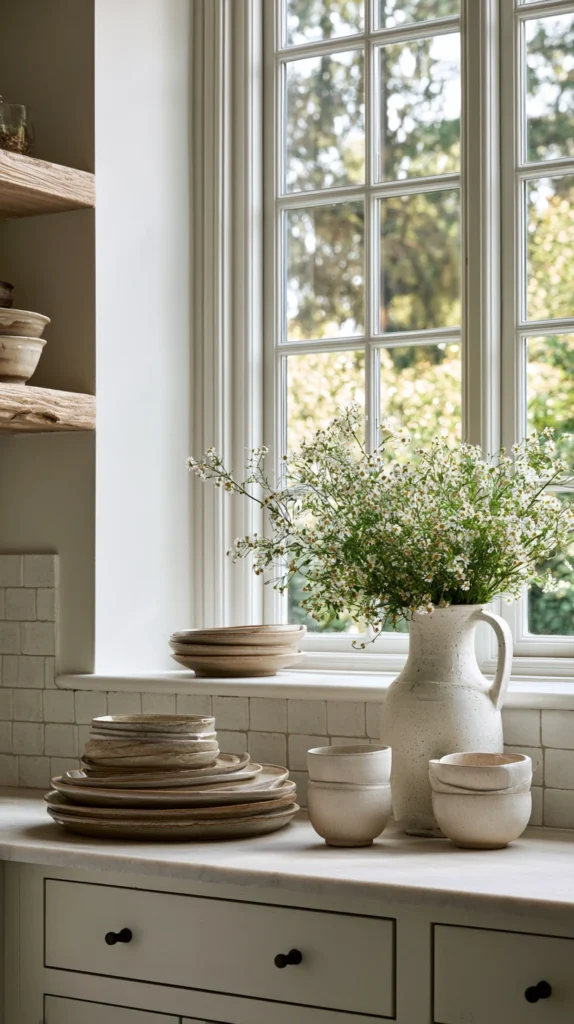
A row of potted culinary herbs growing on the kitchen windowsill, providing both fresh ingredients and a living green element among the room’s warmer, drier textures.
Why fresh herbs balance the dried botanicals elsewhere
A kitchen full of dried herb bundles benefits from at least one living, green counterpoint, and a windowsill herb garden serves that role while also being genuinely useful for cooking.
The pots
Small terracotta pots, matching the room’s warm, earthy material palette better than glazed ceramic or plastic.
The herb selection
Basil, parsley, chives, and thyme, chosen for both culinary usefulness and their compact size suited to a windowsill.
The placement
The sunniest available window, ideally south- or west-facing, rotated occasionally so growth remains even.
The connection to the dried displays
Herbs harvested and hung to dry once a plant is thinned or nearing the end of its productive life, creating a natural cycle between the living windowsill garden and the dried bundles elsewhere in the kitchen.
The labeling
Small wood or chalkboard tags on each pot, adding a modest decorative touch while keeping the herbs easily identifiable.
Cost breakdown: Terracotta pots (4–5): $15–30 Herb starts: $15–30 Total: $30–60
12. The Antique Scale and Kitchen Tool Display
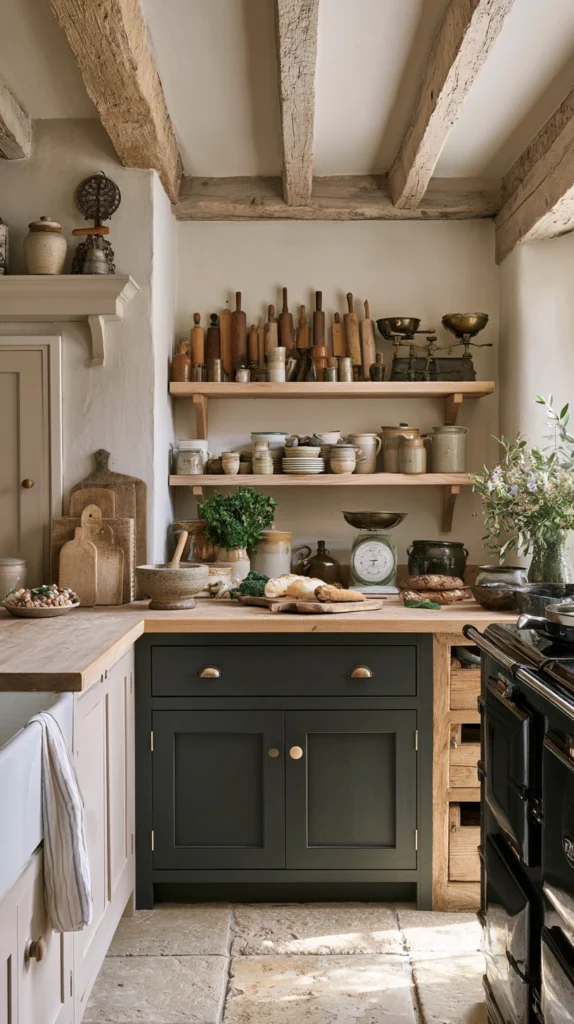
A vintage kitchen scale, wooden rolling pin, and other antique cooking tools displayed on open shelving or a counter, treating old functional objects as decor.
Why old tools read more authentically than new decorative objects
A genuinely old scale or rolling pin carries real history and wear that a new reproduction cannot replicate, and this kind of object is precisely what defines the aesthetic’s difference from a merely rustic-looking new kitchen.
The scale
A vintage balance or spring kitchen scale, sourced from an antique shop, flea market, or estate sale, displayed on open shelving or a counter corner.
The rolling pin and wooden tools
Wooden spoons, a rolling pin, and a wood cutting board, gathered rather than matched, showing genuine and varied wear.
The display method
Grouped together on one shelf or counter section, rather than scattered individually throughout the kitchen, so the collection reads as an intentional vignette.
The functional use
Tools genuinely usable, and occasionally used, rather than purely ornamental — a working scale for baking, a rolling pin for pastry.
The sourcing
Estate sales and antique markets typically offer these pieces at a fraction of new decorative reproduction cost, and with more authentic wear.
Cost breakdown: Vintage scale: $15–50 Wooden tools (assorted, secondhand): $10–30 Total: $25–80
13. The Pressed Flower and Botanical Wall Art
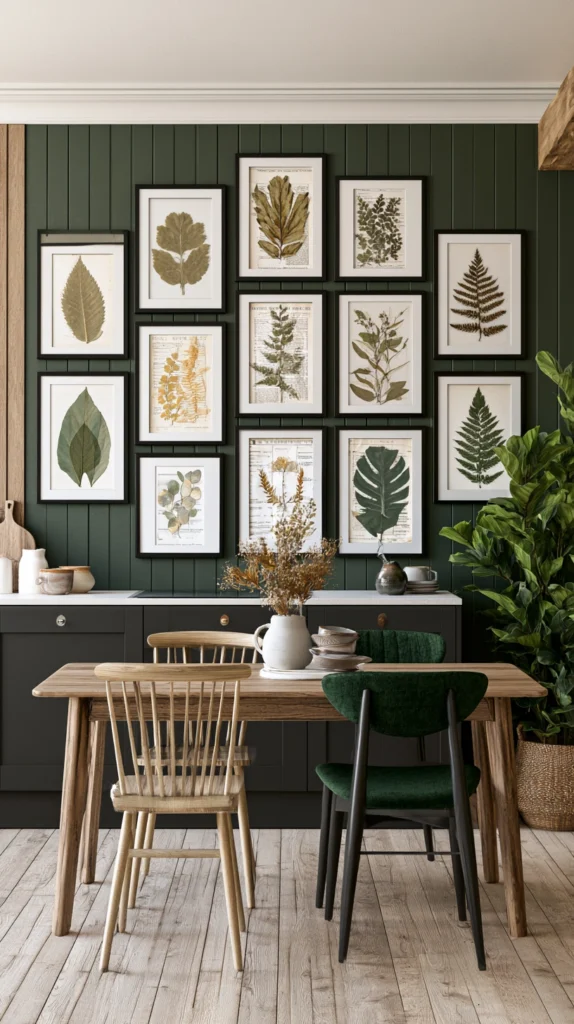
Framed pressed flowers, dried leaves, or botanical prints hung on the kitchen wall, adding a gentler, more delicate layer of nature alongside the sturdier dried herb bundles.
Why pressed botanicals add a different texture than hanging herbs
Hanging bundles are bold and dimensional; pressed and framed botanicals are flat, quiet, and detailed, giving the wall a different kind of natural interest than the more dominant hanging displays.
The pressing
Flowers or leaves pressed for one to two weeks between heavy books before framing, using material gathered from a garden or a fall walk.
The framing
Simple wood or thin brass frames, kept small to medium in scale so a small collection can be grouped together without overwhelming the wall.
The arrangement
A cluster of three to five small frames, rather than one large piece, echoing the same collected, gathered-over-time quality found elsewhere in the room.
The seasonal rotation
Fall-specific botanicals — maple leaves, dried wildflowers, wheat stalks — swapped in seasonally if the framing allows for easy content changes.
The placement
A wall near the dining table or a section of open shelving, rather than directly above the stove where cooking steam and heat could affect the delicate pressed material over time.
Cost breakdown: Small frames (3–5): $20–50 Materials for pressing (often free, gathered): $0–10 Total: $20–60
14. The Ceramic Crock and Preserve Jar Shelf
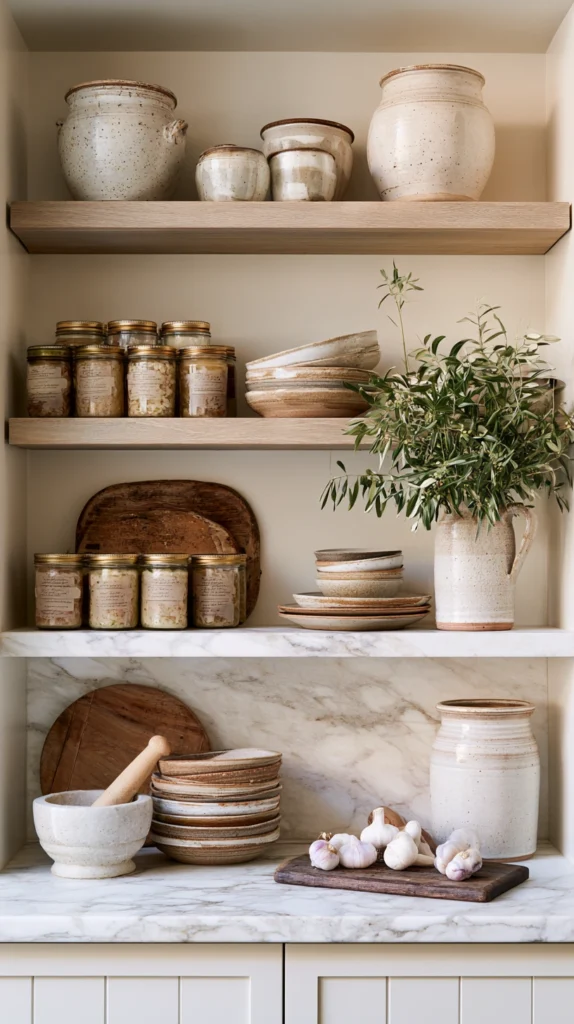
Open shelving or counter space dedicated to ceramic crocks, mason jars of preserves, and pickled vegetables, displaying the kitchen’s actual food preservation work.
Why displaying preserves is the most functionally authentic choice on this list
Unlike purely decorative jars, a shelf of genuine home-canned preserves ties the aesthetic directly to real seasonal cooking and food preservation, the activity the whole look ultimately references.
The jars
Mason jars filled with actual preserves — jam, pickles, or canned tomatoes — labeled by hand with the contents and date.
The crocks
Ceramic fermentation or storage crocks, used for items like sauerkraut or pickles, or simply displayed as vessels even when not actively in use.
The shelf arrangement
Grouped by type or color, with labels facing outward, creating a visual pantry display rather than a hidden one.
The rotation
Jars used in the order preserved, with the shelf restocked seasonally as new batches are made, keeping the display connected to real kitchen activity rather than static.
The lighting
Natural or warm lamp light catching the jars’ color from the side, since preserves — the deep red of tomato sauce, the amber of pickles — are part of what makes this display visually rich.
Cost breakdown: Mason jars (assorted, if not already owned): $15–30 Ceramic crocks: $20–60 Canning ingredients (ongoing): varies Total: $35–90 (excluding ongoing ingredient cost)
15. The Complete Fall Cottagecore Kitchen (The Fully Committed Room)
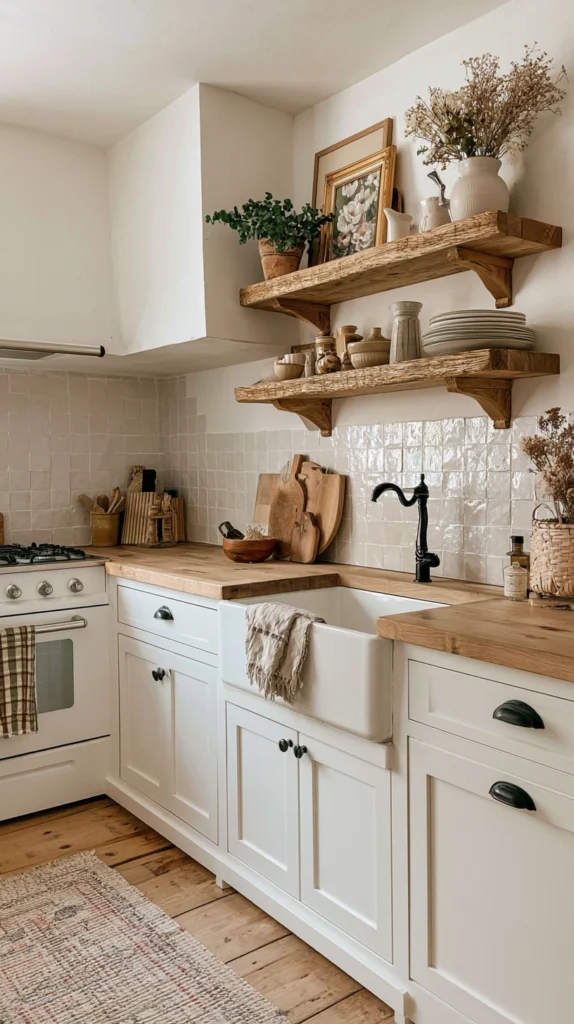
A kitchen designed around cottagecore as the base note of every decision — open shelving, wood surfaces, dried botanicals, and vintage objects all working together as a single warm, gathered room.
What separates the complete kitchen from a single herb bundle
A single dried herb bundle: an accent. A complete cottagecore kitchen: an atmosphere. The difference is whether every other choice in the room was made in response to the aesthetic, or made separately from it.
The elements of the complete fall cottagecore kitchen
The storage
Open wood shelving in place of at least some upper cabinets, displaying mismatched but coordinated dishware.
The surfaces
A butcher block counter or island top, warming at least one significant surface in the room.
The botanicals
Hanging dried herb bundles, a braided garlic or onion display, and a living herb garden on the windowsill, balancing dried and fresh greenery.
The gathering point
A farmhouse table or a well-styled existing table, dressed with linens and a seasonal centerpiece.
The vintage layer
At least a few genuinely old objects — enamelware, a scale, wooden tools — sourced secondhand rather than purchased new.
The textiles
Gingham or checked curtains and linen tea towels, softening the kitchen’s hard surfaces.
The preserves
A shelf of actual home-preserved jars, connecting the room’s look to genuine seasonal cooking.
The complete design in action
A Sunday afternoon in October:
11am: Squash and onions cooling on the open shelf, already part of that week’s cooking rather than purely decorative.
11:30am: A fresh bundle of sage hung by the window to dry, replacing one taken down and used the week before.
Noon: The farmhouse table set for lunch, a small pumpkin and a jar of the season’s first preserves at its center.
1pm: The kitchen smelling of drying herbs and whatever is simmering on the stove, the room doing exactly what it was built to do.
The complete fall cottagecore kitchen: not a kitchen styled to look like cooking happens there, but a kitchen where cooking genuinely shapes how the room looks.
Cost breakdown for the complete room: Assuming a starting point of a plain modern kitchen: Open shelving: $120–300 Butcher block counter or overlay: $150–1,800 Dried botanicals and hanging displays: $50–100 Farmhouse table styling (existing table): $35–70 Vintage objects (enamelware, tools, scale): $50–150 Textiles (curtains, towels, linens): $70–135 Preserve jars and crocks: $35–90 Total: $510–2,645
Phased over two or three seasons:
Season one ($150–350): Dried herb bundles and windowsill herbs Textile swap (curtains, towels) Farmhouse table styling
Season two ($200–500): Open shelving Vintage object collecting A pot rack or wall-hung tools
Season three ($200–1,900): Butcher block counter Ceiling beam detail if desired Full preserve shelf and ceramic crock display
The fall cottagecore kitchen: not a weekend project but a warm, gathered room built with intention over time.
The Question Before Any Cottagecore Kitchen Design
Before choosing a shelf, a textile, a vintage object:
What is the primary reason for wanting this feeling in the kitchen?
If the answer is: full transformation — the open shelving paired with a butcher block counter is the answer.
If the answer is: testing the aesthetic first — the dried herb bundles or the farmhouse table styling.
If the answer is: warmth without any renovation — the textiles and the vintage object collection.
If the answer is: the simplest possible — one herb bundle, one basket of produce, one corner of the kitchen reconsidered.
The design follows the level of commitment available. Every cottagecore idea on this list serves that same warmth at a different scale. The question is which scale is right for this kitchen and this household.
The single dried herb bundle in the right spot: still better than no warmth at all. The full kitchen, done with intention: a room that looks and feels like real cooking happens in it, every season.
That warmth: the whole point of the aesthetic.
Getting Started This Weekend
The immediate fall cottagecore solution:
Tie one bundle of herbs and hang it by the window.
Not a full renovation. Not a shopping trip. Whatever is already growing or already in the fridge, tied and hung today.
Move one collection of dishware onto open display.
A single shelf, not a full cabinet removal — just enough to start the shift from hidden to shown.
Set the table with linen instead of nothing.
A simple runner or a stack of cloth napkins, already changing how the table reads.
Add one basket of produce to the counter.
The rest of the design: the elaboration of this moment.
The bundle: the beginning. The cottagecore kitchen: what grows and gets gathered around it.