
15 Fall Fire Pit Entertaining Ideas With Cozy Seating Arrangements
The seating arrangement changed how people actually used my fire pit more than the fire pit itself ever did. Not the upgraded fire bowl. Not the better firewood. Not the string lights or the extra blankets or the fancier drinks menu.
The circle.
Because how the chairs were arranged did something the fire alone never managed. Before it: a fire pit with whatever chairs happened to be nearby, pulled up at whatever angle seemed convenient, guests drifting off after twenty minutes because nobody was quite facing anybody else. After it: a seating arrangement built specifically for conversation, and people staying two, three hours past when they meant to leave.
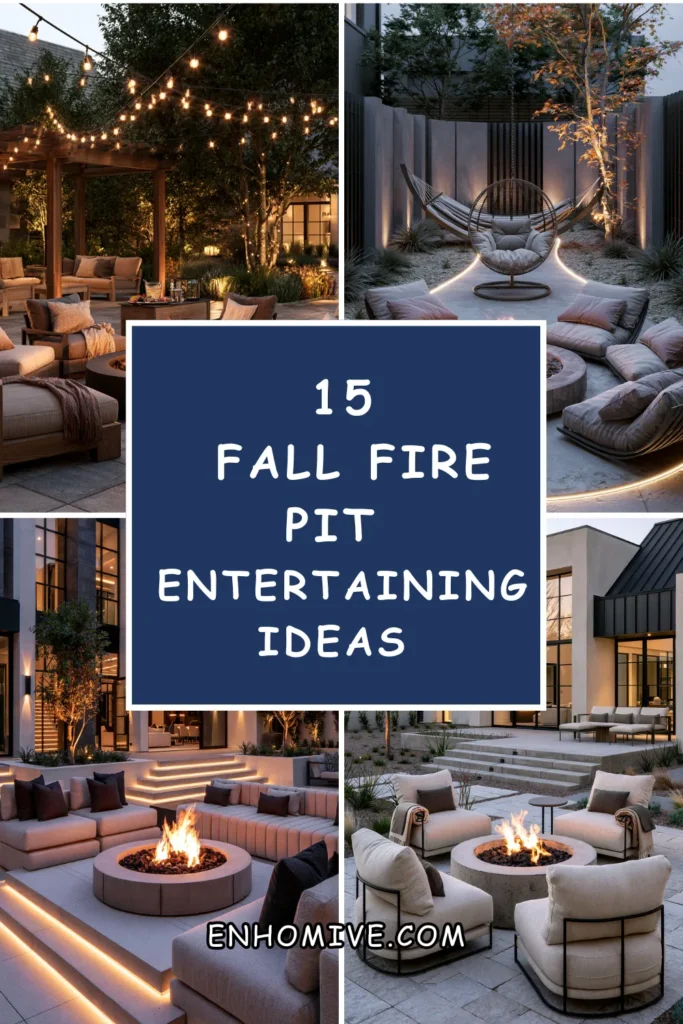
Fire pit entertaining is not just about having a fire. It is a hosting decision, and the seating does more of that hosting work than the fire itself. A fire with the wrong seating is a nice view. A fire with the right seating is an evening people remember. The gathering: no longer accidental, but built.
Here are 15 fall fire pit entertaining ideas with cozy seating arrangements — from the simplest circle of chairs to the most fully hosted evening — built on that understanding.
Why the Seating Arrangement Matters as Much as the Fire
The conversation geometry
Without a considered arrangement:
Chairs scattered or lined up facing the fire in a row, everyone looking at the flame rather than at each other.
The gathering: warm, but strangely quiet, conversation limited to whoever happens to be seated adjacent.
With a considered arrangement:
Seating angled inward, toward each other as much as toward the fire itself.
The gathering: the fire becomes the shared center of a conversation rather than the sole point of focus.
The distance principle
Seating positioned 3 to 4 feet from the fire’s edge balances warmth with comfort — close enough to feel the heat, far enough that nobody is shifting away from an uncomfortable blast partway through the evening.
The capacity honesty
A fire pit comfortably seats far fewer people than most hosts initially plan for. Six to eight is the realistic conversational maximum around a single fire circle; beyond that, conversation splits into separate smaller groups regardless of the seating arrangement.
The layered comfort case
Seating alone is not enough — blankets, cushions, and a nearby heat or light source beyond the fire itself extend how long guests actually stay comfortable, particularly as the evening cools further after 9pm.
The Five Seating Arrangement Types
Before choosing any design:
The full circle
Chairs arranged in a complete ring around the fire.
The most democratic arrangement, giving every seat equal access to warmth and conversation.
Suits a smaller, intimate gathering of four to six.
The horseshoe
An open arc of seating, leaving one side of the fire clear.
Allows a serving table or a clear sightline to a view, a door, or an activity.
The most flexible arrangement for a working host who needs to move in and out of the circle.
The paired clusters
Two or three smaller seating groupings near, but not directly around, the fire.
Suits a larger gathering where several smaller conversations happen at once.
Reduces the pressure of one single large conversation circle.
The built-in bench ring
A permanent low wall or bench circling the fire pit itself.
The most architecturally integrated option.
Requires the most upfront construction investment.
The mixed-height layout
A combination of low chairs, a bench, and floor cushions at varying heights around the same fire.
Adds visual interest and accommodates different comfort preferences within one gathering.
Suits a more casual, come-and-go style of evening.
1. The Classic Four-Chair Circle
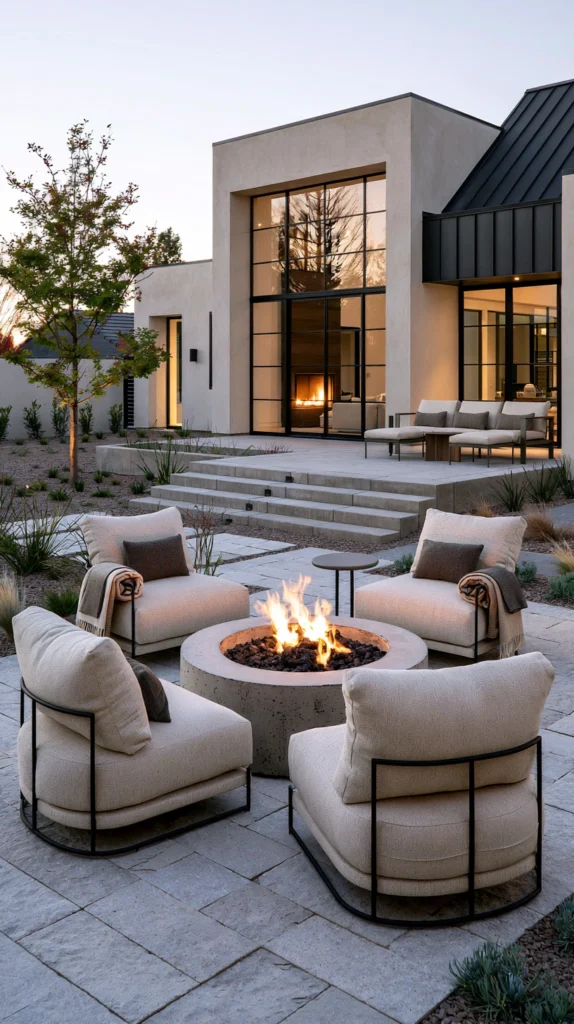
Four deep, comfortable chairs arranged in a complete circle around the fire, spaced evenly for the simplest and most universally workable entertaining setup.
Why four chairs is the ideal starting scale
A circle of four allows genuine group conversation, with every person able to see and speak to every other person without straining, a balance that starts to break down once a circle grows much larger.
The chairs
Deep, low-backed outdoor chairs, cushioned for extended sitting, rather than upright dining-style chairs better suited to a table.
The spacing
Evenly spaced around the fire’s circumference, each chair angled slightly inward rather than pointed directly at the flame, encouraging eye contact across the circle.
The distance
3 to 4 feet from the fire’s edge, adjustable slightly based on the specific fire feature’s heat output and the evening’s temperature.
The small table
A single small table positioned between two of the chairs, within reach of the whole circle, for shared snacks or drinks rather than one table per person.
The blanket basket
A basket or box of folded blankets beside the circle, available without needing to ask or search, lowering the friction for any guest who gets chilly as the evening progresses.
Cost breakdown: Four outdoor chairs (existing or new): $0–800 Small side table: $30–80 Blankets (4): $60–100 Total: $90–980
2. The Horseshoe With a Drinks Station
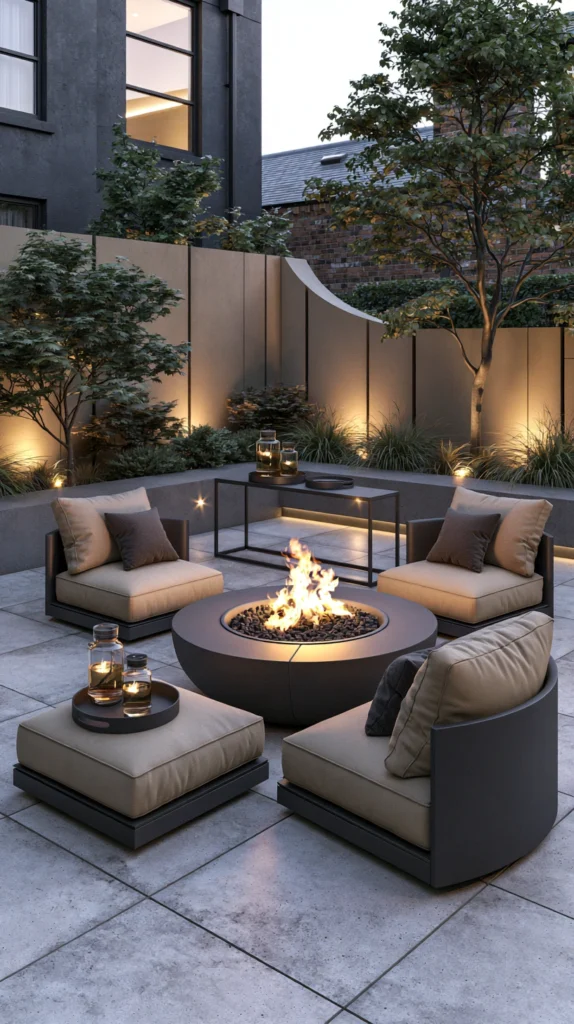
An open horseshoe arrangement of seating, leaving one side of the fire clear for a small drinks or snack station, keeping the host’s movement in and out of the circle unobstructed.
Why an open side matters for a hosting evening
A full circle looks ideal in photos but can trap a host awkwardly between chairs every time they need to refill a drink or check on food. An open horseshoe solves that practical problem directly.
The seating
An arc of chairs covering roughly two-thirds of the fire’s circumference, leaving the remaining third open and clear.
The drinks station
A small bar cart, a folding table, or a simple tray station positioned in the open gap, stocked with drinks, glasses, and a bucket of ice.
The self-serve setup
Guests able to reach the station without stepping fully out of the seating arrangement, keeping the evening’s flow uninterrupted by repeated trips back to the house.
The gap width
Wide enough for one or two people to comfortably stand and serve themselves, without being so wide that it visually breaks the sense of a unified gathering.
The host’s seat
Positioned nearest the open gap, allowing the host to step in and out for hosting duties without disturbing the rest of the circle.
Cost breakdown: Seating for horseshoe (5–6 chairs): $150–600 Small drinks table or cart: $40–150 Total: $190–750
3. The Paired Loveseat Clusters
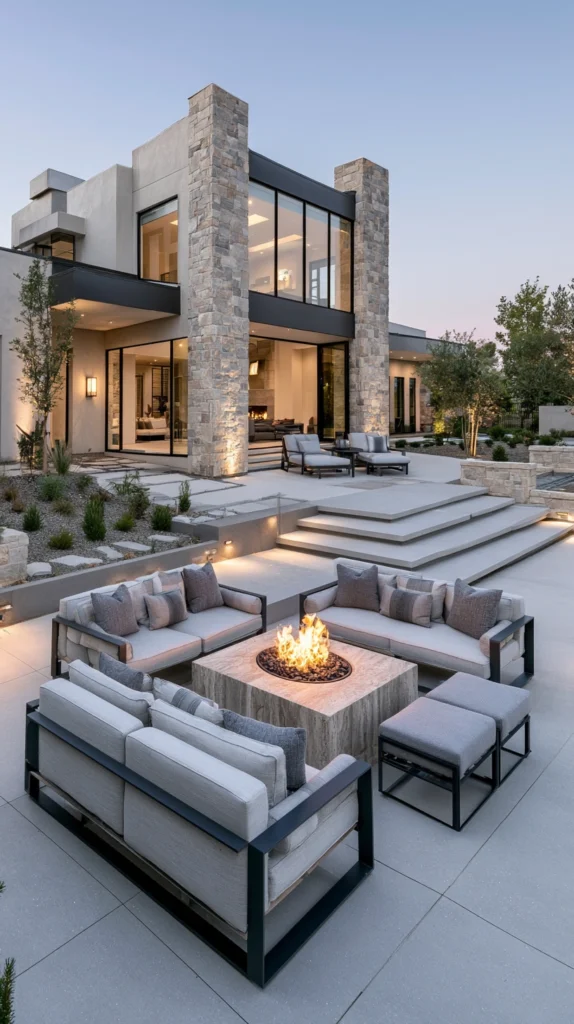
Two outdoor loveseats or small sofas, angled toward each other at a slight offset from the fire itself, creating a more intimate, conversation-focused arrangement than a full circle of individual chairs.
Why loveseats change the conversational dynamic
Shared seating naturally encourages a different kind of closeness than individual chairs — couples or close friends seated together, angled toward the fire and each other simultaneously.
The loveseats
Two matching or complementary outdoor loveseats, positioned at roughly a 90-to-120-degree angle to each other rather than directly opposite, both facing generally toward the fire.
The cushioning
Deep, generously cushioned seating, since a loveseat arrangement depends on genuine comfort to encourage the lingering, settled-in quality this layout is built for.
The connecting table
A small table positioned in the angle between the two loveseats, shared by both, rather than a separate table for each.
The additional single chairs
One or two single chairs added to fill out the arrangement for a larger group, positioned to complete rather than compete with the two-loveseat anchor.
The scale suitability
Particularly well suited to a smaller gathering of four to six people, or as the anchor seating within a larger paired-cluster layout for bigger groups.
Cost breakdown: Outdoor loveseats (2): $400–1,200 Connecting side table: $40–90 Total: $440–1,290
4. The Built-In Stone Seat Wall
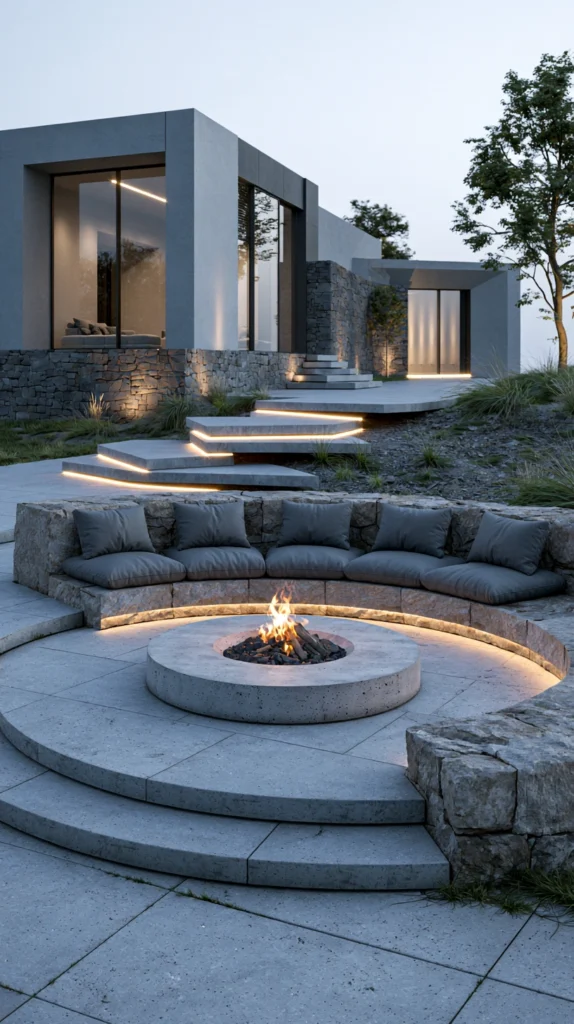
A low, permanent stone or brick wall encircling the fire pit, doubling as both the fire’s structural surround and the primary seating for gatherings.
Why a built-in wall solves the furniture question permanently
No chairs to arrange, store, or weatherproof — the seating is simply always there, ready for any size gathering the wall’s total length can accommodate.
The construction
A dry-stack or mortared stone or brick wall, roughly 18 inches high and 12 to 16 inches wide, built in a full or partial circle around the fire.
The cushioning
Weather-resistant cushions, stored in a nearby deck box and brought out for use, softening the stone or brick surface for genuinely comfortable extended sitting.
The capacity
A wall with a 12 to 15 foot total diameter typically seats 8 to 10 people comfortably, more than most furniture-based arrangements accommodate in the same footprint.
The permanence
A genuine landscaping investment rather than a furniture purchase, suited to a household planning to entertain around the fire regularly and for years rather than occasionally.
The backrest consideration
No built-in backrest on most stone seat walls — cushions with their own back support, or blankets rolled and positioned behind the lower back, address this comfort gap.
Cost breakdown: Stone or brick seat wall (DIY): $300–600 Or professional construction: $1,000–2,500 Cushions for seating: $150–300 Total: $450–2,800
5. The Floor Cushion and Low Table Layout
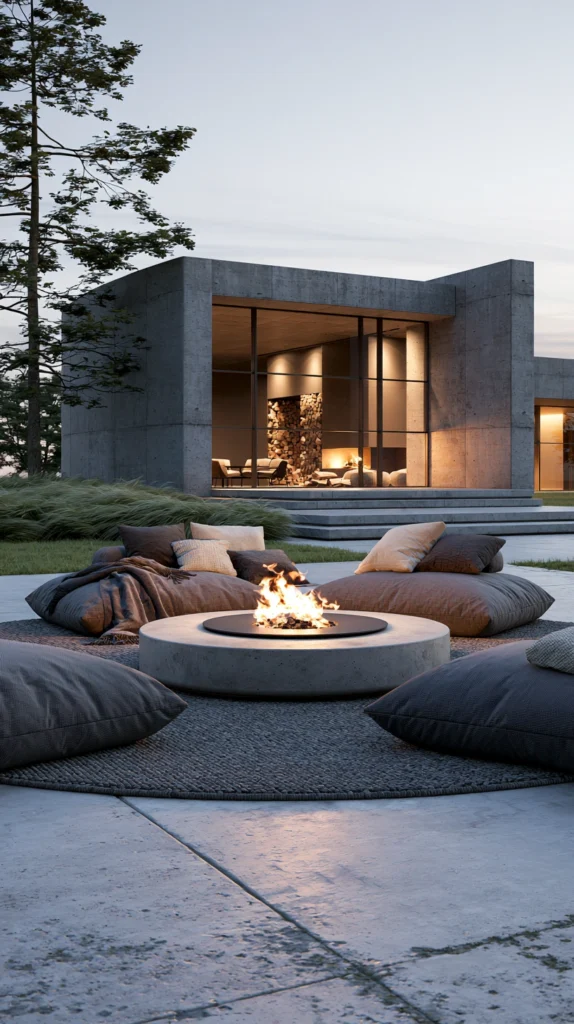
Floor cushions and a low table arranged around the fire, replacing standard chairs entirely for a more casual, ground-level gathering style.
Why floor seating suits a specific, more relaxed kind of evening
Sitting close to the ground changes the whole tenor of a gathering — more casual, more sprawling, generally suited to a younger or more informal group than a chair-based arrangement invites.
The cushions
Large, weather-resistant floor cushions or poufs, generously sized for genuine comfort sitting directly on or near the ground for an extended period.
The base layer
A large outdoor rug or several smaller mats beneath the cushions, both for comfort and to keep the seating area visually and physically defined against the surrounding grass or patio.
The low table
A single low table at the center of the cushion arrangement, within easy reach for shared snacks and drinks, rather than a standard-height table that would feel oddly tall relative to floor-level seating.
The blanket layer
More blankets than a chair-based arrangement typically needs, since floor-level seating puts guests closer to the cooling ground and benefits from more insulation.
The capacity and flow
Naturally accommodates a slightly larger or shifting group, since floor cushions can be added, removed, or repositioned more easily than fixed chairs.
Cost breakdown: Large floor cushions (6–8): $150–320 Outdoor rug: $60–150 Low table: $40–90 Total: $250–560
6. The Hammock and Sling Chair Addition
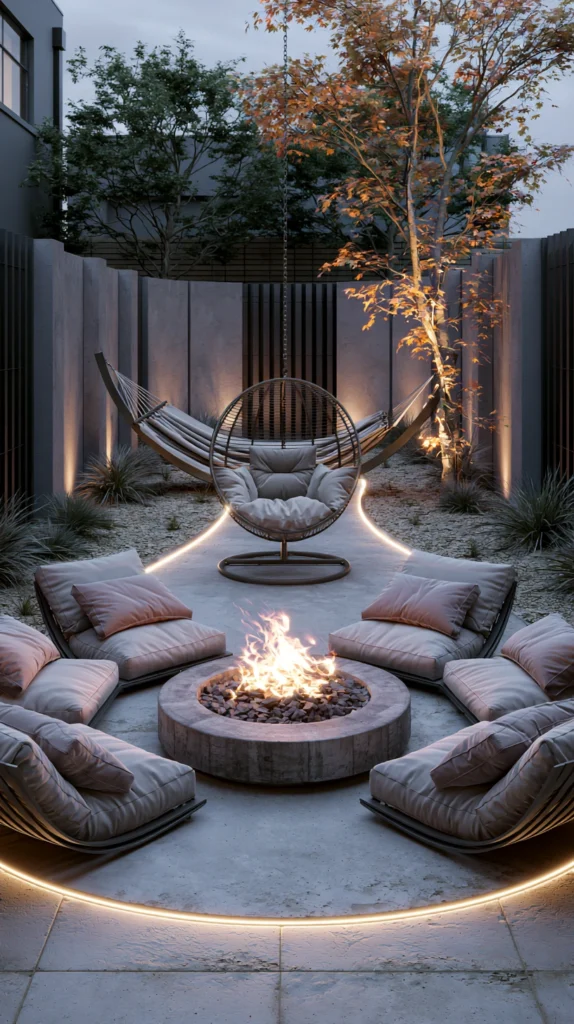
One or two hanging or sling-style chairs added to a standard seating arrangement, offering a different physical experience — gentle motion, a cocoon-like enclosure — within the same fire circle.
Why a single unconventional seat adds character without overcomplicating the layout
One hammock chair or sling seat within an otherwise standard circle gives at least one guest a genuinely different experience, often becoming the evening’s most requested spot without requiring the whole arrangement to be rebuilt around it.
The hanging chair
A hammock chair on a freestanding stand, positioned at one point in the broader seating circle, angled to face generally toward the fire like the rest of the arrangement.
The clearance
At least 3 feet of swing radius around the hanging chair, kept clear of the fire itself and any nearby furniture, for both comfort and basic safety around an open flame.
The cushion
A seat cushion within the hanging chair, matching or complementing the rest of the seating’s cushion palette for visual cohesion despite the different chair style.
The remaining seating
Standard chairs or a bench completing the rest of the circle, with the hanging chair functioning as one distinctive addition rather than the arrangement’s sole seating type.
The evening rotation
Often becomes the seat guests take turns in throughout the evening rather than one person’s assigned spot, adding a small element of playful rotation to the gathering.
Cost breakdown: Hammock or sling chair with stand: $90–200 Seat cushion: $20–35 Total: $110–235
7. The S’mores and Snack Station Layout
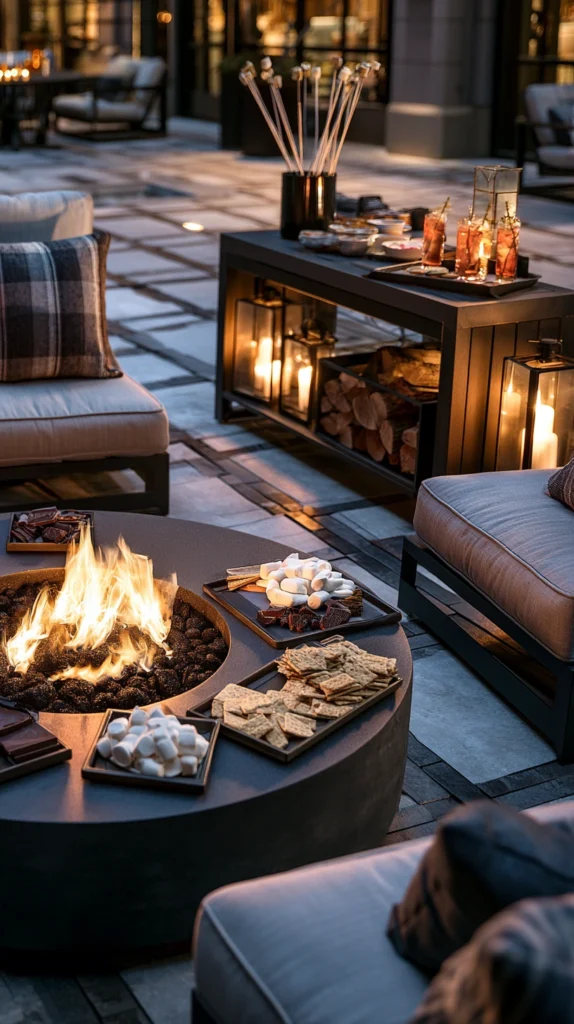
A seating arrangement built around a dedicated s’mores or snack preparation station, positioned within easy reach of the fire for roasting but out of the main conversational circle’s direct path.
Why a dedicated station keeps the roasting activity from disrupting the seating
Without a defined station, roasting supplies end up scattered across whatever surface is nearest, and the activity of roasting interrupts the seated conversation repeatedly. A defined station contains that activity to one specific zone.
The station
A small side table or a dedicated tray, stocked with roasting sticks, marshmallows, chocolate, and graham crackers, positioned just outside the main seating circle but within comfortable reach of the fire.
The roasting sticks
Long-handled roasting forks, stored in a small holder or bucket beside the station, kept distinct from any general fire-tending tools to avoid confusion.
The seating relationship
Seating positioned so guests can lean forward to roast without needing to fully stand or leave their seat, maintaining the conversational circle even during the roasting activity.
The cleanup consideration
A small trash or compost container near the station, keeping sticky wrappers and used sticks from accumulating around the main seating area.
The activity as icebreaker
The shared task of roasting marshmallows naturally prompts conversation and interaction among guests who might not otherwise have an easy opening, functioning as a built-in social icebreaker beyond its role as a snack.
Cost breakdown: Small station table or tray: $20–50 Roasting sticks (6–8): $15–30 S’mores supplies: $15–25 Total: $50–105
8. The String Light Canopy Over the Circle
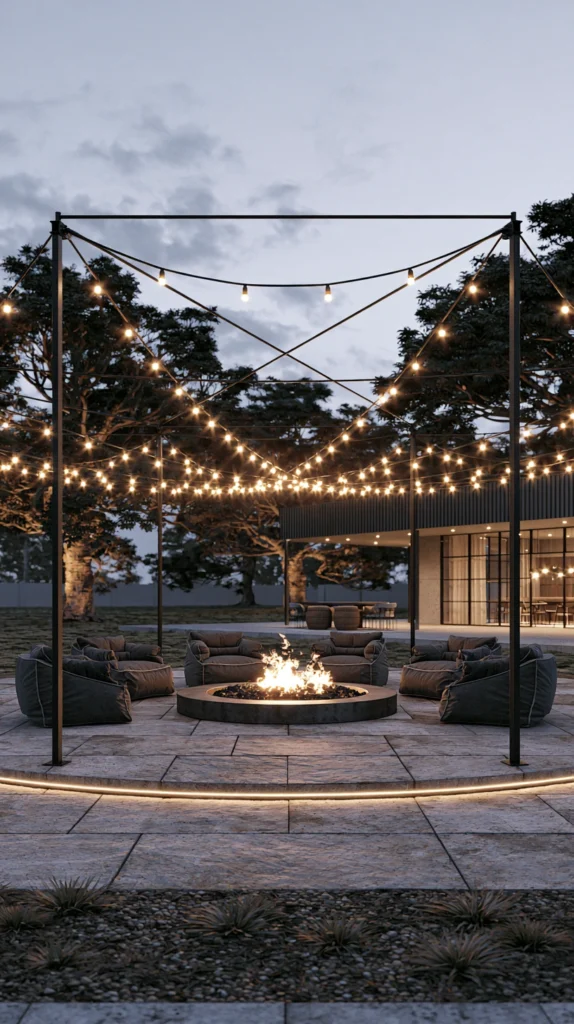
Warm string lights strung above the seating circle, either from a nearby structure or a set of freestanding poles, providing ambient light that extends comfortable use well after sunset.
Why overhead light matters even with the fire already providing illumination
Firelight alone creates strong, uneven shadows and leaves the outer edges of a seating circle dim. A soft overhead layer fills in that unevenness without competing with the fire’s own warm glow.
The lights
Warm white or amber-toned string lights, strung from an existing pergola, tree branches, or dedicated light poles positioned around the seating area’s perimeter.
The height
Hung high enough to clear the heads of standing guests, while still low enough to cast a genuinely warm wash of light down onto the seating below.
The poles
Freestanding light poles, if no existing structure is available, providing a flexible way to add overhead lighting to an open lawn or patio fire circle.
The dimmer or timer
A plug-in timer or dimmer switch, allowing the lights to activate automatically at dusk without requiring a manual switch mid-gathering.
The balance with firelight
Kept genuinely soft and secondary to the fire’s own light, avoiding a string light setup so bright it competes with or diminishes the fire’s natural draw as the evening’s visual center.
Cost breakdown: String lights (2–3 sets): $40–90 Light poles (if needed): $60–150 Timer or dimmer: $10–25 Total: $110–265
9. The Layered Textile Seating Refresh
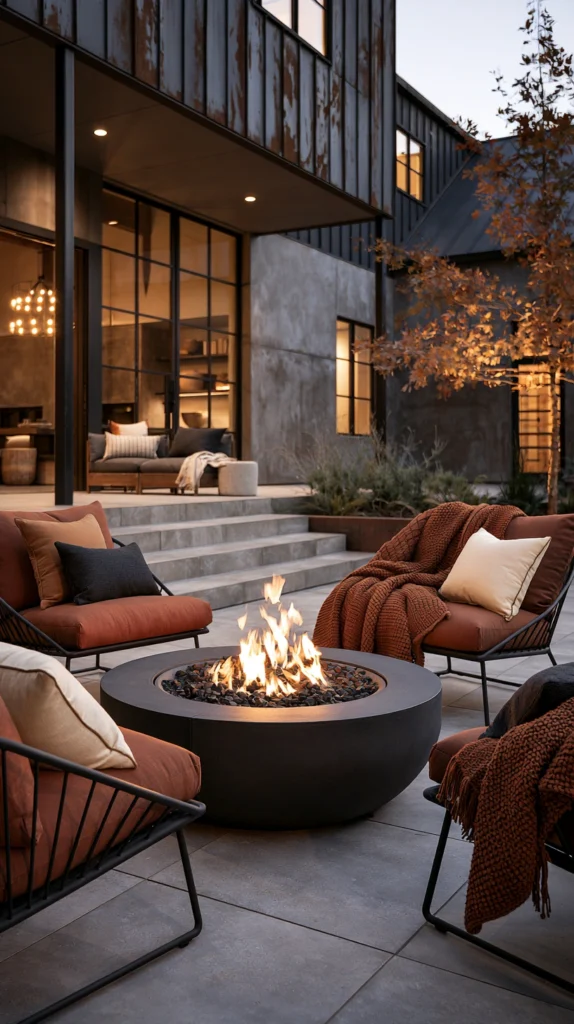
Existing outdoor furniture refreshed for the season with new cushion covers, throws, and a coordinated fall color palette, rather than replacing the furniture itself.
Why a textile refresh is the fastest route to a genuinely inviting fall seating area
The furniture’s actual frames rarely need replacing between seasons — the cushions and throws are what most visibly signal a fresh, considered seasonal update, and at a fraction of the cost of new furniture.
The cushion covers
New covers in a fall palette — rust, mustard, deep burgundy, forest green — fitted over existing cushion inserts, refreshing the color story without replacing the cushions themselves.
The throws
One heavy knit or wool throw per seat, folded over the arm or back of each chair, both for genuine warmth and for the visual layering effect a throw adds even before anyone sits down.
The color coordination
Two to three colors repeated across the covers and throws, rather than every seat in a different, unrelated color, for a cohesive rather than mismatched look.
The texture mix
Knit, wool, and a woven or textured fabric combined across the different throws and covers, adding tactile variety within the coordinated color palette.
The seasonal storage
Summer cushion covers and lighter throws stored away for the season, making the fall refresh a genuine seasonal transition rather than simply an addition on top of the existing summer look.
Cost breakdown: Cushion covers (6–8): $80–160 Throws (6–8): $90–200 Total: $170–360
10. The Two-Tier Height Arrangement
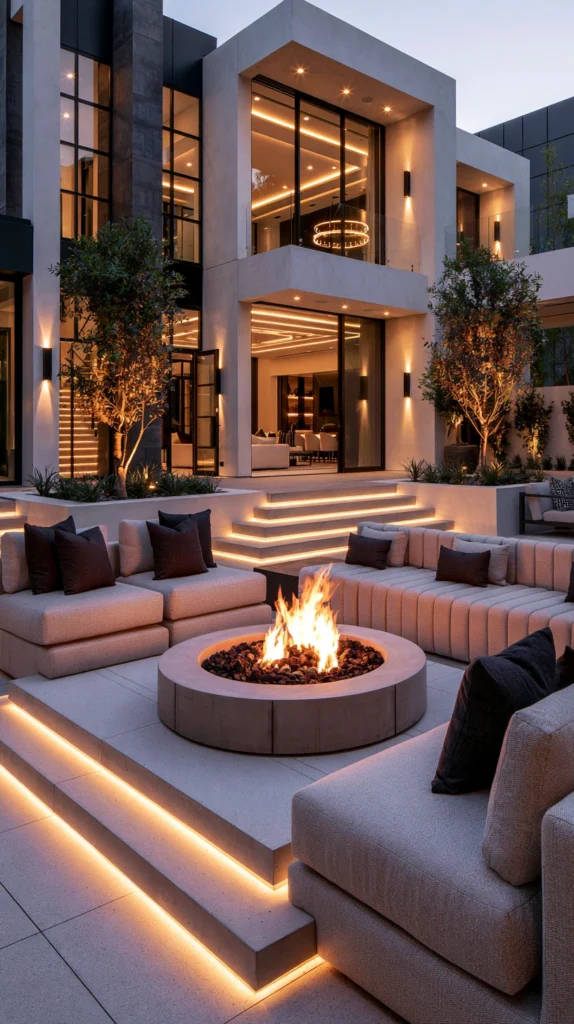
Seating at two distinct heights — standard chairs and a lower bench or floor cushions — arranged together around the same fire, creating visual layering and accommodating different comfort preferences within one gathering.
Why mixing seat heights improves both function and appearance
A circle of identical chairs is functional but visually flat. Mixing standard chair height with a lower bench or floor-level cushions adds genuine visual interest while also giving guests a real choice in how they want to sit.
The upper tier
Standard outdoor chairs, positioned around roughly half the fire’s circumference.
The lower tier
A low bench or a cluster of floor cushions filling the remaining portion of the circle, positioned slightly closer to the fire than the standard chairs given their lower vantage point.
The sightline check
Lower seating positioned so it does not block the standard chairs’ view of the fire, typically achieved by placing the lowest seating nearest the fire itself and the tallest chairs toward the outer edge.
The blanket distribution
Blankets available at both seating heights, since guests at the lower tier are often closer to the cooling ground and may want the extra layer sooner.
The social effect
Different heights naturally create different small conversational pockets within the same overall circle, useful for a slightly larger group where one single continuous conversation becomes difficult to sustain.
Cost breakdown: Standard chairs (3–4): $150–500 Low bench or floor cushions: $80–200 Total: $230–700
11. The Weatherproof Ottoman Footrest Addition
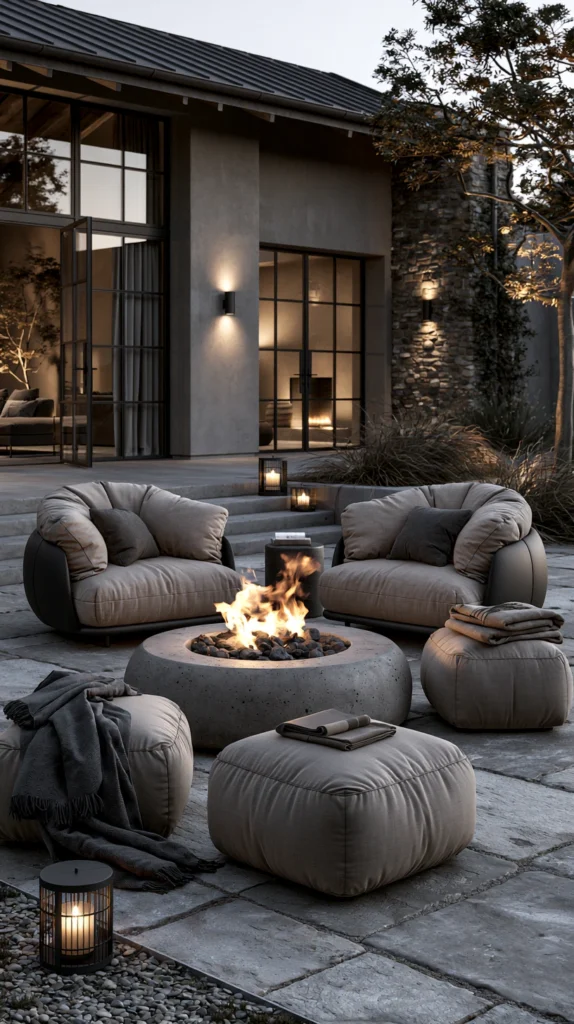
Weatherproof ottomans or poufs added in front of each seat, allowing guests to fully recline and elevate their feet, extending how long the seating remains comfortable through a long evening.
Why footrests matter more than they initially seem to for a multi-hour gathering
A chair alone supports the body for perhaps an hour of true comfort; a chair with a footrest genuinely extends that comfortable duration significantly, a meaningful difference for a gathering that runs three or four hours.
The ottomans
Small, weatherproof ottomans or poufs, sized to sit comfortably in front of each main chair without crowding the overall circle’s spacing.
The material
Outdoor-rated fabric or a woven resin wicker, both able to handle dew, occasional rain, and temperature swings without deteriorating.
The dual function
Doubling as extra seating for additional guests if the gathering grows larger than initially planned, adding flexibility beyond their primary footrest role.
The placement
Positioned to still allow guests to lean forward toward the fire or toward each other in conversation, rather than locking each person into a single, fully reclined position.
The storage
Lightweight enough to be easily moved or stored, unlike a large sectional or built-in bench, keeping this addition flexible season to season.
Cost breakdown: Weatherproof ottomans (4–6): $120–300** Total: $120–300
12. The Multi-Zone Large Gathering Layout
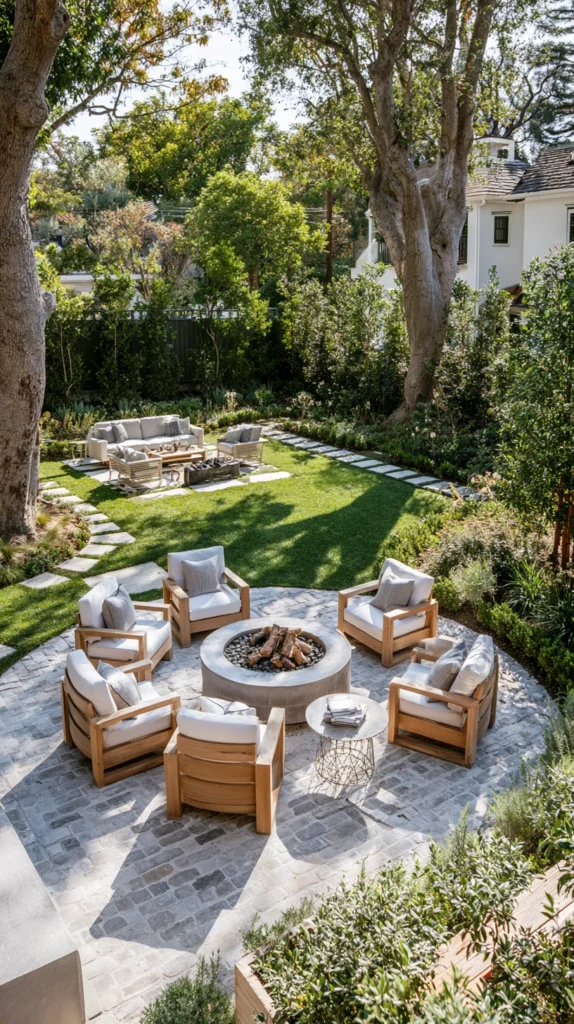
For a larger party, the seating deliberately split into two or three smaller zones near the fire — a main circle, a secondary loveseat cluster, and a standing zone near the drinks station — rather than one oversized circle.
Why splitting a large gathering into zones works better than one big circle
A single circle large enough to seat fifteen people forces conversation to fracture anyway, but does so awkwardly, with people straining to hear across too much distance. Deliberately planned smaller zones let that natural fracturing happen comfortably instead.
The main circle
The primary seating directly around the fire, sized to the ideal six-to-eight-person conversational maximum described earlier.
The secondary cluster
A loveseat or small chair grouping positioned nearby but distinctly separate, close enough to still feel connected to the fire’s warmth and light without being part of the immediate circle.
The standing zone
An area near the drinks or food station where guests can gather standing, particularly useful for the portion of a larger party that prefers moving and mingling over sitting the entire evening.
The overall flow
Guests naturally circulating between the zones over the course of the evening, rather than being locked into one fixed seat for the party’s full duration.
The lighting continuity
String lights or lanterns extending across all zones, visually unifying the separated seating areas as one connected gathering rather than several disconnected pockets.
Cost breakdown: Secondary seating cluster: $200–500 Additional lanterns or lighting for extended zone: $40–90 Total: $240–590
13. The Pet and Family-Friendly Layout
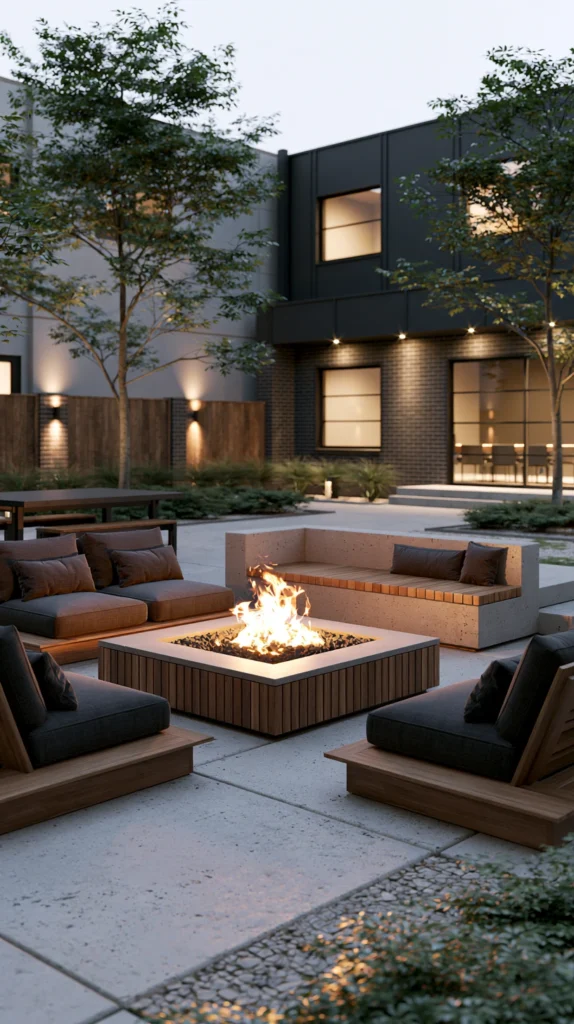
A seating arrangement that accounts for children and pets, including a slightly larger buffer zone around the fire, low stools sized for kids, and a designated play or rest spot just outside the main circle.
Why a family gathering needs a different spatial plan than an adults-only evening
Standard adult-height seating and a standard fire clearance do not automatically account for a child’s different sense of safe distance, or a pet’s tendency to wander closer to the flame than any adult would.
The buffer zone
A wider clearance around the fire than a typical adult gathering — often 5 to 6 feet rather than the standard 3 to 4 — giving children and pets more margin for movement without adult supervision catching every single moment.
The kid-sized seating
Small, low stools or a section of the bench sized appropriately for children, positioned within the family group rather than at a separate, disconnected spot.
The pet zone
A designated pet bed or blanket just outside the main seating circle, giving a dog a comfortable spot near the family without being directly beside the fire itself.
The activity table
A small table or blanket zone for kid-focused activities — coloring, a simple game — positioned within sight of the adult seating but slightly separate from it.
The supervision sightline
Every seating and activity zone positioned within clear adult sightline of the fire itself, the layout’s single most important safety consideration when children or pets are part of the gathering.
Cost breakdown: Kid-sized stools (2–3): $40–90 Pet bed or blanket: $20–40 Activity table: $20–50 Total: $80–180
14. The Weather-Adaptive Covered Seating
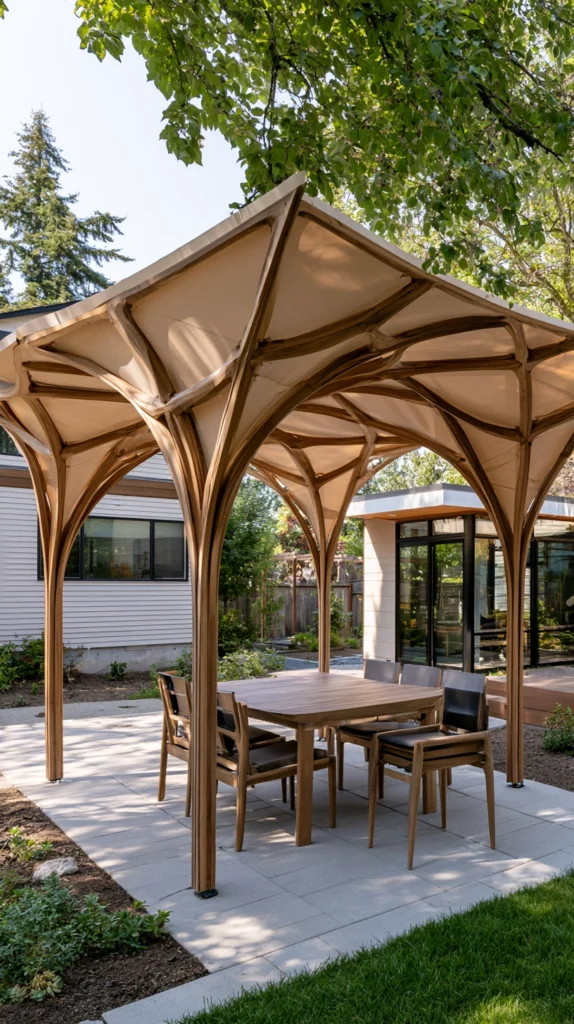
Seating positioned partially beneath a pergola, umbrella, or overhang, allowing the gathering to continue through light rain or an unexpectedly cold, windy evening.
Why weather adaptability extends the fire pit season considerably
Without any overhead cover, a single evening of drizzle or strong wind cancels the gathering entirely. A partially covered seating zone keeps the option open even when conditions are not ideal.
The covered zone
A pergola, a large umbrella, or an existing porch or patio overhang, positioned to shelter at least a portion of the total seating without blocking the fire’s own smoke or requiring the fire itself to sit under cover.
The fire safety note
The fire pit itself generally needs to remain in an open, unroofed area for smoke and safety reasons, with only the seating — not the fire — positioned beneath the covered structure.
The wind consideration
A covered structure with at least one open or low side, since a fully enclosed cover can create smoke buildup issues even with the fire itself positioned outside its footprint.
The mixed-weather seating plan
Some seating fully in the open, closest to the fire, and some seating under partial cover slightly farther back, giving guests a choice based on the specific evening’s conditions.
The extended season
A weather-adaptive layout genuinely extends the fire pit’s usable season, allowing gatherings on marginal-weather evenings that a fully open setup would rule out entirely.
Cost breakdown: Large umbrella or partial pergola addition: $200–800 Total: $200–800
15. The Complete Fall Fire Pit Entertaining Setup (The Fully Hosted Evening)
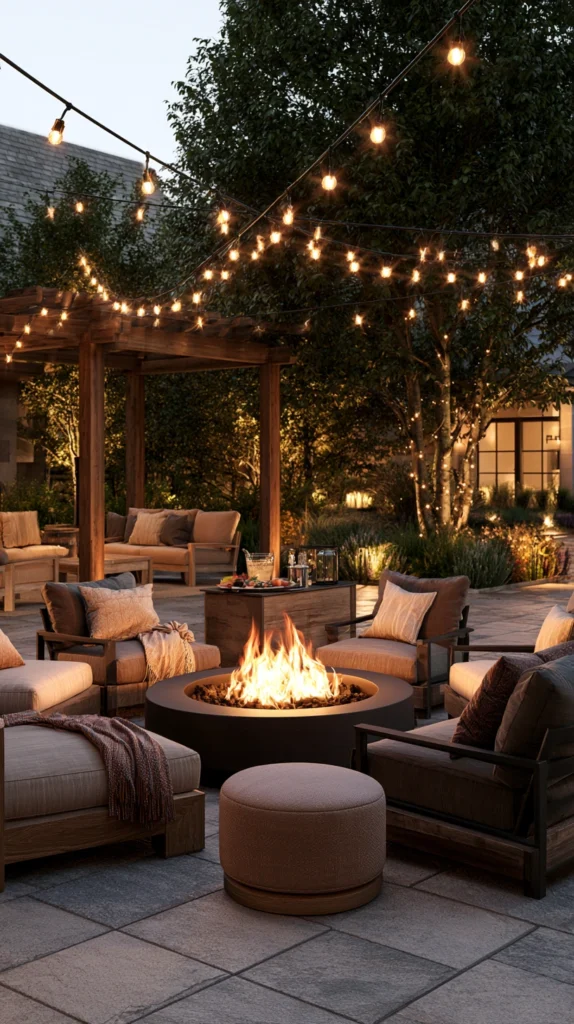
A complete entertaining layout combining several of the approaches above — a well-spaced primary circle, a drinks and snack station, layered textiles, overhead lighting, and weather adaptability — designed to genuinely host a full evening rather than simply provide a fire to look at.
What separates the complete setup from simply pulling chairs up to a fire
Chairs pulled up to a fire: a fire with seating nearby. A complete entertaining setup: every element of an actual hosted evening considered — where people sit, where they get a drink, how they stay warm past 9pm, what happens if it starts to rain.
The elements of the complete fall fire pit entertaining setup
The core seating
A primary circle or horseshoe of four to eight deep, comfortable chairs, spaced 3 to 4 feet from the fire’s edge.
The station
A drinks and s’mores station positioned just outside the main circle, keeping refill and roasting activity from disrupting the seated conversation.
The textiles
Fall-toned cushion covers and one heavy throw per seat, refreshed seasonally rather than left over from summer.
The lighting
Warm string lights overhead, extending the gathering’s comfortable use well past sunset.
The comfort extras
Footrest ottomans and a blanket basket, extending how long guests genuinely stay comfortable through a multi-hour evening.
The weather plan
At least partial covered seating nearby, keeping the option to gather open even on a marginal-weather evening.
The complete design in action
A Saturday evening in late October:
6pm: The fire lit, string lights already glowing as dusk sets in early.
6:30pm: Guests arriving, settling into the circle, a first round of drinks grabbed from the station without anyone needing to step fully away from the conversation.
8pm: Feet up on the ottomans, throws pulled over laps, the s’mores station getting its first real use of the night.
10pm: Still there, two hours past when the evening was meant to wrap up, because every part of the setup made staying the easier choice than leaving.
The complete fall fire pit entertaining setup: not simply a fire with chairs nearby, but an evening built with genuine hosting intention, from the first seat to the last log.
Cost breakdown for the complete setup: Assuming a starting point of an existing fire pit with no dedicated seating plan: Primary seating (4–6 chairs): $150–600 Drinks and snack station: $50–105 Cushion covers and throws: $170–360 String lighting: $110–265 Ottomans: $120–300 Blanket basket and blankets: $70–120 Partial weather cover: $200–800 Total: $870–2,550
Phased over two or three seasons:
Season one ($220–465): The core seating circle A basic drinks station A blanket basket
Season two ($280–625): String lighting Textile refresh (cushion covers, throws) Ottomans
Season three ($200–800): Weather-adaptive covered seating Any secondary zone for a larger gathering
The fall fire pit entertaining setup: not a single purchase but a genuinely hosted evening, built with intention around the fire that started it all.
The Question Before Any Fire Pit Entertaining Layout
Before choosing a seating type, an arrangement, a scale:
What is the primary reason for wanting to entertain around this fire?
If the answer is: an intimate, close conversation among a few close friends — the classic four-chair circle or the paired loveseat clusters.
If the answer is: regular hosting duties requiring easy movement in and out — the horseshoe with a drinks station.
If the answer is: a larger party that needs room to mingle — the multi-zone large gathering layout.
If the answer is: children and pets are part of the regular gathering — the family-friendly layout with its wider buffer and dedicated zones.
The design follows who is actually gathering and how the evening is meant to unfold, more than any single furniture trend. Every idea on this list solves that combination differently. The question is which combination fits the gatherings this particular fire pit is actually meant to host.
The simple four-chair circle with one shared blanket basket: still turns a fire into a genuine evening. The complete setup, planned with intention: an evening people stay at far longer than they meant to.
That lingering: the whole point of getting the seating right.
Getting Started This Weekend
The immediate fire pit entertaining solution:
Rearrange the existing chairs into a proper circle or horseshoe, angled toward each other rather than only toward the fire.
Not new furniture. Not a full setup. Just the existing chairs, repositioned with intention.
Add one blanket per seat, folded and ready before anyone arrives.
The single lowest-cost change most likely to keep an evening going an hour longer than it otherwise would.
Set out drinks and snacks on a small table just outside the main circle, not inside it.
Test the horseshoe or open-gap principle even without any new furniture purchase.
String one set of warm lights overhead before the next gathering.
The rest of the design: the elaboration of this moment.
The circle: the beginning. The fire pit evening: what gets hosted around it.