
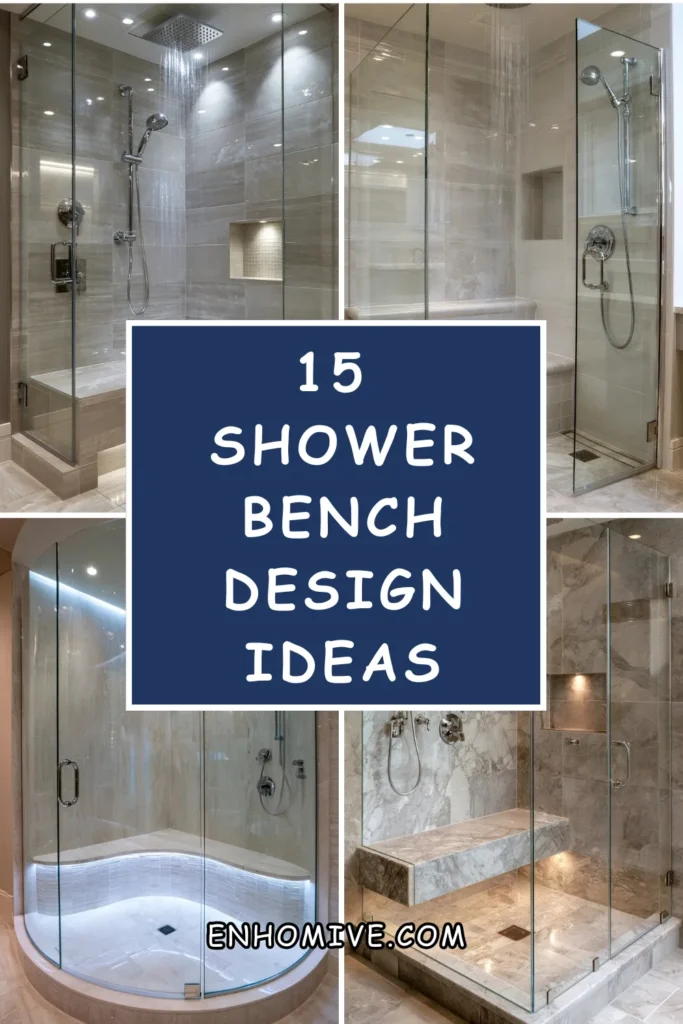
15 Shower Bench Design Ideas
The shower bench changed how the whole bathroom got used more than any fixture upgrade I’ve made since. Not the rain showerhead. Not the new tile. Not the glass enclosure or the better water pressure or the heated floor.
The seat.
Because a place to sit did something no amount of standing-room shower luxury ever managed. Before it: a shower built entirely around standing, shaving done balanced awkwardly on one foot, razors and products stacked on whatever ledge happened to exist. After it: a genuine seat, at the right height, in the right spot, turning a rushed daily routine into something with actual ease built into it.
A shower bench is not an accessibility add-on reserved for households with specific mobility needs, though it serves that purpose well too. It is a genuine daily-use improvement for almost anyone — a place to shave a leg, sit through a long soak under warm water, or simply rest for a moment before the day starts. The shower: no longer built purely for standing, but for whatever the moment actually calls for.
Here are 15 shower bench design ideas — from the simplest teak stool to the most fully integrated built-in seat — built on that understanding.
Why a Shower Bench Earns Its Place in Almost Any Bathroom
The daily function case
A bench addresses several genuinely common shower tasks — shaving legs, washing feet, applying a foot scrub, or simply resting during a longer shower — that are all more difficult and less safe balanced on one leg while standing.
The accessibility principle
Without a bench:
A shower designed entirely around standing use, presenting genuine difficulty or risk for anyone with limited mobility, balance concerns, or simply a preference for sitting during longer showers.
The bathroom: usable, but only for one specific mode of use.
With a bench:
A seat at a comfortable height, built or placed specifically for the shower’s water flow and layout, extending the room’s usability to a much broader range of needs and preferences.
The bathroom: functioning well for a broader range of bodies, ages, and circumstances, both now and as those needs potentially change over time.
The universal design case
A well-designed shower bench benefits nearly everyone at some point — after an injury, during a pregnancy, in old age, or simply on an exhausted evening — making it one of the more broadly valuable bathroom investments available, regardless of a household’s current specific needs.
The value-retention argument
A built-in shower bench is increasingly viewed as a desirable, expected feature in updated bathrooms, often adding genuine resale value rather than reading as a purely functional or clinical addition.
The Five Shower Bench Categories
Before choosing any specific design:
The built-in tiled bench
A permanent bench constructed as part of the shower’s structure, tiled to match the surrounding walls.
The most substantial, most integrated option.
Best planned during a full shower renovation.
The floating or wall-mounted bench
A bench attached directly to the shower wall, without floor-mounted legs, appearing to float above the shower floor.
A strong middle-ground option between full built-in construction and a simple movable stool.
Often foldable for space efficiency.
The freestanding teak or stone stool
A movable stool or small bench, placed within the shower but not permanently attached to any surface.
The lowest-cost, most flexible option.
Requires no construction or renovation at all.
The corner bench
A bench built or fitted specifically into a shower’s corner, taking advantage of two existing walls.
Particularly space-efficient in a smaller shower.
Often integrates naturally with a corner shower’s existing layout.
The full-width bench
A bench spanning the shower’s full width or a significant portion of it, providing substantial seating area.
Suited to a larger walk-in shower with adequate floor space.
Can serve multiple functions beyond seating, including storage or as a surface for products.
1. The Fully Tiled Built-In Bench
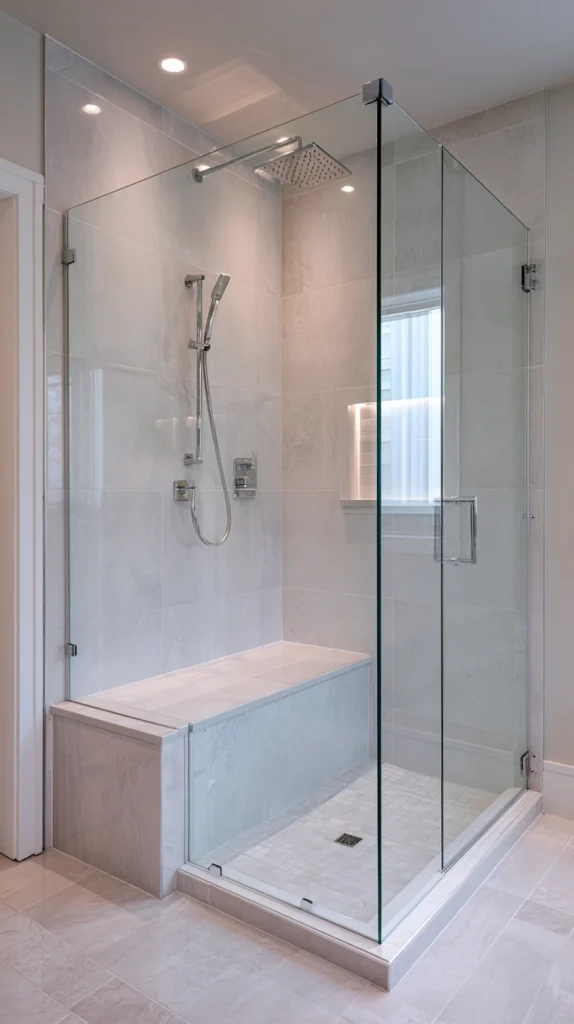
A permanent bench constructed from concrete or cement board and tiled to match the surrounding shower walls, built directly into the shower’s structure during a renovation.
Why a built-in bench remains the most durable, most integrated option available
Unlike any freestanding or wall-mounted alternative, a built-in tiled bench is constructed as part of the shower’s actual waterproofed structure, eliminating any concern about a separate piece of furniture’s water resistance, stability, or eventual wear.
The construction
A framed base, waterproofed with the same membrane system used for the shower’s walls and floor, then tiled to match or complement the surrounding surfaces.
The height
Typically 17 to 19 inches from the shower floor, matching a comfortable standard seat height, though this can be adjusted based on the household’s specific needs or preferences.
The depth
A minimum of 15 inches deep, providing genuine, comfortable seating rather than a narrow ledge that would be uncomfortable for extended sitting.
The slope consideration
A slight forward slope built into the bench’s surface, allowing water to drain properly rather than pooling on the seat itself.
The tile selection
Matching the surrounding shower tile for a seamless, integrated appearance, or a contrasting tile specifically highlighting the bench as a distinct feature.
Cost breakdown: Bench construction (framing, waterproofing): $300–700 Tile and installation: $200–500 Total: $500–1,200
2. The Floating Wall-Mounted Bench
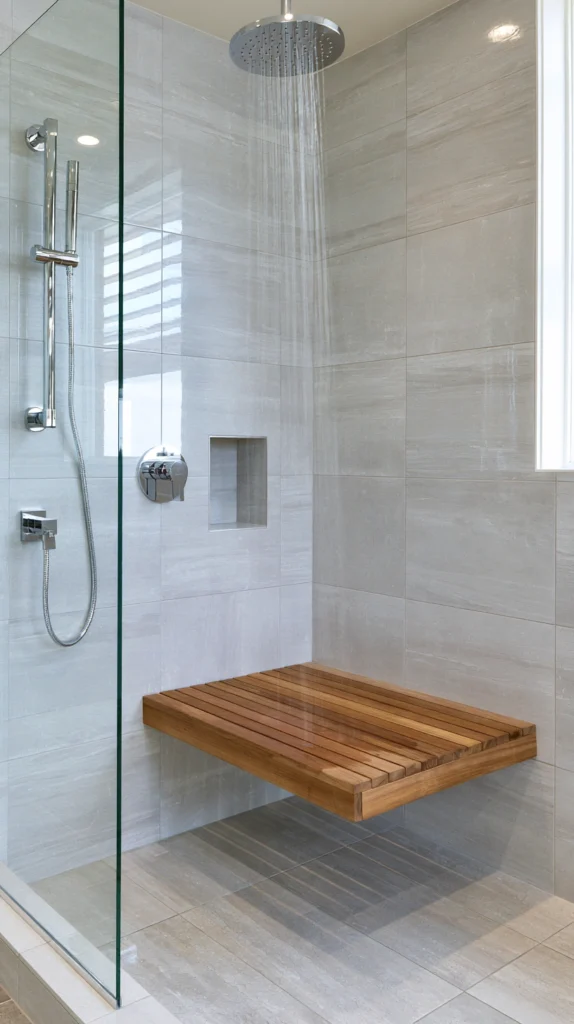
A bench attached directly to the shower wall via a bracket system, with no floor-mounted legs, creating a clean, minimal appearance and easier floor cleaning beneath it.
Why a floating design suits a contemporary bathroom particularly well
Without visible legs touching the floor, a floating bench reads as considerably more minimal and visually lighter than a traditional four-legged bench, while also making the shower floor beneath it easier to clean.
The mounting system
A concealed wall bracket, rated for the bench’s expected weight load, installed into the shower wall’s structural framing rather than simply anchored to tile alone.
The material
Teak, another water-resistant hardwood, or a solid surface material, chosen both for genuine water resistance and for the clean, simple lines this design style typically favors.
The weight rating
Confirming the specific bracket system’s weight capacity before installation, since a floating bench must support a person’s full weight without any floor-level support to share the load.
The foldable option
Some floating bench designs fold flat against the wall when not in use, maximizing floor space in a smaller shower during the times the bench itself is not needed.
The overall aesthetic
A clean, architectural look particularly well suited to a contemporary or minimalist bathroom design, the bench reading as an intentional design element rather than a purely practical addition.
Cost breakdown: Floating wall-mounted bench: $150–400 Wall bracket installation: $150–350 Total: $300–750
3. The Teak Freestanding Stool
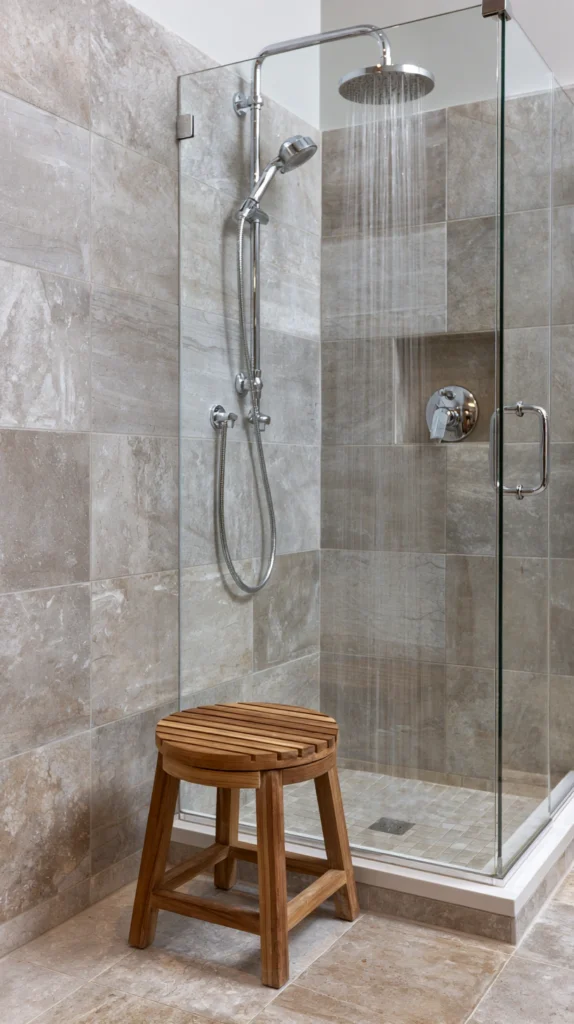
A simple, movable teak stool or small bench, placed within the shower but not permanently attached to any wall or floor surface.
Why a freestanding option remains the most accessible entry point for most households
Requiring no construction, no waterproofing consideration, and no permanent commitment, a freestanding teak stool delivers much of a shower bench’s core functional benefit at a fraction of the cost and effort of any built-in or wall-mounted alternative.
The material
Teak specifically, given its natural water and rot resistance without requiring additional sealing or treatment, making it the standard material choice for this application.
The stool style
A simple slatted stool or small bench, with slats allowing water to drain through rather than pooling on a solid surface.
The size options
Ranging from a small single-person stool to a slightly larger bench, chosen based on the shower’s available floor space and how the seat will actually be used.
The mobility benefit
Fully movable, allowing the stool to be repositioned within the shower as needed, or removed entirely if the floor space is needed for another purpose.
The maintenance
Occasional oiling to maintain the teak’s water resistance and appearance over time, a modest but real ongoing care requirement worth factoring into the otherwise low-maintenance appeal of this option.
Cost breakdown: Teak shower stool: $60–150 Total: $60–150
4. The Corner-Fitted Bench
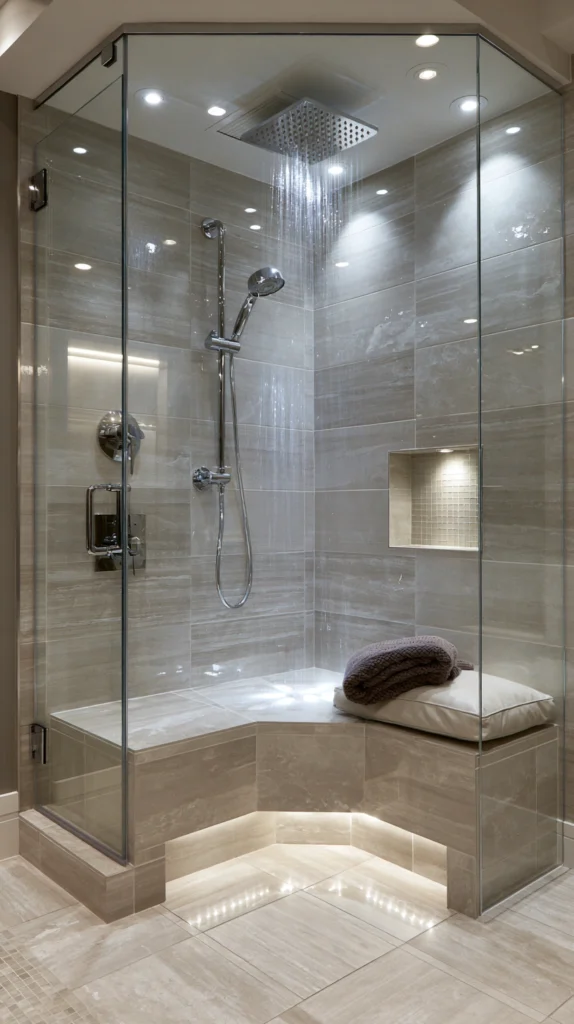
A bench built or fitted specifically into a shower’s corner, using the two existing walls as structural support and taking advantage of space a standard rectangular shower layout might otherwise leave unused.
Why a corner placement suits many standard shower layouts particularly well
Many showers, particularly in smaller bathrooms, are built with a corner configuration already; positioning the bench specifically in that corner uses the two existing walls for support while leaving the shower’s main floor and water flow area completely unobstructed.
The bench shape
A triangular or curved bench, fitted precisely to the corner’s specific angle, rather than a standard rectangular bench that might not use the corner space as efficiently.
The construction
Either a built-in tiled version, following the same construction principles as the fully built-in bench, or a corner-specific freestanding or wall-mounted unit designed for this exact configuration.
The space efficiency
Particularly valuable in a smaller shower, where floor space for the main standing and water flow area is already limited — a corner bench adds seating without meaningfully reducing that primary usable area.
The water flow consideration
Positioned away from the direct spray of the main showerhead, ensuring the bench remains a comfortable, non-drenched seat for tasks like shaving rather than sitting directly under the water stream itself.
The overall efficiency
A bench that adds genuine function without requiring any additional floor space beyond what the shower’s existing corner configuration already provides.
Cost breakdown: Corner bench (built-in tiled): $400–900 Or corner-fitted freestanding unit: $100–250 Total: $100–900 depending on approach
5. The Full-Width Bench With Storage Below
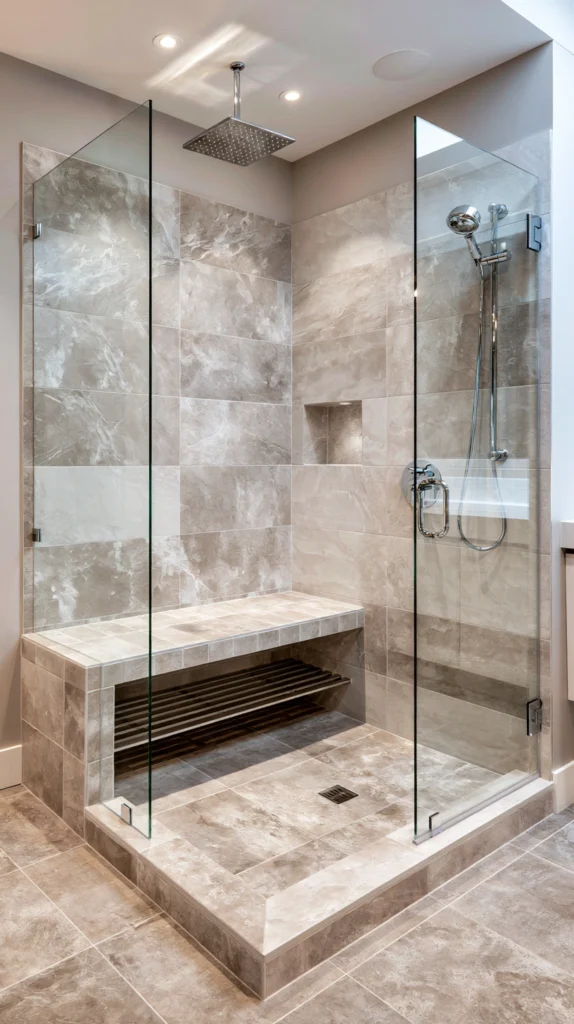
A bench spanning a significant portion of the shower’s width, with open or closed storage built into the space beneath the seat.
Why combining seating with storage maximizes a full-width bench’s value
A bench spanning enough width to provide genuine storage space beneath it does double duty, addressing both the seating need and the shower’s often-limited storage for shampoo, soap, and other daily products.
The bench width
Spanning at least 3 to 4 feet, providing enough length for comfortable seating while also creating meaningful storage volume in the space below.
The storage configuration
Open shelving beneath the bench for easily accessible daily products, or, in a more built-out version, closed cabinet doors for a cleaner overall appearance.
The material
Tiled to match the surrounding shower, with the storage area’s shelving in a water-resistant material such as teak slats or a sealed composite.
The organization
Baskets or bins within the open storage sections, keeping bottles and products organized and easy to access rather than loosely scattered on open shelving.
The overall value
A single bench construction addressing two genuine shower needs simultaneously — seating and storage — rather than requiring separate solutions for each.
Cost breakdown: Full-width bench with storage: $500–1,200 Storage baskets or organization: $30–70 Total: $530–1,270
6. The Cantilevered Concrete Bench
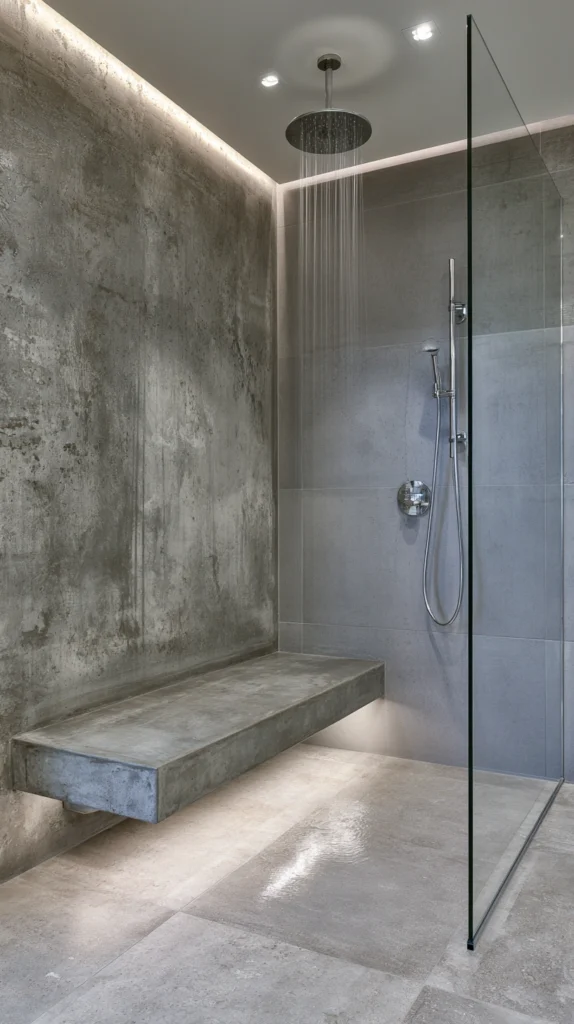
A bench constructed from poured or precast concrete, cantilevered directly from the shower wall for a bold, architectural, minimalist appearance.
Why concrete suits a specifically modern, architectural bathroom design
Concrete’s raw, monolithic quality reads as distinctly more architectural and contemporary than a tiled or wood bench, suited to a bathroom already leaning toward an industrial or minimalist material palette.
The construction
Precast concrete panels installed by a specialist, or poured in place during construction, requiring genuine structural engineering to ensure the cantilevered bench can safely bear a person’s full weight without any floor-level support.
The finish
A sealed, smooth concrete finish, or a more textured, natural finish depending on the desired level of polish versus raw material character.
The structural requirement
Cantilevered construction requires the wall itself to have adequate structural backing, a detail requiring professional structural assessment before installation, given the genuine safety implications of an improperly supported cantilevered seat.
The color options
Natural grey concrete, or a pigmented version matching or contrasting with the shower’s other surfaces.
The overall effect
A bench that reads as a genuine piece of architecture rather than an added fixture, particularly striking in a shower already built around concrete, stone, or other raw material finishes.
Cost breakdown: Precast concrete bench: $600–1,500 Structural assessment and installation: $400–1,000 Total: $1,000–2,500
7. The Foldable Wall-Mounted ADA-Style Bench
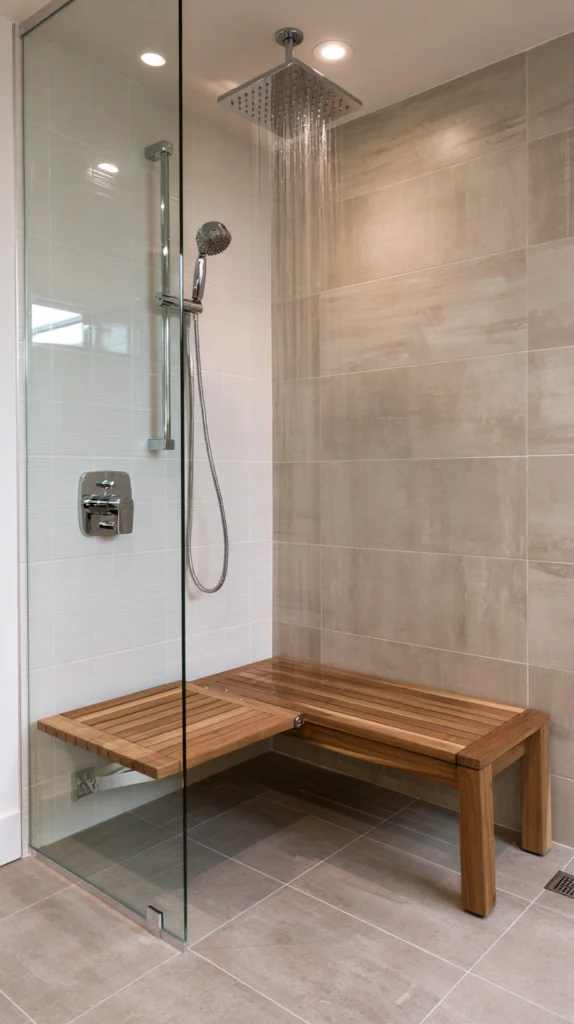
A hinged bench that folds flat against the shower wall when not in use, deploying horizontally when needed, commonly associated with accessible bathroom design but valuable for any household wanting space efficiency.
Why a foldable design suits a smaller shower or a household with fluctuating needs
A foldable bench provides genuine seating exactly when needed while returning the shower’s floor space to fully open when it is not, valuable both in a genuinely small shower and for a household whose need for seating might change over time.
The hinge mechanism
A sturdy, rated hinge and support leg system, allowing the bench to fold down into a stable, weight-bearing horizontal position and fold back up flush against the wall when not needed.
The weight rating
Confirming the specific unit’s weight capacity, since this style of bench is often engineered to meet accessibility standards and should reliably support significant weight when deployed.
The material
Teak, a solid surface material, or a powder-coated metal frame with a slatted seat, chosen for both water resistance and durability given the repeated folding mechanism’s wear over time.
The installation
Mounted into the shower wall’s structural framing, similar to the floating bench’s installation requirement, rather than surface-mounted to tile alone.
The accessibility value
Particularly valuable for a household anticipating changing mobility needs, whether due to aging in place, a temporary injury, or simply wanting the flexibility this design provides.
Cost breakdown: Foldable wall-mounted bench: $150–400 Installation: $150–350 Total: $300–750
8. The Natural Stone Slab Bench
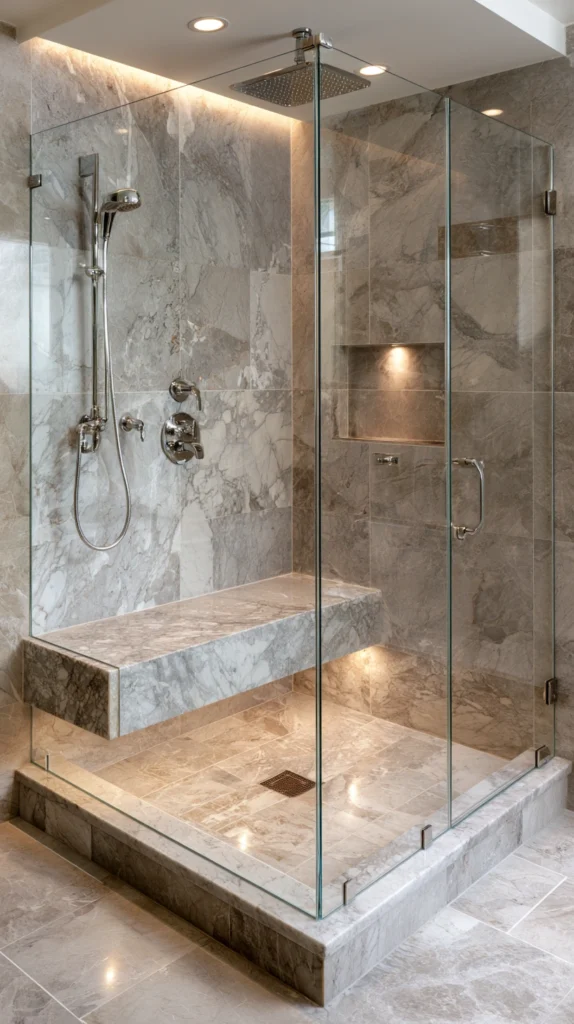
A bench cut from a single slab of natural stone — marble, travertine, or granite — providing a substantial, luxurious seating surface within the shower.
Why a stone slab bench suits a higher-end bathroom renovation
A single substantial stone slab reads as a genuine luxury material choice, particularly when the stone matches or complements the shower’s walls or flooring, creating a cohesive, high-end material story throughout the space.
The stone selection
Marble, travertine, or granite, chosen to match or intentionally contrast with the surrounding shower walls and floor, depending on the desired level of visual consistency.
The slab thickness
A substantial slab thickness, typically 2 inches or more, providing genuine structural integrity and a sense of solidity and permanence.
The support structure
Either resting on a tiled or stone base built specifically to support it, or cantilevered from the wall with appropriate structural backing, depending on the specific design and the wall’s load-bearing capacity.
The sealing requirement
Natural stone requires regular sealing to resist water absorption and staining, an ongoing maintenance consideration worth factoring into the decision between natural stone and a more water-resistant engineered alternative.
The overall effect
A bench that functions as much as a piece of natural material artistry as a functional seat, elevating the shower’s overall sense of luxury and permanence.
Cost breakdown: Natural stone slab: $500–1,500 Support structure and installation: $300–700 Total: $800–2,200
9. The Slatted Teak Bench With Rubber Feet
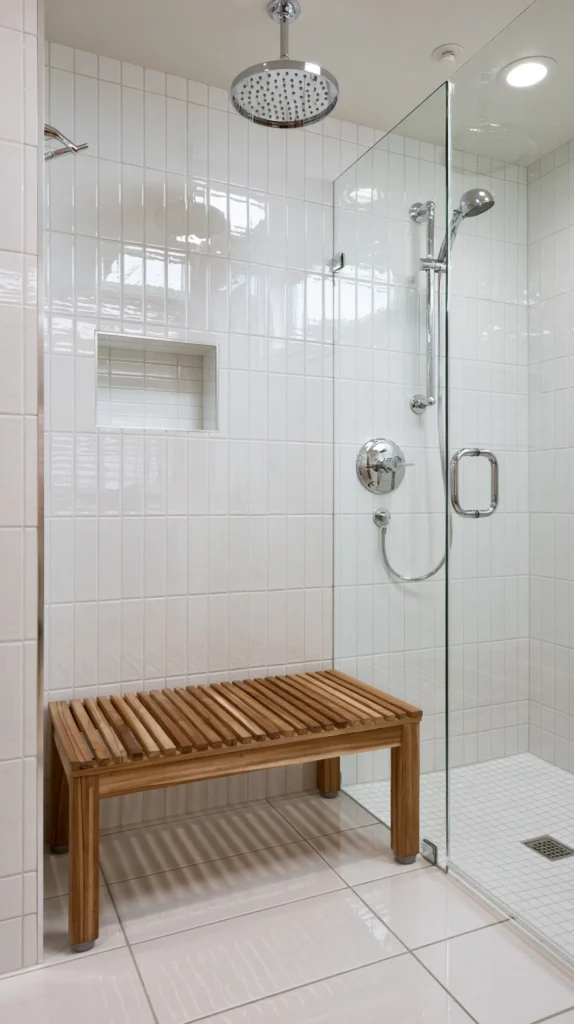
A slatted teak bench with non-slip rubber feet, designed specifically for genuine slip resistance and secure footing on a wet shower floor.
Why slip resistance deserves specific attention in any freestanding bench choice
A freestanding bench, unlike a built-in or wall-mounted one, relies entirely on its own footing for stability, and a wet tile floor presents genuine slip risk if the bench’s feet are not specifically designed to grip that surface.
The bench design
Slatted teak construction, allowing water to drain freely rather than pooling on the seat, paired with rubber or silicone feet specifically rated for wet, slick surfaces.
The foot design
Suction-cup style or textured rubber feet, providing genuine grip against the shower floor even when both the floor and the feet themselves are wet.
The stability testing
Testing the bench’s stability on the actual shower floor before regular use, confirming the feet grip properly on that specific tile or stone surface rather than assuming universal compatibility.
The portability trade-off
Still fully movable when needed, but considerably more stable in place during actual use than a bench without any specific slip-resistant foot design.
The overall safety benefit
A meaningful safety improvement over a standard freestanding stool, particularly valuable for a household with any concern about slip risk on a wet shower floor.
Cost breakdown: Slatted teak bench with rubber feet: $70–180 Total: $70–180
10. The Bench With an Integrated Handheld Showerhead Mount
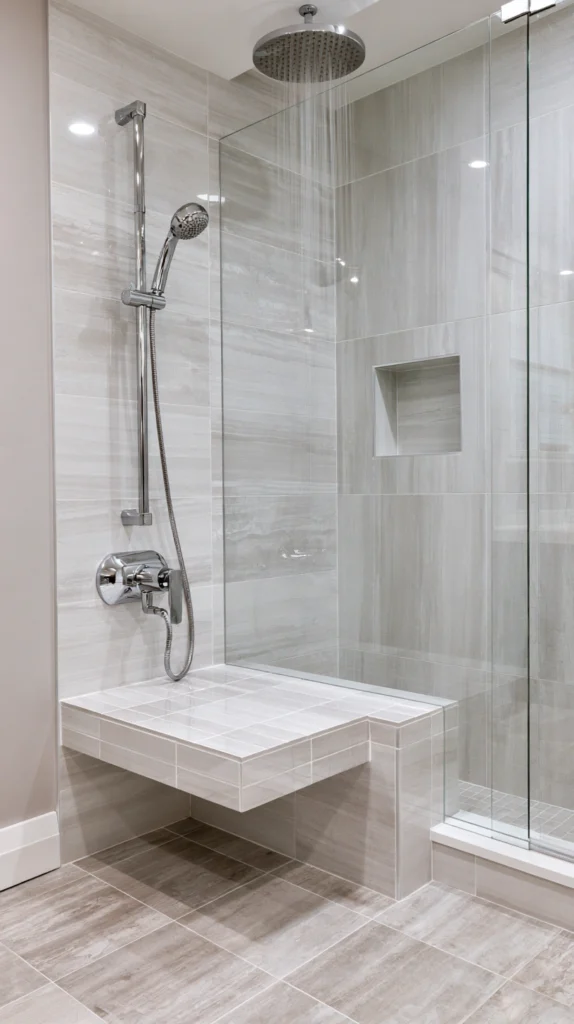
A shower bench positioned and designed specifically alongside a handheld showerhead mount, allowing a seated user to direct water flow themselves rather than relying on a fixed overhead showerhead alone.
Why pairing the bench with a handheld showerhead addresses a real functional gap
A fixed overhead showerhead, positioned for a standing user, often does not direct water conveniently to someone seated on a bench. A handheld showerhead mounted at a height and position accessible from the seated bench solves this directly.
The showerhead mount
A sliding bar or fixed mount, positioned at a height reachable from the seated position, holding a handheld showerhead that can be removed and directed manually as needed.
The bench placement relative to the mount
Positioned so the seated user can comfortably reach and control the handheld showerhead without needing to stand or stretch significantly.
The dual-head option
Some installations retain both a fixed overhead showerhead and the handheld unit, allowing the household to choose between standing use with overhead water and seated use with the more directly controllable handheld option.
The valve control
A diverter valve allowing water flow to switch between the fixed and handheld showerhead, or to run both simultaneously depending on the plumbing configuration installed.
The overall functional improvement
A shower that genuinely serves both standing and seated use equally well, rather than a bench added to a shower still fundamentally designed around only standing users.
Cost breakdown: Handheld showerhead and sliding bar: $80–200 Plumbing and diverter valve installation: $200–500 Total: $280–700
11. The Curved Bench for a Round or Angled Shower
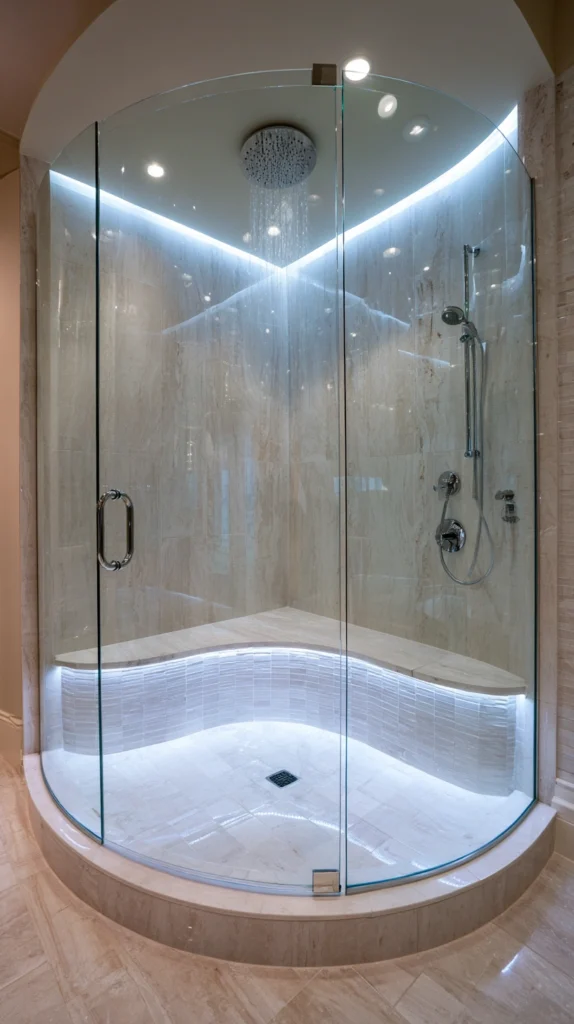
A bench specifically curved to match the contours of a round, angled, or non-rectangular shower enclosure, following the room’s actual geometry rather than a standard straight-edged design.
Why a curved bench suits a non-standard shower shape
A standard rectangular bench, placed in a round or angled shower enclosure, leaves awkward gaps or requires an ill-fitting compromise. A bench specifically curved to match the enclosure’s actual shape uses the available space efficiently and looks genuinely built for the room.
The custom fabrication
Either custom-built to match the specific enclosure’s exact curve, or a modular curved system adapted to fit, requiring more precise planning than a standard rectangular bench installation.
The material
Tile matching the curved wall’s own material for a fully integrated built-in version, or a curved teak or solid-surface piece for a more modular approach.
The measurement precision
Careful measurement of the enclosure’s actual curve or angle before fabrication, since even a small mismatch will be visually and functionally obvious in a bench specifically meant to follow a distinctive, non-standard shape.
The overall fit
A bench that reads as genuinely built for this specific shower, rather than a standard piece awkwardly adapted to fit an unusual space.
Cost breakdown: Custom curved bench: $500–1,400 Total: $500–1,400
12. The Bench Paired With a Built-In Niche Above
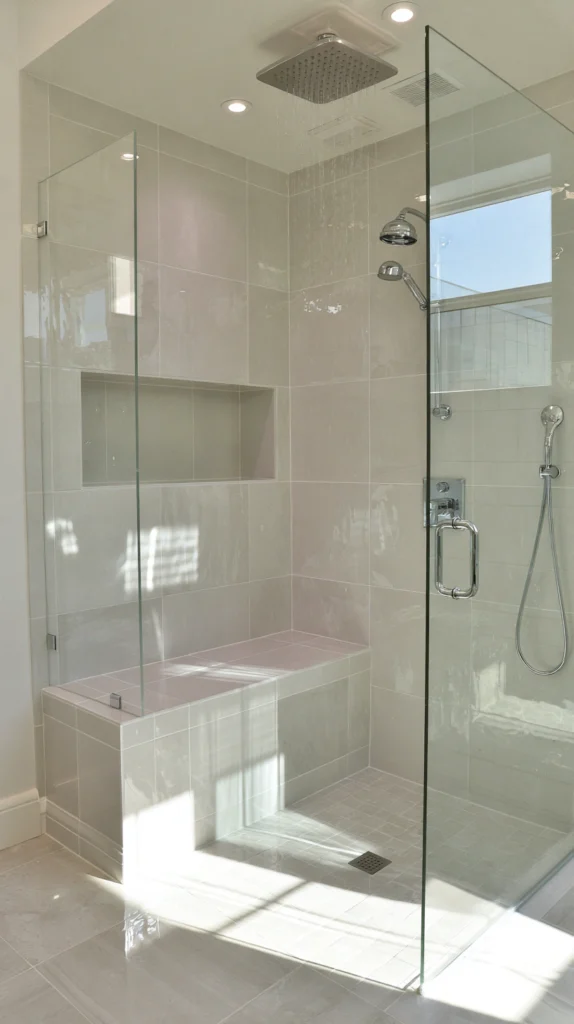
A shower bench positioned directly beneath a built-in tiled niche, combining seating with immediately accessible storage for shampoo, soap, and other products at hand height for a seated user.
Why pairing the bench with an overhead niche improves both features
A niche positioned at standing height serves a standing user well, but a seated user often cannot comfortably reach it. Positioning a niche specifically above or beside the bench, at a height reachable while seated, ensures both users have convenient product access.
The niche placement
Built into the wall directly above or immediately beside the bench, at a height easily reached from the seated position without requiring the user to stand or reach significantly.
The niche construction
Following standard built-in niche construction — waterproofed, tiled to match the surrounding wall — sized to hold the household’s typical daily shower products.
The shelving within
One or two shelves within the niche, providing organized, tiered storage rather than a single flat shelf that might not hold as many items conveniently.
The overall coordination
The niche and bench designed and installed together as one considered composition, rather than two separate features that happen to be near each other without any real coordination.
The daily use benefit
A genuinely convenient arrangement for a seated shower routine, addressing both the need to sit and the need to reach products without requiring any additional movement.
Cost breakdown: Built-in niche: $150–400 Bench (if not already included): $300–700 Total: $450–1,100
13. The Two-Tier Bench for Multi-Height Use
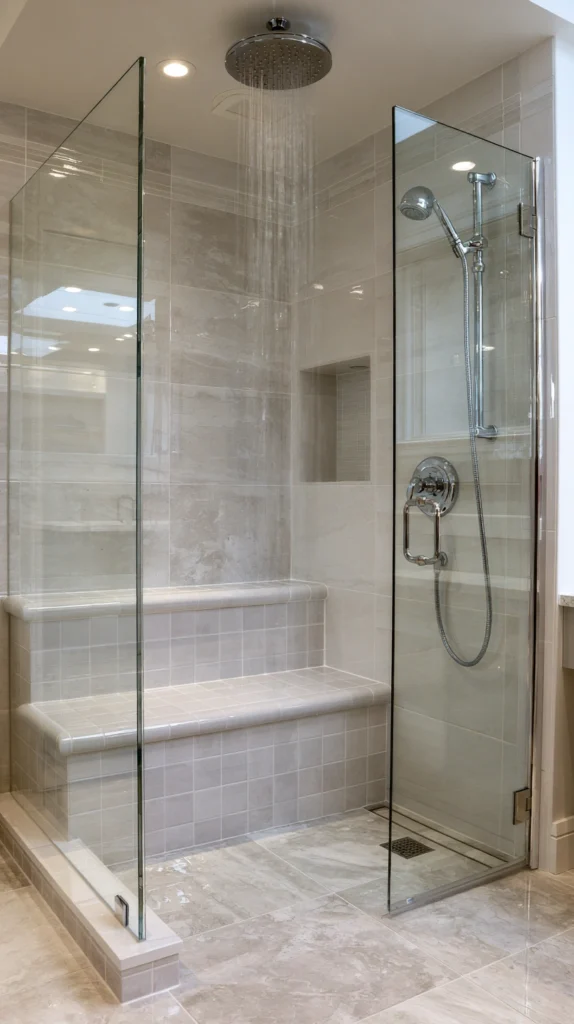
A bench with two distinct seat heights built into a single structure, providing options for different tasks or different users within the same household.
Why a two-tier design serves a wider range of needs than a single fixed height
A single bench height suits one specific use well but may not suit every task or every person equally — a lower tier might work better for foot washing, while a higher tier suits general seated bathing — a two-tier design accommodates both without requiring separate furniture.
The tier heights
A lower tier at roughly 10 to 12 inches, and a higher tier at the standard 17 to 19 inches, built as one continuous or adjacent structure within the shower.
The lower tier use
Particularly useful for washing feet, shaving, or as a step for children to reach the showerhead or fixtures more easily.
The higher tier use
Serving as the primary seat for general bathing, resting, or extended shower use.
The construction
Built as a single tiled unit with two distinct height levels, or as two separate but coordinated built-in benches at each specific height.
The household flexibility
Serving multiple household members and multiple specific tasks from one integrated structure, rather than requiring separate solutions for each different height need.
Cost breakdown: Two-tier built-in bench: $600–1,400 Total: $600–1,400
14. The Bench With Integrated Grab Bar
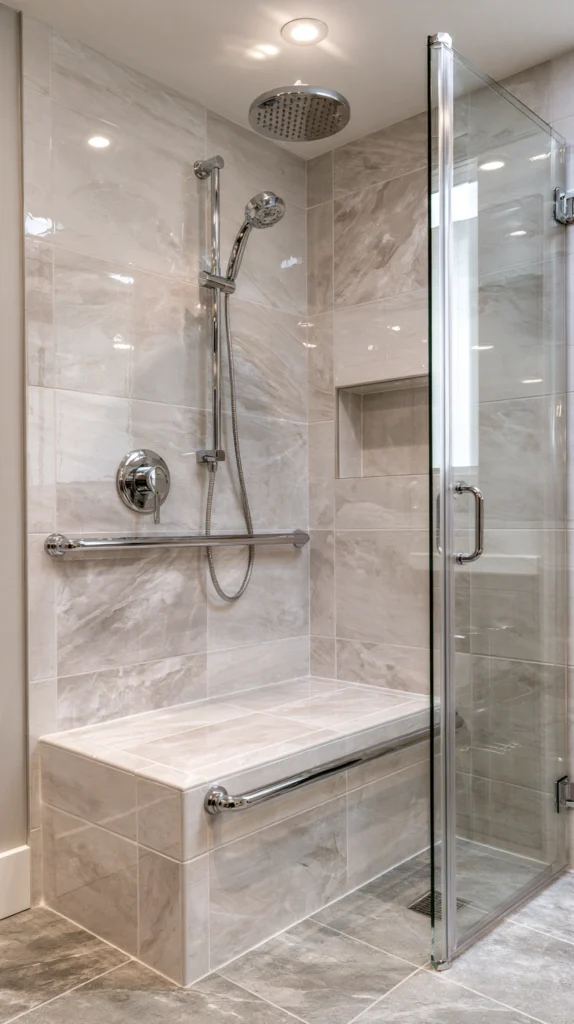
A shower bench installed alongside a coordinated grab bar, positioned specifically to assist with sitting down and standing back up safely.
Why pairing a bench with a grab bar addresses the transition, not just the seat itself
A bench alone addresses seated use, but the specific movements of lowering onto and rising from that seat, particularly on a wet, potentially slippery surface, benefit significantly from a properly positioned grab bar to assist with balance during that exact transition.
The grab bar placement
Positioned directly beside the bench, at a height and angle allowing a natural, secure grip during the specific motion of sitting down or standing up.
The rated installation
A grab bar rated to support significant body weight, installed into the wall’s structural framing rather than a decorative towel-bar-style fixture that lacks genuine load-bearing capacity.
The finish coordination
A grab bar finish matching the shower’s other fixtures, available in styles considerably more design-forward than the purely clinical bars once standard in accessible bathroom design.
The universal design benefit
Valuable for any user at any stage of life, not only those with specific current mobility needs, addressing the simple physical reality that sitting down and standing up on a wet surface benefits from secure support regardless of age or ability.
The overall safety improvement
A meaningful safety addition that directly complements the bench’s seating function, addressing the specific moments of transition rather than only the seated period itself.
Cost breakdown: Grab bar (rated, quality finish): $60–150 Installation: $100–250 Total: $160–400
15. The Complete Shower Bench Design (The Fully Considered Seated Shower)
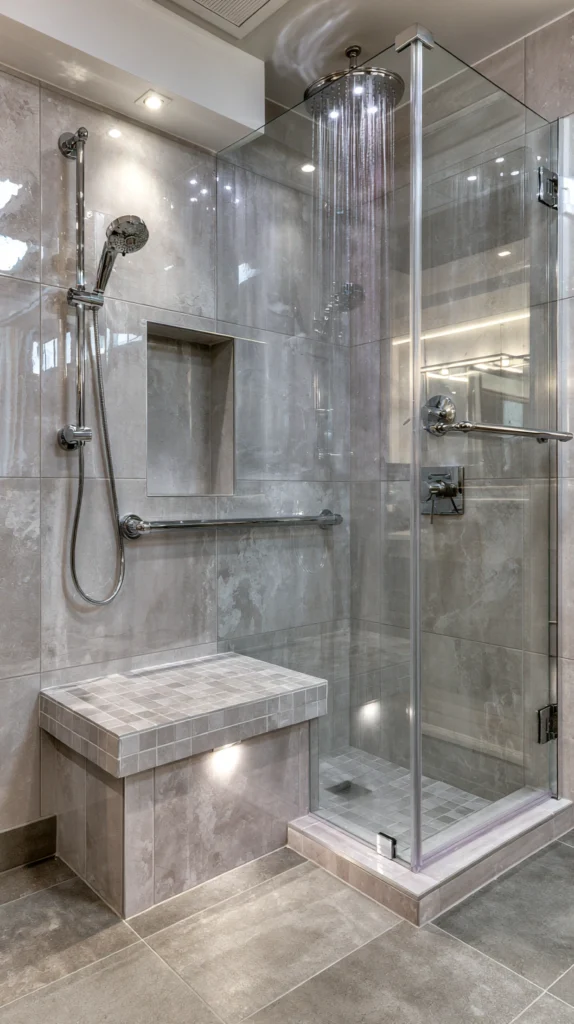
A complete shower bench design combining several of the approaches above — a properly constructed built-in seat, coordinated storage, a handheld showerhead, and a grab bar — treating seated shower use as a genuine, fully planned function rather than an afterthought addition.
What separates the complete design from a single bench added to an existing shower
A stool placed in an otherwise unchanged shower: a helpful addition. A complete shower bench design: every element — the seat’s construction, its height and depth, the nearby storage, the water control, and the safety support — planned together so seated shower use works as well as standing use does, rather than being a secondary accommodation.
The elements of the complete shower bench design
The bench itself
A properly constructed built-in or wall-mounted bench, sized and positioned with genuine comfort and stability in mind.
The water control
A handheld showerhead mounted at a height reachable from the seated position, ensuring water can be directed conveniently regardless of whether the user is standing or seated.
The storage
A built-in niche or under-bench storage positioned within easy reach, holding daily products at hand height for seated use.
The safety support
A properly rated grab bar positioned beside the bench, assisting with the specific transition of sitting and standing.
The slip resistance
Non-slip flooring and a bench design with adequate texture or slatting, addressing genuine safety throughout the seated shower experience.
The complete design in action
An evening shower:
Entering: The bench immediately visible and inviting, rather than a stool crowded awkwardly into a corner as an afterthought.
Sitting down: The nearby grab bar providing secure support during the transition onto the seat.
During the shower: The handheld showerhead easily reached and directed, shampoo and soap within arm’s reach from the built-in niche.
Standing back up: The same grab bar assisting the reverse transition, the whole experience feeling genuinely designed rather than improvised.
The complete shower bench design: not a single seat added to a standing-oriented shower, but a space genuinely planned to serve seated use as thoroughly and comfortably as it serves standing use.
Cost breakdown for the complete design: Assuming a starting point of a standard shower with no seating: Built-in or wall-mounted bench: $300–1,200 Handheld showerhead and mount: $280–700 Built-in storage niche: $150–400 Grab bar: $160–400 Total: $890–2,700
Phased over a renovation timeline:
Phase one: The bench itself, the foundational element every other addition supports
Phase two: The handheld showerhead and storage niche, addressing daily functional use
Phase three: The grab bar, completing the design’s safety consideration
The complete shower bench design: not an accessibility retrofit, but a genuinely well-planned shower that serves every household member, at every stage of life, equally well.
The Question Before Any Shower Bench Decision
Before choosing a specific bench style:
What is the primary reason for wanting seating in this particular shower?
If the answer is: a low-cost, no-construction starting point — the freestanding teak stool with rubber feet.
If the answer is: a full renovation already underway — the fully tiled built-in bench, planned alongside the shower’s other structural elements.
If the answer is: genuine accessibility or safety needs, current or anticipated — the foldable ADA-style bench paired with a grab bar.
If the answer is: a smaller shower with limited floor space — the corner-fitted bench or the floating wall-mounted design.
The design follows the household’s actual needs and the shower’s specific existing layout, more than any single universal bench style. Every idea on this list serves a genuinely different combination of comfort, safety, and space efficiency. The question is which combination matters most for this particular household and this particular shower.
The simple teak stool placed in an otherwise unchanged shower: still meaningfully improves the daily routine of shaving, foot washing, or a longer, more restful soak. The complete design, planned with real attention to seated use: a shower that serves everyone in the household, at every stage of life, without compromise.
That universal comfort: the whole point of taking shower seating seriously.
Getting Started This Weekend
The immediate shower bench solution:
Bring in a simple teak stool and test how it actually gets used before committing to anything permanent.
The lowest-cost, lowest-commitment way to confirm a bench genuinely improves the daily routine before investing in a built-in version.
Note the specific height and position that would feel most natural, based on that test.
Real use, rather than a generic standard measurement, should guide any eventual built-in bench’s exact height and depth.
Check whether the shower’s existing showerhead reaches a seated position comfortably.
If not, a handheld showerhead addition may matter as much as the bench itself.
Consider whether a grab bar is worth adding alongside, even with a simple freestanding stool.
The rest of the design: the elaboration of this moment.
The seat: the beginning. The shower: what gets built, and used, around it.