
15 Summer Shade Ideas for Hot Sunny Days
There is a version of a hot summer day that is entirely pleasant and a version that is entirely not, and the difference between them is almost always shade. The same temperature that feels unbearable on an exposed patio feels generous and warm beneath a tree, a sail, or a well-positioned canopy.
Shade does not cool the air — it simply removes the direct heat source, and the effect of that removal is immediate and significant enough to make an outdoor space usable that would otherwise be abandoned by mid-morning.
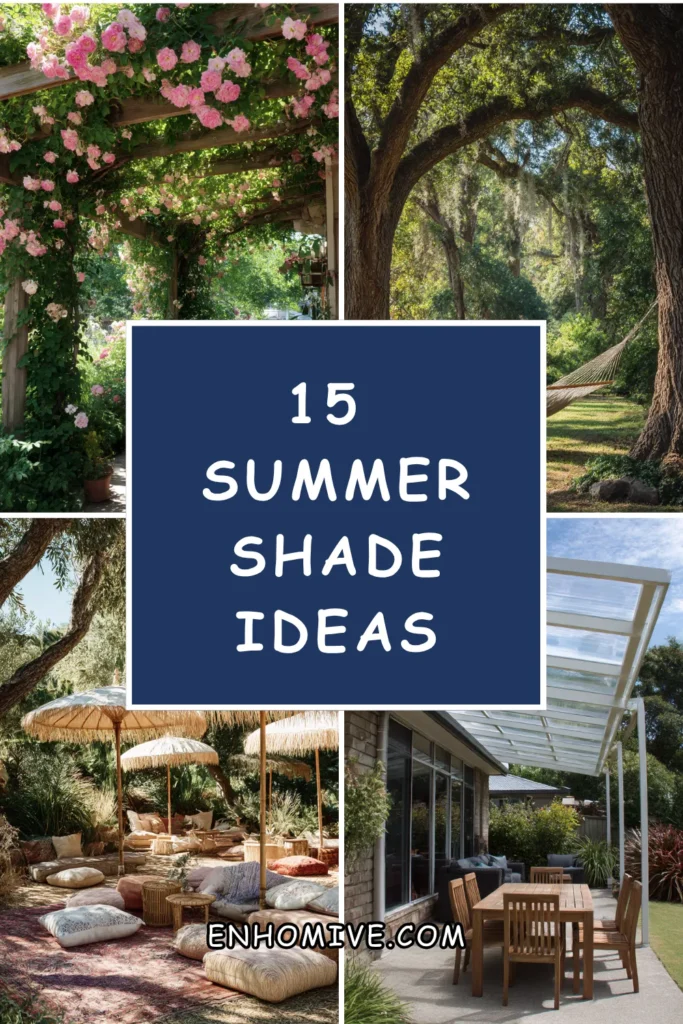
The fifteen ideas below treat shade as a design opportunity rather than a practical concession — not something bolted on after the fact because the sun turned out to be more intense than expected, but something planned for and executed with the same intention as any other element of an outdoor space. Each idea covers what you will need, what it will cost, and a practical tip to make it genuinely effective in a real garden, terrace, or backyard.
1. The Shade Sail Triangle Formation
Budget: $40 – $300
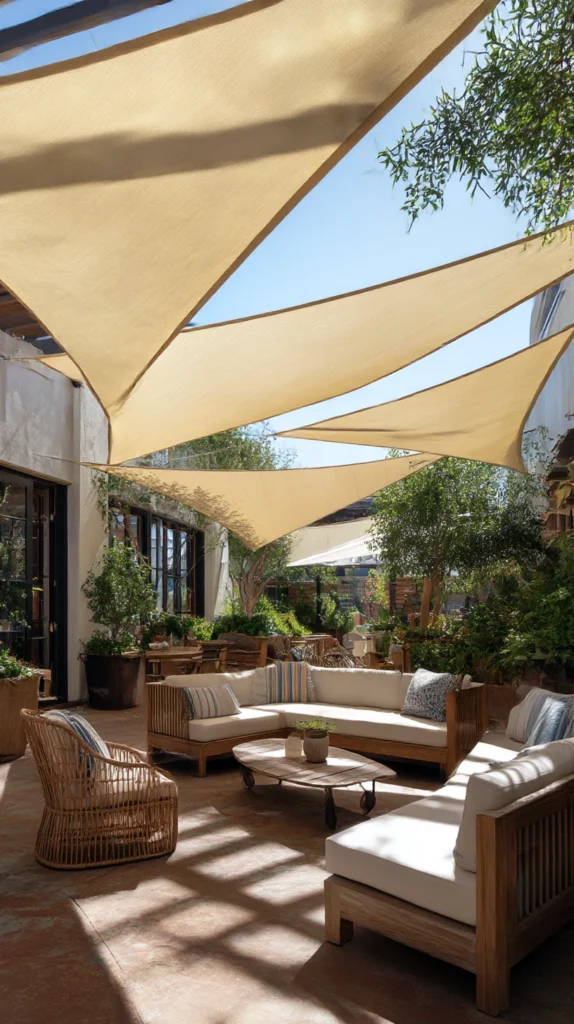
A shade sail — a tensioned triangle or rectangle of UV-resistant fabric stretched between three or four anchor points — is the most widely used and most visually flexible shade solution available for outdoor spaces. A single sail provides meaningful coverage for a dining table or a lounge area. Two or three sails overlapping at different heights create a layered canopy that covers a larger area while allowing airflow between the layers — which is considerably more effective than a single larger sail at the same height.
A quality UV-resistant polyester or HDPE shade sail in a standard triangle size costs $30 – $100. Stainless steel fixing hardware — eye bolts, turnbuckles, and carabiners — adds $15 – $40 per anchor point. Wall-mounted or post-mounted anchor points are the most common installation method. Three overlapping sails in complementary tones — natural, sand, and terracotta, for example — cost $90 – $300 in total and provide a layered canopy that is both functional and genuinely beautiful from beneath.
Decor tip: Install shade sails with a slope rather than horizontally flat. A flat sail collects water in its centre during rain and eventually sags under the weight. A sloped sail at a minimum pitch of 20 degrees sheds water cleanly to one side and maintains its tension after rain without adjustment. The slope also improves the aesthetic — a flat sail looks taught and utilitarian, while a sloped sail has a dynamic, architectural quality that improves the appearance of the space beneath it.
2. The Market Umbrella and Base
Budget: $60 – $400
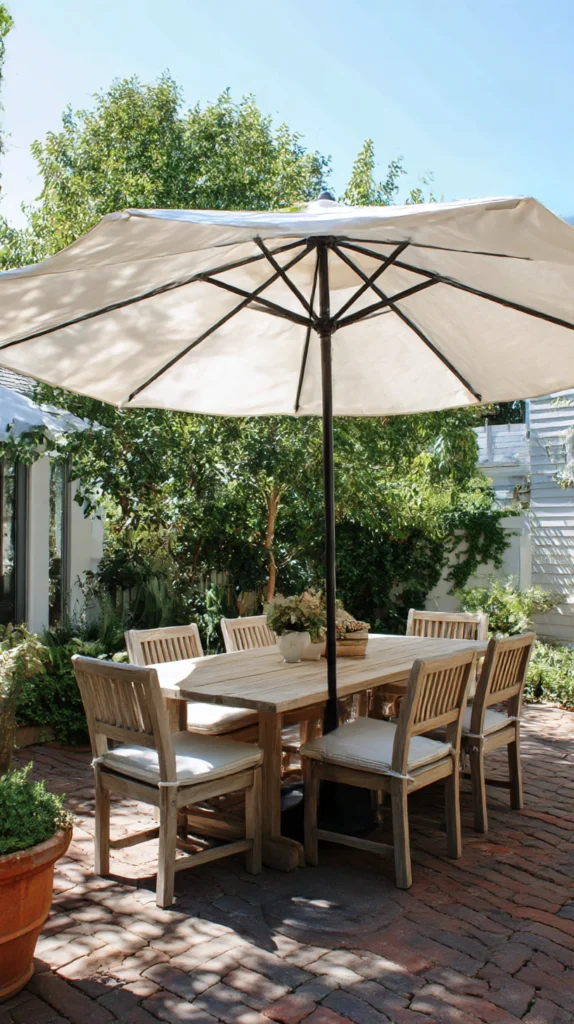
A large market umbrella — 2.7 to 3.5 metres in diameter, with a central pole and a weighted base — is the most portable and most flexible shade solution available. It requires no permanent installation, no anchor points in walls or posts, and no commitment to a fixed location. The umbrella moves with the sun, with the furniture arrangement, and with the changing use of the outdoor space throughout the day. For gardens and terraces without fixed structures, it is the most practical first shade investment.
A quality market umbrella in a fade-resistant polyester canopy with an aluminium pole costs $60 – $200. A weighted umbrella base — essential for any umbrella above 2.5 metres in diameter in any outdoor space exposed to wind — runs $30 – $80. A UV-resistant canopy in a natural or neutral tone fades more slowly than saturated colours and photographs better in the bright light of a summer day. A crank mechanism for opening rather than a push-up system costs slightly more and is used consistently more willingly.
Decor tip: Close the umbrella when not in active use rather than leaving it open overnight or during unattended periods. An open umbrella in an unattended garden acts as a sail in any wind above approximately 15 kilometres per hour — sufficient to topple even a well-weighted base and damage both the umbrella and anything it falls onto. A closed umbrella survives the same wind without drama. The habit of closing takes five seconds and saves the cost of replacement consistently.
3. The Pergola With Climbing Plants
Budget: $300 – $5000
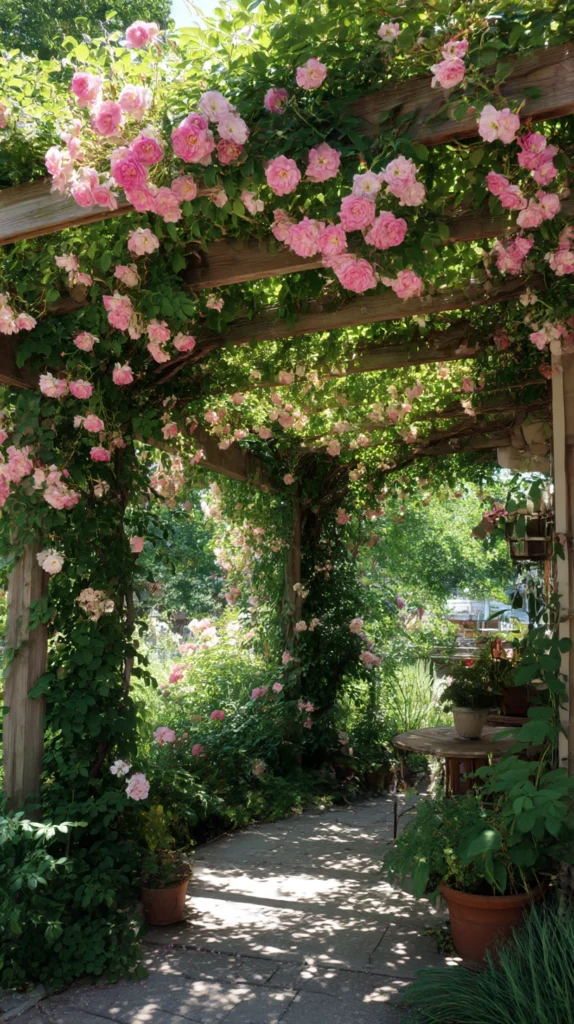
A pergola provides partial structural shade from the moment of installation and complete dappled shade within two to three seasons once climbing plants are established across its overhead structure. Wisteria, climbing roses, jasmine, and Virginia creeper all grow across a pergola structure with vigour, and the canopy of living foliage they produce is the most beautiful shade available in any garden — dynamic, scented in several varieties, and genuinely different in quality from any fabric or synthetic alternative.
A timber pergola kit in pressure-treated pine costs $300 – $800 for a standard size. A custom hardwood version runs $2000 – $5000 installed. Climbing plants — wisteria, rose, or jasmine — cost $15 – $40 each from a garden centre, and two plants per upright post is a generous planting rate that provides full coverage within three seasons. The shade provided by a mature wisteria across a pergola is complete, fragrant in late spring, and produces a light quality beneath it — green-filtered, moving with any breeze — that no artificial shade structure can approach.
Decor tip: Train climbing plants horizontally across the overhead structure from the first season rather than allowing them to grow vertically. A plant that grows straight up produces a column of foliage rather than a canopy. A plant whose lateral shoots are tied horizontally across the pergola beams from the beginning produces a flat, even canopy significantly faster than one left to find its own direction. Early training costs nothing and reduces the time to full coverage by a full season.
4. The Retractable Awning
Budget: $300 – $3000
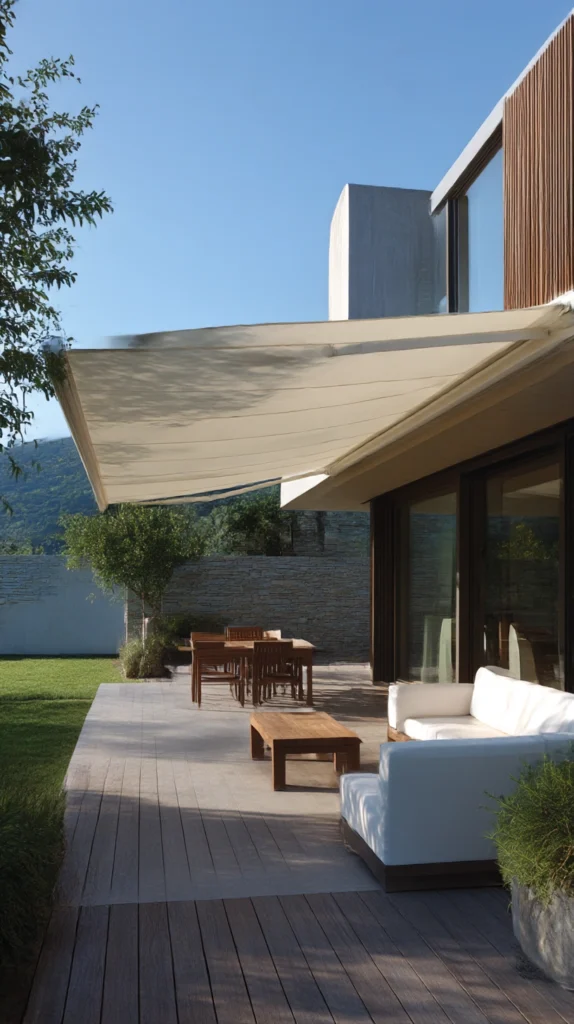
A retractable awning — a fabric canopy on an extendable arm mechanism fixed to an exterior wall — is the most convenient shade solution available for a terrace directly adjacent to the house. It extends in seconds, retracts in seconds, and in its retracted position takes up almost no visual space. The mechanism protects the fabric from UV degradation and rain when the shade is not required, which extends the life of the canopy significantly compared to a permanently deployed fabric structure.
A manual crank retractable awning in a standard 3-metre width costs $300 – $800. A motorised version — extending and retracting at the touch of a button or a remote — runs $600 – $2000 depending on width. Professional installation adds $100 – $300 and ensures that the wall fixings are appropriate for the load, which is particularly important on rendered or cavity wall constructions where the pull force of a deployed awning in wind is significant. A wind sensor that automatically retracts the awning in high wind — $50 – $150 additional — is worth specifying for any exposed location.
Decor tip: Choose an awning fabric in a solid neutral rather than a stripe or pattern if the awning will be visible from inside the house when extended. A striped awning viewed from inside through a glass door or window introduces a pattern into the interior view that can conflict with the interior decoration. A solid natural, cream, or charcoal awning reads as a neutral architectural element from inside and a considered shade canopy from outside — which is the correct balance for a fitting that serves both perspectives simultaneously.
5. The Sail Between Buildings
Budget: $50 – $400
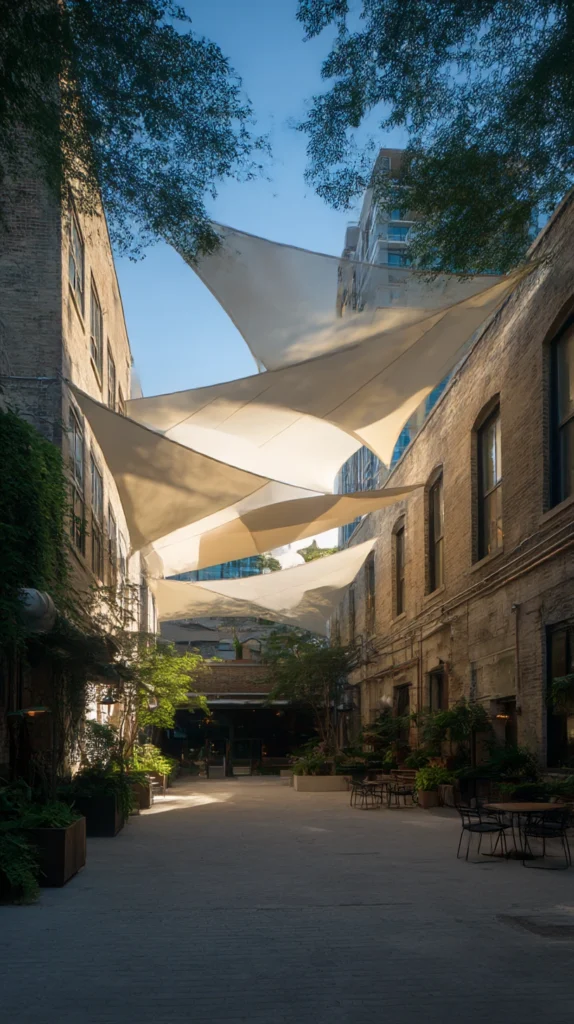
In gardens, courtyards, or terraces flanked by buildings on two or more sides, a shade sail or tensioned fabric panel stretched between the buildings at roofline height provides shade for the entire ground-level space beneath without requiring any freestanding post or pergola structure. The buildings provide the anchor points, the fabric provides the canopy, and the result is a shaded courtyard that feels like a room with an open sky ceiling — contained, protected from direct sun, and significantly cooler than an equivalent exposed space.
A heavy-duty waterproof shade sail rated for permanent installation costs $80 – $200. Stainless steel fixing hardware for wall anchor points — expansion bolts and eye plates rated for the load — adds $30 – $60 per wall. In a courtyard with four walls, two opposing walls provide the tension points and the sail stretches between them. The installation is permanent rather than seasonal, which requires a fabric specification rated for UV exposure and rain rather than a standard shade sail designed for seasonal use.
Decor tip: Install a drainage channel or a gutter lip along the lower edge of the sail if the courtyard below has no alternative drainage route for rainwater. A permanently installed waterproof sail in a courtyard with solid walls on all sides concentrates rainfall into the lowest point of the sail and delivers it in a single stream wherever that point falls. Without drainage provision, this stream hits the courtyard floor and splashes furniture and anyone sitting nearby. A simple gutter at the sail’s lowest point redirects the water to a drain or a planted border.
6. The Bamboo and Reed Screen Canopy
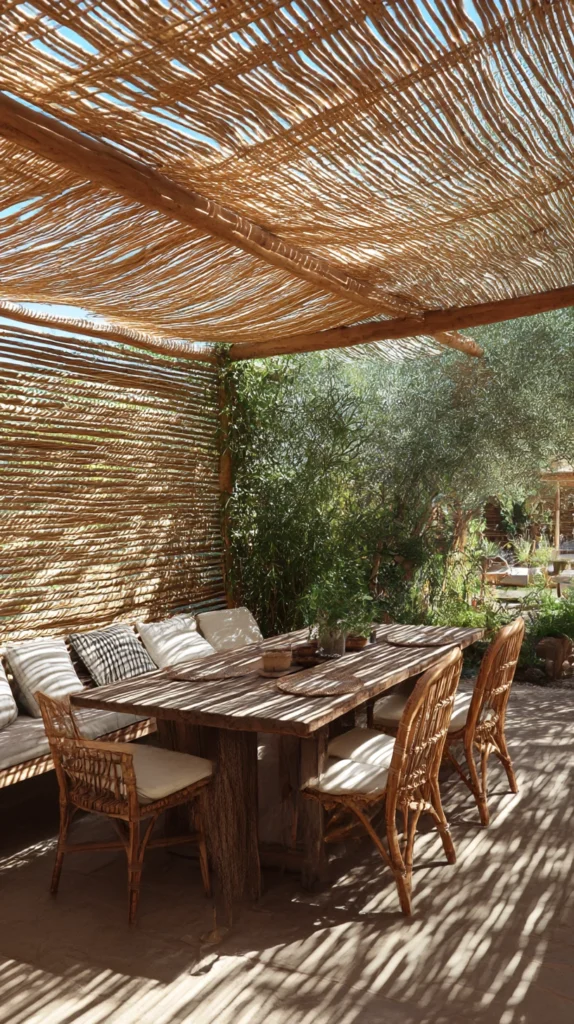
Budget: $30 – $200
Rolled bamboo or reed screening — the material most commonly used for fence privacy panels — can be deployed horizontally as a lightweight overhead shade structure on a simple timber frame. The open weave of the material allows airflow while blocking 60 to 70 percent of direct sunlight, which is sufficient to prevent the burning intensity of direct summer exposure while maintaining the open, outdoor quality of the space beneath. It is particularly effective over a dining terrace where the goal is comfortable shade rather than complete sun exclusion.
Rolled bamboo screening in a 1.8 metre width costs $15 – $40 per roll. A simple timber frame of 4×4 posts with cross beams to support the screening costs $50 – $150 in materials for a standard terrace size. Cable ties or wire to fix the rolled screening to the frame add $5 – $10. The total shade structure for a 3×4 metre terrace sits at $70 – $200 — significantly less than any fabric sail or awning alternative and quicker to install than any structure requiring post foundations.
Decor tip: Treat bamboo screening with an exterior wood preservative or a UV-resistant sealant before installing it horizontally. Bamboo screening designed for vertical fence use is not manufactured to the same UV resistance specification as purpose-made shade fabrics, and horizontal deployment exposes it to more direct sunlight than vertical installation. A single coat of sealant applied before installation doubles the useful life of the screening in an overhead application.
7. The Freestanding Gazebo
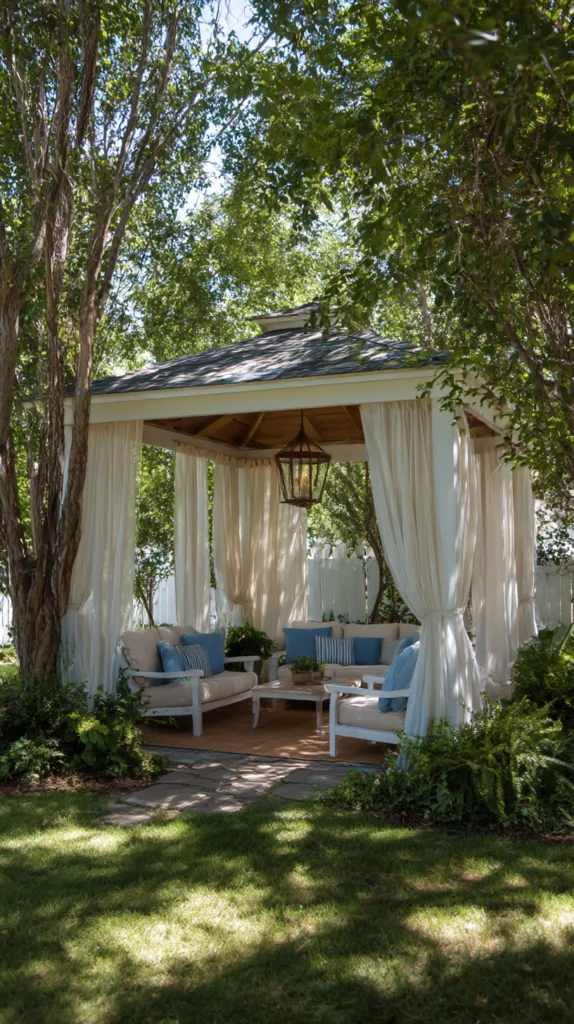
Budget: $100 – $3000
A freestanding gazebo — a four-posted structure with a solid or fabric roof and optional side panels — provides complete overhead coverage for the area beneath it and can be positioned anywhere in a garden that the surface allows. The pop-up fabric gazebo at the lower end of the budget range is a seasonal structure that assembles and disassembles in an hour. The permanent timber or metal gazebo at the upper end is a garden architecture piece that defines the space as a room with a permanent outdoor address.
Pop-up fabric gazebos with a steel frame cost $100 – $300 and are appropriate for seasonal use. A timber or powder-coated steel freestanding gazebo with a polycarbonate or steel roof runs $500 – $2000. A custom-built hardwood gazebo — oak, cedar, or iroko — with an integrated roof and optional glass or polycarbonate side panels costs $2000 – $5000 installed and is a permanent garden building rather than a garden accessory. Ground anchoring with concrete pads or screw anchors is essential for any gazebo in an exposed location.
Decor tip: Add side curtains in a weather-resistant outdoor fabric to at least two sides of a freestanding gazebo. A gazebo without side panels provides overhead shade but no protection from low-angle afternoon sun or from wind-driven rain — the two conditions most likely to end an outdoor gathering prematurely. Curtains that can be drawn when required and tied back when not needed give the gazebo the flexibility that a fixed structure alone cannot provide.
8. The Tree Canopy Hammock Zone
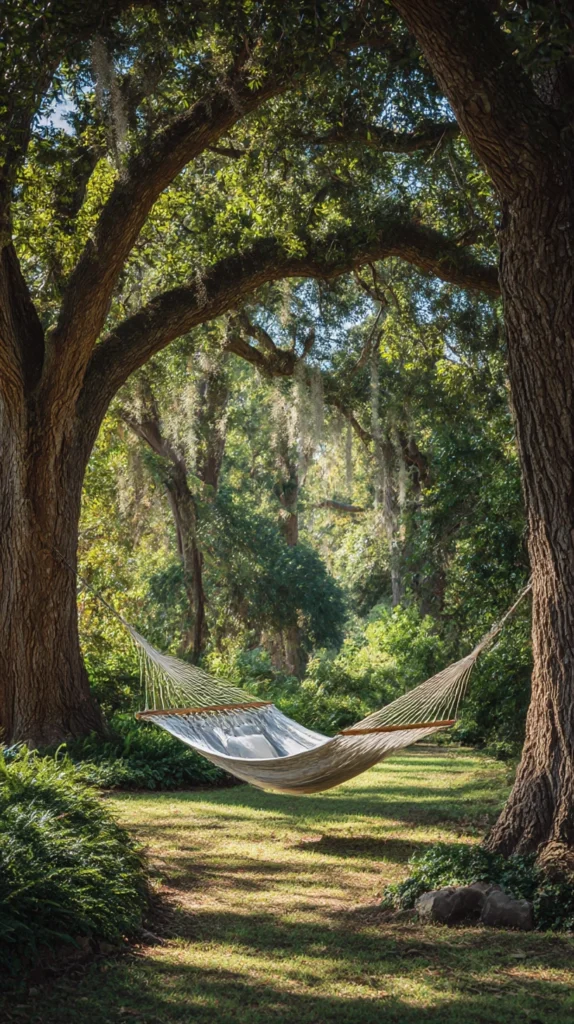
Budget: $40 – $150
An existing mature tree with a wide canopy is the most effective shade structure in any garden and also the most underused. The natural canopy of a mature oak, beech, apple, or lime tree provides dappled shade across a wide area beneath it, filters the light to a quality that fabric shade cannot replicate, and creates an ambient cooling effect from the moisture transpiration of its leaves that is measurable as a temperature reduction of two to four degrees compared to an equivalent area of exposed ground.
A hammock or a set of low-slung hammock chairs positioned beneath a mature tree canopy costs $40 – $150 in furniture. The tree itself costs nothing — it is already there, already growing, already doing the work. The only investment is in recognising the shade it provides and giving it seating that acknowledges that quality. A simple side table, a cool drink, and an afternoon beneath a mature tree is one of the genuinely free pleasures that summer makes available.
Decor tip: Clear the ground beneath the tree canopy of any grass competition and replace it with a layer of woodchip mulch — $10 – $30 for a bag sufficient for a standard tree base. Mulch keeps the ground beneath the tree cool and moisture-retentive, suppresses weeds, and creates a surface that reads as a defined outdoor room rather than a patch of struggling grass. The mulched area under the tree becomes a visually defined destination rather than simply a shaded section of the lawn.
9. The Outdoor Curtain Shade Wall
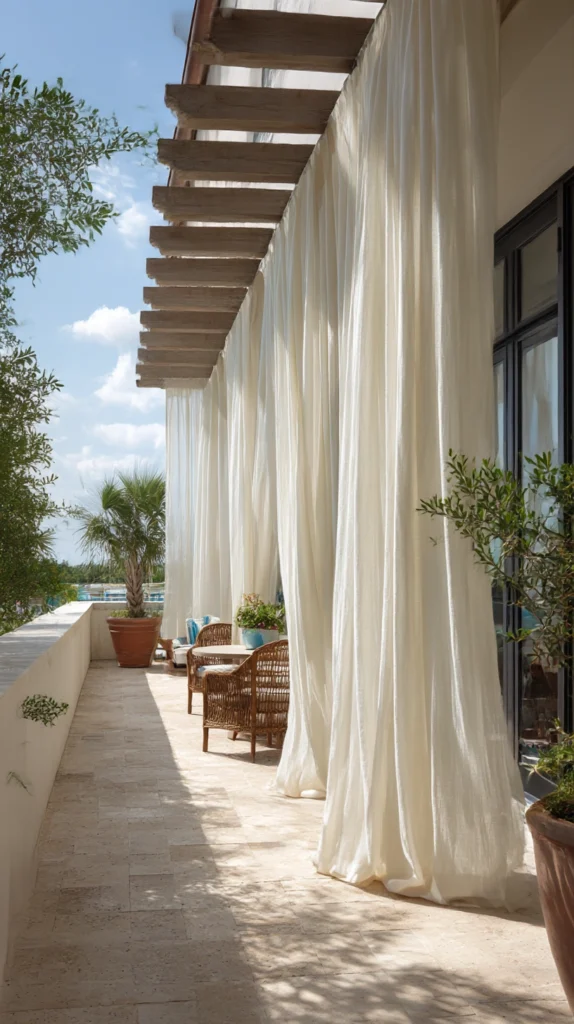
Budget: $30 – $200
Outdoor curtain panels — hung from a tension wire or a curtain rod fixed between two posts or along a wall — provide shade on the sun-facing side of a terrace in a format that is both practical and genuinely beautiful. A set of white or natural linen outdoor curtains billowing in a summer breeze creates one of the most evocative summer images available, and the shade they provide by blocking lateral sun on an afternoon terrace is considerably more effective than an overhead sail at preventing the low-angle afternoon sun that makes west-facing terraces unusable from 3pm onward.
Outdoor-rated curtain panels in a weather-resistant fabric cost $20 – $60 each. A stainless steel tension wire with hooks and turnbuckles to span a 3-metre opening runs $20 – $50. Curtain rings rated for outdoor use add $8 – $20 for a pack. A full set of outdoor curtains across a 3-metre terrace opening costs $60 – $200 in total and provides shade that adjusts — opening and closing as the sun moves — in a way that fixed shade structures cannot.
Decor tip: Weight the hem of outdoor curtain panels with a thin rod or a row of stainless steel washers sewn into a hem pocket. Outdoor curtains without a weighted hem billow unpredictably in any breeze — which is beautiful in a photograph and irritating in practice when the panel wraps around a guest or drapes across the dining table. A weighted hem maintains the drape of the panel in all but the strongest wind and transforms the curtain from a visual element into a functional one.
10. The Polycarbonate Lean-To Roof
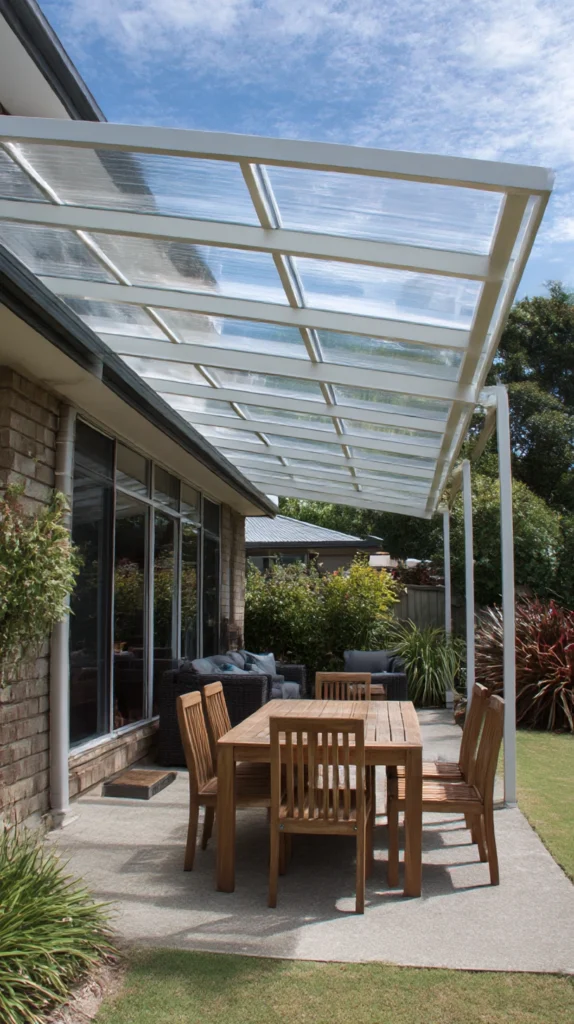
Budget: $200 – $2000
A lean-to structure — a sloped roof fixed at one end to the exterior wall of the house and supported at the other end by posts — is the most practical permanent shade solution for a terrace directly adjacent to the house. A clear or tinted polycarbonate panel roof admits light while blocking UV and provides complete protection from rain simultaneously, making the terrace beneath it a genuinely all-weather space rather than a shade structure that requires dry weather to function.
Polycarbonate roofing panels cost $20 – $60 per square metre. A timber lean-to frame for a 3×4 metre terrace costs $150 – $400 in materials for a DIY build. Professional installation of a complete lean-to with foundations, frame, and glazing runs $500 – $2000 depending on size and specification. Opal or bronze tinted polycarbonate — rather than clear — reduces glare and heat transmission significantly and produces a more even, diffused light beneath the structure than clear panels allow.
Decor tip: Specify a minimum roof pitch of 10 degrees for any polycarbonate lean-to to ensure adequate rain drainage. A flatter pitch allows water to pool in the panel joints and produces a persistent dripping from the leading edge rather than clean drainage from the gutter. A 10-degree minimum pitch — achievable even on a low-profile lean-to with careful wall fixing height adjustment — drains cleanly and quietly in any rainfall.
11. The Living Wall as a Shade Screen
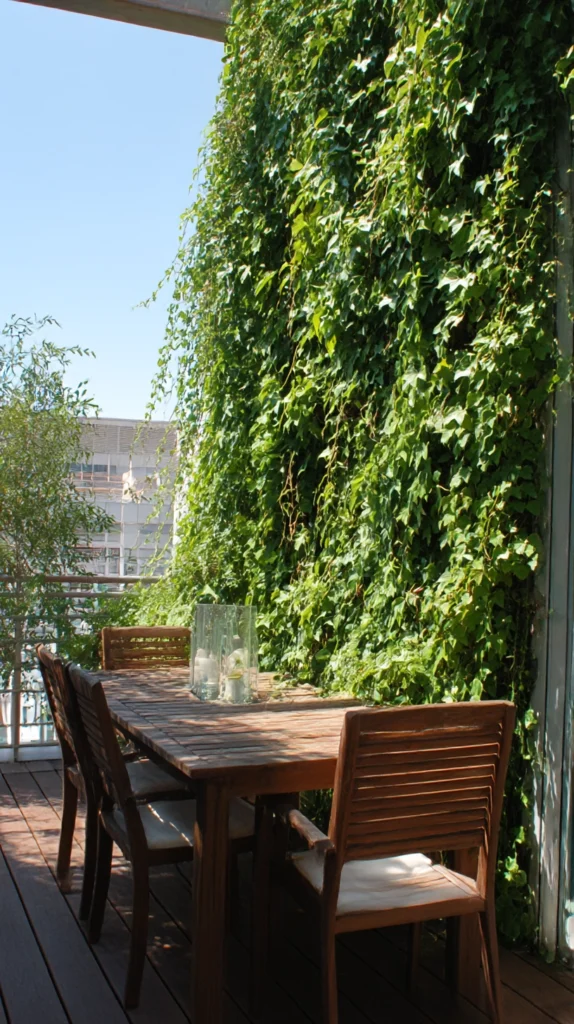
Budget: $80 – $600
A living wall or a densely planted trellis panel on the sun-facing side of a terrace blocks direct sunlight in the same way as a curtain or a screen, while adding the additional benefits of plant transpiration cooling, oxygen production, and visual beauty that no fabric or synthetic alternative can provide. A south or west-facing trellis planted with climbing plants — a dense ivy, a rapid jasmine, a vigorous climbing hydrangea — provides shade within one to two seasons and improves in both effectiveness and appearance every year thereafter.
A timber trellis panel in a standard 1.8×1.8 metre size costs $20 – $50. Climbing plants in three-litre pots — sufficient to establish quickly — cost $8 – $15 each. Three plants per trellis panel is a planting density that produces coverage within a single season. A freestanding trellis frame on feet — no wall fixing required — costs $40 – $100 for a 1.8-metre height and can be repositioned as the garden use changes.
Decor tip: Choose climbing plants based on the direction of sun exposure the trellis faces. A south-facing trellis receives the most intense sun and benefits from a vigorous, sun-tolerant climber — Virginia creeper or climbing hydrangea. A west-facing trellis receives afternoon sun and suits jasmine or climbing roses, which perform best in the warm afternoon light. A plant chosen for its tolerance of the specific aspect it will occupy establishes faster and provides coverage sooner than one placed without reference to sunlight direction.
12. The Umbrella and Canopy Combination
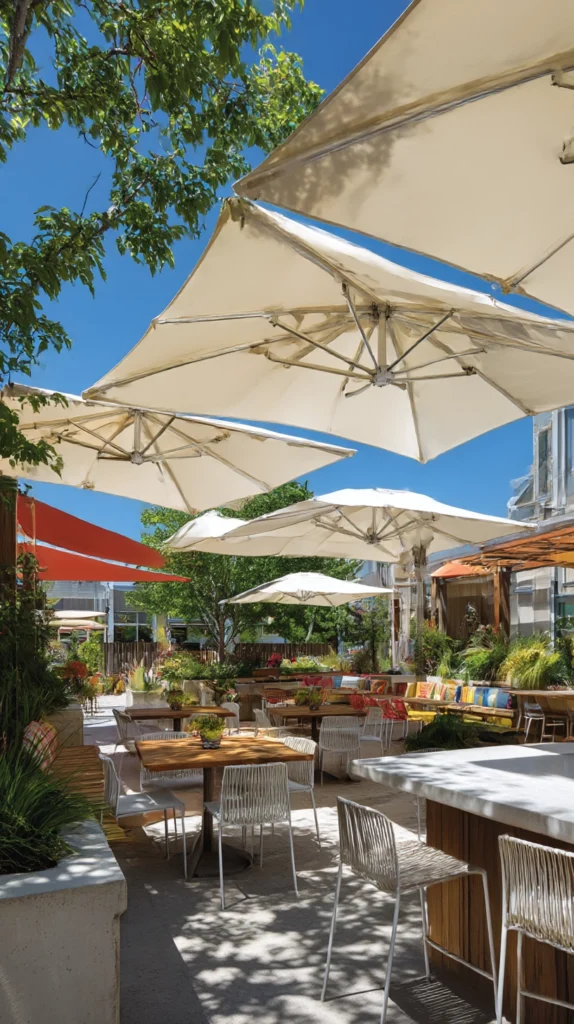
Budget: $100 – $600
A market umbrella positioned at one end of a seating arrangement combined with a smaller cantilever umbrella positioned at the other end — two independent shade sources covering different parts of the same space — provides flexible, adjustable coverage that a single fixed canopy cannot match. As the sun moves through the day, the umbrellas can be repositioned or angled independently to maintain shade over the areas where people are sitting rather than providing static coverage over a fixed footprint.
A large market umbrella costs $60 – $200. A cantilever umbrella — side-mounted rather than central-pole, which allows positioning over a seating area without the pole obstructing the centre of the table — runs $80 – $300 with a weighted base. Two umbrellas in the same canopy colour provide coordinated coverage across a larger area than either alone for a total investment of $140 – $500. The flexibility of two independent shading units is the feature that justifies the additional cost over a single larger umbrella.
Decor tip: Position cantilever umbrellas so that the base weight is on the opposite side of the pole from the canopy — which is the correct installation for all cantilever designs — and ensure the base weight is sufficient for the canopy diameter. An undersized base on a large cantilever umbrella in any wind above approximately 20 kilometres per hour is a significant safety concern. Manufacturers publish minimum base weights for each canopy size — always meet or exceed the stated minimum rather than using whatever base is available.
13. The Bamboo Parasol Garden Cluster
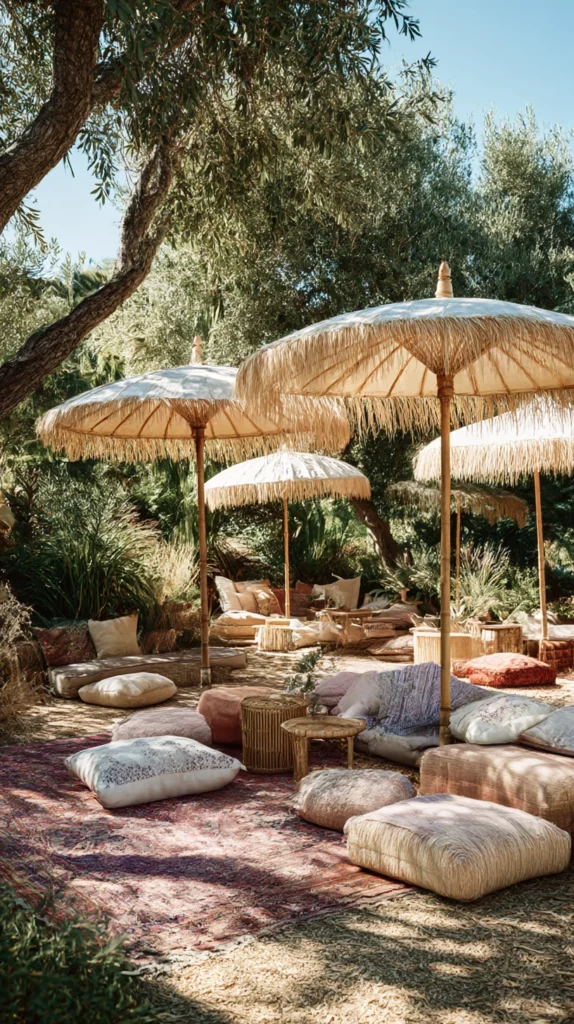
Budget: $60 – $400
A cluster of bamboo or rattan parasols — three or four positioned at varying heights and angles across a garden seating area — creates a shade arrangement that is visually distinctive and functionally generous. Unlike a single large umbrella, a cluster of smaller parasols provides shade at multiple points simultaneously, creates interesting shadow patterns on the ground beneath, and allows individual parasols to be repositioned as the sun moves without disrupting the coverage of the others.
Natural bamboo parasols with a palm leaf or thatched canopy cost $20 – $60 each. A set of four positioned across a 4×4 metre seating area costs $80 – $240 in total. Parasol bases or ground stakes — $10 – $20 each — anchor each parasol independently. The thatched natural canopy provides 60 to 70 percent shade coverage and has a visual quality — warm, organic, tropical — that synthetic canopy materials cannot approach.
Decor tip: Vary the height of parasols within the cluster rather than setting all poles at the same extension. Parasols at the same height create a flat ceiling effect that reads as static. Parasols at three different heights — one fully extended, one at three-quarter height, one at half height — create a layered canopy with depth and visual interest that looks deliberately designed rather than identically positioned.
14. The Linen Canopy on a Simple Frame
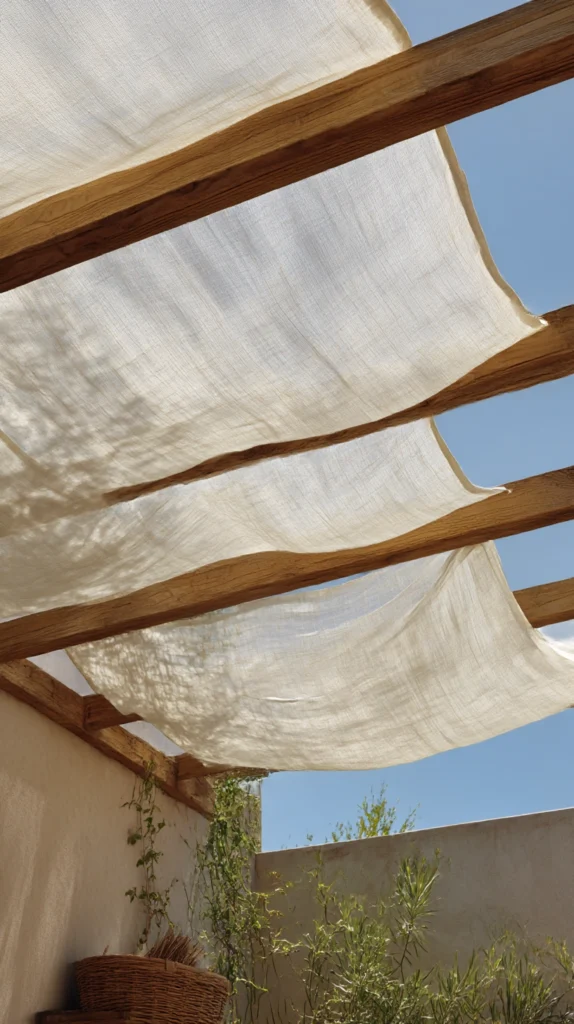
Budget: $40 – $250
A length of heavy linen or outdoor canvas stretched over a simple timber frame — four posts and a series of cross beams — creates the most rustic and the most beautiful shade canopy available at any price point. The fabric filters light to a warm, diffused quality that is unique to natural woven materials, it moves gently in a breeze in a way that solid panels do not, and it weathers over seasons to a softened, slightly irregular surface that becomes more beautiful with time rather than less.
Natural linen by the metre costs $8 – $20 per metre — a 3×4 metre canopy requires approximately 12 metres of 1.5-metre-wide fabric. A timber frame of 4×4 posts with cross beams costs $80 – $150 in materials. Stainless steel staples or copper clips to fix the fabric to the frame add $10 – $20. The total material cost for a linen canopy and frame sits at $130 – $290 — and the result is a shade structure that looks considerably more expensive and considerably more considered than its price point suggests.
Decor tip: Treat the linen canopy with a water-resistant spray — available from outdoor fabric suppliers for $15 – $30 per can — before the first rain of the season. Untreated linen absorbs rain and takes hours to dry, becoming heavy and saggy in wet conditions. A water-resistant treatment causes rain to bead and run off the surface, maintaining the fabric’s shape and allowing it to dry quickly after even heavy rainfall.
15. The Green Roof Pergola
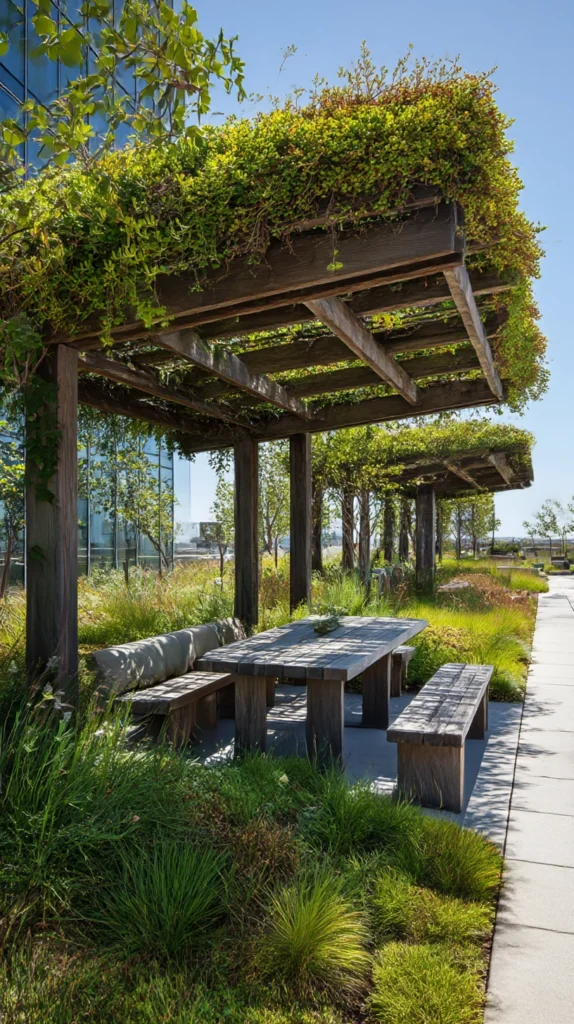
Budget: $400 – $4000
A pergola fitted with a lightweight growing medium and planted with low-growing sedums, succulents, or trailing herbs across its overhead structure produces the most ecologically valuable and visually extraordinary shade structure available for a domestic garden. The plants provide shade through their density, cool the air beneath through transpiration, absorb rainwater, and create a living ceiling that changes with the seasons — green and lush through summer, structural and frost-covered in winter.
A standard timber pergola structure capable of supporting a green roof — the additional load of growing medium and plants requires a heavier structural specification than a standard pergola — costs $400 – $1200 in materials for a DIY build. A proprietary green roof tray system for the overhead panels — planted with pre-grown sedum mat — costs $40 – $80 per square metre. A 3×4 metre green roof pergola requires approximately 12 square metres of planting, bringing the total green roof component to $480 – $960.
Decor tip: Use a sedum mat rather than loose growing medium and individual plants for the overhead planting. Loose growing medium on an overhead structure is heavy, requires containment on all edges, and takes a full season to produce coverage. A pre-grown sedum mat — roots already established in a lightweight growing medium layer — is installed as a single roll, provides immediate coverage, and weighs significantly less per square metre than an equivalent depth of loose soil. The weight reduction also reduces the structural specification required for the pergola frame, which lowers the overall project cost.
Whatever combination of these fifteen shade ideas finds its way into the garden or outdoor space, the underlying principle is the same throughout: shade is not an afterthought — it is the condition that makes outdoor living genuinely possible on the hottest and brightest days of the year.
A garden without planned shade is a garden that belongs to the sun rather than to the people who live in it. Plan the shade before the furniture, position it for the sun angles that actually matter in the hours the space will be used, and build it with enough permanence that it is there and working on the first genuinely hot day without requiring assembly, installation, or improvisation.
The best summer days are spent outside. Make sure the outside is ready for them.