
11 Summer Shelf Styling Ideas That Look Clean and Aesthetic
There is a particular kind of shelf that stops a person mid-room. Not because it is crammed with objects or because every surface has been covered, but because something about the arrangement feels right — considered without being laboured, full without being cluttered, personal without being chaotic.
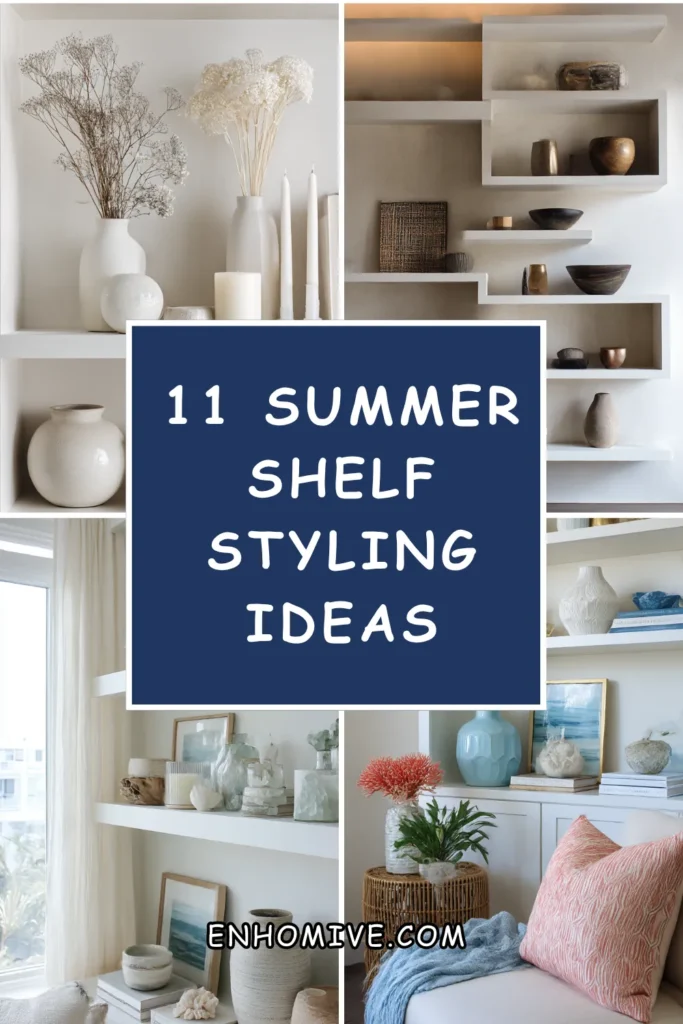
That quality is not accidental and it is not expensive. It is the result of a small number of good decisions made consistently: what goes on the shelf, what does not, how much space is left between things, and whether the whole arrangement speaks in a single coherent voice or shouts in several competing ones.
In summer especially, shelves deserve a seasonal reconsideration. The heavy, layered arrangements that suit a winter interior — the dark ceramics, the chunky candles, the dense collections of books — can feel oppressive in the longer, brighter days of summer. A summer shelf breathes. It uses light, natural materials, open space, and a palette drawn from the season rather than imposed upon it.
The eleven ideas below cover every approach to summer shelf styling — from a single statement shelf to a full wall of shelving — and each one is built on principles that produce a genuinely clean and aesthetic result in a real home rather than a curated studio. Each idea covers what you will need, what it will cost, and a practical tip to make it work consistently rather than beautifully for one photograph and chaotically for every day that follows.
1. The Coastal Edit
Budget: $30 – $150
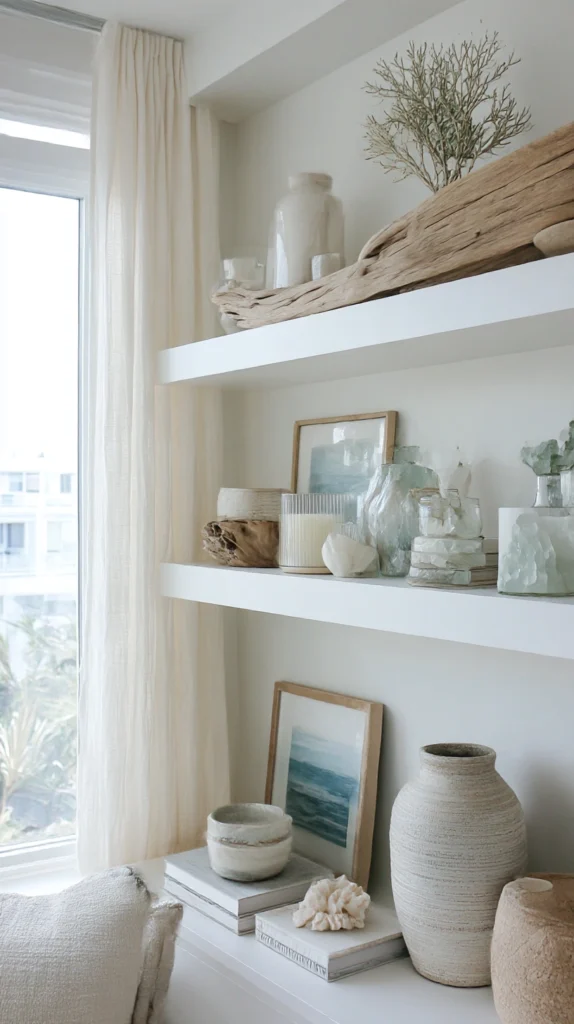
A coastal shelf arrangement works because it draws from a coherent material world — sea glass, driftwood, pale ceramic, natural rope, and shell — and applies those materials with restraint. The mistake most people make with a coastal shelf is adding too much: too many shells, too many small objects, too many colours from the beach palette. The coastal edit that works is the one that has removed everything unnecessary and left only what is genuinely beautiful in the right quantity.
A single piece of driftwood as a horizontal anchor costs $5 – $20 from a florist or online. Two or three sea glass pieces in a shallow ceramic bowl run $10 – $25. A tall pale ceramic vase holding a single stem of dried pampas or bleached wheat costs $15 – $40 for the vase and $8 – $20 for the botanical. A small woven rattan object — a mini basket, a woven ball, a coiled rope object — adds texture for $8 – $20. The total shelf cost sits at $41 – $105 and the palette runs exclusively in whites, naturals, and the washed blue-greens of sea glass.
Styling tip: Limit the colour palette to three tones at most — white, natural, and one accent drawn from the coastal world, whether that is the pale blue-green of sea glass, the warm sand of undyed linen, or the bleached grey of driftwood. A coastal shelf that introduces four or five colours loses the calm, washed quality that makes the aesthetic work and begins to read as a collection of beach souvenirs rather than a considered arrangement.
2. The Botanical and Green Living Shelf
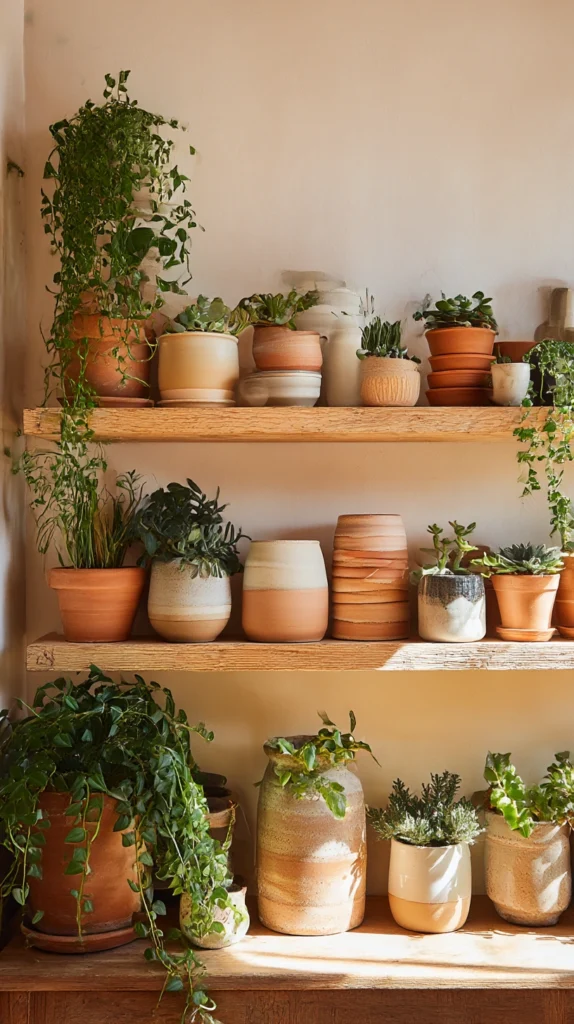
Budget: $40 – $200
A shelf given over primarily to living plants — varied in height, varied in leaf shape, arranged with enough space between each pot that the foliage does not merge into a single undifferentiated mass — is the summer shelf at its most vital and its most seasonal. Green is the colour of summer, living plants communicate care and attention, and a shelf of well-chosen plants in the right light transforms a wall from a storage surface into something that feels genuinely alive.
Small pothos, trailing string of pearls, compact snake plants, and air plants all suit shelf conditions. A selection of four small plants in terracotta or ceramic pots costs $30 – $80 in total. Matching terracotta pots in graduated sizes — $3 – $8 each — unify the arrangement without requiring identical plants. A small stack of two or three books beside one plant cluster adds visual variety and breaks the botanical uniformity with a different object type. A simple marble or slate saucer beneath each pot protects the shelf surface and costs $3 – $8 each.
Styling tip: Group plants in odd numbers rather than even. A single plant, three plants, or five plants reads as a collection. Two plants or four plants reads as a pair — which is a different and less dynamic visual effect. Within a group of three, vary the heights by at least 15 centimetres between the tallest and the shortest to create a profile that moves up and down rather than sitting flat across the shelf.
3. The Monochrome White Shelf
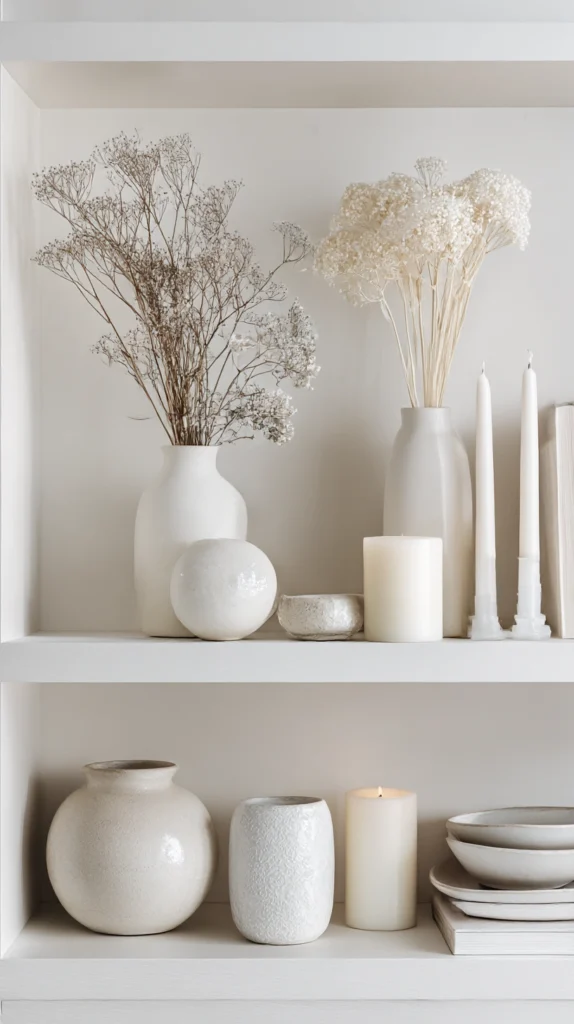
Budget: $30 – $200
A shelf styled entirely in white — white ceramics, white linen spines on books turned away from the viewer, white candles, white-painted objects, dried white flowers — is the cleanest and the most confident shelf aesthetic available. It requires no colour coordination, no palette management, and no seasonal adjustment. It simply requires a commitment to the single tone and the discipline to remove anything that breaks it. In summer especially, an all-white shelf reflects the longer light of the season and contributes to the airy, bleached quality that the warmest months produce best.
White ceramic vessels in varied shapes and sizes — tall vases, low bowls, cylindrical candle holders — cost $8 – $25 each. A bundle of dried white flowers — white statice, dried white ranunculus, or bleached cotton stems — runs $10 – $30. White pillar candles at varying heights add $8 – $20 for a set. The total outlay for a complete white shelf sits at $34 – $100 and the result is a surface that requires almost no maintenance because every element works with every other and additions or substitutions rarely conflict.
Styling tip: Introduce texture as the primary form of visual interest in a monochrome white shelf rather than relying on colour. A smooth white ceramic beside a rough white concrete vessel beside a linen-wrapped white candle beside a dried white botanical — all white, but each with a different surface quality — creates a shelf that rewards close looking in a way that all-smooth or all-matte white arrangements do not. The texture is the detail.
4. The Warm Terracotta and Natural Tone Shelf
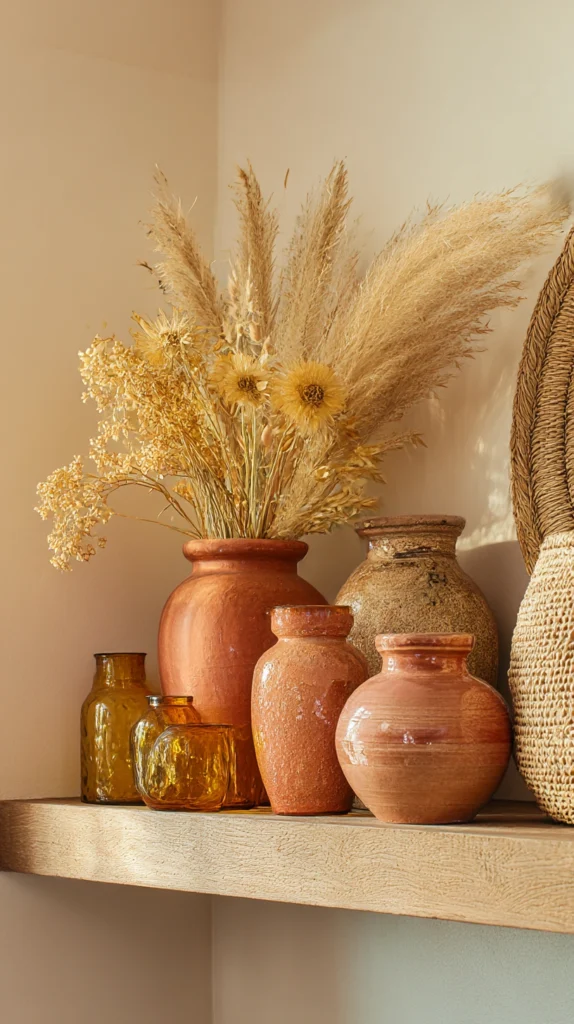
Budget: $40 – $180
A summer shelf built around terracotta, warm amber, sandy neutral, and undyed natural is the seasonal equivalent of golden hour applied to a domestic surface. The palette draws from baked earth, dry grass, and warm stone — the colours of the season at its most generous — and applies them to a shelf in a combination that reads as simultaneously contemporary and deeply ancient. It is the palette that never dates because it is drawn from the natural world rather than a trend cycle.
Terracotta pots in standard sizes cost $3 – $8 each. A warm amber glass vase or vessel runs $15 – $35. Dried grasses, wheat stalks, or dried seed heads in a terracotta or amber vessel add $8 – $20. A small woven or rattan object in a natural, undyed tone contributes texture for $10 – $25. A single amber or beeswax candle in a simple holder completes the arrangement for $8 – $15. The palette is entirely self-consistent — warm, earthen, and requiring almost no coordination effort because every element in the same temperature range coexists naturally.
Styling tip: Add one object that is lighter than the rest of the palette — a white ceramic, a pale linen book spine, a bleached shell — to prevent the terracotta arrangement from reading as heavy or cave-like. A single lighter note in an otherwise warm palette does the same work that a window does in a warm-toned room: it lifts the arrangement and creates a sense of breathing space within the colour story.
5. The Book and Object Balance
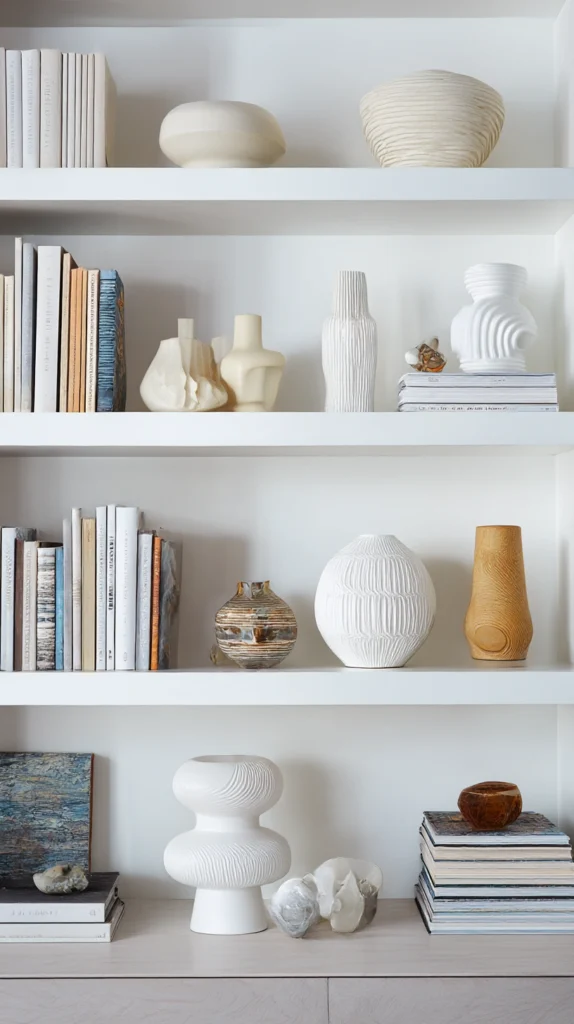
Budget: $20 – $120
A shelf that balances books with objects — neither entirely books nor entirely objects, but a considered alternation between the two — produces a result that feels both intellectual and decorative, personal and designed. The mistake in most book-heavy shelves is that the books and the objects occupy separate zones rather than being genuinely integrated. A successful balanced shelf has objects appearing within book runs, books supporting objects, and neither category dominating the other at any single point along the shelf.
The books are free if already owned — the only cost is in their curation and arrangement. Objects in complementary tones — ceramics, candles, botanicals, small sculptures — add $20 – $80 in total. The editing of the books themselves costs nothing but produces the most significant visual result: removing books whose spines conflict with the palette, grouping by spine colour rather than author, and turning some books spine-inward to produce a textural block of undyed page edges rather than a run of competing colours.
Styling tip: Lay one or two books horizontally within an otherwise vertical arrangement and place a small object on top of the horizontal stack. The horizontal break within a vertical run creates a visual rest point that the eye needs in a long shelf run, and the object placed on top of the horizontal stack anchors the arrangement at that point and creates a moment of interest that a uniformly vertical arrangement cannot produce.
6. The Minimal Negative Space Shelf
Budget: $20 – $100
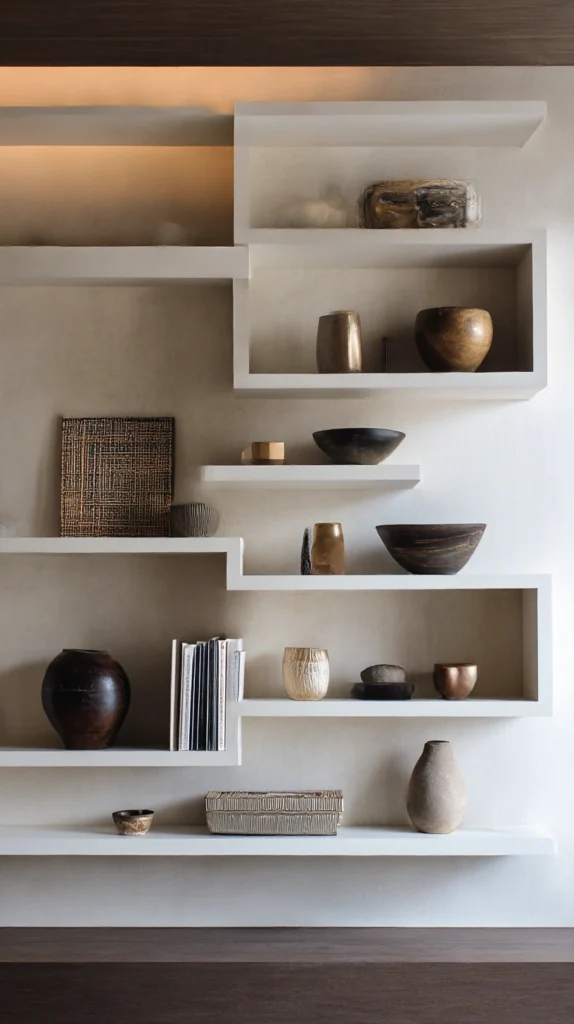
A shelf that is deliberately mostly empty — three or four objects at most, positioned with significant space between them, against a shelf surface that has been left largely bare — is the most difficult shelf aesthetic to maintain and the most rewarding when it works. The negative space is not absence of decision. It is the decision. In summer, a minimal shelf with breathing room between its objects communicates lightness, confidence, and the particular pleasure of a space that has not been filled for the sake of filling it.
Three objects — one tall, one low, one with visual texture — is the minimum arrangement that reads as curated rather than sparse. A tall ceramic bud vase with a single dried stem costs $15 – $35. A low, handmade ceramic bowl in a warm or neutral tone runs $20 – $50. A small sculptural object — a smooth stone, a woven object, a minimal ceramic form — adds $10 – $30. Total cost $45 – $115 for a shelf arrangement that requires more confidence than money and rewards that confidence with a result that few other approaches can match.
Styling tip: Resist the urge to fill the negative space over time. A minimal shelf has an almost magnetic tendency to accumulate objects — a candle placed temporarily, a book left there for convenience, a small object gifted and set down without a plan. Resist each addition unless it is a conscious, considered replacement for something already there. The discipline of the minimal shelf is ongoing rather than achieved once at the point of styling.
7. The Summer Reading Stack
Budget: $10 – $60
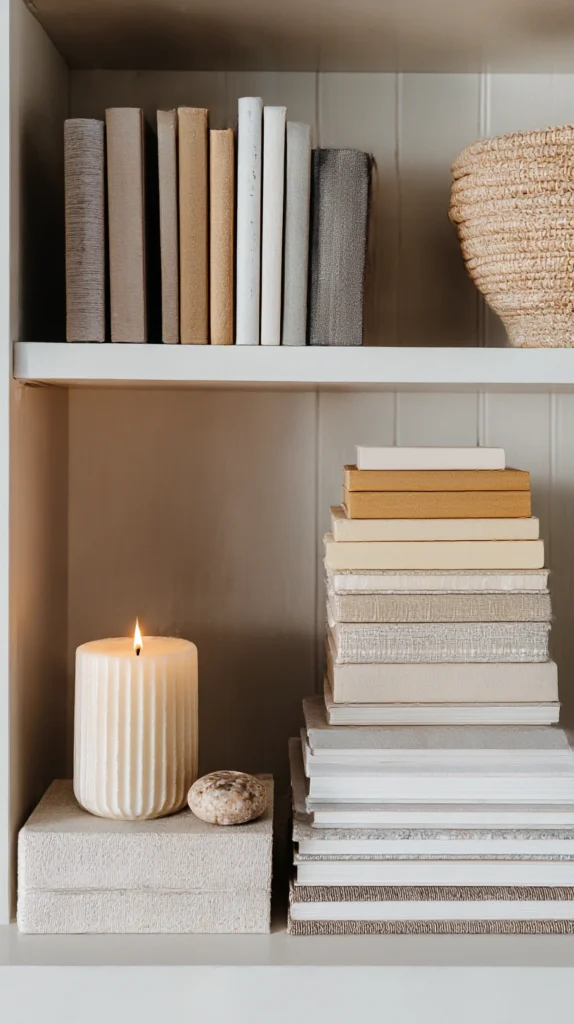
A dedicated section of shelf given over to the summer reading list — a curated stack of books chosen for the season, arranged with their spines facing out in a complementary colour run, and accompanied by a single bookmark, a reading candle, and a small object that relates to the subject matter of the books — turns a functional shelf into a seasonal ritual object. It is both an invitation and a record of the summer’s reading intentions, and it changes as books are read and replaced.
The books themselves are free if already owned or borrowed — or cost $8 – $15 each if purchased for the list. A simple ceramic or wooden bookmark rest — $8 – $20 — keeps the current book marked and displayed rather than face-down on a surface. A small candle in a reading-appropriate scent — sandalwood, clean cotton, light wood — runs $10 – $25. The arrangement requires no additional styling because the books and the single objects beside them provide all the visual content the section needs.
Styling tip: Arrange the summer reading stack by spine colour in a gradient rather than alphabetically or by genre. A run of spines moving from pale cream through warm yellow to soft orange to terracotta produces a shelf that reads as a colour installation as much as a book arrangement — and it costs nothing to produce beyond the time required to sort and re-sort the books until the gradient feels right.
8. The Glass and Light Shelf
Budget: $30 – $150
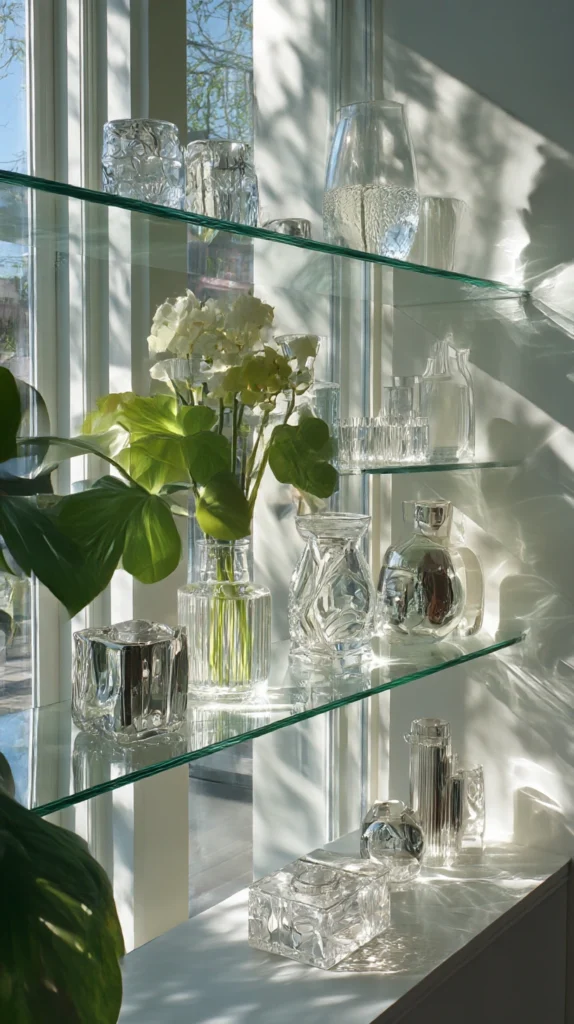
A shelf positioned near a window — or a shelf with a small light source above or below it — styled with glass objects, clear vessels, and reflective surfaces uses the available light to produce an arrangement that changes throughout the day as the sun moves. A clear glass vase casting a shadow in the morning is a different object by afternoon. A pressed glass bowl catching the evening light is something else entirely by night with a candle behind it. Glass-focused shelves reward the light of summer in a way that ceramic or timber objects cannot.
Pressed glass vessels, clear blown glass vases, and glass candle holders cost $10 – $40 each. A small collection of four to six glass objects of varying shapes and sizes sits at $40 – $150 in total. The objects do not need to be expensive — pressed glass produced for the homeware market is significantly more affordable than hand-blown alternatives and, in direct light, the difference is not immediately apparent.
Styling tip: Mix glass with one or two ceramic or natural material objects rather than styling the shelf entirely in glass. An all-glass shelf can read as a display cabinet rather than a styled surface — the effect is interesting but cold. A predominantly glass shelf with one warm ceramic vessel and one dried botanical object has the light-catching quality of the glass and the warmth of the natural materials simultaneously, which is a more balanced and more domestic result.
9. The Travel Memory Shelf
Budget: $10 – $80
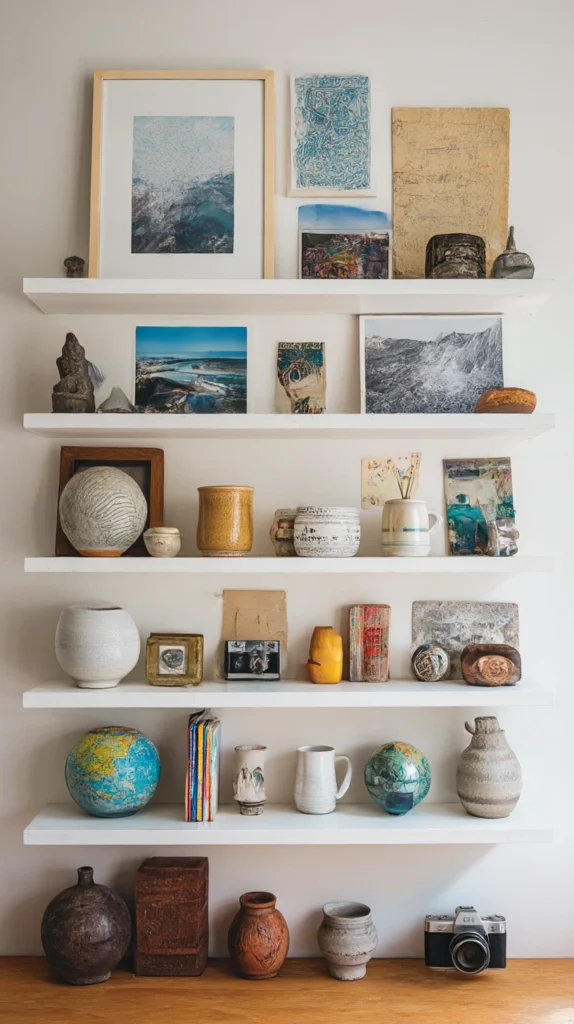
A shelf that tells the story of places visited — a ceramic bowl from a particular market, a small print from a gallery visited on a trip, a stone collected from a specific beach, a book about a city that mattered — is the most personal shelf arrangement available and the one most likely to generate conversation. In summer, when travel is most present in both the planning and the recollection, a travel memory shelf is a particularly appropriate way to acknowledge the places that have shaped the person who lives in the house.
The objects themselves are free if already owned — collected from trips, gifted from those who know the places that matter, or found rather than purchased. Simple frames for small prints or photographs cost $5 – $15 each. A single purchased ceramic or textile object as an anchor piece runs $15 – $50. The arrangement requires editing rather than acquisition — the selection of the right objects from a larger collection, and the decision about which travels deserve a dedicated shelf position.
Styling tip: Limit the shelf to objects from three or four places rather than attempting to represent every trip made. A shelf representing thirty countries produces an impression of a collection. A shelf representing three places — each represented by one or two deeply chosen objects — produces an impression of a life. The editing is the act of deciding which places have mattered most, which is itself a more meaningful process than the styling that follows it.
10. The Linen and Texture Shelf
Budget: $30 – $150
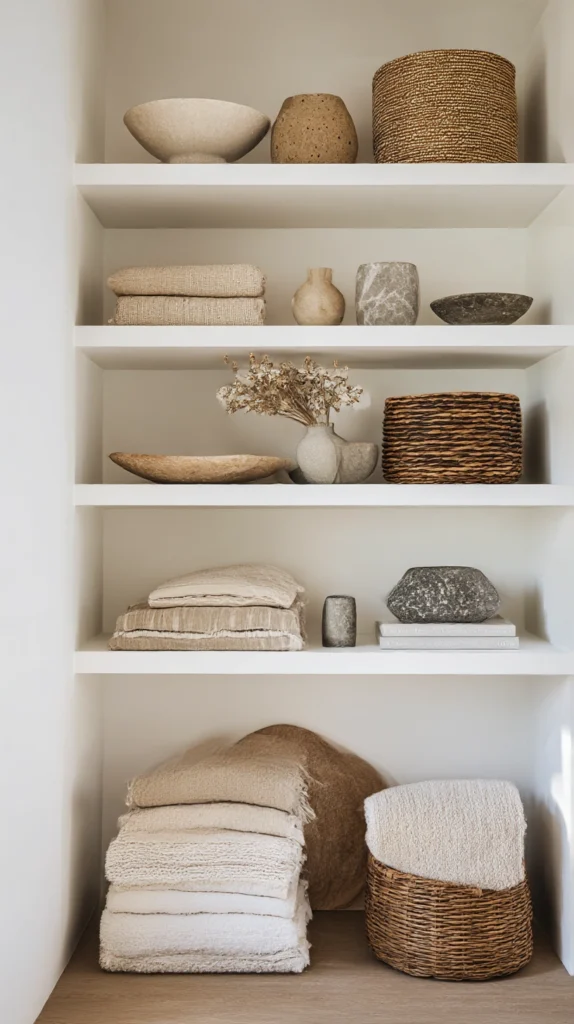
A shelf built around texture rather than colour — rough linen, smooth ceramic, coarse woven rattan, soft dried botanical, cool stone — produces an arrangement that rewards touch as much as sight and communicates a tactile richness that colour-focused arrangements rarely achieve. In summer especially, natural textures — undyed, unpolished, unfinished — have an honesty and a warmth that manufactured surfaces do not, and a shelf that foregrounds these materials feels connected to the season in the way that synthetic equivalents never quite manage.
A small linen-wrapped book or a folded linen cloth as a base layer costs $5 – $15. A rough stoneware ceramic in an undyed glaze runs $20 – $50. A woven rattan or bamboo object adds texture for $10 – $25. A smooth stone or a river pebble — free if collected, $5 – $15 if purchased — provides the contrast of a cool, perfectly smooth surface against the rougher textures around it. A dried botanical in a raw clay vessel completes the arrangement for $15 – $35.
Styling tip: Place the smoothest object in the arrangement next to the roughest one rather than grouping objects by similar texture. The juxtaposition of extremes — the perfectly smooth pebble beside the rough-weave linen, the glass vessel beside the raw clay pot — creates a visual and tactile tension that makes each object more interesting than it would be surrounded by similar surfaces. Contrast is the mechanism that makes texture-led arrangements work.
11. The Seasonal Colour Story Shelf
Budget: $20 – $120
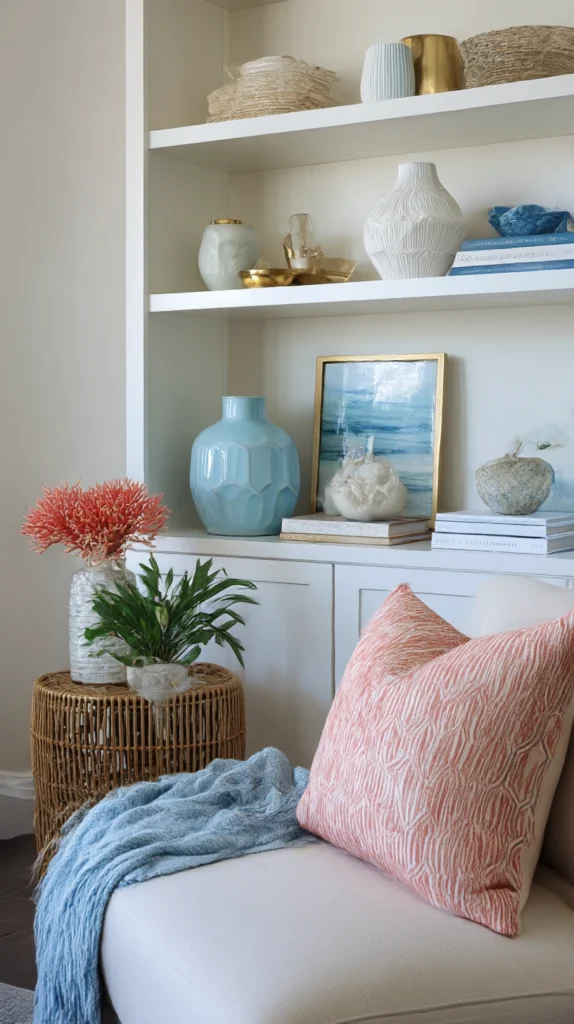
A shelf that changes its accent colour with the season — keeping the same structural objects and the same arrangement logic while swapping one or two accent pieces for the current season’s tone — is the most sustainable and the most considered approach to shelf styling available. In summer, the accent is coral, warm yellow, or faded blue. In autumn, it shifts to amber and burnt sienna. In winter, it moves to deep green or midnight blue. In spring, it returns to blush and soft sage. The shelf is always current and always coherent because only one element changes at a time.
The permanent structural objects — a neutral ceramic, a natural botanical, a stack of books in undyed spines — cost $40 – $100 once and remain in place indefinitely. The seasonal accent object — a single coloured vase, a cushion cover propped against a book stack, a coloured candle in a holder — costs $10 – $30 per season and is the only element that needs to be purchased or swapped at each transition. The total annual investment after the initial setup sits at $40 – $120 for four seasonal transitions — less than the cost of a single mid-range styling purchase.
Styling tip: Choose the seasonal accent colour by looking at what is currently blooming or growing outside the window the shelf faces or the room it inhabits. A shelf accent colour drawn from the actual seasonal palette visible through the window connects the interior surface to the exterior world in a way that a colour chosen from a trend palette does not. The garden tells the shelf what colour it should be at any given point in the year, and the shelf that listens to it is always in season by definition.
Whatever approach you bring to the shelf this summer, the principle that holds all eleven ideas together is the same one that holds any well-edited surface together: less is the mechanism, intention is the method, and restraint is the result. A shelf that has been edited — that has had things removed from it as well as added to it — always outperforms a shelf that has simply been styled. The adding is easy. The removing is where the work is done and where the result is determined.
Clear the shelf entirely before restating it. Look at what was on it and ask which objects genuinely deserve to return. Add the summer layer on top of that edited foundation rather than on top of whatever accumulated there over the previous months. The shelf that results from that process will be the one that stops people mid-room — not because it is full, but because everything that is on it is exactly right.