
15 Barn Door Ideas for Modern and Farmhouse Homes
Our old pantry door used to swing open into the kitchen walkway, catching someone’s hip at least once a week.
I finally swapped it for a sliding barn door on a whim, mostly to solve the traffic problem.
It solved the traffic problem completely, and it also became the first thing visitors comment on when they walk in.

A barn door does double duty in a way almost no other interior door style manages.
Here are 15 ways to use one, whether the house leans rustic farmhouse or clean modern minimal.
Why barn doors solve real problems, not just style ones
A sliding door changes how a room actually functions, beyond how it looks.
- It reclaims the floor space a swinging door needs to clear, which matters in tight hallways or small rooms
- It works as a genuine design feature, not just a functional necessity hidden behind a coat closet
- The hardware itself, exposed and visible, becomes part of the room’s overall material story
Once the door slides instead of swings, the whole space around it gets to breathe differently.
1. Classic X-Brace Farmhouse Door
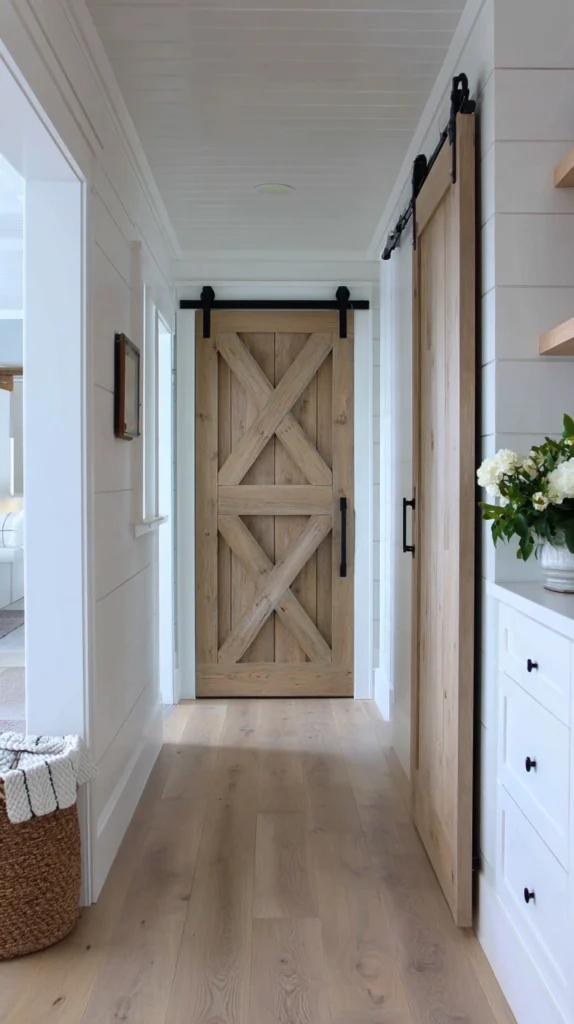
The most recognizable barn door style, built around simple diagonal bracing.
Build it:
- Vertical tongue-and-groove or shiplap boards forming the door’s main panel
- A diagonal X-brace built from the same wood, fastened across the door’s face for both structure and style
- A driftwood or natural wood stain, avoiding a glossy finish that would undercut the rustic look
Why the X-brace remains the go-to choice for true farmhouse style:
- It directly references the original agricultural barn doors this entire style borrows from
- The diagonal bracing adds genuine visual structure to what would otherwise be a flat, plain panel
- It pairs naturally with shiplap walls, exposed beams, and other classic farmhouse details already in the home
Cost breakdown: A classic X-brace barn door runs $250 to $500 including the door panel and basic sliding hardware.
2. Sleek Black Steel-Frame Door for Modern Homes
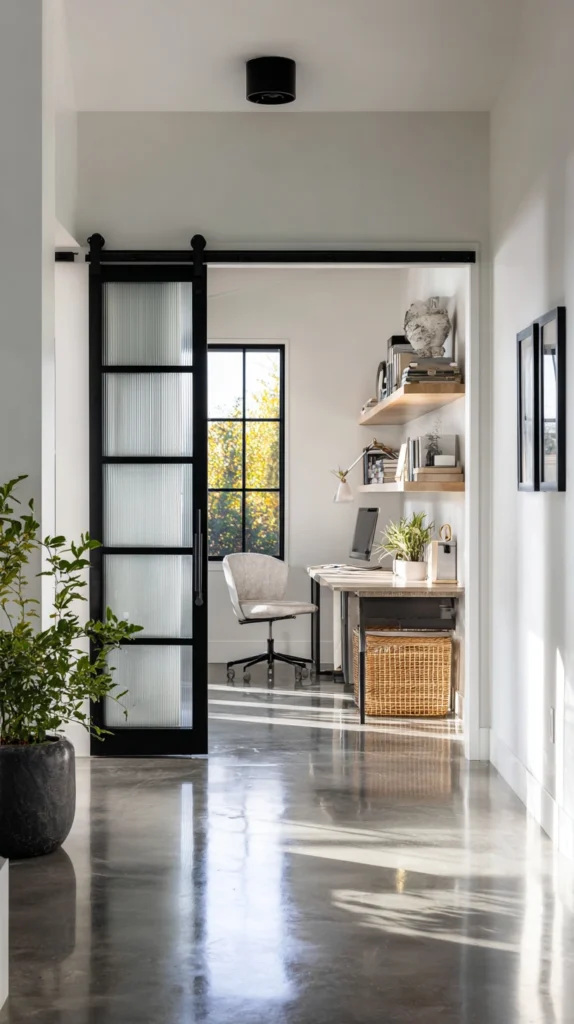
A minimalist take built around clean metal lines instead of wood texture.
Build it:
- A slim black steel frame holding either frosted or clear glass panels
- A single continuous track mounted above the doorway, kept as unobtrusive as possible
- Minimal hardware detailing, avoiding the decorative straps and bolts common on rustic versions
Why steel and glass suit a modern home better than traditional wood:
- The thin black frame lines echo the same aesthetic found in modern black-framed windows and railings
- Glass panels let light pass through between rooms, which a solid wood door can’t offer
- It reads as intentional, architectural design rather than a rustic accent dropped into a contemporary space
Cost breakdown: A steel-frame glass barn door runs $600 to $1,200 depending on size and glass type.
3. Reclaimed Wood Barn Door With Visible Wear
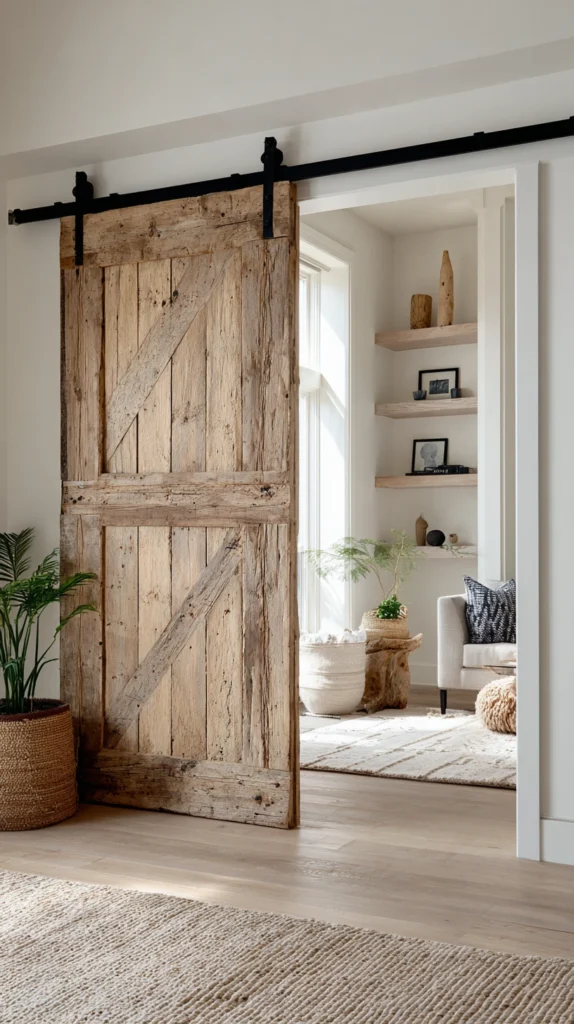
Genuine salvaged material carrying its own history.
Build it:
- Boards sourced from an actual old barn or reclaimed lumber yard, kept in their original weathered condition
- Nail holes, saw marks, and uneven coloring left fully visible rather than sanded away
- Sealed with a clear protective coat that preserves rather than masks the existing patina
Why genuine reclaimed wood outperforms a new distressed finish:
- Every mark tells an actual history that manufactured distressing can only approximate
- The material has already fully dried and settled, making it less prone to warping than fresh-cut lumber
- It keeps real salvaged material in use rather than adding to landfill waste
Cost breakdown: Reclaimed wood barn doors run $350 to $800 depending on source and size, generally higher than new lumber equivalents.
4. Mirrored Barn Door for a Closet or Bedroom
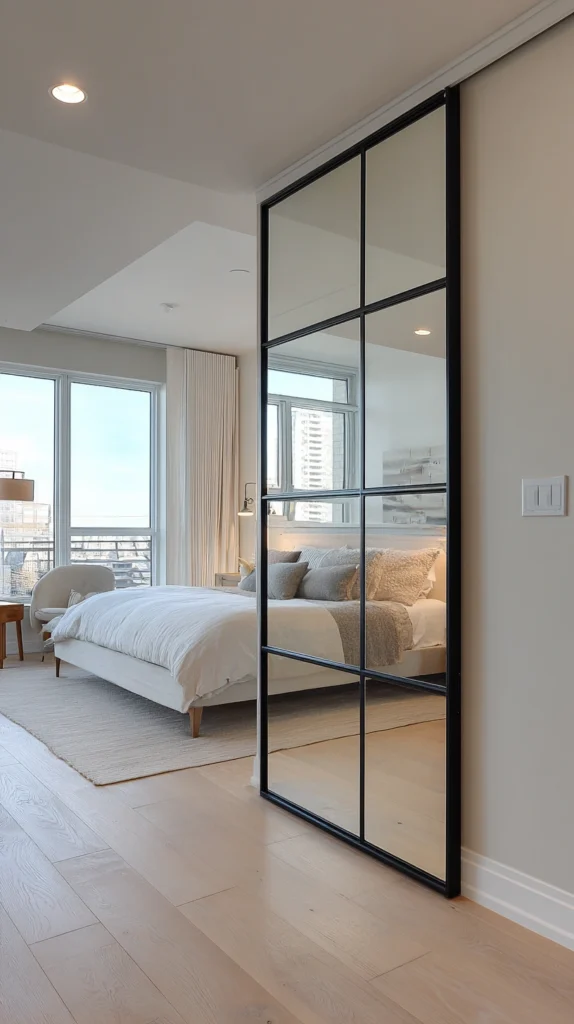
Function layered directly into the door’s surface.
Build it:
- A full-length mirror mounted onto or built into the barn door panel itself
- A simple frame style, either wood or metal, that doesn’t compete visually with the mirror’s reflective surface
- Positioned to double as both a sliding closet door and a genuine dressing mirror
Why a mirrored surface earns its place on a barn door specifically:
- It solves two needs in one object, removing the requirement for a separate wall-mounted or standing mirror
- The sliding mechanism means the mirror never swings open unexpectedly, unlike a traditional mirrored closet door
- It works particularly well in smaller bedrooms where floor space for a separate mirror is limited
Cost breakdown: A mirrored barn door runs $300 to $600 depending on mirror quality and frame material.
5. Double Barn Doors for Wide Openings
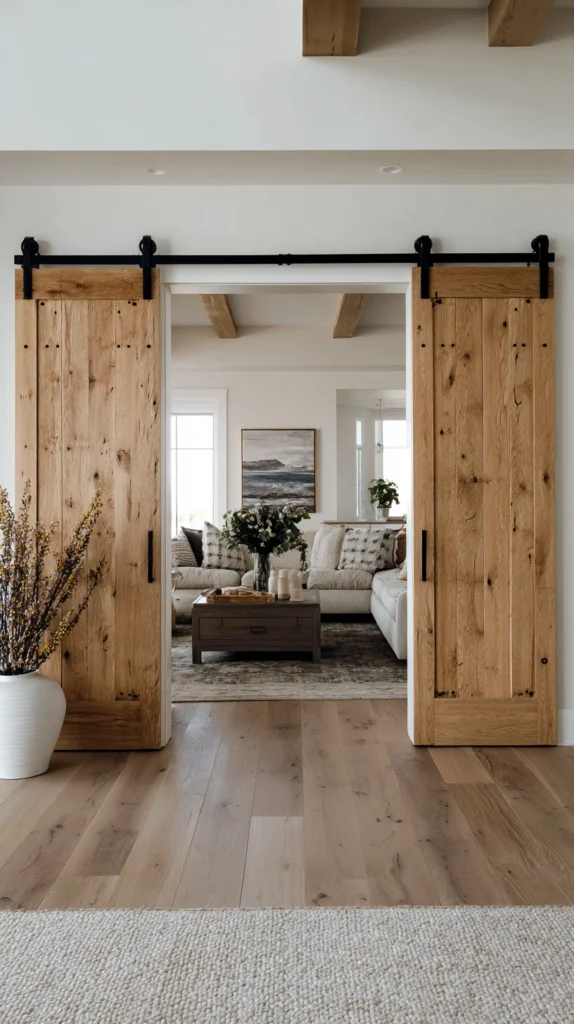
Two doors sliding in opposite directions to cover a larger doorway.
Build it:
- Two matching door panels mounted on a single continuous track, sliding away from each other to open
- Center-aligned when closed, creating a seamless look across the full opening width
- Matching hardware and finish across both panels for a cohesive, symmetrical appearance
Why double doors suit wider openings better than one oversized panel:
- A single door wide enough to cover a large opening becomes heavy and unwieldy to slide smoothly
- Two smaller panels distribute the weight more evenly across the track hardware
- The symmetrical look when closed creates a genuine architectural statement, especially for a main living area or office entrance
Cost breakdown: A double barn door setup runs $500 to $1,000 depending on total width and finish.
6. Whitewashed Barn Door for a Coastal or Farmhouse Look
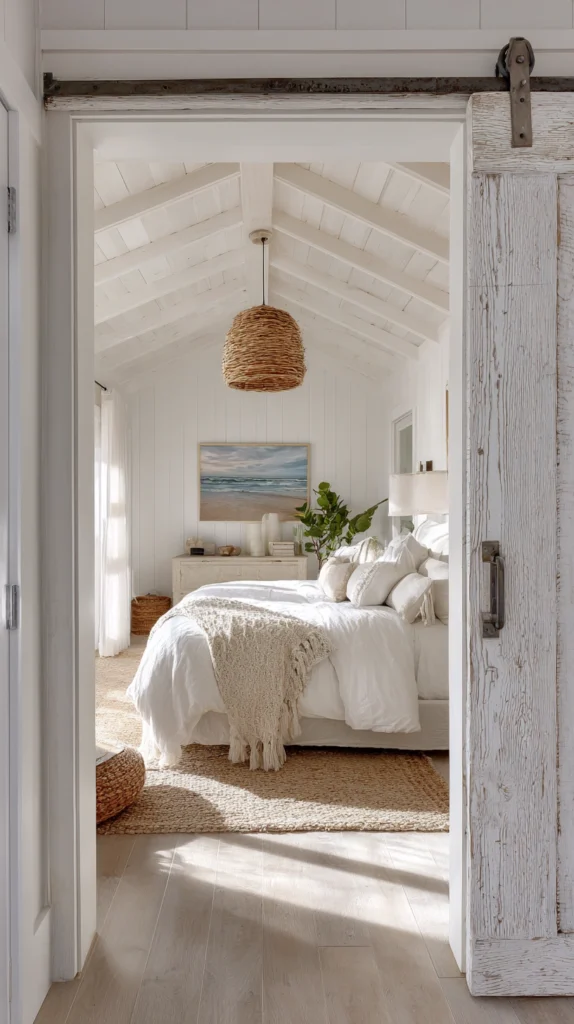
A lighter finish that keeps the wood texture without the heavy, dark tone.
Build it:
- Solid wood door panel treated with a whitewash stain, allowing the grain to remain visible beneath
- Applied in thin layers, building up gradually to control exactly how much wood tone shows through
- Paired with black or brushed nickel hardware for contrast against the lighter wood
Why whitewashing suits brighter, airier interiors specifically:
- It keeps the rustic texture benefit of a wood barn door while brightening rather than darkening the space
- It pairs especially well with coastal, cottage, or Scandinavian-farmhouse interiors that favor a lighter palette
- The visible grain beneath the whitewash keeps the door from looking flat or painted over completely
Cost breakdown: Whitewash stain and application supplies add $30 to $60 on top of the base door cost.
7. Barn Door With Frosted Glass Panel Inserts
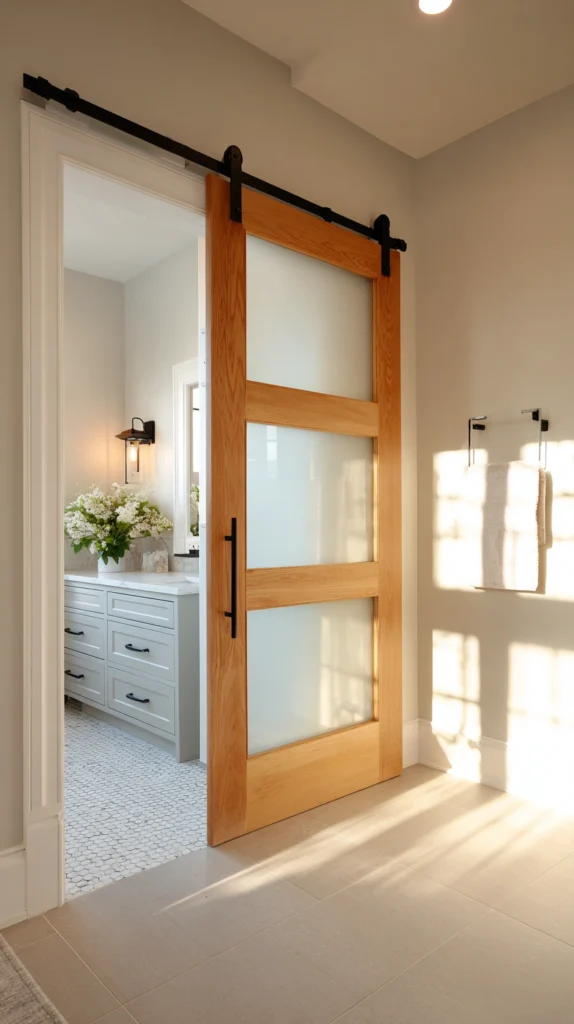
Combining a solid wood frame with translucent glass sections.
Build it:
- A wood frame door with one or more panel sections replaced by frosted or reeded glass
- Glass positioned to let light pass through while still obscuring a direct view into the room
- Simple wood trim around each glass panel, matching the door’s overall frame finish
Why frosted glass panels add function most solid barn doors lack:
- It allows light to pass between rooms, brightening an otherwise closed-off hallway or office
- The frosted finish maintains privacy, making it suitable for bathrooms or bedrooms unlike clear glass
- It softens what might otherwise be a heavy, fully solid door, especially in smaller spaces
Cost breakdown: A wood-framed door with frosted glass inserts runs $400 to $700 depending on glass coverage and frame material.
8. Barn Door With Exposed Rustic Hardware as a Focal Point
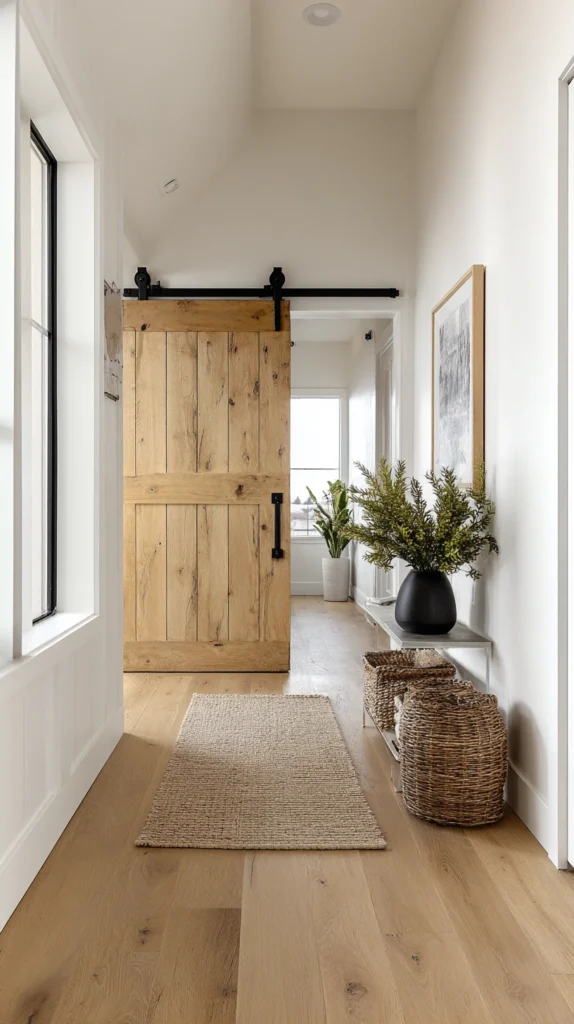
Letting the sliding mechanism itself become the design statement.
Build it:
- Oversized, visibly industrial rollers and track mounted prominently above the door
- Black cast iron or aged bronze hardware finish, left unpolished for genuine texture
- A simple, unadorned door panel that lets the hardware carry most of the visual weight
Why exposed hardware deserves this level of attention:
- The track and rollers are often the most architecturally interesting part of the whole installation
- Choosing a bold, oversized hardware style turns a purely functional element into genuine decor
- It suits industrial-farmhouse crossover interiors especially well, where raw materials are already celebrated elsewhere in the home
Cost breakdown: Premium exposed barn door hardware kits run $100 to $250, considerably more than basic standard track sets.
9. Painted Barn Door in a Bold Accent Color
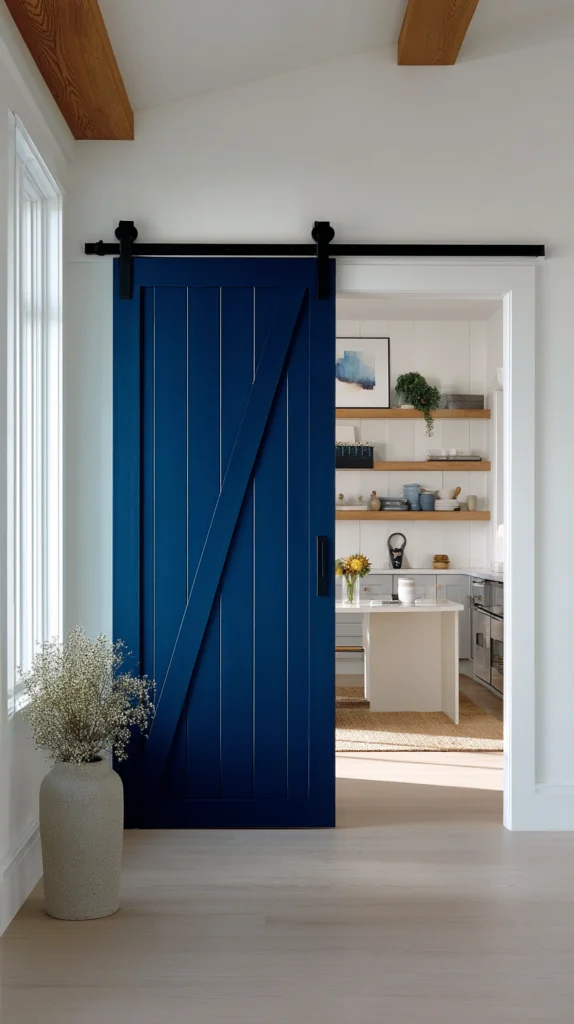
Color used as the door’s primary design feature instead of natural wood tone.
Build it:
- A solid wood or MDF door panel painted in a bold, saturated color like deep navy, forest green, or matte black
- A durable, scrubbable paint finish suited to a frequently touched surface
- Simple black or brass hardware to complement rather than compete with the bold paint choice
Why a painted door suits both modern and eclectic farmhouse interiors:
- It introduces a genuine color statement into a hallway or room that might otherwise rely only on wall paint for color
- A bold door color draws the eye and can visually anchor a room’s overall palette
- It’s an easy way to make an otherwise standard door feel custom and considered
Cost breakdown: Painting an existing or new barn door adds $30 to $60 in paint and supplies to the base door cost.
10. Barn Door Room Divider for Open Floor Plans
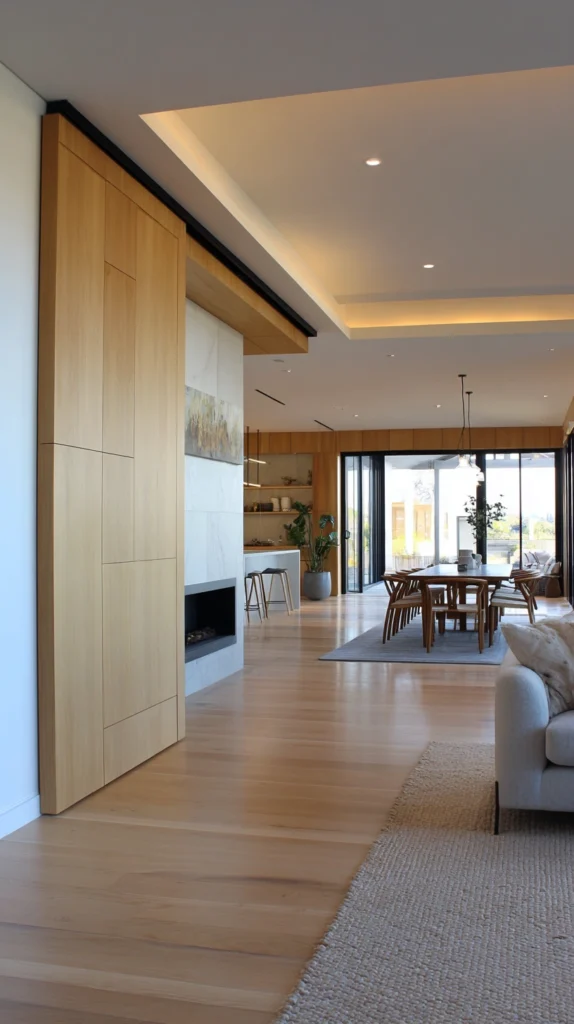
Using the door to create flexible, closable separation in an open layout.
Build it:
- A single or double barn door mounted along an open sightline between a living and dining area, or a living room and home office
- A track long enough to fully clear the opening when the door is pushed aside
- Sized generously to fully close off the sightline when privacy or noise separation is needed
Why a barn door suits open floor plans better than a swinging door:
- It gives an open-concept layout the option of division without permanently closing off the space
- The sliding mechanism means no swing radius needs to be accounted for in an already tight open layout
- It can be left fully open most of the time, only closed when a specific need for separation arises
Cost breakdown: A room-divider-sized barn door runs $400 to $900 depending on width and track length required.
11. Barn Door Pantry Entrance With Chalkboard Panel
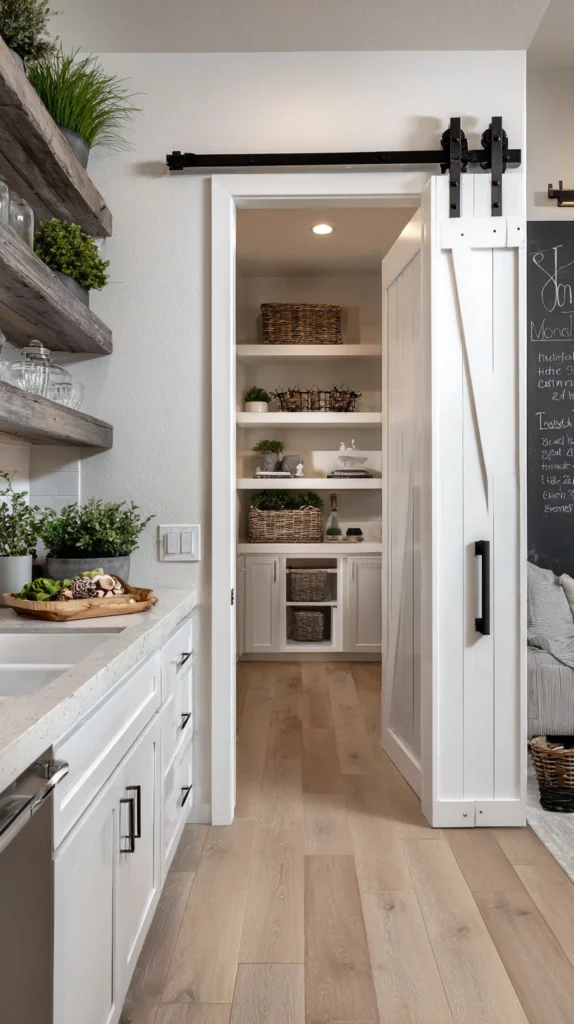
Combining function with a playful, interactive detail.
Build it:
- A section of the door panel finished in chalkboard paint rather than standard wood stain
- Used for grocery lists, meal planning notes, or seasonal messages
- Positioned at a height reachable by both adults and kids in the household
Why a chalkboard panel suits a pantry door specifically:
- It gives the door genuine daily function beyond just closing off the pantry space
- It’s a low-cost addition that adds real personality and interactivity to an otherwise purely practical door
- It works especially well in households with kids, turning a chore list into something more engaging
Cost breakdown: Chalkboard paint for a door panel section runs $15 to $25 in addition to the base door cost.
12. Herringbone or Chevron Pattern Barn Door
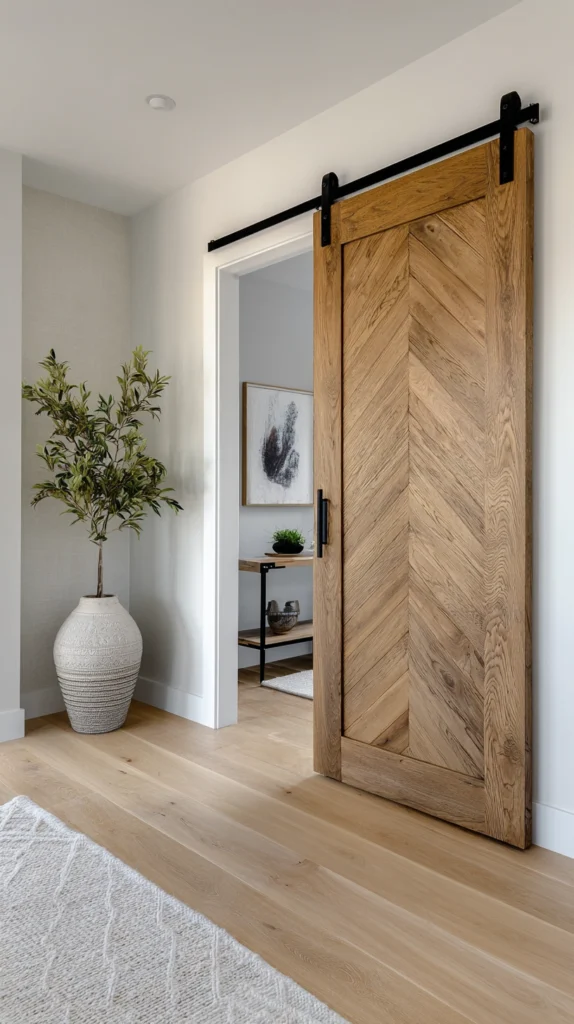
Geometric wood pattern used as the door’s main visual feature.
Build it:
- Individual wood slats cut and arranged in a herringbone or chevron pattern across the door’s face
- A supporting frame built behind the pattern to hold all the angled pieces securely in place
- A clear or lightly tinted finish that lets the pattern’s geometry remain the focal point
Why a patterned door suits a more design-forward farmhouse or modern space:
- The geometric arrangement adds visual complexity well beyond a standard flat or X-braced panel
- It photographs as a genuine custom detail, elevating what’s otherwise a purely functional door
- It pairs particularly well with matching herringbone flooring or tile elsewhere in the home for a cohesive look
Cost breakdown: A herringbone or chevron pattern barn door runs $500 to $1,000 depending on wood type and construction complexity.
13. Barn Door With Integrated Shelving on the Track Wall
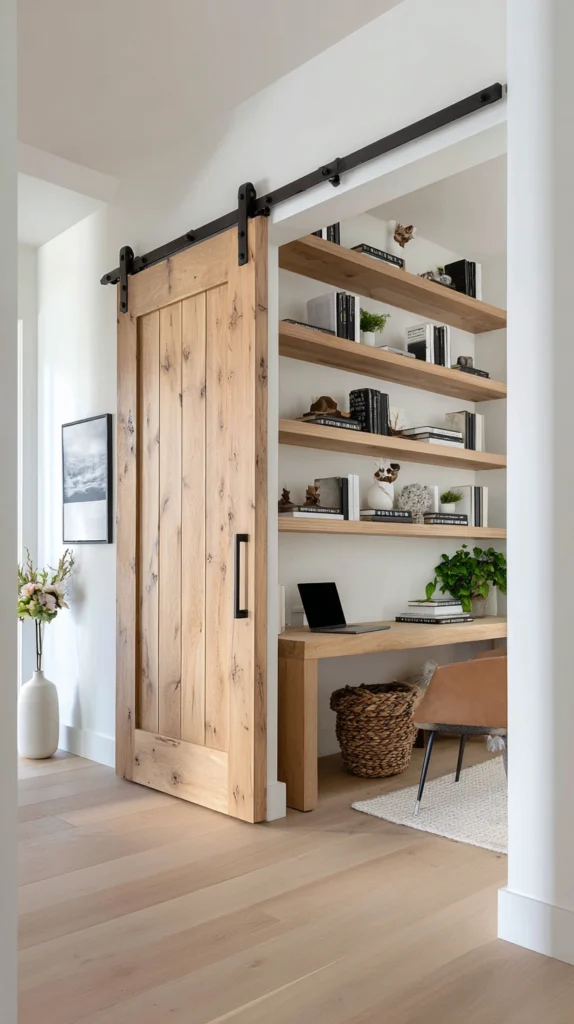
Using the wall space beside the sliding door for additional function.
Build it:
- Open shelving mounted on the wall section the door slides across when open
- Shelf depth kept shallow enough that the door can still slide fully open without obstruction
- Styled with books, plants, or decor that complements the door’s overall finish
Why this detail maximizes an often-overlooked wall section:
- The wall space a barn door slides across is frequently left completely bare, wasting usable square footage
- Shallow shelving adds real storage or display space without interfering with the door’s function
- It ties the door and the surrounding wall into one cohesive, intentional design element rather than two separate features
Cost breakdown: Adding shallow shelving along the track wall runs $50 to $150 depending on shelf material and length.
14. Compact Barn Door for a Small Bathroom or Closet
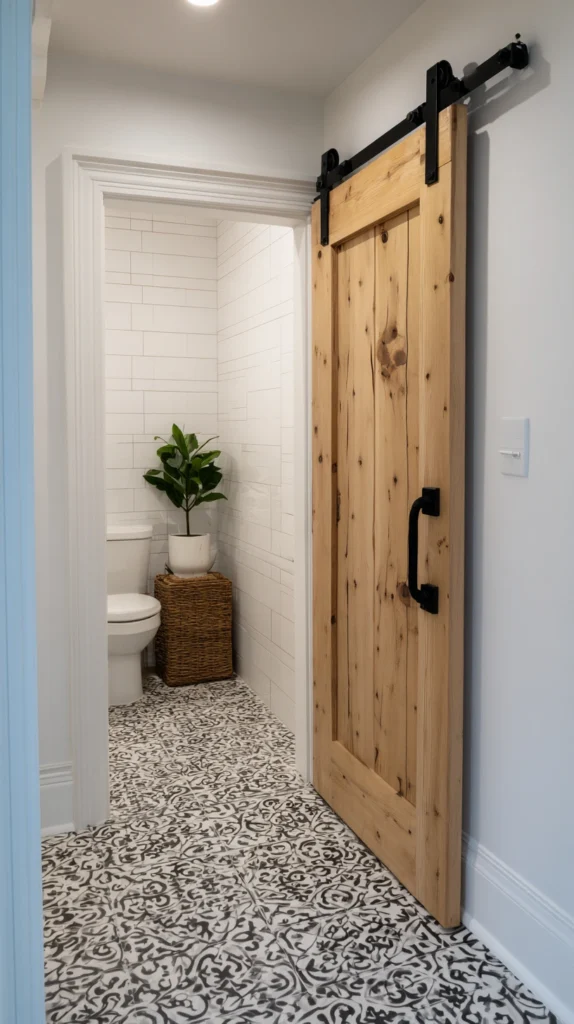
A scaled-down version suited to tighter spaces.
Build it:
- A narrower door panel, often 24 to 30 inches wide, sized specifically to smaller openings like a half bath or linen closet
- A shorter track length to match the reduced door width, keeping the wall footprint minimal
- Lightweight hardware rated appropriately for the smaller door’s reduced weight
Why smaller spaces benefit from a scaled-down version rather than skipping the style entirely:
- It solves the same swing-clearance problem in a powder room or closet that a full-size door would in a larger room
- A properly scaled door and track avoid the visually awkward look of an oversized track over a narrow opening
- It brings the same design benefit to small spaces that often get the least design attention in a home
Cost breakdown: A compact barn door sized for a small bathroom or closet runs $200 to $400 including scaled hardware.
15. Barn Door With Automatic Soft-Close Hardware
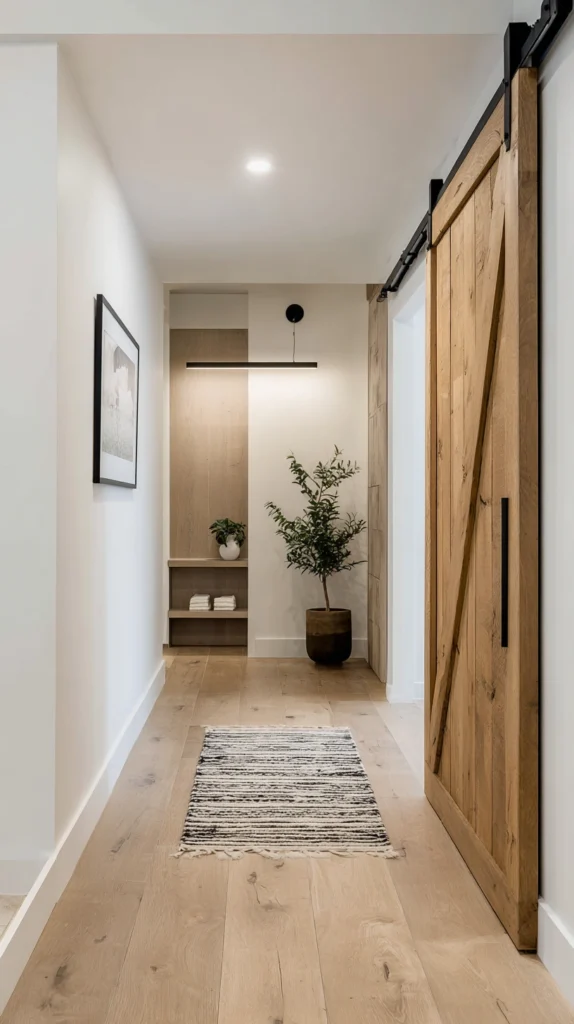
A modern hardware upgrade added to any style of door panel.
Build it:
- A soft-close mechanism built into the track system, gently decelerating the door as it reaches the fully closed or open position
- Compatible with most standard door weights and track lengths
- Paired with any door style on this list, from rustic X-brace to modern steel-frame
Why soft-close hardware is worth adding regardless of the door’s visual style:
- It prevents the loud slam a standard barn door track can produce when pushed with any force
- It reduces wear on both the door panel and the wall-mounted track over years of daily use
- It’s a functional upgrade that works invisibly in the background, without changing the door’s appearance at all
Cost breakdown: Soft-close hardware kits run $40 to $90 in addition to the base door and standard track cost.
Getting started this weekend
You don’t need to replace every interior door before the transformation starts to show.
- Start with the single door causing the most daily friction, like a tight hallway or a frequently used pantry
- Add exposed hardware detailing or a bold paint color once the basic sliding mechanism is installed and working well
- Save larger projects like double doors or a patterned panel for a dedicated second phase
My own kitchen pantry door took a single Saturday to swap, and it’s solved a problem we’d been quietly annoyed by for years.
Budget reality
Barn doors scale from a simple compact swap to a fully custom architectural feature.
- Under $300: Compact bathroom or closet door, basic X-brace panel, chalkboard pantry accent
- $300-600: Mirrored door, frosted glass insert door, whitewashed farmhouse door
- $600-1,000: Double barn doors, steel-frame modern door, herringbone pattern panel
- $1,000+: Premium exposed hardware combined with a custom panel, full room-divider-sized installation
Most of the visual and functional impact comes from the door style and hardware choice, not the largest possible budget.
What actually makes a barn door work in the home
It was never really about picking the most elaborate panel style available.
It’s the hallway that stopped catching hips on a swinging door, the hardware that turned a purely functional choice into something people actually notice, the wall space beside it finally put to use instead of left bare.
Start with the one door solving a real daily problem, and let its success guide whether the rest of the house gets the same upgrade.