

7 Living Room Curtain Ideas to Frame Your Windows
A picture frame’s mat board does one job: it creates enough visual breathing room that the eye knows exactly where to look.
Curtains do the same thing for a window, except most living rooms get this backwards, hanging panels sized and placed like an afterthought rather than a genuine frame.
The window ends up looking smaller, the ceiling lower, and the whole wall less finished than it could be with just a few sizing and placement changes.

Here are 7 ways to actually frame a living room window instead of just covering it.
Why curtain sizing and placement matter more than fabric choice
Most curtain mistakes happen before a single fabric swatch gets chosen.
- Curtains hung too close to the window frame make the window look smaller, not larger
- Panels that stop short of the floor read as unfinished, regardless of how nice the fabric itself is
- Rod placement height changes the perceived ceiling height of the entire room, often more dramatically than people expect
Once the sizing and placement fundamentals are right, fabric and color become the easy part.
1. Mount the Rod Higher Than the Window Frame
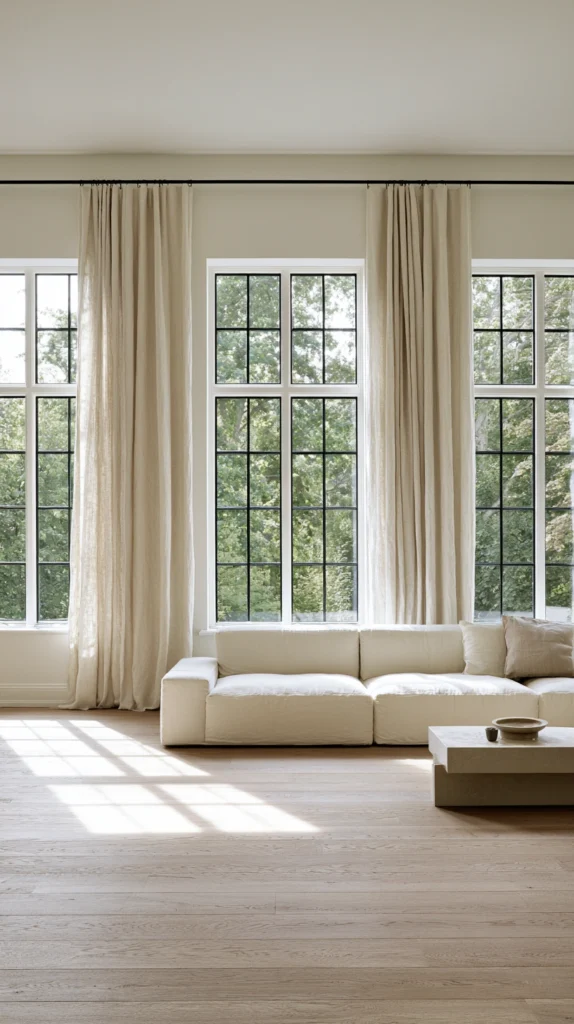
The single change with the most dramatic impact on a room’s proportions.
Build it:
- The curtain rod mounted 4 to 8 inches above the window frame itself, or closer to the ceiling in rooms with extra height to spare
- Curtain panels chosen or hemmed long enough to still reach the floor once hung from this higher position
- Bracket placement checked on both sides to keep the rod perfectly level, since an uneven mount becomes obvious at this height
Why raising the rod changes the whole room’s perceived scale:
- It creates the illusion of a taller window and a higher ceiling, one of the most reliable tricks in professional interior design
- It also allows more natural light into the room when the curtains are open, since the fabric doesn’t block any part of the actual window glass
- It’s one of the few completely free changes available if curtains and rod are already owned, requiring only remounting the existing hardware
Cost breakdown: Free if using existing curtain hardware, or $20 to $40 for new brackets if the current ones can’t be repositioned.
2. Extend the Rod Beyond the Window’s Edges
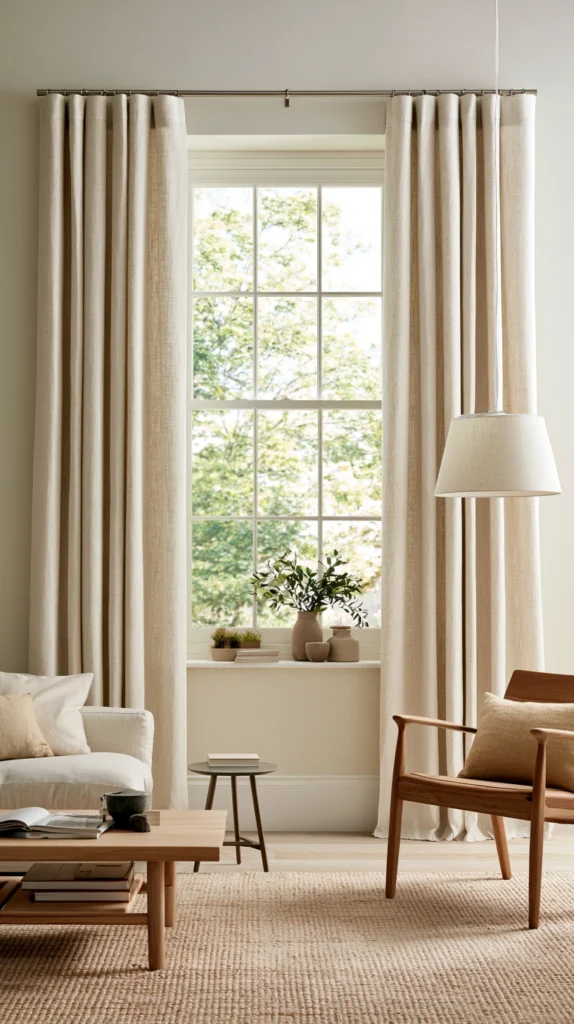
Widening the frame to make the window itself look larger and let in more light.
Build it:
- The rod extended 4 to 10 inches beyond each side of the window frame, depending on the room’s available wall space
- Curtain panels sized generously enough that they fully cover the extended rod width when closed, rather than leaving gaps
- Wall space checked for any nearby outlets, switches, or furniture that might interfere with the wider mounting
Why extending the rod’s width does as much work as raising its height:
- Panels hung directly at the window’s edges block a portion of the actual glass even when fully open, reducing natural light
- Extending the rod lets curtains stack fully to the sides when open, exposing the entire window and maximizing daylight
- It makes the window itself appear wider and more substantial, especially effective on smaller or narrower windows
Cost breakdown: A wider curtain rod runs $25 to $60 depending on length and material, with wider panels adding $30 to $80 more.
3. Choose a Fabric Weight That Matches the Room’s Actual Function
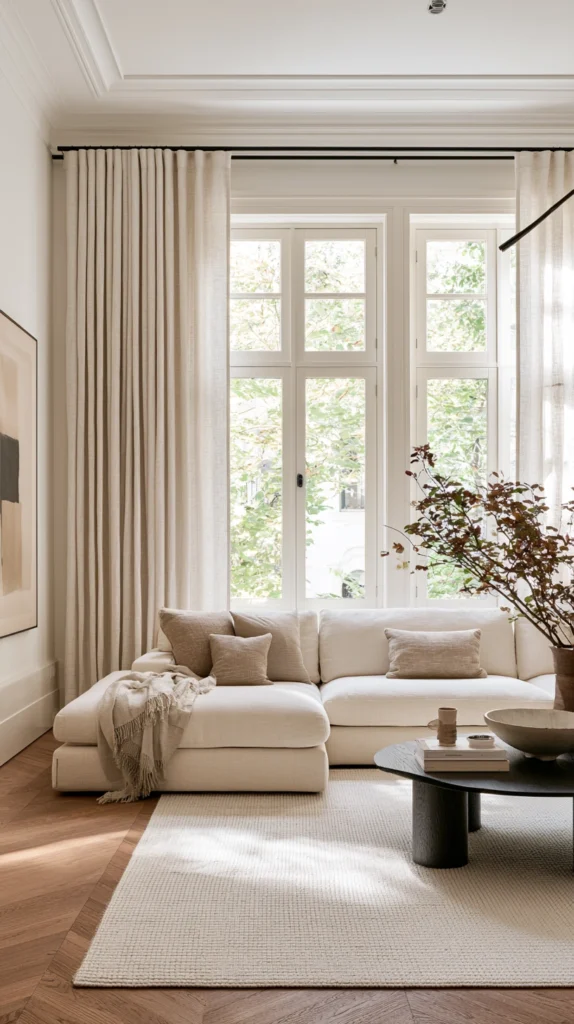
Selecting curtains based on how the room is used, not just how a fabric looks on its own.
Build it:
- A heavier linen or velvet chosen for rooms needing genuine light blocking or noise reduction, like a living room used for movie nights
- A lighter linen or cotton voile chosen for rooms prioritizing airiness and natural light throughout the day
- Blackout lining added beneath a lighter decorative fabric if both privacy and light control are needed without sacrificing the room’s overall airy look
Why fabric weight is a functional decision as much as an aesthetic one:
- A beautiful heavy fabric in a room that wants maximum daylight works against the room’s actual daily use
- A sheer, airy fabric in a room facing a busy street may leave residents wanting more privacy than the curtains can actually provide
- Blackout lining lets a decorative fabric handle both jobs at once, solving the tension between style and function
Cost breakdown: Curtain panels run $30 to $80 per panel depending on fabric weight, with blackout lining adding $15 to $30 per panel if sewn in separately.
4. Layer Sheer and Solid Panels Together
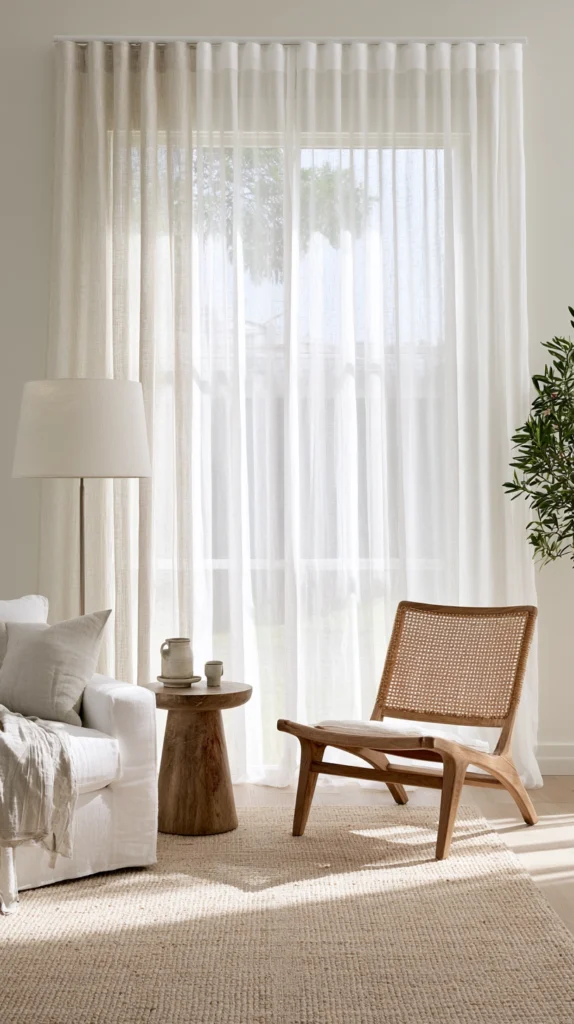
Combining two curtain types on the same rod for both daytime light and evening privacy.
Build it:
- A sheer linen or voile panel hung on an inner rod closest to the window
- A heavier solid or textured panel hung on an outer rod, positioned slightly in front of the sheer layer
- Both layers operated independently, allowing the sheer panel to stay closed during the day while the solid layer opens fully
Why layered curtains solve a problem a single panel type can’t:
- Sheers alone provide privacy without blocking light, but offer no real coverage after dark, when a room becomes visible from outside
- A solid panel alone blocks light and view completely, sacrificing the softer, diffused daylight sheers provide during the day
- Layering both gives a room genuine flexibility across different times of day without switching curtains seasonally
Cost breakdown: A double curtain rod system for layering runs $30 to $60, with the sheer and solid panels themselves running $60 to $150 combined per window.
5. Use a Bold Pattern as the Room’s Main Statement
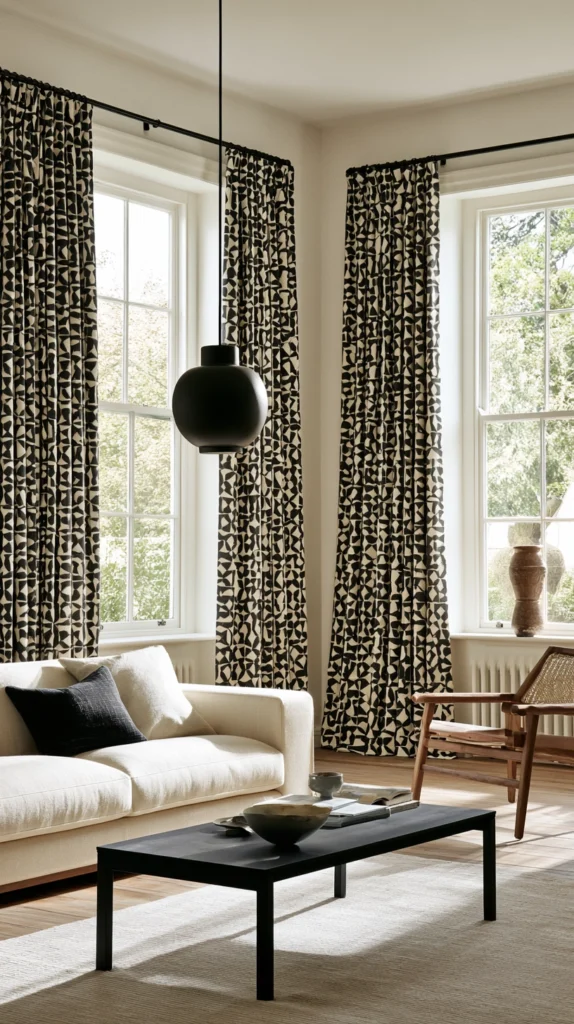
Letting the curtains carry more visual weight than a plain solid color would.
Build it:
- A large-scale botanical, geometric, or graphic pattern chosen specifically for the living room’s largest window
- The rest of the room’s furniture and accent colors kept relatively neutral, letting the curtains function as the room’s primary pattern source
- Pattern scale matched to the window’s actual size, since a small print can look busy and cluttered across a large expanse of fabric
Why bold curtains can do more design work than an accent wall or statement furniture piece:
- Curtains cover a genuinely large surface area in most living rooms, giving pattern more visual real estate than almost any other single design choice
- They’re also one of the easier elements to change later if tastes shift, unlike a painted accent wall or a large upholstered piece
- A patterned curtain against neutral surrounding decor reads as a deliberate style choice rather than an accident of too many competing patterns
Cost breakdown: Patterned curtain panels run $40 to $120 per panel depending on fabric and pattern complexity.
6. Add Decorative Hardware as a Genuine Design Detail
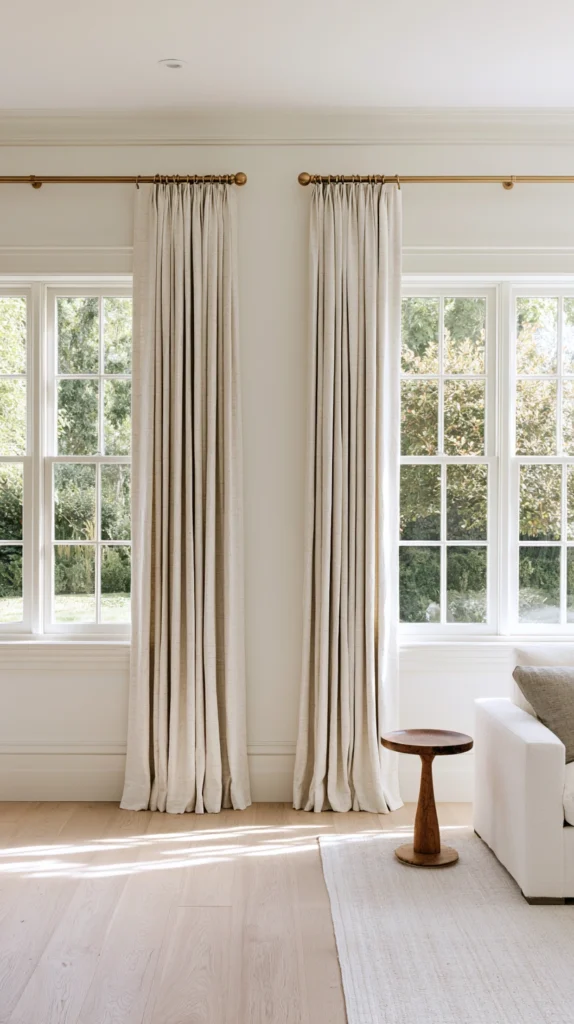
Treating rods, finials, and tiebacks as visible decor rather than purely functional hardware.
Build it:
- A rod finish chosen specifically to complement the room’s existing metal accents, like brass, matte black, or brushed nickel
- Decorative finials selected in a shape that adds character, like a simple sphere, an urn shape, or a geometric cap
- Fabric or rope tiebacks added if curtains are regularly held open during the day, chosen in a material that coordinates with the rod finish
Why hardware deserves the same attention as the fabric itself:
- Cheap, purely functional hardware can undercut even a beautifully chosen curtain fabric once someone looks closely at the window
- Coordinated metal finishes tie the curtains into the room’s broader hardware story, from door handles to light fixtures
- Decorative tiebacks specifically prevent curtains left open all day from bunching awkwardly against the wall
Cost breakdown: Decorative rod and finial sets run $30 to $80, with tiebacks adding $10 to $25 per pair.
7. Let the Curtains Pool Slightly at the Floor
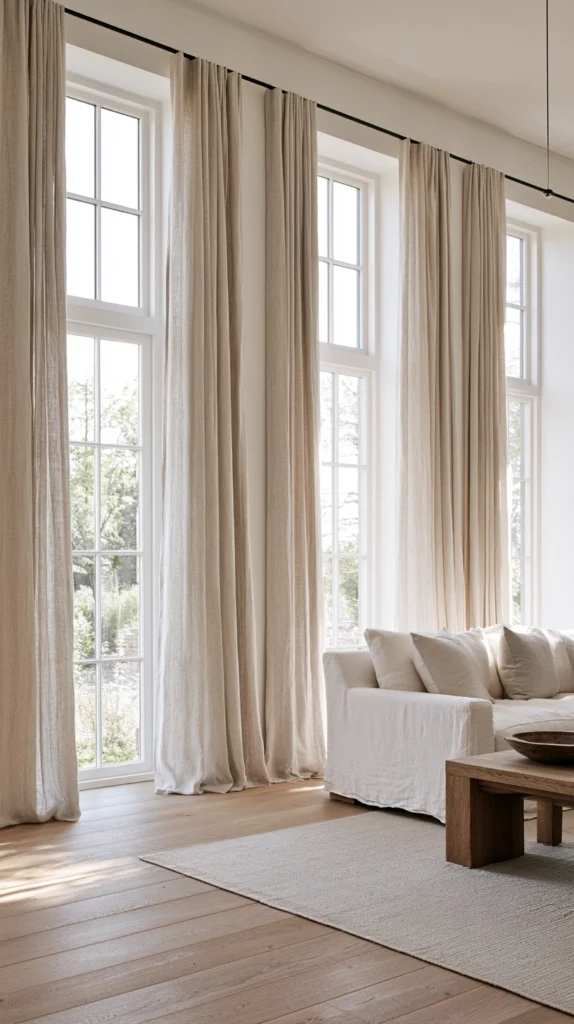
A small proportion detail that changes how finished the whole window looks.
Build it:
- Curtain panels measured and hemmed to extend half an inch to one inch beyond the actual floor length
- The extra fabric allowed to pool gently rather than bunching into a large, dramatic heap
- Panels adjusted and re-draped periodically, since pooled fabric can shift slightly with regular opening and closing
Why a slight pool reads as more considered than a curtain hemmed exactly to the floor:
- Curtains hemmed exactly at floor length can look slightly short or unfinished once fabric settles and shrinks marginally over time
- A gentle pool signals a deliberate, higher-end styling choice rather than an accidental sizing mistake
- It’s a detail borrowed directly from professional interior design and hospitality curtain installations, where this exact proportion is a common standard
Cost breakdown: No additional cost beyond ordering curtains slightly longer than standard floor-length measurements, or a tailoring adjustment running $15 to $30 per panel if hemming an existing set.
Getting started this weekend
You don’t need new curtains before the window starts looking better framed.
- Start by remounting the existing rod higher and wider than its current position, using the curtains already owned
- Add layered sheers or decorative hardware once the basic proportions are settled
- Save a full curtain replacement, like a bold new pattern, for a dedicated second phase once the sizing fundamentals are solved
Most living room windows look meaningfully more finished within an hour, simply from remounting the same curtains at a better height and width.
Budget reality
Framing a window well is often more about placement than new fabric.
- Free to $40: Remounting an existing rod higher and wider, adjusting hem length for a slight pool
- $40-150: New wider or higher-mounted rod, decorative hardware, a single new panel set
- $150-300: Layered sheer and solid panels on a double rod, a bold new patterned fabric
- $300+: Custom-length panels with blackout lining across multiple large windows
Most of the visible improvement comes from sizing and placement, not the cost of the fabric itself.
What actually frames a window well
It was never really about finding the single most beautiful curtain fabric available.
It’s the rod mounted high enough to borrow a few extra inches of ceiling, the panels wide enough to clear the glass entirely when open, the slight pool at the floor that finally makes the whole window look finished instead of just covered.
Fix the height and width first, then let fabric and pattern be the easier decision that comes after.