
14 Glam Built-In Bookshelf Ideas for Living Rooms
Our built-ins used to hold whatever books didn’t fit anywhere else, spines mismatched, shelves sagging slightly under the weight.
I finally pulled everything off one weekend and restyled it the way a designer would style a showroom shelf.
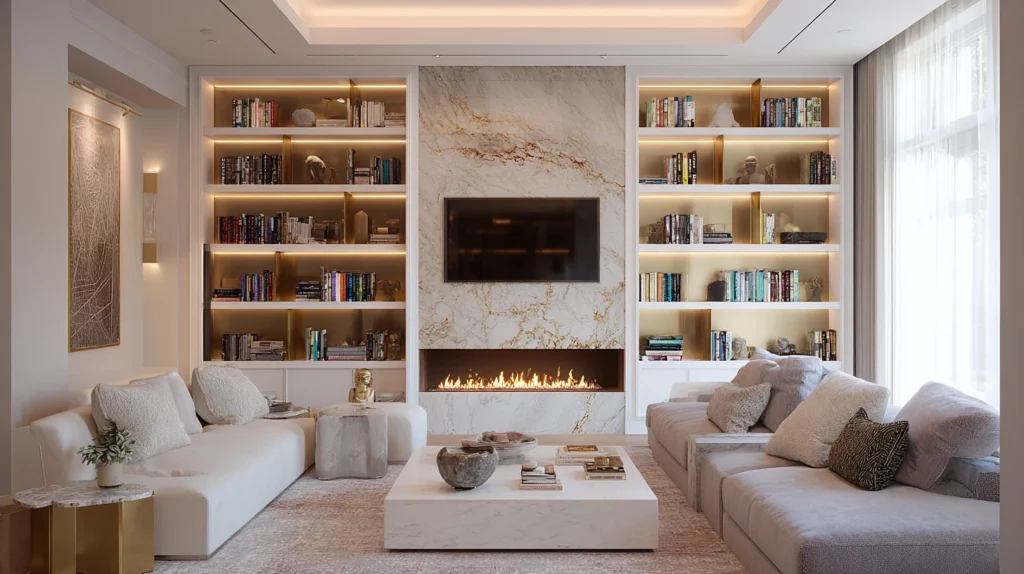
Same books, same shelves, and the room suddenly looked like it belonged in a magazine.
Glam built-ins aren’t about buying new furniture. They’re about treating storage as a genuine design feature.
Here are 14 ways to bring real glamour into a built-in bookshelf without losing any actual function.
Why built-ins carry more design weight than freestanding shelving
A built-in is architecture, not furniture, and that changes how much visual responsibility it carries.
- It’s permanent, so the finish and styling need to hold up as a genuine design statement, not a temporary arrangement
- It often anchors an entire wall, meaning its color and material influence the whole room’s palette
- Glam styling specifically relies on contrast, reflection, and intentional color, all of which built-ins have the surface area to actually deliver
Once the shelf itself is treated as a design feature, styling it becomes the easy part.
1. Mirrored Shelf Backing
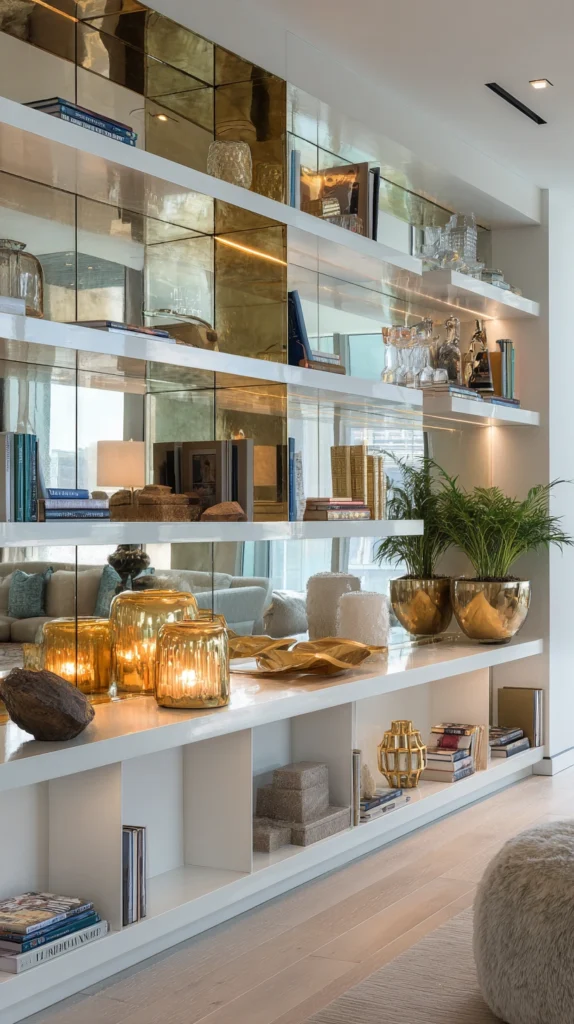
Adding reflective depth behind the books and objects themselves.
Build it:
- Mirrored panels cut to fit the back of each shelving cubby, adhered directly to the existing back panel
- Beveled edge mirror for a subtle detail line, or plain edge for a cleaner modern look
- Objects styled with slight gaps between them so the mirror’s reflection remains visible rather than fully blocked
Why mirrored backing transforms the whole shelf’s presence:
- It doubles the visual depth of every item placed on the shelf, making even a modest book collection look fuller
- It reflects and amplifies whatever light source is nearest, brightening the entire wall
- It’s one of the most dramatic upgrades achievable without touching the shelf’s actual structure
Cost breakdown: Mirrored panel installation runs $150 to $400 depending on the number of cubbies and mirror thickness.
2. High-Gloss Lacquered Interior Finish
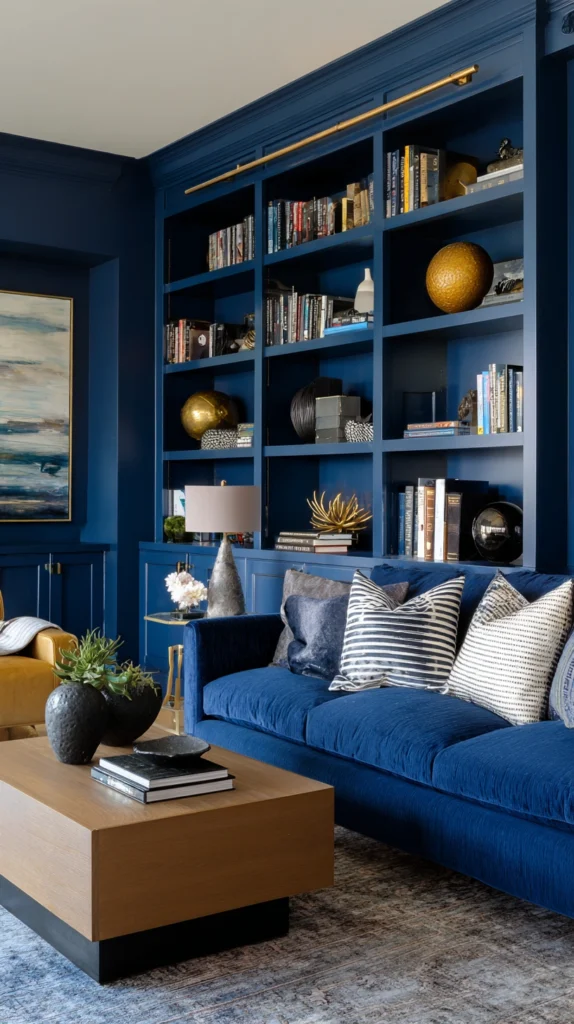
A polished, reflective paint finish inside the shelving cavities.
Build it:
- Interior back panels and shelves finished in a high-gloss lacquer, built up in multiple thin coats for genuine depth
- A bold contrasting color like emerald, navy, or black against neutral exterior trim
- Sanded lightly between coats for a glass-smooth final finish
Why lacquer works specifically inside the shelving rather than on the exterior frame:
- Contained within the cubbies, the bold color reads as a deliberate accent rather than overwhelming the whole wall
- The glossy surface catches light in a way flat paint never can, adding shine even without additional lighting
- It creates striking contrast against the books and objects displayed in front of it
Cost breakdown: Lacquer paint and application supplies run $80 to $200 depending on the shelving’s total interior surface area.
3. Brass or Gold Hardware and Trim Accents
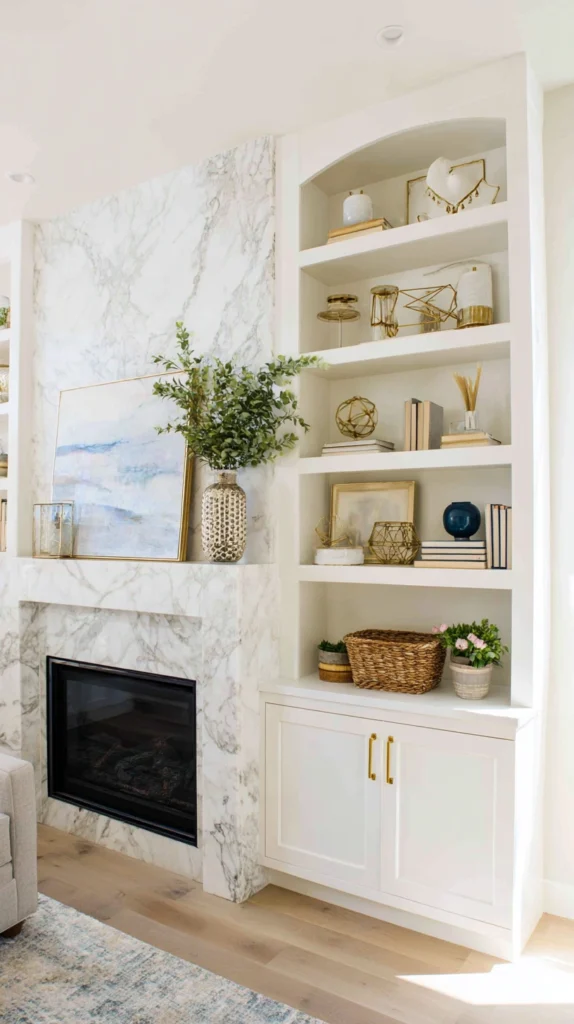
Metallic detailing applied to an otherwise standard shelving structure.
Build it:
- Brass edge trim applied along each shelf’s front lip
- Gold-finished pulls added to any built-in cabinet doors below the open shelving
- A thin brass strip inset where the shelving meets the wall or ceiling for a finished, tailored look
Why metallic trim adds glamour without a full rebuild:
- It’s one of the lowest-cost upgrades on this list, since it layers onto existing shelving rather than replacing it
- Brass and gold tones catch and reflect ambient light throughout the day, adding subtle sparkle
- It ties the shelving into other metallic accents already in the room, like light fixtures or picture frames
Cost breakdown: Brass trim and hardware accents run $60 to $150 depending on the shelving’s total length.
4. Curated Color-Blocked Book Styling
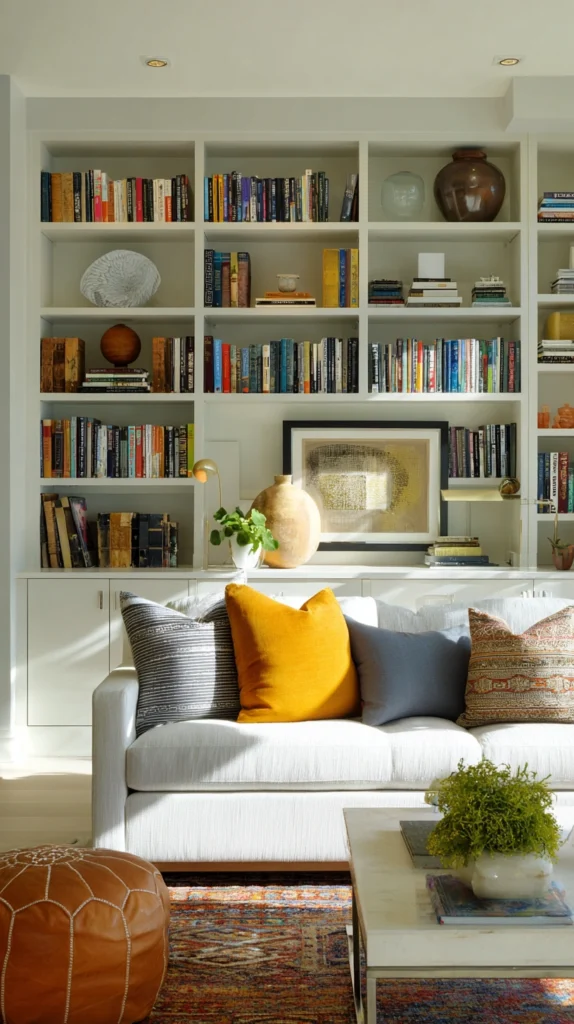
Arranging books by spine color rather than by author or genre.
Build it:
- Books grouped and shelved by spine color, creating gradient sections across each shelf
- Jacket-less hardcovers turned backward if the spine color doesn’t fit the intended palette
- Small decorative objects placed at color transitions to break up long runs of a single tone
Why color-blocking reads as more polished than a standard alphabetical arrangement:
- It transforms a purely functional book collection into a deliberate visual display
- The gradient effect draws the eye across the entire shelf rather than settling on one cluttered section
- It works with books already owned, requiring no new purchases to see the transformation
Cost breakdown: Free, since this only requires rearranging an existing book collection.
5. Integrated LED Shelf Lighting
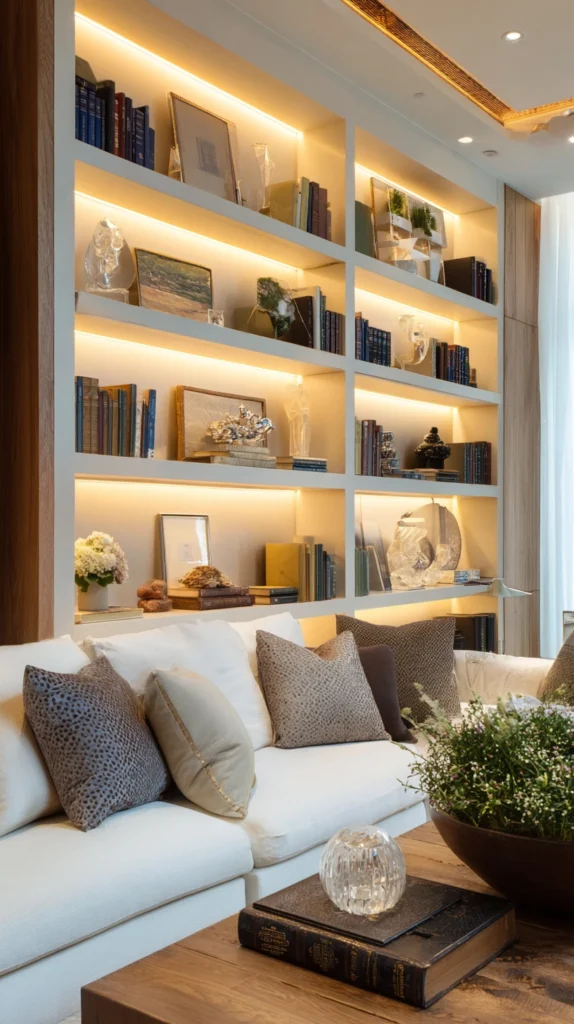
Built-in lighting that highlights the display rather than just the room.
Build it:
- Low-profile LED strip lighting installed along the underside of each shelf, hidden from direct view
- Warm-toned bulbs to complement gold or brass accents elsewhere in the shelving
- Wired to a dimmer switch, allowing brightness to shift from daytime display to soft evening ambiance
Why dedicated shelf lighting elevates styled objects specifically:
- It highlights ceramics, glassware, and book spines individually, rather than relying on general room lighting to do the work
- The hidden strip placement means only the warm glow is visible, not the fixture itself
- It extends the shelf’s visual impact into the evening, when most rooms otherwise rely on a single overhead source
Cost breakdown: LED strip lighting and a dimmer switch installation runs $100 to $250 depending on the shelving’s total length.
6. Velvet-Lined Display Cubbies
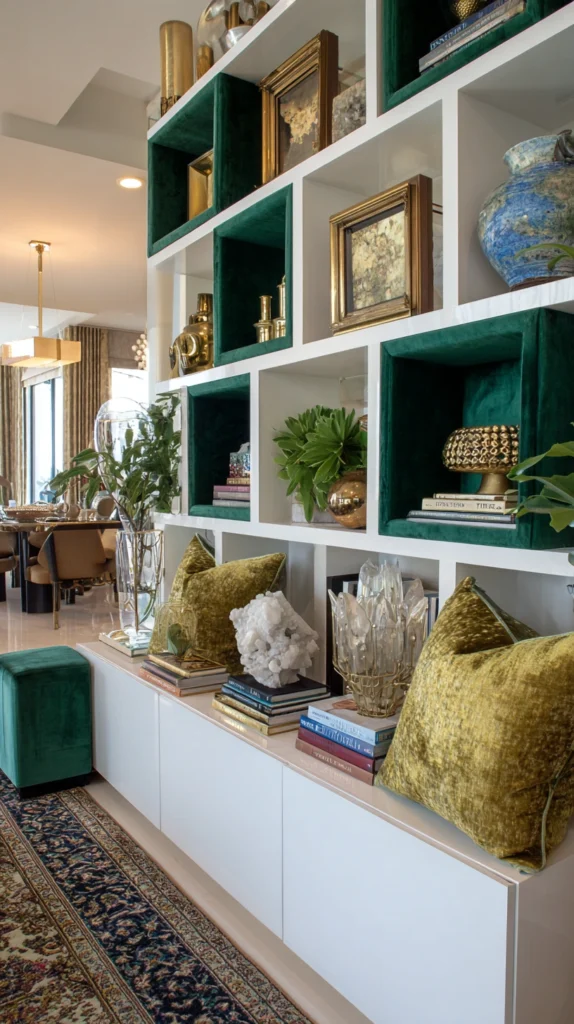
Soft, tactile fabric used to line select shelving sections.
Build it:
- A small number of cubbies lined with velvet fabric, adhered to a thin backing board cut to fit
- Deep jewel tones like emerald or burgundy for maximum contrast against surrounding wood or painted shelving
- Reserved for a few statement cubbies rather than the entire built-in, keeping the effect intentional rather than overwhelming
Why velvet lining adds a genuinely luxurious texture layer:
- It introduces softness into a typically hard-surfaced structure of wood, paint, and glass
- The fabric’s light-absorbing quality creates a striking contrast against glossy ceramics or metallic objects displayed in front of it
- Used sparingly, it reads as a deliberate design choice rather than an overdone effect across the whole shelf
Cost breakdown: Velvet fabric and lining for a handful of cubbies runs $40 to $90 depending on fabric quality and coverage.
7. Symmetrical Styling With Matched Bookends
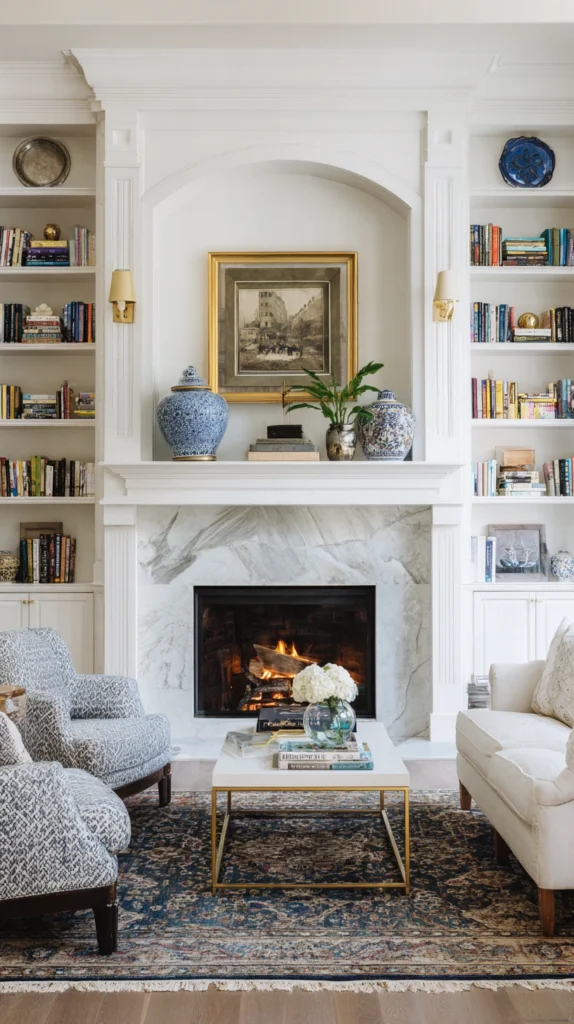
Formal, mirrored arrangement across paired shelving sections.
Build it:
- Identical decorative bookends used on either side of a matching built-in section, whether flanking a fireplace or window
- Objects and book groupings mirrored in placement and height from one side to the other
- A single larger anchor piece, like a lamp or vase, repeated identically on both sides
Why symmetry reads as more formal and considered than an eclectic arrangement:
- It suits the polished, intentional feeling central to glam styling more than a casual, mismatched look
- Matched bookends give an otherwise simple book collection genuine structure and visual weight
- It photographs particularly well in living rooms built around a central fireplace or window with built-ins on either side
Cost breakdown: A set of decorative bookends runs $20 to $60 depending on material, typically needing two matching pairs for symmetry.
8. Faux Marble or Stone Contact Paper Backing
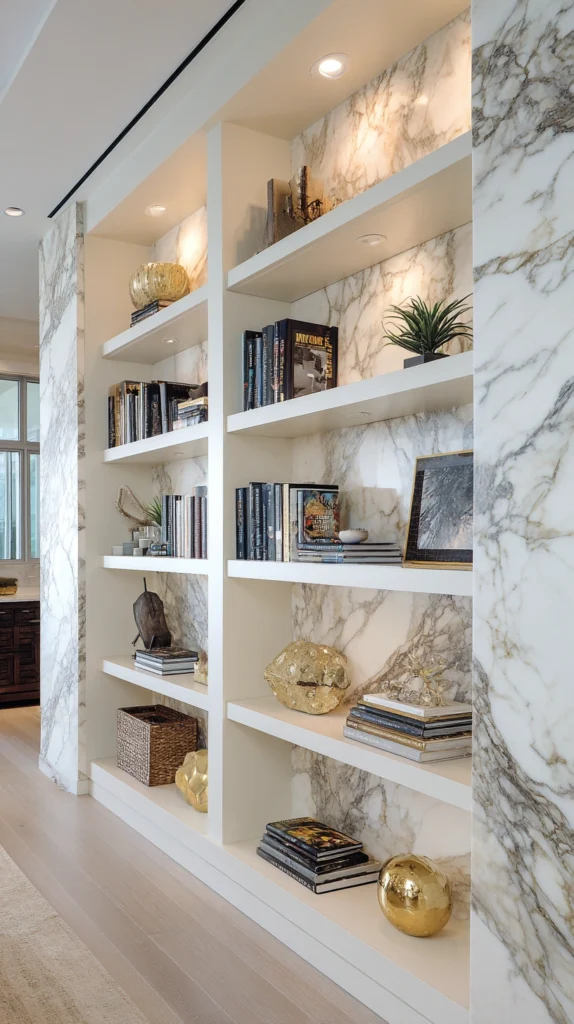
A budget-friendly way to add a stone-look surface behind the shelving.
Build it:
- High-quality marble-look contact paper applied to the back panel of each shelving cubby
- Seams aligned carefully at cubby dividers so the veining pattern reads as continuous rather than obviously segmented
- Sealed at the edges to prevent peeling from regular handling of items on the shelf
Why a marble-look finish delivers glam impact without the real stone cost:
- It introduces the same luxurious veining pattern associated with genuine marble at a fraction of the material cost
- It’s fully removable, making it a strong option for renters who can’t alter the built-in permanently
- The subtle pattern adds visual interest behind displayed objects without competing with them
Cost breakdown: Marble-look contact paper runs $15 to $30 per roll, typically enough to cover a standard built-in’s back panels.
9. Curated Object Styling With Coffee Table Books
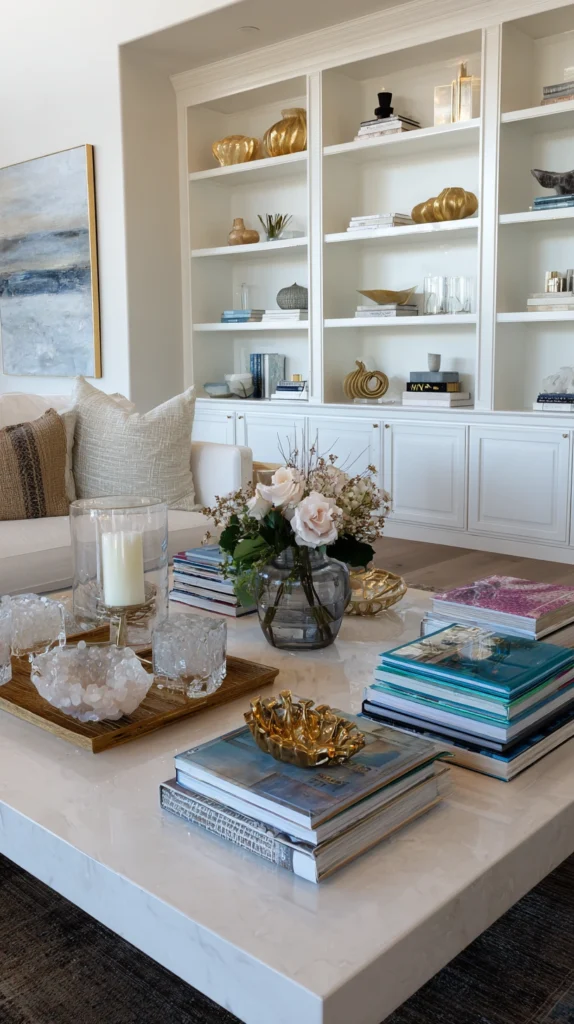
Treating the shelf as a display case rather than pure book storage.
Build it:
- Large-format coffee table books stacked horizontally rather than shelved vertically in select sections
- A small decorative object, like a candle or small sculpture, placed atop each stack
- Grouped in odd numbers alongside the vertical book sections for visual variety
Why horizontal stacking adds more styling opportunity than a fully vertical shelf:
- It breaks up what can otherwise be a monotonous row of upright spines
- Coffee table books, chosen for their own cover design, become decorative objects in their own right
- The flat stacked surface gives smaller decorative objects a stable, elevated place to sit
Cost breakdown: Coffee table books run $15 to $40 each if purchasing new, though many households already own several suited for this purpose.
10. Glass Shelving for a Lighter, Airier Feel
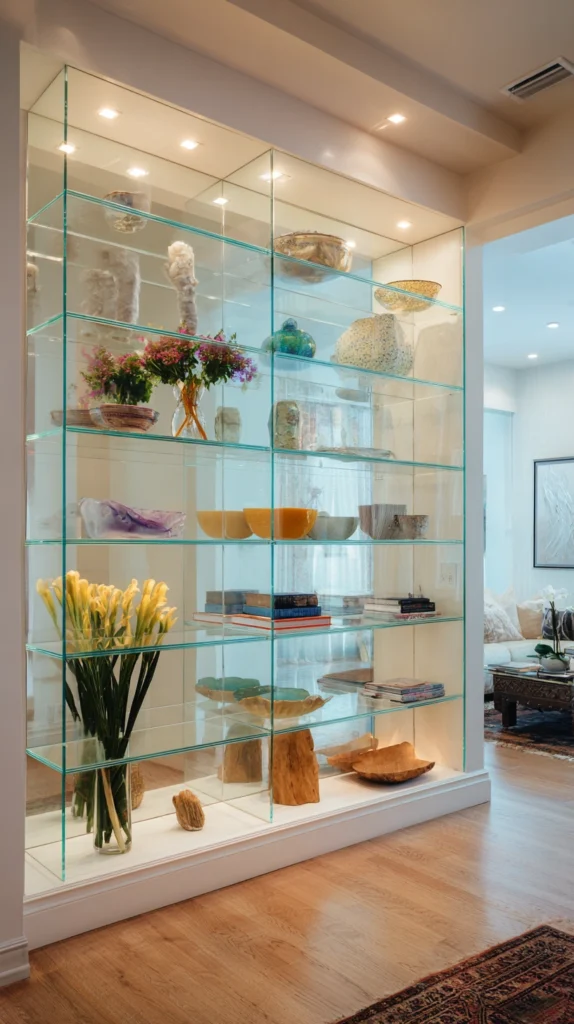
Replacing solid wood shelves with clear or smoked glass.
Build it:
- Tempered glass panels cut to fit the existing shelving structure, replacing solid wood inserts
- Clear glass for maximum light transmission, or lightly smoked glass for a moodier, more dramatic look
- Edge-polished for safety and a finished, professional appearance
Why glass shelving suits a specific style of glam better than solid wood:
- It keeps sightlines open through the shelving unit, particularly valuable for smaller rooms
- Light passes through each shelf level rather than stopping at a solid surface, brightening the entire structure
- It pairs especially well with mirrored backing or LED lighting, since both effects show through the glass itself
Cost breakdown: Tempered glass shelf replacements run $30 to $80 per shelf depending on size and glass type.
11. Wallpapered Back Panels in a Bold Pattern
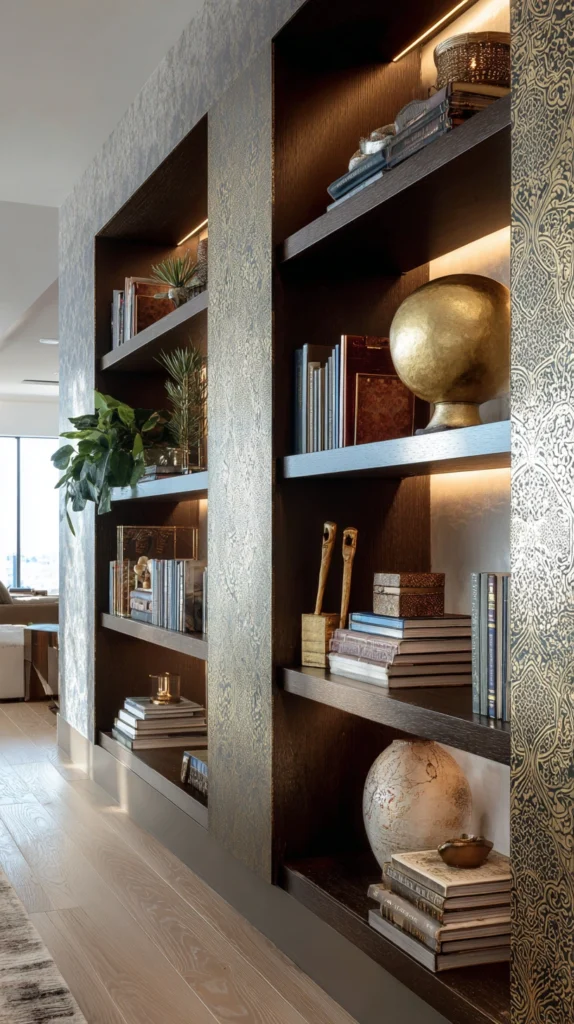
Pattern used behind the books rather than plain paint.
Build it:
- A bold, high-contrast wallpaper pattern applied to the back panel of each shelving section
- Metallic ink patterns for added shine, or a rich botanical print for more organic glamour
- Trimmed precisely to fit each cubby’s exact dimensions for a clean, professional finish
Why patterned backing does more visual work than a single paint color:
- It gives the shelving genuine depth and visual interest even in sections with fewer displayed objects
- Metallic patterns specifically catch light throughout the day, adding to the room’s overall shine
- It’s a relatively simple update that dramatically changes the shelf’s overall character without touching its structure
Cost breakdown: Wallpaper suited for back panel application runs $30 to $60 per roll, typically enough for several cubbies.
12. Acrylic and Lucite Decorative Accents
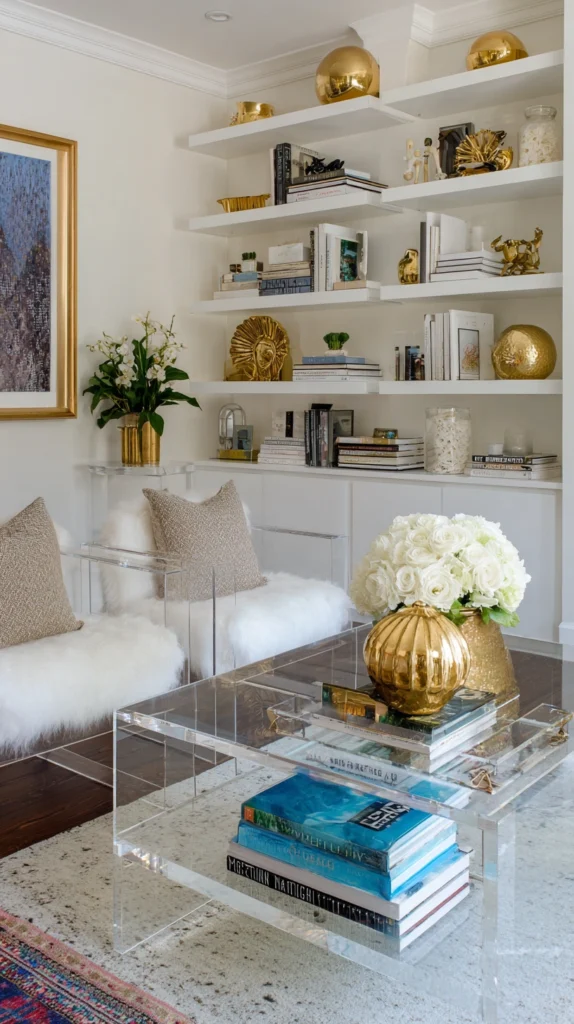
Clear, modern materials mixed in among more traditional glam elements.
Build it:
- Small acrylic or lucite bookends, trays, or riser blocks used to elevate select objects
- Positioned to add height variation without visually crowding the shelf with additional solid material
- Paired with brass or gold accents nearby, since the clear material lets those metallic tones remain the visual focus
Why clear acrylic pieces suit a glam shelf without adding visual bulk:
- The material’s transparency means it adds functional height and structure without taking up visual space
- It bridges more traditional glam materials, like brass and velvet, with a slightly more modern edge
- It’s a practical way to elevate smaller decorative objects to a more prominent height on a crowded shelf
Cost breakdown: Acrylic bookends and riser blocks run $15 to $40 each depending on size.
13. Curated Art and Sculptural Objects Between Books
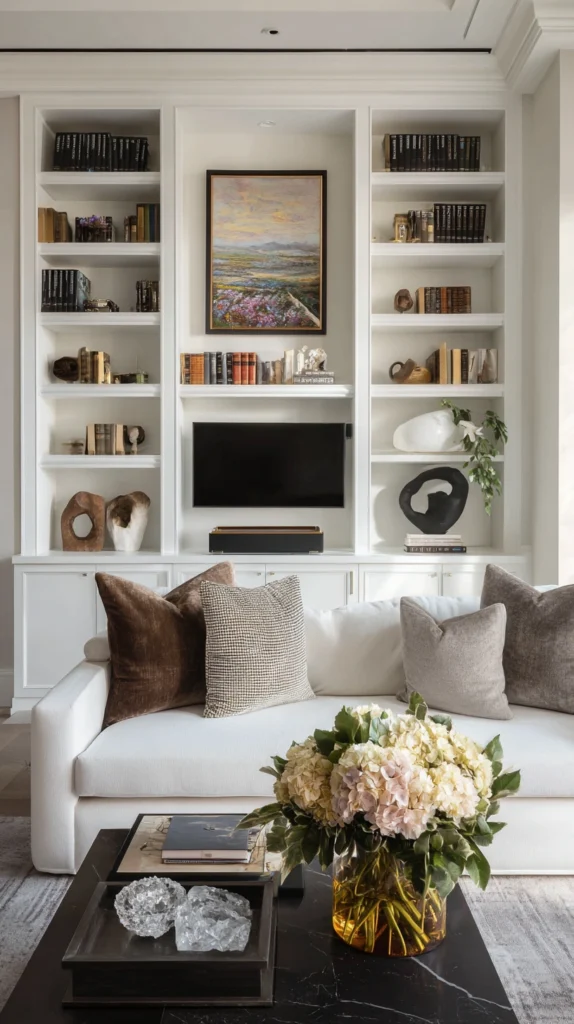
Breaking up long rows of spines with sculptural interest.
Build it:
- Small framed art pieces leaned against the back panel between book groupings
- A single sculptural object, like a ceramic form or small bust, placed at the end of a shelf run
- Objects varied in height and material to avoid a repetitive, uniform look across the shelving
Why sculptural objects matter as much as the books themselves:
- A shelf filled entirely with books, however nicely arranged, can start to feel monotonous without other visual breaks
- Sculptural pieces add genuine three-dimensional interest that flat book spines alone can’t provide
- It gives the shelving a curated, gallery-like quality rather than reading purely as storage
Cost breakdown: Small sculptural decor pieces run $20 to $60 each depending on material and size.
14. Two-Tone Paint Treatment on Exterior Trim and Interior Cubbies
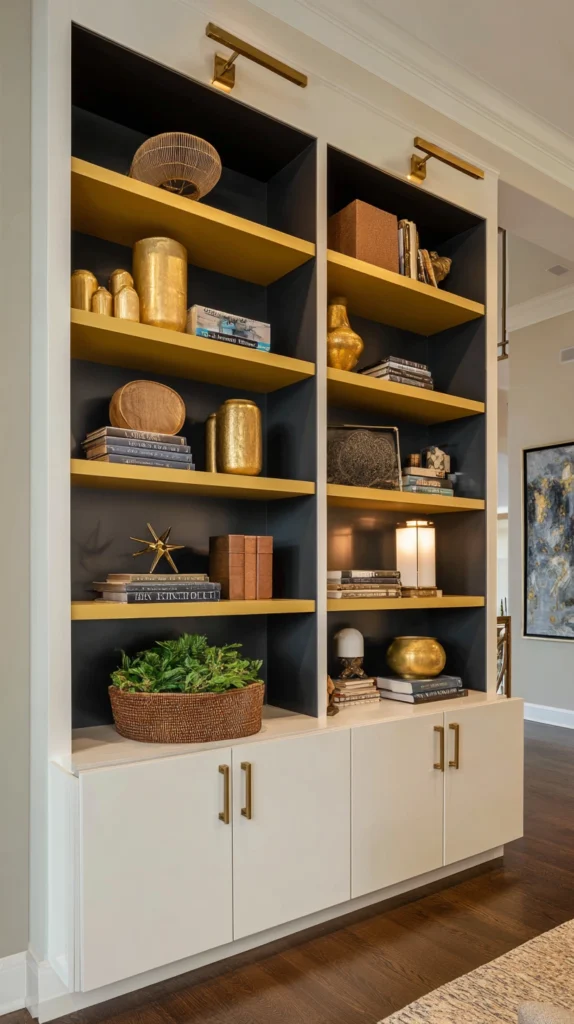
Using two coordinated colors to add depth to the shelving’s overall structure.
Build it:
- The exterior frame and trim painted in a neutral tone that matches the surrounding wall color
- The interior cubby backs painted in a bolder contrasting color, visible only once objects are styled in front of them
- A clean, crisp paint line where the two colors meet, achieved with careful taping before application
Why two-tone treatment reads as more custom than a single uniform color:
- It allows the shelving to blend seamlessly into the wall from a distance while revealing a bolder color up close
- The contrast draws attention specifically to the styled objects rather than the shelving structure itself
- It’s a detail more commonly found in custom, professionally designed built-ins than standard prefabricated units
Cost breakdown: A two-tone paint treatment runs $60 to $150 in paint and supplies depending on the shelving’s total surface area.
Getting started this weekend
You don’t need to rebuild the whole shelving unit before the glamour starts to show up.
- Start by pulling everything off the shelf and restyling with color-blocked books and matched bookends
- Add brass trim accents or a mirrored back panel once you know the basic arrangement works for the room
- Save larger changes like glass shelving or a full lacquer finish for a dedicated second phase
My own built-ins went from cluttered storage to the first thing guests notice, almost entirely from restyling what was already there.
Budget reality
Glam built-in styling scales from a free rearrangement to a full material upgrade.
- Free: Color-blocked book styling, symmetrical arrangement with existing bookends
- Under $100: Brass trim accents, velvet-lined cubbies, contact paper backing
- $100-250: Mirrored shelf backing, LED lighting, glass shelf replacements
- $250+: Full high-gloss lacquer finish, wallpapered back panels across a large built-in, two-tone paint treatment
Most of the visible glamour comes from styling choices and small material accents, not a full shelving rebuild.
What actually makes a built-in feel glamorous
It was never really about buying more decorative objects to fill the shelves.
It’s the mirrored backing catching afternoon light, the brass trim adding shine to an otherwise plain edge, the books finally arranged with real intention instead of shoved in wherever they fit.
Start by restyling what’s already on the shelf, then build the material upgrades from there.