
14 Halloween Mantel Decor Ideas for a Spooky-Chic Home
The mantel changed how my whole living room felt for October more than any other single decoration I have tried. Not the plastic skeleton on the porch. Not the string of orange lights. Not the pumpkin display or the spiderweb stretched across the doorway or the fog machine tucked in the corner.
The styling above the fireplace.
Because a genuinely considered mantel did something the scattered seasonal decorations elsewhere in the house never managed. Before it: a mantel with a few grocery-store pumpkins and a plastic bat, technically Halloween-themed but visually forgettable, competing for attention with everything else in the room. After it: a mantel that looked like it belonged in an actual design magazine’s October issue, spooky and sophisticated in equal measure, the room’s clear seasonal focal point.

Spooky-chic is not Halloween decor with the color turned down. It is a genuine aesthetic approach, treating October’s darker, moodier materials — dried botanicals, aged candlesticks, deep jewel tones, real or convincing skulls and bones — with the same styling intention given to any other seasonal mantel. The mantel: no longer a shelf for plastic props, but a considered composition that happens to be spooky.
Here are 14 Halloween mantel decor ideas for a spooky-chic home — from the simplest candlestick cluster to the most fully realized seasonal display — built on that understanding.
Why the Mantel Deserves the Same Care as Any Other Seasonal Display
The focal point principle
A fireplace mantel is, in most living rooms, already the space’s natural focal point, drawing the eye before any other furniture or decor. Styled well for Halloween, it becomes the single most effective way to establish the season’s mood throughout the entire room.
The chic-over-kitsch distinction
Without a considered approach:
Plastic skulls, orange string lights, and inflatable props, technically seasonal but visually cluttered and disposable-feeling.
The mantel: reading as a costume shop display rather than a genuine design choice.
With a considered approach:
Real or convincing natural materials — aged candlesticks, dried botanicals, genuine or high-quality faux skulls, deep velvet and jewel tones — styled with the same height variation and restraint given to any other seasonal mantel.
The mantel: reading as sophisticated and atmospheric, spooky without sacrificing genuine design quality.
The material upgrade case
The single biggest difference between a kitsch Halloween mantel and a spooky-chic one is material quality — a resin skull with a convincing bone-white finish reads entirely differently than a bright orange plastic one, even though both are technically the same object.
The restraint principle
A mantel with fewer, better-chosen objects, arranged with real height variation and negative space, consistently reads as more sophisticated than one densely packed with every seasonal item available. Spooky-chic depends on this same restraint as any other elevated styling approach.
The Five Materials That Define Spooky-Chic
Before styling any single mantel:
Aged and antique metals
Candlesticks, candelabras, and small objects in aged brass, pewter, or wrought iron.
The single most important material category for this aesthetic.
Provides the moody, historic quality central to spooky-chic.
Dried and dark botanicals
Dried branches, black roses, dark dried grasses, and moody florals.
Adds organic texture without introducing bright, cheerful color.
Echoes the same restrained palette used throughout the rest of the display.
Quality faux bone and skull decor
Well-made resin skulls, bones, and anatomical objects, finished convincingly rather than cartoonishly.
The category most responsible for elevating or undermining the whole aesthetic.
Worth the investment in better-quality pieces over cheap, obviously plastic versions.
Deep jewel-toned and black textiles
A draped fabric runner, ribbon, or small textile accent in black, deep burgundy, or aged purple.
Softens the harder materials elsewhere in the display.
Ties the mantel’s color palette together.
Candlelight and warm low light
Taper candles, lanterns, and warm string lights, rather than bright overhead lighting.
Essential to the mood this aesthetic depends on.
Transforms the same objects dramatically between daytime and evening viewing.
1. The Aged Candlestick and Taper Cluster
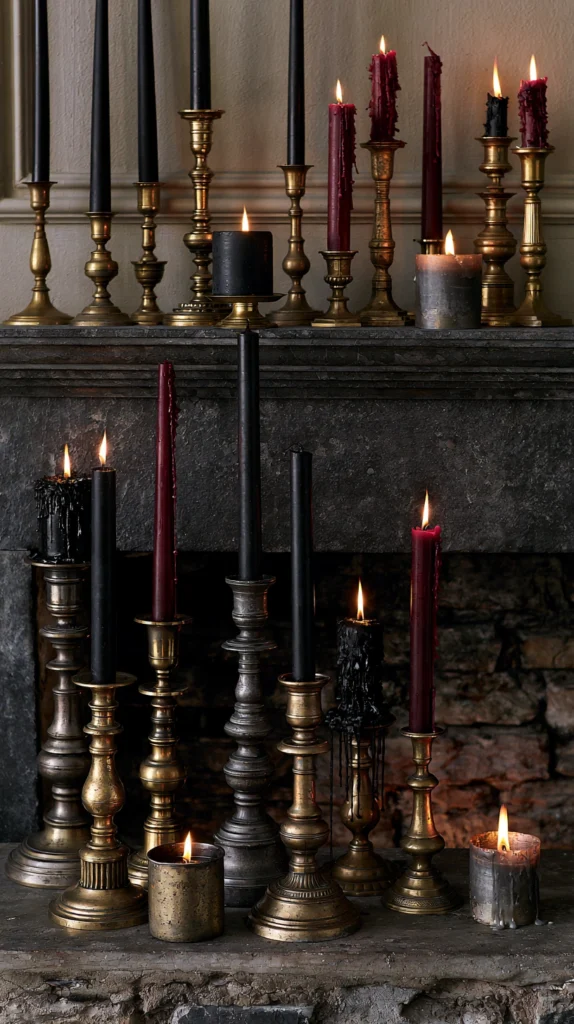
A collection of candlesticks in varying heights, finished in aged brass, pewter, or black metal, clustered along the mantel with dripping black or deep burgundy taper candles.
Why candlesticks are the foundational element of any spooky-chic mantel
Height-varied candlesticks provide the same structural backbone a spooky-chic mantel needs that a floral arrangement provides a spring mantel — the single most versatile starting point for building the rest of the display around.
The candlestick selection
A mix of heights and finishes — aged brass, matte black, pewter — gathered rather than matched, echoing the same collected, varied approach valued in any well-styled vignette.
The candle choice
Black or deep burgundy taper candles, some allowed to drip naturally down the candlestick for an intentionally aged, gothic quality.
The clustering
Grouped in twos and threes rather than evenly spaced individually, creating the same rhythmic variation principle used in any considered styling arrangement.
The safety consideration
Candles kept clear of any nearby dried botanicals or fabric elements, a genuine fire safety concern worth prioritizing regardless of how dramatic the overall display.
The evening transformation
The candlesticks’ true effect only fully realized once lit at dusk, the flickering light catching the aged metal finishes in a way daytime viewing alone does not reveal.
Cost breakdown: Candlesticks (5–6, aged finishes): $30–70 Black or burgundy taper candles: $15–30 Total: $45–100
2. The Quality Skull and Bone Display
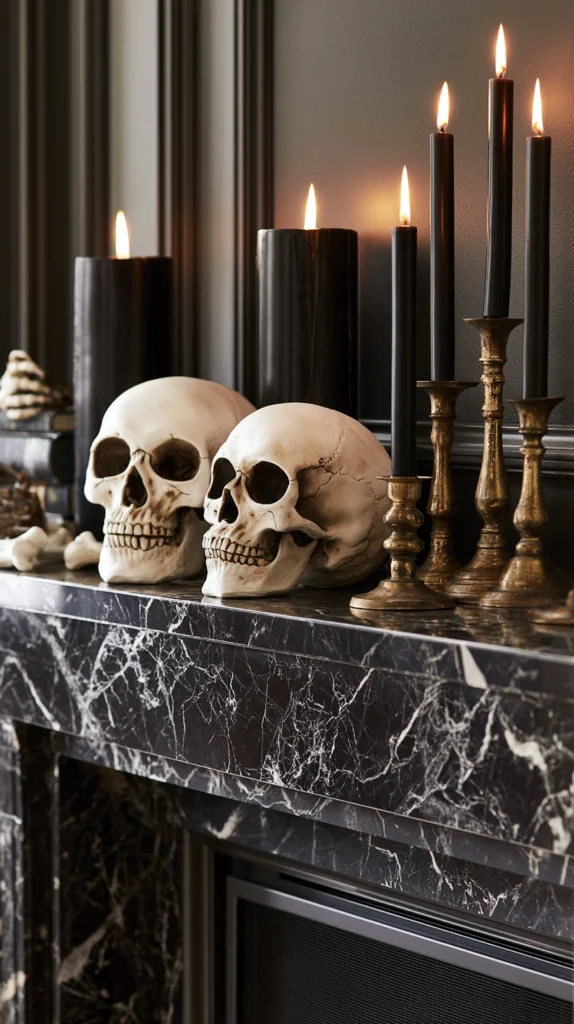
A small collection of well-made resin or ceramic skulls and bones, finished in a convincing aged ivory or bone-white tone rather than a bright, cartoonish white.
Why material quality determines whether this specific decor reads as chic or costume-like
A cheap, glossy plastic skull with an unnaturally bright white finish reads immediately as a costume prop. A well-made resin skull with a matte, slightly aged ivory finish reads as a genuine curiosity or collected object, even though the underlying form is identical.
The skull selection
One or two larger, well-finished skulls as the display’s anchor pieces, rather than a large quantity of smaller, lower-quality versions.
The finish
Matte, slightly yellowed or aged ivory tones, avoiding the bright white or glossy black finishes common in cheaper Halloween decor.
The bone accents
Smaller bone-style objects — a scattering of vertebrae-style beads, a small ribcage accent piece — layered around the main skull for additional texture without overwhelming the display.
The placement
Positioned among the candlesticks or dried botanicals, rather than lined up in an obvious row, integrating the skulls into the broader styled composition.
The overall restraint
One or two well-chosen pieces reading as considerably more sophisticated than a dozen scattered smaller skulls and bones crowding the mantel’s surface.
Cost breakdown: Quality resin skulls (1–2, well-finished): $30–70 Smaller bone accents: $15–30 Total: $45–100
3. The Dried Black Rose and Botanical Arrangement
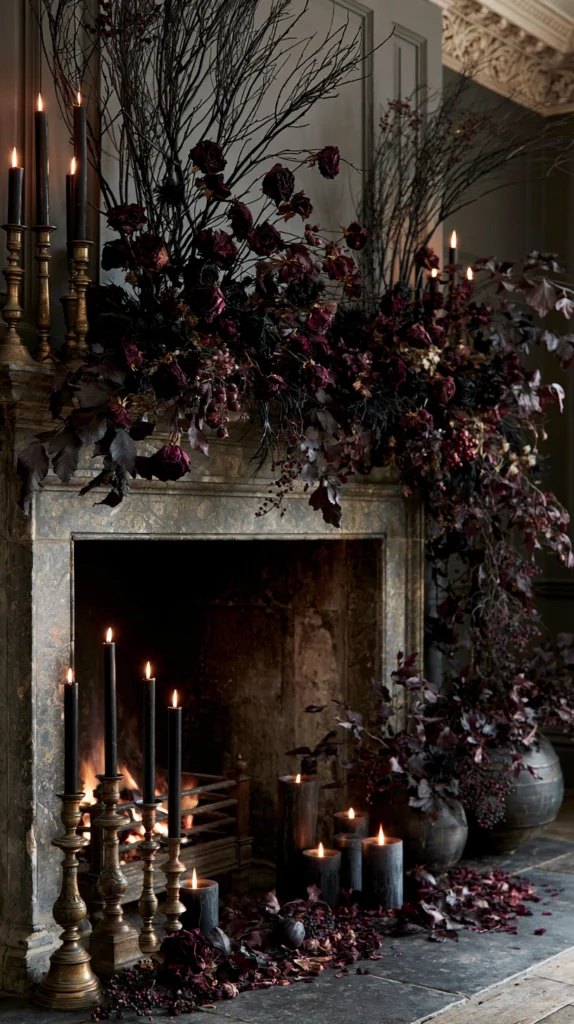
A small arrangement of dried black or deep burgundy roses, paired with dark dried grasses and branches, providing organic texture in the season’s moodier color palette.
Why dried black florals suit this aesthetic better than fresh, bright flowers
Fresh flowers, particularly in bright colors, work against the muted, aged quality spooky-chic depends on. Dried roses, naturally darkened and papery, along with genuinely black-dyed varieties, provide the same organic softness in a color and texture that suits the mood.
The rose selection
Naturally dried deep red or burgundy roses, which darken further as they dry, or specifically dyed black roses available from florists specializing in dried arrangements.
The supporting botanicals
Dark dried pampas grass, black-dyed bunny tail grass, or bare, twisted branches, providing textural variety and height around the roses themselves.
The vessel
A dark ceramic vase, an aged metal urn, or a simple black vessel, chosen to complement rather than compete with the botanicals’ own dark, muted tones.
The placement
Positioned at one end of the mantel rather than dead center, allowing the arrangement to anchor one side while candlesticks or other objects balance the opposite end.
The longevity
Genuinely long-lasting once dried, unlike fresh florals, allowing this element to remain in place and looking good throughout the full Halloween season without any need for replacement or maintenance.
Cost breakdown: Dried black or burgundy roses: $20–40 Dried grasses and branches: $10–25 Dark vessel: $15–40 Total: $45–105
4. The Vintage Apothecary Bottle Collection
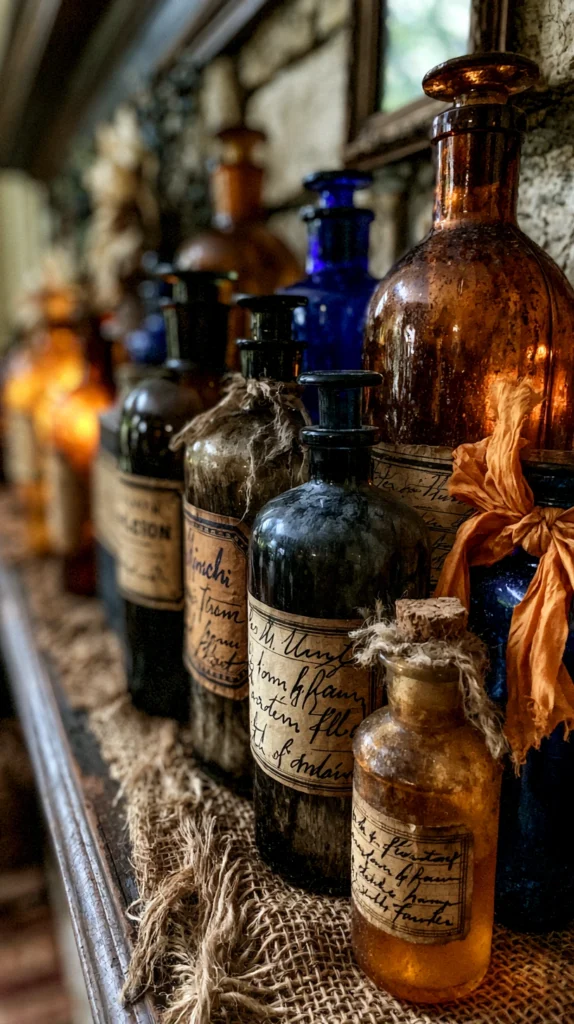
A collection of dark amber, cobalt, or smoked glass apothecary-style bottles, some labeled with old-fashioned handwritten tags, evoking an old herbalist’s or alchemist’s shelf.
Why apothecary bottles carry a specific, effective spooky-chic mood
The visual language of aged glass and mysterious, labeled contents suggests old knowledge, potions, and quiet ritual, a mood central to this aesthetic without relying on anything overtly cartoonish or costume-like.
The bottle sourcing
Antique shops, secondhand markets, or specialty Halloween retailers selling quality reproduction apothecary glass, chosen for genuine age and character over obviously new, mass-produced versions.
The contents
Dried herbs, a colored liquid (using food coloring diluted in water), or simply left empty, each bottle catching light differently depending on its glass color and contents.
The labeling
Small, handwritten or antiqued-looking labels, evoking an old apothecary’s inventory, kept legible and tasteful rather than illegibly ornate.
The arrangement
Clustered by height and glass color, rather than lined up uniformly, echoing the same varied, collected quality valued throughout this entire aesthetic approach.
The lighting interaction
Positioned where nearby candlelight catches and passes through the colored glass, one of this display’s most effective visual qualities, particularly once evening sets in.
Cost breakdown: Apothecary-style bottles (5–6): $25–60 Contents and labeling supplies: $10–20 Total: $35–80
5. The Black and Deep Jewel-Tone Draped Fabric
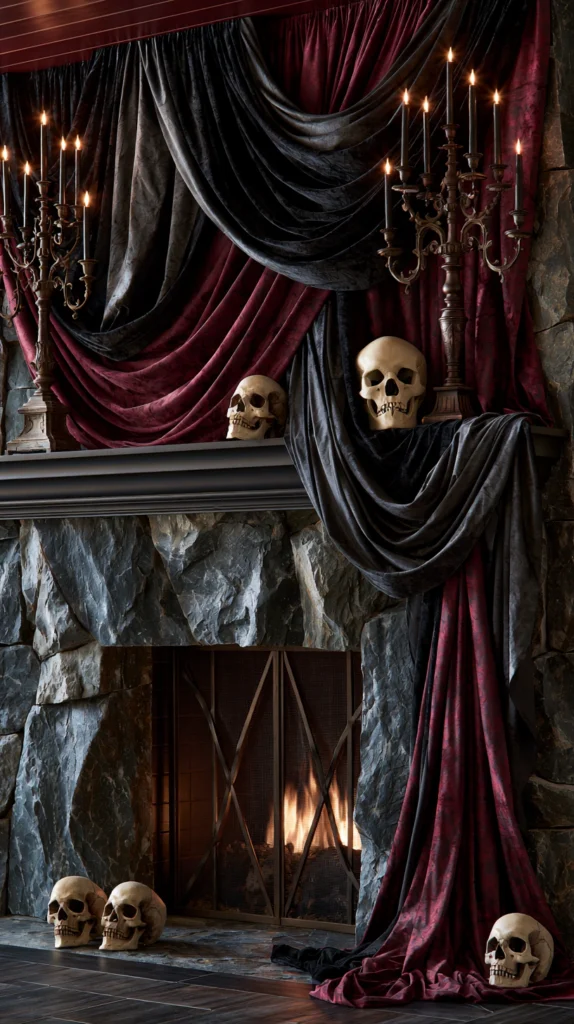
A length of black velvet, deep burgundy silk, or aged purple fabric draped along the mantel’s length, softening the harder materials elsewhere in the display and adding a layer of rich color.
Why draped fabric belongs in this aesthetic despite its simplicity
Every other element in a typical spooky-chic mantel — metal, glass, bone, dried wood — is a hard material. Draped fabric introduces genuine softness and rich color, providing the same textural counterpoint fabric offers in any other well-considered room design.
The fabric choice
Black velvet for maximum richness and light-catching quality, or a deep burgundy or aged purple silk for a slightly softer, more romantic effect.
The draping technique
Draped loosely along the mantel’s length, allowed to fall naturally over the edge in places rather than pulled taut and flat, for a more organic, gathered appearance.
The layering with other elements
Candlesticks, skulls, and botanicals arranged on top of and among the draped fabric, the fabric providing a textural base layer beneath the display’s other objects.
The color coordination
Chosen to complement rather than clash with the other elements’ own color palette — a black velvet base beneath aged brass candlesticks, for instance, or a burgundy silk echoing dried rose tones elsewhere in the display.
The overall effect
A mantel with genuine depth and richness, the fabric doing quiet but significant work in elevating the whole display beyond what the harder objects alone would achieve.
Cost breakdown: Velvet or silk fabric (sufficient length): $20–50 Total: $20–50
6. The Raven and Crow Perched Accent
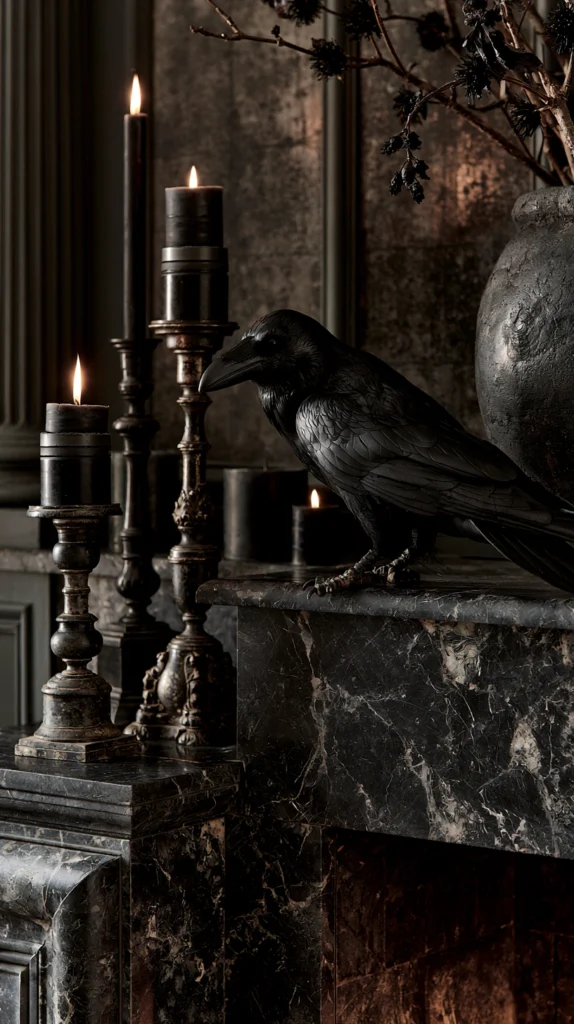
One or two well-made black raven or crow figures, perched among the candlesticks or on the mantel’s edge, providing a restrained nod to a classic Halloween motif.
Why restraint matters specifically with this particular decor element
A single well-placed raven reads as intentional and atmospheric; a dozen scattered throughout the room tips quickly into costume territory. This is one of the clearest examples of the broader principle that fewer, better-chosen objects outperform density in this aesthetic.
The figure quality
Matte black finish, realistic proportions, and genuine weight or substantial material rather than a lightweight, glossy plastic figure that would undercut the display’s otherwise considered material quality.
The placement
One larger figure perched prominently, or one perched raven paired with a second smaller one tucked among the botanicals, rather than several identical figures repeated evenly across the mantel.
The height variation
Positioned at a different height than the surrounding candlesticks, using the same varied-height principle relevant to any well-composed vignette, so the raven adds to rather than disrupts the display’s overall visual rhythm.
The material harmony
Chosen in the same matte black finish as any black metal candlesticks or hardware elsewhere in the display, tying the raven into the broader material palette.
The overall restraint
The single detail most responsible for keeping an otherwise elaborate mantel from tipping into overdone territory, precisely because it appears once or twice rather than repeatedly.
Cost breakdown: Quality raven or crow figures (1–2): $15–40 Total: $15–40
7. The Antique Mirror or Portrait Backdrop
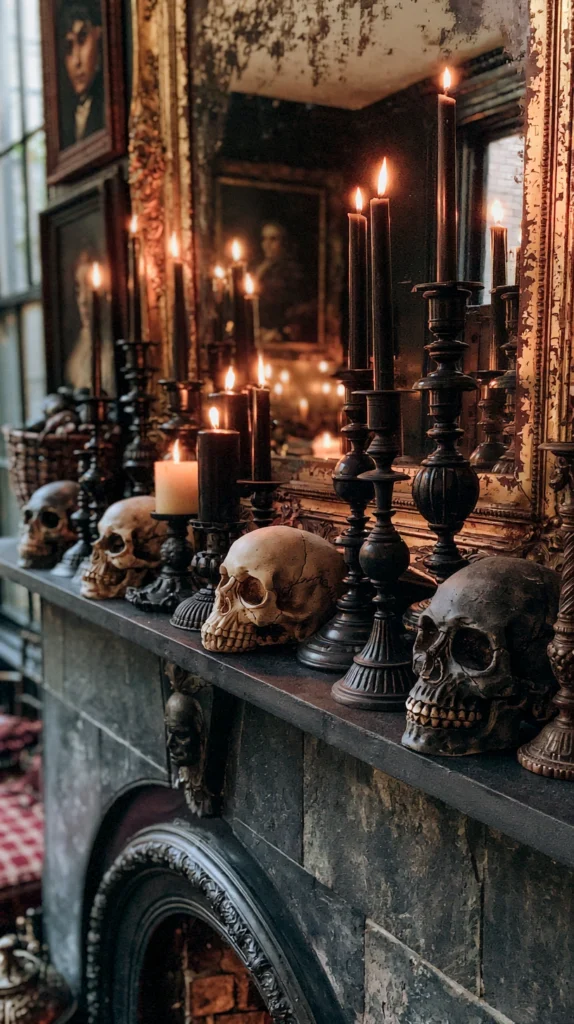
An aged, ornately framed mirror or a moody portrait hung above the mantel, providing a backdrop with genuine gravity and history rather than a typical seasonal print or banner.
Why a substantial framed piece above the mantel elevates everything beneath it
What hangs above a mantel does as much to establish the room’s overall mood as anything arranged on the mantel’s surface itself. An antique-style mirror or a moody, dark portrait sets a tone of genuine history and drama the surface styling then reinforces.
The mirror option
An aged, ornately framed mirror, ideally with some visible tarnishing or foxing in the glass itself, reflecting the candlelight from the display below for additional atmosphere.
The portrait option
A moody oil-painting-style portrait or a dark, atmospheric landscape, in an ornate gold or dark wood frame, providing visual weight and a sense of old, storied history above the mantel.
The frame finish
Aged gold, dark wood, or a distressed black finish, chosen to complement the metals and materials used in the surface styling below.
The scale
Sized generously relative to the mantel’s width, avoiding an undersized piece that would read as an afterthought above the more considered arrangement beneath it.
The overall effect
A mantel with genuine vertical presence, the backdrop piece working with the surface styling to create one full, considered composition from floor to well above eye level.
Cost breakdown: Aged mirror or portrait (secondhand or reproduction): $30–100 Total: $30–100
8. The Spiderweb and Web-Draped Branch Accent
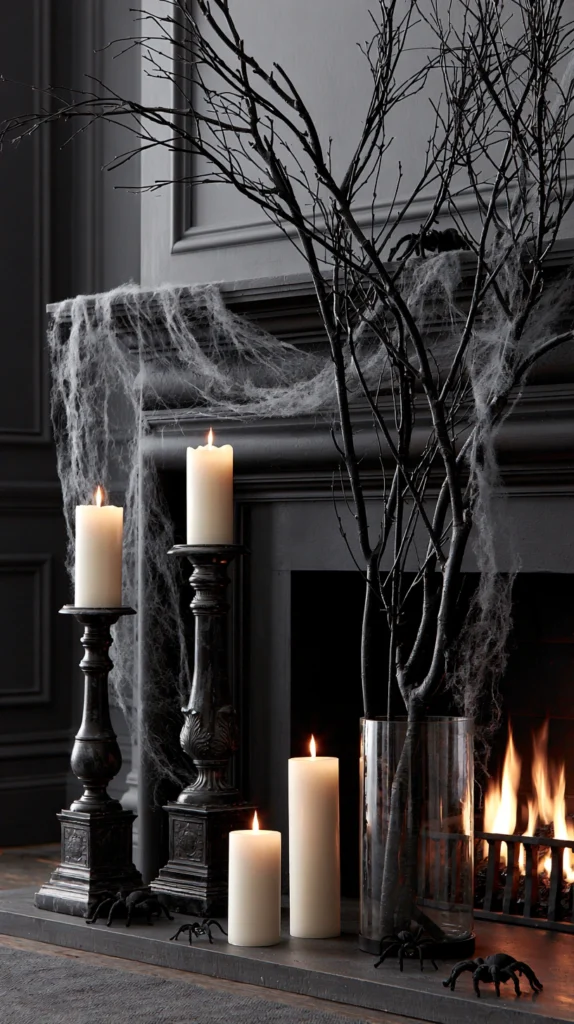
Delicate, realistic spiderweb material draped over a branch or candlestick arrangement, providing a subtle, textural nod to the season without relying on the bright white stretchy webbing common in costume-store decor.
Why realistic web material differs meaningfully from typical Halloween webbing
The stretchy, bright white synthetic webbing sold at most Halloween retailers reads immediately as costume decor. A more realistic, greyish or slightly translucent web material, applied sparingly, suggests genuine age and neglect rather than an obvious seasonal prop.
The web material
A finer, more realistic synthetic web material, in a greyish or slightly yellowed tone rather than stark white, applied in thin, sparse layers rather than thick, obvious sheets.
The application
Draped lightly over a branch, candlestick, or the corner of a framed mirror, suggesting a naturally undisturbed corner rather than covering the entire mantel in an obvious decorative layer.
The restraint principle
Used in one or two small areas rather than across the full mantel, maintaining the same less-is-more approach central to the rest of this aesthetic.
The small spider accent
One or two small, realistic-looking spider figures placed within the web material, adding a subtle detail without an overtly cartoonish or oversized prop spider.
The overall effect
A suggestion of genuine age and quiet neglect, rather than an obvious, decorative Halloween prop, fitting the display’s overall commitment to atmosphere over costume.
Cost breakdown: Realistic web material: $8–15 Small spider accents: $5–15 Total: $13–30
9. The Pumpkin Display in Black and Deep Tones
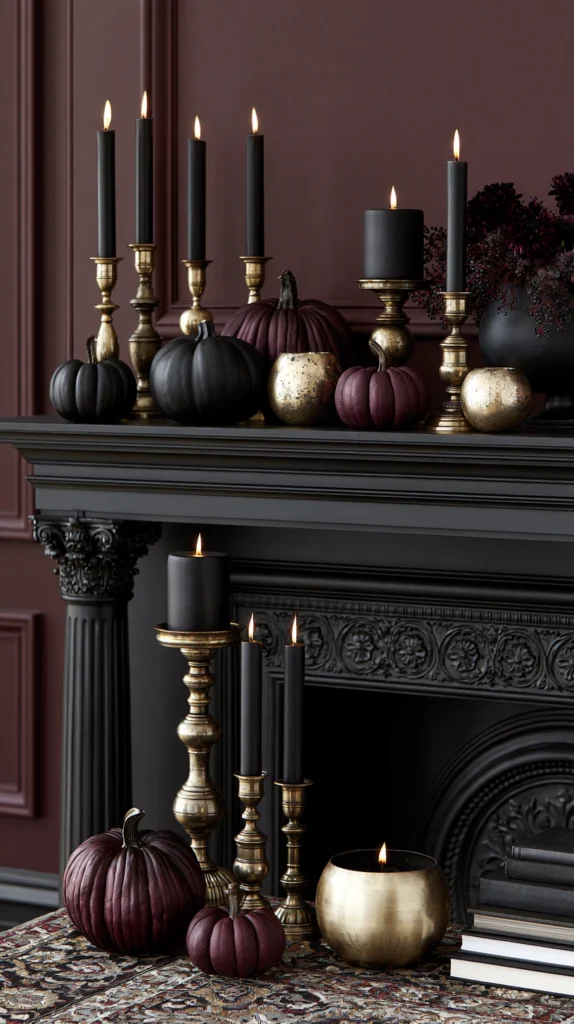
Small pumpkins and gourds in black, deep purple, or near-black varieties, arranged among the mantel’s other elements rather than the traditional bright orange typically associated with the season.
Why unconventional pumpkin colors integrate better into a spooky-chic palette
Traditional orange pumpkins read as cheerfully seasonal, working against the more muted, moody palette the rest of a spooky-chic mantel depends on. Black and deep purple varieties integrate far more naturally into this specific aesthetic.
The pumpkin varieties
Black Kat, Porcelain Doll, or other naturally dark heirloom varieties, sourced from a specialty farm stand rather than a standard grocery store pumpkin display.
The scale
Small to medium pumpkins, sized appropriately to the mantel’s proportions, rather than large pumpkins that would overwhelm the more delicate candlestick and bottle arrangements elsewhere.
The placement
Tucked among the candlesticks and botanicals rather than lined up separately, integrating the pumpkins into the broader composition rather than treating them as a standalone display element.
The natural aging
Left in place to soften slightly as the season progresses, an expected and even desirable quality consistent with the aesthetic’s broader embrace of aged, weathered materials.
The color coordination
Chosen specifically to complement the display’s existing black, burgundy, and aged-metal palette, rather than introducing an unrelated bright color that would disrupt the overall mood.
Cost breakdown: Black and deep purple pumpkins (3–4): $20–40 Total: $20–40
10. The Layered Height Composition
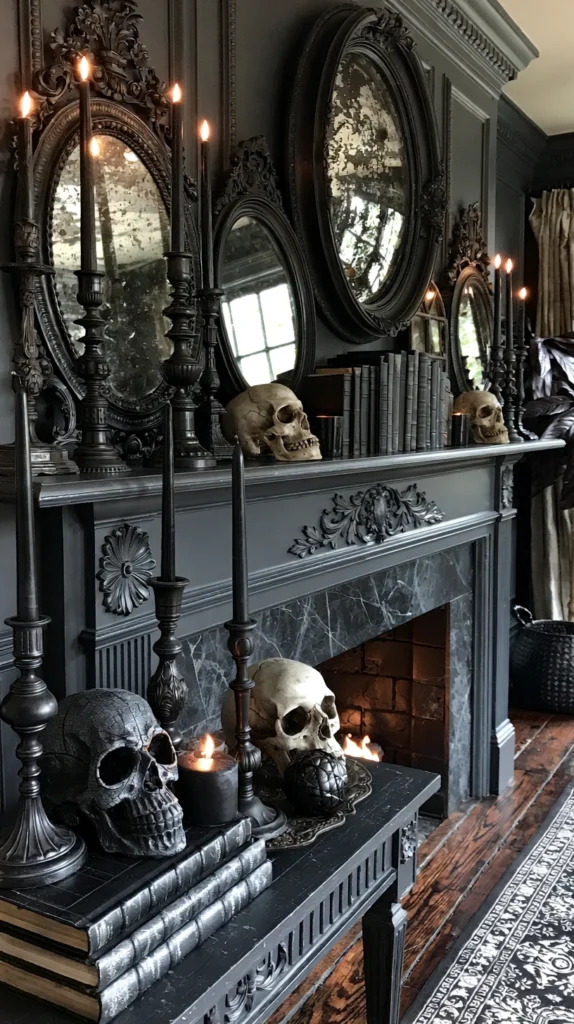
The full mantel arranged with deliberate attention to height variation — a tall backdrop piece, mid-height candlesticks and skulls, and low botanical accents — rather than everything positioned at a single uniform height.
Why height variation transforms a collection of objects into a genuine composition
A mantel with every object at roughly the same height reads as cluttered and flat. Genuine height variation, ascending and descending across the mantel’s width, creates a composition the eye can move through naturally, the same principle relevant to any well-designed vignette.
The back layer
The framed mirror or portrait, plus the tallest candlesticks, positioned toward the back of the mantel’s depth and at the greatest height.
The middle layer
Skulls, mid-height candlesticks, and apothecary bottles, filling the composition’s middle ground at a range of moderate heights.
The front layer
Small pumpkins, low dried botanical sprigs, and any raven figures, kept low and toward the front edge of the mantel, closest to the viewer.
The negative space
Deliberate gaps left between groupings, resisting the urge to fill every available inch of mantel surface, since empty space between clusters gives the eye somewhere to rest.
The asymmetrical balance
A slightly asymmetrical arrangement — taller, denser elements on one side, a simpler, more minimal grouping on the other — generally reading as more natural and less staged than a perfectly symmetrical, matched arrangement.
Cost breakdown: No additional cost beyond materials already gathered Total: $0
11. The Moth and Insect Specimen Accent
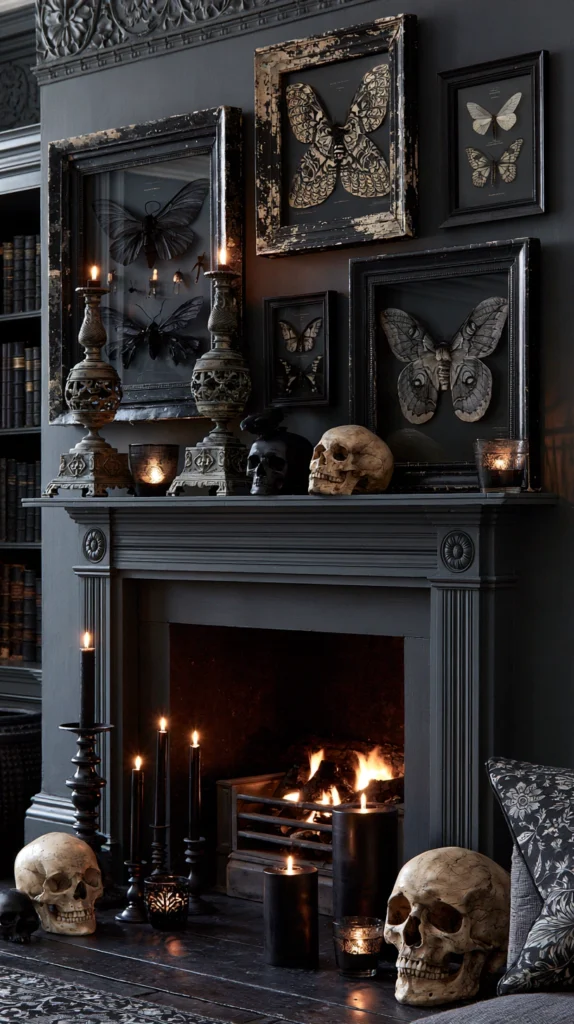
Framed moth or butterfly specimens, real or high-quality reproductions, hung above or displayed near the mantel, adding a naturalist, curiosity-cabinet quality to the overall display.
Why specimen-style framed insects suit this specific aesthetic
The Victorian naturalist tradition of framed insect specimens carries an inherently moody, collected, slightly macabre quality that pairs naturally with the rest of a spooky-chic mantel’s overall mood, without relying on anything overtly costume-like.
The specimen sourcing
Ethically sourced real specimens from a reputable supplier, or high-quality artistic reproductions, chosen based on personal comfort with genuine preserved insects versus a convincing artistic alternative.
The framing
Dark wood or aged black frames, with a glass or shadow-box front, displaying the specimens in the traditional naturalist collection style.
The placement
Hung on the wall directly above or beside the mantel, or leaned against the wall atop the mantel surface itself, depending on the available space and the desired visual weight.
The color palette
Dark-winged moths and muted-toned specimens generally suiting this aesthetic’s palette better than a brightly colored butterfly specimen, which would introduce an unwanted note of cheerfulness.
The overall effect
A detail that reads as genuinely collected and considered, adding intellectual and naturalist intrigue to the display beyond the more common skull and candlestick elements.
Cost breakdown: Framed specimen or quality reproduction (1–2): $30–80 Total: $30–80
12. The Smoking Cauldron or Dry Ice Effect
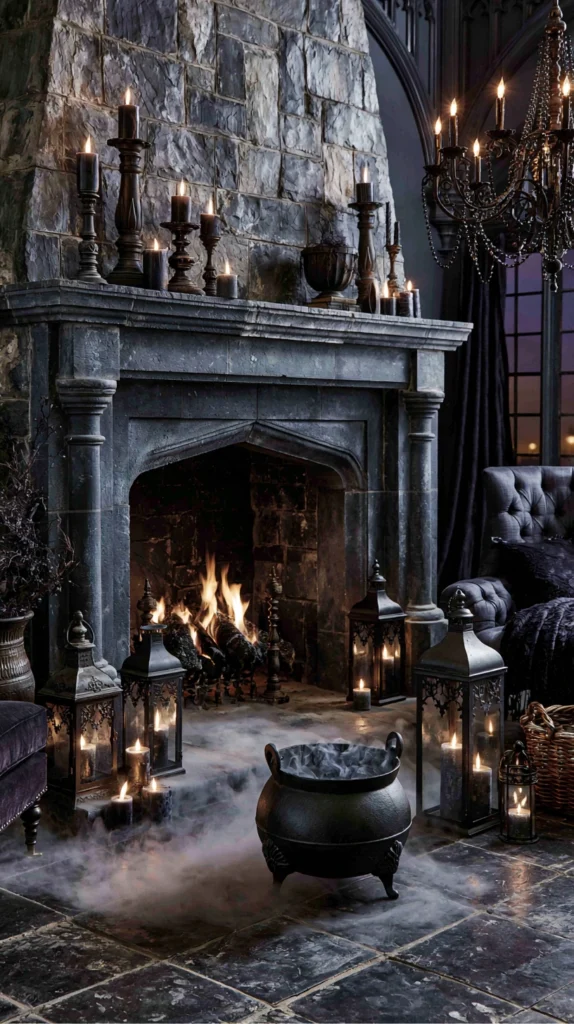
A small cauldron or vessel positioned on or near the mantel, filled with dry ice and water to create a low, atmospheric fog effect, particularly striking for an evening gathering.
Why a controlled fog effect elevates the mantel beyond static styling
Every other element on this list is static — arranged once and simply viewed. A fog effect introduces genuine movement and atmosphere, transforming the mantel from a still composition into something that feels almost alive, particularly effective for guests arriving for an evening gathering.
The cauldron
A small cast iron or resin cauldron, positioned on the mantel or on the hearth just below it, sized appropriately to hold the dry ice and water safely.
The dry ice handling
Dry ice handled with gloves at all times, never touched with bare skin, and used only in a well-ventilated room, genuine safety precautions worth taking seriously given the material’s extreme cold and the display’s proximity to guests and household members.
The fog behavior
The fog naturally sinking and pooling low, rolling off the mantel’s edge or the hearth for a particularly dramatic, low-lying atmospheric effect.
The duration consideration
Dry ice fog effects typically last a limited time, generally 20 minutes to a few hours depending on the quantity used, best planned for a specific gathering or evening viewing window rather than as an all-day, ongoing display element.
The lighting pairing
Combined with the candlesticks’ warm light, the fog catching and diffusing that light for a particularly atmospheric combined effect, especially striking for photographs or an evening party.
Cost breakdown: Small cauldron: $20–50 Dry ice (per use): $5–15 Total: $25–65
13. The Curated Vintage Book Stack
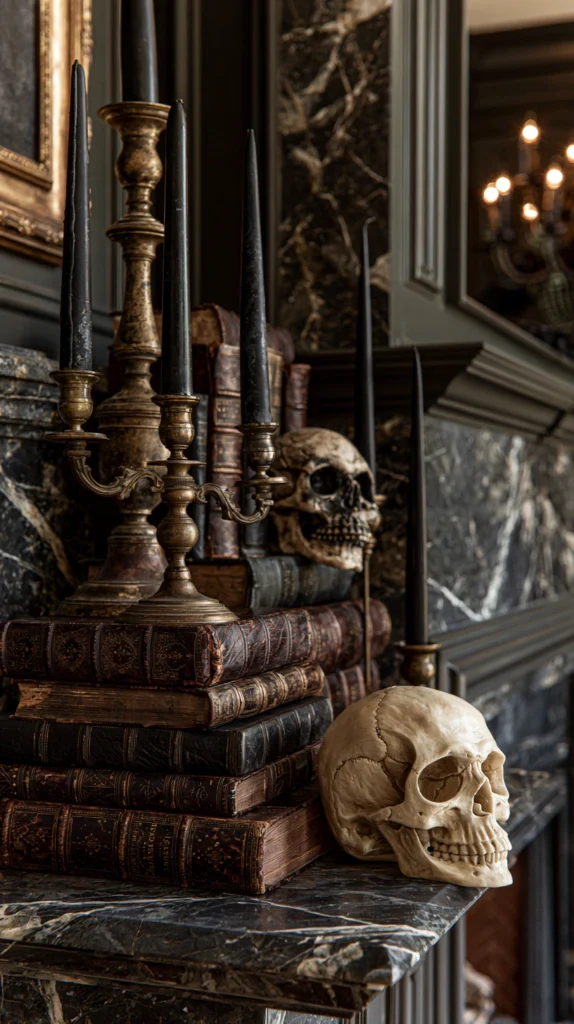
A small stack of aged, leather-bound, or otherwise visually interesting old books, positioned on the mantel and used both as a styling object and a small platform for other items to sit atop.
Why old books add a specific layer of intellectual, gothic atmosphere
A stack of genuinely old or old-looking books suggests a library, a study, or an occult collection, reinforcing the same sense of old knowledge and quiet ritual central to apothecary bottles and specimen displays elsewhere in this aesthetic.
The book sourcing
Secondhand bookshops, estate sales, or thrift stores, chosen for genuinely worn covers, interesting spine colors, and a real sense of age rather than new books dressed up to look old.
The stacking
Three to five books, stacked horizontally, chosen for spine color and texture as much as content, positioned as a small platform for a candlestick or a skull to sit on top.
The height addition
Using the book stack specifically to add height variation to a nearby object, elevating a smaller candlestick or a skull slightly above the mantel’s base surface for additional visual interest.
The color coordination
Deep, muted spine colors — burgundy, forest green, aged brown — complementing rather than competing with the rest of the display’s palette.
The overall effect
A small detail that adds genuine texture, color, and a sense of old, collected history, doing double duty as both a decorative object in its own right and a functional riser for other pieces.
Cost breakdown: Old books (secondhand, 3–5): $10–25 Total: $10–25
14. The Complete Spooky-Chic Mantel (The Fully Styled Seasonal Display)
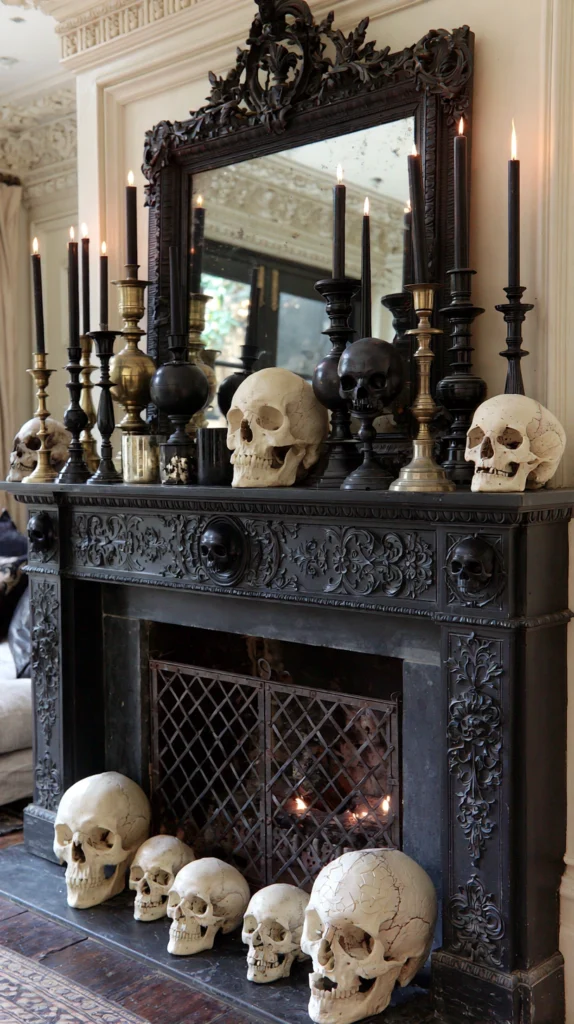
A complete mantel combining several of the approaches above — candlesticks, quality skulls, dried botanicals, a considered backdrop, and warm evening light — treating the space as a single, fully realized seasonal composition rather than a collection of individual Halloween items.
What separates the complete mantel from a few scattered Halloween pieces
A single skull and a pumpkin placed on an otherwise bare mantel: a start. A complete spooky-chic mantel: every element — height, material, color, and light — working together as one considered composition, the same care given to any other seasonal styling project throughout the rest of the home.
The elements of the complete spooky-chic mantel
The backdrop
An aged mirror or moody portrait hung above the mantel, establishing the display’s overall tone from the outset.
The candlelight layer
A cluster of height-varied candlesticks with black or burgundy tapers, providing both daytime texture and genuine evening atmosphere.
The centerpiece objects
One or two quality skulls and a small apothecary bottle collection, anchoring the display’s central visual interest.
The botanical layer
Dried black roses and dark grasses, softening the harder materials with organic texture.
The restrained accents
A single raven, a small spiderweb detail, and a book stack, each appearing once rather than repeated throughout.
The seasonal produce
Black and deep purple pumpkins integrated among the other elements, rather than displayed as a separate grouping.
The complete design in action
An October evening gathering:
Dusk: The candlesticks lit, their flickering light catching the aged brass and the mirror’s tarnished glass behind them.
Guests arriving: The mantel immediately drawing attention, the raven perched quietly among the candlesticks, the small cauldron’s fog beginning to roll across the hearth.
Throughout the evening: The display holding its atmosphere and interest for hours, the height variation and restrained styling reading as genuinely considered rather than a temporary seasonal afterthought.
The complete spooky-chic mantel: not a shelf cluttered with Halloween props, but a genuinely designed seasonal composition, moody and sophisticated in equal measure.
Cost breakdown for the complete mantel: Assuming a starting point of a bare mantel: Candlesticks and tapers: $45–100 Quality skulls and bone accents: $45–100 Dried botanicals: $45–105 Apothecary bottles: $35–80 Backdrop mirror or portrait: $30–100 Restrained accents (raven, web, books): $58–135 Pumpkins: $20–40 Total: $278–660
Phased for planning purposes:
Two to three weeks before: Sourcing candlesticks, bottles, and any secondhand books or mirror Gathering or purchasing dried botanicals
The week of: Full arrangement assembled, height composition tested and adjusted
The day of any gathering: Candles lit, dry ice effect prepared if using, final adjustments made
The spooky-chic mantel: not a last-minute grab from a Halloween aisle, but a genuinely designed seasonal centerpiece, planned with the same intention given to any other room feature.
The Question Before Any Spooky-Chic Mantel Design
Before choosing a single object:
What is the primary mood wanted from this mantel?
If the answer is: moody and atmospheric above all else — the candlestick cluster paired with the dried black rose arrangement and a fog effect for gatherings.
If the answer is: intellectual and collected, like an old study or curiosity cabinet — the apothecary bottles, book stack, and framed specimen accent.
If the answer is: restrained and elegant, more suggestion than statement — the aged mirror backdrop, a single raven, and minimal candlelight.
If the answer is: the simplest possible start — one cluster of candlesticks and one well-made skull, with restraint applied to everything else.
The design follows the specific mood wanted, more than any single template for what a Halloween mantel should include. Every idea on this list contributes to that mood at a different scale and in a different way. The question is which particular atmosphere this household wants guests to notice first.
The single cluster of aged candlesticks with one quality skull: still reads as considerably more sophisticated than a mantel crowded with cheaper, more obviously costume-store decor. The complete mantel, styled with real attention to height, material, and light: a genuine seasonal centerpiece, spooky and chic in equal measure.
That balance: the whole point of taking Halloween mantel styling seriously.
Getting Started This Weekend
The immediate spooky-chic mantel solution:
Clear the mantel completely before adding anything new.
Starting from a genuinely blank surface, rather than layering Halloween items onto whatever is already there, makes the height and composition principles far easier to apply.
Start with candlesticks in varying heights, even before any other object is added.
The single foundational element every other piece will build around.
Add one quality skull or bone piece, chosen specifically for its finish rather than its price.
Better to have one well-made piece than several cheap ones.
Light the candles and step back to view the mantel at dusk.
The rest of the design: the elaboration of this moment.
The candlestick: the beginning. The spooky-chic mantel: what gets built, and lit, around it.