
15 Halloween Table Setting Ideas for a Spooky Dinner Party
The table setting changed how my Halloween dinner party actually felt more than the costumes anyone wore to it. Not the decorations elsewhere in the house. Not the playlist. Not the appetizers or the lighting in the rest of the room or the carved pumpkins on the porch outside.
What was actually in front of each guest.
Because the table itself, set with real intention, did something the rest of the house’s decorations never quite managed on their own. Before it: a nice enough dinner table with a few plastic spiders scattered across it, the actual Halloween atmosphere confined to the room’s edges while the table itself looked like any other dinner. After it: a table that committed fully, every place setting part of one considered, spooky-elegant scene, the meal itself becoming the party’s actual centerpiece.
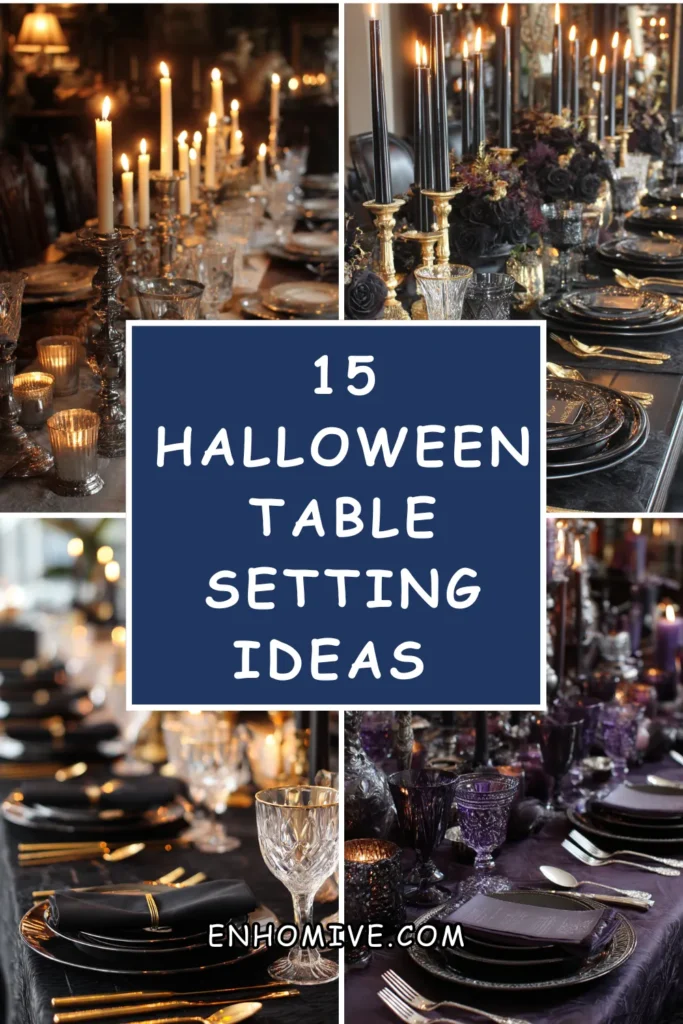
A Halloween table setting is not a few props added to an otherwise ordinary table. It is the dinner party’s real opportunity for atmosphere, since it is what every guest looks at and interacts with for the entire evening. The table: no longer an afterthought beside the room’s decorations, but the party’s most immersive, most sustained point of seasonal drama.
Here are 15 Halloween table setting ideas for a spooky dinner party — from the simplest place card detail to the most fully realized themed table — built on that understanding.
Why the Table Deserves More Attention Than Any Other Party Decor
The sustained-attention principle
Guests look at and interact with the table setting for the entire duration of a dinner party, far longer than they spend looking at any other single decoration in the room. This makes it the single highest-value place to invest genuine styling attention.
The layered detail opportunity
Without a considered table:
A generic dinner table with a few scattered Halloween props, the atmosphere established elsewhere in the room but absent from where guests actually spend the evening.
The party: technically Halloween-themed, but the table itself feeling disconnected from that theme.
With a considered table:
Place settings, centerpiece, glassware, and lighting all working together as one sustained scene, guests discovering new details throughout the meal rather than taking in the whole display at a single glance.
The party: the table becoming the evening’s actual immersive centerpiece, rather than a functional surface incidental to the room’s broader decor.
The individual place setting opportunity
Unlike room-wide decor, a table setting allows for genuine per-guest personalization — a place card, a small individual detail, a specific glass or napkin fold — creating a level of intimate, personal atmosphere no larger decoration can replicate.
The material quality case
The same principle relevant to any elevated Halloween decor applies directly here: real materials, a controlled color palette, and restraint in quantity separate a sophisticated spooky table from a costume-store version, regardless of the specific theme chosen.
The Five Elements of a Complete Halloween Table Setting
Before styling any specific table:
The centerpiece
The table’s primary visual anchor, whether a floral arrangement, a collection of candles, or a themed vignette.
Sets the tone for every other element on the table.
Worth planning first, before individual place settings.
The place settings
Plates, chargers, and napkins, layered with genuine attention to color and texture.
The detail every guest interacts with most directly and repeatedly throughout the meal.
An opportunity for real personalization per guest.
The glassware and drinkware
Wine glasses, water glasses, and any specialty drinkware, chosen to complement the table’s broader palette.
Often overlooked relative to plates and centerpieces, despite being equally visible throughout the meal.
Catches candlelight in a way that adds real atmosphere.
The lighting
Candles, lanterns, or string lights specifically positioned at table level.
As important to a Halloween table as to any other evening dining setup.
Transforms the same objects considerably between daytime setup and actual evening use.
The individual details
Place cards, small favors, or a personal touch at each setting.
The finishing layer, applied last.
Creates a sense of intimate, considered hospitality beyond the table’s overall visual theme.
1. The Black and Gold Elegant Table
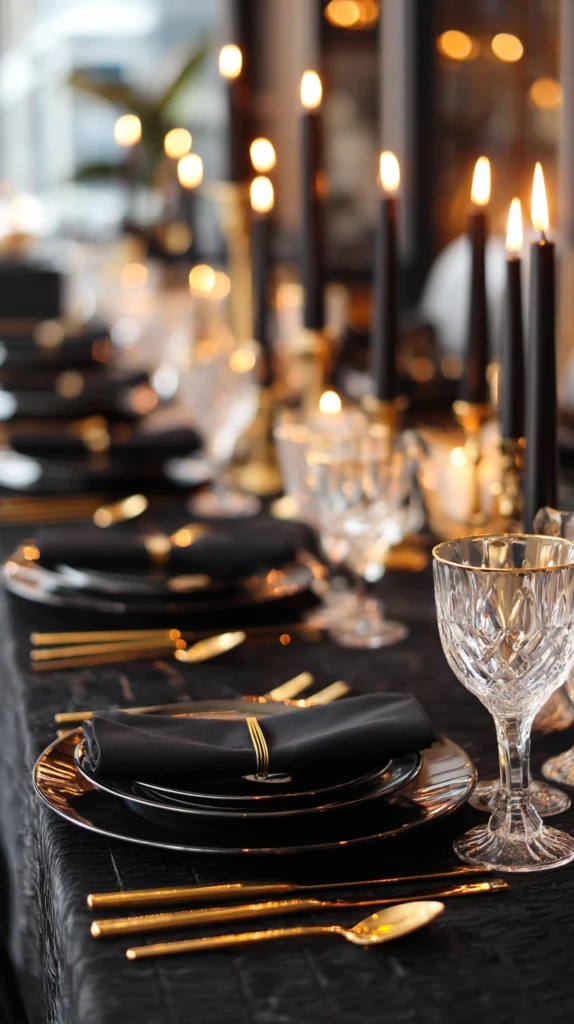
A table set entirely in black and gold, using dark chargers, gold-rimmed glassware, and black napkins, for a sophisticated, glamorous Halloween palette rather than the traditional orange and purple.
Why black and gold suits a genuinely elegant Halloween dinner party
Restricting the palette to two colors immediately elevates the table beyond the more common, brighter Halloween color combinations, reading as a considered dinner party rather than a themed costume event.
The chargers and plates
Black chargers beneath white or cream dinner plates, providing dramatic contrast and a clean base for the rest of the setting.
The glassware
Gold-rimmed wine and water glasses, catching candlelight and adding warmth against the black and white base.
The napkins
Black linen napkins, folded simply and tied with a thin gold ribbon or cord.
The centerpiece
A cluster of black candlesticks at varying heights, echoing the same palette established by the place settings.
The overall effect
A table that reads as a genuinely elegant dinner party first, and a Halloween gathering second, the restrained two-color palette doing considerable work toward that impression.
Cost breakdown: Black chargers: $20–40 Gold-rimmed glassware (per setting, if new): $40–80 Black napkins: $15–30 Black candlesticks: $25–50 Total: $100–200
2. The Apothecary and Potion Bottle Place Settings
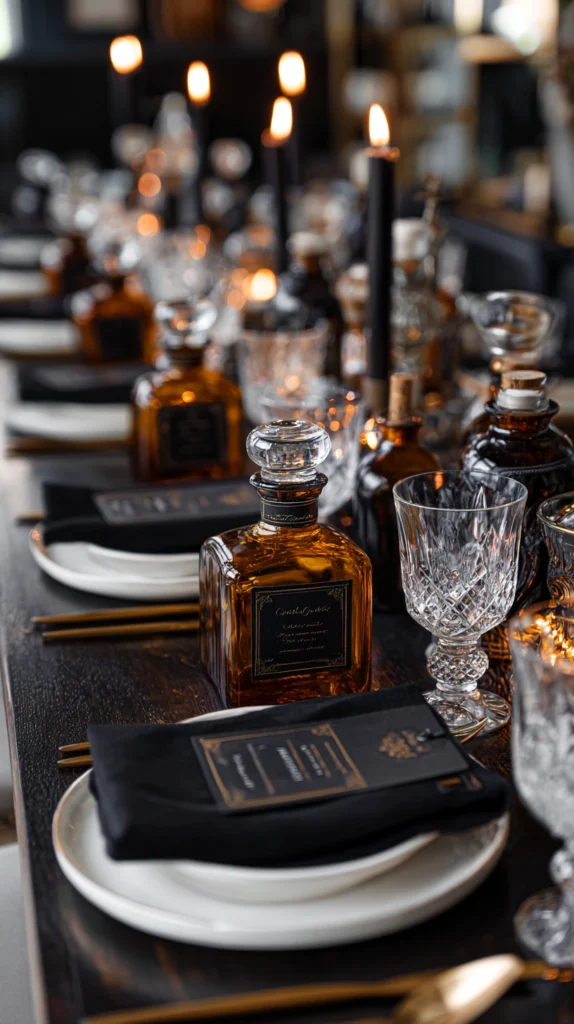
Each place setting styled with a small labeled apothecary-style bottle, functioning as either a favor, a personalized cocktail vessel, or simply a decorative detail evoking an old alchemist’s dinner.
Why individual bottles add a personal, discoverable detail to each place setting
Rather than a single shared centerpiece, a bottle at every place gives each guest their own small detail to notice and discuss, extending the table’s atmosphere down to the individual level.
The bottles
Small amber or dark glass bottles, labeled with a guest’s name or a themed ingredient name, positioned at each place setting.
The contents
A guest’s individual welcome cocktail, a small treat, or simply left empty as a decorative detail, depending on the specific evening’s format.
The labeling
Small handwritten or printed labels in an old-fashioned apothecary style, doubling as both decor and, if labeled with a guest’s name, a functional place card.
The placement
Positioned above the place setting or beside the water glass, integrated into the overall table layout rather than as a separate, disconnected addition.
The overall effect
A detail that rewards close, individual attention, giving each guest their own small piece of the evening’s atmosphere rather than relying entirely on a single shared centerpiece.
Cost breakdown: Apothecary bottles (per setting): $3–8 Labels and ribbon: $5–15 (total) Total: $30–105 depending on guest count
3. The Skeleton Hand Place Card Holder
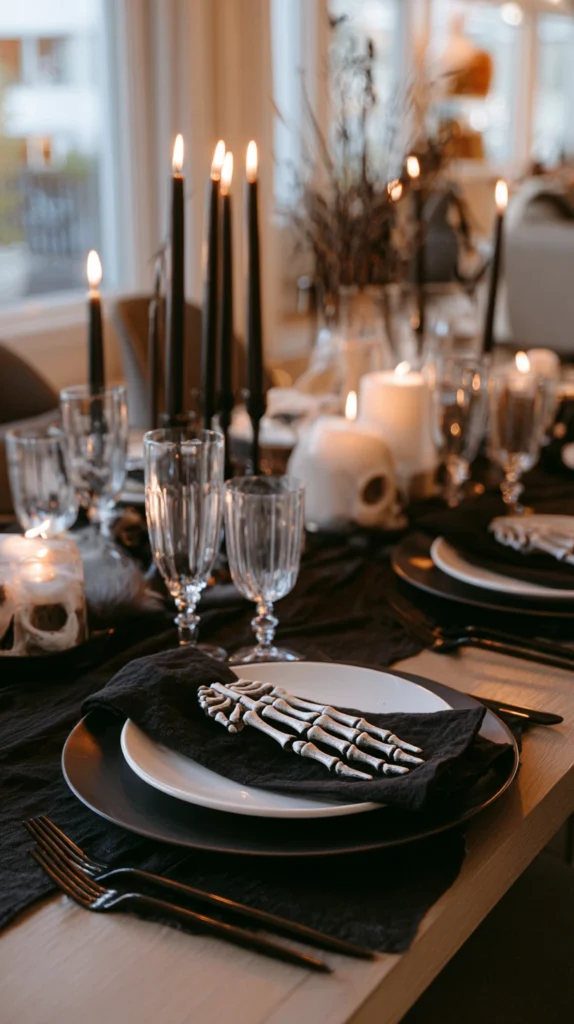
A small, well-made resin skeleton hand at each place setting, holding a place card between its fingers, combining function and a restrained nod to the season’s classic imagery.
Why a single well-executed skeleton detail per place setting avoids tipping into costume territory
One small, tasteful skeleton hand at each setting, used for a genuine functional purpose, reads as a clever detail rather than an overdone prop, particularly when the material quality is considered rather than cheap and glossy.
The material
A well-made resin hand in a matte, bone-like finish, avoiding a bright white or glossy plastic version that would read as considerably more costume-like.
The place card
A simple card with the guest’s name, held gently between the skeleton hand’s fingers, giving the piece genuine function beyond pure decoration.
The scale
Small and proportional to the place setting, rather than an oversized or overly dramatic version that would dominate the table visually.
The consistency
The same hand style repeated at every place setting, creating a cohesive, considered detail rather than a single novelty item that would feel out of place among more elegant surroundings.
The overall effect
A detail that signals genuine thought and a touch of playful drama, without relying on cheap or overtly cartoonish Halloween props.
Cost breakdown: Skeleton hand place card holders (per setting): $4–10 Total: $40–150 depending on guest count
4. The Deep Burgundy and Black Floral Centerpiece
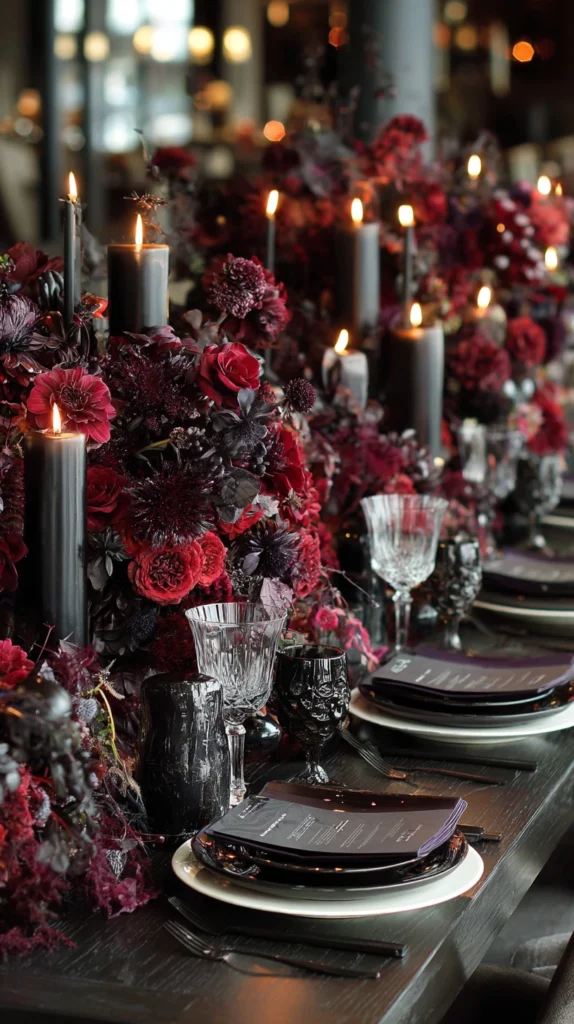
A low, running centerpiece of dark burgundy and near-black florals, paired with dried botanicals, providing rich, moody color along the table’s length.
Why a dark floral palette suits a Halloween dinner more than bright, traditional autumn flowers
Deep burgundy dahlias, black-dyed roses, and dark foliage create a genuinely moody, sophisticated centerpiece, distinct from both a traditional bright fall arrangement and an overtly costume-themed display.
The floral selection
Deep burgundy dahlias, black or near-black roses, and dark foliage, arranged in a low, running style along the table’s center rather than a single tall, obstructive centerpiece.
The vessel
A dark ceramic or metal vessel, or several smaller vessels spaced along the table, continuing the arrangement’s overall dark, rich palette.
The height management
Kept low enough to preserve sightlines across the table, following the same sightline principle relevant to any dinner party centerpiece, regardless of the specific seasonal theme.
The candle integration
Black or deep burgundy taper candles interspersed among the florals, adding height variation and genuine evening lighting.
The overall effect
A centerpiece that provides real color and organic texture without relying on any overtly Halloween-specific props, the dark floral palette alone establishing the evening’s moody, sophisticated atmosphere.
Cost breakdown: Dark florals and foliage: $40–90 Vessels: $20–50 Taper candles: $15–30 Total: $75–170
5. The Raven Feather and Black Napkin Fold
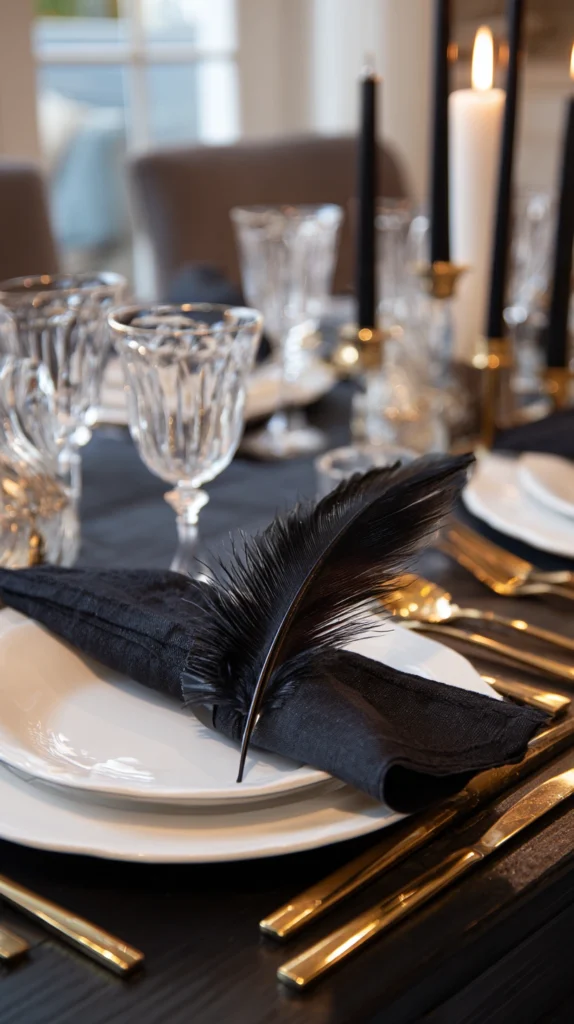
Black cloth napkins folded into a distinctive shape and tucked with a single dark feather, providing a simple, elegant per-setting detail.
Why a considered napkin detail elevates the table without requiring any additional tabletop objects
A distinctive napkin fold, paired with one small natural detail, adds genuine visual interest to each place setting using materials already required for the meal itself, rather than introducing additional purely decorative objects.
The napkin
Black or deep charcoal linen napkins, chosen for a genuinely elegant material rather than a printed or novelty Halloween napkin design.
The fold
A simple pocket or roll fold, creating a small opening or band where the feather can be tucked securely.
The feather
A single dark feather — black or a deep iridescent tone — tucked into the napkin’s fold, adding a natural, slightly gothic detail without any overt costume association.
The consistency
The same fold and feather detail repeated at every place setting, creating a cohesive, considered visual rhythm down the table’s length.
The overall effect
A refined per-setting detail achieved without any additional tabletop object beyond what a dinner table already requires, demonstrating that genuine styling attention, rather than added quantity, elevates the setting.
Cost breakdown: Black linen napkins (per setting): $5–12 Feathers: $1–3 per setting Total: $60–180 depending on guest count
6. The Antique Silver and Candlelight Table
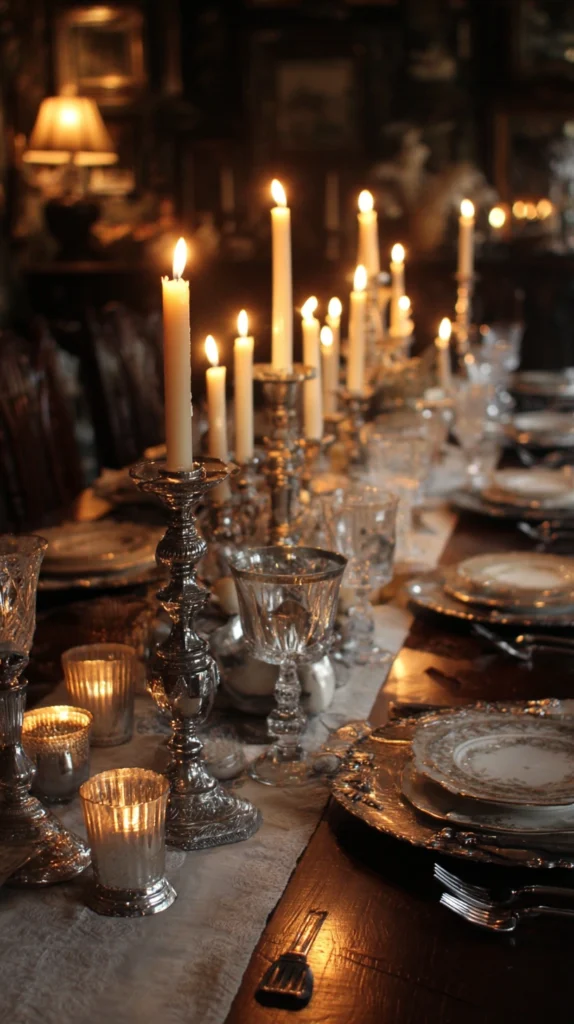
A table set with genuine or reproduction antique silver — candlesticks, flatware, and serving pieces — relying on tarnished or aged metal and abundant candlelight rather than any overtly spooky props at all.
Why antique silver alone can carry a Halloween dinner’s atmosphere
Aged, slightly tarnished silver combined with abundant candlelight creates a genuinely moody, historic atmosphere on its own, without requiring any literal Halloween imagery — skulls, spiders, or witches — to establish the evening’s spooky-elegant mood.
The silver
Vintage or reproduction silver candlesticks, flatware, and serving pieces, sourced from antique shops, estate sales, or a household’s own inherited collection.
The tarnish consideration
A deliberately unpolished or lightly tarnished finish, rather than bright, mirror-polished silver, reinforcing the sense of age and history central to this specific approach.
The candlelight volume
A genuinely substantial number of candles, more than a typical dinner party might use, since the candlelight itself is doing much of the evening’s atmospheric work in the absence of any more literal Halloween decor.
The remaining table
Simple white or cream linens and plates, allowing the silver and candlelight to remain the table’s clear, singular focus.
The overall effect
A table that achieves genuine Halloween atmosphere through material and lighting alone, without relying on any of the season’s more literal, recognizable imagery.
Cost breakdown: Antique or reproduction silver (candlesticks, flatware): $50–200 Candles (substantial quantity): $30–60 Total: $80–260
7. The Spiderweb Charger Plate
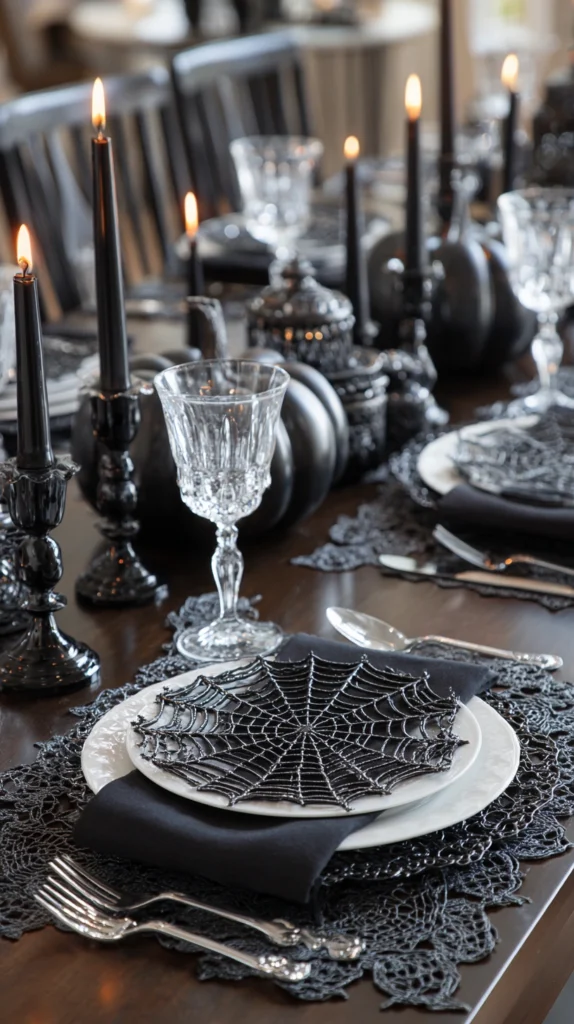
A delicate, lace-style spiderweb charger plate beneath each place setting, providing a subtle textural nod to the season without any glossy or garish synthetic webbing elsewhere on the table.
Why a charger-level web detail reads as elegant rather than costume-like
Restricting the spiderweb motif to a single, well-made charger plate — rather than draping synthetic webbing across the whole table — keeps the detail contained, tasteful, and easy to pair with otherwise elegant surrounding elements.
The charger
A lace-patterned or laser-cut charger plate in a web-inspired design, in black, white, or metallic finish, providing texture beneath the dinner plate itself.
The material quality
Metal, resin, or a genuine lace fabric charger, rather than a flimsy plastic version that would undercut the detail’s otherwise elegant effect.
The placement
Positioned beneath the dinner plate as the setting’s base layer, visible around the plate’s edge rather than as a separate, competing tabletop object.
The consistency
The same charger used at every place setting, creating a cohesive visual rhythm and reinforcing the theme subtly rather than through a single standout piece.
The overall effect
A refined, single-point nod to a classic Halloween motif, integrated into the table’s functional layering rather than added as a separate decorative object.
Cost breakdown: Web-pattern charger plates (per setting): $8–20 Total: $80–300 depending on guest count
8. The Dried Botanical and Wheat Place Setting Accent
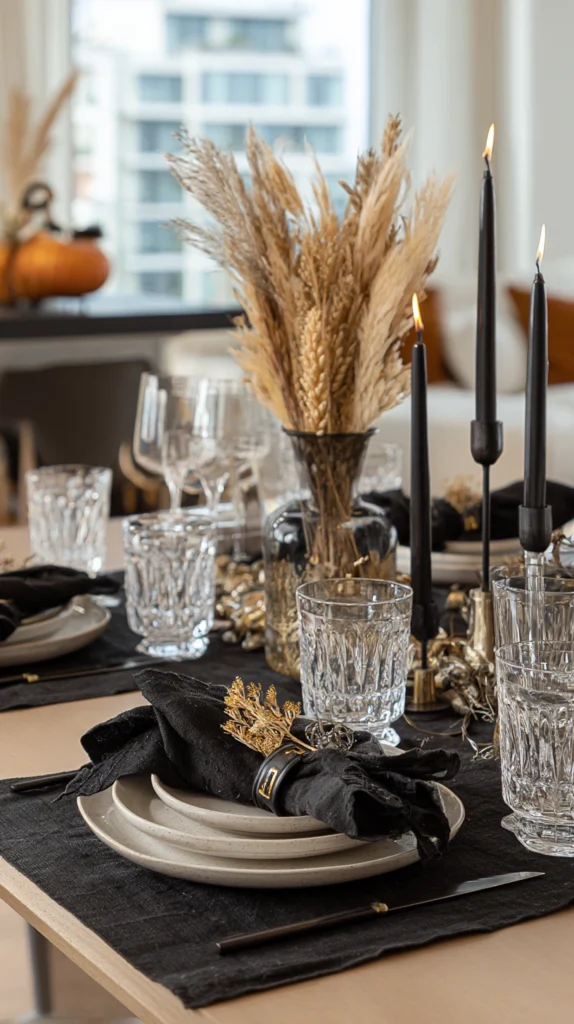
A small bundle of dried wheat, dark botanicals, or a single dried flower stem placed at each setting, tied with black or burgundy ribbon.
Why dried botanicals add organic texture without any overt Halloween imagery
A small natural bundle at each place setting introduces genuine texture and a seasonal, harvest-adjacent quality, working as well for a sophisticated Halloween dinner as for any other fall gathering, while avoiding any literal spooky iconography.
The bundle
Dried wheat, a small cluster of dark dried flowers, or a single dramatic seed pod, tied together with a short length of ribbon.
The ribbon color
Black, deep burgundy, or a muted charcoal, continuing the table’s broader restrained color palette.
The placement
Laid across the top of the napkin or beside the place card, providing a small, considered detail without requiring any additional plate or glass.
The connection to the centerpiece
Made from the same botanical material used in the table’s main centerpiece, tying the individual place settings back to the overall composition rather than introducing an unrelated element.
The overall effect
A subtle, elegant detail rooted in genuine seasonal materials, working as a Halloween table accent specifically because of its restraint rather than despite it.
Cost breakdown: Dried botanicals and ribbon (per setting): $2–6 Total: $20–90 depending on guest count
9. The Deep Purple and Silver Gothic Table
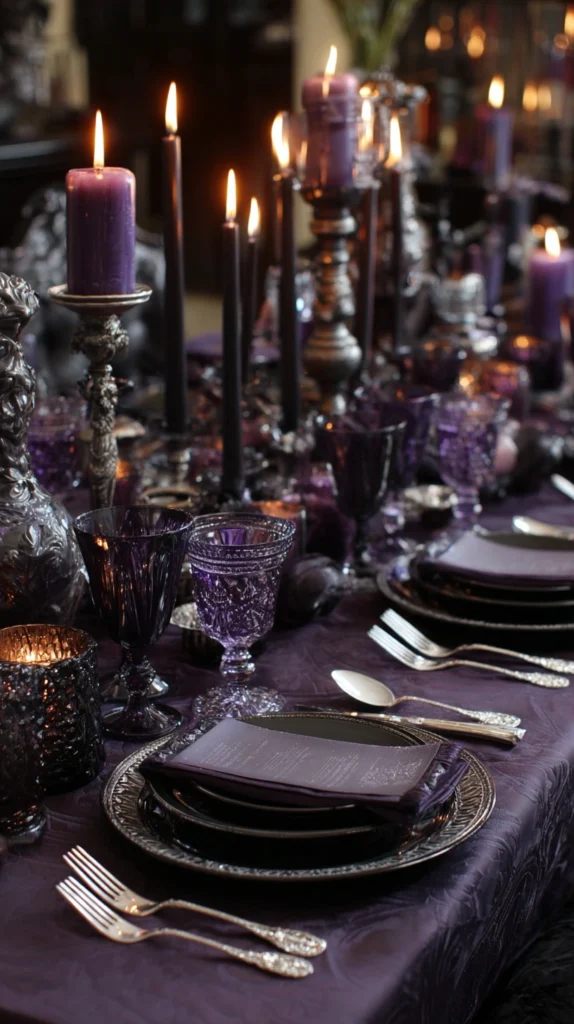
A table set in deep purple and silver tones, using purple glassware, silver flatware, and a dark tablecloth, for a rich, gothic-inspired alternative to the more common black and orange palette.
Why purple and silver offers a genuinely different mood than black and gold or black and orange
Where black and gold reads as glamorous and black and orange reads as traditionally Halloween, a deep purple and silver combination leans specifically gothic and romantic, offering households a genuinely distinct alternative mood for their specific gathering.
The tablecloth
A deep aubergine or plum tablecloth, providing the table’s rich, dark foundation color.
The glassware
Purple-tinted or amethyst-colored glassware, catching candlelight with genuine color and depth.
The flatware
Silver or pewter flatware, providing cool metallic contrast against the deep purple base.
The candles
Deep purple or black taper candles in silver candlesticks, continuing the palette’s overall cool, rich tone.
The overall mood
A table with a genuinely different emotional register than the more common Halloween color combinations, leaning romantic and gothic rather than glamorous or traditionally seasonal.
Cost breakdown: Deep purple tablecloth: $25–50 Purple-tinted glassware (per setting): $30–60 Silver candlesticks and candles: $30–60 Total: $85–170
10. The Witch’s Dinner Cauldron Serving Display
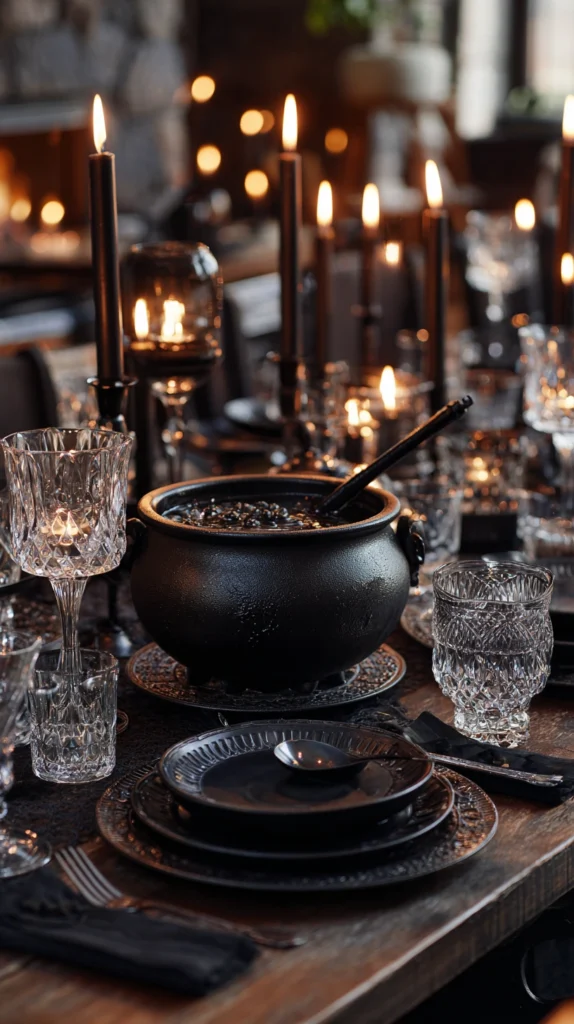
A small cauldron used as an actual serving vessel — for a soup, a punch, or a side dish — integrating a classic Halloween prop into the meal’s genuine function rather than as pure decoration.
Why a functional cauldron differs meaningfully from a purely decorative one
A cauldron used to actually serve food or drink earns its place on the table through genuine function, reading as a clever, considered choice rather than an unnecessary decorative prop competing for space with the meal itself.
The cauldron
A cast iron or heavy-duty cauldron-style serving vessel, sized appropriately for the specific dish or drink it will hold.
The serving use
A rich soup, a punch, or a hearty side dish, ladled or served directly from the cauldron at the table, giving guests both the visual drama and the genuine practical function.
The placement
Positioned at the table’s center or on a nearby sideboard, depending on whether it serves as a self-serve station or is portioned out by the host.
The heat safety consideration
If used for a hot dish, confirming the cauldron and its placement account for genuine heat safety, using appropriate trivets or stands to protect the table surface.
The overall effect
A classic Halloween prop reimagined as genuinely functional tableware, earning its dramatic presence through actual use rather than existing purely as an unused decorative object.
Cost breakdown: Cast iron or serving cauldron: $30–70 Total: $30–70
11. The Moody Taper Candle Runner
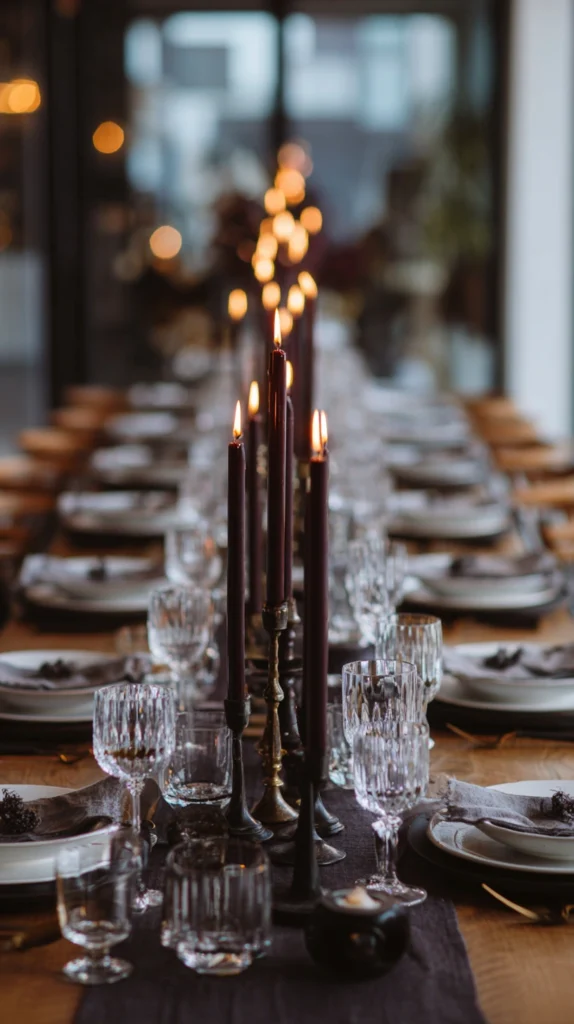
A long row of taper candles at varying heights, running the table’s full length, providing the evening’s primary lighting and visual rhythm without any additional centerpiece objects.
Why a candle-only centerpiece can work as the table’s sole visual anchor
Rather than combining candles with a floral or object-based centerpiece, a dedicated, dense row of varying-height tapers can serve as the table’s entire visual statement, particularly effective for an evening event where the lighting itself is doing considerable atmospheric work.
The candle heights
A genuine mix of heights, from short votives to tall tapers, clustered rather than evenly spaced, creating a rhythmic, uneven skyline down the table’s center.
The candle color
Black, deep burgundy, or a mix of both, continuing the table’s broader restrained color palette.
The holder variety
Mismatched candlesticks in varying heights and finishes, gathered rather than matched, echoing the same collected quality valued in any well-composed vignette.
The sightline management
Positioned centrally but kept narrow enough in overall footprint that guests can still see and speak across the table, despite the candles’ height variation.
The overall effect
A table lit almost entirely by its own centerpiece, the candlelight itself becoming both the lighting source and the primary visual interest, particularly striking once the sun has fully set.
Cost breakdown: Taper candles (12–15, varying colors): $30–50 Mismatched candlesticks: $40–90 Total: $70–140
12. The Blood-Red Wine and Crystal Glass Focus
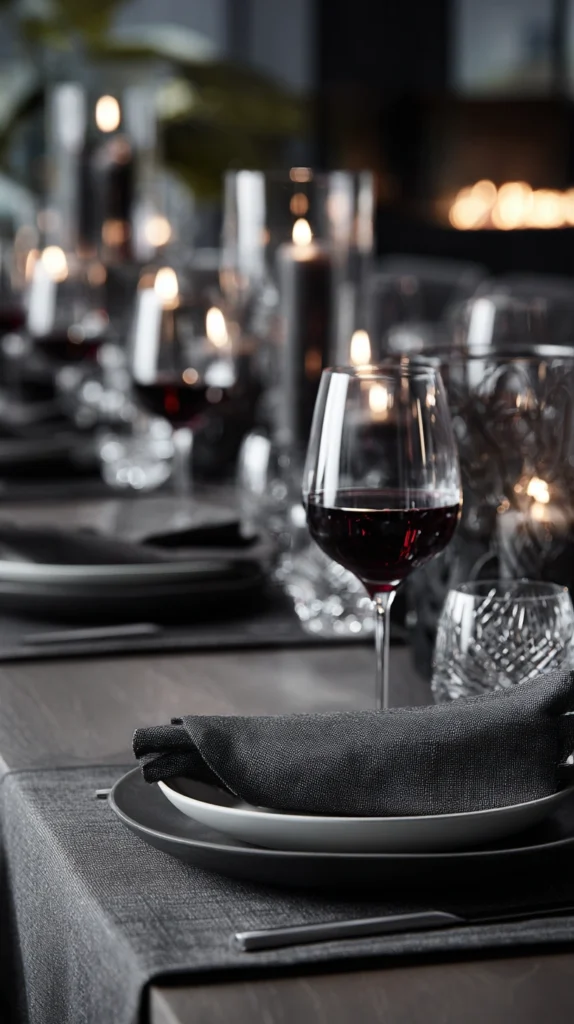
A table where the wine glasses and their contents become the primary visual and color statement, using genuinely nice crystal or cut glass to elevate the deep red wine itself into the table’s centerpiece.
Why the wine glass can function as the table’s actual visual focus
Rather than adding a separate decorative element, this approach recognizes that a full glass of deep red wine, held in genuinely nice crystal, already provides significant color and visual drama — a detail every dinner already includes, simply elevated through better glassware.
The glassware
Genuine crystal or well-made cut glass wine glasses, chosen for how the glass itself catches and refracts candlelight.
The wine selection
A deep, rich red wine, chosen partly for its color as much as its flavor profile, reinforcing the table’s overall dramatic, saturated palette.
The surrounding restraint
A comparatively simple table otherwise — clean white or black linens, minimal additional centerpiece objects — allowing the wine and glassware to remain the clear visual focus without competing elements.
The lighting
Candlelight specifically positioned to catch and pass through the wine glasses, maximizing the effect this approach depends on.
The overall effect
A table elevated through a single, already-present element — genuinely improved rather than expanded, proving that not every Halloween table setting requires additional objects to achieve real drama.
Cost breakdown: Crystal or cut glass wine glasses (per setting): $15–35 Total: $150–350 depending on guest count
13. The Personalized Tarot Card Place Setting
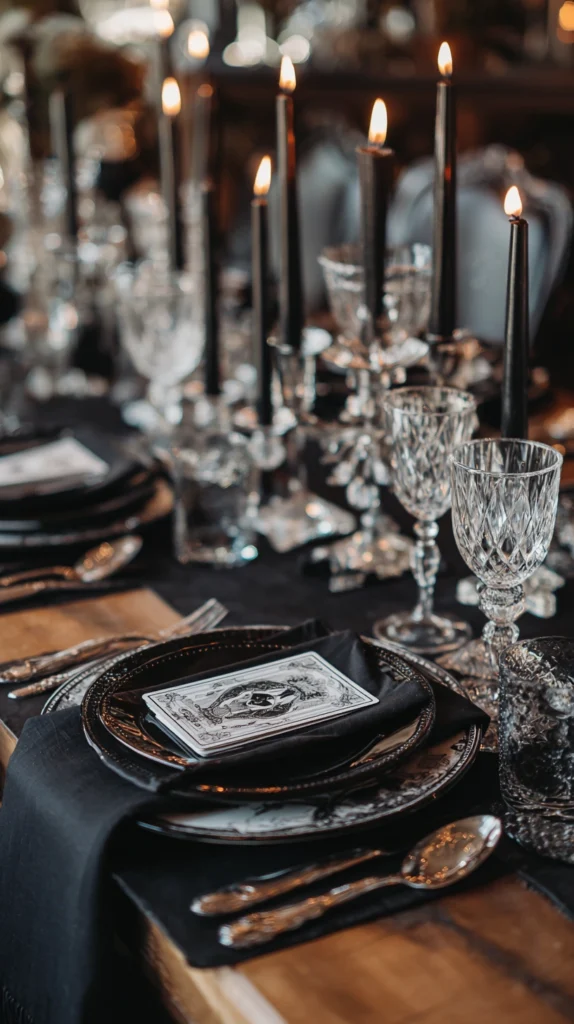
A single tarot card placed at each guest’s setting, either randomly drawn or chosen specifically for that guest, serving as both a conversation starter and a place card.
Why a tarot card adds genuine personalization and conversational value
Beyond pure visual decor, a tarot card at each place setting gives guests something to discuss and interpret together, adding an interactive, conversational dimension most purely visual table details do not provide.
The cards
A genuine or reproduction tarot deck, with one card per guest, either drawn at random as guests arrive or selected specifically based on the host’s knowledge of each guest.
The presentation
The card placed atop the napkin or leaned against the water glass, positioned as a discoverable detail guests notice upon sitting down.
The conversational function
Guests encouraged to interpret or discuss their card during the meal, giving the table detail a genuine social function beyond pure decoration.
The aesthetic integration
A card deck with art complementing the table’s broader color palette, whether the classic Rider-Waite imagery or a more contemporary, stylized tarot deck design.
The overall effect
A detail that adds both visual interest and genuine interactive value, extending the table’s atmosphere into actual dinner party conversation.
Cost breakdown: Tarot deck: $15–30 Total: $15–30
14. The Moth-Winged Napkin and Place Card Detail
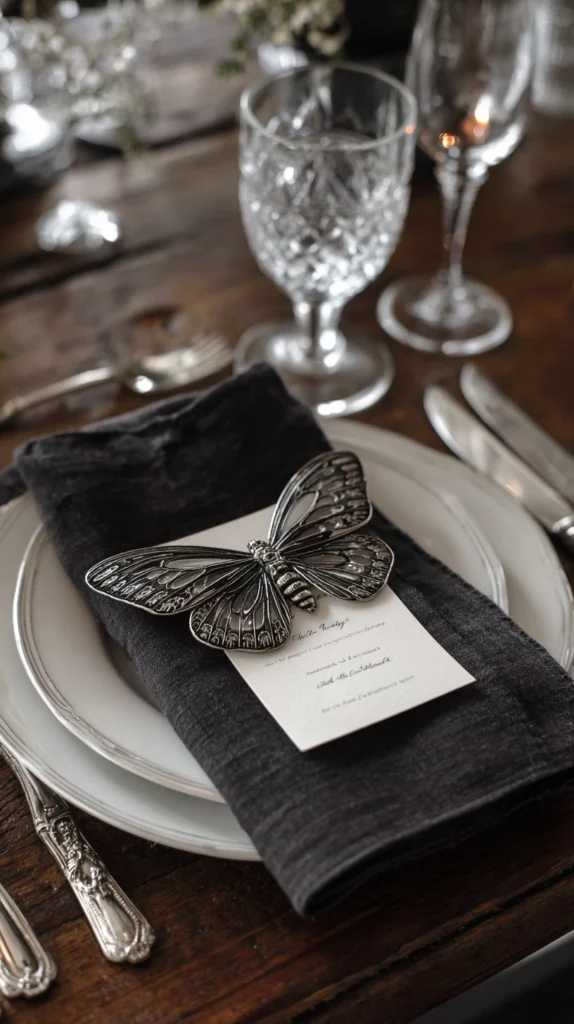
A delicate paper or fabric moth wing motif incorporated into each napkin fold or place card, providing a subtle nod to the season’s naturalist, slightly macabre imagery.
Why moth imagery offers a more understated alternative to more common Halloween motifs
Moths carry a genuinely moody, naturalist association without the more overtly costume-associated imagery of witches, skeletons, or jack-o’-lanterns, suiting a household wanting a subtler, more sophisticated seasonal reference.
The wing detail
A small paper cutout or fabric moth wing motif, incorporated into the napkin fold or attached to the place card itself.
The color
Dark, muted tones — charcoal, deep brown, or black — rather than any bright or overly decorative moth imagery.
The material quality
A genuinely well-cut or well-printed detail, rather than a cheap sticker or overly simple craft-project version that would undercut the table’s otherwise elegant impression.
The placement
Integrated into the existing napkin fold or place card rather than as an additional standalone object, keeping the table’s overall object count restrained.
The overall effect
A subtle, naturalist detail that reads as sophisticated and slightly gothic, distinguishing the table from more common and more literal Halloween imagery.
Cost breakdown: Moth wing details (per setting): $2–5 Total: $20–75 depending on guest count
15. The Complete Spooky-Elegant Dinner Table (The Fully Realized Setting)
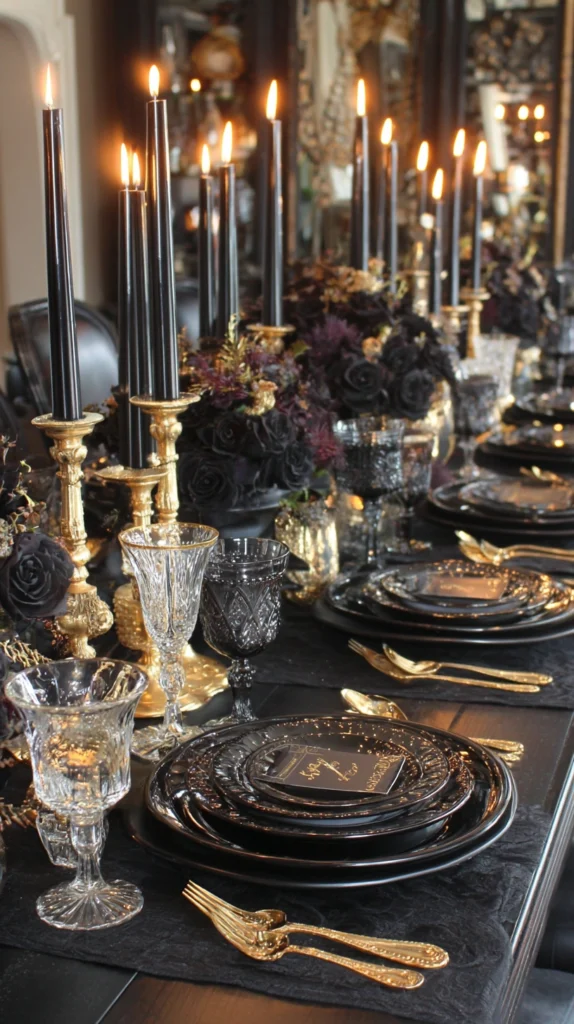
A complete table setting combining several of the approaches above — a restrained color palette, a considered centerpiece, personalized place settings, and abundant candlelight — treating the entire table as one sustained, immersive composition rather than a collection of individually purchased Halloween items.
What separates the complete table from a few Halloween props scattered across an ordinary setting
A single skeleton hand place card holder on an otherwise unstyled table: a nice detail. A complete spooky-elegant dinner table: every element — centerpiece, place settings, glassware, lighting, and individual details — working together as one considered scene, guests discovering new details throughout the meal rather than taking in everything at a single glance.
The elements of the complete spooky-elegant dinner table
The palette
A restrained two- or three-color scheme — black and gold, or deep purple and silver — carried consistently across every element.
The centerpiece
A low, running arrangement of dark florals and candles, preserving sightlines while providing genuine visual richness.
The place settings
Layered chargers, plates, and napkins, each with one small personal detail — a place card, a dried botanical accent, or a tarot card.
The glassware
Genuinely nice glasses, chosen to catch candlelight and complement the palette.
The lighting
Abundant candlelight, providing both the evening’s primary illumination and much of its atmospheric quality.
The complete design in action
A Halloween dinner party:
Guests arriving: The table immediately visible and striking, the candlelight and dark florals establishing the evening’s mood before a single course arrives.
Sitting down: Each guest discovering their own small detail — a tarot card, a labeled bottle, a place card held by a skeleton hand.
Throughout the meal: Conversation flowing easily across a table where sightlines remain clear despite the centerpiece’s richness, candlelight flickering across the crystal glassware.
After dinner: The table itself remembered as much as the meal, guests commenting specifically on the setting’s considered, immersive detail.
The complete spooky-elegant dinner table: not a functional surface with a few seasonal props added to it, but the party’s genuine centerpiece, sustaining atmosphere for the entire evening rather than a single first impression.
Cost breakdown for the complete table (per 8 guests): Assuming a starting point of standard dinnerware and glassware: Restrained color palette elements (linens, chargers): $150–300 Centerpiece (florals and candles): $75–170 Personalized place setting details: $60–200 Glassware upgrade (if needed): $150–350 Additional candles for lighting: $30–60 Total: $465–1,080
Phased for planning purposes:
Two to three weeks before: Sourcing linens, chargers, and any glassware upgrades Ordering or gathering dried botanicals for the centerpiece
The week of: Assembling the centerpiece and testing the overall table arrangement
The day of the party: Final place setting details added, candles set and ready to light as guests arrive
The spooky-elegant dinner table: not a last-minute addition of a few Halloween props, but the evening’s genuine centerpiece, planned with the same care given to the meal itself.
The Question Before Any Halloween Table Setting Decision
Before choosing a single element:
What is the primary mood wanted for this specific dinner party?
If the answer is: glamorous and sophisticated — the black and gold table or the antique silver and candlelight approach.
If the answer is: romantic and gothic — the deep purple and silver table.
If the answer is: interactive and conversational — the tarot card place settings or the apothecary bottle details.
If the answer is: subtle and understated — the moth wing detail or the dried botanical accent, avoiding any overtly literal Halloween imagery.
The design follows the specific mood and guest experience wanted, more than any single template for what a Halloween table should include. Every idea on this list contributes to a different specific atmosphere. The question is which particular mood this household wants their dinner party to embody.
The single well-chosen centerpiece and one personal detail per place setting: still transforms an ordinary dinner table into a genuine seasonal occasion. The complete table, considered in every layer: an evening where the setting itself becomes as memorable as the meal served on it.
That sustained atmosphere: the whole point of styling a Halloween table with real intention.
Getting Started This Weekend
The immediate Halloween table setting solution:
Choose a two-color palette before selecting any individual item.
Black and gold, or purple and silver — the restraint of a limited palette does more than any individual purchase to elevate the table.
Start with the centerpiece, keeping it low enough to preserve sightlines.
The foundational element every other detail should complement rather than compete with.
Add one small personal detail per place setting, rather than several competing objects.
A single place card, a tarot card, or a small labeled bottle — one genuine point of individual discovery.
Light considerably more candles than usual.
The rest of the design: the elaboration of this moment.
The palette: the beginning. The spooky-elegant table: what gets set, and lit, around it.