
15 Maximalist Gallery Wall Ideas for Personality-Packed Rooms
Our staircase wall used to hold exactly one framed print, centered, safe, and completely forgettable.
I started adding pieces one at a time, without much of a plan, just things I actually liked looking at.
Somewhere around piece number twelve, people stopped walking past it and started standing in front of it.
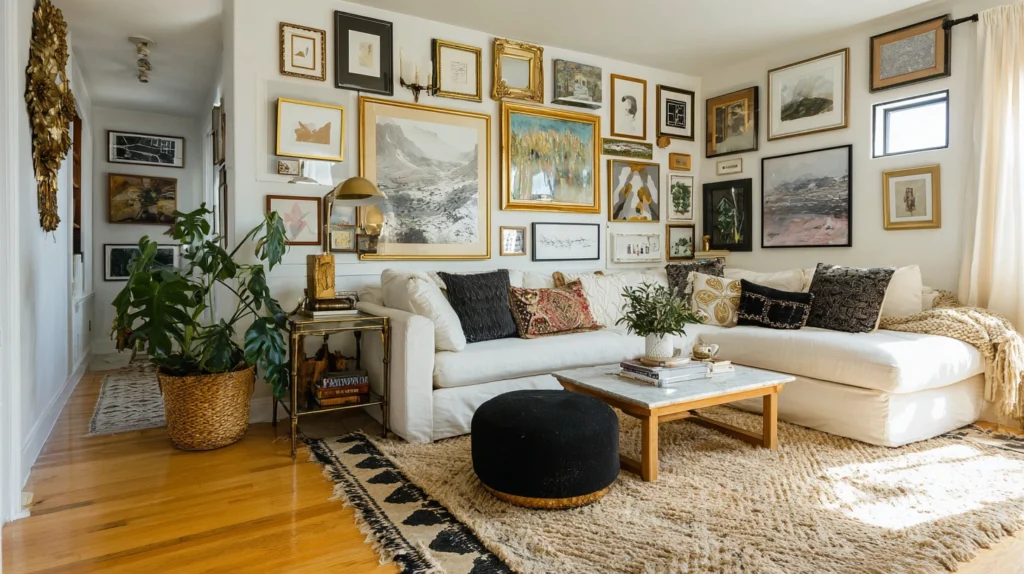
A maximalist gallery wall isn’t about matching frames. It’s about finally letting a wall reflect everything you’ve collected.
Here are 15 ways to build one that reads as intentional chaos, not just clutter.
Why maximalist gallery walls work when they’re done with intention
The style looks effortless, but the best versions follow real structure underneath the density.
- A unifying thread, whether color, subject, or frame finish, keeps dozens of pieces from feeling random
- Density itself is the point, so resist the urge to leave large gaps of empty wall between pieces
- Mixing scale, medium, and era adds the personality this style is actually built around
Once the underlying structure is in place, you can keep adding pieces indefinitely without the wall ever feeling finished, which is exactly the intent.
1. Mismatched Frame Styles With One Consistent Color
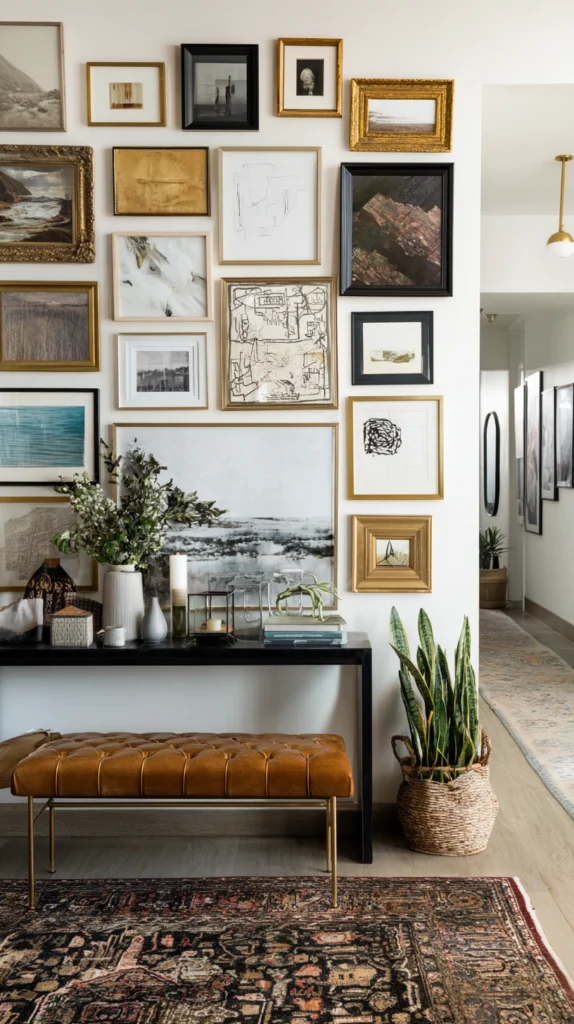
Variety in shape, unity in tone.
Build it:
- Frames in wood, gold, black, and ornate vintage styles, all mixed together on the same wall
- Every frame kept within a single tonal family, like all warm woods and brass, or all black and white
- Artwork and photos varied freely in subject, since the frame color does the unifying work
Why this approach lets true maximalism stay cohesive:
- It gives you permission to buy or thrift almost any frame you like without worrying about an exact match
- The single color thread reads clearly even from across the room, holding the wall together visually
- It’s the easiest entry point for anyone nervous about starting a maximalist wall for the first time
Cost breakdown: A mixed collection of ten to fifteen frames runs $80 to $200 if thrifted, considerably more if purchased new.
2. Family Photos Layered With Fine Art Prints
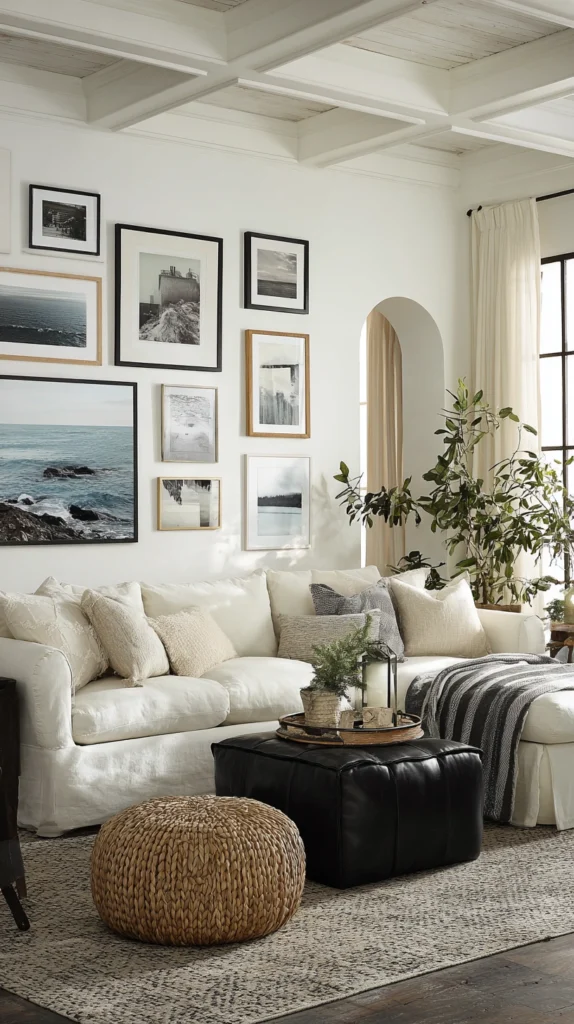
Personal history mixed directly with purchased or printed artwork.
Build it:
- Black and white family photographs interspersed among framed art prints and postcards
- Photos printed in a consistent size range, even if the art pieces vary more dramatically in scale
- Arranged so no single family photo sits isolated among a cluster of art, keeping the mix genuinely blended
Why combining personal and purchased pieces adds real depth:
- It keeps the wall from reading as purely decorative, since real memories are woven directly into the display
- The contrast between candid family moments and more polished art prints adds visual and emotional variety
- It naturally grows over time as new family photos get added alongside whatever art you continue collecting
Cost breakdown: Printing and framing family photos runs $10 to $25 per piece depending on size and frame quality.
3. Vintage Oil Paintings Stacked Salon-Style
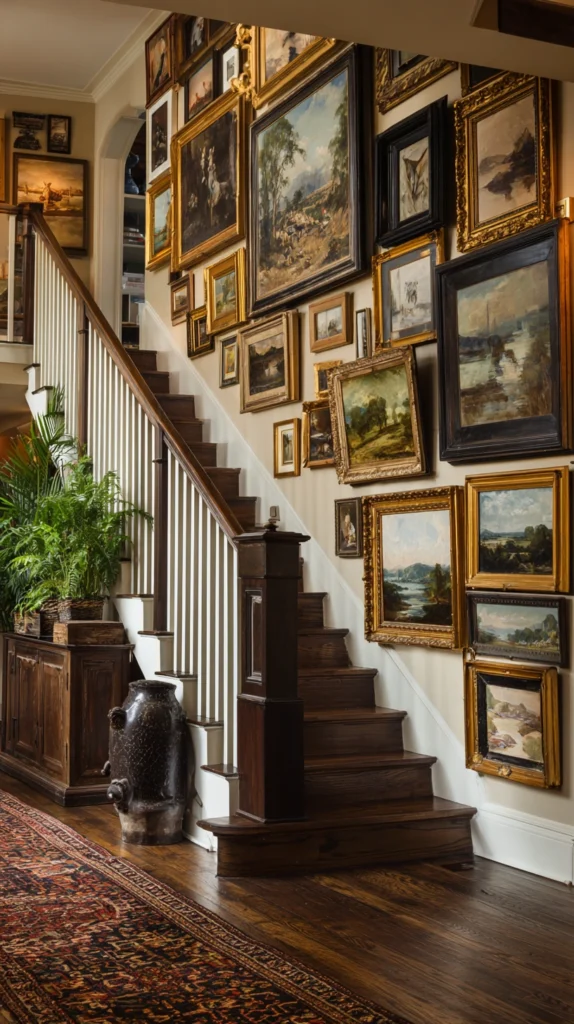
Floor-to-ceiling density inspired by traditional European salon hangs.
Build it:
- Oil paintings and ornate framed prints stacked in overlapping rows from just above eye level up to the ceiling
- Larger, heavier pieces positioned lower on the wall, smaller ones filling in higher up
- Minimal or no visible wall space left between pieces, embracing the style’s signature density
Why salon-style hanging is the most maximalist approach on this list:
- It’s directly modeled on historic gallery and salon walls, where density itself was the entire visual point
- Vintage oil paintings, even mismatched in subject and era, share a certain textural and tonal similarity that unifies the wall
- It works particularly well on a tall wall or stairwell, where the vertical stacking has genuine room to breathe upward
Cost breakdown: Vintage oil paintings suited for this style run $20 to $80 each at estate sales or thrift stores, with fifteen to twenty pieces typically needed for a full salon wall.
4. Bold Color-Blocked Sections Within One Wall
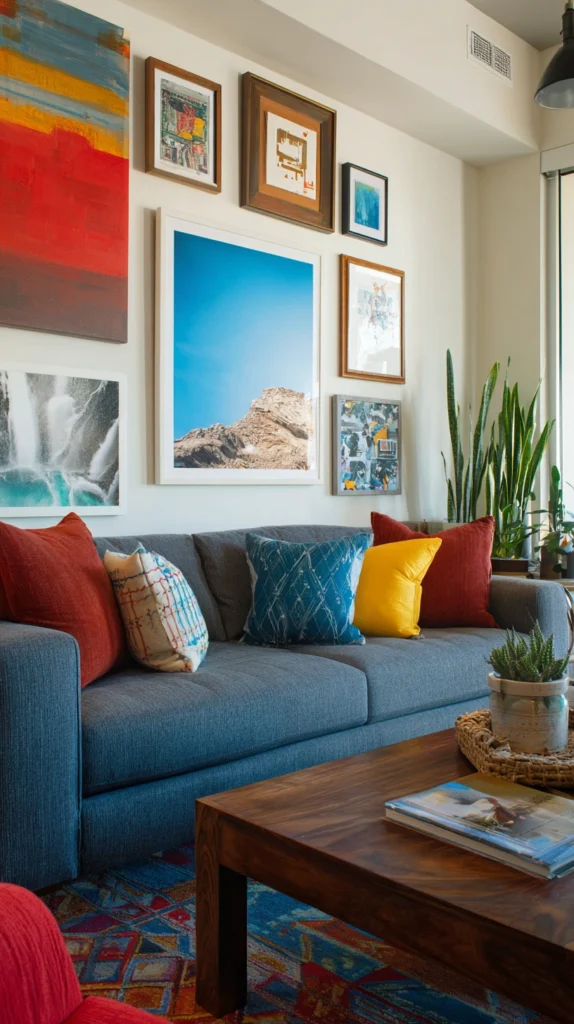
Dividing the wall into color zones rather than blending everything evenly.
Build it:
- The wall mentally divided into two or three sections, each built around a dominant color palette
- Artwork and objects selected specifically to fit each section’s color story, creating visible zones within the larger display
- Transition pieces placed at the boundary between sections to soften the shift from one color zone to the next
Why color zoning adds structure without sacrificing maximalist density:
- It gives the eye a way to process a very busy wall in manageable sections rather than all at once
- It allows bold, saturated pieces to coexist without the whole wall reading as visually chaotic
- It’s a technique that works particularly well for larger walls that would otherwise feel overwhelming as one continuous mix
Cost breakdown: Comparable to any other maximalist wall, typically $150 to $400 depending on the number and size of pieces used.
5. Mixed Media Wall With Textiles and 3D Objects
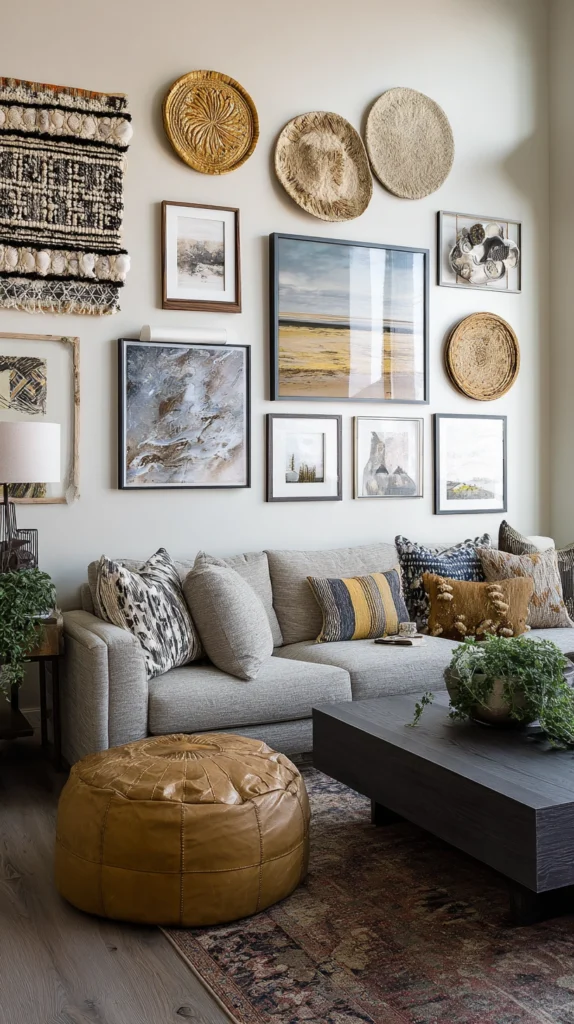
Moving beyond flat framed pieces entirely.
Build it:
- Small woven wall hangings, ceramic wall sconces, or hanging plates mixed directly among framed artwork
- Textural pieces distributed evenly rather than clustered in one corner, keeping the dimensional variety spread throughout
- Secure mounting hardware appropriate to each object’s weight, since 3D pieces often need sturdier anchors than a simple picture hook
Why adding dimension changes the whole wall’s character:
- Flat framed pieces alone, however well curated, can start to feel one-note across a large wall
- Textiles and ceramics introduce genuine shadow and texture that a purely flat display can’t achieve
- It reflects a more eclectic, collected-over-time feeling than a wall built entirely from matching frame shapes
Cost breakdown: Woven hangings and ceramic accent pieces run $15 to $50 each depending on size and material.
6. Postcards and Ephemera in Small Uniform Frames
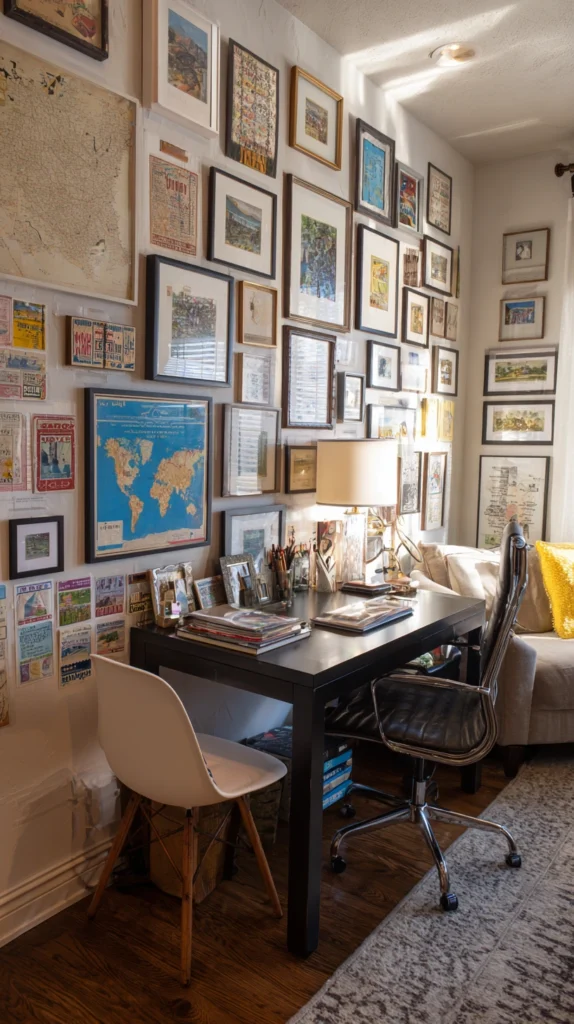
Small-scale collected items given equal visual weight.
Build it:
- Vintage postcards, ticket stubs, and small prints framed identically in simple, uniform small frames
- Arranged in a tight grid or loosely scattered pattern, depending on the rest of the wall’s overall structure
- Grouped together as a distinct cluster within the larger gallery wall rather than scattered individually throughout
Why small ephemera deserves its own dedicated section:
- These small, personal collected items often get lost or discarded if not given a genuine display purpose
- Uniform framing gives a wildly varied collection of small items visual cohesion despite their different origins
- It adds a genuinely personal, travel-and-memory layer that purchased art alone can’t replicate
Cost breakdown: Small uniform frames run $3 to $8 each, typically $40 to $80 for a full cluster of ten or more.
7. Black and White Photography Mixed With Line Art
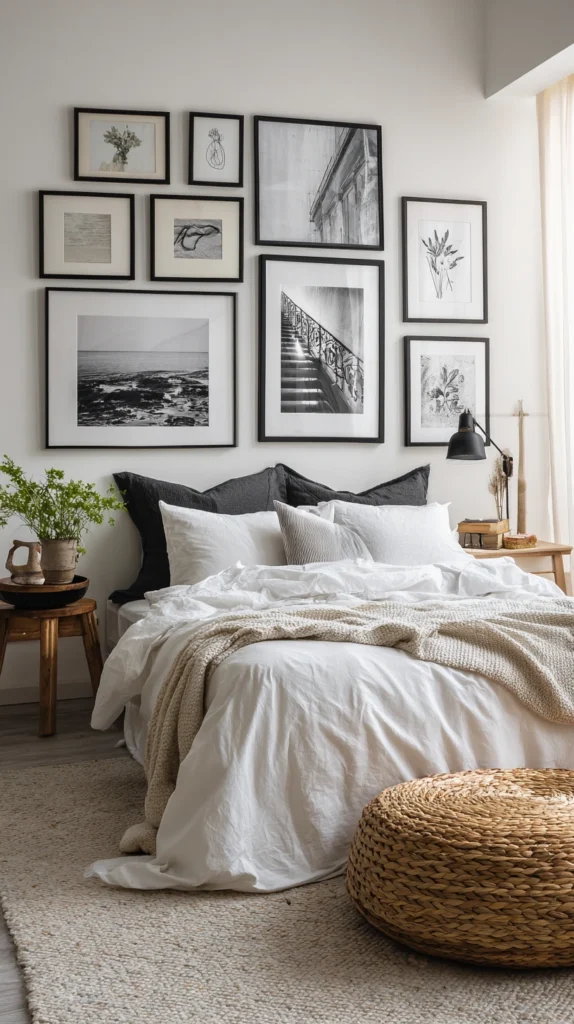
A more restrained maximalist approach built around tonal contrast rather than full color chaos.
Build it:
- Black and white photographic prints paired with simple black line drawings or botanical illustrations
- Frames kept in a consistent black or white finish, letting the artwork’s tonal contrast carry the visual interest
- Density still high, filling the wall generously, but restrained specifically to a black, white, and gray palette
Why this version suits someone wanting maximalist density without full color intensity:
- It delivers the same collected, layered feeling as a fully colorful wall while staying visually calmer
- The tonal consistency makes an otherwise eclectic mix of subjects and styles feel unified
- It works particularly well in more monochromatic or minimalist-leaning rooms that still want a maximalist focal wall
Cost breakdown: Black and white prints and simple line art run $10 to $30 each, with fifteen to twenty pieces needed for full wall coverage.
8. Gallery Wall Built Around a Single Obsession or Collection
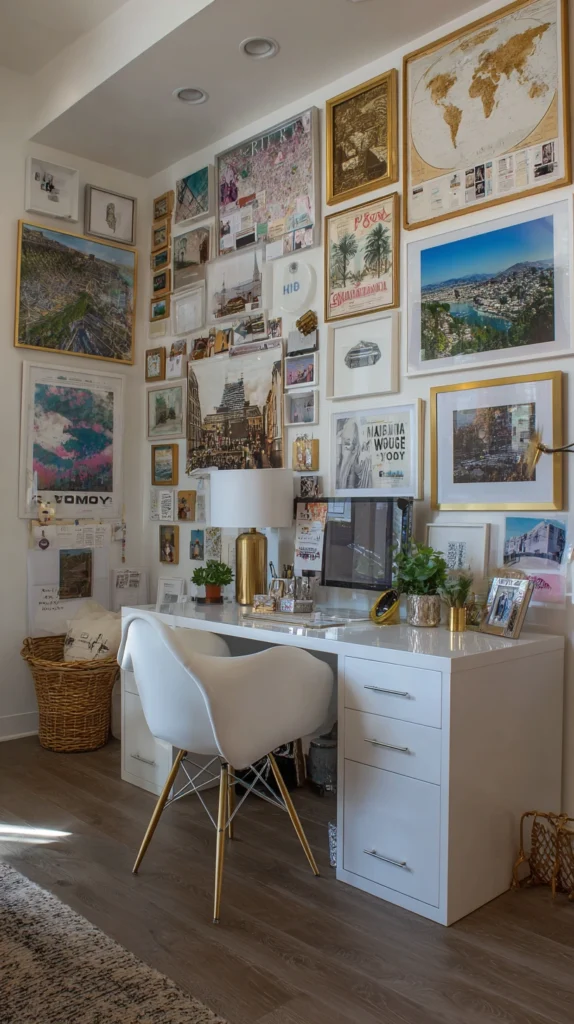
A themed wall centered on one specific personal interest.
Build it:
- Artwork, photos, and objects all tied to a single unifying subject, like travel, birds, botanicals, or a specific hobby
- Pieces sourced from a wide range of eras, styles, and price points, united only by the shared theme
- Displayed with genuine density, since a themed collection tends to grow indefinitely once the wall exists
Why a single-obsession wall reads as more personal than a generic art mix:
- It communicates something specific and true about the people living in the space, rather than a generic decorative choice
- A themed collection naturally invites continued growth, since new finds related to the theme have an obvious home
- It gives visitors an immediate, genuine conversation starter, unlike a wall of unrelated purchased art
Cost breakdown: Themed collections vary enormously depending on subject and sourcing, typically $100 to $300 for an initial full wall.
9. Layered Frames With Objects Leaned in Front
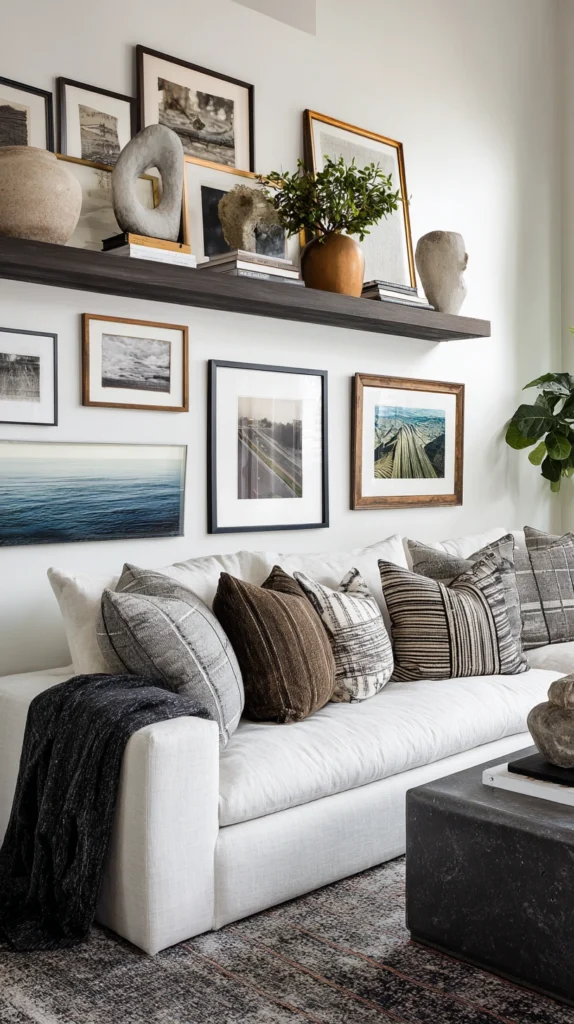
Adding depth by placing items on a shelf in front of the hung pieces, not just on the wall itself.
Build it:
- A narrow picture ledge shelf installed partway up the gallery wall
- Framed pieces leaned against the wall on the ledge, overlapping slightly rather than hung flat
- Small objects, like a vase or small sculpture, placed on the ledge among the leaned frames for added dimension
Why leaning frames adds a layer flat-hung walls can’t achieve:
- The slight forward lean and overlap creates genuine depth and shadow that a fully flush wall doesn’t have
- It makes rearranging or adding new pieces far easier, since nothing needs new nail holes
- It mixes naturally with fully wall-hung pieces above or beside the ledge for a wall that has real dimensional variety
Cost breakdown: A picture ledge shelf installation runs $30 to $80 depending on length and material.
10. Gallery Wall Incorporating Mirrors of Varying Shapes
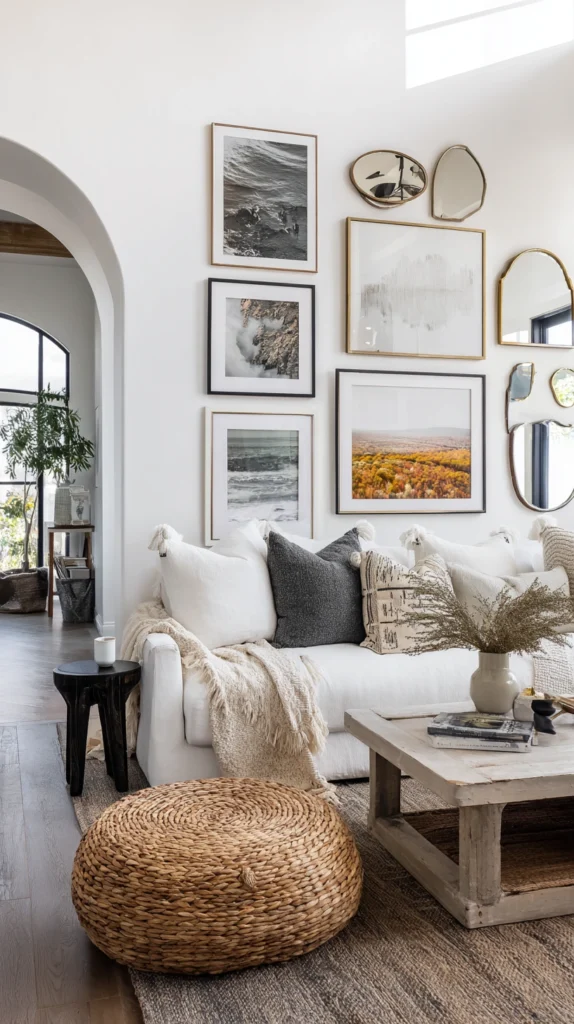
Reflective pieces mixed directly among the framed artwork.
Build it:
- Two or three mirrors in varied shapes, like round, arched, and asymmetrical, distributed among the framed pieces
- Positioned to reflect light or an interesting view from elsewhere in the room, adding function alongside decoration
- Frame finishes on the mirrors matched to at least some of the surrounding artwork frames for partial cohesion
Why mirrors add both visual and functional value to a maximalist wall:
- They break up what would otherwise be an entirely flat collection of framed images
- Reflected light and views add movement and brightness that static artwork alone can’t provide
- The varied mirror shapes reinforce the eclectic, collected-over-time feeling central to this style
Cost breakdown: Small to medium decorative mirrors run $20 to $70 each depending on shape and frame finish.
11. Bold Wallpaper Backdrop Behind a Dense Gallery Wall
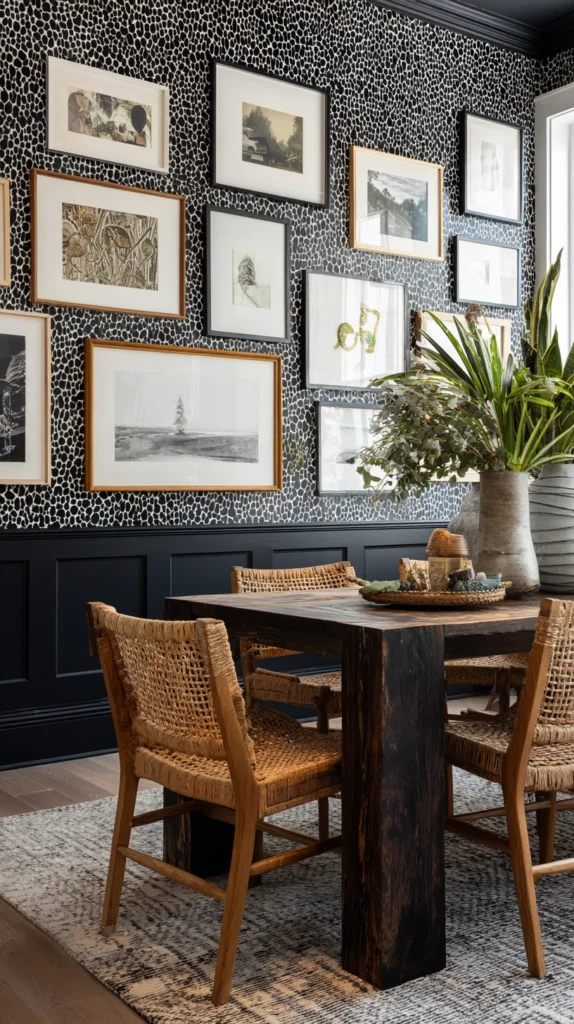
Pattern beneath the artwork rather than a plain painted wall.
Build it:
- A bold, busy wallpaper pattern applied to the wall before hanging any artwork
- Frame finishes kept simple, often black or plain wood, letting the wallpaper and artwork share visual attention without competing directly
- Density in the artwork itself kept slightly lower than a plain-wall version, since the wallpaper is already contributing significant pattern
Why a patterned backdrop adds an extra layer of maximalist personality:
- It gives even the small negative space between frames genuine visual interest rather than plain, empty wall
- The combination of pattern and dense artwork is about as maximalist as a single wall can get
- It suits rooms already leaning into a bold, pattern-rich overall design rather than a more neutral backdrop
Cost breakdown: Wallpaper for a single accent wall runs $80 to $200 depending on pattern and coverage needed.
12. Gallery Wall With Deliberate Asymmetry Instead of a Grid
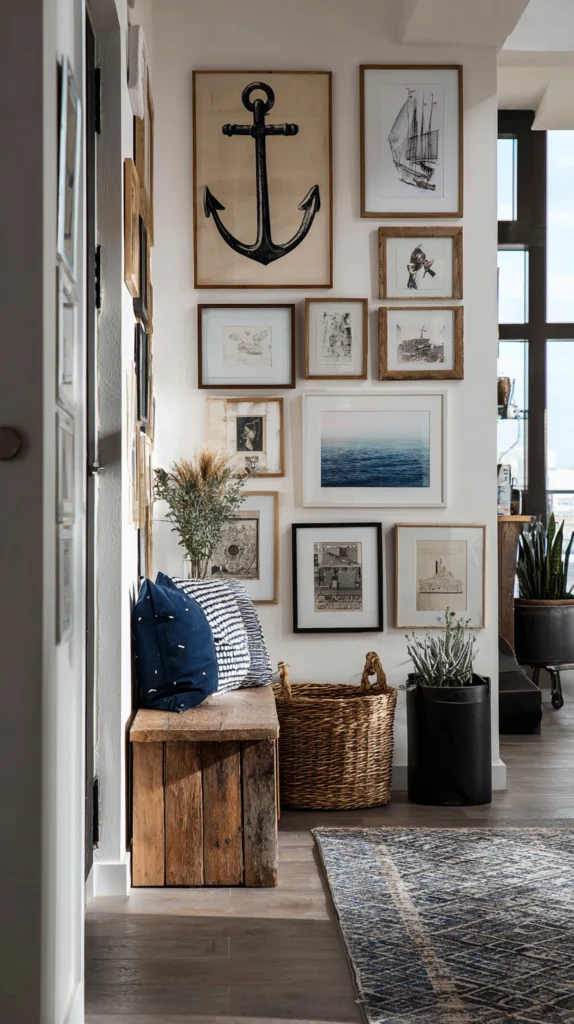
Organic, uneven placement rather than a structured grid layout.
Build it:
- Frames arranged in an intentionally uneven pattern, varying both height and horizontal spacing throughout
- A loose visual center established with one or two larger anchor pieces, with smaller pieces radiating outward unevenly
- Paper templates traced and taped to the wall first, allowing the whole arrangement to be tested before any nails go in
Why asymmetry suits maximalism better than a rigid grid:
- A perfectly even grid can undercut the collected, organic feeling that makes maximalist walls feel personal rather than curated by formula
- Uneven placement mimics how a genuine collection actually accumulates over years, rather than being installed all at once
- Testing the layout with paper templates first avoids unnecessary wall damage while finding the right asymmetrical balance
Cost breakdown: Free beyond the artwork itself, since this is a layout technique rather than a material purchase.
13. Gallery Wall That Wraps Around a Corner
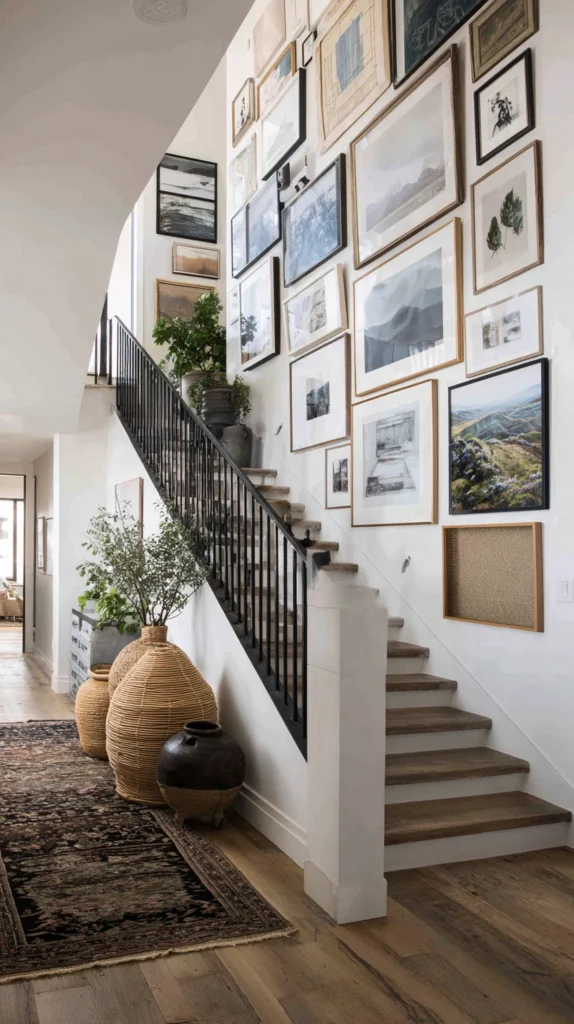
Extending the display beyond a single flat wall.
Build it:
- Artwork continued around an interior corner, treating both wall sections as one continuous display
- Smaller, lighter pieces used near the corner itself, where hanging hardware often has less wall support
- Density maintained consistently across both wall sections so the corner doesn’t read as an abrupt stopping point
Why wrapping a corner expands what a gallery wall can accomplish:
- It uses wall space that’s frequently left bare, since most people default to stopping a gallery wall at the corner
- It creates a genuinely immersive feeling when the display continues past the point where a flat wall would end
- It works particularly well in a stairwell or hallway, where corners are common and often underutilized
Cost breakdown: No additional cost beyond the artwork itself, since this is a placement strategy rather than a new material investment.
14. Gallery Wall Featuring Kids’ Artwork Alongside Fine Art
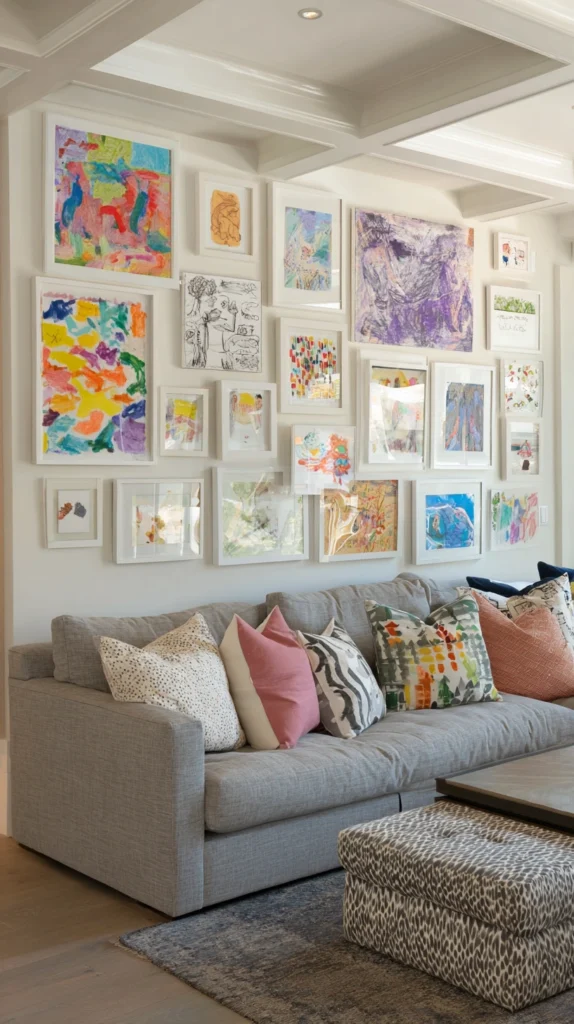
Genuine family creativity displayed with the same respect as purchased pieces.
Build it:
- Children’s drawings and paintings framed in the same quality frames used for the rest of the wall’s artwork
- Rotated periodically as new pieces are created, keeping a few standout favorites in permanent rotation
- Interspersed throughout the wall rather than segregated into a single separate section
Why treating kids’ art as equal to fine art changes the wall’s whole meaning:
- It signals that the wall reflects the whole family’s creativity and history, not just purchased decor
- Quality framing elevates a child’s drawing in a way that instantly makes it feel intentional rather than a refrigerator afterthought
- It gives kids genuine pride in seeing their work displayed with the same care as anything else in the home
Cost breakdown: Simple frames suited for rotating kids’ artwork run $8 to $20 each depending on size.
15. Gallery Wall With a Running Narrative Through Placement
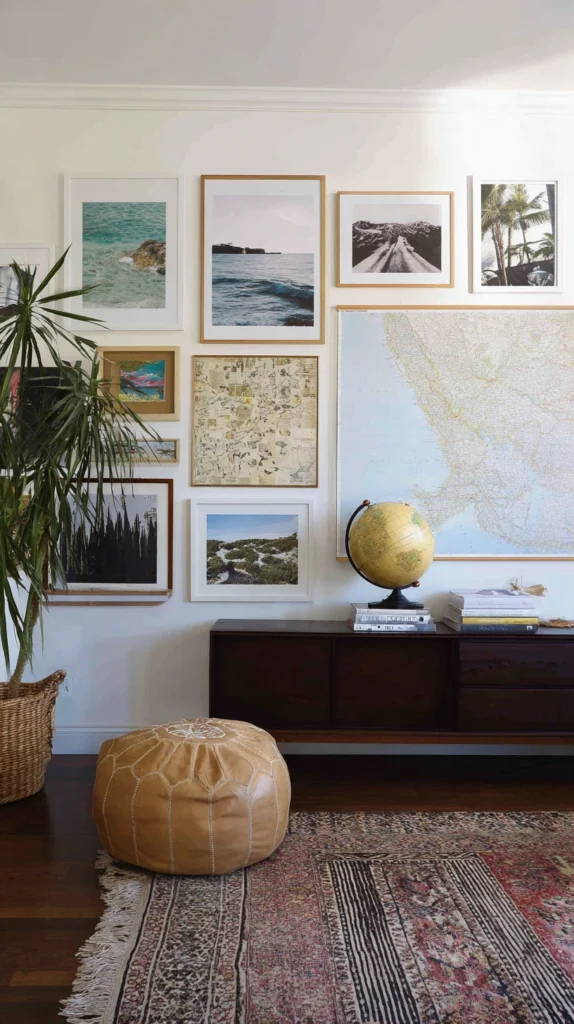
Arranging pieces so the eye follows an intentional story across the wall.
Build it:
- Pieces grouped loosely by theme or chronology, such as travel photos moving left to right in the order the trips happened
- Small connecting elements, like a shared color or subject, placed at the transition points between different narrative sections
- A key anchor piece, like a large map or a significant photo, positioned as the story’s natural starting or ending point
Why a narrative structure adds meaning beyond visual density alone:
- It gives visitors a genuine reason to look closely and ask questions, rather than taking in the wall as pure background decor
- It provides an underlying organizational logic that helps a very dense, maximalist wall still feel intentional rather than random
- It turns the wall into something that can be described and explained, adding a layer of personal storytelling most gallery walls lack
Cost breakdown: No additional cost beyond the artwork itself, since this is an organizational approach applied to pieces likely already being collected.
Getting started this weekend
You don’t need every piece hung before the wall starts feeling maximalist.
- Start by laying out paper templates on the floor first, testing arrangement before committing to any wall holes
- Add family photos and small ephemera pieces once the larger anchor artwork is settled
- Save wallpaper backdrops or corner-wrapping expansions for a second phase once the core wall is established
My own wall took about four months to fill in fully, adding pieces gradually rather than all at once.
Budget reality
Maximalist gallery walls scale from an entirely thrifted collection to a more curated investment.
- Under $100: Postcard and ephemera clusters, kids’ artwork framing, family photo printing
- $100-250: Mismatched thrifted frame collection, black and white photography mix, mirror additions
- $250-500: Themed obsession collection, vintage oil painting salon wall, mixed media textile pieces
- $500+: Wallpaper backdrop combined with a large dense artwork collection spanning a full wall or corner
Most of the personality-packed impact comes from the mix and arrangement, not the price of any single piece.
What actually makes a maximalist wall feel intentional rather than cluttered
It was never really about how many pieces fit on the wall.
It’s the unifying color thread running through mismatched frames, the family photo tucked beside a piece of real art, the corner that keeps going instead of stopping where most walls would.
Start with a handful of pieces you genuinely love, let the collection grow slowly and honestly, and the wall will build its own personality over time.