
14 Awkward Hallway Decorating Ideas That Finally Make Sense
The awkward hallway is one of the most consistently mishandled spaces in residential design — too narrow to furnish conventionally, too long to leave empty, too visible to ignore, and too transitional in its function to be treated with the same design investment applied to the rooms it connects.
Most people respond to the awkward hallway with one of two equally unsatisfying approaches: they fill it with whatever furniture happens to fit regardless of whether it belongs there, or they leave it completely bare on the assumption that a transit space does not deserve decoration. Both approaches produce the same result — a hallway that makes the house feel smaller, less considered, and less welcoming than every room that opens off it.
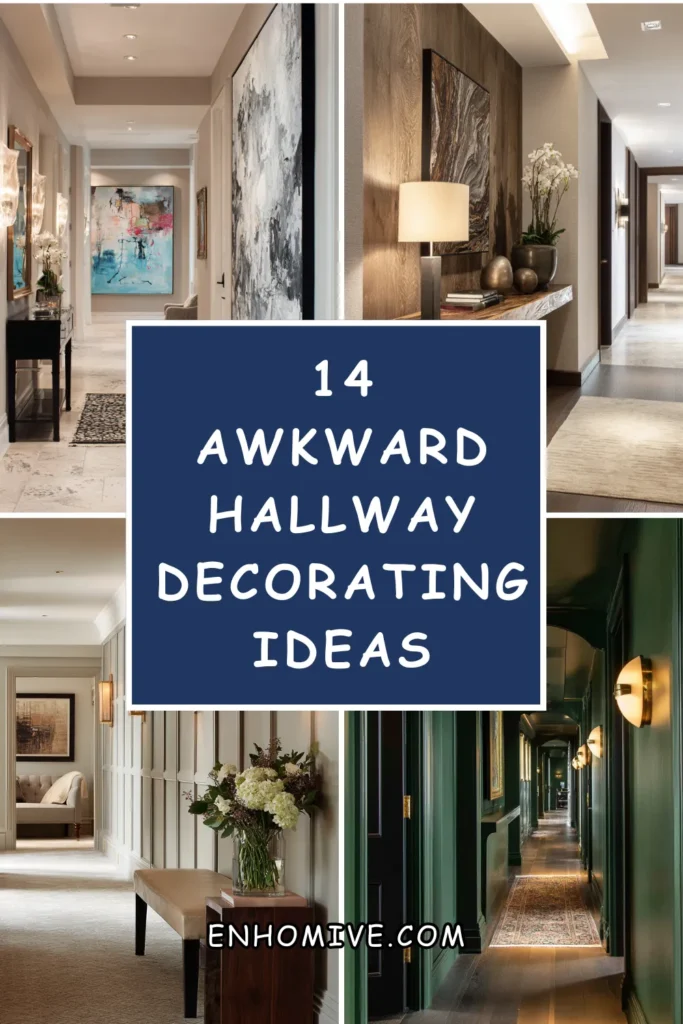
The reality is that the hallway — awkward in proportion, challenging in its lighting conditions, demanding in its practical requirements — is one of the most important decorative opportunities in any home. It is the first interior space every visitor experiences and the last they see on leaving. It sets the tone for everything beyond it.
Designed with genuine intelligence and genuine care, the awkward hallway becomes not the house’s most problematic space but one of its most characterful and memorable. These fourteen ideas demonstrate exactly how to achieve that transformation.
1. Commit to One Strong Paint Colour on Every Surface
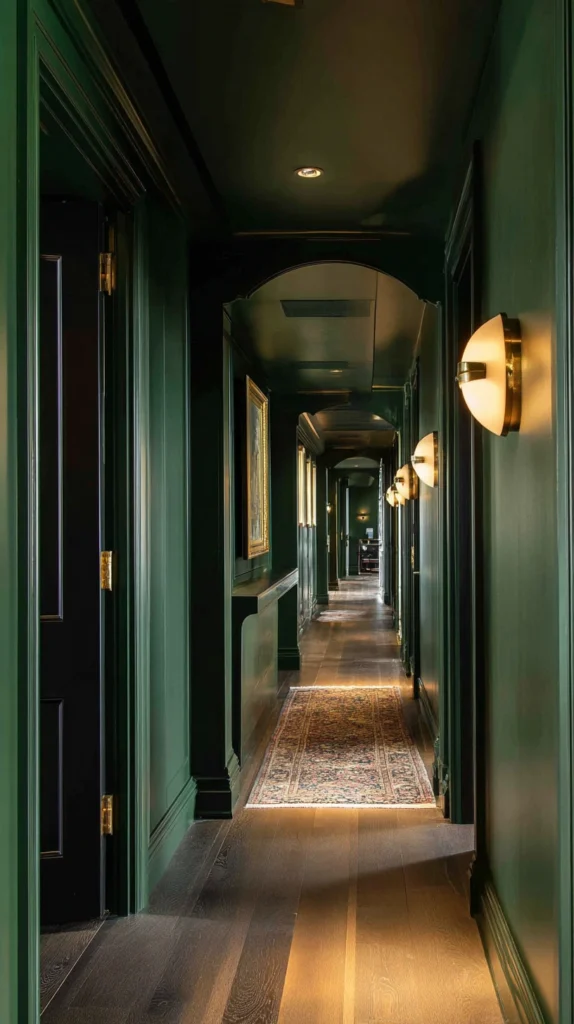
The narrow hallway painted in a pale, cautious neutral in the hope that lightness will create the impression of width achieves precisely the opposite of its intention — the pale colour draws attention to the hallway’s proportional awkwardness by providing no visual distraction from its narrowness, making the tunnel quality of a long narrow space more apparent rather than less.
The counterintuitive solution that works consistently and works well is colour commitment — painting the walls, ceiling, and woodwork in the same deep, rich tone that envelops the space rather than defining its boundaries.
A deep forest green, a warm charcoal, a rich terracotta, or a saturated navy applied to every surface simultaneously creates a colour-drenched atmosphere of genuine drama that makes the hallway feel deliberately intimate rather than accidentally narrow. The depth of colour becomes the design rather than a problem to be solved around it.
2. Install a Runner Rug the Full Length of the Hall
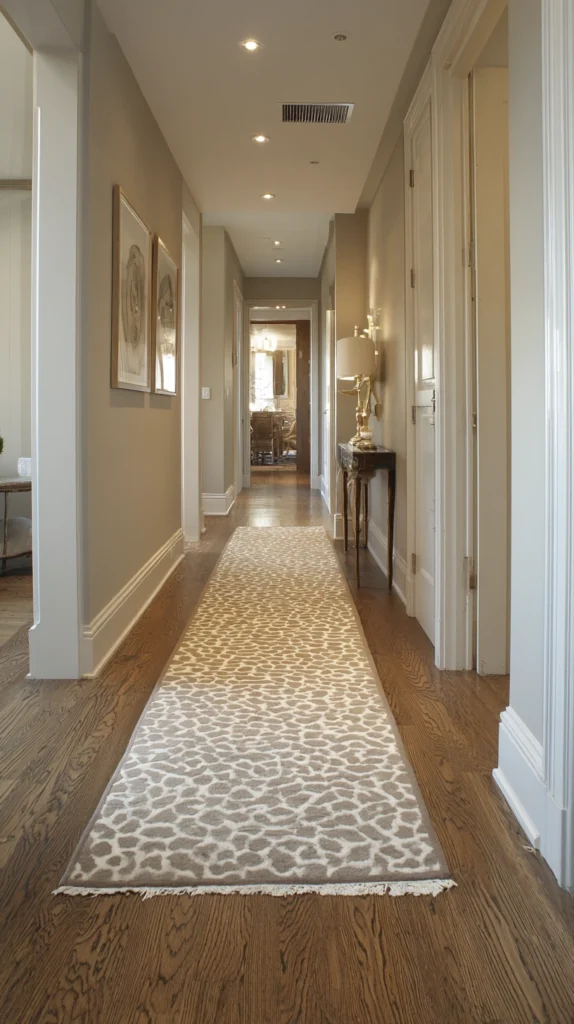
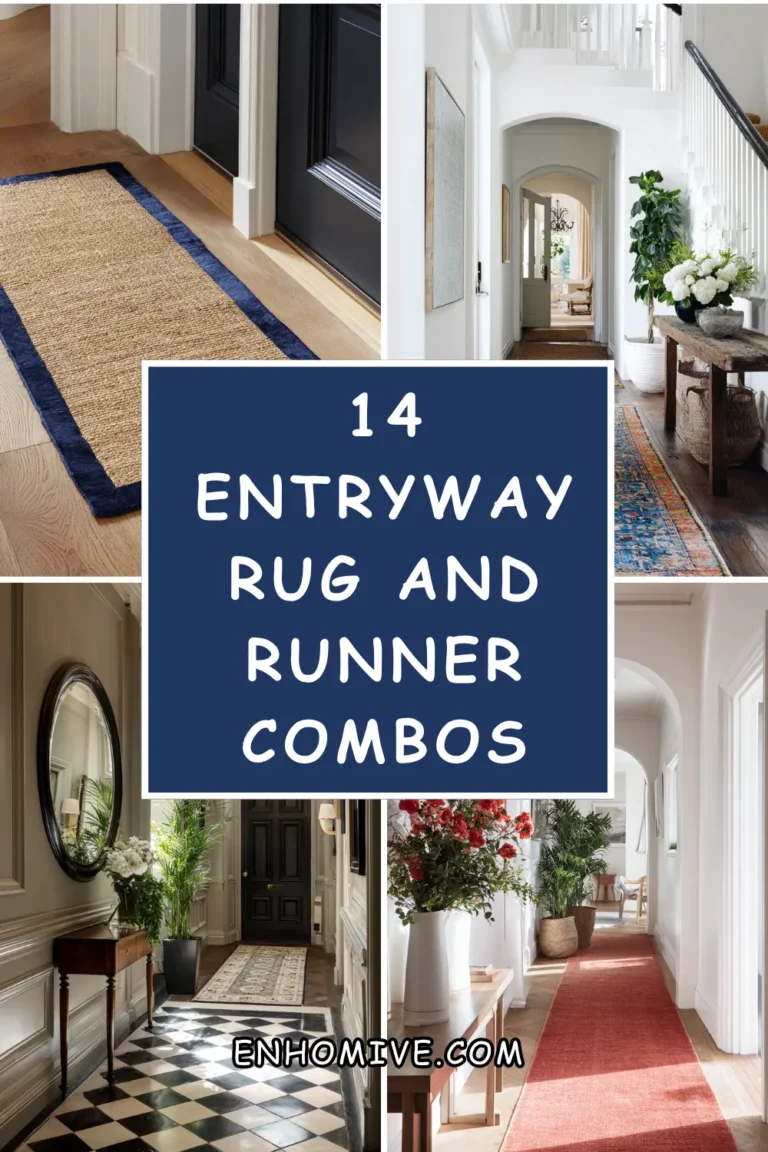
A runner rug extending the complete length of a narrow hallway — its pattern or colour providing the primary decorative element of the floor surface, its edges clearing the skirting boards by a consistent margin on both sides — does more to make a long, narrow hallway feel designed and purposeful than almost any wall-mounted or furniture-based intervention.
The runner draws the eye along the length of the hallway rather than across its width, working with the space’s proportional character rather than against it and creating a strong directional element that gives the hallway a genuine sense of movement and destination.
Choose a pattern with linear elements — a stripe, a geometric repeat, a traditional Persian with a clear border — that reinforces the directional quality rather than interrupting it, and select a pile height low enough for practical use in a high-traffic space that must accommodate doors opening and closing across its surface.
3. Use Vertical Panelling to Create Architectural Interest
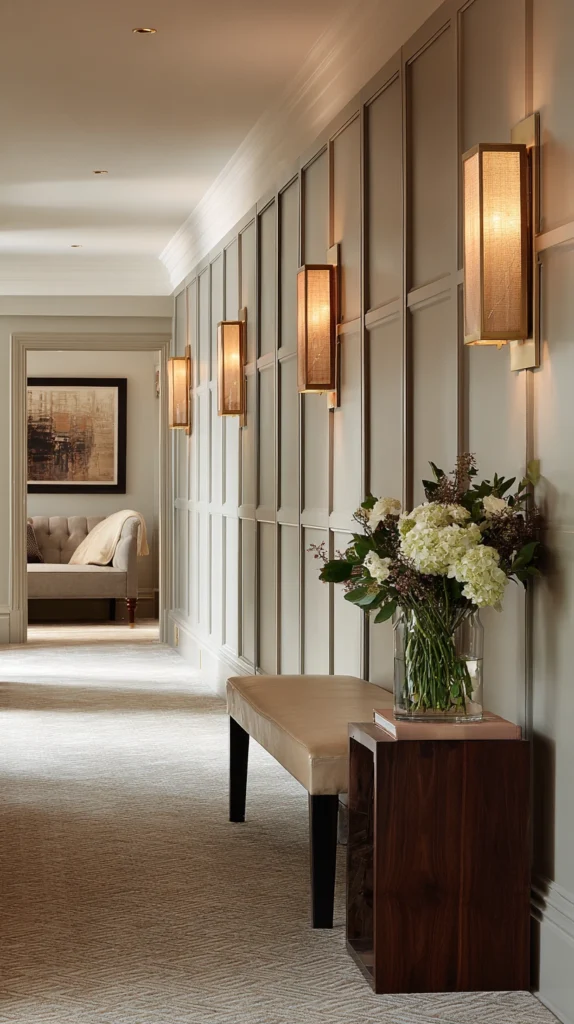
Timber wall panelling applied to the lower half of a hallway wall — shaker-style panels, simple square grid panelling, or a more elaborate raised-and-fielded profile — converts a plain, featureless passage into a space of genuine architectural character and detail, providing the visual interest and the quality of craftsmanship that transforms a transit corridor into a room that rewards attention.
The panelling also serves the practical function of protecting the lower wall from the scuffs, marks, and impact damage that narrow hallways accumulate through the collision of bags, furniture edges, and passing shoulders with the wall surface. Paint the panelling in the same colour as the wall above for a seamless, architectural quality, or in a contrasting tone that defines the dado line clearly and creates a two-tone composition of considerable elegance.
4. Line One Wall With a Full-Length Mirror
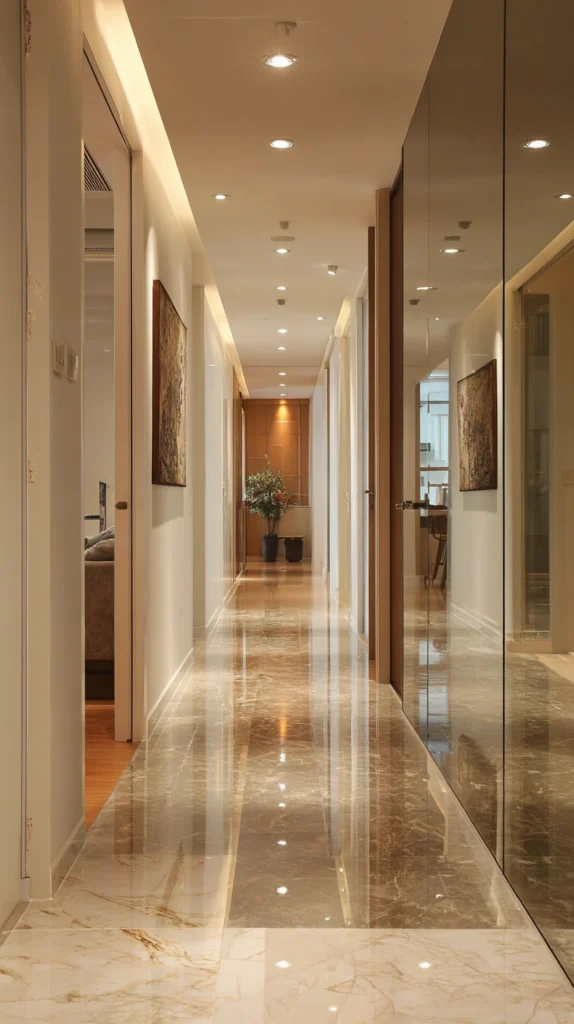
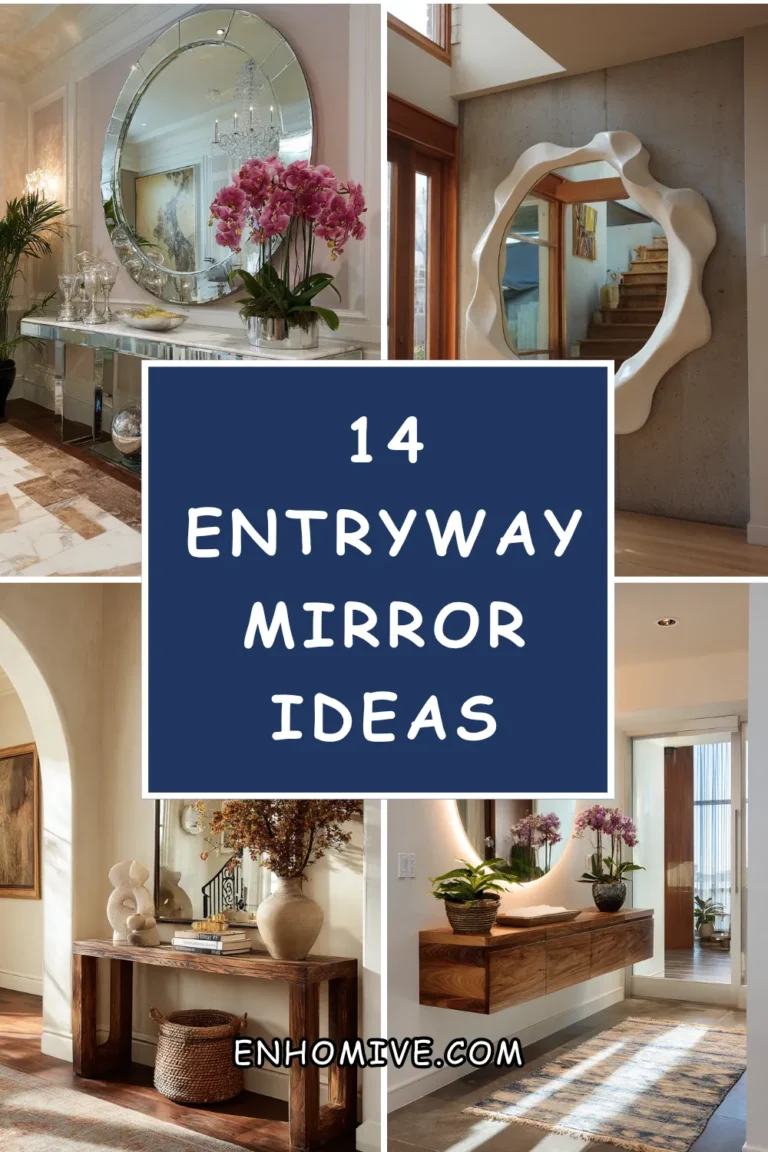
A full-length mirror — frameless, or in a slim frame that minimises its visual weight — positioned flush against one of the hallway’s long walls doubles the perceived width of the space, reflects whatever natural or artificial light the hallway receives, and provides the practical function of a full-length dressing mirror in a location where it is most naturally and most frequently used.
The mirror works best when positioned directly opposite a wall hung with art or a decorative surface of genuine interest — the reflection then creates apparent depth and visual content rather than simply doubling the view of a plain wall.
In an extremely narrow hallway where a full wall mirror is the only furniture-free solution, a continuous run of mirror panels from floor to ceiling at full wall width creates a spatial expansion that is the most dramatic and most complete available within the constraints of the architecture.
5. Create a Gallery Wall That Wraps the Length of the Hallway
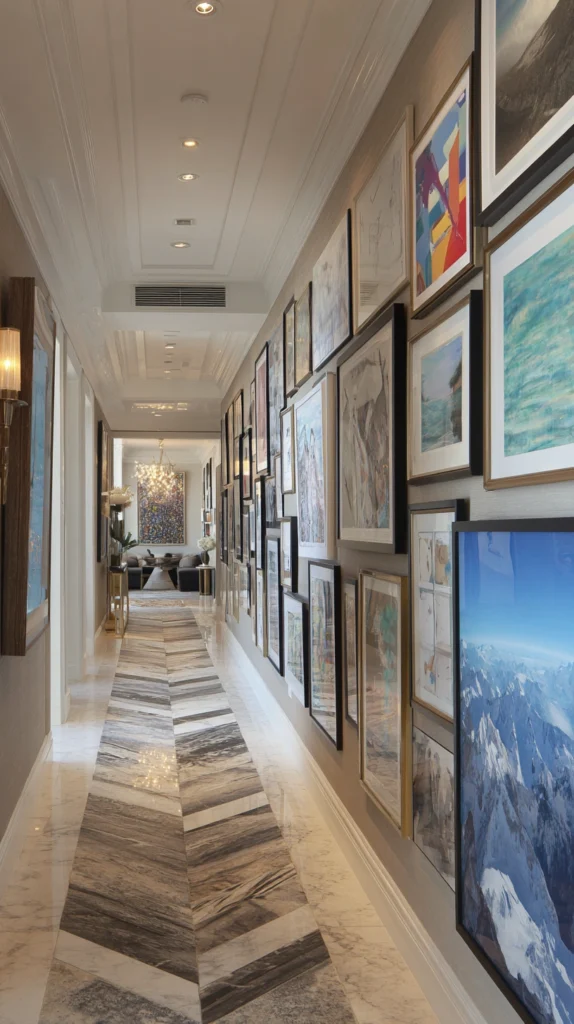
A gallery wall running the full length of a hallway — frames at consistent hanging height, artwork varying in size and subject but unified by frame finish, arranged in a continuous horizontal band that the eye follows from entrance to destination — converts the hallway’s most problematic quality, its length, into its primary design asset.
The gallery wall works in a long, narrow hallway because it gives the eye something genuinely interesting to engage with at every point along the journey through the space, transforming a transit corridor into a curated exhibition that rewards slow movement and genuine attention.
Hang the centre line of all frames at consistent eye height — typically 145 to 150 centimetres from floor to frame centre — and vary the frame sizes above and below that centre line to create rhythm and visual movement through the composition.
6. Install Sconce Lighting at Regular Intervals
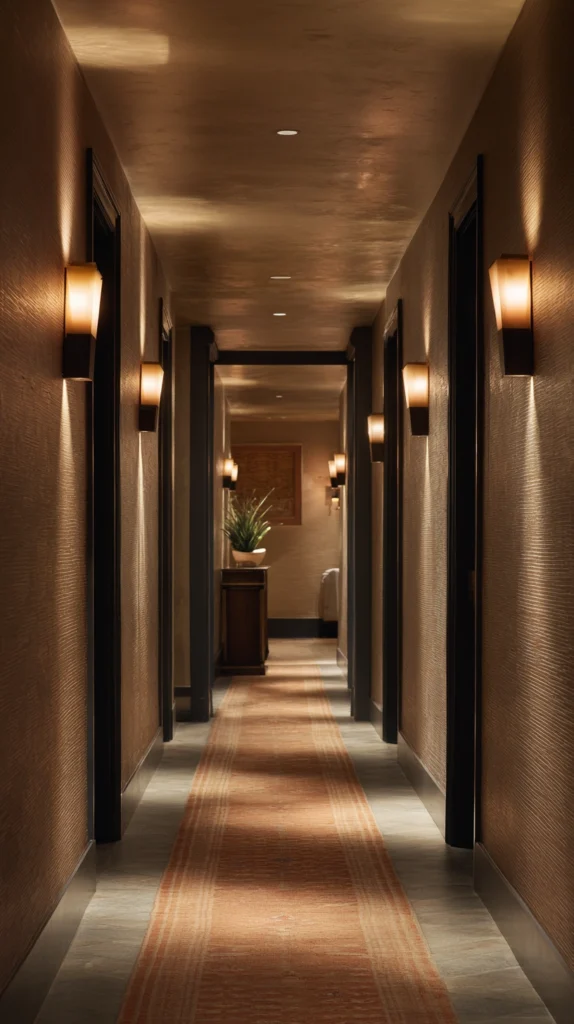
A narrow hallway lit exclusively from a single overhead ceiling fixture — or worse, a series of recessed downlights that illuminate the floor and the top of the head while leaving the walls in relative shadow — is a hallway that will never feel comfortable or welcoming regardless of the quality of its decoration.
Wall-mounted sconces installed at regular intervals along the hallway’s length, positioned at a height that casts warm light across both the wall surface and the faces of people moving through the space, transform the hallway’s lighting character from institutional to genuinely residential and genuinely warm.
Choose sconces with a simple, elegant profile that does not project significantly into the hallway’s width, in a finish that connects to the hardware choices made elsewhere in the home — aged brass, matte black, brushed nickel — and fit with warm bulbs that create the quality of light the hallway’s transitional function deserves.
7. Add a Slim Console Table With Purpose
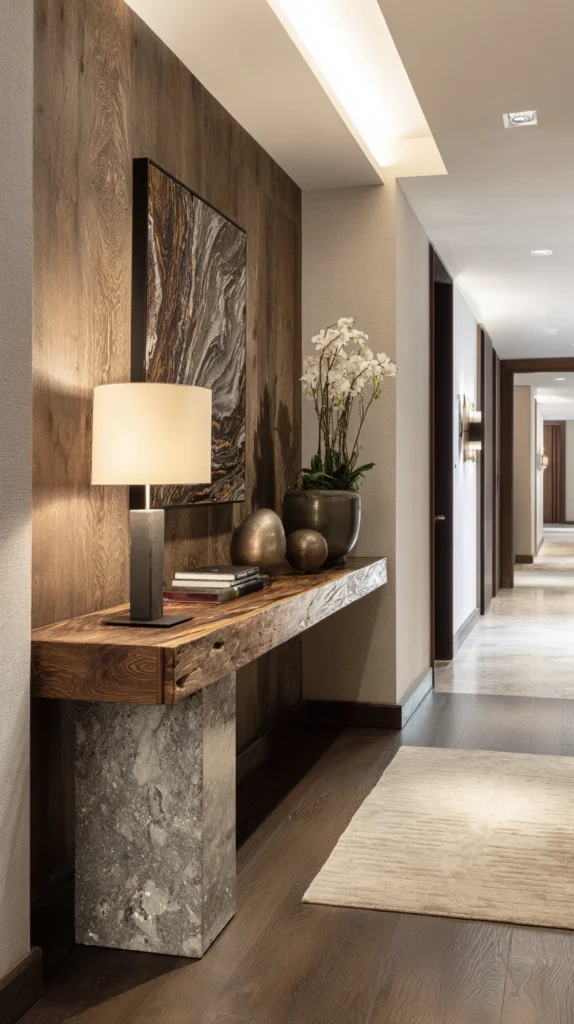
A console table in a hallway must earn its position through genuine functional contribution as well as visual presence — in a narrow hallway where every centimetre of width matters, a console table that merely holds decorative objects without providing practical storage or organisational function is a piece of furniture that makes the hallway more difficult to use while adding only marginal visual value.
Choose a console of minimal depth — ideally 25 to 30 centimetres maximum — with a surface at a height that serves as a natural drop zone for keys, post, and the items that accompany people through the front door, and a lower shelf or drawer that provides concealed storage for the practical miscellany of hallway life.
Style the surface with genuine restraint — one lamp if the power supply exists, one small plant or ceramic object, one tray for keys — and resist the accumulation of additional objects that the surface will attract if allowed.
8. Use Wallpaper on One Wall or the Ceiling
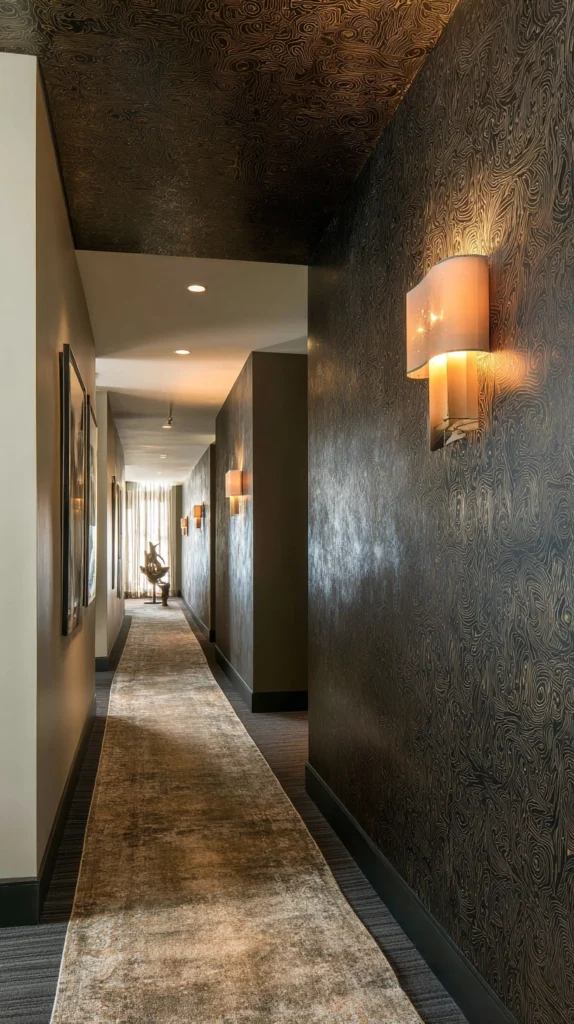
A single wallpapered wall — the primary long wall of the hallway treated in a bold, patterned, or textured wallpaper while the remaining surfaces are kept in a complementary plain colour — creates an instant focal point of considerable visual drama in a space that typically has no architectural features substantial enough to serve as one.
The hallway ceiling is an underused wallpaper opportunity of particular effectiveness — a ceiling papered in a botanical, geometric, or abstract pattern draws the eye upward and creates the impression of greater height while providing a decorative surface that is genuinely surprising and genuinely delightful in a space where surprise and delight are rarely expected.
Choose a scale of pattern appropriate to the hallway’s proportions — small-scale repeat patterns can feel restless in a long, narrow space, while larger-scale designs create a confident, generous effect that suits the architecture.
9. Build In-Storage That Disappears Into the Wall
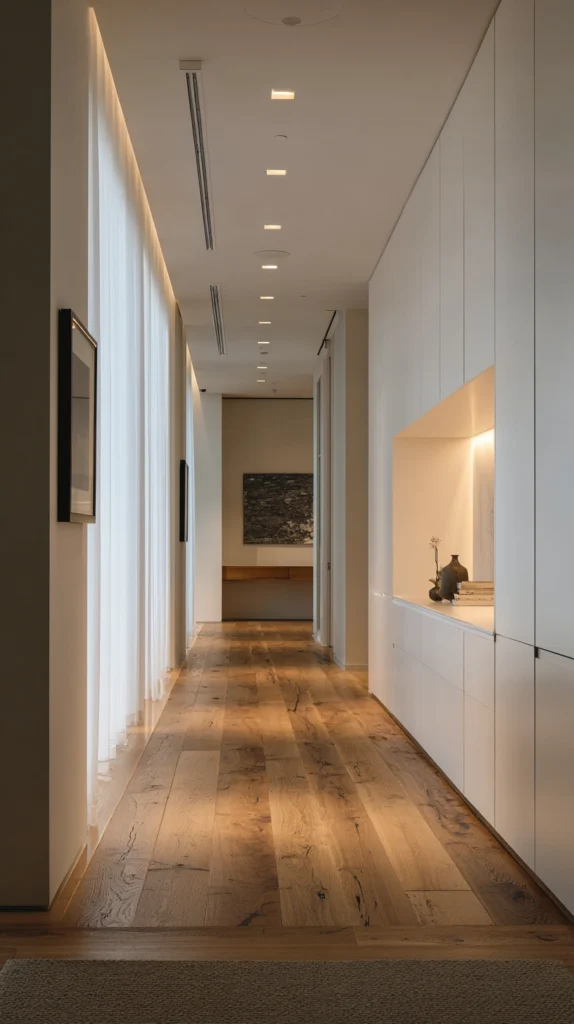
A narrow hallway that must also function as a storage space — for coats, shoes, bags, and the practical equipment of daily entry and exit — requires storage solutions that do not consume the hallway’s already limited width with the visual and physical bulk of freestanding furniture.
Built-in storage running floor to ceiling, its doors flush with the wall surface and finished in the same colour as the surrounding walls, creates storage capacity of genuine generosity while consuming no more visual width than a plain wall — because from the front, in its closed state, it essentially is a plain wall.
This approach requires more initial investment than freestanding furniture but delivers a hallway that functions as a complete storage solution while appearing entirely uncluttered — the storage is there in full, simply invisible until needed.
10. Introduce a Statement Light Fixture
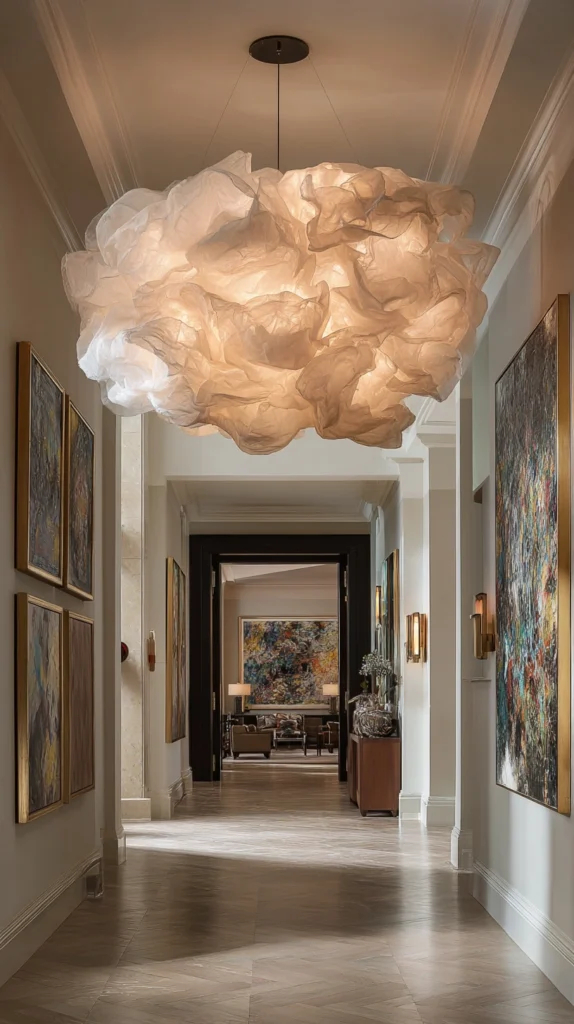
A hallway lit by a genuinely beautiful pendant light or chandelier — properly scaled to the hallway’s ceiling height, positioned at the spatial centre of the hallway’s length, and chosen for its sculptural quality as much as its functional illumination — immediately establishes the hallway as a space that was designed with genuine intention rather than treated as a leftover corridor between the rooms that matter.
The statement fixture works in a hallway because it occupies vertical rather than horizontal space, delivering significant visual presence without consuming any of the hallway’s precious floor width.
Choose a fixture that is elongated rather than wide — a lantern form, a linear pendant, a cluster of small pendants hung at varying heights — and position it low enough to be appreciated as an object rather than receding into the ceiling where it can barely be seen.
11. Create a Moment With Architectural Arches
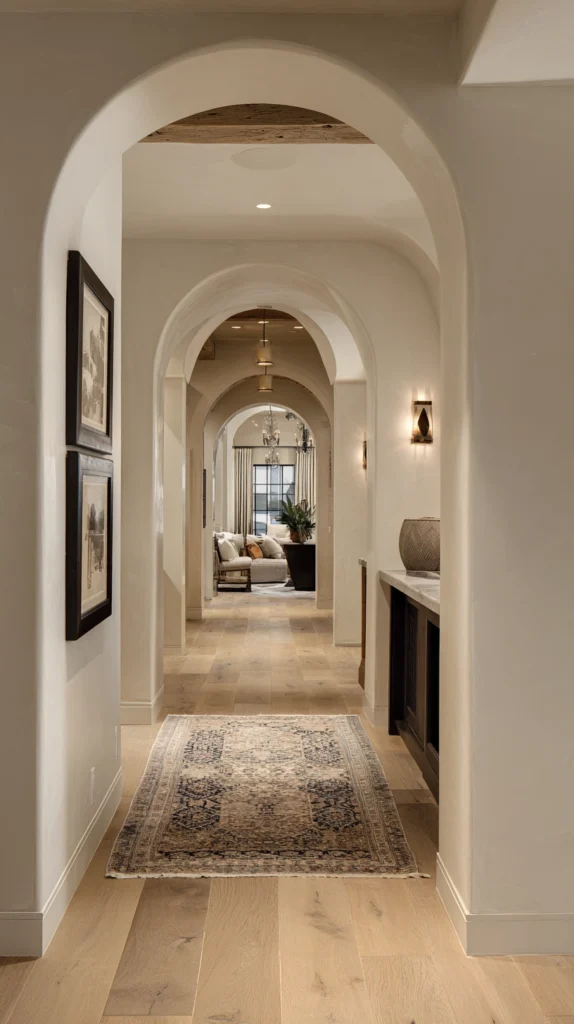
Converting a standard rectangular doorway at the end of a hallway into an arched opening — or installing a series of decorative arched frames at intervals along the hallway’s length, each one framing the view through to the next section of the passage — creates an architectural quality and a spatial drama that transforms the experience of moving through the hallway from a functional transit into something genuinely beautiful and genuinely theatrical.
The arch at the hallway’s terminus, glimpsed from the entrance, draws the eye forward and creates a sense of destination and arrival that a plain rectangular doorway never achieves.
Where structural arches are not feasible, a painted arch — applied directly to the wall surface at the hallway’s end or around a doorframe — achieves a significant proportion of the same visual effect at a fraction of the cost and the structural complexity.
12. Style the Floor as the Primary Decorative Surface
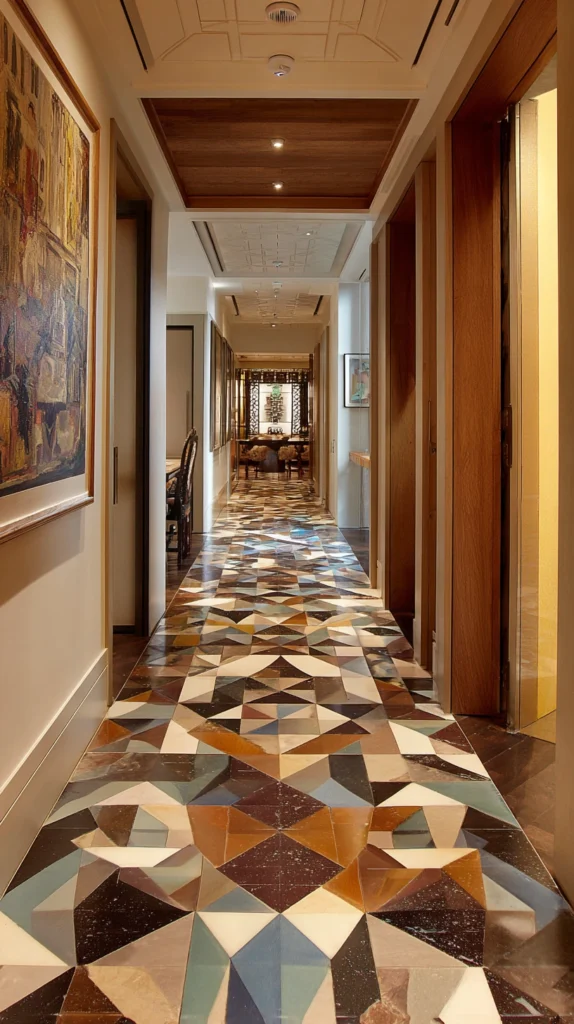
In a hallway so narrow that wall-mounted decoration and freestanding furniture are both difficult to accommodate without creating congestion, the floor becomes the primary decorative surface — the element that carries the most visual interest and expresses the most design personality in a space where every other surface is constrained.
A patterned tile floor — encaustic cement tile in a geometric pattern, Victorian-style black and white checkerboard, a bold contemporary graphic tile — treats the hallway floor as the equivalent of a statement rug in a room with adequate wall space, concentrating decorative investment at the one level where the narrow hallway’s proportions place no restrictions.
Choose a pattern with a scale and a colour palette that works with the hallway’s length — elongating patterns read better than those that emphasise width, and warm tones perform better than cool ones under the artificial lighting conditions that most hallways rely on.
13. Hang a Large Single Artwork as a Focal Point
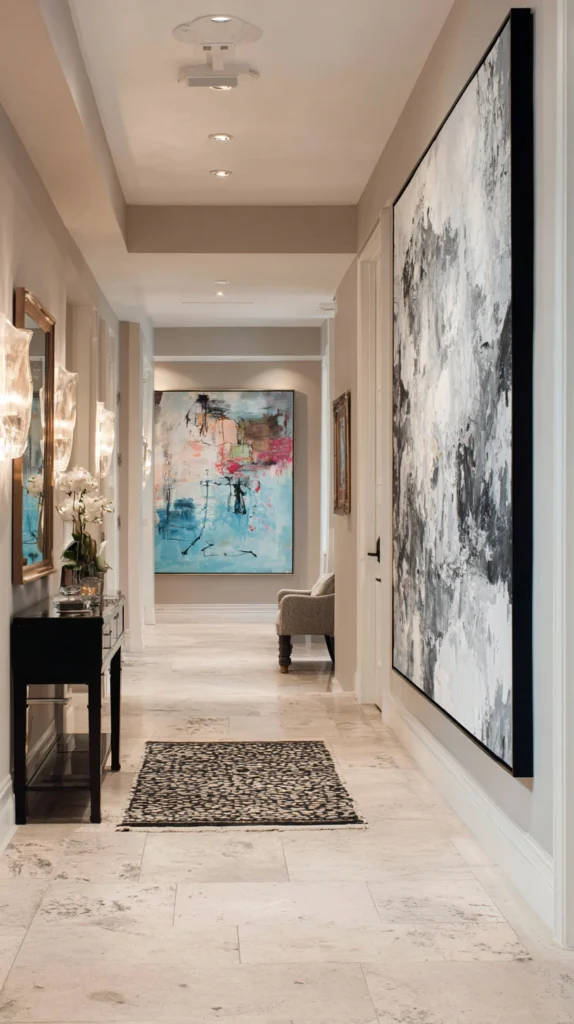
A single large artwork — a canvas, a print, a textile work, or a photographic image — hung at the hallway’s end wall or at its visual midpoint creates an immediate focal point that gives the eye a destination and gives the hallway a compositional centre that organises every other decorative element around it.
The large single artwork works in a narrow hallway because it occupies wall surface rather than floor space, delivering maximum visual impact at zero width cost, and because its scale creates the impression of a considered, gallery-quality display that a collection of smaller works arranged more tentatively rarely achieves.
Choose a work large enough to read clearly from the hallway’s entrance — a work that requires close inspection to appreciate is a work that will be passed rather than engaged with in a space designed for movement rather than lingering.
14. Use Collected Objects to Tell a Story Along the Hall
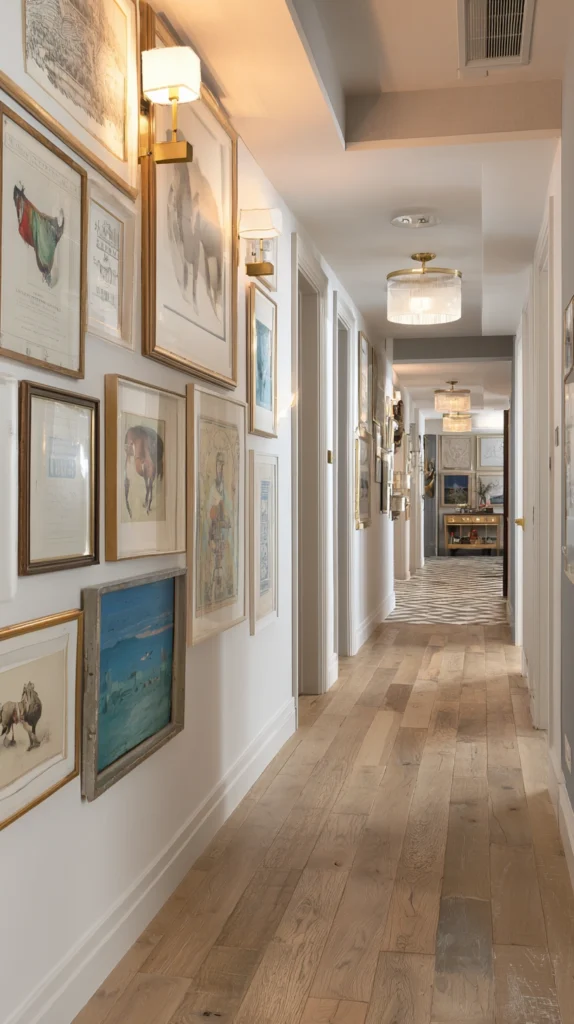
A hallway decorated with a collection of related objects — vintage maps of places that matter to the household, a series of framed botanical prints, a collection of antique mirrors in varying frames, a sequence of family photographs in consistent frames at consistent intervals — tells a coherent visual story along the hallway’s length that transforms it from a corridor into a narrative space of genuine personal character.
The collection approach works because it gives the long hallway’s wall surface a consistent decorative language that unifies the space without requiring a single large-scale intervention, and because the objects chosen reflect the genuine interests and genuine history of the people who live in the house rather than the generic decorative choices of a styled but impersonal interior.
Hang with consistent logic — the same spacing between objects, the same hanging height for the centre line — and allow the collection to evolve and accumulate over time rather than completing it in a single installation.
Final Thoughts: Designing the Hallway With the Confidence It Deserves
The awkward hallway that finally makes sense is the one approached with the same design ambition and the same material investment applied to the rooms it serves — not treated as a leftover space where second-choice decisions are acceptable simply because the space is transitional rather than occupational.
Choose one strong idea and execute it with complete commitment — the colour-drenched walls, the full-length gallery, the built-in storage that disappears, the statement floor. The hallway that is half-decorated, where one good idea has been partially implemented and abandoned before completion, is worse than the hallway left entirely alone.
Commit fully, finish completely, and the awkward hallway becomes the space that makes every visitor understand, from the first moment of arrival, that this is a home where every detail was considered and every space was cared for — including the ones that nobody else bothers with.