
12 Bathroom Shelf Styling Ideas for Function and Flair
Our bathroom shelf used to hold whatever landed there first, half-empty bottles facing every direction.
It wasn’t storage, it was just a place things piled up until someone got annoyed enough to clear it.
I finally sat down one Saturday and actually styled it, the way I would a bookshelf in the living room.
Twenty minutes later it looked like something out of a hotel, and it’s stayed that way since.
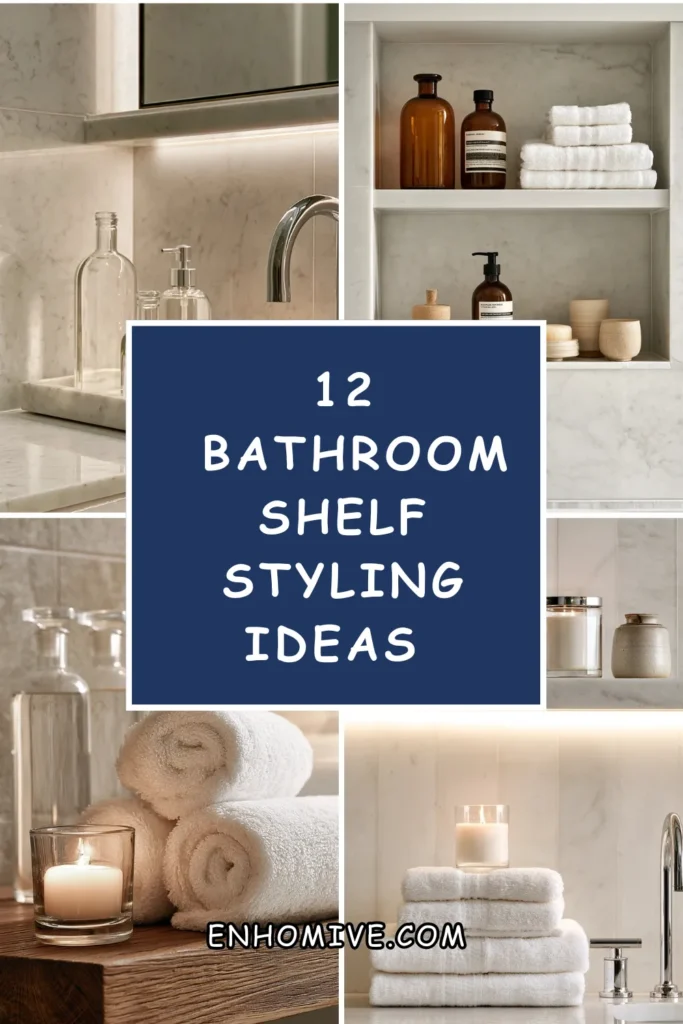
Here are 12 ways to make a bathroom shelf work as hard visually as it does practically.
Why bathroom shelves need actual styling, not just storage
A shelf in a bathroom gets seen constantly, morning and night, by everyone in the house.
- It’s one of the few surfaces guests actually look at closely while washing their hands
- Clutter here reads instantly, since bathrooms have so little other furniture to distract from it
- A styled shelf takes the same effort as an unstyled one, just with more intention
Once you treat it as a display, not a dumping ground, the whole room feels more finished.
1. Group Items in Odd Numbers
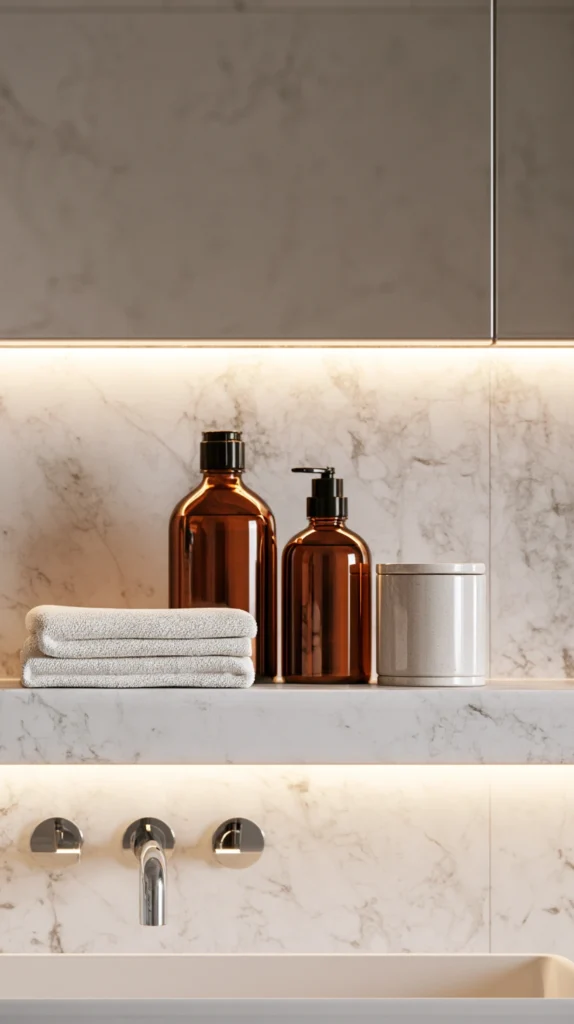
The simplest styling rule, borrowed directly from interior design basics.
How to apply it:
- Cluster three or five items together rather than two or four
- Vary the heights within each group, tallest in back, shortest in front
- Leave visible negative space between groupings rather than filling the whole shelf edge to edge
Why odd numbers read as more intentional:
- Even-numbered groupings tend to look accidentally symmetrical rather than deliberately arranged
- The human eye naturally finds asymmetrical odd groupings more visually interesting
- It’s the fastest styling fix if your shelf currently just has everything lined up in a row
Cost breakdown: Free, this is purely a rearranging exercise with what you already own.
2. Decant Products Into Matching Glass Bottles
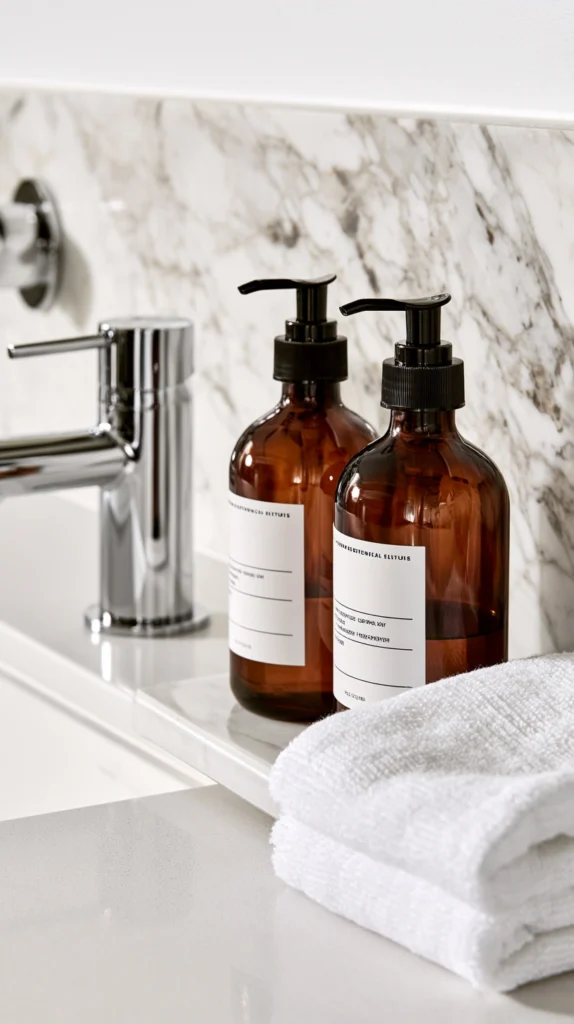
Uniform vessels instead of mismatched plastic packaging.
Build it:
- Amber or clear glass pump bottles for shampoo, conditioner, and body wash
- Small handwritten or printed labels, or none at all if the products are easy to tell apart by scent or color
- A funnel kept in a drawer nearby to make refilling simple when bottles run low
Why decanting changes the whole shelf’s feel:
- Branded plastic bottles are the single biggest giveaway of an unstyled bathroom shelf
- Matching glass immediately reads as spa-like, regardless of what’s actually inside
- It also tends to reduce actual product waste, since glass bottles rarely get tossed half-full by mistake
Cost breakdown: Glass pump bottles run $8 to $15 each, typically needing three to four for a full shelf refresh.
3. Add One Living Plant
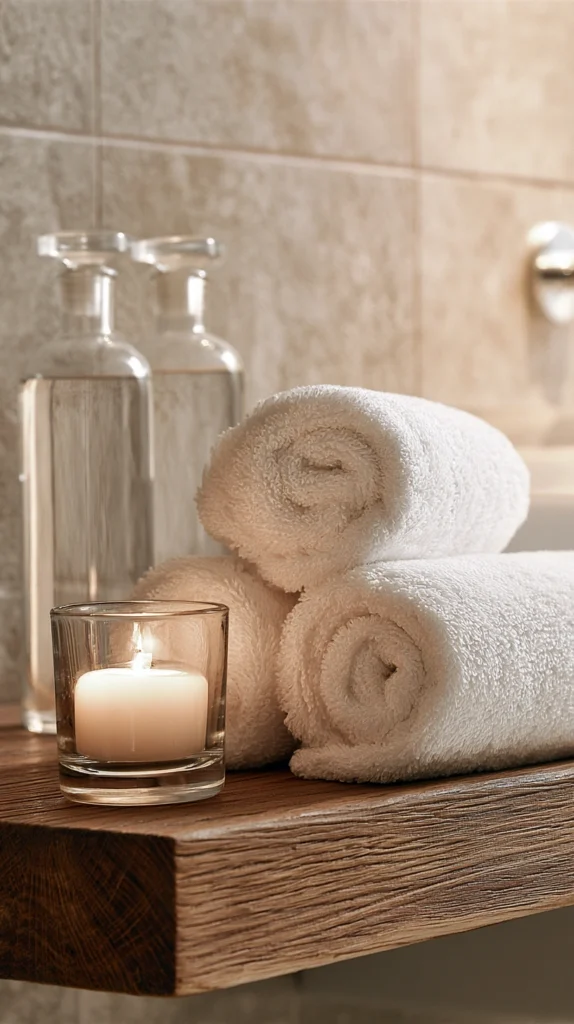
A single plant does more than any other single object on the shelf.
What to look for:
- Low-light, high-humidity tolerant plants like pothos, snake plants, or ZZ plants
- A small pot sized proportionally to the shelf, not one that overwhelms the other items
- Positioned at one end of the shelf rather than dead center, to balance an asymmetrical layout
Why a single plant outperforms multiple decorative objects:
- It brings in the only living, changing element on an otherwise static shelf
- Bathroom humidity often suits these specific plants better than any other room in the house
- It softens what can otherwise be an entirely hard-surfaced, glass-and-tile styled space
Cost breakdown: Small potted plants suited to bathroom conditions run $10 to $25 depending on variety and pot size.
4. Stack Folded Towels as a Styling Element
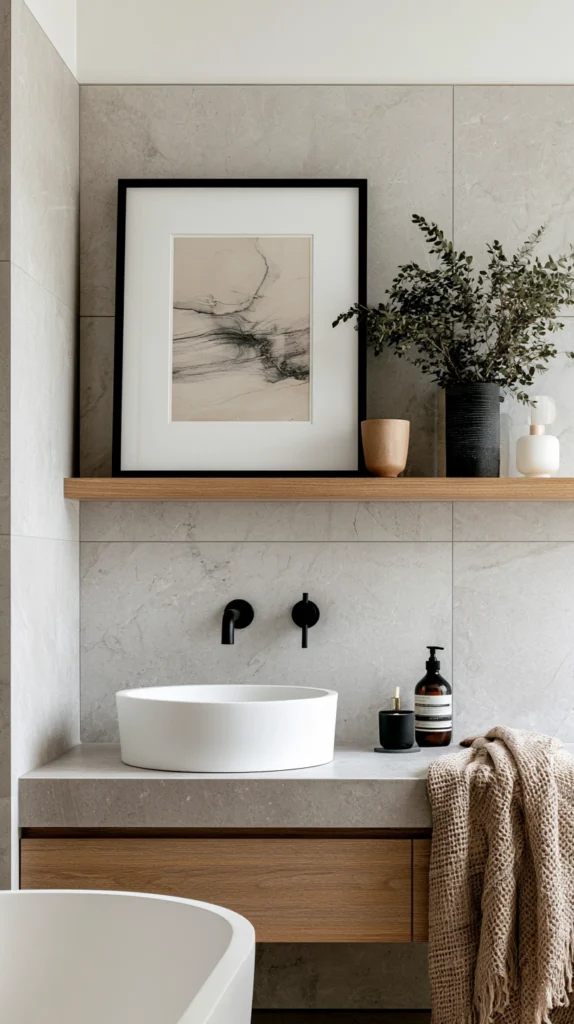
Towels doing double duty as both function and display.
How to style them:
- Roll rather than fold for a spa-like appearance, stacked two or three high
- Choose towels in a single tone or two complementary tones rather than a mismatched collection
- Reserve the styled stack for display only, keeping a separate set for actual daily use in a drawer
Why rolled towels read as more boutique than folded ones:
- Rolling shows more of the towel’s texture and color at once than a flat fold does
- A single-tone stack looks considerably more expensive than it actually costs
- It fills shelf volume efficiently, which helps balance out smaller decorative objects nearby
Cost breakdown: A matching towel set suited for display runs $30 to $60 depending on material quality.
5. Introduce a Woven Basket for Concealed Clutter
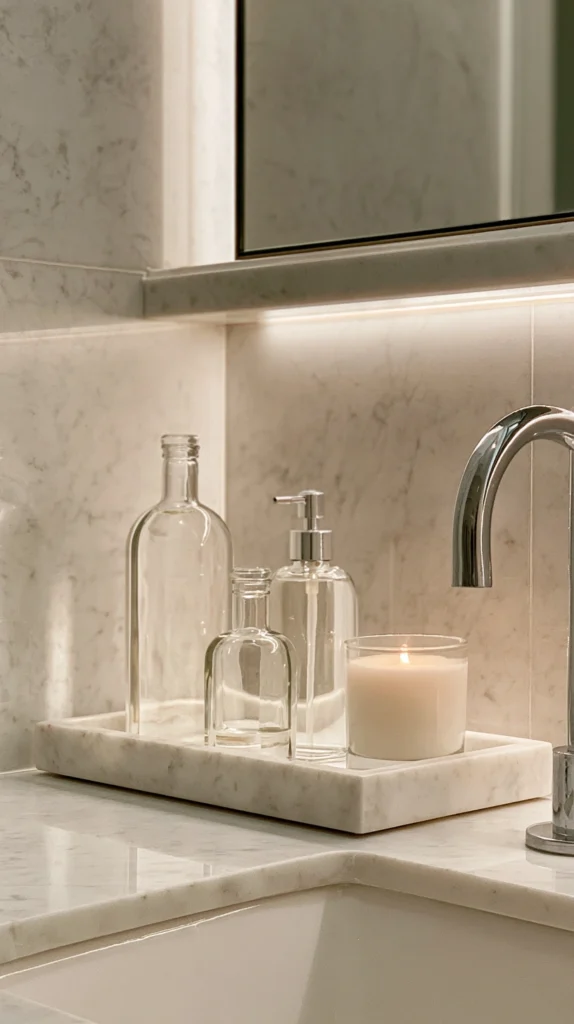
Not everything on a shelf needs to be seen.
What to look for:
- A small woven seagrass or rattan basket, sized to tuck into one section of the shelf
- Used specifically for items that don’t photograph well, like cotton swabs, hair ties, or daily medications
- One basket per shelf section rather than several scattered ones
Why a single basket solves more than it hides:
- It gives genuinely necessary clutter somewhere to live without it sitting in full view
- The woven texture adds visual interest of its own, similar to the wood or glass elsewhere
- It keeps the actual daily-use items easy to grab without digging through a drawer
Cost breakdown: Small woven baskets run $10 to $20 depending on size and material.
6. Layer in a Small Piece of Art or a Framed Print
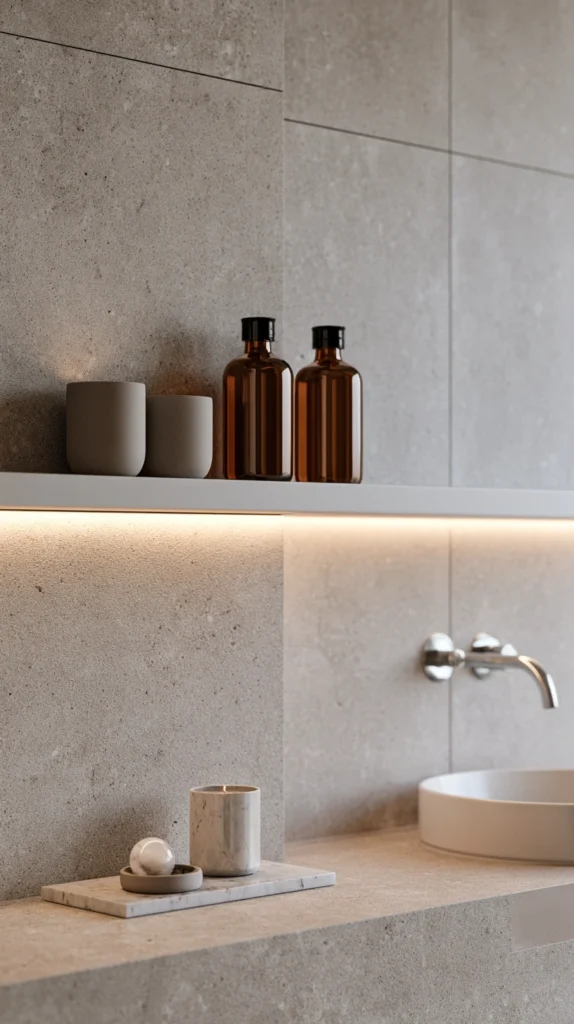
Vertical interest above the shelf itself.
How to do it:
- A small framed print leaned against the wall behind the shelf rather than hung above it
- Choose a piece with a color palette that echoes the towels or bottles already on display
- Keep the frame slim and simple, since a bathroom shelf can’t support a heavy statement frame safely
Why leaning art works better than hanging it here:
- It’s easier to adjust or swap seasonally without patching wall holes
- The leaned angle adds depth to a shelf that would otherwise be entirely flat-fronted
- A humid room is easier on artwork protected behind glass, which most small framed prints already have
Cost breakdown: Small framed prints run $15 to $40 depending on size and framing.
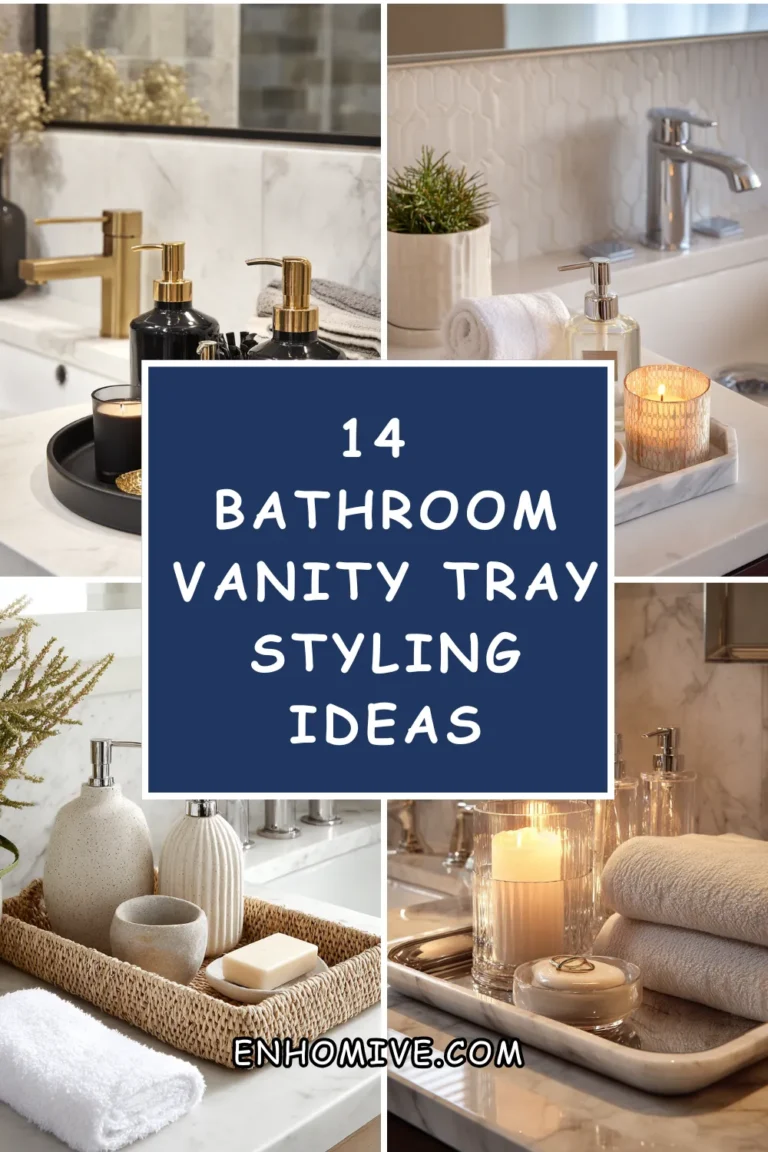
7. Use a Tray to Define a Zone Within the Shelf
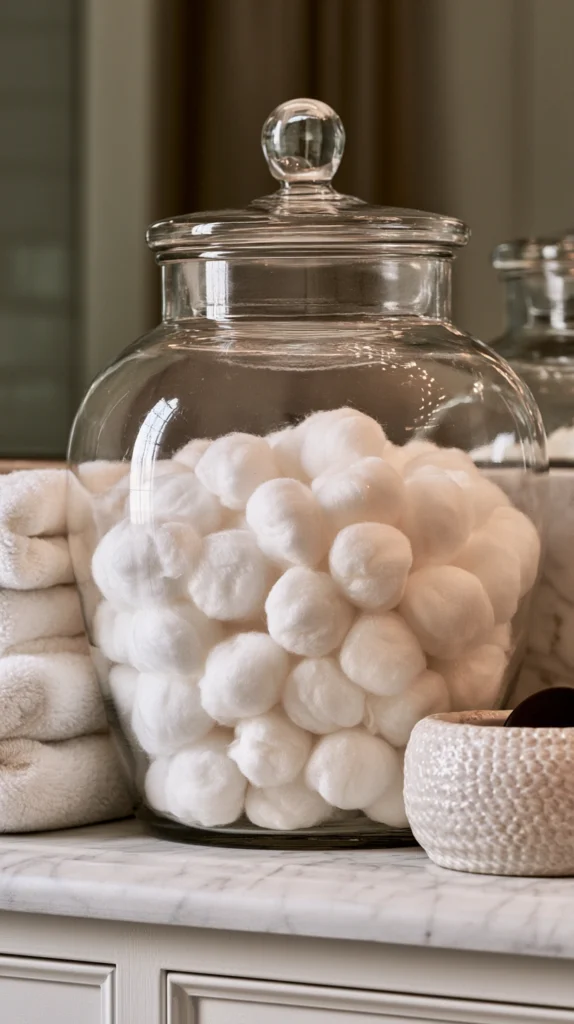
Boundaries that keep grouped items from drifting apart.
Build it:
- A small wood, marble, or metal tray sized to hold three to four items together
- Positioned at one end of the shelf, leaving the rest of the surface for other groupings
- Filled with items that get used daily, since a tray also makes it easy to lift the whole group down for actual use
Why a tray earns its spot on an already busy shelf:
- It visually contains a grouping that would otherwise look scattered
- It doubles as function, letting you carry several items to the sink at once
- The material choice adds one more texture to the overall styled look
Cost breakdown: Small trays run $12 to $30 depending on material.
8. Mix Matte and Glossy Textures Intentionally
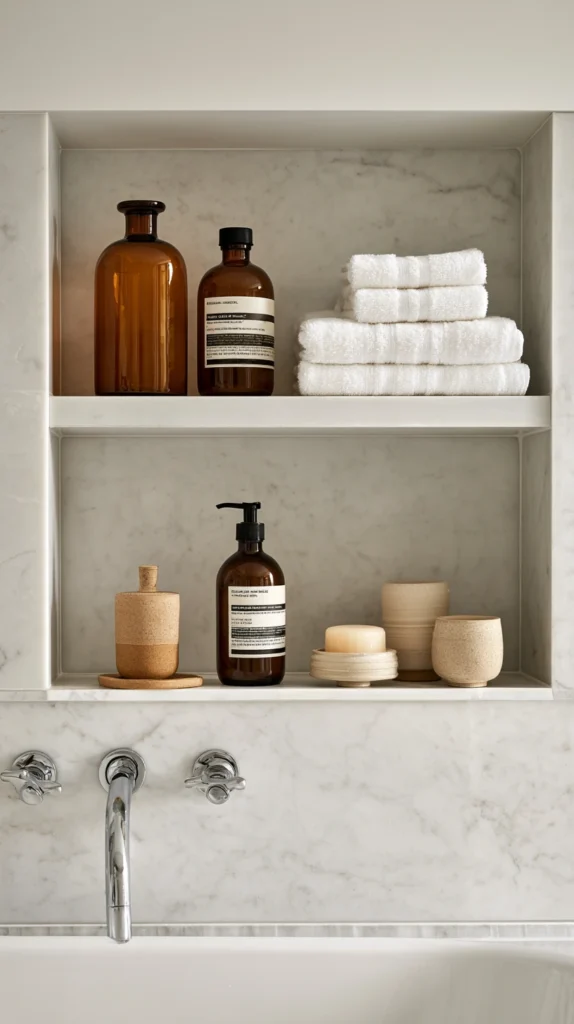
Contrast that keeps a shelf from looking flat.
How to apply it:
- Pair a matte ceramic vessel with a glossy glass bottle rather than choosing all one finish
- Add a woven basket’s rough texture next to a smooth marble tray
- Avoid an entire shelf of the same material, which tends to look monotonous rather than curated
Why texture variety matters as much as color coordination:
- A shelf that’s all one finish, however nice, reads as flat under bathroom lighting
- Contrast between matte and glossy catches the eye in a way uniform materials don’t
- It’s a free styling principle, requiring no new purchases if you already own a mix of finishes
Cost breakdown: Free, assuming a mix of finishes already exists somewhere in the house to pull from.
9. Anchor the Shelf With One Larger Statement Object
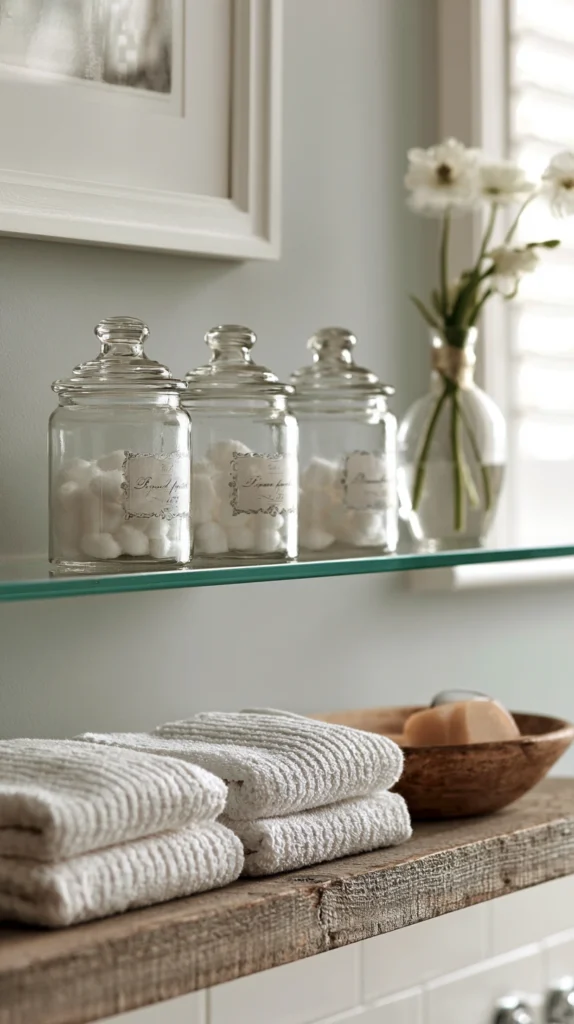
A single piece that gives the whole arrangement scale.
What works:
- A taller glass apothecary jar filled with cotton balls or bath salts
- A single larger candle in a substantial glass or ceramic holder
- A small vase with one or two stems of eucalyptus or dried pampas grass
Why every styled shelf needs one larger piece:
- Without a taller anchor, a shelf of similarly sized small objects can look cluttered rather than curated
- The larger piece gives the eye somewhere to land first before taking in the smaller details
- It should be positioned toward the back or one end, letting smaller items step down in height toward the front
Cost breakdown: A single statement jar, candle, or vase runs $15 to $35 depending on size and material.
10. Rotate Seasonal Accents Instead of Buying New Pieces
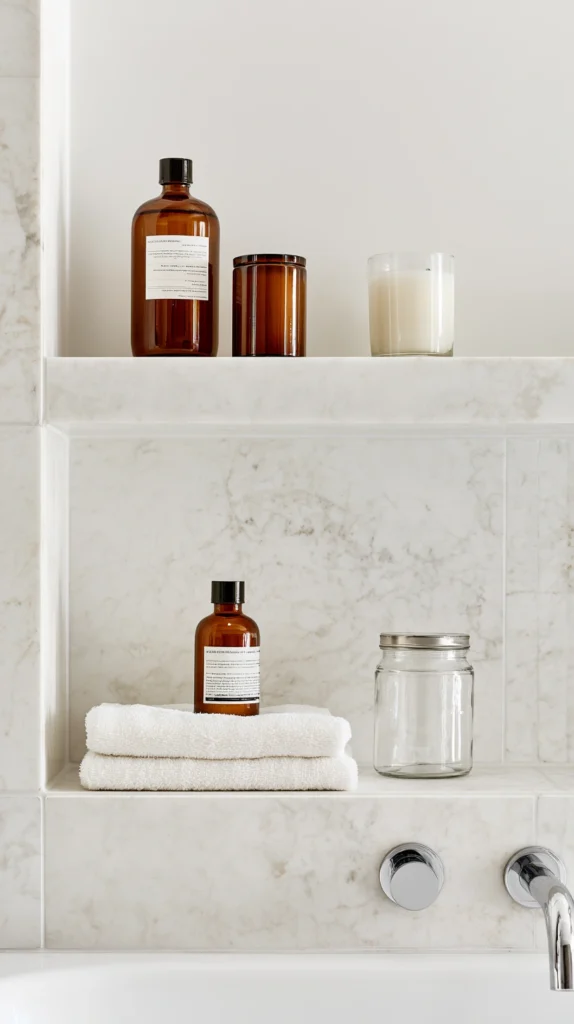
Keeping the shelf feeling fresh without constant new purchases.
How to build a rotation:
- A small box or bin stored elsewhere in the house with seasonal add-ins, like a small pumpkin in fall or a sprig of eucalyptus in winter
- Swap just one or two accent pieces each season rather than restyling the entire shelf
- Keep the core pieces, like the glass bottles and towels, constant year-round
Why rotating beats a full seasonal overhaul:
- It keeps the shelf feeling considered and current without a real ongoing budget
- The core styled elements stay consistent, so the room never loses its established look
- It takes minutes rather than a full afternoon each time the season changes
Cost breakdown: Seasonal accent pieces run $5 to $15 each if bought new, or free if pulled from decor already owned elsewhere in the house.
11. Use Labeled Apothecary Jars for Daily Essentials
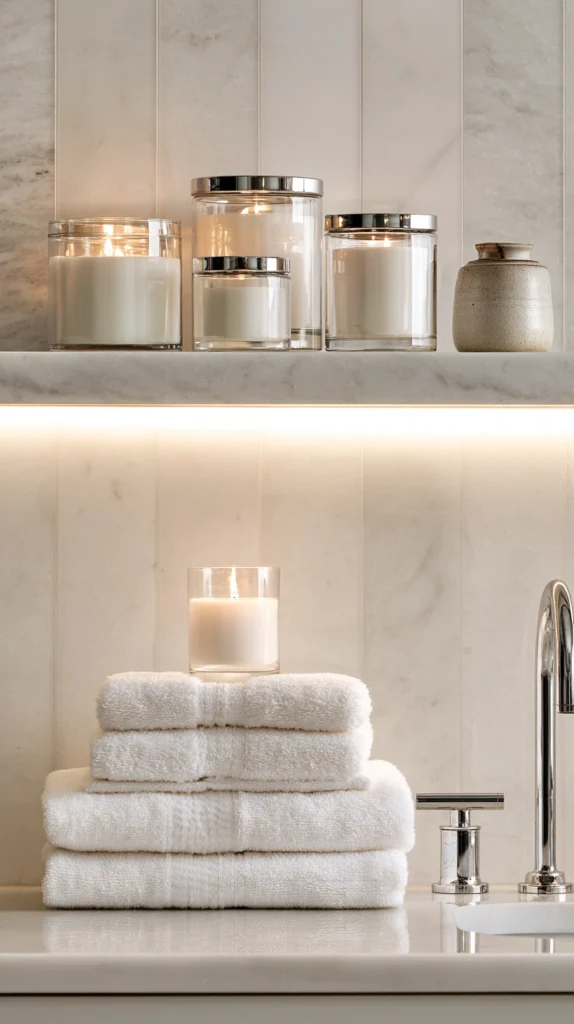
Function elevated to match the rest of the display.
Build it:
- Clear or amber glass jars with metal or cork lids for cotton balls, bath salts, or hair pins
- Simple engraved or printed labels rather than handwritten ones for a more polished look
- Grouped together rather than scattered individually across the shelf
Why labeled jars outperform their plastic packaging equivalents:
- Everyday essentials become part of the display instead of visual clutter to work around
- Glass shows the product itself, which often has its own appealing texture or color
- The uniform jar shape ties a grouping together even when the contents differ
Cost breakdown: A set of three to four labeled apothecary jars runs $20 to $40.
12. Leave Deliberate Negative Space
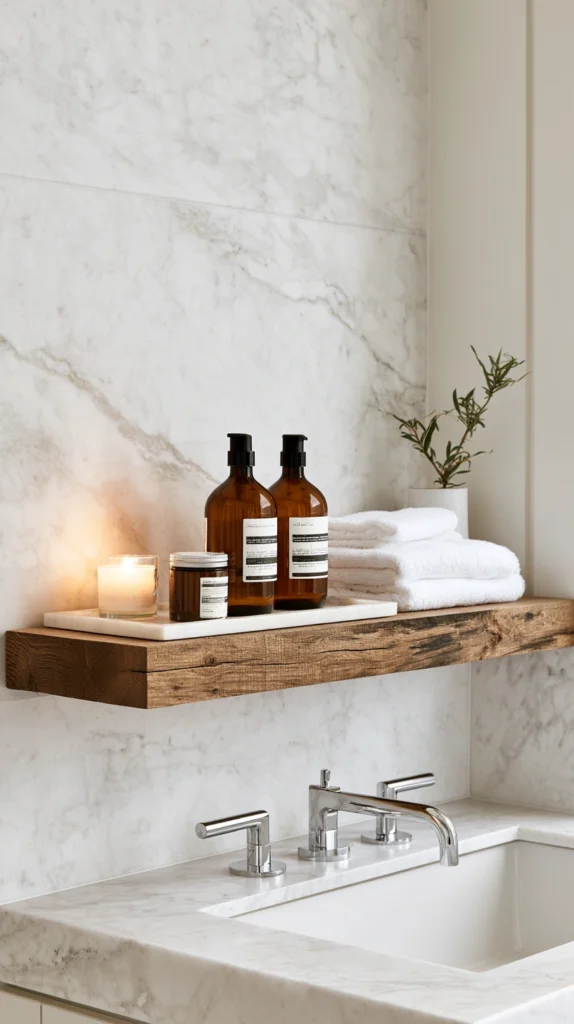
The styling choice that costs nothing and matters the most.
How to apply it:
- Resist the urge to fill every inch of shelf surface with an object
- Aim for roughly a third of the shelf to remain visibly empty at any given time
- Use negative space between groupings rather than only at the shelf’s outer edges
Why empty space is doing real design work:
- A completely filled shelf reads as cluttered no matter how nicely each individual item is styled
- Negative space gives the eye a place to rest between groupings
- It’s the difference between a shelf that looks curated and one that just looks full
Cost breakdown: Free, and arguably the easiest fix of all twelve ideas here.
Getting started this weekend
You don’t need new products to see a difference by tonight.
- Start by clearing the shelf completely and only putting back what you actually use daily
- Group what’s left in odd numbers before adding a single plant or larger anchor piece
- Save decanting into glass bottles and adding art for a second pass once the basic layout feels right
My own shelf went from cluttered to styled in one evening, almost entirely just by rearranging what I already owned.
Budget reality
Most of this styling comes from arrangement, not spending.
- Free: Grouping in odd numbers, mixing textures, leaving negative space
- Under $25: Small plant, woven basket, single tray
- $25-60: Decanted glass bottles, matching towel set, framed print
- $60+: A full refresh across bottles, jars, tray, and towels all at once
Most of the visible transformation happens well before the highest spending tier.
What actually makes a shelf feel styled
It was never really about buying the perfect matching set of anything.
It’s the odd-numbered grouping, the one plant that softens the hard surfaces, the empty inch of space left on purpose instead of filled out of habit.
Clear the shelf down to what you actually use, then build back up slowly from there.