
15 Coffee Cart Styling Ideas for a Cozy Home Café
The coffee cart changed my actual morning more than any other single furniture purchase in the house. Not the espresso machine upgrade. Not the fancier beans. Not the new mugs or the better grinder or the reorganized kitchen cabinet.
The dedicated spot.
Because giving coffee its own small, considered station did something scattered kitchen counter clutter never managed. Before it: a coffee maker crowding the kitchen counter alongside everything else, mugs in a cabinet across the room, sugar and syrups tucked wherever there was space, the whole morning routine feeling like a small daily scavenger hunt. After it: everything in one place, styled with actual care, the morning coffee ritual becoming something closer to a small, genuine pleasure rather than a rushed chore.
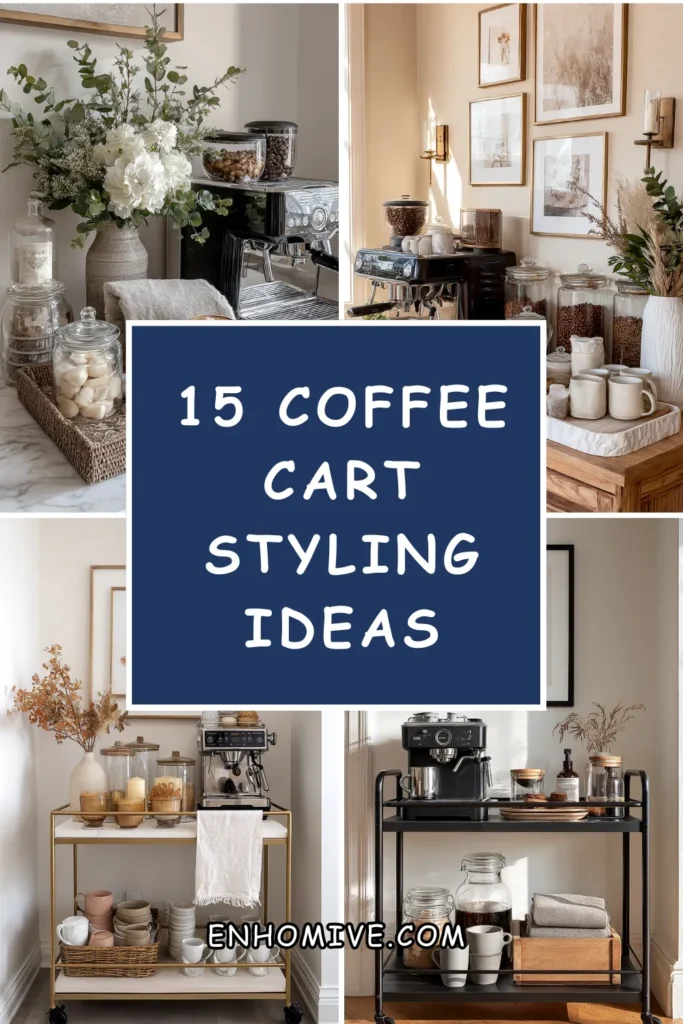
A coffee cart is not simply moving the coffee maker to a different piece of furniture. It is a small, contained design opportunity, borrowing the same considered styling principles used on any other well-composed surface and applying them to the one corner of the house responsible for how nearly every morning actually begins. The cart: no longer just storage for coffee supplies, but a small daily ritual made physical.
Here are 15 coffee cart styling ideas for a cozy home café — from the simplest tray setup to the most fully realized dedicated station — built on that understanding.
Why a Dedicated Coffee Station Changes the Whole Morning Routine
The ritual concentration principle
Consolidating every coffee-related item into one specific, well-organized spot removes the small daily friction of gathering mugs, beans, and syrups from separate locations, turning a scattered task into a single, considered stop.
The styling opportunity most kitchens overlook
Without a dedicated station:
The coffee maker crowding the main kitchen counter among other appliances, mugs stored separately, syrups and sugar tucked into a pantry shelf.
The routine: functional, but visually and physically scattered, with no specific spot inviting any actual styling attention.
With a dedicated station:
Everything gathered onto one cart or console, styled with the same height variation and material consideration given to any other well-composed display.
The routine: concentrated into one small, attractive spot, the daily ritual itself becoming something the household actually looks forward to.
The counter-clearing benefit
Moving coffee equipment off the main kitchen counter onto its own dedicated cart also frees the primary counter for cooking prep, addressing a genuine kitchen function alongside the purely aesthetic improvement.
The small-space adaptability
A coffee cart requires only a modest footprint — a narrow bar cart, a small console, or even a single tray on an existing surface — making this one of the more achievable styling projects regardless of a kitchen’s actual size.
The Five Elements of a Well-Styled Coffee Cart
Before styling any specific station:
The base furniture
A cart, console, or tray, chosen for scale and material appropriate to the available space.
The foundational decision every other element builds upon.
Ranges from a simple tray to a full furniture piece.
The equipment
The coffee maker, grinder, and kettle, positioned for genuine daily function.
The station’s core practical purpose.
Worth arranging for actual ease of use, not just visual appeal.
The vessels and glassware
Mugs, cups, and glasses, displayed openly rather than hidden in a separate cabinet.
Adds genuine visual interest through variety and material.
Keeps daily-use items within easy reach.
The supplies and syrups
Sugar, creamer, and flavor syrups, decanted into attractive containers.
Elevates ordinary pantry items into part of the station’s overall styling.
Requires ongoing refilling and upkeep to remain genuinely functional.
The finishing details
A small plant, a tray, or a piece of art, adding personality beyond pure function.
The detail most responsible for the station feeling like a considered vignette rather than mere storage.
Kept restrained, following the same less-is-more principle relevant to any small styled display.
1. The Classic Bar Cart Coffee Station
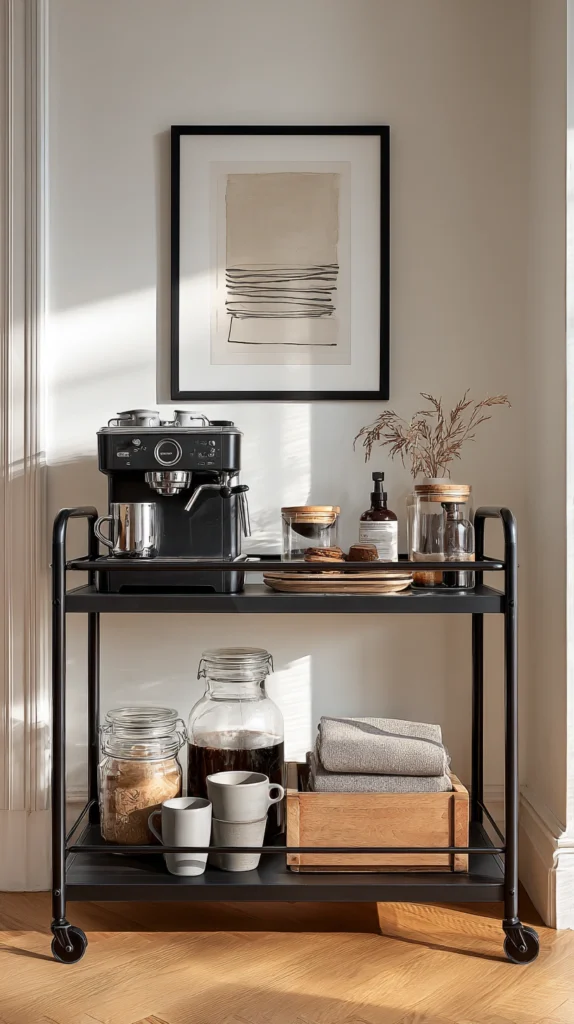
A narrow, wheeled bar cart repurposed entirely for coffee service, holding the coffee maker on one tier and mugs, supplies, and styling objects on another.
Why a bar cart suits a coffee station as naturally as it suits a drinks setup
A bar cart’s narrow footprint and tiered structure, designed originally for beverage service, translates directly and effectively to a coffee station’s similar functional needs.
The cart selection
A metal or mixed-material bar cart, with two tiers providing enough surface area for both the coffee maker and the surrounding mugs and supplies.
The tier organization
The coffee maker and kettle on the lower, sturdier tier, with mugs, a small sugar bowl, and creamer positioned on the upper tier for easy visual access and reach.
The mobility benefit
The cart’s wheels allowing it to be repositioned — rolled closer to an outlet, moved for a gathering, or relocated entirely if the kitchen layout changes — offering more flexibility than a fixed console.
The styling extras
A small plant or a piece of art leaned against the cart’s back rail, adding a personal touch beyond the purely functional coffee equipment.
The overall effect
A genuine, dedicated coffee station achieved through a piece of furniture already well suited to exactly this kind of tiered, mobile beverage service.
Cost breakdown: Bar cart: $80–200 Mugs and supplies (if new): $30–70 Total: $110–270
2. The Console Table Built-In Station
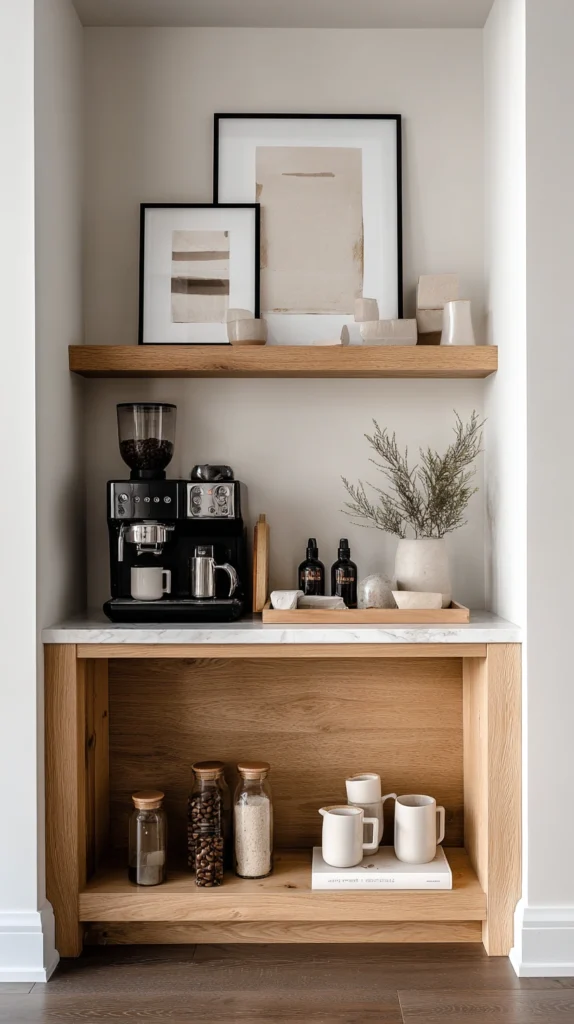
A small console table, positioned against a kitchen or dining room wall, styled as a permanent, more substantial coffee station than a mobile cart provides.
Why a console suits a household wanting a more fixed, furniture-grade station
Where a cart offers mobility, a console table provides a more substantial, permanent presence, often with more surface area and sometimes drawer storage, suited to a household with a specific dedicated spot for the station rather than needing it to move.
The console selection
A narrow console table, sized to fit the available wall space, in a material and finish complementing the kitchen or dining room’s existing furniture.
The surface organization
The coffee maker and grinder positioned toward one end, with mugs, syrups, and a small tray of sweeteners arranged toward the other, creating a clear left-to-right or functional flow across the console’s surface.
The drawer storage
Any console drawers used for less visually appealing supplies — extra filters, spare pods, cleaning supplies — keeping the visible surface reserved for the station’s more attractive, everyday elements.
The wall styling
A small piece of art or a floating shelf above the console, extending the station’s visual presence vertically rather than confining all the interest to the surface alone.
The overall effect
A more substantial, furniture-grade coffee station suited to a household with a specific dedicated wall or corner to commit to this function permanently.
Cost breakdown: Console table: $150–400 Mugs and supplies: $30–70 Total: $180–470
3. The Open Shelf Coffee Bar
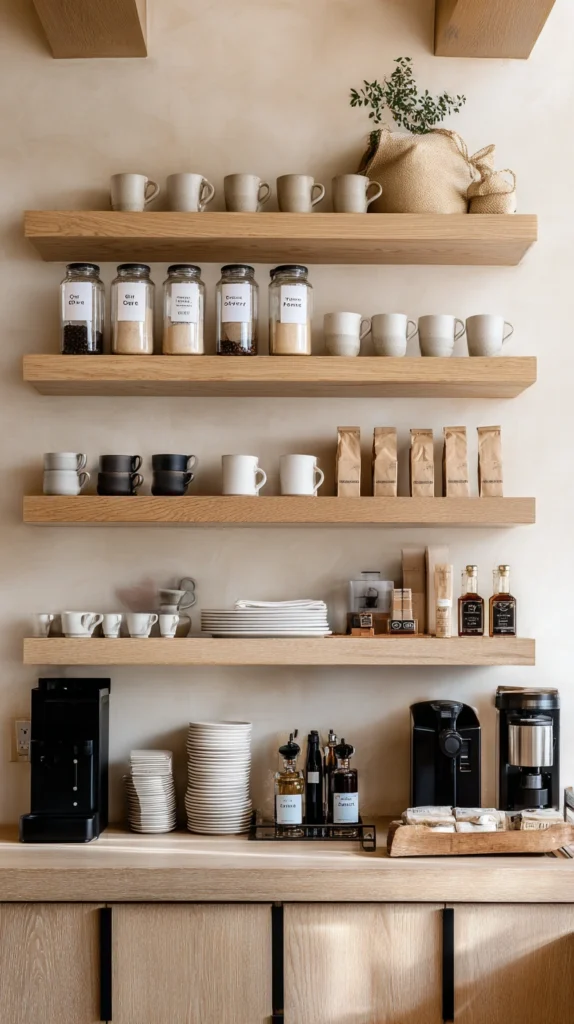
Wall-mounted open shelving above a small counter or cart, displaying mugs, glass jars of coffee and tea, and syrups as an open, visually accessible display.
Why open shelving suits a coffee station particularly well
Coffee equipment and vessels are used daily and benefit from genuine visual accessibility, making open shelving — rather than closed cabinets — a natural fit for a station meant to be used constantly rather than occasionally.
The shelving
Simple wood or metal open shelves, mounted above a small counter, cart, or narrow console, providing vertical display space beyond the surface below.
The mug display
Mugs hung from small hooks beneath a shelf, or arranged upright on the shelf itself, chosen for a mix of styles and colors that adds genuine visual interest rather than a uniform matched set.
The glass jar storage
Coffee beans, tea, and sugar stored in clear glass jars with wood or cork lids, both keeping supplies fresh and adding a considered, visually appealing storage layer to the display.
The styling objects
A small plant or a single piece of art positioned among the shelves, breaking up the purely functional items with one point of purely decorative interest.
The overall effect
A station with genuine vertical presence and visual richness, the open shelving inviting daily use through its accessibility while also serving as an attractive, considered display.
Cost breakdown: Open shelving: $40–100 Glass jars and mugs: $30–70 Total: $70–170
4. The Vintage Tray and Small Table Setup
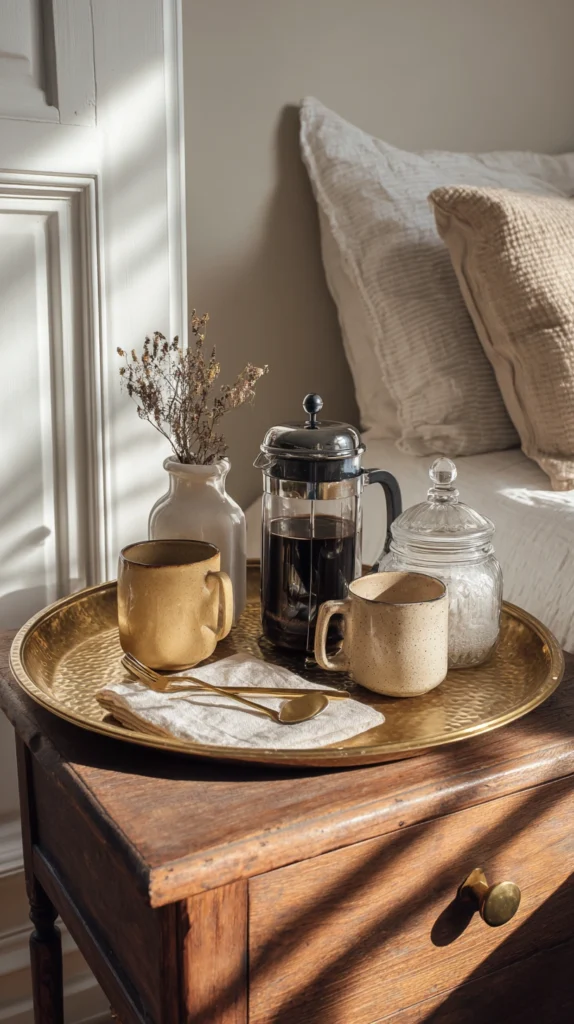
A simple vintage or antique tray, holding the coffee essentials, placed atop an existing small side table or counter corner, for the lowest-cost, most immediately achievable station.
Why a tray alone can create a genuine dedicated station without any new furniture
Similar to the containment principle relevant to a bathroom vanity tray, a single well-chosen tray corrals coffee items into one defined, visually cohesive zone even without any new furniture purchase, using whatever surface is already available.
The tray
A vintage or vintage-style tray, in wood, metal, or a mixed material, sized to hold the coffee maker or a French press alongside one or two mugs and a small container of sugar.
The existing surface
Positioned on an already-existing counter corner, small side table, or shelf, requiring no new furniture investment at all.
The contained styling
Everything needed for a single coffee service contained within the tray’s boundary, creating the same sense of intentional grouping a tray provides on any other surface.
The portability
The tray liftable and movable as needed, whether to bring the whole setup to a different room or simply to clean the surface beneath it easily.
The overall effect
A genuine, considered coffee station achieved with minimal cost and no new furniture, proving the concept scales down as effectively as it scales up.
Cost breakdown: Vintage or vintage-style tray: $15–40 Total: $15–40
5. The Built-In Cabinet Nook Station
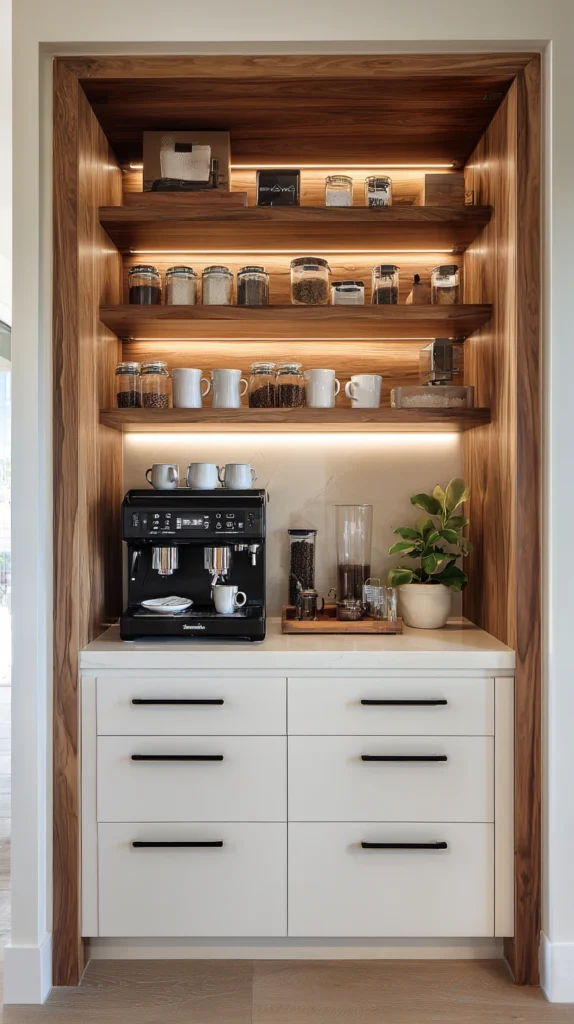
An existing kitchen cabinet or a section of built-in cabinetry converted specifically into a coffee station, with the coffee maker and supplies housed within a dedicated nook.
Why converting existing cabinetry suits a kitchen without room for additional furniture
Not every kitchen has floor space for an additional cart or console. Repurposing a section of existing cabinetry into a specifically designated coffee nook achieves the same concentration and organization without requiring any new furniture footprint.
The cabinet section
A section of upper or lower cabinetry, or a corner nook, cleared out and specifically designated for coffee equipment and supplies rather than general kitchen storage.
The interior organization
Coffee maker, mugs, and supplies arranged within the designated section using the same height-variation and grouping principles relevant to any well-organized shelving display, even within a closed cabinet.
The open-door display option
Cabinet doors removed entirely from the designated section, converting what was closed storage into an open, visually accessible display similar to open shelving, if the household prefers that more visible approach.
The counter integration
If the designated cabinet sits above or beside an existing counter section, that counter surface used specifically for the coffee maker itself, with the cabinet above or beside it holding mugs and supplies.
The overall effect
A dedicated coffee station achieved entirely within the kitchen’s existing footprint, requiring no new furniture and no additional floor space.
Cost breakdown: No new furniture cost — reorganization of existing cabinetry Optional door removal and finishing: $30–80 Total: $0–80
6. The Copper and Warm Metal Accent Station
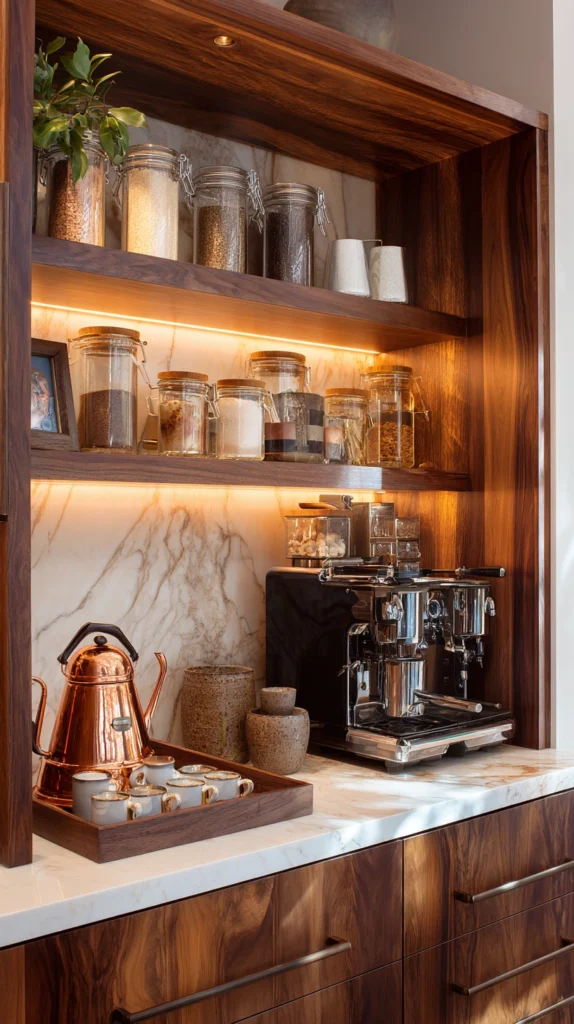
A coffee station styled specifically around copper and warm metal accents — a copper kettle, brass canisters, copper-toned mug hooks — for a warm, rich material palette.
Why copper and warm metals suit a coffee station’s specific daily ritual
Copper’s warm, reflective quality pairs naturally with the ritual and warmth associated with coffee itself, creating a station that feels rich and considered through material choice alone.
The kettle or coffee equipment
A copper or copper-toned kettle, chosen both for genuine function and for the warm material tone it introduces to the station’s overall palette.
The canisters
Brass or copper-lidded glass canisters for coffee and sugar, continuing the warm metal theme throughout the station’s storage vessels.
The hooks and hardware
Copper or brass mug hooks, if using open shelving, tying the metal accent theme into even the smallest functional details.
The surrounding materials
Warm wood surfaces and neutral, earthy tones elsewhere in the station, allowing the copper and brass accents to stand out clearly against a complementary rather than competing backdrop.
The overall effect
A station with genuine material richness and warmth, the copper and brass accents elevating ordinary coffee equipment into a considered, cohesive display.
Cost breakdown: Copper kettle: $30–70 Brass or copper canisters: $25–60 Copper hooks: $10–20 Total: $65–150
7. The Minimalist White and Wood Station
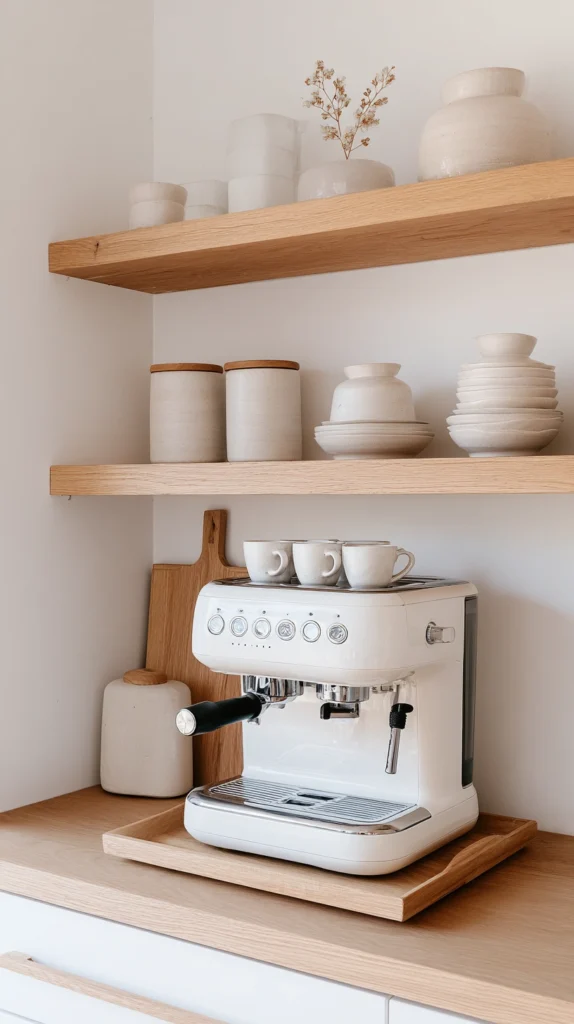
A coffee station styled in a restrained white and natural wood palette, keeping the display clean and uncluttered rather than densely styled.
Why a minimalist approach suits a household preferring restraint over abundance
Not every coffee station needs to be densely layered with objects. A tightly restricted white and wood palette, with genuine negative space, can read as equally considered through restraint rather than through quantity of items.
The base materials
A simple wood cart or shelf, paired with white ceramic mugs and canisters, restricting the palette to just these two material and color families.
The equipment
A coffee maker in white or a neutral finish, chosen specifically to blend into rather than stand out from the restrained overall palette.
The negative space
Genuine empty space maintained across the station’s surface, rather than filling every available inch, consistent with the same restraint principle relevant to any minimalist styling approach.
The single accent
One small plant or a simple wood cutting board leaned against the back, providing a single point of organic texture within the otherwise tightly controlled white and wood scheme.
The overall effect
A station that reads as calm and considered specifically through what has been left off it, suited to a kitchen already leaning toward an overall minimalist aesthetic.
Cost breakdown: White ceramic mugs and canisters: $30–70 Wood cart or shelf: $60–150 Total: $90–220
8. The Espresso Bar Wall-Mounted Station
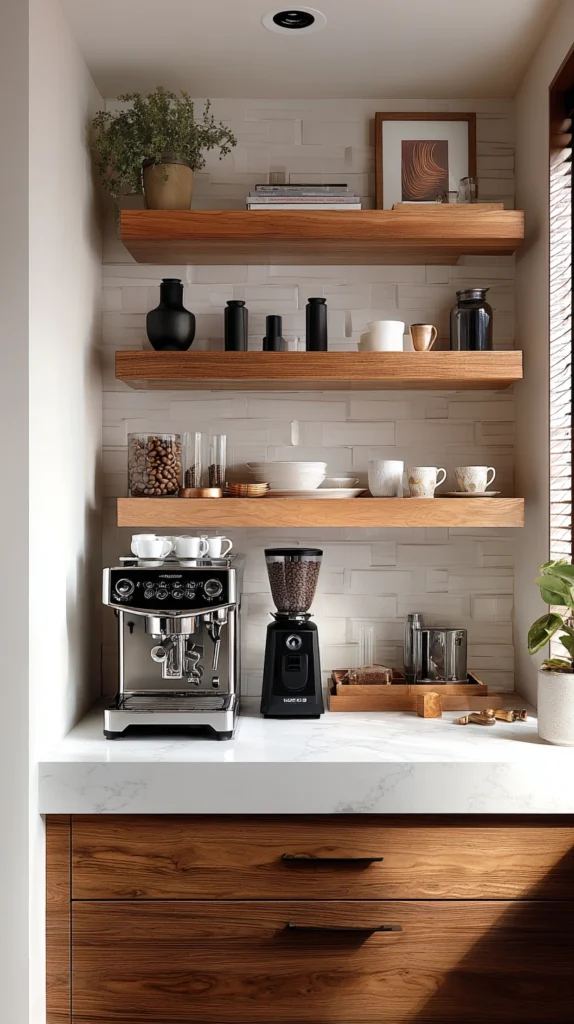
A small wall-mounted shelf and counter specifically designed around an espresso machine, grinder, and the specific equipment a genuine espresso setup requires.
Why an espresso-focused station needs its own specific planning
A household with a genuine espresso habit typically has more specialized, and often larger, equipment than a standard drip coffee maker requires — a grinder, an espresso machine, a knock box — needing a station specifically planned around that equipment’s particular footprint and function.
The equipment layout
The espresso machine and grinder positioned together, allowing beans to be ground directly before pulling a shot, with adequate counter space for both machines without crowding.
The cup warming consideration
A small shelf or the machine’s own warming tray, keeping espresso cups warm before use, a genuine detail relevant to serious home espresso preparation.
The knock box and cleaning supplies
A small knock box for spent grounds, and a cloth or brush for machine maintenance, kept nearby but organized rather than left loosely cluttering the counter.
The cup display
Small espresso cups displayed on an adjacent shelf or hook, distinct from any larger everyday mugs the household might use for drip coffee.
The overall effect
A station genuinely planned around the specific equipment and ritual of home espresso preparation, rather than a general coffee setup that happens to also include an espresso machine without dedicated planning.
Cost breakdown: Wall-mounted shelf and counter: $80–200 Cup display and knock box: $20–50 Total: $100–250
9. The Seasonal Rotating Coffee Station
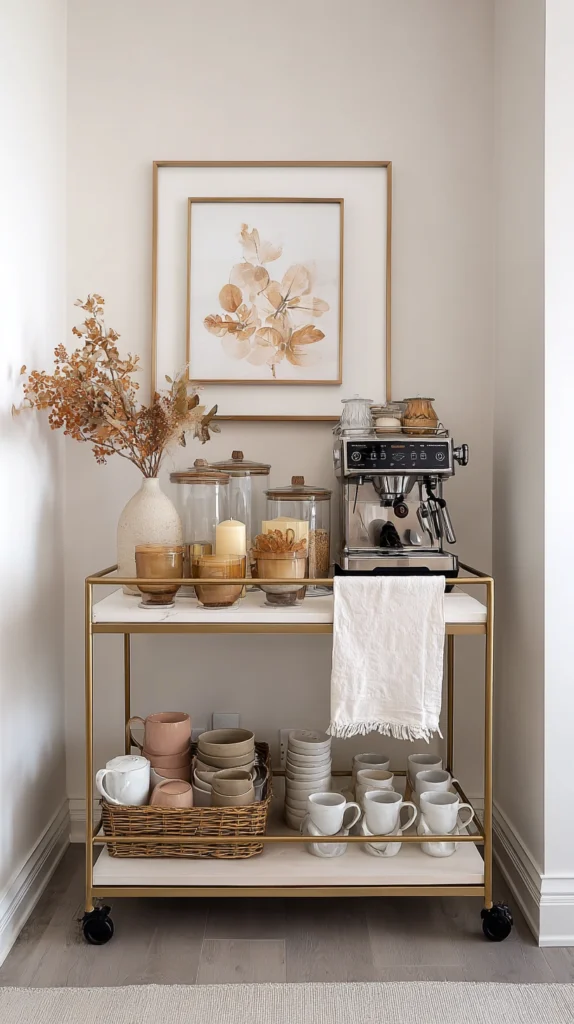
A station whose small decorative details — a runner, a seasonal mug set, a small accent object — are swapped periodically through the year, while the core equipment and organization remain constant.
Why isolating seasonal change to the station’s decorative layer keeps it feeling current
Similar to the seasonal rotation principle relevant to a bathroom vanity tray or a nightstand, designating the coffee station’s small decorative elements for periodic seasonal change lets the functional core remain stable while still providing regular visual freshness.
The constant elements
The coffee maker, grinder, and primary mug collection remaining the same throughout the year, providing functional and visual consistency across every seasonal rotation.
The seasonal accent
A small seasonal runner, one specific seasonal mug brought to the front of the display, or a small seasonal decorative object — swapped periodically rather than requiring a full station overhaul.
The low-effort refresh
A meaningfully lower-effort way to keep the station feeling current than restyling the entire setup each season, isolating that seasonal change to one or two small, manageable elements.
The consistency of core function
The actual coffee-making process and equipment location remaining unchanged regardless of the season, ensuring the daily routine itself is never disrupted by the seasonal decorative refresh.
The overall value
A coffee station that feels attended to and seasonally aware without requiring disproportionate effort relative to its role in the household’s daily routine.
Cost breakdown: Seasonal accent (per season): $10–25 Total: $10–25 per seasonal refresh
10. The Chalkboard Menu Coffee Station
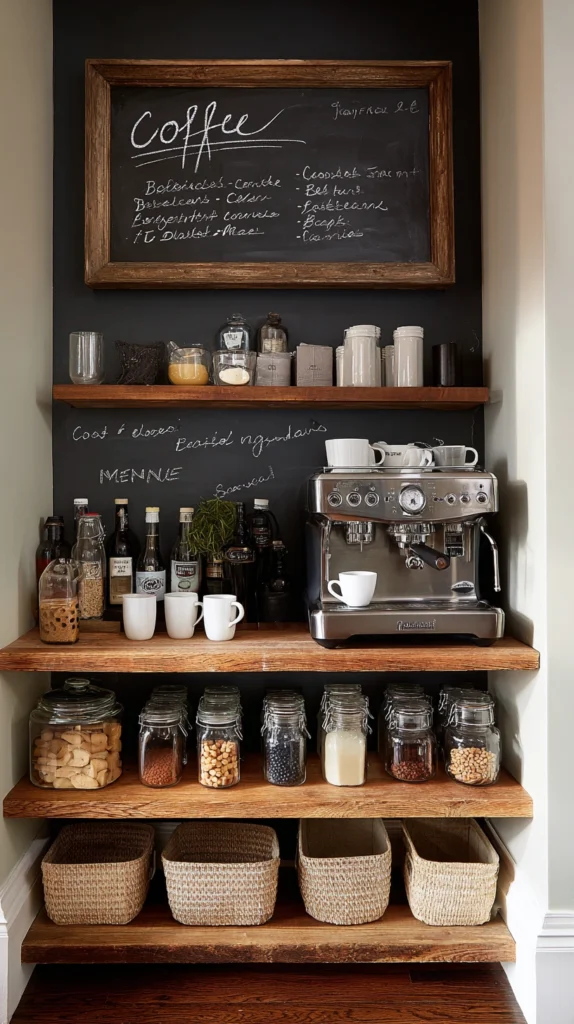
A small chalkboard or a chalkboard-painted panel positioned above or beside the coffee station, listing available drink options or simply adding a café-style decorative detail.
Why a chalkboard adds genuine café character to a home station
A chalkboard menu is one of the most immediately recognizable visual signifiers of an actual café, and including one, even purely decoratively, reinforces the station’s intended “home café” character directly.
The chalkboard
A small framed chalkboard, or a section of wall painted with chalkboard paint, positioned within view of the coffee station itself.
The content
A simple, hand-lettered list of drink options, a daily quote, or simply the date, updated periodically to maintain the sense of an actively used, living display rather than a static decorative object.
The lettering style
Simple, legible hand-lettering or chalk marker text, avoiding an overly elaborate or difficult-to-read script that would undercut the board’s actual communicative function.
The frame or border
A simple wood frame around the chalkboard, if using a standalone board rather than a painted wall section, providing a clean, finished edge.
The overall effect
A detail that immediately reinforces the station’s café-inspired character, adding genuine personality and a sense of an actively used, evolving display.
Cost breakdown: Small chalkboard: $15–35 Chalk or chalk markers: $5–10 Total: $20–45
11. The Fresh Flower and Greenery Accent
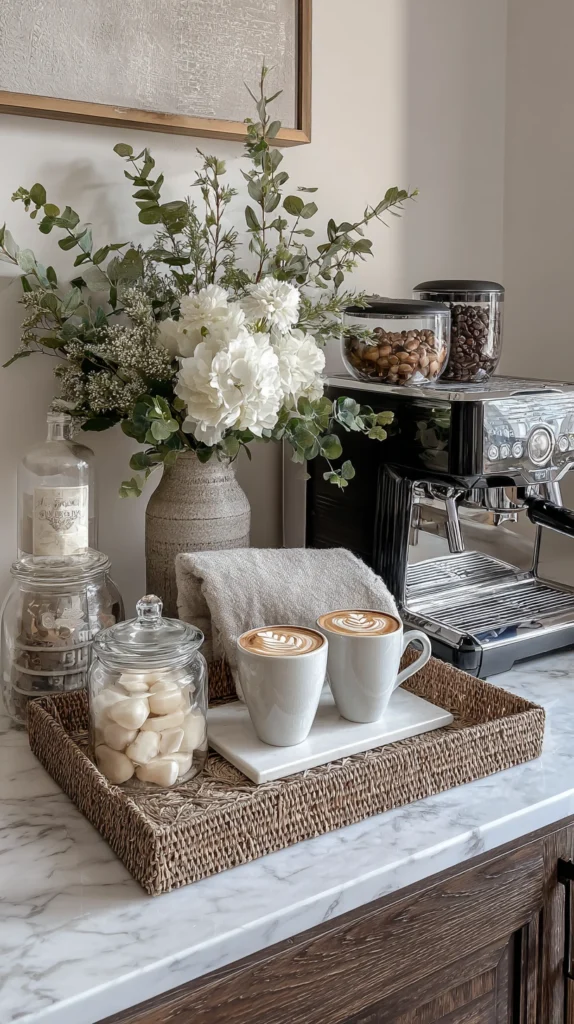
A small vase of fresh flowers or a trailing plant positioned on the coffee station, adding a living element that complements the station’s daily ritual use.
Why a living element suits a station used every single day
A coffee station is interacted with daily, making it a natural spot for a small living element that receives the same regular attention as the coffee-making process itself, the two rituals reinforcing each other.
The flower option
A small vase with one or two fresh stems, refreshed weekly, positioned where it will not interfere with the actual coffee-making equipment’s function.
The plant option
A small trailing plant or a low-maintenance succulent, providing a lower-maintenance living element for a household less inclined toward fresh cut flowers.
The scale restraint
Kept small enough not to crowd the station’s functional equipment, since the coffee maker and mugs remain the space’s primary practical purpose.
The daily interaction
The flower or plant positioned where it will be seen and appreciated during the actual daily coffee-making process, rather than tucked out of the way where it goes unnoticed.
The overall effect
A small living element reinforcing the station’s overall sense of considered, daily ritual, complementing rather than competing with its practical coffee-making function.
Cost breakdown: Small vase and fresh flowers: $10–20 (recurring) Or small plant: $10–25 (one-time) Total: $10–25
12. The Labeled Canister and Organization System
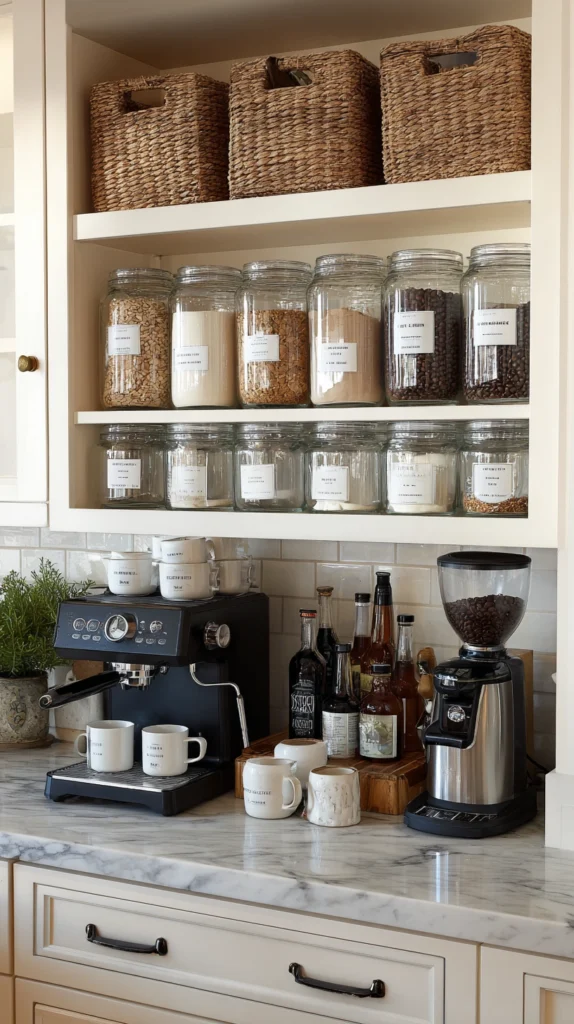
Coffee, tea, sugar, and other supplies decanted into matching labeled canisters, providing both visual cohesion and genuine organizational clarity.
Why labeled canisters elevate ordinary pantry items into part of the station’s styling
Coffee bags, sugar boxes, and syrup bottles in their original retail packaging introduce visual clutter and inconsistency. Decanting these same items into matching, labeled canisters transforms them into part of the station’s considered overall display.
The canister selection
Matching glass or ceramic canisters, in a consistent size and style, each holding a specific supply — coffee beans, sugar, tea bags.
The labeling
Simple, legible labels, either printed or hand-lettered, identifying each canister’s contents clearly, both for genuine function and as a small additional styling detail.
The material consistency
All canisters in the same material and finish, providing visual cohesion even though their contents differ, similar to any well-coordinated open shelving display.
The refilling routine
Genuinely refilled as supplies run low, rather than left empty or half-full, maintaining the station’s considered appearance through ongoing, actual use.
The overall effect
A station where even the most mundane pantry items contribute to the overall considered, cohesive display, the labeling and matching canisters elevating basic supplies into genuine styling elements.
Cost breakdown: Matching canisters (4–5): $30–70 Labels: $5–15 Total: $35–85
13. The Personal Photo or Art Display Above the Station
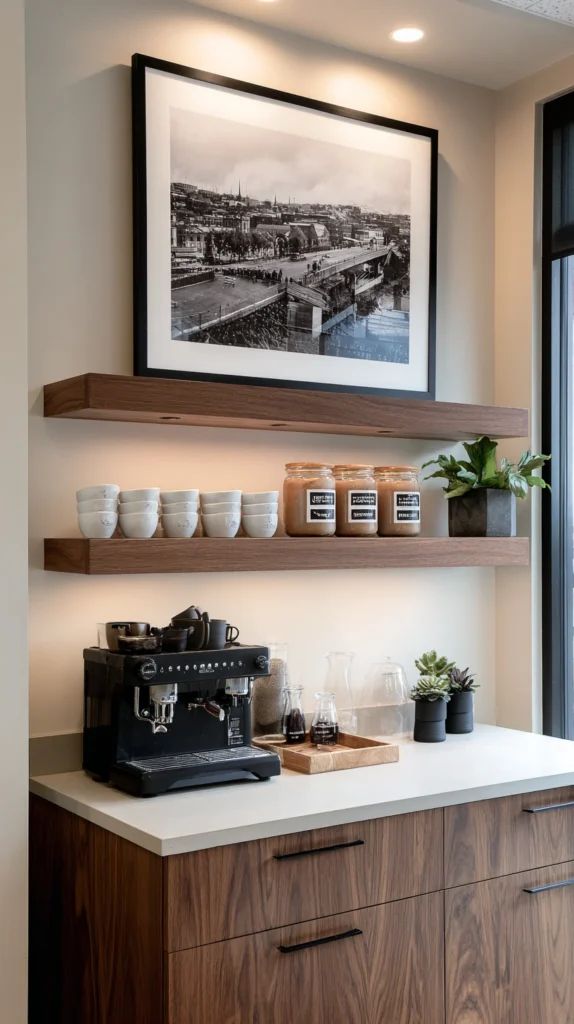
A small piece of art or a personal photograph hung directly above the coffee station, giving the small daily-use spot its own point of visual interest beyond pure function.
Why the wall space above a coffee station deserves the same attention as any other styled surface
Most coffee stations focus styling attention entirely on the surface itself, overlooking the wall space directly above it as an additional opportunity for personality and visual interest.
The art or photo selection
A single small piece of art or a personal photograph, chosen for a connection to the ritual of coffee itself — perhaps a photo from a memorable trip, or art depicting a coffee or café scene — or simply a piece that complements the kitchen’s broader decor.
The frame
A simple frame in a material and finish consistent with the station’s other metal or wood accents.
The scale
Sized proportionally to the station below, avoiding an oversized piece that would overwhelm the small, functional spot, or an undersized piece that would go unnoticed.
The placement height
Positioned at a height easily seen during the actual coffee-making process, rather than so high it goes unnoticed during the brief daily ritual.
The overall effect
A small additional point of personality and visual interest, extending the station’s considered styling vertically rather than confining all the attention to the surface alone.
Cost breakdown: Small framed art or photo: $20–50 Total: $20–50
14. The Full Beverage Station With Tea and Hot Chocolate
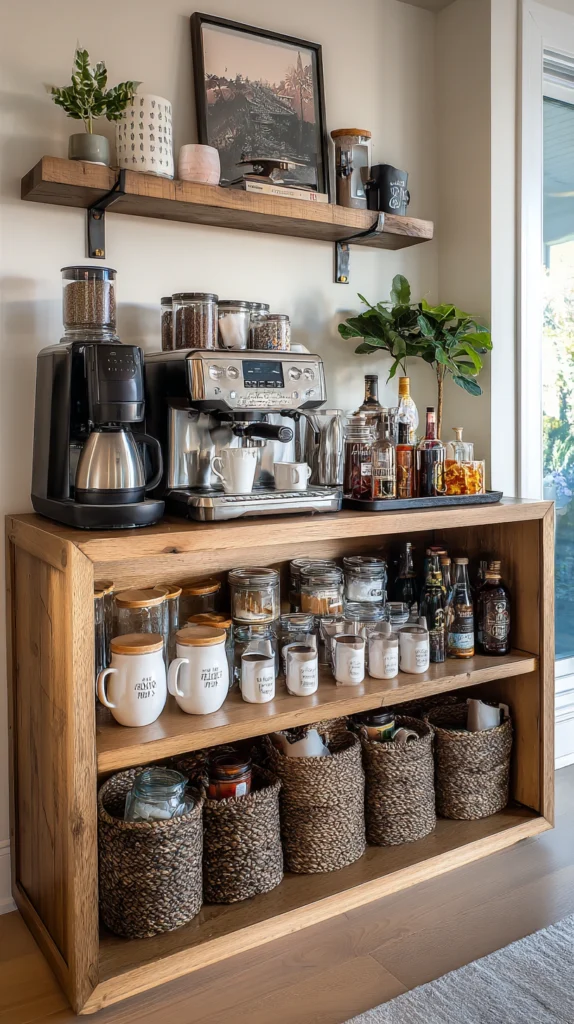
The coffee cart expanded to include tea, hot chocolate, and other warm beverage supplies, becoming a genuine multi-beverage station rather than coffee alone.
Why expanding beyond coffee alone suits a household with varied beverage preferences
Not every household member drinks coffee, and a station stocked only with coffee supplies excludes tea drinkers or those preferring hot chocolate from the same considered daily ritual the coffee drinkers enjoy.
The tea supplies
A selection of teas in a small caddy or labeled canister, alongside a kettle or hot water dispenser, providing genuine parity with the coffee-drinking household members’ setup.
The hot chocolate option
Cocoa powder or hot chocolate mix, alongside marshmallows or other toppings, particularly valuable for a household with children who might not yet drink coffee or tea.
The shared equipment
A kettle serving both tea and hot chocolate needs, alongside the separate coffee maker, allowing the station to serve multiple beverage preferences from one shared, organized spot.
The vessel variety
Tea cups alongside coffee mugs, providing appropriate vessels for each specific beverage rather than assuming one mug style suits every drink equally well.
The overall effect
A station that includes the whole household’s actual beverage preferences, rather than serving only the coffee drinkers while excluding everyone else from the same considered daily ritual.
Cost breakdown: Tea selection and caddy: $20–40 Hot chocolate supplies: $10–20 Kettle (if not already owned): $30–70 Total: $60–130
15. The Complete Cozy Home Café Station (The Fully Realized Coffee Corner)
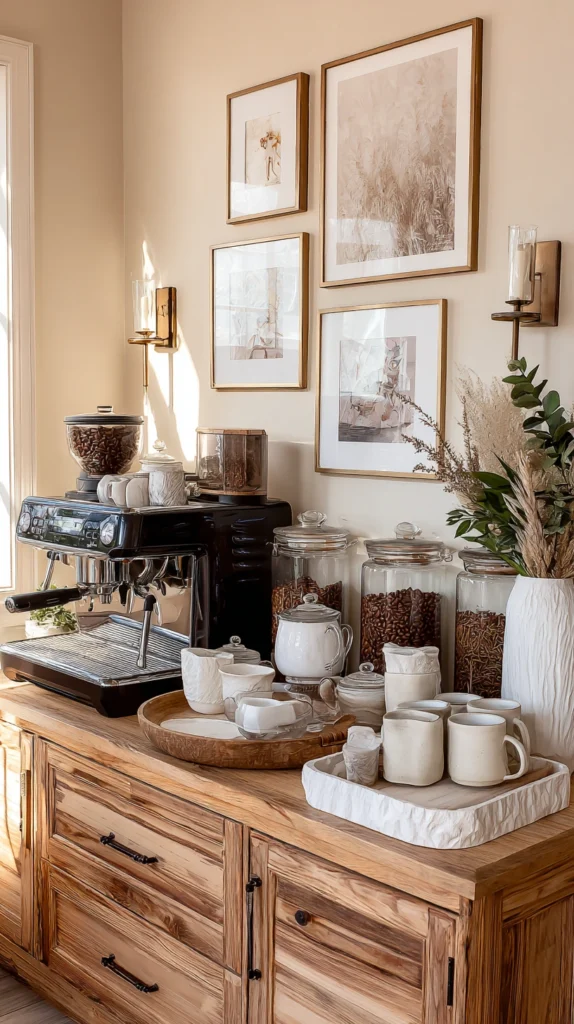
A complete coffee station combining several of the approaches above — a well-chosen base furniture piece, organized and labeled supplies, layered lighting, and personal styling details — treating the small spot as a genuine daily ritual destination rather than simply where the coffee maker happens to sit.
What separates the complete station from a coffee maker placed on a cart
A coffee maker moved onto a cart without any further styling: a modest improvement. A complete cozy home café station: every element — the base furniture, the organized supplies, the vessels, and the personal finishing touches — working together, turning a small daily task into a genuine considered ritual.
The elements of the complete home café station
The base
A cart, console, or shelving unit, chosen for the household’s specific space and mobility needs.
The equipment
The coffee maker, grinder, and kettle, arranged for genuine daily ease of use.
The vessels
A varied but coordinated mug and cup collection, displayed openly rather than hidden away.
The organized supplies
Coffee, tea, sugar, and syrups, decanted into labeled, matching canisters.
The finishing details
A small plant, a piece of art, and perhaps a chalkboard, adding personality beyond pure function.
The whole-household inclusion
Tea and hot chocolate supplies alongside coffee, ensuring every household member has a place within the station’s daily ritual.
The complete design in action
An ordinary weekday morning:
6:45am: The kettle filled, the grinder used, everything needed for the morning’s coffee within arm’s reach on one considered cart.
6:50am: A mug chosen from the open display, sugar scooped from its labeled canister, the whole process taking less time and feeling more pleasant than gathering the same items from separate kitchen locations ever did.
7am: Coffee in hand, a glance at the small art piece above the station, the morning’s first genuinely calm moment.
The complete cozy home café station: not simply a relocated coffee maker, but a small, considered daily ritual made physical, turning an ordinary morning task into something the household genuinely looks forward to.
Cost breakdown for the complete station: Assuming a starting point of a coffee maker on the main kitchen counter: Base furniture (cart or console): $80–400 Mugs and vessels: $30–70 Labeled canisters and supplies: $35–85 Finishing details (plant, art, chalkboard): $45–130 Tea and hot chocolate expansion: $60–130 Total: $250–815
Phased for a gradual approach:
Immediate: The base furniture and moving the coffee maker off the main counter
Following weeks: Labeled canisters, mug display, and organized supplies
Ongoing: Finishing details, seasonal accents, and the whole-household beverage expansion
The complete cozy home café station: not a large investment, but a small, consistently maintained corner that changes how genuinely pleasant an ordinary morning routine feels.
The Question Before Any Coffee Cart Styling Decision
Before choosing a specific setup:
What is the primary problem the current coffee routine actually has?
If the answer is: supplies are scattered across the kitchen with no defined spot — start with a simple tray or a small cart, concentrating everything into one place first.
If the answer is: the counter feels crowded with the coffee maker taking up prime real estate — the console table or a wall-mounted shelf, physically relocating the equipment.
If the answer is: only the coffee drinkers feel served by the current setup — the full beverage station expansion, including tea and hot chocolate.
If the answer is: the station is functional but visually uninspired — the copper and warm metal accents, or the labeled canister system, adding genuine styling atop the existing function.
The design follows the household’s actual current coffee routine and its specific shortcomings, more than any single universal coffee cart template. Every idea on this list solves a different piece of what makes a morning routine feel scattered or uninspired. The question is which particular issue matters most for this specific kitchen and household.
The single tray gathering the coffee maker, one mug, and a small sugar bowl: still transforms a scattered routine into one considered spot. The complete station, styled and organized with real intention: a small daily ritual that makes an ordinary morning feel like a genuine, cozy pleasure.
That daily pleasure: the whole point of building a coffee cart rather than simply leaving the coffee maker wherever it happened to land.
Getting Started This Weekend
The immediate coffee cart solution:
Choose one specific spot — a cart, a console, or simply a tray — and commit to it as the coffee station.
Not a full kitchen renovation. Just a defined destination for everything coffee-related to live.
Move the coffee maker, mugs, and supplies to that one spot, clearing them from wherever they currently scatter across the kitchen.
The single foundational change every other styling detail builds upon.
Decant one supply — sugar or coffee beans — into an attractive container.
A small, immediate improvement testing the broader labeled canister concept.
Add one small personal touch — a plant, a piece of art, a chalkboard — before considering the station complete.
The rest of the design: the elaboration of this moment.
The dedicated spot: the beginning. The home café: what gets brewed, and enjoyed, at it every morning.